

Barings -

2027 Credit Outlook: Income Across Outcomes

Abstract overlapping ribbons and geometric shapes in shades of blue, teal and green.

Investors are entering the year ahead facing an unusually wide range of possible economic and market outcomes.

AI is driving historic capital investment, supporting economic growth and increasing demand for external financing, but also creating more volatility across markets. At the same time, fiscal deficits, demographic pressures, geopolitical dynamics and uncertainty around inflation and monetary policy are making the path ahead harder to predict.

These forces are also challenging familiar portfolio relationships. Long-duration assets may remain vulnerable to volatility, while traditional hedges may not respond to market stress as reliably as they have in the past. Elevated equity volatility and market concentration could add to that vulnerability if expectations around growth and AI fall short.

Investors do not need to predict every outcome to find opportunity. With real and nominal yields at levels that have been difficult to access for much of the last two decades, portfolios can be built around something more tangible: current income and carry across public and private credit.


In This Report

AI Is Rewiring Capital Markets

What’s Happening

The AI buildout is becoming a major influence on economic growth, capital formation and credit markets. The investment requirements extend across:

  • Data centers
  • Power generation & transmission
  • Cloud & computing capacity
  • Semiconductors & equipment
  • Cooling, connectivity & supply chains
  • Real estate & digital infrastructure
  • Public & private financing markets

The Scale Is Significant

  • $1T: Projected annual capital spending by the largest hyperscalers in 20271
  • 2x+: Projected growth in global data center electricity consumption by 20302
  • 95%: of North American data center capacity under construction is already committed3

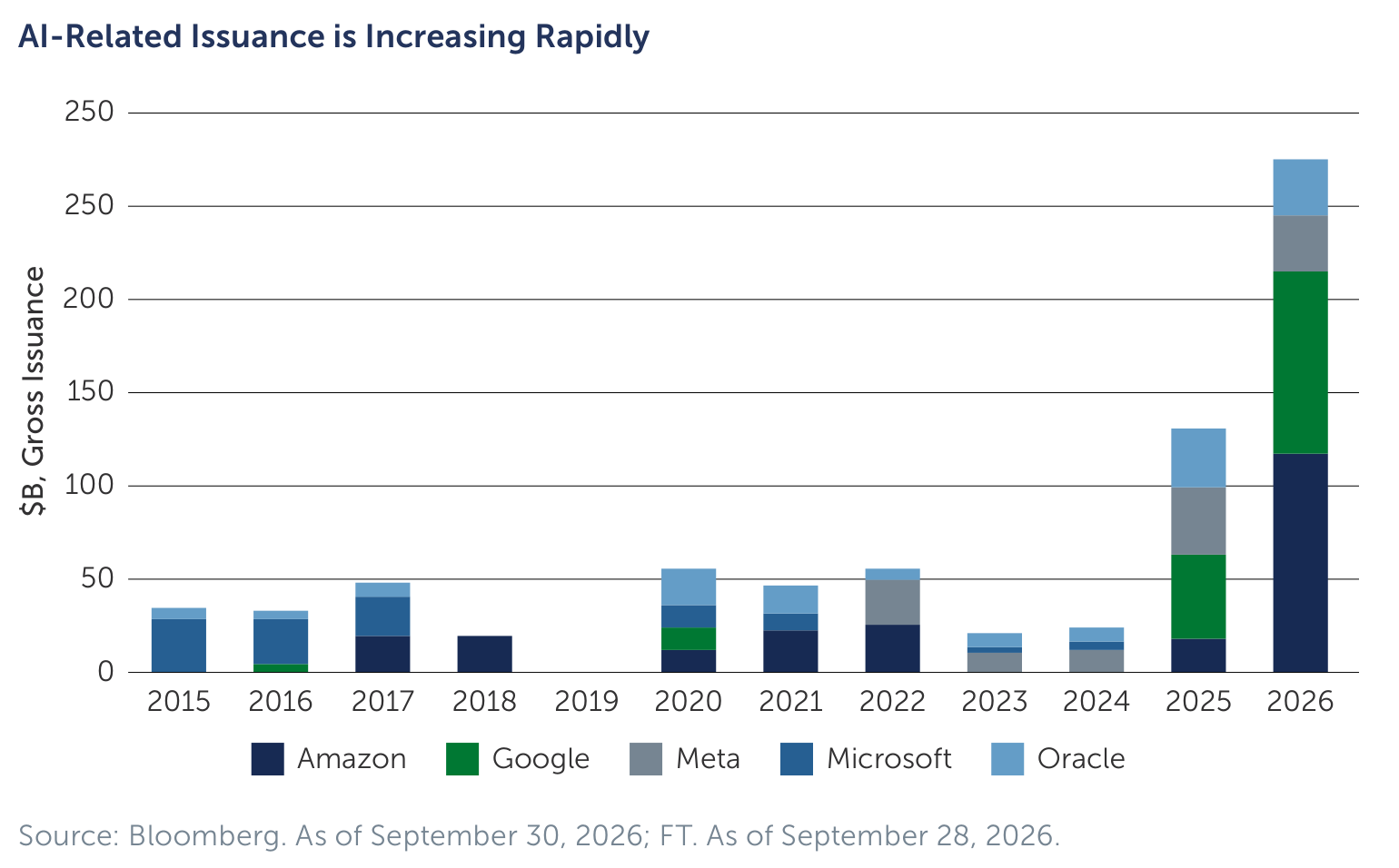
The financing implications are already substantial. AI-related investment is increasing corporate borrowing, particularly in investment grade markets, where net issuance in 2026 could reach roughly three to four times the average of the previous five years. Its effects also extend across high yield, infrastructure debt, asset-based finance (ABF) and other specialized markets, particularly as large projects increasingly draw on multiple lenders, asset classes and structures.

AI-related debt issuance by Amazon, Google, Meta, Microsoft and Oracle from 2015 through 2026.

The Central Tension

The opportunity is significant, but so is the uncertainty. AI investment is being supported by rapid growth in demand for computing capacity, but much of its ultimate value still depends on revenues, productivity gains and business models that may take years to develop. The scale and strategic importance of the buildout may sustain financing demand even when capital is expensive, raising the stakes if adoption, profitability or utilization fall short of expectations.

Historically, major capital-investment cycles have produced valuable infrastructure alongside periods of overinvestment. The risk is not necessarily that demand disappears, but that capital is deployed at the wrong price, in the wrong location or against cash flows that do not materialize within the financing period. That risk is complicated by a mismatch in timing: digital demand can grow rapidly, while power generation, transmission, interconnection, permitting and equipment develop much more slowly. These constraints may limit broad near-term oversupply, but they do not protect every project or financing from poor execution or overpayment.

What to Watch

  • Financing: AI-related investment is driving heavy issuance across credit markets, which may create opportunities as individual credits or parts of the maturity curve reprice to absorb new supply.
  • Execution: Construction, permitting, power access, connectivity and lease structures can all shape outcomes. Risk will vary with the project’s stage of development, the visibility of its cash flows and the extent to which repayment depends on factors like lease renewal, residual value or refinancing.
  • Concentration: AI exposure is spreading across technology, utilities, infrastructure, real estate and corporate credit. Investments that appear diversified by issuer or asset class may still depend on similar assumptions about AI adoption and growth.
  • Disruption: Software may provide an early test of the market’s ability to distinguish beneficiaries from vulnerable business models, particularly where AI compounds pressures already facing weaker companies.
  • Crowding Out: Large AI transactions could absorb traditional sources of capital, potentially creating opportunities in mispriced smaller, mid-market or non-AI transactions.
  • Geopolitics: Competition for AI leadership could reshape trade, technology policy, supply chains and capital allocation. Following the U.S. midterms, greater scrutiny of power costs, permitting, grid reliability and the allocation of infrastructure costs could also affect the pace and location of data center development.

Where Credit Fits

Credit offers several ways to participate without relying on one prediction about the ultimate AI winners. Financing needs and risks change as projects move from development and construction to equipment installation and stabilized operations. This creates opportunities across credit markets, with the balance of risk and return shaped by the visibility of cash flows, the timing of repayment and the maturity of the underlying project or asset.

Public corporate credit markets will finance a growing share of AI-related investment as companies turn to external capital to support the buildout.

Infrastructure debt and ABF can provide exposure to physical assets, equipment and identifiable cash flows.

Beyond the largest AI-related issuers and projects, broad credit markets generally have less direct technology and software exposure than major equity indexes, providing potential diversification as concentration around the AI trade increases.

What It Means

AI is expanding the credit opportunity set, but it is also creating common exposures across companies, sectors and markets—potentially equating to concentration risk for investors. As the buildout accelerates, the challenge will be distinguishing durable sources of income from investments that depend too heavily on a single path for AI adoption and growth.


Policy & Structural Pressures Widen the Range of Outcomes

AI is only one source of uncertainty. Fiscal deficits, demographics, geopolitics, inflation and monetary policy are interacting in ways that leave policymakers with few easy choices.

The Policy Dilemma

Core inflation may continue to moderate even as energy, food and AI-related investment create pressure at the headline level. Those pressures could persist even if global growth remains modest as they increasingly reflect constraints on labor, energy, supply chains and productive capacity, rather than simply excess demand.

Central banks have limited ability to address these supply-driven pressures without also weakening labor markets and economic activity:

  • Further tightening could weaken employment and increase the need for fiscal support.
  • Easing too quickly could raise questions about inflation credibility.
  • Large deficits and rising interest expense constrain the fiscal response.
  • Aging populations and slowing labor-force growth may add to public spending pressures.
  • Persistent government borrowing could keep long-term yields elevated even if policy rates decline.
  • Government bonds and other traditional hedges may respond less predictably to stress when fiscal and inflation concerns remain high.

For credit markets, the pace of rate moves may be just as significant as the absolute level. Gradually higher yields can improve prospective income and attract demand, while a rapid increase in long-term rates could pressure credit spreads and long-duration assets.

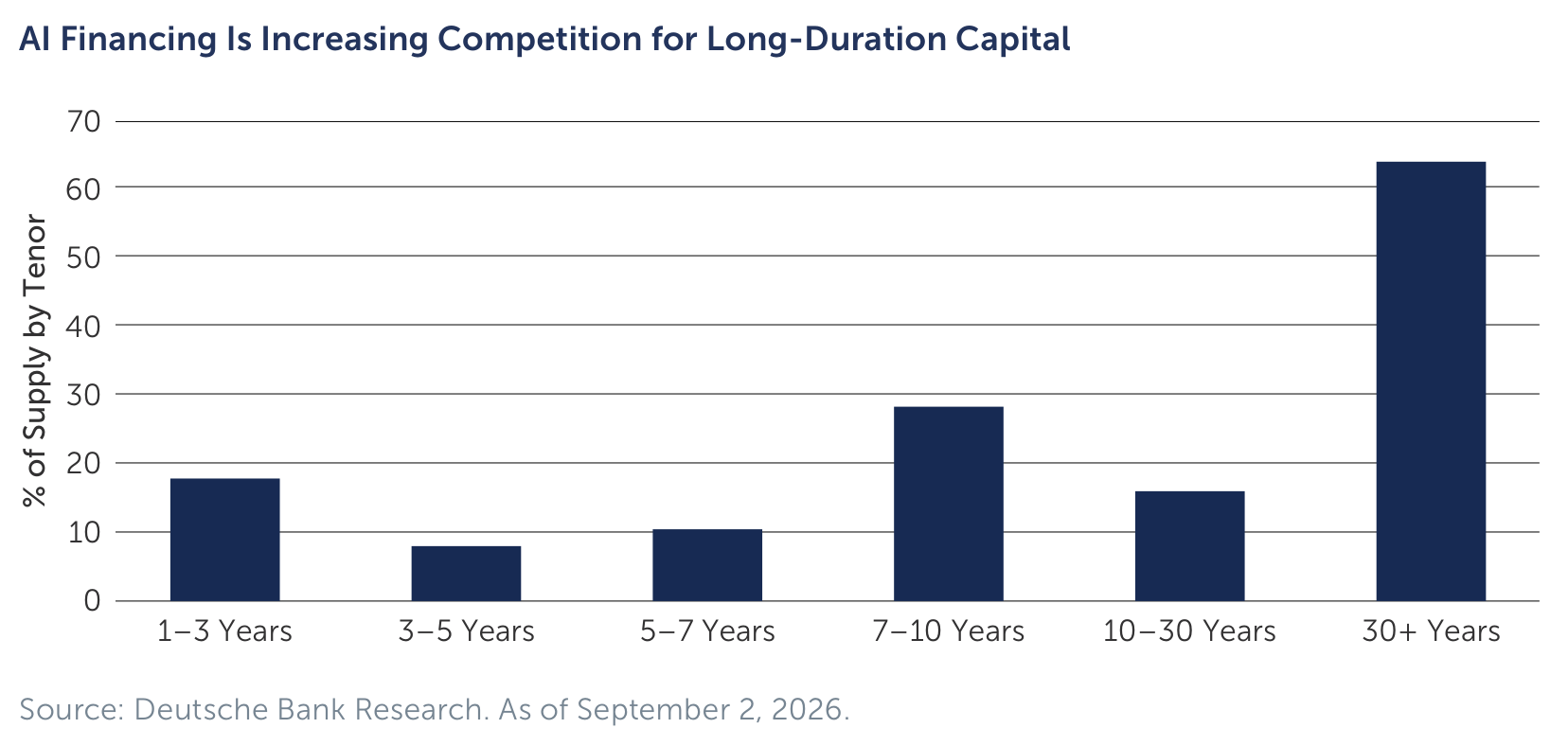
Supply may add to that volatility. Persistent government borrowing and longer-dated AI-related corporate issuance are increasingly competing for the same pools of capital, potentially keeping pressure on the long-end even if policy rates decline. Higher rates are therefore not uniformly negative for credit, but the path matters: higher starting yields can support income when fundamentals remain resilient, while abrupt rate moves can weaken the diversification benefits traditionally associated with duration.

AI-related financing supply by maturity tenor, illustrating increased competition for long-duration capital.

The Opportunity Is Not Uniform

These pressures will not affect every region, borrower or asset in the same way:

  1. Several emerging market central banks acted earlier and more forcefully during the recent inflation cycle, strengthening their policy credibility relative to historical investor perceptions.
  2. Supply chain reconfiguration and AI investment have strengthened the positioning of select economies and companies connected to semiconductor production and the broader technology sector.
  3. Fiscal, monetary policy and currency cycles vary considerably across markets, creating opportunities for active country and issuer selection.

The differences extend within markets as well. Outcomes are increasingly influenced by individual assets, borrowers, locations, business plans and capital structures, making broad market or sector labels less informative. Aggregate resilience can also conceal pressure beneath the surface. Household balance sheets, for example, may remain healthy overall even as stress increases among lower-income and lower-credit-quality consumers.

What It Means

The answer is unlikely to be one sweeping call on growth, inflation, rates or currencies. It is flexibility across regions, structures and individual investments across public and private markets. As economic and market outcomes diverge, broad labels will provide less guidance about where investors are being adequately compensated for risk.


Prioritize Income Across Outcomes

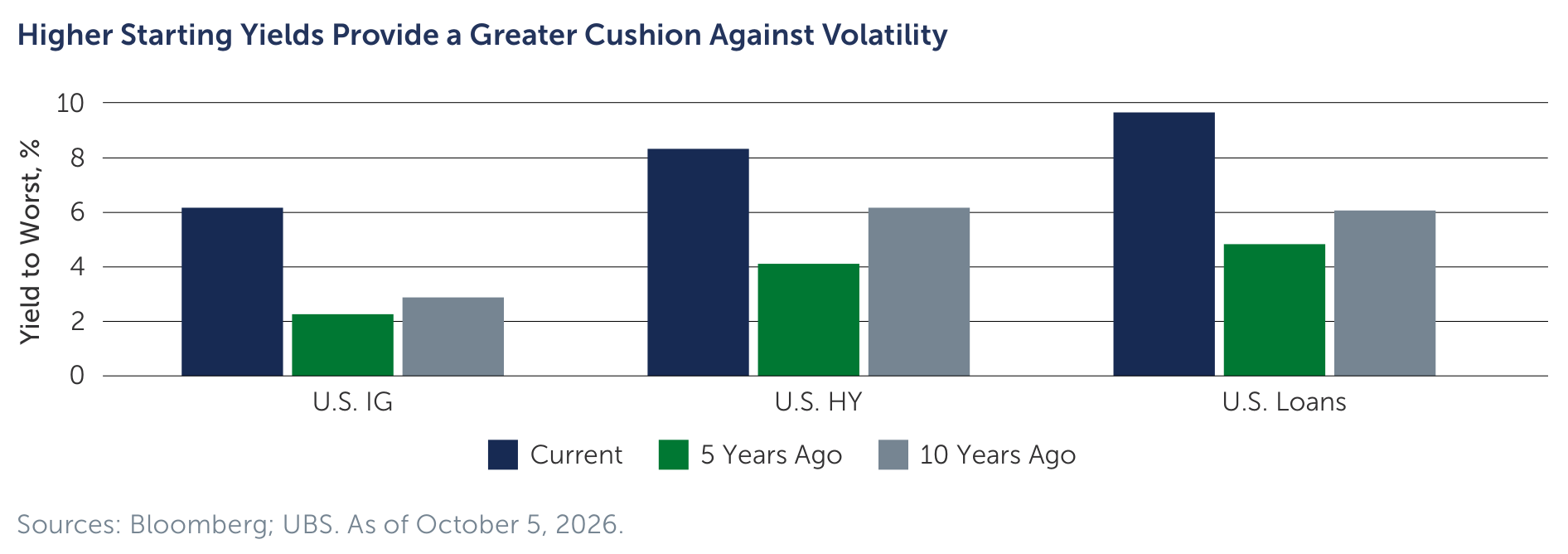
When capital appreciation is uncertain and traditional hedges are less reliable, income can play a larger role in expected returns. Carry can also provide a cushion against adverse market moves, allowing some assets to absorb moderate spread widening or higher yields before price declines offset the income earned.

Comparison of current, five-year-ago and ten-year-ago yields across U.S. investment grade credit, high yield bonds and loans.

That does not mean ignoring valuations. Credit spreads may appear tight in several markets, but they are only one part of the return equation. Starting yields, carry, duration, collateral and structural protections also factor in. Historically, starting yields have been an important driver of forward credit returns, particularly in shorter-duration markets where income represents a larger share of the return profile. Corporate fundamentals and improvements in the quality of some public credit markets provide additional context that headline spreads alone may not capture.

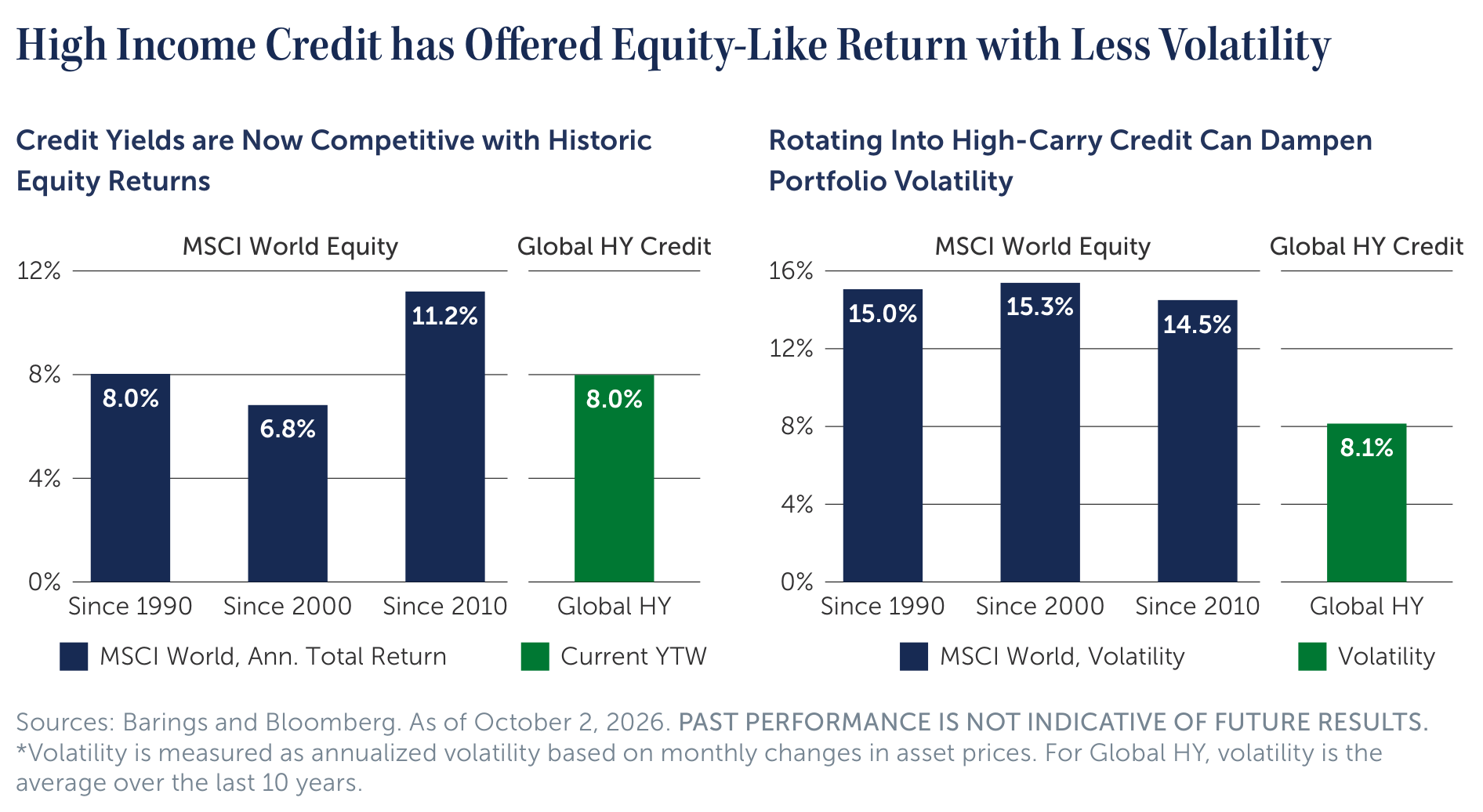
Comparison of historical global equity returns and volatility with global high yield credit yields and volatility.

That means investors may not need to predict a single outcome when income can provide a meaningful foundation for returns while the outlook unfolds.

The Portfolio Playbook: Things to Consider

  • Prioritize Carry: Consider building more of the return profile around current and contractual income rather than falling rates or spread compression. Attractive starting yields can provide resilience if markets move moderately against investors.
  • Manage Duration Intentionally: Shorter-duration assets may be less exposed to volatility at the long-end, while selective duration can be attractive when real yields provide sufficient compensation. Even high-quality government bonds can experience substantial volatility when duration is high.
  • Blend Fixed & Floating Rates: Different structures can play distinct roles as inflation and monetary policy evolve, balancing the income benefits of floating rates with the potential value of selectively locking in yields.
  • Diversify Broadly: Look across public and private credit, regions, borrowers, collateral, and repayment sources rather than relying on one market or benchmark. That includes looking through apparently distinct exposures to identify shared economic risks and diversifying beyond corporate credit into assets supported by different cash flows and collateral.
  • Emphasize Quality: Attractive starting yields may allow portfolios to generate meaningful income without reaching into the weakest credits.
  • Look for Structural Protections: Seniority, collateral, covenants, structural protections and multiple repayment sources can improve the quality of income. The form of protection will vary by market, from control and documentation in direct lending to collateral pools, amortization and overcollateralization in ABF.
  • Stay Flexible: Strategies able to move beyond traditional benchmarks can pursue relative value as opportunities shift across issuers, regions, sectors and capital structures.

Income does not eliminate volatility. It reduces the extent to which returns depend on rising valuations, falling rates or one favorable economic outcome. Public and private credit offer diverse ways to build that income: public markets provide liquidity and tactical flexibility, while private markets can add floating-rate exposure, differentiated cash flows and structural protection. Infrastructure debt, real estate debt and ABF broaden the opportunity further through risks and repayment sources that differ from traditional corporate credit, while portfolio finance and more bespoke capital solutions can provide additional sources of differentiated income.

That breadth creates more ways to pursue income as economic and market conditions change.


Private Credit Outlook

Direct Lending

More Activity, More Dispersion

Direct lending will present a broader but more selective landscape in 2027. With M&A still subdued, refinancing activity should drive a substantial portion of deal flow as companies financed during the active 2021–2022 period move closer to maturity.

But managers will need to approach refinancings with a healthy amount of skepticism—distinguishing transactions supported by new equity and renewed sponsor commitment from those that simply transfer exposure from one lender to another. When M&A opportunities do emerge, they may offer a more compelling source of deployment.

Competition will also remain uneven. The reopening of broadly syndicated markets has intensified competition for larger, upper middle market borrowers. The core middle market remains comparatively insulated, allowing lenders to retain greater influence over pricing, structure and documentation.

Less Uniformity

Higher financing costs continue to pressure some borrowers, while underwriting decisions made earlier in the cycle are increasingly showing up in manager-level results. Recent volatility and redemption activity among certain BDCs have drawn attention to these differences, although individual vehicles remain an imperfect proxy for the broader direct lending market.

The Wider Point

Dispersion is growing. Portfolio composition, documentation quality, leverage and sector selection are becoming increasingly important as economic and market conditions evolve.

AI adds another layer to that analysis. In software and other potentially disrupted sectors, lenders must distinguish between businesses that can use AI to improve efficiency and those whose products or competitive positions may become more vulnerable. So far, the effects appear most pronounced among companies already under pressure, suggesting AI may accelerate existing weaknesses rather than create entirely new ones. That places a greater premium on understanding how specialized and defensible a business is, and whether AI strengthens or threatens its value proposition.

Control Can Shape Outcomes

Against this backdrop, direct lending continues to offer contractual floating-rate income that can support returns across varied market conditions, alongside senior secured positioning and structural protections negotiated directly with borrowers.

But the quality of that income depends on execution:

  • Diversification across issuers, sectors and regions can reduce the impact of individual credit events.
  • Selectivity can help preserve the illiquidity premium as competition pressures pricing.
  • Control, through lead-lender positions, covenants and strong documentation, can give lenders greater influence when performance falls short.
  • Global sourcing can provide flexibility as relative value shifts across North America, Europe and Asia Pacific.

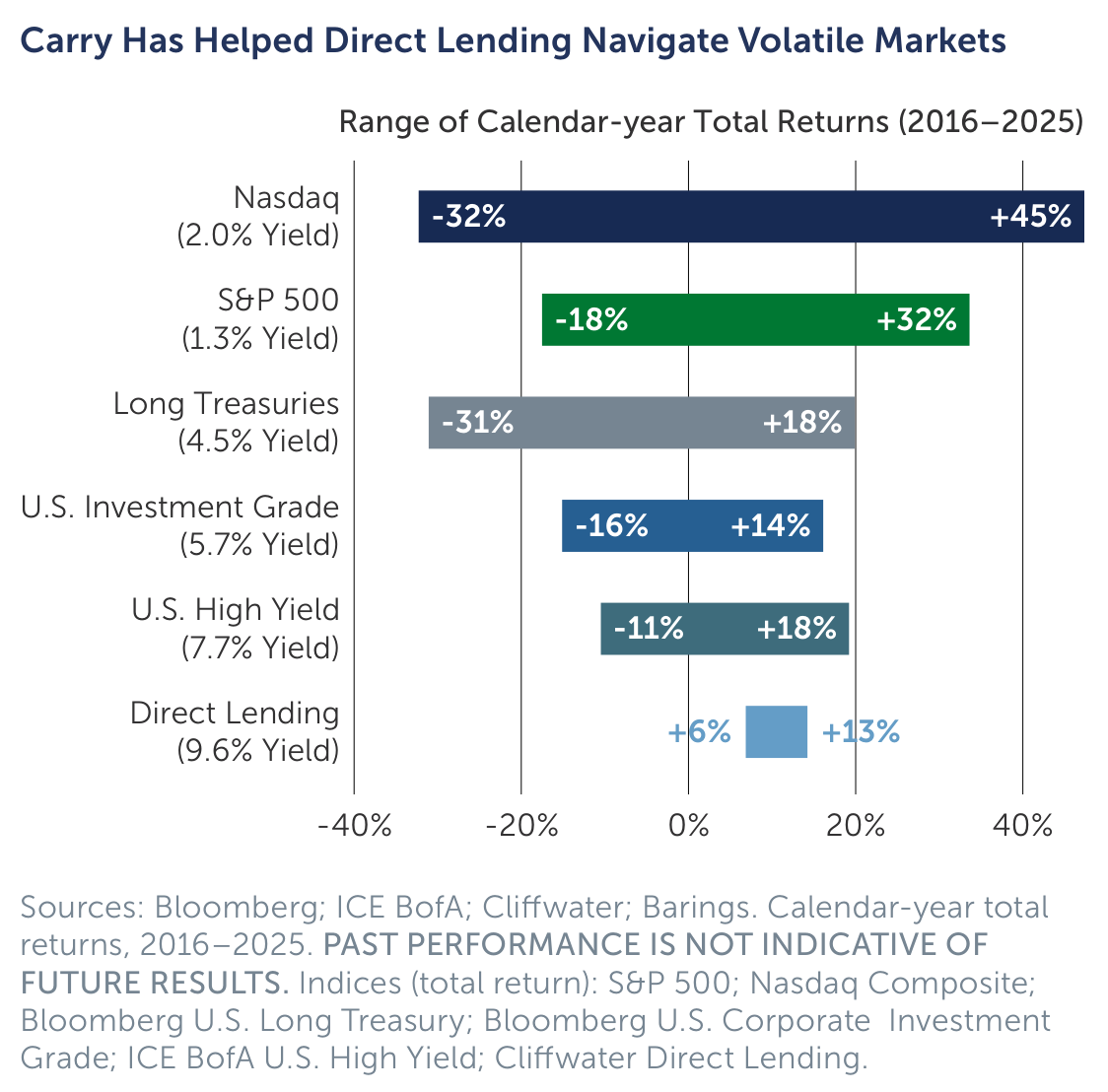
The bottom line: Direct lending can provide meaningful income across a range of outcomes, but growing dispersion means that the quality of that income will depend increasingly on selectivity, diversification and lender control.

Range of calendar-year total returns from 2016 to 2025 across direct lending, equities, Treasuries, investment grade and high yield credit.


Infrastructure Debt

Opportunity Across the AI Buildout

The AI buildout is reshaping infrastructure markets. AI is accelerating investment in data centers, power generation and grid capacity, while energy security, transportation and broader modernization needs are sustaining deal flow across the asset class. Infrastructure debt provides direct exposure to this investment through financing backed by data centers, power generation, transmission and other physical assets.

The scale of these transactions represents a step-change. Whereas a $5–$10 billion financing once tested the capacity of the infrastructure market, some AI-related deals today are reaching $20–$30 billion.3 Heading into 2027, that is expanding the financing pipeline both within the AI ecosystem and around it.

AI’s Infrastructure Challenge

Scale does not remove risk. Construction complexity can be managed through rigorous project finance principles and protections, but data centers also require lenders to look beyond traditional project finance risks. Technological obsolescence and re-leasing are key considerations, raising questions about whether highly specialized assets can retain tenants or attract new ones as technology and capacity requirements evolve. Coupled with more complicated financing structures, these risks can make it harder to see where leverage sits and how heavily repayment depends on continued demand from a small number of customers or tenants.

That places a premium on selectivity. The strongest opportunities are those where the path to repayment is clear and supported by contractual cash flows, rather than assumptions about how quickly AI demand develops or what an asset may eventually be worth.

The second-order opportunity: As banks and other large capital providers commit resources to large AI-related transactions, smaller, mid-market and non-AI projects may face less competition for financing. The result could be:

  • More attractive pricing
  • Stronger lender protections
  • Greater influence over terms and documentation

Beyond AI

Energy and transport should also generate substantial financing demand. Grid infrastructure illustrates the scale of the opportunity:

  • More than 2,500 gigawatts of renewable, storage and large-load projects are waiting in grid-connection queues globally
  • Meeting projected electricity demand will require annual grid investment to increase roughly 50% from about $400 billion today to $600 billion by 20304
  • These opportunities are often supported by essential assets and long-term agreements. Contractual inflation adjustments in many underlying agreements can also help protect cash flows against rising costs.

The bottom line: Infrastructure debt offers access to a major capital-investment cycle, but the best opportunities may not always be the most prominent. In 2027, value could emerge both from financing essential AI infrastructure and from areas where capital is scarcer, structures remain protective and repayment does not depend on a single AI outcome.

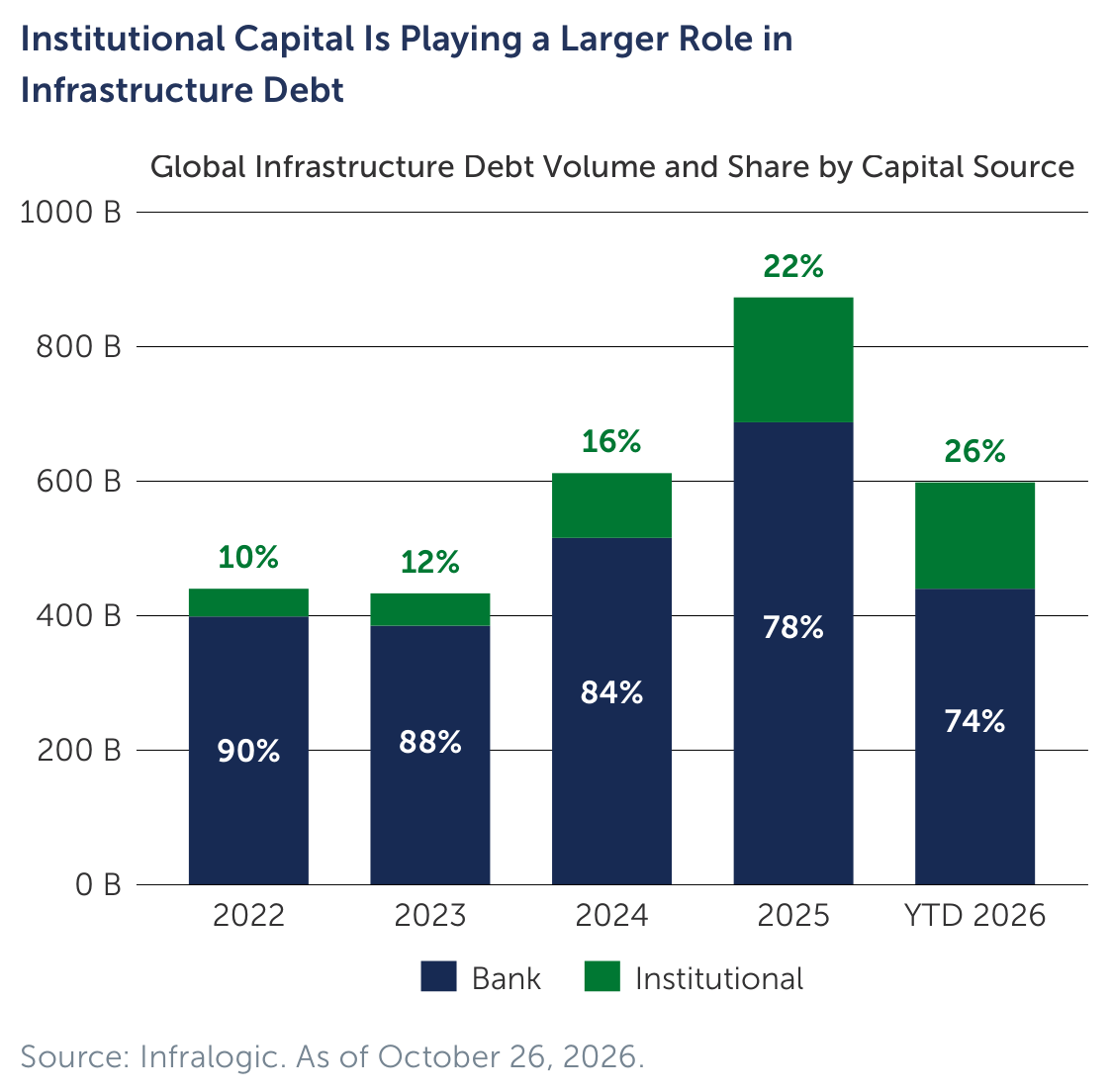
Global infrastructure debt volume and the growing share of institutional financing compared with bank financing from 2022 through 2026.


Asset-Based Finance

A Window Into a Diverging Economy

Asset-based finance (ABF) provides a window into several parts of the economy at once. Its collateral spans households, businesses and physical or digital assets, with returns supported by different cash flows and economic drivers. That makes changes in consumer health, financing conditions and capital investment visible across the market.

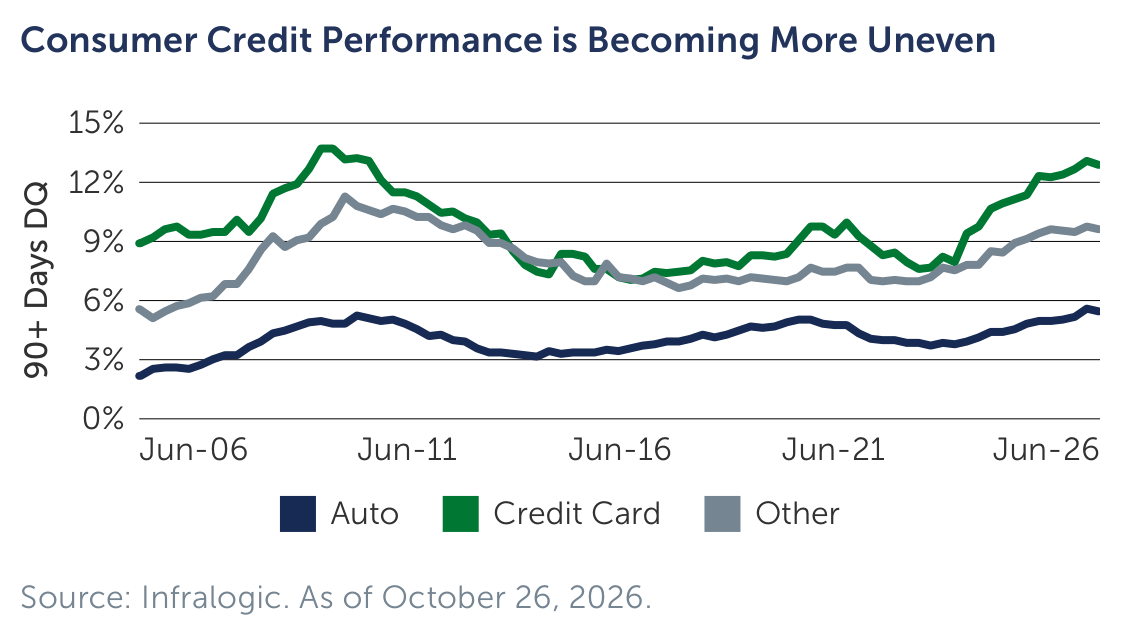
The 2027 view: Those signals are diverging. Consumer stress is becoming more visible, while AI-related investment is driving demand for digital infrastructure financing even as growing supply creates new risks.

The Consumer Is Sending Mixed Signals

Household balance sheets remain broadly healthy, but pressure is growing among lower-income and lower-credit-quality borrowers. Signs of deterioration are also emerging in some prime and higher-income cohorts.

What to watch:

  • Persistent borrowing costs, inflation and government policy could influence household spending and repayment priorities.
  • Different forms of consumer credit may therefore produce meaningfully different outcomes.

This places greater importance on looking through headline consumer data to the borrowers, collateral and protections underlying each transaction.

AI Creates Opportunity & Supply Risk

The AI buildout has quickly become a major source of new collateral in ABF markets, supporting demand for data centers, fiber and other digital infrastructure. Fiber and select digital infrastructure financings may offer attractive relative value, but the broader outlook is more balanced and deal-specific. While data centers continue to experience strong secular fundamentals and growing investor demand, increasing financing supply could eventually pressure technical conditions.

Going forward, broad exposure to AI will not be enough. Asset quality, structure, capital structure positioning, and the durability of underlying demand will increasingly determine whether individual financings adequately compensate for their risks.

Structure Is Important as Outcomes Diverge

When economic signals are mixed, ABF’s diversified collateral base, structural protections and repayment structures can provide a layer of differentiation and help investors manage uncertainty. Transactions are typically backed by diversified pools potentially containing hundreds or even thousands of assets across a range of collateral types, including: transportation, equipment financing, residential mortgages, unsecured consumer credit, specialty finance.

Together, these exposures can help diversify portfolios beyond traditional corporate credit risk. Within individual transactions, diversified collateral pools, overcollateralization and other protections can provide a potential cushion against weaker performance.

Many ABF assets are also self-amortizing, returning principal gradually alongside income rather than depending on a large payment at maturity. If rates remain volatile and relative value continues to shift, these recurring cash flows can reduce reliance on a single refinancing event and provide capital to redeploy as opportunities change.

The bottom line: ABF’s breadth provides more ways to respond as consumer health, financing conditions and AI-related investment evolve. In 2027, capturing those opportunities will require disciplined selection across borrowers, collateral and structures.

Historical consumer credit delinquency rates of 90 or more days across auto loans, credit cards and other forms of consumer credit.


Real Estate Debt

Finding Opportunity as Dispersion Widens

The next phase of the commercial real estate cycle will be defined less by sweeping sector trends than by widening differences among individual assets.

Higher rates continue to pressure property values and capital structures, while a multiyear refinancing cycle is creating sustained demand for debt capital. Traditional lenders are returning selectively, but financing remains less readily available for transitional assets and more complex situations. Some of the most significant refinancing needs, particularly in multifamily, may not emerge until 2028 or 2029, potentially extending the opportunity well beyond the coming year.

Dispersion Changes the Playbook

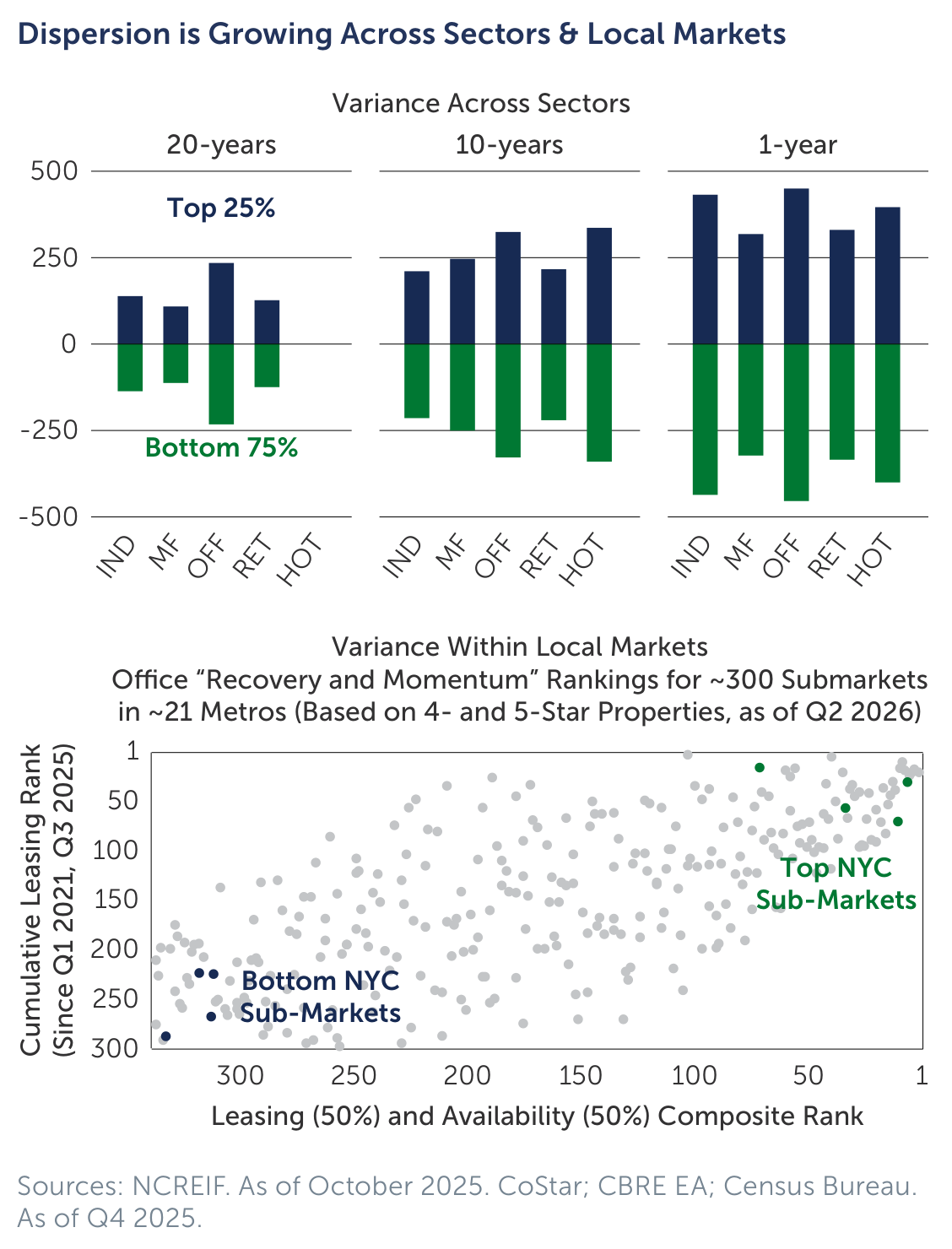
Performance dispersion is growing, not only across property types, but also among assets and local markets within the same sector. An office building near transit in a supply-constrained market, for example, can have a fundamentally different outlook than a broadly similar property elsewhere. The same principle applies across multifamily, industrial, retail and other sectors.

The implication: Directional property calls such as “favored” or “challenged” provide an incomplete picture. Outcomes will increasingly depend on location, property quality, business-plan execution and the structure of the financing.

More Ways to Shape the Risk

Real estate debt also allows risk to be calibrated across several dimensions at once:

  • Property and market: Different lease structures, supply conditions and local demand drivers create distinct cash-flow profiles.
  • Capital structure: Seniority, collateral and loan terms offer protection if valuations remain under pressure.
  • Duration and income: Shorter-duration, floating-rate loans generate contractual income with less sensitivity to long-term rates.
  • Portfolio construction: Real estate debt can diversify private credit portfolios through different collateral, cash flows and economic drivers.

The diversification role is becoming more established as private credit allocations broaden beyond corporate direct lending. In one recent industry survey, the share of respondents placing real estate debt within their private debt allocation nearly doubled year over year, from 25% to 48%.5

AI is adding another dimension. The digital infrastructure buildout is generating substantial financing demand across data centers and related assets. But underwriting will need to reflect constraints like power availability, location, lease terms and the visibility of repayment cash flows.

The bottom line: In 2027, the defining question will not be which property type wins, but which individual assets and financings are best positioned to perform across a wider range of outcomes.

Commercial real estate performance dispersion across property sectors and differences in office market recovery across local submarkets.


Public Credit Outlook

High Yield

Let Income Do the Heavy Lifting

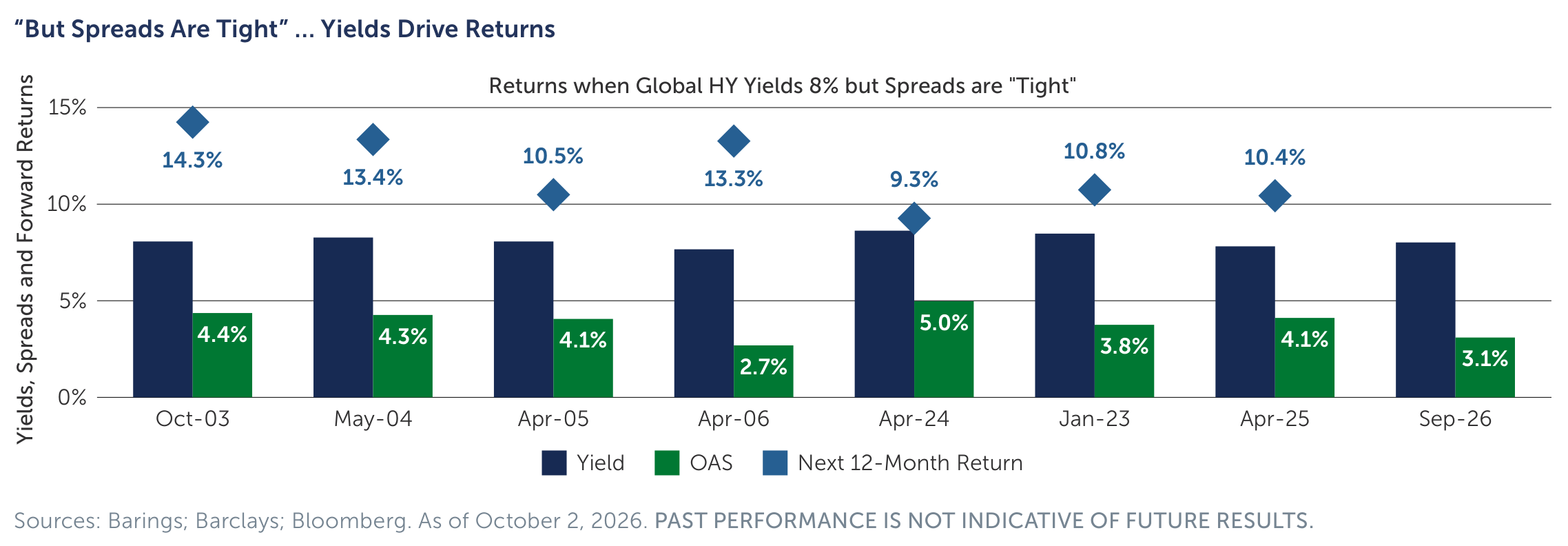
Higher underlying rates have lifted all-in yields, creating opportunities to generate attractive income in high yield without moving significantly down in credit quality. Historically, when global high yield bond yields have been around 8%, subsequent returns have remained attractive even when spreads were already tight.6

Why It Matters

Resilient growth and corporate earnings continue to support balance sheets and debt service capacity across much of the market. Heading into 2027, current yields may provide a meaningful foundation for returns without requiring a sharp decline in rates or further spread compression.

At the same time, growing dispersion across ratings, sectors and issuers is creating a less uniform market. Recent weakness has been concentrated primarily in lower-quality credit, while widening in parts of the BB market is beginning to create more attractive relative value.

Where we see opportunity:

  • Higher income with less rate sensitivity. High yield bonds look well positioned in an environment where growth remains robust and rates stay elevated or volatile. Their relatively short duration can help limit rate sensitivity, while current yields provide substantial carry.
  • Select opportunities in loans. Floating-rate coupons remain attractive if policy rates stay higher for longer. But with much of the market trading near or above par, and weaker single-B and CCC borrowers facing greater pressure, returns will depend heavily on credit selection.
  • Regional diversification. Differences in market composition, monetary policy and issuance may create opportunities to rotate between the U.S. and Europe as relative value shifts.

AI Is Also Worth Monitoring

AI-related debt currently represents only a small share of the U.S. high yield market and has been minimal to date in Europe, making it more of a potential source of future opportunity and risk than a first-order concern today. That could change if issuance continues to grow or investment grade issuers are downgraded into high yield. In the meantime, the market is increasingly demanding higher yields from transactions viewed as more speculative.

The bottom line: High yield’s starting income and manageable duration can provide a potential return advantage under different paths for growth, inflation and rates. Volatility may create opportunities, but the strongest return potential is likely to come from distinguishing temporary technical pressure from more fundamental credit deterioration.

Historical high yield bond yields, option-adjusted spreads and subsequent 12-month returns during periods of relatively tight credit spreads.


Investment Grade Credit

AI Is Reshaping the Opportunity Set

AI is reshaping the investment grade (IG) market, creating a growing but increasingly complex opportunity set:

  • Hyperscalers are shifting from predominantly self-funded investment toward greater reliance on the capital markets, materially expanding the technology sector's footprint within IG credit.
  • Data center financings are bringing greater structural complexity and new risk considerations to a market traditionally centered on conventional senior unsecured debt.
  • Chip-related financing could add another segment to the opportunity set in 2027, potentially offering shorter-duration exposure but requiring careful assessment of technological obsolescence, collateral values and repayment assumptions.

The Surge in Issuance Is Creating More Attractive Entry Points

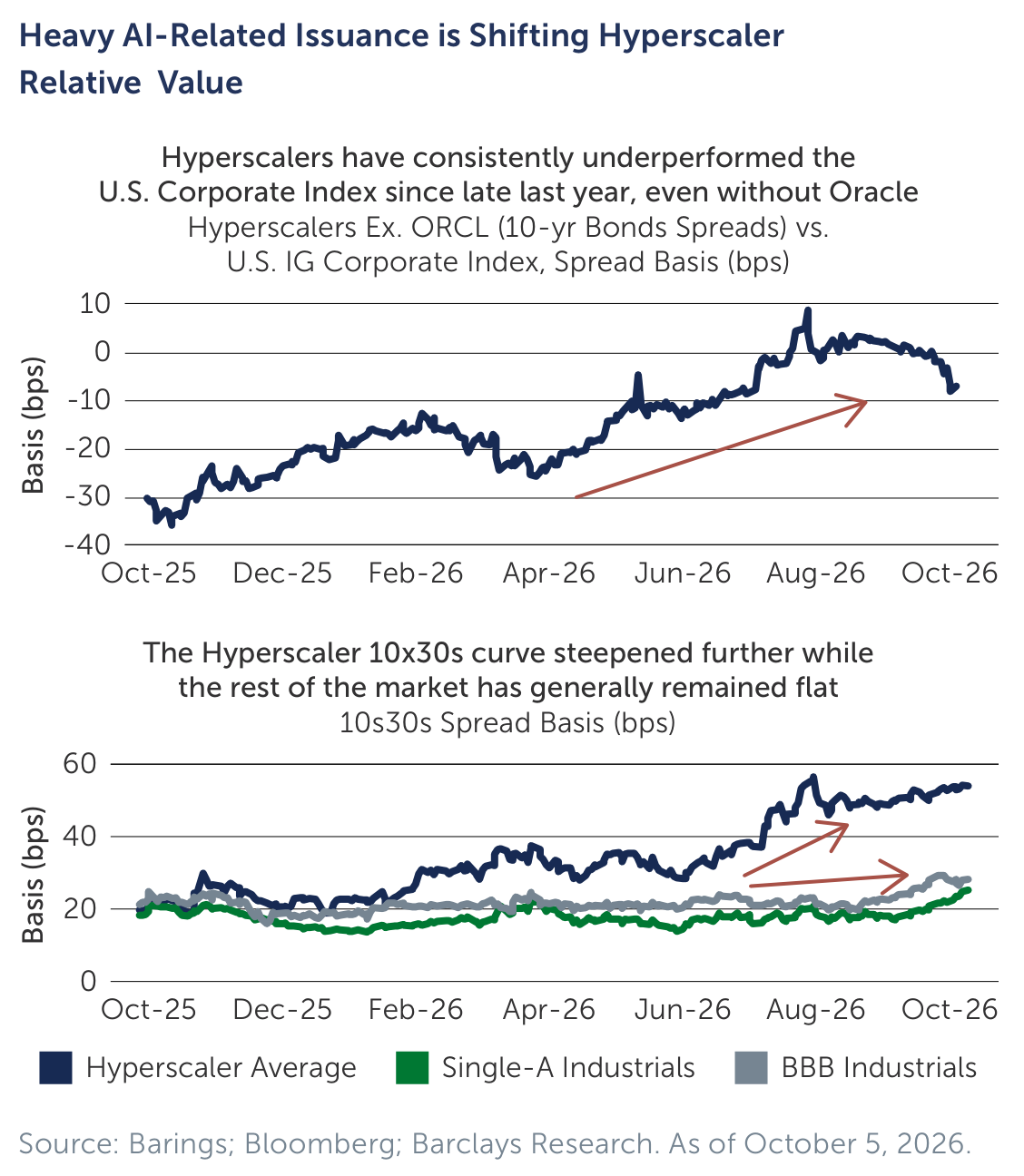
Hyperscaler bonds have underperformed the broader IG market, while heavy long-dated issuance has contributed to steeper credit curves. The resulting repricing has improved the relative value of select high-quality issuers that, for years, offered limited compensation for their credit risk. With substantial borrowing expected to continue in 2027, however, further spread widening could create even more compelling opportunities.

The opportunity may therefore be less about making a broad allocation to AI and more about gradually adding exposure where investors are adequately compensated for issuer, maturity and structure-specific risks.

The Risks Extend Beyond Corporate Balance Sheets

Strong corporate balance sheets do not eliminate questions about the durability of end demand, the economics of AI services or the returns ultimately generated by today’s capital spending. Data center debt requires additional scrutiny of construction timelines, power availability and lease terms, particularly when repayment extends beyond firm tenant commitments or collateral values depend on sustained demand.

For benchmark-aware investors, the growth of AI-related issuance also creates a concentration challenge: as these borrowers become larger components of IG indexes, passive exposure may rise precisely as sector leverage and capital intensity are increasing.

Beyond AI, Dispersion Presents an Opportunity

Despite tight index-level spreads, differentiated opportunities continue to emerge among smaller, less-followed issuers, including niche and non-bank financials, industrials and energy companies. Select subordinated and hybrid securities also offer attractive incremental yield from investment grade issuers, compensating investors for their greater structural complexity and subordination.

The bottom line: AI financing is creating new opportunities while raising the bar for underwriting. Attractive starting yields, improved market quality, and issuer-level dispersion provide room to remain patient while IG continues to offer the broader portfolio benefits of income, duration and liquidity.

Hyperscaler bond spread performance relative to the U.S. investment grade corporate index and changes in hyperscaler credit curve steepness.


Emerging Markets Debt

Rethinking Risk in 2027

A key question for fixed income investors in 2027 is whether they are being adequately compensated for mounting risks in developed markets. Fiscal pressure, persistent inflation and questions around policy credibility are increasingly shaping the outlook, challenging familiar assumptions about where sovereign risk resides.

Enter emerging markets, which today are in a stronger position than many investors may assume. Underlying fundamentals vary considerably, but across much of the universe, improving inflation, fiscal and external dynamics could present opportunities for investors willing to look beyond the EM label.

A Stronger Starting Point

For many emerging market economies:

  • Inflation has moderated closer to pre-pandemic levels
  • Fiscal deficits have largely normalized, whereas developed market deficits remain elevated
  • External buffers have strengthened, supported by manageable current account balances and rising foreign exchange reserves

That said, the picture is far from uniform, particularly given the significant differences in countries’ borrowing costs and capacity to raise revenue. But that variation is precisely the point: “emerging markets” encompasses economies with widely different policy frameworks, balance sheets and sources of growth.

Trade Rewired, Not Retreated

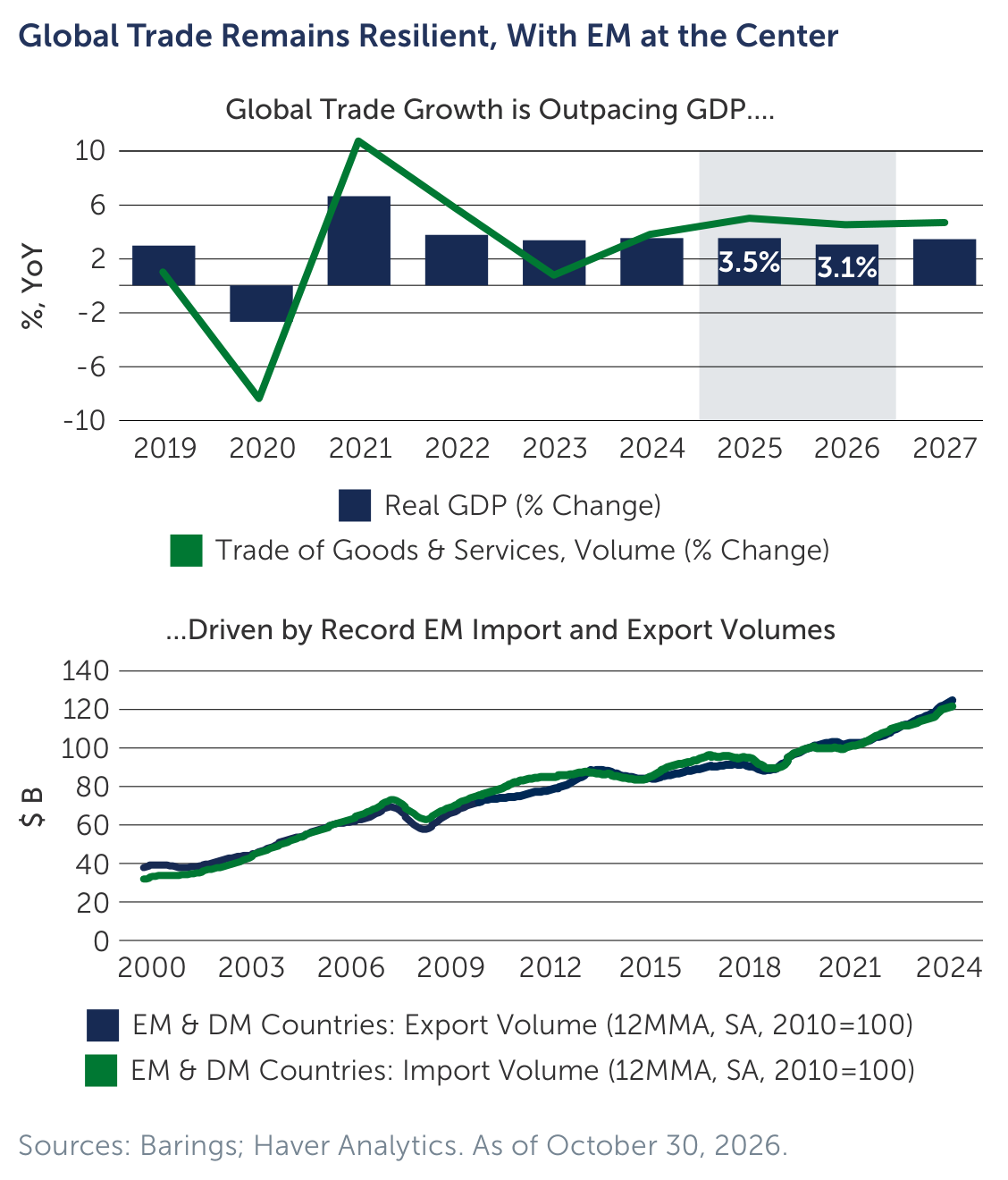
We expect global trade to remain resilient in 2027, but increasingly rerouted as tariffs, geopolitics and changing supply chains reshape where goods and capital flow. The effects of U.S. policy, commodity prices and technology investment will also differ considerably across countries. This will likely create new winners and losers, favoring economies positioned to benefit from shifting trade relationships, as well as sovereigns with the capacity to withstand less favorable outcomes.

Where Risk May Be Mispriced

The differentiation across EM is also visible in valuations. Sovereign spreads compensate investors not only for expected defaults, but also for uncertainty, volatility and liquidity risk. Yet in parts of the hard currency market, the default probabilities implied by spreads are several times higher than underlying fundamentals would suggest. This divergence between perceived and fundamental risk could create selective opportunities in sovereigns that remain misunderstood or misrated.

The bottom line: In a universe that accounts for more than 40% of global GDP7 and roughly one-quarter of global fixed income markets, the potential opportunity is too significant to ignore.8 But capturing it will require looking beyond the EM label to assess factors like policy credibility, external liquidity, debt-service capacity and the flexibility to adjust when conditions change.

Global GDP and trade growth alongside long-term import and export volume trends across emerging and developed markets.


Conclusion

Investors do not need to choose one “perfect” forecast for 2027. They need portfolios capable of navigating several plausible ones.

AI could deliver substantial productivity gains or encounter setbacks. Inflation could continue to moderate or remain volatile. Fiscal and policy pressures could produce different outcomes across rates, currencies and regions.

Different environments will favor different markets. Across those outcomes, diversified income supported by careful credit selection and appropriate structural protections may provide a more tangible foundation for returns.


Footnotes

AI Is Rewiring Capital Markets

1. Sources: Morgan Stanley; Visible Alpha. As of August 2026.

2. Source: International Energy Agency. As of 2025.

3. Source: JLL North America Data Center Report, Midyear 2026. As of August 11, 2026.

Infrastructure Debt

3. Source: Barings market observations. As of October 2026.

4. Sources: International Energy Agency (2026); Electricity 2026; IEA; Paris.

Real Estate Debt

5. Source: PERE Credit. As of December 2025.

High Yield

6. Sources: Barings; Barclays; Bloomberg. As of October 2, 2026. PAST PERFORMANCE IS NOT NECESSARILY INDICATIVE OF FUTURE RETURNS.

Emerging Markets Debt

7. Source: Barings estimates; IMF. As of September 2026.

8. Source: JPM. Data through 2024, Barings estimates for 2025.

IMPORTANT INFORMATION

Forecasts in this document reflect Barings’ market views as of the preparation date and may change without notice. Projections are not guarantees of future performance. Investments involve risk, including potential loss of principal.

The value of investments and any income may fluctuate and are not guaranteed by Barings or any other party. PAST PERFORMANCE IS NOT INDICATIVE OF FUTURE RESULTS. Examples, portfolio compositions, and investment results shown are for illustrative purposes only and do not predict future outcomes. Actual investments may differ significantly in size, composition, and risk. No assurance is given that any investment will be profitable or avoid losses. Currency exchange rate fluctuations may impact investment value. Prospective investors should consult the offering documents for detailed information and specific risk factors related to any Fund/Strategy mentioned.

AI tools may have been used to assist with the design and general content of these materials, subject to human review and oversight. AI was not used for substantive content, investment analysis, business judgments, or factual representations.

NO OFFER: The document is for informational purposes only and is not an offer or solicitation for the purchase or sale of any financial instrument or service in any jurisdiction. The material herein was prepared without any consideration of the investment objectives, financial situation or particular needs of anyone who may receive it. This document is not, and must not be treated as, investment advice, an investment recommendation, investment research, or a recommendation about the suitability or appropriateness of any security, commodity, investment, or particular investment strategy, and must not be construed as a projection or prediction.

Unless otherwise mentioned, the views contained in this document are those of Barings. These views are made in good faith in relation to the facts known at the time of preparation and are subject to change without notice. Individual portfolio management teams may hold different views than the views expressed herein and may make different investment decisions for different clients.

Parts of this document may be based on information received from sources we believe to be reliable. Although every effort is taken to ensure that the information contained in this document is accurate, Barings makes no representation or warranty, express or implied, regarding the accuracy, completeness or adequacy of the information. Any service, security, investment or product outlined in this document may not be suitable for a prospective investor or available in their jurisdiction.

Barings is the brand name for the worldwide asset management and associated businesses of Barings LLC and its global affiliates. Barings Securities LLC, Barings (U.K.) Limited, Barings Australia Pty Ltd, Barings Japan Limited, Baring Asset Management Limited, Baring International Investment Limited, Baring Fund Managers Limited, Baring International Fund Managers (Ireland) Limited, Baring Asset Management (Asia) Limited, Baring SICE (Taiwan) Limited, Baring Asset Management Switzerland Sarl, Baring Asset Management Korea Limited, and Barings Singapore Pte. Ltd. each are affiliated financial service companies owned by Barings LLC (each, individually, an “Affiliate”). Some Affiliates may act as an introducer or distributor of the products and services of some others and may be paid a fee for doing so.

Copyright and Trademark

Copyright © 2026 Barings. Information in this document may be used for your own personal use, but may not be altered, reproduced or distributed without Barings’ consent.

The BARINGS name and logo design are trademarks of Barings and are registered in U.S. Patent and Trademark Office and in other countries around the world. All rights are reserved.

About Barings

Barings is a $500 billion* global alternative asset manager that partners with institutional, insurance and wealth clients and supports leading businesses with flexible financing solutions. The firm, a subsidiary of MassMutual with a minority investment from MS&AD, seeks to deliver excess returns by leveraging its global scale and capabilities across credit, real assets, capital solutions and emerging markets.

*As of September 30, 2026

26-6116998

Share this post

Sign Up Now for Full Access to Articles and Podcasts!

Unlock full access to our vast content library by registering as an institutional investor

Register

Contacts


Image
Logo

Barings is a $500 billion* global alternative asset manager that partners with institutional, insurance and wealth clients and supports leading businesses with flexible financing solutions. The firm, a subsidiary of MassMutual with a minority investment from MS&AD, seeks to deliver excess returns by leveraging its global scale and capabilities across credit, real assets, capital solutions and emerging markets.

*As of September 30, 2026
 

Ilena Coyle
Head of North American Insurance and Intermediary  
ilena.coyle@barings.com
973-271-2400

www.barings.com
 
300 South Tryon St, Suite 2500,
Charlotte, NC 28202


View the contributor page

Sign Up Now for Full Access to Articles and Podcasts!

Unlock full access to our vast content library by registering as an institutional investor .

Create an account

Already have an account ? Sign in

Ѐ Ё Ђ Ѓ Є Ѕ І Ї Ј Љ Њ Ћ Ќ Ѝ Ў Џ А Б В Г Д Е Ж З И Й К Л М Н О П Р С ΄ ΅ Ά · Έ Ή Ί Ό Ύ Ώ ΐ Α Β Γ Δ Ε Ζ Η Θ Ι Κ Λ Μ Ν Ξ Ο Π Ρ Ё Ђ Ѓ Є Ѕ І Ї Ј Љ Њ Ћ Ќ Ў Џ А Б В Г Д Е Ж З И Й К Л М Н О П Р С Т У Ф Х Ц Ч Ш Ā ā Ă ă Ą ą Ć ć Ĉ ĉ Ċ ċ Č č Ď ď Đ đ Ē ē Ĕ ĕ Ė fi fl œ æ ß