
Ahead Of The Curve
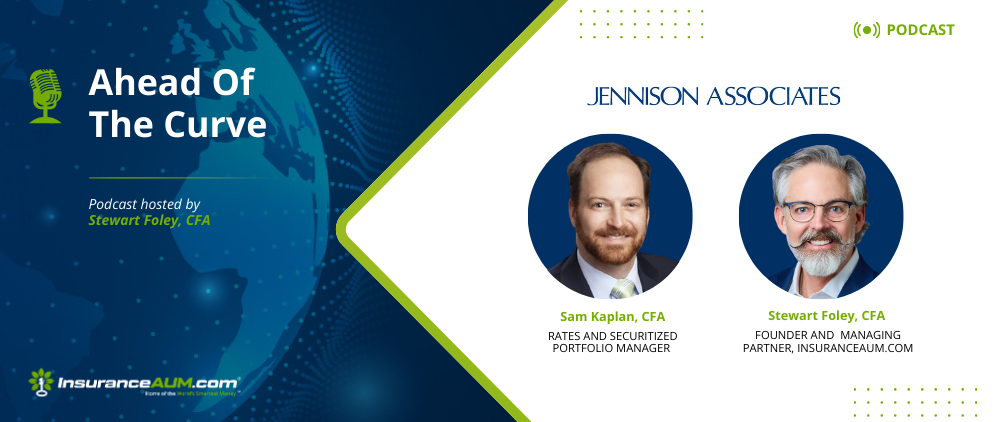
Stewart: Hey, welcome back. It's great to have you. My name's Stewart Foley. I know most of you know that this is the InsuranceAUM.com podcast. Today's title is “Ahead of the Curve,” and my guest is Sam Kaplan, Rates and Securitized Portfolio Manager at Jennison Associates. Sam oversees investment strategy, implementation, and risk management for yield curve decisions. He joined Jennison in 2008 as a trader and became a PM in 2016, after starting his career at Lehman Brothers. He's a Wharton grad and a CFA charter holder. You've got deep education. Sam, welcome back.
Sam: Thanks for having me. Yeah, I believe the last time I was on was April of last year, and certainly a lot's changed in the rates market, so I think it would be a very timely and interesting discussion to say what's happened over the last year and a half and what we can expect going forward, especially with a Fed meeting coming up soon.
Stewart: Yeah, absolutely, and I mean, at the end of the day, our repeat guests are kind of special, right, because you've already been down the path. We're at 320-something podcasts, and it's really nice to have people back because our process has changed a lot for us. Our podcast audience has been growing really nicely, and, in particular, our per-episode downloads have been up in a neighborhood of 20% month over month lately, and we're very happy with that. I appreciate everyone's listenership. If you will, it's been a minute since you've been on, so why don't you remind us where you grew up and what was your first concert?
Sam: Sure. I grew up in a town called New City, New York. It's in Rockland County, a county in New York. That's about 30 miles north and west of New York City, so technically it's considered upstate for anyone who lives in Long Island or New York City, even though we're about 10 miles away from the New Jersey border.
Stewart: That's interesting.
Sam: Yeah. It's all those city folks and people on Long Island. Anything that's north of the city is considered upstate, but New York's a big state, so a lot of it is upstate. I guess if you're from the city originally or from Long Island. My first concert, I might be dating myself here, but I grew up in a time when Dave Matthews Band was very popular, and that was my first concert. A lot of my friends from high school and I would go to outdoor concerts during the summer in either Connecticut or New Jersey nearby, and Dave Matthews was one of the first.
Stewart: I think when I went to my first concert, Dave Matthews was about two, so trust me, I'm no stranger to dating myself on this show. Let's talk about the first question: yield curve normalization. You mentioned this, but since we spoke about a year and a half ago, the yield curve has shifted a lot. Fed has cut rates, the curve has mostly uninverted, and we've seen a twist steeper with short rates down and long rates higher. From your perspective, how do you characterize the shape of the curve, and what factors do you see driving it going forward?
Sam: As you mentioned, Stewart, a lot has changed since April. When we last spoke, the yield curve was inverted pretty much across the board. As you mentioned, it's disinverted pretty much everywhere, with the exception of the one-year point to the two-year point. The last sort of inversion to normalize or disinvert was actually the 20-year point versus the 30-year. That point was inverted for almost four years until July of this year, and now it's finally upward sloping, where you move from 20-year vs. 30-year maturities: +4–5 bps (0.04%–0.05%). As you said, the Fed cut 100 basis points (1.00%) in Q4 2024 and then has been on hold so far this year, waiting to see the impacts of tariffs and what that would do to inflation with their dual mandate, with inflation on one side and job growth on the other.
The job market has remained pretty resilient up until recently, where we saw large downward revisions to job growth over the summer and a continued weak print at the beginning of this month in September. So that begs the question, are we at a turning point? It's been very rare what unemployment has crept up from the lows to a certain point and then just stagnated or gone back down. Typically, when unemployment starts to creep up, it usually shoots higher pretty quickly, so it'll be interesting to see if that transpires this time. From a Fed perspective, you have two different factors right now at play. You have the economic data and the job picture on one side of their mandate, and if that is weakening, should the Fed try to get ahead of the curve and lower rates quickly to try to arrest any kind of spike in unemployment?
But then you have the pressure coming from the administration of wanting lower rates and questioning Fed independence and whether it's trying to fire Fed Governor Cook or threatening to fire Chair Powell, trying to sort of put people on the board that would be loyal to the administration and just do what the administration wants, and so what does that mean for rates going forward? Certainly, it probably means lower rates in the front end as far as the Fed cutting rates, but if they're cutting rates for the wrong reasons, and that means that inflation is allowed to run above target, maybe even accelerating, does that mean that longer run rates should actually be higher? Should we see a continuation of that move that you mentioned, where it was a twist steeper where front-end rates came down and long-end rates go up as opposed to the whole curve moving down in yield and steepening out as the Fed cuts rates, which is more of a traditional path.
Stewart: I mean, it's interesting because, and I don't know you're likely to see, I think at some point, tariffs could have an impact on inflation, and that can be challenging for economic growth. At the same time, you might see job market weakness, which I think a lot of people who aren't in this business or understand it think the Fed controls interest rates like the whole curve somehow, right? And they only control the overnight lending rate, and the bond market vigilantes control the back end, and it's interesting, you could completely see the back end backing up while the Fed is being beaten into more cuts.
Sam: Yeah, I mean, you've already seen it in the last year, as I mentioned with the Fed cutting rates a hundred basis points and the long end actually being higher in yield since we last spoke in April of last year.
Stewart: So let's talk a little bit about relative value along the curve, and that has shifted too since we last spoke. What can you tell us about relative value?
Sam: From a yield curve perspective, we're not just looking at the shape of the curve overall - 2-year vs. 10-year, 5-year vs. 30-year. We're looking at individual securities and different points of the curve and whether or not they offer value versus other treasury securities. When I came on in April last year, we were really bullish on the 20-year point offering value as it was a place where you could pick up yield if you sold the 10-year or sold the 30-year and bought 20 years against it. Since then, as I mentioned, the curve has started to normalize out there twenties, the curve is now a pick and yield. 20-year vs. 30-year: +4–5 bps, so we still like the 20-year point because it offers rolldown into the 10-year point, but we have also started to extend duration to the 25-year maturity, currently the peak of the curve.
What we've seen over the last couple years is that there's been a large amount of buying at the tip of the curve that is price indiscriminate, whether it's insurance companies that just need as much duration as possible, buying 30-year Principal STRIPS or other liability driven investors that say, I might be able to pick a little bit of yield if I go shorter on the yield curve, but really I care about matching the duration of my liabilities. I just want as much duration as possible. They continue to buy that 30-year point. And so, if you look at the shape of the yield curve right now it's upward sloping from 2s all the way out to 25s, and then from the 25-year point to the 30-year point, just like 2050 maturity bonds to 2055 maturity bonds, the yield curve is actually inverted. Some of those 2050 bonds actually offer more duration than 2055 bonds because those were issued during COVID when you had much lower rates and much lower coupons, so you could buy almost a zero coupon bond or it's a very low coupon bond with a 2050 maturity, actually get more duration and get more bang for your buck as far as how much money you're investing from a duration perspective, and you can pick up yield versus buying at the tip of the curve because of that price indiscriminate buying of Principal STRIPS and just buying that 30-year point.
So we have started to shift our portfolios to not only own the 20-year but also own the 25-year and then be underweight fifteens and thirties against it because you basically have a frown in the long end of the curve where it goes up and then goes down. And so we prefer to own the points that are higher yielding and not own the points that are lower yielding right now.
Stewart: And turn that front upside down.
Sam: Yeah.
Stewart: It's interesting. That's the kind of stuff that I remember when I was running money, and you'd be at the morning meeting, and the rates person would bring up something like that, which says there's more duration in the 25-year bond because of the coupon than there is in 30, which I think is a really interesting point that you're making there. I appreciate you bringing that up for our audience to take a look at. The third question really talks about treasury issuance and fiscal debt. You've heard, I'm sure, as the rest of us have concerns here, treasury issuance, and it's at the front of mind. What can you talk to us about the treasury issuance and fiscal debt situation?
Sam: It's very interesting. When Treasury Secretary Bessent was not in the administration, he was very critical of the previous Treasury Secretary Janet Yellen, for not taming out the debt and for relying on bills, and then as soon as he came into office, he just continued that pattern. So you actually have 20 to 25% of the deficit being funded in T-bills right now, which is not a record, but it is much higher than average and if the deficit continues to increase and we continue to fund that deficit with short-term debt, there is a risk or a concern that longer term debt people, who when they want go to buy are going to want to get compensated for the fact that they know that deficits are going to be increasing, the treasury is going to need to borrow more and more money and that keeps long end rates higher.
This administration, I think, has said that their goal is to bring 10-year yields down because that's the yield that controls the mortgage rate, and that's the yield that a lot of borrowing is based on. And so, I think they're waiting for lower yields at the long end of the curve to term out the debt potentially, but they could be waiting a long time. As you mentioned, there are bond vigilantes out there. You saw what happened in April of this year on the back of Liberation Day, where yields actually moved higher in the long end on the back of those concerns, even though there were concerns of trade policy potentially tipping us into a recession; long-end rates moved higher, and then the administration was very quick to backtrack on those policies. So there is a world where the administration doesn't get what they want as far as lower long-end yields, even if the Fed is cutting rates, and then all of a sudden, what do they do then?
Do they continue to just issue short-term debt? Does that mean that long-term debt continues to move higher from a yield perspective, or do we get some sort of credit cycle event, a recession, as the job data continues to turn, do we get some sort of flight to quality where yields come down, and that the government is able to actually term out some of that debt at lower rates? I think it's sort of a catch-22, though, right? If you do get those lower rates in the long end of the curve, it's probably because the economy is not doing very well. Risky assets probably start to underperform. You have job losses, and you have the potential to move into a recession. What does that do for voters at the midterms next year or even the presidential cycle three years from now? Does that mean that republicans lose some seats and the administration isn't able to govern as effectively as they are right now? Or on the flip side, if you keep issuing short and long end rates, keep staying elevated, and maybe even go higher, you have that risk of bond vigilantes continuing to drive long end rates higher, and then what does that do to the economy as we stay in longer rates for a longer period of time?
Stewart: It's interesting, and this is kind of an off the wall question, and you can completely pass on this if you want, but as you were explaining that it occurs to me, is there a world in which the administration forces rates short rates lower to bring more of the debt into T-bills and try to, I mean obviously risking the backend going up, but is that potentially a strategy to lower the borrowing cost?
Sam: That's a good question. In thinking about it, it could be a strategy of the administration, if I'm being honest. I don't know that I could say what the strategy of this administration is ever. They talk about wanting to lower 10-year yields and yet then you have President Trump come out and talk about firing chair Powell, and that leads to higher long end rates because there's a question of Fed independence and if the Fed is going to cut rates even as inflation is above target and maybe accelerating, then investors are going to want more compensation for moving out the curve because they have more inflation eating into those nominal returns when they buy a 10-year or buy a 30-year treasury. So in a perfect world, if their goal is to lower tenure yields, they wouldn't be going out and saying, “We're going to fire Powell.”
They wouldn't be when you had the revisions to the unemployment data or the job data, they wouldn't say that it's faulty data and fire the head of the BLS because that was actually a way for the Fed to now cut rates in the front end and bring long end rates lower because the economy is starting to turn potentially, but they didn't want to be seen as in power when all of a sudden we're heading into a recession and it would be hard for Trump to blame the previous administration saying it's his economy given that we've put all these tariffs in place and we've had time and policies that have been implemented by the current administration. So it's hard for me to say what their strategy is because they say what they want and then they do things that bring about the opposite.
And then they go and bring things that do what they want to do. And there doesn't seem to be a clear-cut strategy or policy across the entire administration or across the different policies that they're implementing. So yes, I mean, bringing front-end rates down would mean lower borrowing costs in the short term because we would just roll over bills at lower rates than we have in the last couple of years. But that's very short-term, right? You're issuing one years and who knows what can happen to rates a year from now if the Fed is cutting because of pressure, but then all of a sudden tariffs lead to inflation, expectations being increased, inflation is now passed through and we’re back toward a 1970s-style event where the Fed cuts too early inflation re-accelerate past where it was previously, and if inflation gets up to 9%–12% higher than we were in 2022, what does the Fed do then? Right? You would expect the Fed to have to reverse course and hike rates pretty aggressively, and then all those bills are coming due, and we need to refinance, and we're refinancing either at very high rates in the front end or what I would expect is even higher rates in the long end of the curve. Not necessarily as high as bills, but higher than we are currently.
Stewart: Yeah, no, that makes sense. So the next topic is where do yields go from here, which is like, I don't know about my crystal ball clouded over a while ago, but I'm hoping that yours is better. You've talked about the push and pull of inflation versus deflationary forces. We've talked about weaker unemployment. I, like you, thought when those weak job numbers came out, this is a lot of fodder for the cannon to lower rates, and instead, we fired the BLS director. The Fed is already lower. Right? Talk to us about where you think rates go from here and listen with the following caveat: I'm a fixed-income person. I realize how hard it is to forecast rates, so we're not going to hold you to it, Sam.
Sam: The first is that we don't really take a lot of duration calls in our portfolios because, as you said, it's very hard to forecast the direction of rates. Not to toot our own horn, but because we certainly get duration calls or calls on the market wrong all the time, and again, that's why we don't position that way. But I believe the last time that we spoke, I said something to the effect that US treasuries are still a safe-haven asset and will do well in an economic downturn. However, if one believes the Fed dot plot and economic projections, we could envision front end rates declining while long end rates continue on an upward trajectory, and that is exactly what transpired inflation moderating towards target with some bumps in the road, but still coming down and sort of on a downward trajectory paused a little bit by tariffs from April onward, but that's what we've seen since April of last year’s inflation starting to moderate, getting closer and closer to the fed target.
The economic data or the economy has remained somewhat resilient, especially on the jobs picture, until recently. And so the Fed was able to cut slowly back towards neutral, still in restrictive territory, but ease some of that restriction that we had when we got north of 5% and try to engineer that ever elusive soft landing. Now the question is, did they stay in restrictive territory for too long? It's going to be interesting. At the September meeting coming up on Wednesday, if you look at the Fed dot plot in June, they were calling for two interest rate cuts this year and only 1 25 basis point cut next year. They actually had us above neutral well into 2028. The market right now is actually pricing in about 70 basis points of cuts for the rest of 2025, another 70 basis points of cuts next year, and has us basically back to neutral in the high twos by the end of next year.
So it'll be interesting to see if the Fed is going to mark to market their dot plot at the September meeting or if they're going to sort of hold on to the message that they've been sending that inflation is moderating towards target. There have been some bumps in the road, but inflation is coming down. Tariffs, we've waited to see the effect of tariffs. We think that it's really just a one-time price rise and is not going to be consistent inflation, and we think that while the economy is showing signs of weakening, we don't think that we're headed towards any kind of recession, and this is just sort of normal moderation of economic data. And so we can remain in restrictive territory to make sure that inflation doesn't get out of control, slowly but surely getting back to neutral over the next couple of years. I think that's going to be hard to do.
Again, it's very rare that a soft landing is engineered. You still have lots of uncertainty from policy, whether it's tariff policy that's still being challenged in courts as to whether tariffs are legal or not. You have an immigration policy, and you have the administration being sued for lots of different reasons. They also seem to change their mind on some of these policies on a day-to-day basis. So with ever-increasing uncertainty from what's going on from a fiscal standpoint, I think that term premium is really what is needed, and that's what you've seen happen over the last year and a half, is we've seen term premium return to the market, and that is what's driven the normalization of the curve. Yes, you've had the fed cut front-end rates a hundred basis points, but you really priced in more term premium to take risk, that duration risk out the curve, and that's what has caused the curve to normalize and invert, and I think that should continue.
It's pretty much a done deal. The Fed's going to cut rates in September, 25 basis points. Where they go from here is anyone's guess, but I think the path in the front end is lower rates over time, whether that's from just the economic data continuing to weaken or the Fed losing independence and pressure from the administration. But as we've spoken about multiple times already, long-end rates are anyone's guess, right? The administration can say they want lower rates. There are things that maybe they could do if the Fed could do return to quantitative easing, could do some sort of yield curve control. But typically, historically, that stuff doesn't necessarily work in the long run. Typically, it's the market participants that drive where yields are going to go out the curve, and as a market participant myself, if I have more uncertainty, more risk, but every time I take more and more duration, I want to get compensated for that. So it's going to be harder and harder for me to buy long-end rates if I'm not getting that compensation, if the curve isn't continuing to steepen out.
Stewart: That's a really thorough explanation. I appreciate that. I know our audience does. Last question for you on this show, we've got a couple of fun ones for you, but I mean market-related, is really the opportunity to extend duration, and there are insurers who are sitting on cash or money market allocations. Can you talk a little bit about whether you think that this is an opportune time to extend? Do you think there's going to be a better time? What's your view of extending duration?
Sam: I think it's a question of where or how much you're extending the duration. If you're talking about going from money market to a core strategy with a five or six duration, I think now is actually a very good time. As we mentioned, the Fed is going to be cutting rates; how much they cut, I don't know. But that just means money market rates are going to come down over time. I remember my savings account, I got multiple emails in Q4 of last year that my savings rate went down as the Fed was cutting rates a hundred basis points, and I think that will obviously start to transpire again as the Fed starts cutting in September and maybe potentially in October and December and into next year. So those money market rates of 4% or somewhere around there that you're getting right now are probably not going to last for long.
Meanwhile, you still have yield north of 4% out of the curve, 10 years and out, I think 10 years and out is anyone's guess from a duration perspective, yields could come down if you are a believer that the economy is headed towards a downturn in potential recession. But if you're a believer that the economy is going to remain resilient and that the Fed is cutting in the front end and that might stoke the economy and animal spirits and maybe even stoke inflation again, you could definitely see long end rates moving higher, but the three to seven year point in the curve is more going to move with what the Fed is doing than really what the long end might do. So moving from a money market or a really short one-year strategy out to something in the three to five year part of the curve with a duration of 4–6 years, I think now is actually a very opportune time.
Stewart: If there were one or two key points that you would've wanted our audience to take away today, Sam, what would they be?
Sam: I think the first is that while the yield curve has normalized a lot and steepened out a lot since we last spoke in April, I think there's a lot more room to go. The themes that we've spoken about are a front-end that is being driven lower in yield, and whether that's because the Fed is making that decision on their own or if they're being pressured to do so, either way, that leads to lower front-end rates in the short term, whereas the backend is hard to control. As you mentioned, the Fed doesn't control the entire curve. They can lower front-end rates and overnight rates, but that doesn't mean that investors are going to reach for duration and reach for yield out of the curve. So I think the curve can continue steepening. The first scenario I envision is one where the revision to job data continues the negative trend from jobs continues.
Maybe we have job losses instead of very small job growth. The economy does start to move into recession, and sort of the hard data does catch up with those sentiment numbers that are already showing us in contractionary territory or having concern on the economy. If that's the case, the Fed is going to need to cut a lot more aggressively than what the market is pricing in. They're not just going to cut to neutral to high twos, 3%, they're probably going to cut to easy accommodative territory. I don't think they're going to go back to the zero lower bound, but I could see them cutting rates to 1% very easily from here. And that will steepen the curve out just because the Fed is so aggressive in cutting rates in the front end. On the flip side, if the Fed is cutting rates because they're not independent anymore and they're just being told to do so by the administration, front-end rates are going to come down sort of in line with what the market is pricing in.
But I think that leads to higher backend rates because the market is concerned that the Fed is doing something they shouldn't be doing. Inflation can become unanchored, can re-accelerate like we saw in the 1970s, not to maybe that level, but re-accelerate from current levels. And then investors are going to want more compensation out of the curve from taking that duration risk and that hit from inflation over time. So the most likely scenarios that I see just lead to a steeper yield curve. Fives thirties is already sort of back to the long-term average, fives, tens are pretty close to the long-term average, but that two, your point two, tens is actually still historically flat at positive 50 basis points, that the long-term average is north of a hundred. So I think there's still a lot of room for that steepening to run, especially in the front end of the curve.
Stewart: Very helpful. Alright, so before we close, this is a question we've been asking quite a bit of late, which is what characteristics are you looking for when you're adding to members of your team at Jennison? And the purpose of the question is really to talk about the culture of Jennison in a way that I think folks understand, but it also helps folks who are younger and earlier in their career get an idea of what things are important to be successful in an asset management firm.
Sam: Yeah, two of the key attributes that I look for especially are someone who's a self-starter and a go-getter, and someone who's very curious and asks a lot of questions. The fixed income markets are, there's lots of information that can drive markets. You never know which data point is going to be the one that triggers something or causes the market to move in a certain way. There are certain times when I see a data print and I'm like, ‘Oh, the market is going to do this, and then it does the complete opposite.’ And that might be because everyone was positioned for the market to go that certain way, and then they're taking profits on the trade. So what I love about the markets in general and fixed income specifically is that I learn something new every day. And if you're not curious and not inquisitive and wanting to ask questions and learn all the time, I don't think you're going to be successful in the industry.
And certainly not at Jennison, where we're a pretty lean team, we rely on people to wear multiple hats, to do a lot of work, not just sort of stay in their box. And that leads me to the other point that I mentioned of being a go-getter. Because we're a lean team, I don't necessarily have the time to set aside and say to a young person, I want you to work on this project and I want you to do this, this, and this. There is that. There is formal training, but I really need someone who is going to come to me and say, ‘Well, why did you do that trade? What can I learn from here? Or what can you tell me about the trade that you did that I can then take away and work on my own to learn about why we're doing what we're doing?’ And so I really think that we need people who are constantly wanting more, asking for more, not just waiting to be given assignments, because that is how they wind up helping the senior members of the team, and also learn on their own to eventually become a senior member of the team over time.
Stewart: Yeah, it's very consistent with my experience as well. Alright, so change up the last question because I don't know what it is, but I just feel like you're going to have a good answer to this. Do you remember graduating from Wharton? I remember graduating from Chicago, and I mean, I remember the day it was a big deal from my perspective that I was doing it. Do you remember that?
Sam: I remember it somewhat, yep.
Stewart: Somewhat. I was massively hungover, I'll be honest. But at the end of the day, just being honest, the class I was in, wow, they studied hard, but there was plenty of socializing as well.
Sam: It is called the Social Ivy for a reason.
Stewart: That's right. But as you've been in this business for a minute, you've been in a senior position for a while, is there something that you wish you had known when you graduated that you think would've been particularly helpful or would've helped you accelerate your career or something like that? What I'm heading for here is that there are people who, and I was one of them, who didn't know I didn't have a compass, if you will. Nobody gave me a compass, and I kind of floundered around for a while, and I didn't know this industry existed. I didn't know people like you existed. I didn't know that Jennison people like that. And we've got over 60 clients. I didn't know any of them existed except for the ones that advertise on TV. You know what I mean? I was the first person to get a degree and all that. So what do you think would've been helpful for you to know coming out of grad school?
Sam: Besides the fact that I should have gone into private equity?
Stewart: Yeah, that's the same for me.
Sam: I was very fortunate. So Wharton has a very good on-campus recruiting network and service as far as helping people look for opportunities. Not to mention, there are lots of cohorts that are interviewing and have internships and different jobs, and can tell you what the experience is like and what they do on a day-to-day basis. I was in a fraternity, and so people graduate and they come back to campus and they tell me what they're doing. So I was lucky in the sense that I did know sales and trading jobs existed. I did know market-oriented jobs existed, even though at Wharton, you were told, go be an investment banker for two to three years, and then you can set yourself up for whatever else you want in life. That wasn't the path that I really wanted, mostly because I didn't want to work a hundred-hour workweeks when I was 22 years old, living in New York City.
I actually had in my fraternity, there were 11 of us in Wharton, 10 of us graduated and went to New York City. Nine of them were in investment banking, and I was the only one who wasn't. And I didn't see any of the nine of them for the first two years. I thought we were out of school because they were constantly working. And I just knew that wasn't for me. I was a soccer player in high school, and played for a year in college. I played poker a lot, and my parents introduced me to sort of card games at a young age. I always felt that I wanted a scoreboard in front of me, and there's no bigger scoreboard than the market. I know how I'm positioned. Either the market moves my way that day or it doesn't. And then I get a performance report saying, we made performance versus the benchmark, or we lost performance versus the benchmark.
So from my perspective, I was, again, very fortunate that I found out these jobs existed. And even though I had some internships, I realized those weren't for me. And when I went back my senior year, I specifically targeted sales and trading roles at sell-side shops, Lehman Brothers, Deutsche Bank, Barclays, whatnot, because that's where I wanted to wind up. So what I would tell to people out there is that these jobs exist. If you're someone like me who likes to scoreboard, likes a challenge, likes to see work and get results on a daily basis, as opposed to working on projects that could be for nine months to a year and then fall through, and you did all that work for basically nothing, definitely look at sales and trading positions. Definitely look at buy-side shops, asset managers, hedge funds as you're coming out of college, and then pick what's right for you that not only is interesting to you and something that you're going to want to pursue not just for a couple of years, but hopefully for your entire career, but something that is challenging and something that you enjoy. Because if you enjoy what you're doing on a day-to-day basis, it definitely doesn't feel like work.
Stewart: That's fantastic. I really appreciate you being on today, Sam. It was a fantastic education, and I really appreciate you taking the time to come back.
Sam: Thank you for having me.
Stewart: Our pleasure. We've been joined today by Sam Kaplan, Rates and Securitized Portfolio Manager at Jennison Associates. If you like what we're doing, please rate us, review us on Apple Podcast, Spotify, Amazon, or on our new YouTube channel at Insurance AUM community. Thanks for listening. We are the home of the world's smartest money at InsuranceAUM.com.
The InsuranceAUM.com podcast is available on




Sign Up Now for Full Access to Articles and Podcasts!
Unlock full access to our vast content library by registering as an institutional investor
Sign Up Now for Full Access to Articles and Podcasts!
Unlock full access to our vast content library by registering as an institutional investor .
Create an accountAlready have an account ? Sign in