




T. Rowe Price-

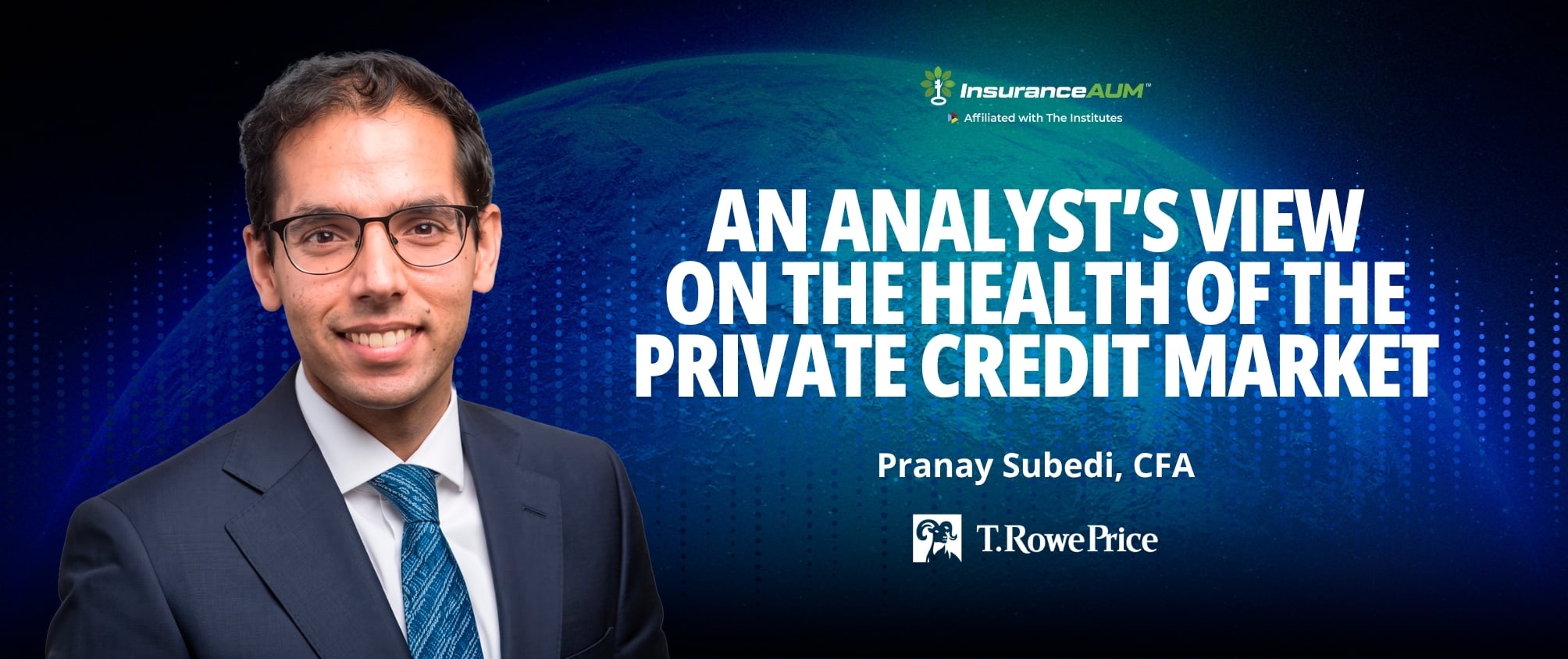
An Analyst’s View on the Health of the Private Credit Market

Image
IAUM_Podcast_TRowePrice-10.12.26_Web_2026


Stewart: Hey, welcome back. This is the InsuranceAUM podcast. I think most of you know that. Our audience is pretty consistent. And my name's Stew. I think you know that too. And so if you listen on this podcast very much, you know that we talk about private credit pretty frequently, but today it's through a different lens, right? Rather than talk with a private credit manager about the loans they're making and their underwriting and whatever it is, we're talking with an investor who analyzes the health of the private credit ecosystem itself.

And today the title of the podcast is An Analyst’s View on the Health of the Private Credit Market. My guest is Pranay Subedi, Associate Portfolio Manager in Fixed Income at T. Rowe Price. Pranay, welcome to the show. I've got a little more on your background, but I wanted to bring you in here.

Pranay: Hi, Stewart. Thanks. It's great to do this.

Stewart: So Pranay is an Associate Portfolio Manager on the Dynamic Credit Strategy and chair of the Money Market Credit Committee. His background is interesting for a couple of reasons. Prior to T. Rowe, he was at HarborVest in its customized solutions group and spent four years at PIMCO. He holds a degree in mathematics and physics. They stopped letting dummies in those fields a long time ago from the University of Warwick. And you got an M.B.A. from the finest business school in the world, the University of Chicago's Booth School of Business. We share that, my friend. Welcome to the show.

Pranay: Thank you very much. Pleasure to be here.

Stewart: And so we're here to talk about our private credit, how we got here and why we've seen recent volatility and whether the system is actually safer or not. But before we get going, I want to ask you our icebreaker questions, which is where did you grow up and what's a fun fact that your colleagues at T. Rowe Price would be interested to find out?

Pranay: Sure. So I'm from the UK. I was born and raised in London. My parents are from Nepal, so they moved to the UK in the late '80s, but I was born there and we bounced around a little bit when I was growing up, but the UK’s been home, well, was home until Chicago for most of my childhood and adolescence. So that's been where my most formative memories were based. In terms of one thing that I think my colleagues would be surprised by, when I graduated from my undergraduate degree, I lived at home for the first two years to save some money, London rents being phenomenally expensive. And in my spare time, I had to get out of the house, so I volunteered everywhere I could. And one of the places I volunteered at was the Science Museum in London, which is a phenomenal institution.

Stewart: Oh, interesting. Especially with your background in math and physics.

Pranay: Yeah, I've always been drawn to the sciences, and the opportunity to volunteer there was a really unique one. And it turned out to be a great experience, not only for the volunteering, but it's where I met my wife and where we also got engaged was at the Science Museum as well.

Stewart: Oh, how interesting. That's so cool. How long have you been married?

Pranay: For four years now.

Stewart: Wow. All right. Well, congratulations. That's awesome. What a great story. That's nice. I'd love to hear, I've got to think that working in a museum, you get to know it so much better than you possibly could coming for a day or two visiting. So I'd love to get a Cook's tour of that, Pranay, if we can make that happen, I'd be grateful. So let's talk a little bit about the lay of the land. I think it might be helpful to lay out the ecosystem in private credit a little bit. I think the vehicle matters almost as much as the underlying assets. We have public business development companies (BDCs), SMAs, drawdown vehicles. Can you give us a lay of the land and explain how these different pools of capital have changed the private credit market?

Pranay: Absolutely. So I think when people talk about private credit, really spans a whole variety of underlying asset classes. You go from asset-backed finance, you can cover distressed opportunities, you can cover various parts of the securitized market. In this conversation, I suspect we're going to be focused mostly on direct lending, which is the act of just lending to smaller, we call them middle market companies. And there's really a variety of ways that managers have set up vehicles to lend into this space. The business development companies (BDCs), as you noted, come in three flavors, which I'm sure we'll talk about in more detail. But in addition to the BDCs, there are also separate accounts when an institution wishes to allocate to the space and they'll do it in their own separate account. And there'll also be drawdown funds where they'll be pooled together with other investors and they'll have the opportunity to call capital and deploy it as they wish.

BDCs are kind of somewhere in the middle. They're open-end vehicles, which means that capital flows into and out of the vehicle, and they go from public where they trade on a stock exchange and you can see a daily price, and those are marked minute by minute. There are perpetually nontraded BDCs, which are vehicles that allow flows to come in and out, but they only get marked once a month and money can come in monthly, but can only come out once a quarter. So that's actually been the area that we've seen the most rapid form of growth in. And then the final type of BDC is a drawdown BDC where it kind of looks like a drawdown fund, but it has the benefits of the BDC wrapper.

Stewart: Yeah, it's interesting. I mean, if we can go back in time just a little bit. Around the global financial crisis (GFC), banks pulled back from certain types of lending. Regulation changed the economics of holding that risk on bank balance sheets, and private lenders increasingly stepped in to fill that gap. How did we get from the post-GFC banking reforms to the private credit market that we have today?

Pranay: What's really interesting is going into the financial crisis, the global financial crisis, banks used to underwrite a lot of fairly risky loans. So things that we would today consider loans that would fall squarely into the remit of the BDC. A lot of those used to sit on bank balance sheets. Banks in general took a lot of credit risk pre-financial crisis. And the big step change post-financial crisis in terms of bank regulation is a lot of that risk, the credit risk that banks were taking has been squeezed out of the banking system and it's entered the nonbank sector. So we see it in the growth of the mutual fund complex, we see it in the growth of the BDC complex. We see it everywhere. We see credit risk broadly as having left the banking system. What the banking system has hung onto, however, is interest rate risk and liquidity risk.

And if you're a bank, you have three broad levers you can use to generate returns: credit risk, interest rate, liquidity risk. In the act of giving away the credit risk, banks have almost had to take more liquidity and interest rate risk in order to continue to generate returns on equity that are acceptable to their shareholders. And that's really the step change that I think's happened in the banking system and has also helped give birth to the growth in the private credit world that we've seen over the past couple of years in particular. One of the reasons why this transition has taken place, part of it is the way that the new Basel reforms have been written. Banks can lend not necessarily to the portfolio companies, directly, to these levered loans where maybe it's a small family-run business. Instead, what they can do is they can lend to a BDC and the BDC then goes and makes the underlying loans.

The reason why a bank would want to do that instead is because they can qualify for risk capital treatment that is at just 20% of what it is to lend directly to the company itself. So it creates this really interesting opportunity for banks. They can lend to a lender and pay just 20% of the capital that they would pay lending directly. And there are a whole bunch of advantages for banks in terms of the reasons why they would do that, but it has had this effect of allowing banks to lend into that private credit ecosystem without having to take direct credit risk themselves. They are taking interest rate risk and liquidity risk, but not the credit risk, and that's a really big step change looking at the system before and after the financial crisis.

Stewart: That's interesting. It's almost like they're outsourcing the underwriting. They go, "You guys can underwrite this better than we can." That's a really interesting development. So anyway, I digress. So the big picture question here is, is the system actually safer today? And so this is where your perspective gets really interesting. There's been a lot of concern about the growth of private credit, and I think that a lot of us, I've got a lot, a lot of gray hair, which means I've seen a lot of movies, and whenever there's a lot of capital flowing in one particular direction, folks have seen that not work out well previously. And I think there's some of that like, "I'm not exactly sure what the problem is, but I bet there's going to be one." So I know that there are folks with that mindset, but your view is that some important aspects of today's system may actually be safer than the pre-GFC system. Can you talk with us about that?

Pranay: Yeah, absolutely. And I think this is a really important change that's happened. If you accept this idea that credit risk has left the banking system and they've just hung onto interest rate risk and liquidity risk, essentially what we've done is we've focused those risks more intensely in the banking system, but those are risks that can be solved by policymakers and by authorities and central banks. So for instance, as we saw in 2023, if the system starts to run low on liquidity and if interest rates are really moving higher, you can do things as an authority like you can cut rates but only aim it at the banking system, and I can go into more detail on that. You can provide a ton of liquidity into the banking system. You can open up the discount window. You can launch this program called the Bank Term Funding Program. There are ways that you can solve those first two problems, interest rate risk and liquidity risk.

If those start to get too big, authorities have tools in the toolkit that they can readily do to solve that. What authorities cannot do is solve credit risk problems. That involves almost what we would call a bailout. It involves injecting banks with capital and hoping that the loans that they make turn good. And regulators, as we saw coming out of the financial crisis, have absolutely no appetite to do that anymore. So if the credit risk now sits in the private credit ecosystem, a lot of the benefit of that is the credit risk is now being absorbed by holders. The underlying investors in those private credit funds are willing and able to take that risk in a way that banks were not able to. So it's a better set of holders who own that underlying credit risk. That's the first advantage that I would say. The risk is held by better hands.

The second advantage is pre-GFC, credit risk was held by banks who were levered, if we want to be generous, 10 times. If you look at Lehman, it was closer to 30 times. So the amount of leverage that a bank would take would be 10 times. The amount of leverage that a BDC takes, for instance, is 1 times. So you've moved credit risk from a 10-times-levered vehicle into a 1-times-levered vehicle. So that means you just need to take a lot more losses on the credit risk side of things in order to impair those vehicles. So when you combine those two things together, there are better holders in these vehicles and it's much less levered. I would argue that the current system, the evolution of the system, has made it safer, not riskier than pre-GFC. I think the point that you make is a really important one though: the growth.

And this is really, really important because having studied financial cycles through history, the single biggest indicator of financial crisis is outsized growth. And what's really hard to disentangle is how much of the growth in private credit is just a flow of risk from the banking sector to the non-bank sector and how much of it is net new credit the banks would've never taken, but the BDCs are taking that kind of risk. That is very difficult to disentangle. And I think when people worry about the space, really it's a question of sizing up how much of it has flown out of the banks and how much of it is just speculative lending that will just destroy returns in the long term.

Stewart: Yeah, and I guess that's always the way is ultimately, we learn this in the subprime crisis, when you lend money to people who can't pay you back, bad things are going to happen. And I think that we probably don't have enough data to really determine or haven't had enough time passed to determine which one's which. I think that question will be answered in time. But private credit in ’26 has had a number of headlines. You're the first person I think that's come on and said that the system is safer now, and your logic really makes sense to me. I mean, I'm surprised more people haven't, and maybe they will now, but I'm surprised more people haven't observed this and talked about it. Can you talk a little bit about what created some of the volatility that we've seen this year? I mean, it's a little bit of headline versus reality. Help us where we've gotten it right and help us where you think we could probably use some adjustments.

Pranay: Absolutely. So in the beginning I kind of talked about these three risks: credit risk, interest rate, and liquidity risk. And one of the things that I benefit that we previously had thought we were getting with private credit is we were taking loans, these risky loans to middle market companies, and in a bank, they're backed with overnight deposits. In a BDC, they're backed with what we thought was term funding. We thought it was matched. We thought it was locked in for the duration. And at the outset, that was certainly the case. All the money was in these closed-ended funds where investors couldn't redeem. And I think that's been one of the big changes, one of the big surprises year to date, and in fact, over the past 12 to 18 months has been when headlines start to pick up and when uncertainty about the space starts to rise, one of the benefits that we thought we were getting, okay, we're not being backed by overnight deposits, we're being backed by these long-term holders.

Actually, it turns out that assumption may not have been true in all instances. So to help narrow the scope of this a little further, when we look at just say the BDC ecosystem, for instance, the public vehicles, they're almost like shares in a company. You can't really take the capital out. The shares will trade at a discount to what they're worth, intrinsic value, and that's the mechanism by which people can redeem, but that's fine. The bigger concern has been in the perpetually nontraded BDC space. So these are vehicles that you can subscribe monthly, you can redeem quarterly up to 5% maximum per quarter. And going into the past couple of years, the way that these funds were sold a lot of the time to high-net-worth individuals was historically BDCs have never been anywhere close to hitting that 5% limit on how much redemptions they can take in a quarter.

And investors had grown pretty comfortable with the fact that actually maybe they can get in and out of these funds pretty easily. And it turns out when the headlines start to pick up, there is a hot money effect where some investors were trying to redeem from their funds given the elevated level of uncertainty. And we really saw that manifest itself at a few funds where redemption requests were well above the 5% in some instances. And I think that's an example of perhaps a time when we had thought this was a benefit to the private credit being the holder of these loans instead of banks. And actually it turns out that benefit didn't really exist when we came to the crunch time. So that's one of the reasons we had this liquidity risk that flared up that we thought the banks had been keeping it all, but actually it turns out the BDC had inherited some of it as well.

Stewart: Yeah. I've made this point on this podcast and I got a nice note back, but I think it is the case that high net worth individuals who bought these things in a lot of cases should not have been there because if you are buying an asset class that has an illiquidity premium that you're happy to accept in the form of higher yield, how on earth can you possibly turn around and think that this is a liquid investment for me? I can buy and sell it like I do Walmart tenure. It doesn't work that way. And I think that these guys, I mean, it's like the minute the wind changed direction, people are trying to redeem. And I just feel like there's a lot of people who own this stuff that shouldn't have.

And the insurance investors that I know that are very, very sophisticated, and it leads me to my next question, which is that we have a call with a group of chief investment officers (CIOs), and in my lived experience, it's relatively unusual that they will agree on everyone is talking about the same thing.

And the thing that they were trying to get their arms around is, “What is the full extent of my artificial intelligence (AI) exposure, not only in private credit, but more broadly?” And it became incredibly obvious that there are a lot of folks in our industry that are not big users of AI because there was some of the discussion that it was fairly, it is sort of like, let's see if this is going to work or not. I'm like, I feel like we're kind of past that. But if you were sitting across from a CIO, what would you tell them where they should be looking for potential problems? And not that you're going to call out names, but there's a lot of things they're concerned about, but I think sometimes they're maybe not looking at the specific right thing. So can you give them some guidance there?

Pranay: Yep, absolutely. And it's a great question. And to your earlier question on what caused the volatility, liquidity was one part and AI was another big part, software in particular, which is a big part of BDC. So it's a very timely question. What I go back to again is my framework of all balance sheet financials take three risks: credit, liquidity, and interest rate risk. We can put interest rate risk to one side because BDCs don't really take it and we can focus on credit and liquidity risk. And so if you're looking at a BDC or any private credit vehicle, the question is how much credit risk are they taking? Do you really understand their underwriting, the philosophy, how they seek to generate returns? How are they set up to deal with periods of really tight spreads and compressed valuations? Are they forced to put money to work or can they lean back out? Can they be opportunistic?

Those are really important questions to understand. On top of that, we now have to deal with AI. So software exposure in BDCs, somewhere between 20% to 25% on average across the BDC space. It's a huge part of what BDCs do, and there are a bunch of good reasons for why that's the case. But it does mean that as of today, when we are very worried about AI disruption, in particular in the software space, we have to ask the question, how have managers been preparing for this AI cycle? How do they underwrite software companies where there's risk of AI disruption? So to give you an example, if the BDC can talk about they look for proprietary data or they look for moats or they look for regulatory constructs that make it very hard to rip out software systems, those things are great.

What we have seen is some managers don't think of it that way, and they think more about, well, if I can earn an extra 100 or 150 basis points, then maybe they're willing to sacrifice a little. Maybe it doesn't have the best data, maybe it's easier to take out, maybe it's a low-code base, so on and so forth. And we do see dispersions in managers. Unfortunately, it's very qualitative. It's you have to go to each manager one by one, really understand how they think about the world. And some of these managers are exceptional, exceptional software underwriters, and they've been doing it for 30 years and they have teams and teams of people who come in all day, Monday morning, 9 a.m., and they spend 100 hours that week thinking about AI disruption. So a lot of them are really well prepared to handle it.

A good number of them are not. And so that's the first question that comes to my mind. In a BDC, you're getting paid to take credit risk and to be illiquid. The key question is, is your manager able to generate good risk-adjusted returns on the credit risk that they're taking? So that's the first part. The second part is this idea of liquidity risk. So I talked about this run dynamic in the perpetually nontraded BDC. If you want to get your money out and you know there's a 5% cap and everyone else is rushing for the exits, even if you're on the fence, just seeing everyone else rush to the exits may make you also want to rush to the exits because you don't want to be the last person in the BDC with all the bad assets if everyone else has left. So managers really have to prepare for that.

And when I think about as a BDC, as a credit investor in BDCs, this is the risk that really concerns me because the credit risk part will be a very slow bleed. It'll take a long time to play out. These managers will amend and extend, they'll restructure, they'll figure out ways to keep the lights on at some of these companies. Maybe they'll think of new products to innovate and so on. So that risk is a slowly building risk. It's very important, it can be very significant, but it's a slow risk that we can kind of wrap our arms around. The more concerning risk is a liquidity crisis, and it can come from investors rushing to the exits at the same time that maybe we have a COVID-style event and all of a sudden all the portfolio companies in the BDC are saying, "Hey, we want to draw on our revolver or we want you to give us some extra cash. We're running a bit tight at the moment."

It can come at the same time that in general, investor sentiment turns against the asset class. And so you can really have these perfect storms where banks start pulling back on the availability of funding, people get concerned about software, so they shrink the amount that they're willing to lend. So you can have these periods of time when things really get squeezed. And as we saw during COVID, there were a few managers that didn't manage liquidity well, and they were forced to take some pretty painful actions, and that was a very short-lived liquidity squeeze. We're talking in the order of a few days as opposed to weeks or months. And so when I look at a manager, I want to understand the credit risk and the liquidity risk. And those are the two things, the two vectors of risk, that I think are absolutely critical when thinking about underwriting in this space.

Stewart: When private credit managers come on, you can talk about how they underwrite borrowers and what industries they're looking for and so on and so forth. But as a credit investor analyzing BDCs and other vehicles, you're effectively underwriting the underwriters. So it's sort of like, I think you were close at the end of your last answer, but when you look at a manager, are there things that would tell you, yep, this manager is going to be able to withstand that rogue wave that we weren't anticipating and this other manager, I'm less confident? Yes. How do we figure that out?

Pranay: Yeah, it's a great question. And honestly, it's really challenging other than just going manager by manager, having a sense of the framework and over time being able to compare different managers, how they think about taking credit risk, how they think about sourcing returns. So part of it is this sort of qualitative assessment of who do they hire? Where do the individuals come from? How much experience do they have? Have they been through cycles? That's sort of the qualitative aspect. The quantitative aspect, and this is pretty interesting, as in my role as an unsecured bond investor into BDCs, I have a very privileged position because I can see real-time market pricing of the equity layer of capital below me and the collateralized loan obligation (CLO) that sits ahead of me in the capital structure. So I can look at three real-time market indicators on pricing. So I get the collective wisdom of the CLO market, the equity market, and the unsecured bond market.

And what you find is the CLO market by its nature, it's a term-matched vehicle, so they don't have to worry about liquidity risk. It's floating rates, so they don't have to worry about interest rate risk. The CLO is almost as close as a pure expression of credit risk as you can find. The unsecured market, I have to think about credit and liquidity risk because I can also have a run-style dynamic on my BDC, so I have to think about two. The equity investor has to think about credit risk, liquidity risk, and then earnings power of the franchise, how's this BDC going to grow, all these other things. So if the CLO pricing is unchanged and the unsecured pricing is moving wider, it's telling me the market is starting to price liquidity concerns. That's what we saw happen late last year and at the beginning of this year.

It's not sending me an indicator that it's credit risk that I have to be worried about. When I will start to get a lot more concerns, if you see CLO pricing, and this is middle market private credit CLOs, so it's like for like in terms of the asset quality, the assets are the same. If I see CLO pricing start to widen, that's my indicator that another very savvy group of investors is starting to get more concerned about credit. And I think the fact that CLO pricing has been extremely well behaved for the past 12 to 18 months, even though unsecured pricing has been highly volatile, is an indicator that it's a market that's grappling with liquidity risk, not credit risk. So that's kind of the quantitative aspect that gives me comfort that if I'm leaning into liquidity risk, I can stress test for that. I can ask managers how they plan on dealing with contingencies.

I can look at the balance sheet in great detail and look at how they fund themselves. I can get comfort with that. What I can't get comfort with is AI disruption risk to software because the distribution of outcomes is so wide, even the experts disagree on what AI will do, and it ranges from utopic to dystopian and everyone has an opinion somewhere in between.

Stewart: Yeah, I think that's true.

Pranay: So that makes unsecured bond investing actually quite interesting from that perspective because it really isolates that liquidity component. And my belief is that's the part that's been driving a lot of the concerns. And so when I see credit risk headlines, I tend to not get as concerned as I do about the liquidity risk headline.

Stewart: Yeah, that's great. That's great color. All right, so as we move into 2027 here, dust off the crystal ball if you would, and give us a couple of takeaways that our audience can remember as we kind of wrap up.

Pranay: Sure. So I think when we think about private credit, a couple of things to keep in mind, we have been in an exceptionally benign credit environment for quite a while now, and it's been a function of quantitative easing, it's been a function of fiscal support. There are a whole bunch of reasons for why we have, if you pull way up to the macroeconomic level, we have a very low level of leverage sitting in the system, certainly relative to pre-financial crisis. So we are coming off an extremely good, strong base for taking credit risk. The picture is starting to look a little cloudier as we go forward for a whole host of reasons that we can get into, but that's the number one thing to be aware of. We will see credit losses start to rise, and that's normal to be expected. Some level of normalization of an extremely low base is consistent with the very high spreads you can earn in this asset class. So in an asset class that spreads 500 to 600 basis points over Secured Overnight Financing Rate, you don't expect it to be zero loss. You expect to take some losses and some normalization there is healthy. So if we see a healthy level of normalization, I think that's fine.

If we see it start to accelerate, I think that's when we have to really start to understand what's driving it and maybe the concern begins to ramp. So that's maybe the first point that I would make, that the credit side of things may deteriorate from here. And in fact, I think that's what the market is prepared for. The liquidity piece, however, is starting to get better. So it appears as though the experience over the last couple of quarters where we had elevated redemptions, we're seeing those start to slow. The number of new investors who are trying to escape from those funds has come down and down. And so I feel fairly convicted that we've sort of gone through the process of maybe flushing some of that really hot money out of this ecosystem. I think that's a healthy thing. I think what we're left with is a stronger, better, higher-conviction holder base of private credit. Now that may change going forwards if these investors start to come back in, but for now, I think the liquidity risk aspect has sort of eased off its worst. If I'm right about unsecured bond spreads being so wide because of liquidity risk, that leaves me pretty comfortable, pretty convicted that BDC bonds will do well from this point here.

The final point I'll make is, I think the point you made earlier in the conversations you heard around the growth in this space is really important. High levels of flows into this space typically are accompanied by weak underwriting, some managers out there, and for context, there are over 200 BDCs out there. There are maybe 10 or so that attract the outsized amount of time and attention and headline share, but we have a long tail of managers that I think we really do need to be careful of and pay attention to.

That may be where some of the weakness lies going forward. The concern is always in this sector is contagion risk. Once you start seeing a couple of managers in the tail start to underperform, will it affect the entire sector as a whole? Will it cause everyone else to constrict the flow of capital? Will it lead to losses elsewhere? Those are some of the questions that I'm thinking about going forward.

Stewart: It has been a great education today. I really appreciate you being on, Pranay. It's good. I got a fun one for you on the way out the door. We've changed our closing questions, so this is new, but just for everybody, you've made some really good points today and I really appreciate that. It's been a very good education. All right, fun one. Describe your best real or fantasy dinner.

Pranay: Okay.

Stewart: I can cue Jeopardy music while you think. It doesn't matter. I can sing. I'm not a very good singer, but I can sing. I think our audience would stop listening.

Pranay: I think I have a couple of people who come to mind. I never really got to know my grandfathers, either of them, that well. I'd love to, in a fantasy world, have them at the dinner table and hear about their experiences growing up and what shaped them. I'd really love that, really love to be able to do that. I'm a big Bruce Springsteen fan, so of course I would—

Stewart: Oh wow, there you go.

Pranay: Love the opportunity to have him at the table. I think he'd make for a good dinner party guest. Then maybe just one from the world of investing and private credit is Hyman Minsky, the Minsky moment sort of creator. I think it dovetails really well to a lot of this conversation. It's this idea that good times beget, stability begets instability. We've just been in such a stable world for so long. I would love to sit him down with all the metrics that we get, pick nonaccrual, non-performers, show them the innovation in the space and say, "Where do you think we are in this process? How far along are we?" I'm sure he'd have some pretty hot takes on what's happening in this sector right now.

Stewart: Wow, that's awesome. Well, listen, thanks for taking the time with us today. I really appreciate you being on, Pranay. Thank you.

Pranay: It's a pleasure. Thank you very much, Stewart.

Stewart: We've been joined today by Pranay Subedi, Associate Portfolio Manager in Fixed Income at T. Rowe Price. If you like what we're doing, please rate us and review us wherever you listen to your favorite podcast. You can also watch this podcast at InsuranceAUM Community on YouTube. My name's Stew Foley. We look forward to seeing you on the next episode of the InsuranceAUM Podcast.

Share this post

Sign Up Now for Full Access to Articles and Podcasts!

Unlock full access to our vast content library by registering as an institutional investor

Register

Contacts


T. Rowe Price

T. Rowe Price is a global asset management firm founded in 1937, with USD $1.8 trillion1 in assets under management and offices in 17 markets across four continents. Our investment philosophy is built on proprietary credit and equity research, disciplined risk management, and a collaborative, client-focused culture. We are dedicated to delivering investment excellence and tailored solutions for individuals, advisors, institutions, and retirement plan sponsors.

Since 1985, T. Rowe Price has managed insurance assets and currently oversees USD $35 billion1 in Insurance General Accounts for U.S. and international clients through T. Rowe Price and its subsidiaries.

Our deep fundamental expertise, combined with engaged and integrated relationship and investment management teams, enables us to provide insurance clients with thoughtful partnerships focused on compelling risk-adjusted outcomes. This highly interactive approach to client engagement is a key differentiator that reinforces T. Rowe Price’s service-oriented culture.

Ben Riley 
Head of Insurance 
benjamin.riley@troweprice.com
410-345-2223

Chase Uhlein, CFA
Senior Relationship Manager
chase.uhlein@troweprice.com
410-577-3077

Blayze Hanson, CFA
Senior Relationship Manager
blayze.hanson@troweprice.com

Taylor Davis 
Senior Relationship Manage
taylor.davis@troweprice.com
410-577-2054

1307 Point Street
Baltimore, MD 21231

 

View the contributor page

Image
trp_logo

Sign Up Now for Full Access to Articles and Podcasts!

Unlock full access to our vast content library by registering as an institutional investor .

Create an account

Already have an account ? Sign in

Ѐ Ё Ђ Ѓ Є Ѕ І Ї Ј Љ Њ Ћ Ќ Ѝ Ў Џ А Б В Г Д Е Ж З И Й К Л М Н О П Р С ΄ ΅ Ά · Έ Ή Ί Ό Ύ Ώ ΐ Α Β Γ Δ Ε Ζ Η Θ Ι Κ Λ Μ Ν Ξ Ο Π Ρ Ё Ђ Ѓ Є Ѕ І Ї Ј Љ Њ Ћ Ќ Ў Џ А Б В Г Д Е Ж З И Й К Л М Н О П Р С Т У Ф Х Ц Ч Ш Ā ā Ă ă Ą ą Ć ć Ĉ ĉ Ċ ċ Č č Ď ď Đ đ Ē ē Ĕ ĕ Ė fi fl œ æ ß