





American Century Investment Services-

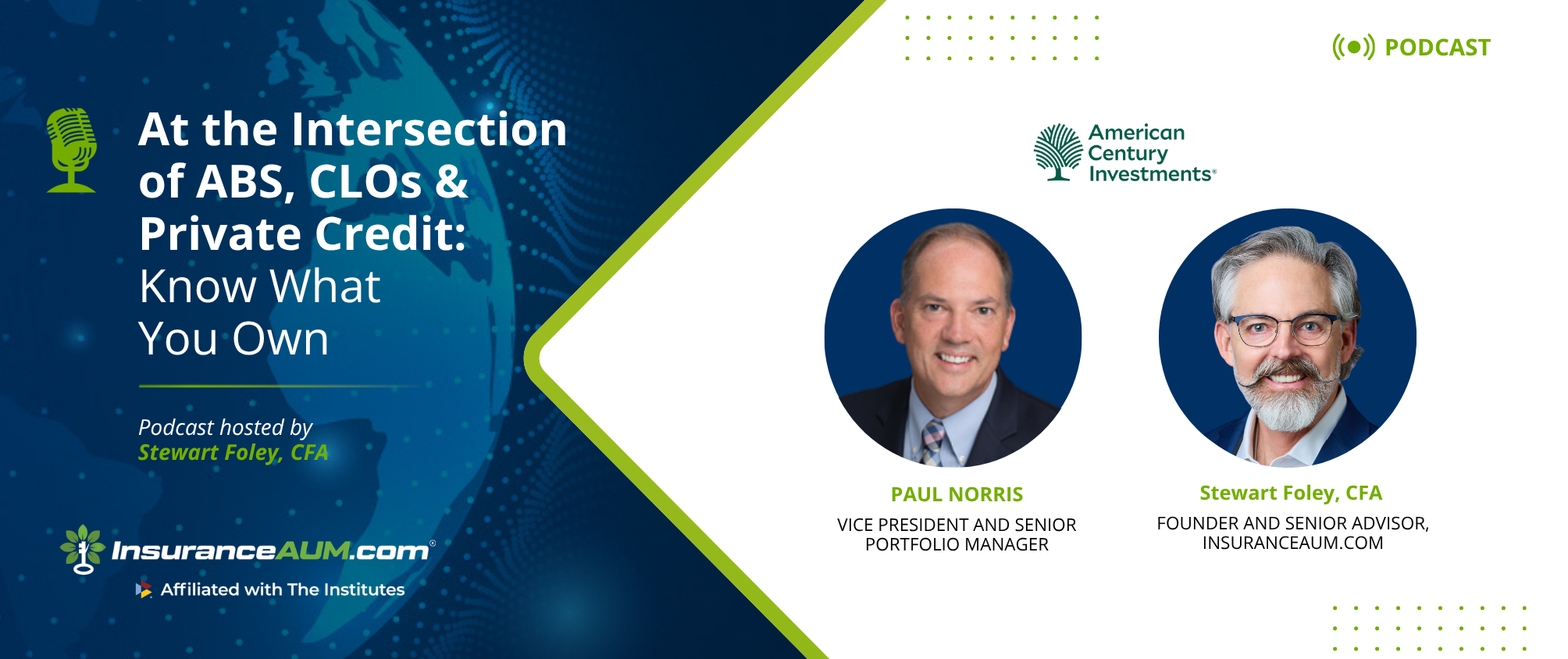
At the Intersection of ABS, CLOs & Private Credit – Know What You Own

Image
5.28.26 American Century_Web

This strategy may not be suitable for all investors. Investment return and principal value will fluctuate, and it is possible to lose money by investing. There is no guarantee that the investment objectives will be met. The information is not intended as a personalized recommendation or fiduciary advice and should not be relied upon for investment, accounting, legal or tax advice.

The yield target is aspirational in nature and is not based on any criteria or assumptions. The target is not meant to reflect any projection or promise of performance. No guarantee or representation is being made that any account will or is likely to achieve the target shown.

The opinions expressed are those of American Century Investments and are no guarantee of the future performance of any American Century Investments portfolio. This material has been prepared for educational purposes only and is not intended as a personalized recommendation or fiduciary advice. It is not intended to provide, and should not be relied upon for, investment, accounting, legal or tax advice.

Investment return and principal value of security investments will fluctuate. The value at the time of redemption may be more or less than the original cost. Past performance is no guarantee of future results.

©2026 American Century Proprietary Holdings, Inc. All rights reserved.

FOR INSTITUTIONAL USE ONLY/NOT FOR PUBLIC USE


Stewart: Hey, welcome back to The Home of the World's Smartest Money. My name's Stewart Foley, CFA. I'm your host and we're thrilled to have you with us today. We've got a very interesting topic and a repeat guest and we're thrilled to have both. The lead here is, as private credit has grown, the line between asset classes have started to blur a little bit. ABS or ABF, if you want to call it that, CLOs private credit are often grouped together. As most of you listening to this podcast know headlines have been painting private assets with a broad brush. But the underlying structures, risks, and portfolio roles can be very different across these asset classes and understanding those differences and knowing what you actually own matters more than ever. And the title of the podcast is “At the Intersection of ABS, CLOs and Private Credit: Know What You Own.”

And I'm joined today by Paul Norris, Vice President and Senior Portfolio Manager at American Century Investments. Paul leads the firm's securitized markets team and serves as a senior portfolio manager across a wide range of fixed income strategies. He also sits on the Global Fixed Income Investment Committee. Prior to joining American Century, Paul held senior roles at Conning, Mariner Investment Group, Dwight Asset Management and Fannie Mae with over three decades of experience, although it does not show, Paul. Across structured products and securitized markets, we're thrilled to have you back. Welcome to the podcast.

Paul: Thanks, Stew. As I like to mention, I feel like I'm fully amortized right now, after you say 30 years in the business.

Stewart: I can relate.

Paul: I love it.

Stewart: I can relate. I became the CIO of Missouri Employers Mutual when I was 30 and it was amazing. You look at it, I'm going to be 62 in October, and it doesn't seem possible. But I will say, I think you'll be with me on this. For about 25 of those years, it was pretty sleepy. And all of a sudden everybody's like, "Oh wow, the insurance market." So you and I have both been at this for ...

Paul: Not sleepy anymore, Stewart.

Stewart: No, no. And it's like the song says: I was country when country wasn't cool. I was insurance for 25 years when insurance wasn't cool at all. So you've been on the podcast before. I want to skip the usual icebreaker and step into something just a little different, which is what is something about you that you'd like the industry to know that you think they might be surprised to know?

Paul: Wow.

Stewart: The questions get harder the more you're on.

Paul: Yeah, I would say I'm a nerd at heart and I think if I could spend my days doing crossword puzzles and Sudoku and solving those types of things, I think that's what I like to do. And I think most people might find that surprising after they've met me and think that I am an extrovert when I'm actually very shy and an introvert.

Stewart: Very interesting. That's good stuff. Good insights. All right, let's talk first of all about private credit growth and what it changed. So private credit has grown to roughly three trillion. How has that scale changed the asset class both in terms of opportunity and risk?

Paul: Well, I think first of all, hats off to private credit five, 10 years ago, home run investment. I think there was a lot of really smart people that got in early and made good returns. It's grown a lot and it's changed a lot. And I think back in the years when it was a hundred-billion-dollar type of industry, it was really focused on good quality companies. And I think from where we sit, what we've seen is the popularity has changed the opportunity set. And what I mean by that is private credit has grown from a niche strategy into this huge, colossal asset class, and that's really changed the types of yields that you can get. It's also changed the type of quality companies that are being originated. And I think from where we sit and a lot of ink has been spilled on this and it's debatable, but we're with those that say that underwriting is slipped and that there's not the same type of companies being underwritten. And so we just think that there's weaker protections, more credit and capital, chasing finite borrowers really leaves you with less yield and less protections.

Stewart: Yeah, it's a great point. I want to go back right here to this next question, which is what ABS actually is. So back when the earth was cooling and I was managing money live, ABS was very common autos, cards, lots of different things, very reliable structures, not massive spread, but very dependable, good diversifier, et cetera. I mean, this is a sincere question from me that I've done this a long time and I don't know the answer. What is the difference between ABS, ABF and traditional private credit?

Paul: Great question. I think if you had another expert on the call, they might describe something different than what I'm going to describe. So I think it's often in the eyes of the beholder. I think ABF, asset-based finance and asset-backed securities can be substantially similar in that I think what's happened is that ABF of the old days where they're doing financing on receivables has really been starting to compete with the old asset-backed securities that you knew where we've seen some very large players not able to get enough product so they start buying all the Harley-Davidson or Sallie Mae receivables that they can buy and calling that asset-based finance. That is in fact asset-backed securities as you and I would know it where it's credit cards, autos, consumer receivables. For my thinking, when I talk about what we'll call either non-traditional or esoteric ABS, which is where we focus, these are really on the more commercial side of the balance sheet.

So you're talking about aircraft, maybe some barges, some cell towers, fiber optic, those sorts of things. And so that's how I define them. I define asset-backed securities as commercial and then consumer. Asset-based finance I had always thought of in terms of receivables that move from a company's balance sheet to a large player and they're securitizing those or putting them into an asset-based finance vehicle. I think as you and I talked how the insurance industry has changed and how many of these larger PE firms have now bought insurers, I think the lines are blurring. And then when we come into private credit, I think those lines are also blurring too in that we've seen private credit sort of merge where it was once more of a banking sort of product to this very large asset class that is now almost including CLOs. I think what's interesting to me, Stewart, is if I look at some of the very large players and looking at their private credit offerings or even their ABF offerings, oftentimes they're including CLOs, which to me is interesting in that's just saying there's not enough product to go around and so they're having to fill it with other vehicles.

Stewart: So we had one of those large players on the podcast last week and they mentioned their origination of approximately 300 billion in 2025. And I asked if that was sustainable, and I don't want to speak for them, but generally they said, "We are not a drop in the bucket. We're a drop in the ocean versus global demand for private financing of projects and/or other ways to originate." In your mind, can capital continue to flow into private markets like this, or are we, as you pointed out, sort of indicating that we've got a degradation in spreads and protections?

Paul: Great question. I would say my honest answer is yes, it can continue to flow, but I think the opportunities have been already picked over and that what we're doing now or what they're doing now is originating less and less creditworthy borrowers. And so, the fact that many of these large players have to resort to taking down large chunks of Harley Davidson's production or large chunks of Sallie Mae's production to me simply means that there's not enough supply. And so as you continue to grow this bucket, you're talking about either huge concentration risk of data center and fiber, or you're talking really tiny companies that probably don't deserve to be financed anyway. But I think to go back to something that I think is really almost more important and that's why I'm really here today in that I think all three of these asset classes deserve a place in an insurer's portfolio.

However, I think we're well past what I would call good relative value in asset-based finance and good relative value in private credit. I think we've sort of a term from way back in the day, I think we've jumped the shark a bit here. And what I find interesting is that if we were to build a portfolio of investment grade, non-traditional ABS, our overall yield might be in the mid sevens after fees. And then if you were to compare that to an investment grade asset-based finance portfolio, generally they might get in the mid-eights, but the fees and the performance fees on top of that will get you right back to our number in the mid-sevens. And so why I think that is important to highlight is because we're talking about if you're in the asset-based finance, you're gated, you're evergreen, you have big exposure to SaaS-based loans, you're leveraged and you have a ramp period.

So if I'm measuring the two, I frankly want the one where I just have pure liquidity, can pull my money out whenever I want and I'm earning the same return after fees. That's where I think things have gone a little bit different in that five years ago, Stewart, I could never have told you that. I would've said we would've been losing by three, 400 basis points. And now today, when I look at the landscape, they're all the same. So why do you want to be gated and getting the same return? That's what I don't understand.

Stewart: Yeah, it's a very interesting point that you're making there. And I think part of the argument is that there's an illiquidity premium, but based on those numbers, it's very thin and is compressed due to the amount of fund flows. So you mentioned CLOs a moment ago. I want to talk a little bit about where CLOs fit. So if you would, and just to take a step back, can you just tell us what CLOs are and how do they fit into this mix and how should insurers think about them relative to ABS and private credit?

Paul: I think ABS, private credit, they all sort of overlap a little bit. ABS in its purest form, I think is what we talked about where these are loans backed by either equipment or personal loans. There's a tangible asset there, not that others don't have tangible assets, but it could be a home, could be an auto, you get the picture. CLOs are more backed by bank syndicated loans. There's also a middle market component where they call those private credit CLOs. And I think where the overlap is, is that what we're seeing is that you've heard the term SaaS where we're talking about software loans and the huge origination that took place in the early 2020s, where we saw a tremendous amount of private equity buy purchase loans backed by basically some sort of software firm or some sort of technology. And so, what I'm positing here is that for us, CLOs has some overlap with private credit in that some of these private credit loans are backed by SaaS and technology, the same can be said for CLOs.

And so maybe the percentages are different, maybe 20% of CLOs are backed by these software loans, maybe private credit's a little bit higher, but the game is substantially similar in that there's a significant proportion of these software loans in both private credit, BDCs, as well as CLOs.

Stewart: Very helpful. Thank you. Portfolio construction and complementing private credit. So a lot of insurers already have allocations to private credit ABF seems to be the flavor of the day, but it can complement those exposures and provide some diversification. How should insurers be thinking about ABS relative to private credit?

Paul: I think the way I think about it and putting on my insurance hat is basically, can I get the same amount of income without sacrificing anything? And I think today the answer is yes, you can basically use asset-backed securities without sacrificing your current income in other asset classes like private credit or like asset-based finance. And I think the complement here is that you're not going to be in a locked-up vehicle, which I mentioned before. You'll have really highly liquid and highly transparent vehicles and asset classes. And so I think what you're going to get is transparency for the same yield. And I think today when I talk to many of my insurance friends, I think what they worry about is the lack of transparency and the opaqueness of some of the things that they might have on their balance sheet. So I think what we offer is the same yield, the same income, the same NAIC rating, which is very high, but the ability to sleep at night, the ability to have transparency and fully understand what you own. And I think a little advertisement here, Stewart, is that we built tools that give our insurance clients quite literally full transparency into what they own through us. And so I think they can sleep well at night knowing what they own.

Stewart: Yeah, I think it's interesting that, and I have no any sort of inside information on this, but I don't think it takes a tremendous amount of insight to say that the transparency requirements coming from the regulator are likely to increase too. I mean, I think that the regulator, not only are the carriers concerned about what's in there, the regulators, the regulators, I think, want to be sure that the insurers know what they own. So I think you're probably coming at something that's you're talking about something I think that's a very important point. And just to kind of go, let's just talk about this for a minute. So you and I both know that Harry Markowitz won the Nobel Prize in finance and economics for this concept of modern portfolio theory, which says that if I combine assets that are not perfectly correlated, I can get a better, or what's known in the terminology as more efficient portfolio, which means I can get either more return per unit of risk or the same return and less risk.

And so when you look at that, correlation is something that is often not talked about. So can you talk a little bit about the correlation of non-traditional ABS collateral relative to investment grade corporates and/or munis?

Paul: Yeah, I think that's an important point in terms of how asset-backed securities tend to, I don't want to say be in their own little world, but I will say for the every 5 to 10 basis point move in high yield spreads, as an example, we're not necessarily going to be correlated to those moves and it's going to be more about the underlying asset classes and how are they performing, how are the cashflows performing for some of these aircraft or cell towers, et cetera. So they're kind of, I don't want to say immune Stewart from those other markets because we're certainly not in that if high yield were to widen out a hundred basis points, of course we're going to react. But within the day-to-day and the movements of the S&P or movements of high yield or IG, we're much less correlated. And so, I think it really offers a diversifying way to approach your portfolio.

And I will say, in fact, when we have brought on new clients, one of the things we're talking about is how do we provide to you an income stream that is different from the one that's largely on your balance sheet that has a higher rating point, typically single A or minus, and doesn't have as much duration sensitivity. Not that you as an insurer might care about that, but we're able to be something that's different without correlation to your existing asset class and your existing portfolio. So, I think a lot of insurers really appreciate that.

Stewart: So we lamented the fact that we've both been at this for a minute and one of the things that I think you'd agree with me is that sometimes insurance carriers have a perhaps, and I'm guilty of this too, a dated view of an asset class or a misperception of an asset class. Perhaps based on past experience, you know these insurers have long organizational memories for investment mistakes that they've made. Yep. Yeah. I mean, you know as well as I do, you've seen people that two people lean back in their chair, and they look at each other like, "Remember when we did that back in 94?" And you go, "Yeah, okay, this conversation just ended." But so when insurance investors look at ABS, CLO and private credit together, is there some commonality about a misperception or a misunderstanding of those asset classes, either how they assess risk or how they understand what they actually own?

Paul: I think the thing that I run into when I go to board meetings is this, that when it has a three-letter acronym, that's not good. So CLO, ABS, even private credit, they might rhyme with CDO. And so when they hear when the board who might not be as in the weeds as we are, when the board hears those three letters, you typically become an apologist for the asset class, which isn't great. And so I think I spend a lot of my time explaining to folks that are on boards or investment committees that this is not the same. These are not subprime backed CDOs. These are asset-backed securities that in fact did very well during the great financial crisis and survived and came out on the other side looking pretty great. But as you know, sometimes that doesn't matter. Sometimes they just don't want to hear that, which I totally understand maybe they had such a bad experience that they don't want to move into something they view as new. And so we do our best to educate and to explain that ABS and CLOs and even private credit are not subprime CDOs or things like that.

Stewart: Yeah, I think it's interesting the board education, there's so much to know. I mean, when we did the CIIM designation, we went to 40 subject matter experts because none of us know all of it. Everybody's a specialist and everybody has their area of the forest. And so there is a lot to know and I can appreciate what you're saying about the nonstop educational process. But as we wrap up here, can you talk a little bit about how insurers should think about positioning these asset classes together within their existing portfolio just more of a holistic view?

Paul: Yeah, I think we talked a little bit about it before, but I think each one of these asset classes deserves a place in their portfolio. And I think at different periods and in different economic scenarios, these are going to perform very well. And I think we've seen that private credit over the last five to 10 years has been absolutely amazing. But I think now when we look at the returns and duration and gates that are inherent with private credit, there's competing asset classes, namely non-traditional ABS that I think offer better relative value. And so to me, that deserves a place to be considered in their portfolios at this present time. And so I think we're probably going to go on a pretty good run here in terms of different asset classes like asset-backed securities that are going to put up some pretty good numbers. And then over the next five years, something else will pop up and be a really good asset class for insurers to consider.

Stewart: That's awesome. What a great education today. I really appreciate it, Paul. I want to go to a couple of other questions that are a little bit different. You know one's coming, but I wanted to talk a little bit about, you've had a very successful career in this industry and I know you've built teams, successful teams over the years. And the question really is trying to get at the heart of culture at American Century. What are you looking for when you're hiring and adding new members to your team?

Paul: I think that one's kind of easy, Stewart. We're looking for people that are humble, looking for people that are hungry, but we're also looking for people that are really smart. And so the combination of those three we think are really powerful in building great teams that want to be collegial and want to do great things.

Stewart: And not easy to find, right?

Paul: Yeah, that makes it difficult. You can get two out of three, but a lot of times you can't get three out of three, so it takes a little while.

Stewart: Yeah. It's like the hockey team at Lake Forest College. It's like you have to be good at hockey and you have to be able to get in. Not all schools. Not all small schools have the two criteria. Finding one or the other is easy, but finding all of it, that's the challenge. All right, last one. Dinner for four. We're on the hook for the check. You can bring one, two or three guests. Who's coming to dinner with Paul Norris, alive or dead?

Paul: Oh my gosh. I think I've thought about this one before, but so I want to bring three different people from three different periods of history and this is a little crazy, but I really want to meet this guy, Pontius Pilate. I want to see what he's got to say and what he went through.

Stewart: Wow. Yeah.

Paul: I'd love to meet the Centurion from the Bible. So, two biblical figures. And then I'd really love to hear what Abraham Lincoln was going through when he was so despised and how he kept his sanity and drove through before those unfortunate things happened to him. And you, of course, Stewart, we'll pull up a chair. We need you there.

Stewart: Yeah, thank you so much. I appreciate that. It's a great answer. That would be quite a conversation, quite a conversation. I read a book about Lincoln and how he managed the really passionate and disparate interests of the people at that time. Really amazing. All right. So it's been great to have you on. We've been joined today by Paul Norris, Vice President and Senior Portfolio Manager at American Century Investments. Paul, thanks for taking the time. Really appreciate it. Very good podcast.

Paul: As always, great to talk with you, Stewart, and hope to see you soon.

Stewart: Thanks so much. If you like what we're doing, please rate us and review us on Apple Podcast, Spotify, or wherever you listen to your favorite shows. You can also listen to this one, but you can watch others on our YouTube channel at InsuranceAUM. It's InsuranceAUM Community on YouTube. I really appreciate you listening, really appreciate our audience. If you have ideas for a podcast, please shoot me a note at podcast@insuranceaum.com. My name's Stewart Foley. This is the home of the world's smartest money on the InsuranceAUM.com podcast.

Sign Up Now for Full Access to Articles and Podcasts!

Unlock full access to our vast content library by registering as an institutional investor

Register

Contacts


American Century Investments®

American Century Investments is a global asset manager dedicated to making a difference. For our insurance company clients, that means understanding your industry’s unique investment needs and challenges, including balancing liquidity with returns, along with managing complex accounting and tax-reporting requirements.

We can help you through our diverse range of fixed income, equity, and private investments. Our fixed income team’s mindset—dynamic approach to management, disciplined risk-taking, and deep relationships with clients—aligns particularly well with insurers’ needs. Insurers see that value, as 20* insurance-related clients entrust American Century with more than $3.7B* in assets under management. Overall, we manage more than $279B* in assets on behalf of individuals, intermediaries, and institutional investors.

*As of 6/30/2025

Kevin Eknaian
Head of North America Institutional
Kevin_Eknaian@americancentury.com
+1-646-658-7710


View the contributor page

Sign Up Now for Full Access to Articles and Podcasts!

Unlock full access to our vast content library by registering as an institutional investor .

Create an account

Already have an account ? Sign in

Ѐ Ё Ђ Ѓ Є Ѕ І Ї Ј Љ Њ Ћ Ќ Ѝ Ў Џ А Б В Г Д Е Ж З И Й К Л М Н О П Р С ΄ ΅ Ά · Έ Ή Ί Ό Ύ Ώ ΐ Α Β Γ Δ Ε Ζ Η Θ Ι Κ Λ Μ Ν Ξ Ο Π Ρ Ё Ђ Ѓ Є Ѕ І Ї Ј Љ Њ Ћ Ќ Ў Џ А Б В Г Д Е Ж З И Й К Л М Н О П Р С Т У Ф Х Ц Ч Ш Ā ā Ă ă Ą ą Ć ć Ĉ ĉ Ċ ċ Č č Ď ď Đ đ Ē ē Ĕ ĕ Ė fi fl œ æ ß