
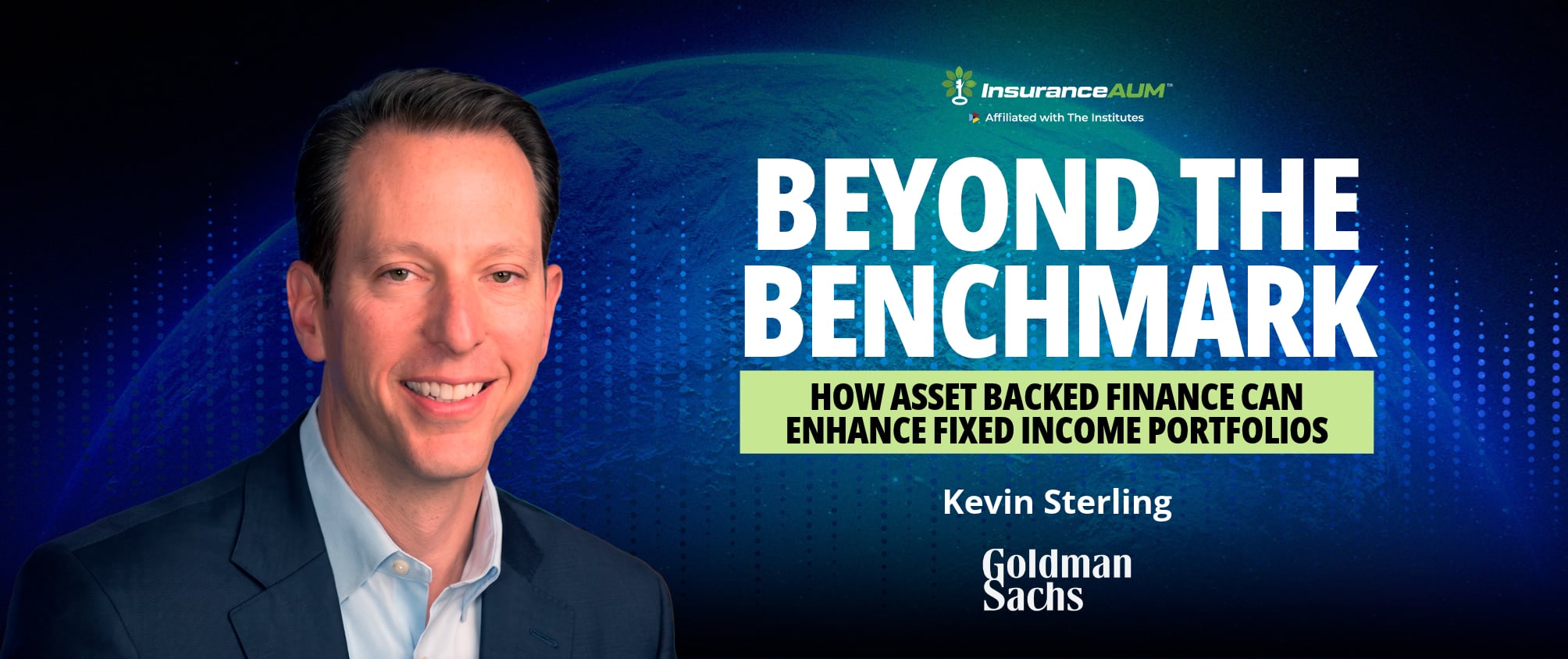
Beyond the Benchmark: How Asset Backed Finance Can Enhance Fixed Income Portfolios
Stewart: Welcome to another edition of the InsuranceAUM Podcast. My name's Stewart Foley. I'll be your host. Hey, welcome back. This is The Home of the World's Smartest Money, the InsuranceAUM Podcast. My name's Stu Foley. I'll be your host. I'm really glad you're with us. And I mean that sincerely. As my number of podcasts has gotten up there, my appreciation for the privilege of doing this podcast has as well. So very, very happy to have you on.
So what happens when a $20 trillion financing market historically dominated by banks begins to open up to institutional investors? That's the opportunity that we're going to talk about today and why asset-based finance is attracting so much attention from insurance investors. The title of today's podcast is Beyond the Benchmark: How Asset-Backed Finance Can Enhance Fixed Income Portfolios.
And I'm joined by Kevin Sterling, Global Head and Chief Investment Officer of Asset Finance and Investment Grade Corporate Credit at Goldman Sachs Asset Management. Kevin leads Goldman's asset finance and investment-grade private credit business, spanning corporates, infrastructure, and asset-based lending strategies. He has been with Goldman Sachs since 1998, which, as I used to refer to with my students, was back when the earth was still cooling, beginning as an analyst and ultimately becoming a partner in 2014. He has also led Americas Leveraged Finance, co-chaired the firm's Capital Committee, and served as the Global Co-Head of Private Credit. Kevin, welcome to the program. You're also a graduate, I forgot to mention you're a graduate of Wharton, which is a very prestigious school. Welcome.
Kevin: Stewart, thank you for having me. It's a great podcast, so I appreciate just being able to be part of it.
Stewart: Listen, we're very happy. So let me ask you, I got a couple icebreakers and I got a fun one for you because I did some research on Wharton. So where'd you grow up, and what fun fact would your colleagues or our audience be interested in knowing?
Kevin: So I actually grew up in the Philadelphia, Pennsylvania area. So going to Wharton, I'd say, was more of a coincidence than a designed geographic decision. So stayed local, but I think went for the education, not so much for the location. Fun fact, there's so many things to choose from, but just in the spirit of non-business-related, I have been inside a volcano's lava chamber. So there's one place in the world that's accessible, as I understand it, which is, we went to Iceland. It was a great family trip, cool experience. You hike out, you get lowered in, you get to see an amazing viewpoint from inside a volcano. So there's my fun fact for you.
Stewart: That's a fun fact. All right, so here's my Wharton trivia. So Joseph Wharton did not just create the first collegiate business school in 1881. He had an industrial empire. Do you know what it was?
Kevin: Oh, I probably should, but not at the tips of my fingers.
Stewart: He refined nickel, and he was the supplier to the U.S. Mint for the original five-cent nickel coin. There you go. You heard it here first.
Kevin: You learn something. I can be a guest, but also be educated.
Stewart: There you go. Hey, it's a two-way street over here. I'm going to get some education right now. So Goldman Sachs has a long history in private credit. You've personally seen that business evolve from leveraged finance into a much broader set of investment capabilities. Give us an overview of Goldman Sachs Asset Management's private credit platform today and what that breadth means for your clients.
Kevin: Yeah, look, I appreciate it. Goldman Sachs Asset Management has a rich history of investing in private credit markets that spans over 30 years. And so we think that's important for clients. One, this is not a new activity for us. So we've been here, we've been doing it for a long time, and experience matters. And so when you've been in the markets for as long as we have and had longevity, we think it gives us differentiated insight across market cycles, rate environments, exogenous shocks. And so you can really begin to synthesize data points, information, structural changes, and be able to steward capital, we think, in the best possible way.
The platform overall is about $200 billion of AUM, and it offers our clients and partners an ability to really invest across the private credit landscape. That includes asset-backed finance, or ABF. It includes investment-grade corporate exposure and infrastructure, as well as non-investment-grade corporate. And so the full risk spectrum when you think about credit portfolio construction. And we think it's an interesting time in the markets. Scale is helpful, but it really is about creating differentiated investing opportunities for clients. And we think there's a lot going on in the market structurally, secularly, interesting developments, especially in the asset-backed arena.
Stewart: Yeah, it's interesting because, and we've talked about it on this podcast, but the biggest change is really the evolving role of banks, and there's good reasons for that. I have said, and dataless, by the way, Kevin, I have said that the insurance industry has been a significant source of economic growth given how much they're financing today, which was done largely by banks prior. So Goldman describes a market where institutions that historically originated and held these assets are increasingly acting as intermediaries. Can you talk a little bit about the changing structure of the ABF market, and why is that creating so much interest right now from insurance investors?
Kevin: I think you articulate that pretty well as a framework, but let me try to delve into it a little bit more. So when we think about asset-backed finance, just from a defining-it perspective, that's lending against collateral that's either a pool of financial or hard assets. And so what we're trying to finance is effectively discrete collateral with discrete cash flows associated with it. And we think that's important because there's some granularity, there's some diversification effect with it.
But as you highlight, asset finance is really not new. It has been around 20-plus years, but the difference is it has historically been a bank-originated product and a bank-consumed product. And what we think is happening in the market right now, there's two bigger, I'd say, changes evolving in the market. One is around the market structure and the bank's role in that in terms of how assets are consumed. And then there's an asset allocator approach to how they think about portfolio construction. And those two trends and dynamics are really at play.
And so I characterize that there's a push effect and a pull effect. On the push, banks are moving more and more to intermediary models, so they want to originate different investing opportunities and really sort of syndicate that out or intermediate that out to the market. And so what that's resulted in is asset allocators or investors now getting access to a pool of investments that have historically not been as available as they are now. So investable supply is going up.
Also, I would highlight asset-backed finance is, you really are financing the real economy. So there is secular growth that occurs. So this is not private equity or direct lending where you're generally tied more toward private equity or M&A activity, but this is really around the economy. You are financing granular elements, either consumer loans or small businesses or diversified real estate or fund finance, things that are sort of ancillary to GDP growth. And so we think there's a secular trend that's associated with it. So supply is up, investable supply is up, and that's creating an opportunity.
At the same time, and I think this is a big theme that's beginning to play out, but it's still in the earlier innings, is really around portfolio construction evolving. And it started, as you highlight, with insurance companies. It's expanding to pensions, sovereigns, et cetera. And it's not really just a U.S. dynamic. This dynamic of portfolio reevaluation and the role that private asset finance can have in it is global. It starts in the U.S., but you can already see that it's extending beyond the borders, and there's different elements for different parts of the world. So Europe has Solvency II to adjust to, but nonetheless, the thematic is the same.
And I think the real key experience is asset allocators thinking about how to evaluate fixed income portfolio construction as a whole, instead of, "I have public investing and I have private investing." And I think that is a big theme that's beginning to play out because if you think about it, one of the key trends historically, or one of the key aspects historically, has really meant if you wanted to do private market investing, it generally led to very long, illiquid, locked-up capital for 10-plus years. And that made sense then to go into alternative products with the highest yields, whether it be private equity, whether it be direct lending, real estate, et cetera. You're going to keep extrapolating.
And so today we believe that really private asset finance is a complement to public fixed income because it's offering a path to greater diversification, ALM matching, there's some structural protections, the income and premium associated. But all of that is wrapped up in an area where you're not illiquid and locked up for 10 years. And I think that distinction of being able to access private markets and all the elements that are associated with it in a positive way, but do so in a product that can create liquidity and better alignment to the front of the curve, is actually quite interesting. I think those are the two big structural themes playing out in the market.
Stewart: Yeah, it's interesting. I mean, you make some great points there. I mean, one person's opinion is, like, if you look at an insurance company, even a P&C insurance company, they've got way too much liquidity. They do. And they've got belt-and-suspenders liquidity facilities and so on and so forth. And I know why, because people on boards of directors feel that comfort in having all that liquidity. But that liquidity has a cost, and there seems to be a lot of demand for high-grade ways to take illiquidity on without going down the capital stack, which is kind of bringing it back to our insurance audience.
The insurance CIOs that listen to our podcast, they have to allocate in the context of the overall general account, so the income, the capital, duration, liquidity, and the underlying liabilities, which is where it all begins in this business. So where does investment-grade asset-based finance fit alongside public fixed income? Can you give us a practical example of how an insurer might use it?
Kevin: Yeah, look, and I think this is the most topical part of what's going on in the market right now, and I'll touch on liquidity because it's a great philosophical discussion around portfolio construction. But if you step back, just to maybe set the stage for a moment, when you think about investment-grade fixed income portfolios, for the most part, they comprise corporates, mortgages, and govies. Now, I appreciate I'm generalizing, but that's a pretty big predominance of how the book is.
Stewart: Yeah, that's not far off.
Kevin: Now, imagine if you're a CIO and you have front-end exposure, call it five years, and that today trades roughly at 50 basis points in spread. Now imagine you can create a complementary front-end exposure that trades and you can invest at 250 over in spread. One, that premium of 200 basis points is meaningfully significant to portfolio construction. And if you just think about it on a relative multiplier effect, it's quite impactful. And so I paint that scenario for a minute because I don't think that's a theoretical exercise. We believe that that's actually something that's quite actionable.
And so now, further, think about your liquidity needs. And right to what your original opening statement was, there's always going to need to be liquidity in portfolios. There's no way around it. There's a role for that, and I would not suggest otherwise. Liquidity is expensive.
Stewart: Yes, it is.
Kevin: You pay a lot in tight spreads, and I would argue that in times of real need of liquidity, there is some real frictional cost on exit to get it. So you kind of pay on the way in and you pay on the way out. And so what asset finance is offering is an ability to match the front end, in particular, of an investment portfolio, but invest in something that I would argue has characteristics of providing, I'll say, natural liquidity. Meaning these assets are meant and designed to be cash-paying coupons. They're meant to have contractual amortization, and so they will naturally cash flow by just holding the investment. And you're not locked up and illiquid for 10 years.
And so this ability to marry, I'll call it the front end of the curve, with something that has similar ALM matching characteristics has materially enhanced potential for coupon and cash flow, spread and yield mechanics, but done so in a way that you can actually get cash flowing back to you in a very predictable way. And then you, as the CIO or asset allocator, can then choose how you want to reinvest. And so you can be dynamic in your portfolio construction. You can continue to roll it over, you can reinvest it in other asset classes if you think there's value. But this enhancement of being able to do something in the private market at elevated and increased premiums, but not materially change the characteristics of your ALM, your portfolio construction, we think is actually quite interesting from a CIO's perspective.
Stewart: Well, and I mean, the other thing too, Kevin, is that 200 basis points, you've got to remember what the basis is. If you look at that in percentage terms of the basis, it's arguably more significant because it's not like it's 200 basis points 30 years out the curve. It's 200 basis points way in the curve, and it has much less other ancillary fixed income risks.
So, interesting conversation about digital infrastructure at this point. So it's a huge financing theme in the market, but financing a data center, fiber network, or a power project can involve a bunch of different assets and contracts and counterparties. How do you distinguish the attractive financing opportunities in this digital gold rush, for lack of a better term, and the risks that an investor needs to understand?
The follow-on thought that goes along with this is that we were on a call not that long ago with a group of CIOs who were trying to get their arms around, what is the full extent of my AI exposure across the portfolio? Which is related to this. How do you separate, with all the capital flows and all of the activity, how do you separate the wheat from the chaff, if you will?
Kevin: Digital, you can't have a conversation around portfolio construction today without thinking about digital. You can't escape the headlines. The capital needs that are required by investment-grade companies and use cases is really, like, we think a generational element of CapEx that needs to be spent, needs to be financed, needs to be invested in. It's probably one of the top items that we talk to clients around portfolio construction.
But when you think about digital, it's a big umbrella statement. And so the reason I say that is we think about it in different pieces, and different ones have different characteristics and different exposures. So, for example, fiber and financing and finding the investments around fiber is different than cell towers, which is different than data centers and AI and GPU financings. So they're all, I would argue, under the digital umbrella, but have very different elements of risk and positive and negative considerations to be made around them.
So we think about it as bifurcating out those different streams. Now, the big topic that everyone can't get away from is really AI and data centers. And so when we even think about this segment, when we talk to clients, even within data centers and AI and GPU, we further segment down. At the heart of what we're trying to do when we segment down into smaller lanes to assess is really around what risk are we really trying to invest in? What considerations do we need to have? And each one's different. So just to put some tangibility around it, if you think about data centers, is it new construction? Is it stabilized? Is it a single tenant or is it multi-tenant? Is it AI-centric or is it cloud? What's the quality of the offtake? And so all of those different elements have different considerations, and they should have different investment profiles associated with them.
Just as another example, and we do think there's some really compelling value in this space, but to your point, you have to think about your exposure holistically. And then how do you want to express that point of view? Do you want to do it in top-of-the-capital-structure credit? Do you want to be down in the capital structure credit? Do you want to be in data centers or GPUs? Do you want to be in the equity? And so there's different ways to express it. But just as an example, in data centers and GPUs, there's construction risk, there's operator performance, there's power availability, there's GPU timeline funding, there's offtake termination rights.
And I highlight that only because I think digital is very easy to just commoditize. Part of it, one of the risks that we focus a lot on, and one reason why we think it's imperative to stay disciplined around this, is that I think from the outside, all of that can look pretty similar. And the risk is that pricing and structure get commoditized, but the underlying risk is not. And so we segment out a little bit for that reason, so we can begin to really underwrite and look for risk-adjusted, compelling returns across the various opportunities, recognizing that we don't think commoditization and pricing commoditization is one that's going to be reflective of all the risks.
Stewart: So I've got a dumb question, and if you go, "Hey, that's the dumb question," we can move on. But you mentioned the quality of the offtake, and then you mentioned offtake again. I don't know what offtake is, and forgive me for that, but I just don't know what it means. And so I suspect others don't either.
Kevin: There's a vernacular I think a lot of people use, and I'm certainly guilty of it. But when we think about it, it's ultimately the lessor of the space. Well, there's the lessor of the space, meaning owning the data centers, then there's the lessee who's actually consuming the compute power. So you have two parts to the equation. The offtake, when we think about it, is who is consuming, who's contractually entering into the use of the compute space. And so that could be the hyperscalers. It could be a single tenant, meaning one person. It could be multi-tenant and having the ability to tap into compute power in one physical data center, but multiple corporates or clients that tap into that. So the offtake is really just who is going to actually lease the space and use the compute.
Stewart: And the quality of the offtake is like, is it Meta or is it Stu, right?
Kevin: Exactly.
Stewart: Got it. Okay. Thank you.
Kevin: I mean, I believe in you, Stewart. I believe in your quality, but—
Stewart: Trust me.
Kevin: You have a little different profile than the hyperscalers.
Stewart: Hello, that's true. So let's talk about, from the allocator's perspective, we can finish there. So a lot of folks talk about asset-based finance, and everybody's got a story about origination and whatever else. Just from my own perspective, one of the things I think people don't often talk about is the portfolio management side of it, like the monitoring of it, the early detection, early warning kind of systems. So when you're sitting across from a CIO evaluating an ABF strategy, what should that person be looking at? Because it's sort of like the tech AI buildout. It's easy to kind of get lost in the terms, and everybody's deck looks the same or similar. What should that person be looking for?
Kevin: I mean, everyone has their own lens that they evaluate managers with or investment opportunities. I would highlight, as a manager, and I talk to a lot of clients and CIOs, I think of it in three main areas.
One is really around scale and origination. And so scale's important as an asset manager because you want to be able to offer customized solutions to borrowers. You want to be able to create interesting solutions for the borrower that fits what you're trying to do as a lender. And we believe the sourcing and the origination is really at the heart of how to create compelling risk-reward. So I like to use the example when I talk to clients, in particular CIOs, if you had $100 million to invest and you only had $300 million of opportunities to choose from, then that's your data set. But now imagine if you had $3 billion or $30 billion of opportunities to choose from. Your ability to have an enhanced view of the landscape of investment opportunities, structure, risk-reward to choose from is just materially better.
And if I bring this back to the beginning a little bit, ABF is not new. This has been around a long time. It's been a bank-originated product. I actually get the benefit of being attached to a bank. So as a firm, Goldman Sachs covers 13,000 corporate clients. We cover 300 sponsors. And so we're in the boardroom, we're trusted advisors. We think we have immense sourcing capability, which allows us as an asset manager and as a fiduciary to actually have a huge amount of wide-funnel opportunity to choose from. So if I were a CIO, I think the ability to generate a large quantum of investment opportunity is important so you can be the most selective and disciplined in your actual investing. So that's one point.
The second point I talk a lot about with clients is around what I would characterize as the difference between investing versus deploying. And I delineate that because at the heart of it, deploying money is easy. Just say yes. Yes to price, yes to terms, yes to structure. Investing, well, actually means maintaining discipline, and I would say having the courage to say no. So really being an investor comes with experience. It's your investment philosophy. It's the comfort you have around your sourcing capacity. So you want to stay disciplined and stay true to what you're trying to achieve for your clients. Whether that's portfolio construction, diversification, spread, ratings, ALM matching, you want to make sure you stay disciplined in that lane and in that view for them.
And then the third thing I generally like to highlight is really about pricing risk and not ratings. And what I mean by that is there's lots of different ways to invest in asset classes. It could be investment grade, it could be non-investment grade. And at the heart of it is, we do know the world and insurance companies, ratings do matter from an efficiency of balance sheet and portfolio construction and regulatory capital, et cetera. But at the heart of it, in our minds, it starts with pricing risk. Then we can get it rated if clients would like to get a rating for their benefit from an agency or so. But we think pricing risk is first and foremost, and then we can get it rated.
And I highlight that because, just to give you an example, if you think about the public securitization markets and you think about mezz tranches in CLOs, and there's nothing wrong with those, I'm not advocating against them. I'm just saying they might attach or detach at 65% or 75%, and it might be triple-B. We might lend to a borrower to enhance their financing, and we might lend through the same 75%, but we attach at zero, and that still might be triple-B-rated. But the risk profile of attaching at zero to 75% is fundamentally better than attaching at 65% to 75%. And so while the ratings might be the same, the risk profile is not. And that's a good example I like to give, is that you want to price risk and not the rating to really understand what you want to portfolio construct and how to get the best value for what you're trying to invest in.
Stewart: Wow, what a great conversation. I've learned a lot about asset-based finance today. I really appreciate that, and I appreciate you being on. I've got a fun one for you on the way out the door. I don't even know half of the time where these come from, but I'll share it with you. So the question goes, describe your best real or fantasy dinner. There it is. How about that?
Kevin: There's a lot to work with there, but—
Stewart: Yeah, sure. We want flexibility, Kevin. We want flexibility.
Kevin: No, I appreciate that. I'll give you, best real dinner is probably the night after I got engaged to my wife. We were young, and that was 25-plus years ago. Fantasy dinner maybe would be... I'm a big soccer fan.
Stewart: Oh, there you go.
Kevin: My kids grew up playing some soccer. So I think someone who would be interesting to have dinner with is Pep Guardiola. So I don't know if you know Pep Guardiola, but he's probably considered one of the most successful managers of soccer in the world. He coached Barcelona, Bayern Munich, Manchester City. And so he revolutionized the game.
But I think what's interesting with him, he's been so successful as a coach for so long, 15-plus years, lots of accolades. But more importantly, he was able to work with a lot of people over many years to improve them, to get more out of them, work as a team. And I think there's a lot of life lessons in both sports and for business around trying how to work with people in different environments over long periods of time and get good performance and social dynamics there. So I think that'd be pretty interesting. And honestly, I think it'd be just kind of fun to sit around and have a discussion at the table and talk sports with him.
Stewart: There you go.
Kevin: There's my fun dinner guest.
Stewart: Absolutely. Thanks so much. My guest today has been Kevin Sterling, Global Head and Chief Investment Officer of Asset Finance and Investment Grade Private Credit at Goldman Sachs Asset Management. Kevin, thanks for taking the time today.
Kevin: Stewart, really thanks for having me on.
Stewart: It's been a pleasure. So thanks for joining us. Please rate us, like us, and review us on Apple Podcasts, Spotify, or wherever you're listening to your favorite shows. You can also watch us on our YouTube channel at InsuranceAUM Community. My name's Stewart Foley. I'll see you next time on the InsuranceAUM Podcast.
The InsuranceAUM podcast is available on




Share this post


Sign Up Now for Full Access to Articles and Podcasts!
Unlock full access to our vast content library by registering as an institutional investor
Sign Up Now for Full Access to Articles and Podcasts!
Unlock full access to our vast content library by registering as an institutional investor .
Create an accountAlready have an account ? Sign in