
Building Resilience Through Liquidity Optimization
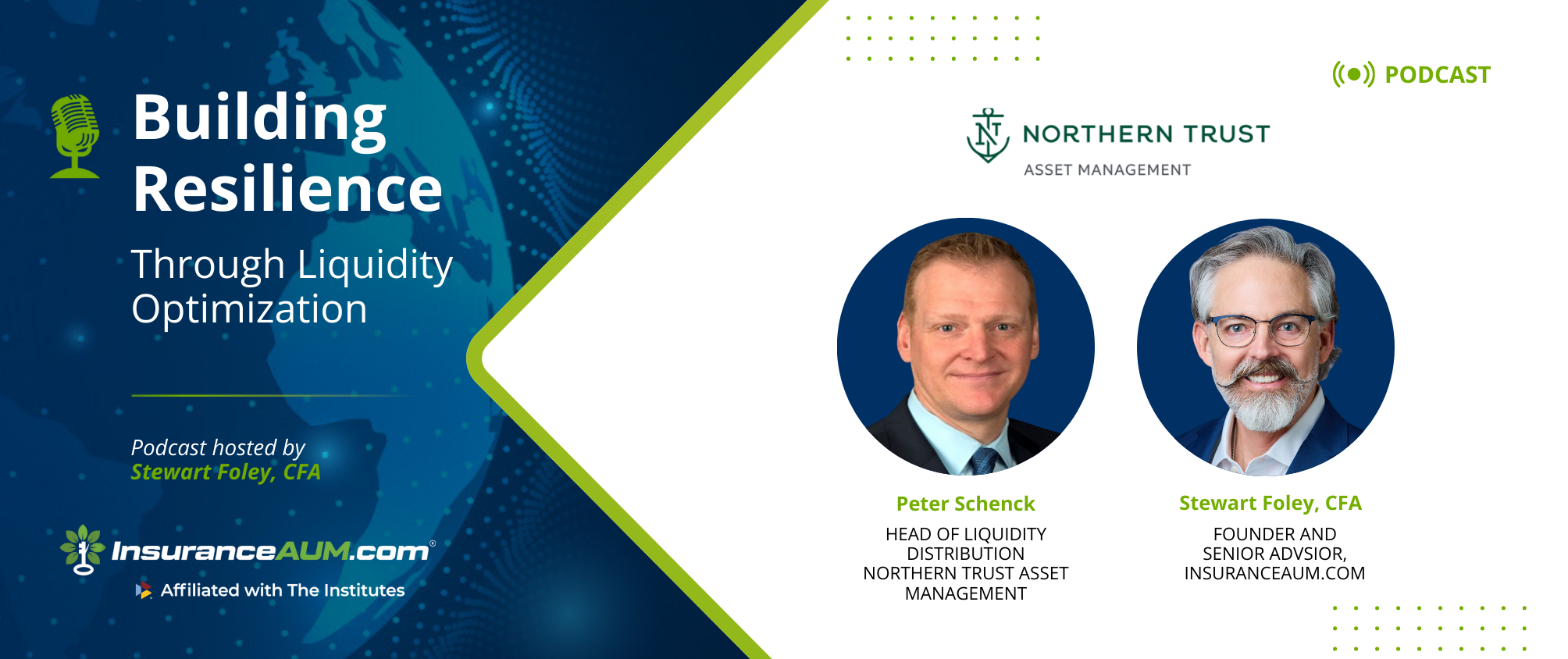
Stewart: Hey, welcome back to the home of the world's smartest money. I'm Stewart Foley. I'm your host. I'm the Founder and Senior Advisor of InsuranceAUM.com these days, and also the Principal Architect of the upcoming CIIM designation, the Chartered Insurance Investment Manager designation. Look for that in this first quarter. For the first time, there's ever been a textbook or some reference materials on how to manage insurance assets being brought to you by The Institutes. We are proudly affiliated with The Institutes and just some housekeeping there. But today's topic is a good one and one that we have not had on any of our 350 podcasts. There hasn't been much on this. And today we're talking about Liquidity, which is an area of investing for insurance companies that doesn't get a lot of spotlight sometimes, but absolutely should.
Liquidity isn't just about cash sitting idle. It's about resilience, flexibility, capital efficiency, and readiness, and readiness stands for being able to pay claims, especially in an environment where uncertainty, volatility and regulatory scrutiny remains elevated. Today our subject matter expert is Peter Schenck, Head of Liquidity Distribution at Northern Trust Asset Management. Peter leads global liquidity distribution across a broad institutional client base, including insurers, and brings deep expertise from prior roles at BlackRock's Cash Management Group, Citibank, and First Chicago. Peter, welcome to the show, man. We're very happy to have you. Thanks for taking the time.
Peter: Stewart, thank you very much. Looking forward to it.
Stewart: We haven't lost one yet, so we're in good shape here. I want to start it off the way we always do. Where did you grow up? What was your high school mascot? And what job would you most like to have if you weren't doing this?
Peter: So I grew up in Garden City, New York, which is a suburb on Long Island. My high school mascot was the Gales, the St. Mary's Gales. And third question, what would I be doing if I wasn't doing this? I would say probably a high school teacher and basketball coach.
Stewart: Wow, there you go. I taught for seven years as a college prof. There you go. And one person's opinion, teaching high school is about 400 times harder. It's just so much harder. And you know what? But it's so important because that's a pivotal time for a lot of students. So, let's start at a high level. If you would, and I think Northern Trust Asset Management is not a lot of folks know how big it is at $1.3 trillion, which is the last number I had. You can probably tell me a better number. Largest asset manager in Chicago. But talk a little bit about how your team engages with insurance companies around liquidity solutions and really a little bit about your background and how you got into this seat. And because man, cash is, that is a specialty within a specialty. And there's so much to know, and I've never really been steeped in the tea there, so I'm looking forward to this.
Peter: Yeah. So I would say first, you mentioned Northern Trust. So just briefly about Northern Trust, and I'm not going to do a big sales pitch on Northern Trust, but three primary businesses are our wealth business, then our asset servicing business, which includes global custody and banking, and then asset management, which is the one I'm in. Within asset servicing and asset management, we engage a number of institutional investors, including close to about over 200 insurance companies. From the asset management side and the liquidity side, you mentioned right now we're at what 1.4 trillion total in assets under management. About $350 billion of that is in cash and short-duration strategy. So about 20 to 25%, which is a big piece of the pie. You asked how I got into this business. I wish I could say I had a grand plan.
Stewart: I don't think any of us did, Peter. Heck, I didn't.
Peter: Yeah, but I just kind of followed the money. So when I started my career, I started my career in asset-based lending, then I moved to asset-backed lending. And then when I was on the asset-backed team at First Chicago and Bank One, we were putting together the asset-backed programs, Falcon and Prevco, which are the CP programs. And I used to work with the trading desk down on the floor. And I used to go down there and visit a couple of buddies down there and love the environment down there. So kind of transferred internally, got onto a trading desk and got onto a cash trading desk. So I was actually trying to sell short-term securities into asset managers, insurance companies, pension funds, things like that. So kind of got a taste for it and then just fell into when Bank One was acquired or when Jamie Dimon moved us from Bank One into JPMorgan, I was looking to do something different and moved over to BlackRock and kind of fell into their cash role there.
And now 10 years later at BlackRock, moved over to Northern Trust to run the team here. So it's been a great role, but as I said, I don't think there's a grand plan. I think things just happen and you just kind of have to keep your head up and see where the opportunities take you.
Stewart: Yeah. You used the term CP and I want to make sure everybody knows. I believe that stands for commercial paper. Would you please confirm?
Peter: Correct. Okay. That is absolutely right.
Stewart: Yeah. All right, good deal. So a lot of people talking right now about dry powder sitting across the globe. And what I mean by dry powder is cash. What's been going on in the money fund space and what's driving this sustained growth in cash balances?
Peter: Yeah, it's a great question because we've had an interesting run over the past kind of eight to 10 years. I think it all starts kind of right around COVID. So when you think about the balances, global money fund balances pre- COVID were roughly, let's call it three and a half trillion dollars. As of end of year 2025, I think global money fund balances are now at somewhere between 10 and $11 trillion. So we've seen tremendous growth in the cash space and in particular in the money fund space. I really think the reasons for that growth are twofold. One is the short-term rate environment over the past couple of years, and then secondly is technology. With regards to the short-term rates, I think I'll go back to COVID again. At the beginning of COVID, if you remember, we had a liquidity crisis in the short-term credit markets, and this forced institutions, including insurance companies, to hold a lot more liquidity.
Companies were tapping credit lines to make sure that they had enough cash to do their operational business, a day-to-day business. They were holding more cash even through zero rates. Probably not the best investment strategy, but at the time it was you wanted your money safe and you wanted your money liquid so that you could pay your bills when you needed to. Through COVID and coming out of COVID, if you recall, the Fed started raising rates, rates got to a peak of about 5.5%. So I like to say cash became an asset class again. You were making money in cash, and so it started to be very attractive again to keep significant money in cash. From the technology side, it really is all about ease of use. We've seen tremendous growth in the technology infrastructure. What has happened over the last, let's call it 10 to 12 years, is you've seen treasury workstations and investment platforms be integrated into custody platforms and investment portals to make it easy for treasurers and cash managers to invest efficiently and move on with their day.
The last thing I would just say probably is just, and I think anybody who's in the treasury unit of an insurance company or a corporation, what they've seen is they're being asked to do more and more with less resources. So I think the efficiency is probably one of the things I hear most about. How do I do my cash investing quickly, safely, and then I can move on and do the hundred other projects I have to do in the next day, week.
Stewart: Yeah. You mentioned money funds. They have been around a long time. How do you explain the enduring attractiveness of these vehicles for insurance companies and other institutional investors? What would be helpful, I think, is to start by defining money funds and then talk about the rest of it.
Peter: Yeah. So when you talk about a money fund, you're talking either if you're in the US, you're talking about a SEC registered 2A7 money fund. If you're talking globally, you're talking predominantly about UCITS money funds, which is their regulatory body. I would say within the money fund space, there's varying degrees. You start with treasury only, no repo, then you go to a treasury, then you go to a government fund, and then even into a prime money market fund. I think whether you're in any of those investments, any of those different funds, the core tenants are the same. You're talking about safety, you're talking about liquidity, and then a competitive yield being offered. So when I talk about safety, I mean preservation of capital. What we always talk about is it's return of capital rather than return on capital first. The second is liquidity. You mentioned it earlier.
It's when an insurance company has to pay claims, that money needs to be there. And I think that's one of the true benefits of a money fund. It's T-zero settlement. You can get your money same day and it's available to pay, whether it's a claim or your day-to-day operating expenses. And then lastly, again, as a competitive yield. Right now it's paying around, let's call it 3.5%. So you're still getting paid to keep cash in money funds.
Stewart: And my curiosity is really ... And the way I remember the cash market being like, those guys were done early in the day. And I think a lot of times, and I don't know, man, I've been in this business a long time, and sometimes my recollection of an asset class is no longer valid. People think about whatever is that there's a historical bias that may no longer be the case. So when we talk about money funds, can you tell us with the big crayons, what are the major asset classes or types of investments that will be found in a well-run money fund? Just give us a little color on what's in there.
Peter: Yeah. So our flagship, we have two flagship, truly two flagship money funds. Our first is our treasury portfolio, and that is made up of US Treasury securities and then repo backed by those treasury securities. We can go out, the SEC mandates our investment policy, and so we need to have no longer than a 60-day weighted average maturity, and our weighted life can only go out to roughly one year. So our portfolio managers are really working within a tight universe of securities and then try to read the tea leaves on where the Fed is going to position the portfolio in the right duration. When you talk about our government portfolio, you're talking about US Treasury securities, you're talking about US government agency securities, and then on top of that, you're talking about the repo backed by those two types of securities. So same. And when you're talking about a risk profile, you're still talking about very safe, very liquid securities underneath that.
I think the nice thing is when you're in a money fund, you're getting the benefit of a pooled liquidity. So each investor is a shareholder in the underlying fund. And in our funds, we have roughly somewhere between, let's call it 500 and 1,000 clients. So everybody's got a slice of the fund and our portfolio managers are keeping a large slug of that cash in overnight securities for things. Again, in the insurance world, if there is an unexpected claim that an insurance client needs, that money's there and it's paid back. It's dollar in dollar out. So you're getting a $1 NAV on that fund.
Stewart: Super helpful. Earlier you mentioned that Northern Trust works with about 200 insurers worldwide. My experience with my friends on the buy side of the insurance industry is they're trying to optimize every aspect of the portfolio. And that optimization is on a risk-adjusted basis on a return on regulatory capital basis and so forth. And insurance companies are like Snowflakes, you've seen one, you've seen one, right?
Peter: Yeah.
Stewart: They're all, even on paper, if they look exactly the same, there's nuances that can make those companies invest very differently. Having said that, how are insurers thinking about optimizing their cash positions today?
Peter: Yeah, it's a great question. It really depends on the sophistication of the insurance company and their investment team. What we're seeing and where we really play a role with the insurance companies is helping them segment their cash. So what I mean by segment or segmentation is really there's really two main buckets. You have your operating cash and then you have your strategic cash. Money funds and cash or like bank deposits really fall into that operating cash bucket. And that's where we can really help an insurance company short-term getting them invested in overnight vehicles to have that money safe and liquid. Where the next step out really is when the client has that strategic cash bucket. And at some insurance companies, they have a sophisticated investment team and they throw anything that is not needed in overnight. They throw over the fence, the fixed income team, and they sometimes can invest that themselves.
In other cases, we're helping the insurance company kind of build let's call it short duration to longer duration portfolios. We do that through ultra short duration funds. We do that through separately managed accounts where we're helping them craft an insurance policy that will help them give the liquidity they need, but also the optimization of return.
Stewart: Yeah, that's awesome. And it makes a lot of sense. So I think it was Yogi Berra that said prediction is difficult, especially when it involves the future. So having said that, Peter, I want to ask you an unfair question to dust off the crystal ball over there at Northern Trust and tell us, as you look ahead, where do you see the liquidity and cash management space going in 2026? Any predictions around innovation or evolution? You mentioned technology earlier that may impact how insurers approach liquidity.
Peter: Yeah, I feel like we're living an interesting time, Stewart. In late 2025, we started hearing the word digitalization and tokenization, and I feel like 2026 is going to be the year of digitalization within the money fund space. What do I mean by that? So we're looking at in the money fund space, we're looking at tokenizing money funds. So that's either building a private network and tokenizing a share class or putting money funds on public blockchain so they're traded. You might ask what the purpose of that is, and it really comes down to movement of money. I truly believe we're living in a 24/7 global economy right now, and clients need to move money around the world and they want to do it in an efficient manner. And I think when you look at the core of what a money fund is, you have to remember, money funds are close to 50 years old and they're reliant on the Fed being open to trade in and out of.
The tokenization gives the ability to move a token around the network and around the globe a lot easier. It's early days, but I think you're going to see more and more of it this year. The other thing we're seeing in the short-term cash space is stablecoin and stablecoin reserve funds. And again, much for the same reasons. Clients are looking to pay vendors, global vendors around the world, and this is a very efficient way to do it. So I think you're going to see banks, you're going to see insurance companies, anybody that has to pledge margin and post-margin. There are a lot of opportunities to use stablecoins and tokens or tokenization to do that.
Stewart: Super interesting. Let me close with a couple of takeaways for our audience, and then I've got a couple of more for you on the way out the door. I think based on your comments, I mean, I would say liquidity is no longer just a defensive allocation. It's a strategic tool that helps insurers manage volatility, meet obligations, and position themselves for opportunities. And optimizing cash requires intentional design, combining safety, liquidity, yield, and operational efficiency in a way that aligns each insurer's broader portfolio and risk framework. Peter, it's been a great conversation, a very timely one for our insurance audience, and I've got a couple of fun ones for you on the way out the door. The first one is really intended to get at the heart of culture at Northern Trust, and it goes like this. What characteristics do you find most important when you're adding members to your team?
Peter: I would say one is teamwork. I think at Northern the culture is all about teamwork. So I look for someone that wants to be part of a team. The second thing I look for when I'm hiring is someone that's fearless. I'm in a distribution role primarily, so I want someone that is able to go into a room and be able to meet a lot of people, shake a lot of hands, and develop relationships in that marketplace. So those would be the two I would say is really someone that wants to be a team player and someone that is fearless and not afraid to make relationships.
Stewart: So you know this one's coming, right? If dinner's on us, up to four guests, one, two, or three, don't have to have four. You and three others, who would you most like to have dinner with, alive or dead?
Peter: So I knew this question was coming because I've listened to a couple of your podcasts and I've heard kind of a wide array coming out of the holidays and being together with family. I think the person I'd really most want to have dinner with is my great-grandmother. And I'll give you the reason it'll be short. She lived with us when I was very little, but then passed away. She came to the US. She was an immigrant from Ireland and came over on a boat by herself when she was 15. And when she lived with us, I was too young to ask her all the interesting questions. And now I would love to just pick her brain on how she made it over. She ended up owning a grocery store in Manhattan, her and her husband. And so I'd love to find out how she made it through a boat journey across the ocean at 15 by herself and how she made it to be successful in the US.
Stewart: I can relate to that. I mean, I wear one ring and it was my great-grandfather's and it's his Mason ring. Somebody polished it along the way. It's kind of shiny. It probably shouldn't be, right? But I appreciate that same thing. He died in 1968, and I'd love to pick his brain. He was a very interesting guy, but I can really relate to that answer. So thanks for being on, Peter. I really appreciate it. Thanks for taking the time. It's been a great education, and thanks for being here.
Peter: Hey, thank you. This has been great. Appreciate it, sir.
Stewart: My pleasure. We've been joined by Peter Schenck, Head of Liquidity Distribution at Northern Trust Asset Management. Thanks for joining us. If you like what we're doing, and I'm sincere about this, if you like what we're doing, please rate us, like us, review us on Apple Podcasts, Spotify, or wherever you listen to your favorite shows. We're also on our YouTube channel, which is growing. It's a small but growing audience at InsuranceAUM Community for more great content. If you have ideas for podcasts, please shoot me a note at podcast@insuranceaum.com. My name's Stewart Foley. I've been your host. We'll see you next time on the InsuranceAUM.com podcast.
The InsuranceAUM.com podcast is available on




Sign Up Now for Full Access to Articles and Podcasts!
Unlock full access to our vast content library by registering as an institutional investor
Sign Up Now for Full Access to Articles and Podcasts!
Unlock full access to our vast content library by registering as an institutional investor .
Create an accountAlready have an account ? Sign in