

TCW -

Capital Efficiency as Alpha: The Rise of Return-on-Risk-Based Capital (RBC)

Abstract wooden architectural structure with repeating geometric beams.

Keith Luna, CFA

Eddie Wang, CFA, FRM


Key Takeaways:

01 | Investors constrained by capital face additional investment constraints.

Banks and insurers must weigh required regulatory capital alongside risk and return. As a result, their optimal investment may differ materially from that of pensions, endowments, or total return investors, even for the same security.

02 | A decision mechanism is necessary when facing multiple investment opportunities.

When several investments look fundamentally attractive, investors need a comparison framework. Return-on-Capital (ROC), measured as yield or spread relative to capital requirement, standardizes comparison and shows where scarce capital can be deployed most efficiently.

03 | Investment solutions is a requirement to meet differing investor needs and perspectives.

No investment is universally best; the right choice depends on investor’s objectives, regulatory framework, liabilities, taxes, and capital constraints. Portfolio construction requires combining fundamental credit analysis with deep understanding of investor specific considerations.

When faced with competing investment choices, what is one supposed to do? Is there always a BEST answer? Can particular rules guide the process? The discussion around how to pick particular securities has been around since the beginning of markets. We have created numerous theories about how markets work and what should outperform what. We have random walks, momentum, growth versus value, mean reversion, and any number of other philosophies. But at the end of the day, we are left with clients that need to invest assets to achieve a certain outcome.

Not All Investors Are Created Equal

Markets are made from different investors with different opinions, different objectives and different constraints. The collision of these three factors results in a wide assortment of investment portfolios. A high net-worth individual seeking to invest his assets for the next generation will build an entirely different portfolio than a public pension fund that exists to pay benefits to retiring employees. We can extend this comparison across various types of corporate entities (including both operating and retirement accounts), financial institutions, endowments, foundations, public sector entities, and several others.

Going back to Investments 101, we are taught that the most important factor in investment selection and portfolio management is risk and return. We consider the expected return for an investment over some horizon relative to the volatility of those potential returns. The combination of these factors allows an investor to determine whether the investment meets the objective with an acceptable level of risk that it does not. But what happens when risk and return are not the only factors that enter the decision calculus?

When we think about what makes capital-constrained investors unique, the first factor is that there is something beyond the return expectations that guides the investment thesis. Capital is a scarce resource that demands compensation. It is not unlimited. Investors such as banks and insurance companies operate in a world where they try to maximize the return they can earn for a given amount of capital, or they have a certain hurdle return and attempt to find the most efficient way to generate it. Yes, there are potentially additional considerations such as taxes, public and regulator perception, and jurisdictional optimization that can influence these decisions. However, for the sake of our discussion we will limit the constraint to capital.

There is no RIGHT answer when it comes to return-versus capital. There are organizational preferences across the allowable investment opportunities. Different capital regimes treat investments in different ways, depending on how the regulator chooses to assess risk for different types of organizations. For some, below investment grade bonds are allowed. For others, only investment grade opportunities are permitted. Some measure risk based on spread duration. Others look only at ratings. The combinations are as varied as the list of global regulatory institutions. Therefore, a common framework is necessary in order to construct portfolios that meet the needs of differing clients.

We believe that Return-on-Capital (ROC) is the best metric available for comparing across different investment opportunities. We typically compute two variations on this metric – yield divided by the applicable capital requirement, and spread divided by the same capital requirement. Both variations play an important role in the decision process depending on the other trading factors and objectives of the portfolio. By dividing by the capital requirement, all investments are placed on a level playing field. The question becomes, “How can I use my capital optimally in pursuit of my objectives?” The answer to this question is as unique as the number of investors in the marketplace.

Putting It Into Practice

Let’s say we have three competing investment opportunities. Each might be equally compelling for their own individual reasons. How do we determine which investment opportunity is most appropriate for a given investment mandate? The answer varies according to the nature of the investor.

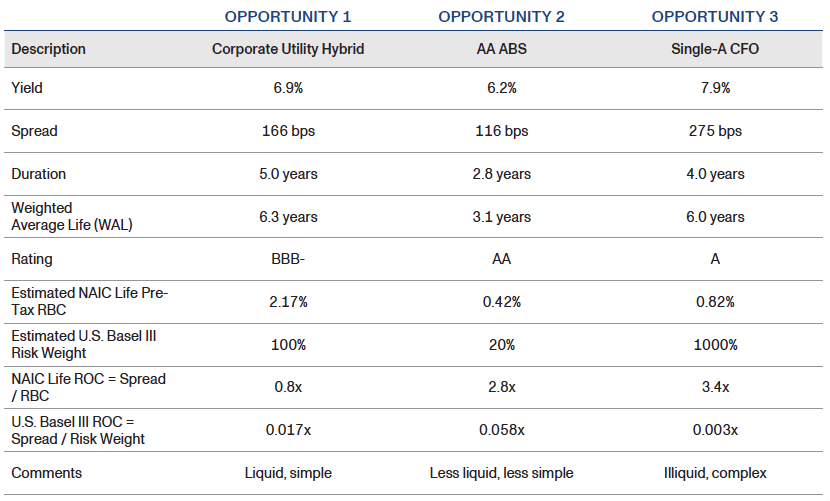
Let’s take a case example of three different investment choices – a corporate bond, an AA asset-backed security (ABS), and a collateralized fund obligation (CFO). Table 1 below highlights the characteristics of these three potential investments.

Depending on our investment objectives the choice among these three investments will be different.

Investor 1, who happens to be a pension plan, is going to lean toward an investment with the highest total return potential. As a pension plan, this investor does not need to worry about taxes, and is therefore free to trade the bond when the targeted return has been realized. He does not need to worry about a capital requirement because that is not a relevant metric.

Investor 2 is a U.S.-based bank. As a bank, he is regulated under Basel III by the Fed, the FDIC, and the Comptroller of the Currency. The Basel III capital regime has certain characteristics that steer banks into certain types of investments, and defines which securities are bank-eligible in the first place (see BOLI in a New Capital Regime).

Investor 3 is a U.S.-based life insurance company. He is regulated by the insurance department of his state of domicile, under rules created by the National Association of Insurance Commissioners (NAIC).

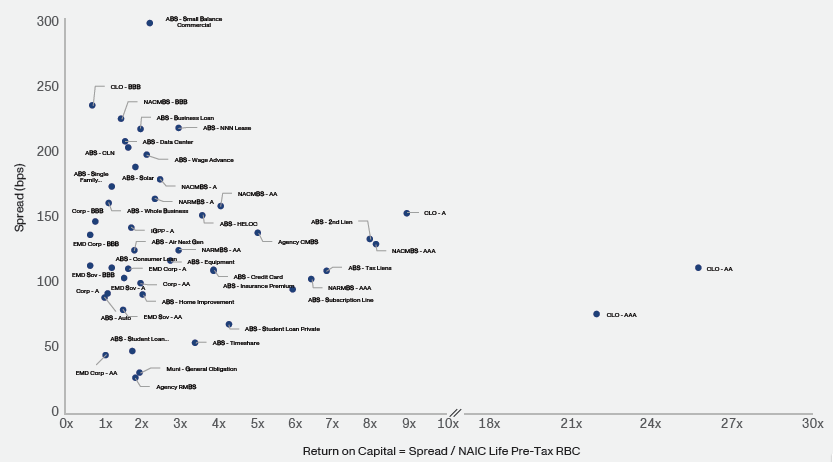
We have structured our investment solutions around fundamental credit analysis in combination with ROC. In the table below, we show the ROC for various asset classes under the life insurance capital framework specified by the NAIC as of September 30, 2026.

Table 1. Three Potential Investments

TCW table comparing three potential investments and their capital characteristics

Source: TCW

Figure 1. Return-on-Capital, Selected Sectors NAIC Life RBC Capital Efficiency: Spread vs. Return on Capital

TCW chart showing return-on-capital across selected sectors under NAIC life RBC capital requirements

Source: TCW

There are several things to note about the data in this chart. First, the yields and spreads on the y-axis are not static numbers. The implication is that relative value can and does change over an economic cycle. While other constraints may dictate ultimate trading decisions, the use of ROC as a feature to drive positive investment performance does not preclude active portfolio management.

Second, while ROC is not “alpha” in the traditional sense, the concept can be understood in terms of positive investment outcomes. Just like total return investors (and sometimes even capital-constrained investors) have an objective to outperform a particular benchmark, ROC investment return measures the return or spread generated relative to the capital utilized. Generating more return for the same amount of capital is considered a desirable result.

It is important to distinguish among different types of investments that may screen as particularly attractive according to ROC. There are several reasons an investment may stand out:

  • Liquidity/Complexity. One of the most common reasons for securities to present as attractive under the ROC framework is due to the liquidity or complexity of the structure. When we think about compensation provided by the market, it is common that less liquid private securities trade with a premium to liquid public securities (note the difference between public investment grade corporates and private investment grade corporates in the chart above).

    Additionally, product complexity can play a significant role in wider spreads for like-rated products. This can be easily observed as the reason investment grade securitized credit will trade with a premium to investment grade corporate debt, despite being secured by underlying assets. The time and resources needed to analyze the collateral, the legal structure of the transaction and the ongoing credit monitoring makes such investments more resource-intensive, which generates additional spread compensation.
  • Credit Risk. It is often the case that ratings agencies (credit ratings providers in U.S. insurance regulations) are behind when it comes to assessing credit risk. Securities usually experience spread widening and higher yields in advance of a ratings event. While in this time period, these securities will often appear very cheap/capital efficient based on our screening metric. This is where fundamental credit analysis comes into play. It is important to apply fundamental analysis to determine if a particular investment or asset class is truly cheap or simply trading cheap in anticipation of a downgrade/credit problem. We will adjust capital requirements to reflect anticipated changes in credit for proper comparison purposes.
  • Limited Investor Base. In some instances, certain products are truly designed for a limited segment of the market. One prime example of this is the collateralized loan obligation (CLO) junior tranches that have been created strictly to take advantage of certain regulatory limitations imposed by the NAIC. We used to have junior BBB tranches. With the revised rules on CLO capital requirements, those tranches have been eliminated and we now have junior A tranches. Investment bankers are keenly aware of the regulations and will focus on product design to attract certain types of capital. Because of the narrow niche of these products, they will often trade with a spread premium (which may partly reflect the reduced liquidity profile due to the smaller investor base).
It’s All About Solutions

In evaluating the choices in our hypothetical example above, it becomes immediately clear that there is no one right answer. There are different answers for different problems. One bond may be what we call a “bendable” credit that tends to trade in a wide spread range over the course of an economic cycle – midstream energy for example. This type of security was attractive to our pension fund at the right time and price. Our bank investor was focused on minimizing capital usage for the BOLI portfolio and therefore was attracted to the AA ABS, where yield and spread created an attractive opportunity versus a 20% capital requirement. Lastly, our insurance company was looking to reach a particular yield hurdle for a hold-to-maturity investment that is matched against policies written. He selected the CFO due to the high yield generated against a capital system that focuses on rating. We model out each regulatory regime in order to understand the rules of the framework and evaluate the implications of those rules. Our process focuses on finding “sweet spots” in the regulations where certain investments receive favorable treatment relative to the marketcompensated risk. We model out each regime ourselves so that we not only understand it at a very granular level, but we can also interpret it and find those places to optimize return-on-capital. This also puts us in a position to support clients from a reporting perspective to defend classifications to the regulators.

It would be easy to stick all of this data into an optimizer and generate a set of solutions for any return/capital combination. However, quantitative optimization models are only as good as the rules they are given. Without constraints, an optimizer will generate a completely inappropriate portfolio that concentrates in a single type of risk. This is inconsistent with our view on fundamental credit analysis and risk diversification. We utilize quantitative optimization models, but at the end of the day our team-oriented portfolio management structure looks at all of the data and the options available and constructs a fundamentally sound portfolio the achieves the desired client outcome.

Capital efficiency is not a substitute for investment skill; rather, it is an additional lens for investment analysis. Just as traditional investors seek to maximize return relative to risk, capital-constrained investors seek to maximize return relative to the capital required to support that investment. ROC provides a common framework for identifying opportunities, but it is only one component of the decision-making process. The most successful outcomes occur when regulatory expertise, fundamental credit research, risk diversification, and portfolio construction discipline are combined to create solutions tailored to the unique objectives of each investor. In a world where capital is increasingly scarce and valuable, the ability to identify and capture capital-efficient opportunities may be one of the most important sources of competitive advantage available to institutional investors. Capital efficiency can become a source of alpha, not because it changes the underlying economics of an investment, but because it enables investors to earn more return from every unit of scarce capital they deploy.


READ MORE FROM TCW


DISCLOSURE

1. For institutional investor use only. This material reflects TCW views as of July 2026 and is based on proposed rules that may change before adoption. Return-on-capital figures are index-level illustrations, not portfolio results, and are not a recommendation to buy or sell any security.

This material is for general information purposes only and does not constitute an offer to sell, or a solicitation of an offer to buy, any security. TCW, its officers, directors, employees or clients may have positions in securities or investments mentioned in this publication, which positions may change at any time, without notice. While the information and statistical data contained herein are based on sources believed to be reliable, we do not represent that it is accurate and should not be relied on as such or be the basis for an investment decision. The information contained herein may include preliminary information and/or “forward-looking statements.” Due to numerous factors, actual events may differ substantially from those presented. TCW assumes no duty to update any forward-looking statements or opinions in this document. Any opinions expressed herein are current only as of the time made and are subject to change without notice. Past performance is no guarantee of future results. All investing involves risk including the potential loss of principal. Market volatility may significantly impact the value of your investments. Recent tariff announcements may add to this volatility, creating additional economic uncertainty and potentially affecting the value of certain investments. Tariffs can impact various sectors differently, leading to changes in market dynamics and investment performance. © 2026 TCW

Share this post

Sign Up Now for Full Access to Articles and Podcasts!

Unlock full access to our vast content library by registering as an institutional investor

Register

Contacts


Image
TCW_Logo_Black


TCW has a dedicated insurance platform that is fully integrated with our dynamic investment management platform, which has served investors for over 50 years, enabling clients to evaluate opportunities through both an investment and insurance lens. The firm’s insurance portfolios incorporate a full range of solutions that can be customized as individual strategies or designed to function together within a diversified general account framework.  

Combining insurance-focused expertise, specialized infrastructure, and analytical capabilities, the platform helps insurers address portfolio construction, capital efficiency, regulatory considerations, statutory reporting, and balance sheet optimization as part of the investment process. By integrating these capabilities into a single client experience, TCW provides insurers with a more comprehensive approach to managing assets and liabilities. In a market where many managers offer insurance-compatible products, TCW distinguishes itself through the depth of its insurance-focused resources and its ability to support insurers holistically as regulatory, reporting, and capital requirements continue to evolve.

TCW is a global asset manager with $200 billion in assets under management as of June 30, 2026, offering innovative strategies across fixed income, equities, and alternatives to diverse insurance clients. 
 

TCW
515 South Flower Street
Los Angeles, CA 90071
insurancesolutions@tcw.com
 

View the contributor page

Sign Up Now for Full Access to Articles and Podcasts!

Unlock full access to our vast content library by registering as an institutional investor .

Create an account

Already have an account ? Sign in

Ѐ Ё Ђ Ѓ Є Ѕ І Ї Ј Љ Њ Ћ Ќ Ѝ Ў Џ А Б В Г Д Е Ж З И Й К Л М Н О П Р С ΄ ΅ Ά · Έ Ή Ί Ό Ύ Ώ ΐ Α Β Γ Δ Ε Ζ Η Θ Ι Κ Λ Μ Ν Ξ Ο Π Ρ Ё Ђ Ѓ Є Ѕ І Ї Ј Љ Њ Ћ Ќ Ў Џ А Б В Г Д Е Ж З И Й К Л М Н О П Р С Т У Ф Х Ц Ч Ш Ā ā Ă ă Ą ą Ć ć Ĉ ĉ Ċ ċ Č č Ď ď Đ đ Ē ē Ĕ ĕ Ė fi fl œ æ ß