
Celebrating Episode 400 with Stewart Foley, CFA: Building InsuranceAUM and What Comes Next
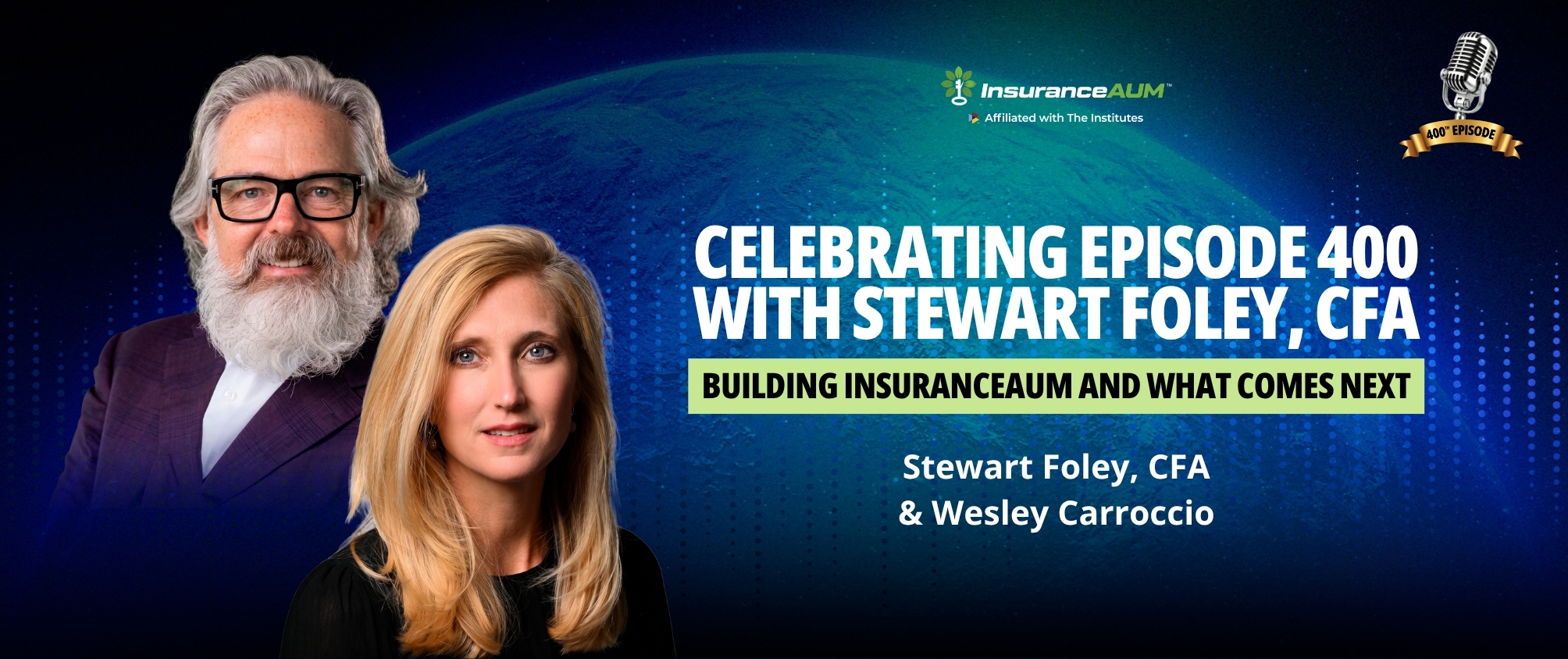
Stewart: Hey, welcome back. This is a special edition of the InsuranceAUM Podcast. And as most of you know, my name is Stu Foley and I'm the host.
And this one is going to be a little different. The title is essentially, where have we been and where are we going? So, from an overlooked market to a thriving community, what comes next?
And so when I actually founded InsuranceAUM in June of 2013, at that time, insurance investors were not a mainstream part of the market, were not well understood, and most institutional asset managers found that they had an easier time raising money outside of insurance.
I was too stupid to realize that because insurance is all I knew. I had been a CIO prior. I had been a senior portfolio manager in two different firms, and I had worked as a consultant for about a minute, and I didn't know anything else.
So everybody wants to do business with insurance companies today. And as I've said on this show before, it's 30% of the world's invested assets, approaching $40 trillion. It's approaching $10 trillion here in the U.S.
And so I think I'd like to think that we played a part in that. The other thing is that other forms of institutional capital ceased growing like the insurance industry is.
So 13 years later and more than 400 podcast conversations since March of 2020, I'm prepared to step away at the end of the year.
And the title is InsuranceAUM's Next Chapter: From an Overlooked Market to a Thriving Community — What Comes Next?
And I'm delighted to welcome our new Executive Director, Wesley Carroccio, who has a deep background in institutional asset management working in the E&F space.
She's had leadership roles at Brockenbrough, Verger Capital Management, TIFF Investment Management. She spent much of her career building relationships and helping institutional investment organizations succeed, which is a great fit for this role.
And so today we're going to turn the tables a little bit. Wesley's going to ask me some questions about InsuranceAUM and kind of co-host it with me, and I'm going to ask her stuff about the future.
But we wouldn't be anywhere without this question. We always start with the same two questions, Wesley. Where'd you grow up and what's a fun fact?
Wesley: Sure. Well, thank you. First of all, thank you so much, Stewart, for having me today.
And also, really, the warm welcome from you, the team, and the entire InsuranceAUM community, for those that I've gotten to meet already. It's been a pleasure, and I can't wait to meet the rest of the crowd.
Any friend of Stewart's and our team here at AUM is going to be a friend of mine. So looking forward to that moving forward.
And so I moved around a little bit growing up, spent most of my childhood in New England. I grew up in a small town on Cape Cod in Massachusetts.
And then when I was in high school, my family moved to northeastern Pennsylvania. So very different, going from the ocean to the coal mines, but a totally different experience.
And then ultimately went to college here in Philadelphia, where I am today.
I met my husband there. Neither of us thought we would ever live in Philadelphia, but all these years later, here we are.
So that's a little bit about the geography background. But a fun fact, as I was saying, how is that the question that's going to stump me?
But I've got four children. My husband and I have four children and two dogs. So as you can imagine, the logistics of keeping that train running on time really probably puts me in the not-fun category a lot.
I often wonder if they think I'm fun and if I'm doing a good job keeping everybody where they need to be on time.
So I asked my kids to share a fun fact about me, which was entertaining for me and probably them.
Turns out I can make a really incredible sandwich, guacamole top of the list, family dinners, and having everybody around the dinner table.
So anticipating and maybe previewing an answer to another question down the line, I think for me, the fun fact is that element of family and sharing a meal together around the kitchen table.
Stewart: It does follow that a sandwich made by someone else is automatically better than the one that you made yourself.
Wesley: That is true. I mean, I am shocked with that answer. I thought, of all the things, is that the one?
But that's always a highlight. So hopefully those kids will make a sandwich for me someday, and we'll see how it turns out.
Stewart: So in 400 podcasts, it's the first time I've ever handed the mic over to somebody else. And so this is good practice for me doing it permanently in a little bit here.
So go ahead. Let's hear the first one.
Wesley: I think really I would like to take the opportunity, as someone that's coming in new to the community, maybe that's a really good excuse to remind everyone that's been here since the beginning and even those that have come more recently, what's some of that history?
What are some of the most important things that inspired you?
You talked a lot as we opened about why you felt InsuranceAUM was a community that needed to be highlighted over the years, but take us back a little bit.
And what did you see in the insurance investment market that really made you believe that InsuranceAUM needed to exist, and what trends are still there and what have you seen change?
Stewart: So in 2010, I was working at New England Asset Management, NEAM, and running money, and happy days, everything's fine.
And I made the decision to essentially do something else. I was running core bonds, and I loved our clients. Wonderful group of people at NEAM. I mean, still to this day, a lot of those folks are still there and a wonderful group of people.
But I was like, I need to go do something else. And I didn't want to run core bonds anymore, and I didn't really know anything else.
And so I quit a perfectly good job, bought a motorcycle, bought a BMW, and rode Key West to Halifax alone and came back without really a good plan.
So I decided I was going to open up something called Insurance CIO, where I was going to be an outsourced CIO.
And I was just way massively early and completely underestimated what was required.
So I ended up combining efforts with an existing consulting firm, and that just didn't work out. I mean, it was a rough go.
So I went from a successful role and a successful job and whatever else to really not succeeding.
And then I moved to Chicago because my daughter was there, and I moved there on Saturday, December 1st of 2012.
And that was a Saturday. I spent the weekend wiring the place that I had subleased for my office equipment and everything else.
And I called the office at 9:00 a.m. on Monday, and I got fired at 2:00 p.m. on Monday.
So I was in Chicago working for them for a grand total of about six hours, and it was done.
And I literally packed up the stuff that I had just unpacked and put it in boxes and mailed it back to them.
And I was on gardening leave for a couple, pretty generous gardening leave, and I was trying to find a job and just couldn't find one.
And so one day I cold-emailed a college on the North Shore of Chicago because I had taught a little bit in Hartford, where NEAM is based in Farmington, Connecticut, but it's right outside of Hartford.
So I taught for a minute at the University of Hartford. So I had some professor reviews and whatever else, and I'm like, maybe this is God calling me in a different direction.
So I went and became, I applied and there's a little bit more of a story there, but at the end of the day, I got hired full-time to teach finance on faculty at a small liberal arts college.
And I was making drastically less than I had. And so I'm like, "What am I going to do?"
But it had benefits, which was really important to me. It had benefits, and I was like...
And so I started InsuranceAUM after some conversations with some guys at Eager Davis and Holmes in Louisville, and I started InsuranceAUM to help managers run insurance money on a consultative basis where you would be paid for service.
And that was marginally, it was not really successful. I mean, it was a little bit, but not enough to be sustainable.
And so I'm like, I've got this massive Rolodex of all these people that I know in this business in my phone.
And I'm like, nobody talks to these people. Nobody really speaks to them. And it's a massive pile of money.
People don't really know what they need. They don't know what the eccentricities are, all of the externalities that these guys deal with.
And I don't say guys as a gender, I'm from the Midwest, so we use it for everybody.
But at the end of the day, I had some friends in the business, and without those friends, this would've gone nowhere because I picked up the phone and I called some people and I was like, "Hey, listen, send me..."
And I had six firms send me an article that was branded for them, and I literally put a cover on it and glommed them all together and emailed them to everybody I knew.
And we eventually put together a website. We actually published a paper document for a while, and that we started publishing in the fourth quarter of '17, and we would have six articles on our website and they would change once a quarter.
Wesley: Oh, wow.
Stewart: Yeah. I mean, literally that was it.
And so I did it for free for about nine months. I was $60,000 deep in credit card debt. I was making not a lot of money, and I was wondering about the line between persistence and stupidity, and I didn't know which side of the line I was on.
And my wife at the time said, "I think you should keep going."
And honestly, she was making more money than I was. I had spent a bunch of money doing this, and I was working seven days a week, and I'm like, "Whatever."
And then in June of '18, that's based on my memory, but I think that's about right, in June of '18, Rich Kaufman at Wellington called me up and said, "I want to buy your best package and send me an invoice right away."
And in what seemed like five minutes, a check showed up for $15,000, which was the biggest package we had.
And that's what set it going forward. I'll never forget it.
I've told Rich that. I can't even tell you how many times I've told Rich that story.
And so from there it got into, we published, we kind of did it backward. Everybody wants to do events because that's more profitable. I didn't know that. I mean, I was so stupid and I didn't know that.
So we did media, and then we kind of got forced into podcasts.
I didn't think it would work. I really didn't.
And the person that was pushing me to do it essentially sponsored our podcast and said, "Go learn how to do it."
And believe me, I was horrible at first. I mean, we started in March of '20, and in June of '20, sorry, July, we had 136 downloads for the month, and the next month we had 90.
And I was like, "What am I doing?"
And so we kept going, and I was talking to Aaron Diefenthaler, who's at RLI, and Aaron and I worked together at AAM, and Aaron is as good, as solid of a guy as you're going to ever meet.
He's just a really solid human being.
And he goes, "Stu, they don't even ask us what we want on the event," meaning the event planners don't even ask us what we want on the agenda.
I said to several people, we were getting asked to do events, and I was like, "I do not want to do an event like everybody else does. I just don't."
I mean, it's like crawling with salespeople, and people don't want to come to that.
So I was like, "Okay."
So Aaron gave me the recipe to the secret sauce, and he goes, "Nobody even asks us what we want on the agenda."
And I was so shocked by that. And I go, "Listen, dude, I'll give you the agenda. You can have the whole thing."
And I said, "Let me deal with the sponsors."
And I explained to the sponsors what we were doing, and some of them didn't get the assignments that they wanted.
And I must have heard a thousand times, "Well, this isn't how other people do it."
And I'm like, "I know. And if I did it like everybody else did, I can't make any progress."
So the events are what turned the business profitable, and I've told this story to others.
In January '24, on the same day, I got a phone call. We had been at an offsite and it looked like we were going to run out of money in about nine months, and I didn't know quite what to do with that.
This was before we created the private assets event.
And that evening, my wife called and asked for a divorce.
Wesley: Oh my gosh.
Stewart: And I set off, I left Chicago like a man on fire and showed up in Texas. I'm not even sure how or why.
And in 2024, don't ask me how, we tripled our business.
And then we became more attractive to a potential buyer, and I was unable to fund the growth, to be candid. I just couldn't fund it.
Nobody wants to lend that small amount of money to an entrepreneurial organization. It's hard to get funding.
So I was funding it with credit cards and weird loans and stuff, just getting my face ripped off.
And so we had been talking with The Institutes quite a while about the need for insurance asset management education, and that kind of dovetailed into what I was really wanting to do, some education, which resulted in the CIIM designation, which I'm super proud of.
Wesley: So can I interrupt you and ask you a question about The Institutes?
What do you think the InsuranceAUM community outside of you and the team, what does The Institutes mean to them? Is that an organization they're familiar with?
How did you introduce the two organizations to one another, and maybe a little bit about why that's such a great partnership for the long term?
Stewart: Yeah. I mean, at the end of the day, I knew about The Institutes from teaching.
I used The Institutes' materials, their curriculum and their materials.
I think they have a partnership with over 50 risk schools, and they provide curriculum, a whole bunch of insurance and risk management courses all of every which way.
And so they are a great partner because they have about 75% or 80% of the P&C industry's premium on their board in the form of 45 CEOs.
They are the purveyor of the CPCU designation, among many others, and they educate on everything related to insurance with the exception of the investment side.
And we only do the investment side. So it was a really good fit.
The other thing is I didn't want to sell the firm to somebody who just wanted the contact list and who just wanted to sell the contact list something.
And The Institutes is an educational nonprofit. They too are Switzerland.
I never took a cent from anybody based off of an allocation or any of that. I didn't want to pollute what we were doing.
And I think The Institutes is the same.
And the other thing that The Institutes, I mean, people don't know, but it's like they own 20 other digital media properties.
So they have resources in this area that InsuranceAUM could never afford. Functionality, they've done a lot in AI that we could never do.
There were just no resources to do some of the things that they do routinely.
And they have a much bigger balance sheet, and they've been around for a hundred years, and Pete Miller's been the CEO for over 20 years.
And it's a very stable organization.
And my interest was to maintain the continuity of the community going forward, and that it wasn't sold as just some guy like me that really probably wasn't long-term sustainable.
So they were a great partner, and I thought a great fit.
Now, our community didn't know them at all, and that's what surprised me.
They're like, "Who are The Institutes?"
I'm like, "How do you not know who these people are? You've been in this business for years."
And all these people have a CPCU. I mean, they're the P&C equivalent of the CFA.
And so there's a learning curve. Still, there's a learning curve.
I think culturally it's different. The insurance industry and the investment business kind of run at different speeds, and there's some of that.
But at the end of the day, I still believe strongly that The Institutes is a great partner for InsuranceAUM for those reasons.
Wesley: That's great. That's really helpful.
It's always good to see the vision and how you think about the fit and how it can help propel things forward. So it's helpful.
Stewart: Well, and I mean, for me, it was difficult at some point to differentiate between me as a person and me as InsuranceAUM.
And it was really unhealthy for me because the success or failure of InsuranceAUM was a tremendous amount of my self-worth.
Wesley: Of course, the curse and the exhilaration of an entrepreneur.
Stewart: Right, right.
And I've got, our logo is tattooed on my left wrist.
And it's like the old saying, it's like bacon and eggs, right? The chicken's involved, the pig is committed.
And I was majorly committed to this group and this community.
And by the way, I can't tell you how many people who took my call that didn't have to, that bent over backward trying to help me when I needed help and they knew it and they were in a position to do it and they did it.
And I owe a lot of favors to a lot of people. I really do.
And I think anybody who's successful could say the same, but in my case, I mean, when we did this CIIM designation, there were people who did that, spent an hour, prepped for it, you name it, and there was no compensation for them other than the desire to pay it forward to future generations.
And that's super important to me.
And you know what I would say about this community is that it is the finest group of people professionally. The ethics are very high, very high.
The level of analysis, the sophistication of being able to run a hundred-yard dash competitively with a myriad of externalities that other institutional investors don't face, which is why I coined the phrase Home of the World's Smartest Money.
Because it's not that these guys have a better crystal ball than everybody else, but other people don't have to deal with capital charges and lines of business and loss experience and a whole host of other things in addition to managing capital markets, which is super difficult to begin with.
So I really love this community. It's meant a lot to me.
I've been at it for a long time. I started as the CIO at Missouri Employers Mutual when I was 30, and I just turned 62.
So I've been at it for a while, as you can tell by looking at me.
Wesley: Well, talk to us a little bit about maybe something that you learned along the way that you didn't anticipate, maybe you didn't get right, and how that's continued to sort of shape the evolution of where we are today and what you've set us up for going forward.
Stewart: I've learned a lot.
I've learned a lot about, I have a lot of ideas and some of them are not commercially viable.
And after making some really big mistakes, I learned to try to see if there is a revenue source or a revenue stream or not.
And things that people say, "We need that," or whatever, "We need that," and "We're willing to pay for that" are two very different things.
And so for me, I would welcome a more robust feedback loop from the LP community, the insurance side, as to what could we do to be more helpful?
Can we conduct research for you? I mean, we can conduct research agnostically, right? You don't have to give up your name, but just tell us what you want us to do.
I don't know if that has any value or not.
I've learned that what I think has value and what the market thinks has value can be very different.
Wesley: Sure.
Stewart: And in all sincerity, I'll get on my soapbox for a minute and I'm going to make some people mad, but it's the way it is.
It's like all these award shows, all these award things, these people give out these awards.
"We're the best manager of this. We're the best manager of that."
I'd love to have them publish the criteria by which that decision is made because I think there's a best manager for any given insurance company, but I don't think there's a best manager across the insurance industry.
And I just think that I've never believed in award shows for that reason.
The managers on our platform, every one of them is very capable of what they do, but not every one of them is a fit for a given carrier.
And so figuring that out, what's best for me and what's best for you is different.
And so it's been a burr in my saddle since I saw the first one, and I'm like, "What's this based off of?"
And we get all our finery on and get out and whatever and pat each other on the back.
But it's like, I'm a big racing fan. You know how I know who won? The guy that came across the finish line first. It's pretty clear.
So that's where I'm at.
But so what else can I tell you?
The evolution of this platform has been amazing. And I think I get way too much credit.
We have a really remarkable team. I mean, Lindsay Michaels was with me when nobody wanted to be with me, right?
Wesley: Yeah.
Stewart: She's still there. Yes.
We've got Jennifer that schedules all the podcasts and creates all these dossiers and all this stuff.
We've got an audio engineer named Mazed that does an amazing job, video and audio, and who edits every one of these podcasts.
And I'm unusual because I do all the production here locally, so I do it by myself basically.
You know why? Because when I started, that was the only choice I had, was to do it myself.
But the team does an awful lot with a very small number of people. They all do an awful lot.
Wesley: That's remarkable.
Stewart: Yeah. And the reason is I just didn't have the money to do anything. I just couldn't make it all work.
But they're the ones who really deserve the credit for whatever platform success we've had because you have to have people who...
I mean, I've learned this. There's a book called Rocket Fuel, and it's about visionaries and implementers, and the term they use is "vision without execution is hallucination."
And so there have been some very good...
Lindy O'Brien joined us when, I mean, she brought a tremendous amount of professionalism to the organization, really committed to team development and did a lot of good things for our team.
That's not my, I'm not good at that.
And kind of things that you've learned, I've learned what I'm not good at.
I'm still figuring out what I am good at, but I've learned what I'm not good at for sure.
Wesley: Well, that's the fun of it.
And having a team around you really can make it so much more enjoyable to have that success and to see it grow.
And I think as I'm just crossing over about a month here, so still really getting my feet wet and learning, and the welcome I've gotten and the sort of immediate confidence I've had.
And this is a group that doesn't drop a ball. They know what is happening behind the scenes at every moment.
And I think that's unbelievable, as you mentioned, for you and for anyone else on the team.
But I think that really translates to the community because if they can count on the foundation that you all have built and the platform that we have to be able to promote the idea generation and the thought leadership and spark the conversations and getting the right people in the right room for the right topics and the right conversations, that leaves the community time to really think and do the work that they're committed to and grow their businesses and develop relationships and spread the education and sort of continue that mentorship wheel.
So I think as we see the community expand and grow and at the same time all becoming tighter, it really does go back to that foundation that was created in the beginning and the vision with maybe a couple hallucinations of good ideas that took a while to get to, really, it's really how it all comes together.
So it's an impressive group and an even more impressive network.
Stewart: Well, I mean, the LP community, I know they've told me what they value most is talking to each other.
Wesley: Of course.
Stewart: Because if you think about it, a CIO is essentially sitting on an island, and they're in a company where there's not like there's eight senior executives that are equally well versed in the investment side that they can bounce stuff off of.
And they've got a team maybe, or it depends on the size, but it's somewhat lonely.
And it's like, who do you ask?
When you don't understand something, aside from your AI, who do you ask that you trust?
And for the most part, a lot of these guys are really friends, and they genuinely like each other, and they're able to share information, not competitive information, but like, "Hey, have you looked at this? What have you found?" Da, da, da, da, da.
I think it makes everybody better.
Wesley: Absolutely.
Stewart: You've got an industry that runs all this money, and there's not really broad agreement on best practices.
What's the right liquidity threshold for a given set of business lines? What's the liquidity floor?
We take private asset illiquidity risk, but I'm not sure that there's not really a uniform way of determining liquidity, a liquidity floor, and things like that.
I think there's room for innovation.
There's room for guiding principles to be put together by our executive council or something like that.
Where particularly one of my things, and I was on the phone with Bill Rotatore yesterday, who is my old boss at NEAM, and you'll never meet a better guy than that guy. I mean, a salt-of-the-earth guy.
And we were talking about a lot of their clients are on the smaller side, and a lot of those carriers, they don't have exposure, can't get exposure or efficient exposure to private assets.
And so there's a 90-basis-point gap between small and large.
And we talked about ways to try and work on that.
But at the end of the day, one of the reasons for the guiding principles and best practices, and you can take best practices for what it's worth, but if there was a way to transfer some of that knowledge to smaller carriers that might not have a full-time CIO or can't afford one, don't have a team, so on and so forth, I think it would be helpful.
Pete Miller uses this terminology for the industry, by the industry.
And the roadside is littered with situations where insurance companies have gotten together, like Underwriters Laboratory, testing the flammability of kids' pajamas and stuff like that.
And so I have a feeling that there's an opportunity to collaborate on some risk management best practices or whatever it may be.
And it's always my hope that by putting a bunch of really smart people together, you get a pretty good result.
Wesley: Yeah, for sure.
I mean, and that is what it all comes down to, is that community too.
And so taking on some of those themes and thinking ahead, if you and I were to sit down again in another 400 episodes or another 13 years, what would you really hope to see for this community, about this community?
What would surprise you and what would maybe make you feel really, really proud?
Stewart: Well, I mean, I think that the direction's right.
I think it's important, and I always try to do this, I think it's important to serve the insurance community.
And there's a lot of ways to do that.
But one of the ways that we do it is we manage the LP-to-GP ratio at our events to make sure that folks aren't overrun with too much business development coverage.
Not to say that we aren't all for business development because we are, but I do think that creating environments where you can have really meaningful information exchange and conversations about things that are head-scratchers to some of these folks.
And various people are experts in various things, so when you put them together, good things happen.
And my hope is, and I see no reason why it won't continue, my hope is that that continues.
And I hope that we can...
I mean, we are largely dealing with the right tail of the sophistication distribution, and the ability to get some of that brainpower to the folks who are on the smaller side, I think would benefit the folks on the smaller side that have fewer assets and get less attention, frankly.
But for me, and talking with you, you have spent a lot of your career working with institutional investors.
I know this wasn't your only opportunity. So what attracted you to do this?
And you just got hired a minute ago, so how did you make this decision?
Wesley: Well, for an overthinker and someone that's constantly trying to spin things around, this was a really easy and obvious fit.
And I feel very fortunate to have been talking to the right people at the right time and learn about InsuranceAUM in the way that I did.
As you mentioned, I've spent a long time working with endowments and foundations on the outsourced chief investment officer side of the world.
And there's a lot of parallels too.
When I started my journey, I didn't really know anything about investments, about foundations, about probably, if I'm honest, much of anything.
And so I had an opportunity to join TIFF, the Investment Fund for Foundations, which is now TIFF Investment Management.
And a lot of the same things that you were seeing in 2013 when you got started were happening at TIFF.
Nonprofit organizations didn't really know what an OCIO was, let alone how it worked. They didn't know what it stood for.
It was really going out and talking to that community.
It was smaller groups, so talking to them about benefits of scale, talking to them about how to have access to investment portfolios that mirrored some of the big endowments out there.
And what we were able to do at TIFF was really spend time on that community and bringing those folks together.
And I fell in love with that.
I fell in love with the nonprofit community.
I found it to be challenging, but also a tremendous amount of really just good fun to be in the room with those folks when they were both educating one another and learning at the same time.
And so understanding that audience of the most and the least sophisticated person in the room and how that person could be leading an organization at either end of the spectrum.
And we created some really cool relationships.
As the industry changed and I watched it change, that landscape is different now.
It is more saturated. There's so much more understanding and competition for that connectivity and for that membership community.
And so I was looking to find that again.
And The Institutes is here based in my hometown. It's a great nonprofit organization, which I of course knew through that side of the world.
And as I was watching what they were doing and I saw the InsuranceAUM connection come about, I really didn't know too much about InsuranceAUM.
You and I weren't connected, although we have lots of folks in common, had never crossed paths.
So I was really curious, what is a relationship out there that has so many parallels that I haven't tripped over yet?
And as I became more familiar and asked more and more questions, seeing that community that you've built and put together really took me back to some of my best days, and I just got really excited about what we can do together moving forward.
I think now being able to be in a space where you can help with the innovation and the use of technology to take some of the burden off of the investment teams and the marketing teams that are trying to get out there and really develop relationships in a world where we're expecting constant communication and content and new ideas and new ways of thinking, it can be really challenging.
So I think for InsuranceAUM, there's a real opportunity to be a leader in the space of understanding what that innovation looks like and how to be a partner, sort of a behind-the-scenes partner that can see what's coming before it comes.
You and I have talked about this before, Stewart, but the Radar O'Reilly approach to some things so that really our community can get back to basics.
Let's get back to that human element where people are in the same room and talking to one another and helping one another.
I think, as you said, the entire investment community, you mentioned in the beginning just the incredible way folks are always there to lend a hand and to reach out when you need help, when you know someone else that might need help, oftentimes they know it before you do.
So continuing to cultivate those types of in-the-room relationships that are long-lasting and ultimately bring a lot of people good relationships, great success for firms, and to play a role in the background to help see that happen is really exciting for me.
Stewart: What surprised you when you walked in?
Wesley: But I think we've got a really far way to go to get back to basics in a way.
Stewart: Listen, I think the shoes look bigger from a distance than they are up close, I'll be honest with you.
Wesley: We'll see. We'll see.
Stewart: Was there anything that surprised you? What surprised you, and was there anything to the downside that surprised you?
Wesley: Let's see. What surprised me?
I'm not sure a surprise.
I think the folks that have been a part of the community for a really long time and that know this history that you're talking about, that know you really well, have been great in picking up the ball and extending that hand that we just talked about and really showing that they're a part of this community, that they have confidence in you and our team and The Institutes and really what we stand for.
So I think that's an exciting thing to find. You don't really know that until you get going.
So I'm not sure it's necessarily a surprise, but something I'm really, really excited about.
Ultimately, this whole thing comes back to that community.
And so I think there's a lot that we can do, a lot that we can support, but ultimately it's just about facilitating an opportunity for folks to be together and talk about what they love doing.
Stewart: Yeah. I mean, I've always said that the biggest asset we had never shows up on our balance sheet, which is the trust of this community to not sell out, to not dilute.
I mean, it's like I went out and bought PensionAUM and EndowmentAUM and FamilyOfficeAUM. I have all the AUM domains, all of them, everything you could think of, vacuum cleaner AUM.
And so I had visions at one point to expand this into other areas, but the thing that our clients and our LP community comes back to is the narrowness of our focus is the attraction.
Wesley: Absolutely.
Stewart: And so like a lot of things, I tossed that in the wastebasket and moved on.
But I would be remiss if I didn't take this opportunity to pitch our private assets event.
Wesley: You've got to get all your friends to show up.
Stewart: Yeah, that's right.
So if anybody listened to the end of this thing, which is way too long, at the end of the day, we do have a private assets event that's in Austin.
It'll be private credit, ABF. We're also very happy to have folks who are in other private asset classes as well.
It's at the Thompson Hotel, November 12th and 13th, at the Thompson Hotel in Austin.
And you can go to our website at InsuranceAUM.com, and you can look under our events tab and it's the first one that pops up, and you can register right there.
And it is my last InsuranceAUM event.
So if you want to come and just have some great conversations with some great folks, I want to invite you personally and tell you that I welcome you and hope that it's beautiful in Texas.
Austin's a great town, and the weather's going to be good and we'll have a nice time.
So I really want to say I have a lot of confidence in you.
Wesley: Well, thank you very much.
Stewart: You get the joke on what this is, and it's not easy to define.
There's a commitment from the LP community to make these events as good as they can be because it benefits everybody.
Wesley: Absolutely.
Stewart: It benefits that community.
I mean, we had over 80 CIOs in one place in June or July. It's incredible. It's got to be the largest gathering of CIOs in the world.
Wesley: It's really remarkable.
Stewart: Yeah. And I mean, everybody gets along. Everybody is willing to share.
I mean, TC brought it up on our promo video. People are willing to share. People are willing to...
And it was one of the concerns when we first started, like, "Well, what if other people don't share?"
And it's like everybody seems to want to share, and it's a good community.
But it's time for me.
I've been doing this a long time, and the podcast and whatever else, and I appreciate very much all the kind words, but it wouldn't hurt a thing to change the format and change the host and have someone from a different perspective.
Pete Miller, who's the CEO of The Institutes, is going to take over the podcast initially, at least.
And hopefully you'll have a chance to do some hosting as well. You do a great job.
Wesley: Oh, well, thank you. I would love that. I would love that.
Stewart: And so it's a blessing.
It has been a blessing, this business, this community, The Institutes, you and the team, Lindy, all of my friends on both sides of the ball, and there are a number of them that have really—
Wesley: Well, that's just it, right?
And they go back a really long way, and we're going to keep everybody rolling together forward.
And we're anticipating that although you're stepping away, you won't be too far, so we know where to find you.
But I am so excited to see, this will be my first InsuranceAUM event.
I have heard from so many members of the community already what a fantastic event that you all put on.
So cannot wait to be there, meet some more folks, and of course, thank you again in person for all that you've done for all of us.
Stewart: The difference is that it's you all putting it on. It's not me, but I appreciate it.
Wesley: I came in at the last minute, so me neither, but I can't wait to see it.
Stewart: I failed to mention Kate Himes or Kate Soldant, who's our head of events. I mean, she is such a rock star. People love her.
Wesley: She's fantastic.
Stewart: She is really special.
Wesley: Talk about wearing a lot of hats.
Stewart: And she's about to have her first child.
Wesley: I know.
Stewart: And she is, I mean, that is very special.
Wesley: Well, she's still fun because she hasn't had all those kids yet.
Stewart: That's right. Yeah.
Oh, listen, there was no bigger hypocrite than me.
I was like, "Oh, how can you keep your house like this?"
And five minutes after that kid came home, our house was a disaster.
But no, seriously, I really appreciate everybody. I mean, I really do.
I owe a lot of people a lot of thank-yous and wish everybody well, certainly wish you well.
And I know that you're going to be successful, and so I can't wait to see what happens.
Wesley: Well, we're excited too, but you usually end this. You usually end—
Stewart: Oh yeah, that's right.
Wesley: Okay.
Stewart: See what we do.
Wesley: With one way. And I'm not going to let you do it this time because I think that we've heard a lot.
I'd be happy to report back on maybe my favorite real or fantasy dinner in another thousand episodes or so.
But in the meantime, you answer the question.
Tell us a little bit about a dinner, I think.
So have you asked everyone on all 400 episodes about a real or fantasy dinner?
Stewart: No. It was for a long time, it was described, "Who would you most like to have dinner with, alive or dead?"
That's the most common question.
And people began to game it and front-run it.
And they studied and they have a cute answer and whatever. So we had to change it a little bit.
And people are still preparing for questions I stopped asking a year ago, which is okay. It's okay.
But I used to ask, "What was your first job?"
And the 14th time I heard, "Caddy at my dad's club," I just stopped asking, which will probably get me in trouble with some people, but I can't relate.
And I was just like, okay.
But at the end of the day, my grandmother saved my ass.
And my grandmother got her high school diploma in May of 1933, and I got the next one in our family in May of 1982.
Wesley: Oh my goodness.
Stewart: And so there were 49 years there where nobody got a high school diploma.
And my grandmother insisted that I go to college, and I didn't even know what that meant.
I grew up in Imperial, Missouri, and Imperial, Missouri taught me a lot.
My grandma, when I applied in Missouri, if you were in the top 25% of your class, you didn't have to take an entrance exam.
And I got into the University of Missouri at Rolla, and my grandmother saved me from a really, really bad number of very, very unfortunate situations.
And she's the one who got me to go to college.
And without her, I assure you, this wouldn't be possible.
And it's also God. I've been blessed many, many times over and deserved none of it.
It is the grace of God that's gotten me here and my grandma.
Wesley: That's unbelievable. Thank you for sharing that.
Stewart: If I'm going to have dinner with anybody—
Wesley: It'd be a heck of a dinner. Yeah. I would love to be there. I'll make some sandwiches.
Stewart: And she's 4'10". She was 4'10".
So I'm 6'2". I know I don't look in this chair, but I'm 6'2" and I'm a pretty decent-sized dude.
And my grandmother was so little and her hands were really small, and she could grab my thumb.
Wesley: She could run you out of town so fast.
Stewart: She'd grab my thumb, and without hurting her, I couldn't get loose.
And so my grandmother was a remarkable lady and tough as nails, tough as nails.
So I appreciate the question. I really do.
And my daughter, Maggie, we're going to do a celebration in December in New York, and my daughter's coming, who's 21. She's my only daughter.
And it means a lot.
So I appreciate everybody listening to this and listening to the whole thing.
Wesley: Well, it is. It's family, right? The community has become the family and vice versa.
Stewart: Yeah, it is family. It is family for us.
I mean, on the invitation, I put friends and family, you know who you are.
And so there's a lot of them, but you don't have to rate this podcast necessarily. You don't have to rate and review this one. You can skip that, and hopefully you'll have a chance to watch it on YouTube.
We're on all the major platforms.
We've been blessed to be accepted and trusted by this incredible community.
And I know that you're committed to continuing that.
So thanks for being on.
Wesley: Well, thanks for inviting me. I appreciate it. It's been a lot of fun, and I can't wait to see what's next.
Stewart: All right. Sounds good. Have a good day. I'll talk to you soon. Thank you. Bye-bye. Goodbye, everybody.
The InsuranceAUM podcast is available on




Share this post


Sign Up Now for Full Access to Articles and Podcasts!
Unlock full access to our vast content library by registering as an institutional investor
Sign Up Now for Full Access to Articles and Podcasts!
Unlock full access to our vast content library by registering as an institutional investor .
Create an accountAlready have an account ? Sign in