

We're currently experiencing email delivery delays. For urgent matters, please contact us directly at lindsay@insuranceaum.com.

New England Asset Management -

Challenges Facing Higher Education: Risks & Opportunities

The image depicts an empty classroom or lecture hall. The room contains multiple rows of long desks with attached chairs, all facing toward the front. At the front of the room, there is a large chalkboard or blackboard mounted on the wall and a podium or lectern positioned in front of it. Several large windows on the left side let in natural light, and the room appears clean, orderly, and modern. The photo is in black and white, giving it a quiet, still atmosphere.

Higher education is undergoing rapid transformation, driven by a range of pressures that are reshaping the marketplace. U.S. insurer portfolios are potentially exposed to these shifts.

By Harold B. Hawkins - New England Asset Management


Higher education in the U.S. is in a crisis of sorts. The sector is contending with a litany of pressures that are forcing institutions to evolve in an increasingly bifurcated marketplace. This directly impacts insurer portfolios, as higher education represents approximately 9% of U.S. insurance company municipal bond holdings. Despite the recent Federal policy headwinds, the most competitive institutions continue to demonstrate resilience while others face mounting financial and enrollment pressures. A combination of federal funding constraints, demographic shifts, and rising operational costs are converging to create a challenging environment, particularly for institutions with weakening demand and limited financial flexibility. These headwinds have led to wider credit spreads and downward ratings migration, cautionary signals in the higher education sector. In this evolving landscape, identifying where the risks lie is essential for making informed and strategic investment allocation and security selection decisions.

Demographics: A Shrinking Pipeline
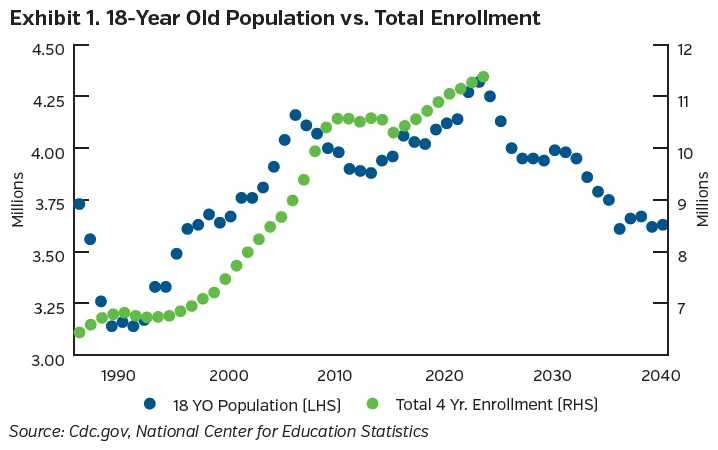
A fundamental challenge facing higher education is the projected 13% decline in the number of high school graduates by 2041, a trend rooted in falling birthrates since the Great Financial Crisis. Unlike previous periods of economic prosperity that fueled population growth, recent trends show the opposite. Importantly, this contraction is not uniform: the Northeast and Midwest are expected to see the steepest declines in school-aged populations. Institutions that draw heavily on these regions, especially those with high admissions rates and low selectivity, warrant heightened scrutiny.

Image
NEAMgroup_population_v_enrollment

Research from the Federal Reserve Bank of Philadelphia identifies enrollment declines as a leading indicator of institutional closure risk. Schools with this dilemma often cut budgets, which can lead to reduced program offerings. Persistent deficits, over extended periods of time, can erode institutional competitiveness and increase the risk of closure.

Enrollment Pressures & Tuition Discounting
Enrollment challenges are especially acute for institutions with weak brands and limited demand. Many of these schools rely heavily on tuition discounting, a strategy that, when overused, materially erodes operating margins. While targeted discounting can be effective, widespread use often signals underlying financial distress. In FY22, only 62% of higher education institutions reported positive net income.
Huron Consulting Group estimates that up to 370 private colleges could close or merge by 2035. These institutions often operate with thin margins and modest endowments, making them vulnerable to even minor shifts in enrollment or cost structures.

Financial Positioning Post-Pandemic
The expiration of Higher Education Emergency Relief Funding (HEERF) has created a revenue gap for many institutions, especially those already at risk. These schools typically received more pandemic-related aid than their fiscally stronger peers, making the loss of support particularly impactful. At the same time, inflation has increased costs across wages, facilities, and operations. The combination of reduced federal support and rising expenses has accelerated credit deterioration among weaker institutions. Colleges with limited reserves and constrained revenue streams now face urgent needs to restructure or consider consolidation.

Credit Markets: Spread Widening Creates Selective Opportunities
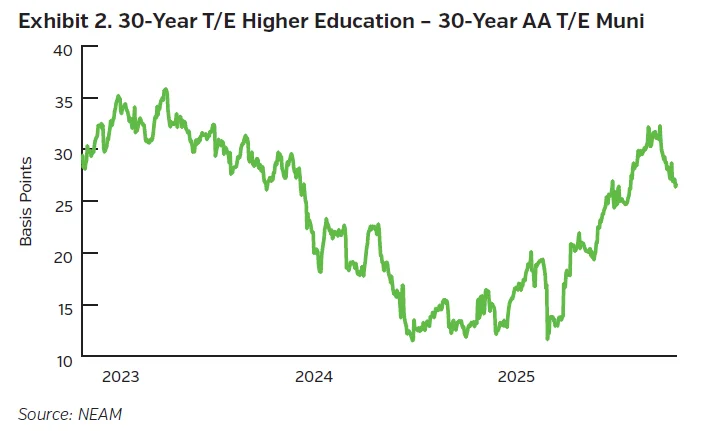
These sector challenges have led to wider credit spreads and relative underperformance. While some credits justify the increased risk premium, others appear mispriced, presenting attractive entry points. The top five universities1 represent 23% of the total higher education endowment pool. During last spring’s period of elevated issuance and intensified Federal rhetoric (which temporarily widened spreads) there were opportunities to capitalize on the dislocation.

Image
NEAMgroup_higher_education_muni

Current Environment: Closures, Defaults, & Strategic Consolidation
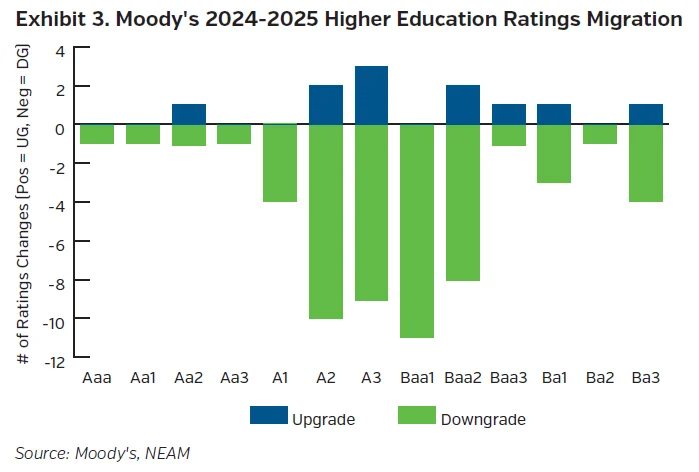
Since 2020, approximately 50 colleges and universities have closed, including 16 non-profit institutions.  These closures have been concentrated among smaller schools with high tuition dependency and limited alternative revenue sources.  As of 2023, Municipal Market Advisors counted 17 higher education municipal bond defaults, 4 rated BBB or below at issuance while 13 were unrated, representing a negligible amount of par value relative to the sector’s size.  Unsurprisingly, downgrades have outpaced upgrades over the past two years (consistent with observed Moody’s data below).  Strategic mergers may offer a path to survival for some, though often at the expense of institutional identity.  In other cases, schools are exploring collaborative models, such as shared course offerings or joint programs with nearby institutions, to reduce costs and expand access without requiring full consolidation.

Image
NEAMgroup_moodys_higher_education_ratings_migration

Value Proposition Under Pressure: Rising Costs vs. Career Outcomes
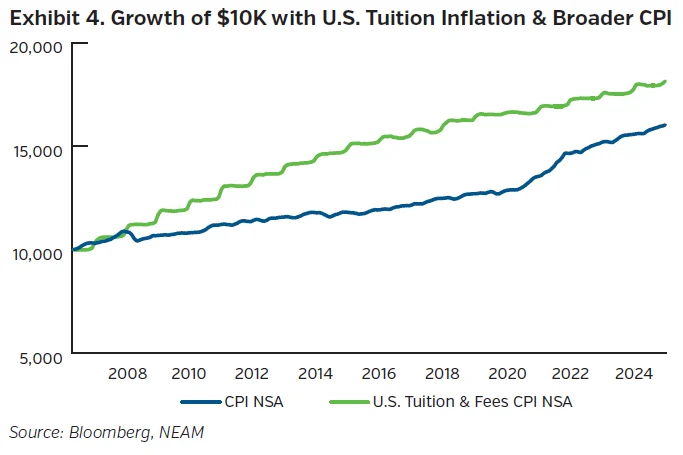
There is a growing perception that graduate earnings often fail to offset rising student debt burdens.  As a result, there is increasing emphasis on STEM curricula, which are generally associated with higher salaries and stronger employment outcomes.  However, not all students are inclined towards fields like engineering or medicine.  The value proposition of a traditional liberal arts education remains a topic of debate, especially as tuition costs continue to outpace inflation.  In fact, today’s college-aged freshmen face tuition levels that have risen ~12% above the rate of inflation since they were born.

Image
NEAMgroup_growth_tuition_inflation_CPI

Conclusion: Navigating the Cycle
Thematically, insurance company allocators would be well served by maintaining exposure to leading institutions, as well as to schools with strong STEM programs, solid demand metrics, and sustainable tuition revenue.  Additionally, state-supported colleges and universities benefit from a layer of state-level structural support, bolstering credit quality. Despite the difficult backdrop, higher education bonds can continue to offer meaningful portfolio diversification and attractive risk-adjusted yields for insurance investors.

Key Takeaways

  • A combination of federal funding constraints, demographic shifts, and rising operational costs are converging to create a challenging environment, particularly for educational institutions with weakening demand and limited financial flexibility.  
  • Despite the recent Federal policy headwinds, the most competitive higher education institutions continue to demonstrate resilience while others face mounting financial and enrollment pressure.  
  • Insurance investors should focus on leading institutions, schools with strong STEM programs and demand metrics, and state-supported colleges, which benefit from additional structural support and credit quality.
  • Through thoughtful security selection, higher education bonds can provide meaningful portfolio diversification and attractive risk-adjusted yields for insurance investors.

Endnote
1  As of 2021: 1) Harvard University  2) Yale University  3) University of Texas  4) Stanford University  5) Princeton University


Read More From NEAM


Originally published by NEAM in November 2025. This is not an offer to conduct business in any jurisdiction in which New England Asset Management, Inc. and its subsidiaries are not registered or authorized to conduct business.

© 2025 New England Asset Management, Inc.
 
All rights reserved. This publication has been prepared solely for general informational purposes and does not constitute investment advice or a recommendation with respect to any particular security, investment product or strategy. Nothing contained herein constitutes an offer to provide investment or money management services, nor is it an offer to buy or sell any security or financial instrument. The investment views expressed herein constitute judgments as of the date of this material and are subject to change at any time without notice. Future results may differ significantly from those stated in forward-looking statements, depending on factors such as changes in securities or financial markets or general economic conditions. While every effort has been made to ensure the accuracy of the information contained herein, neither New England Asset Management, Inc. (“NEAM, Inc.”) nor New England Asset Management Limited (together, “NEAM”) guarantee the completeness, accuracy or timeliness of this publication and any opinions contained herein are subject to change without notice. This publication may not be reproduced or disseminated in any form without express written permission. NEAM, Inc. is an SEC registered Investment Advisor located in Farmington, CT. This designation does not imply a certain level of skill or training. In the EU this publication is presented by New England Asset Management Limited, a wholly owned subsidiary of NEAM, Inc. with offices located in Dublin, Ireland and London, UK. New England Asset Management Limited is regulated by the Central Bank of Ireland. New England Asset Management Limited is authorized by the Central Bank of Ireland and subject to limited regulation by the Financial Conduct Authority. Details about the extent of our regulation by the Financial Conduct Authority are available from us on request. This is not an offer to conduct business in any jurisdiction in which New England Asset Management, Inc. and New England Asset Management Limited are not registered or authorized to conduct business.

Share this post

Sign Up Now for Full Access to Articles and Podcasts!

Unlock full access to our vast content library by registering as an institutional investor

Register

Contacts


New England Asset Management

New England Asset Management (NEAM) strives to be integral to the success of our insurance industry clients by providing investment management solutions through a team of skilled professionals dedicated to delivering exceptional client service. We aim to build true, enduring relationships with our insurance company clients by combining three core attributes:

Dedicated Teams    
NEAM is staffed with dedicated teams of knowledgeable insurance and capital markets professionals.

Actionable Tools    
Our combination of talent and technology is designed to support all aspects of your investment management.

Tailored Solutions    
We are acutely aware of the unique concerns and challenges insurers face on a daily basis and so these are reflected in our investment process.

Our comprehensive offering includes a wide range of services:

  • Asset Management Services
  • Enterprise Capital Strategy Services
  • Capital & Risk Analytics Platform
  • Investment Accounting & Reporting Services

www.neamgroup.com
74 Batterson Park Road
Farmington, CT 06032


View the contributor page

Sign Up Now for Full Access to Articles and Podcasts!

Unlock full access to our vast content library by registering as an institutional investor .

Create an account

Already have an account ? Sign in

Ѐ Ё Ђ Ѓ Є Ѕ І Ї Ј Љ Њ Ћ Ќ Ѝ Ў Џ А Б В Г Д Е Ж З И Й К Л М Н О П Р С ΄ ΅ Ά · Έ Ή Ί Ό Ύ Ώ ΐ Α Β Γ Δ Ε Ζ Η Θ Ι Κ Λ Μ Ν Ξ Ο Π Ρ Ё Ђ Ѓ Є Ѕ І Ї Ј Љ Њ Ћ Ќ Ў Џ А Б В Г Д Е Ж З И Й К Л М Н О П Р С Т У Ф Х Ц Ч Ш Ā ā Ă ă Ą ą Ć ć Ĉ ĉ Ċ ċ Č č Ď ď Đ đ Ē ē Ĕ ĕ Ė fi fl œ æ ß