





Shelter Growth Capital Partners-

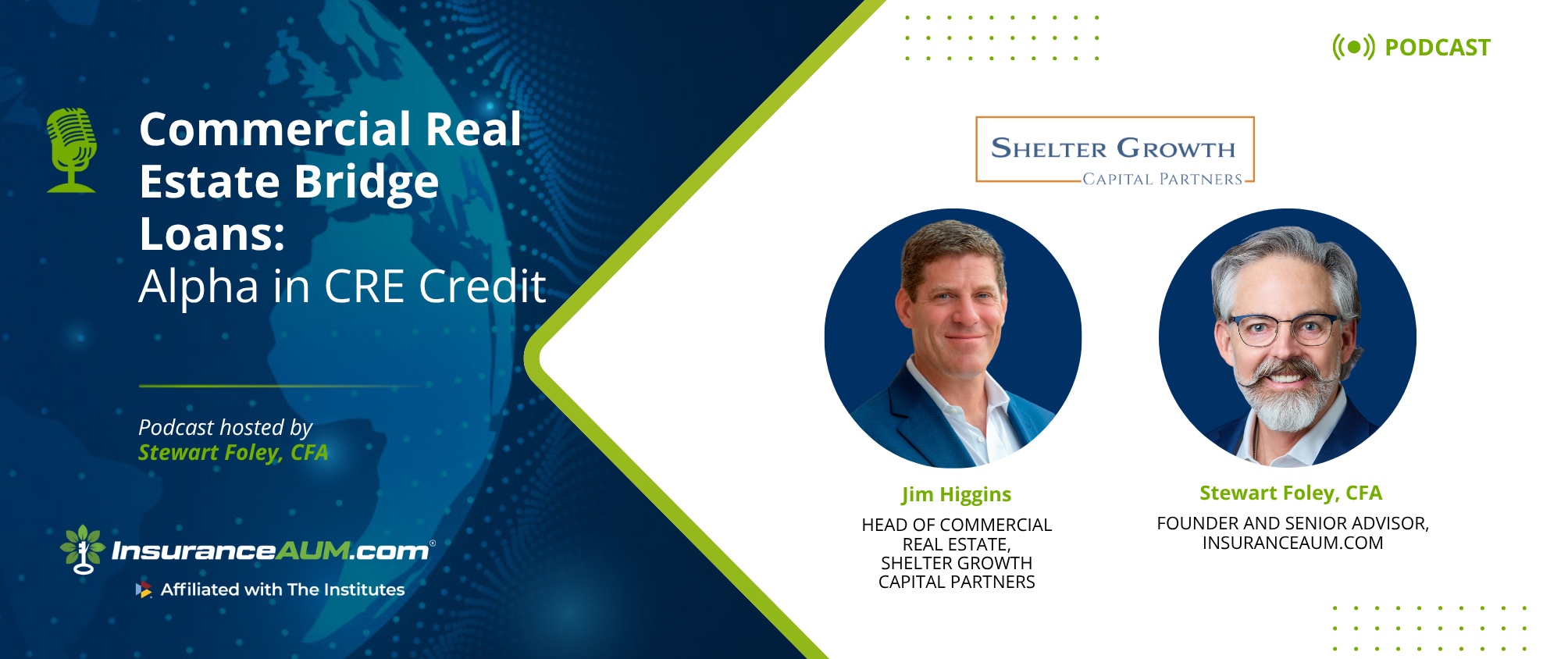
Commercial Real Estate Bridge Loans: Alpha in CRE Credit

Image
5.28.26 Shelter Growth_Web


Stewart: Hey, welcome back to the home of the world's smartest money on the InsuranceAUM.com podcast. My name's Stewart Foley, as I hope you know, CFA. I'm your host. I'm thrilled to have you with us today. This is an interesting topic and it really comes down to the fact that commercial real estate has been through one of the most heavily scrutinized periods in modern market history, but as often happens in credit markets, periods of dislocation create opportunities, particularly for investors that have a lot of experience, structure, and discipline in this space. With CRE debt, bridge lending, which is something that I'm looking forward to learning more about. Bridge lending may be one of the more misunderstood areas of the market today. It is certainly not my area, but our expert, it certainly is his area. The title of today's podcast is Commercial Real Estate Bridge Loans Alpha and CRE Credit.

I'm joined today by Jim Higgins, head of commercial real estate at Shelter Growth Capital Partners. Jim, welcome to the show. How are you today?

Jim: Thanks, Stew. I am great and excited to be here on your show.

Stewart: Well, I'll tell you, we were just talking about this. You and I have some commonality. Chicago, you're a UT guy. You lived down here in Texas for a while. We were just talking about that. I want to talk a little bit about your background. You're a longtime commercial real estate investor and previously founded a firm called Sorin Capital where you specialize. I mean, this is like you're as bad as I am. All I know is insurance asset management and all you know is this, which is like it's a blessing and a curse.

Jim: Guilty as charged.

Stewart: Guilty is charged. So tell me a little bit about this. Where'd you grow up? I haven't asked this question for a while, but I love this question. What was your first job, not the fancy one?

Jim: Absolutely. So I'm a Midwest boy, born and raised in the Midwest, mostly suburban Chicago. And my first job was at a commercial bank in Chicago called American National Bank. And that was the middle market subsidiary of First Chicago, one of the great money center banks that used to exist before the great consolidation of money center banks. And was in their credit analyst training program and they got placed in their commercial real estate construction lending division. And this was 1989, which was really the beginning of a really bad period for commercial real estate. The SNL crisis had kind of morphed into the commercial banks and a lot of commercial banks were having big problems because of their commercial real estate loan exposure. So there I was at the right age of 22, 23 years old in the commercial real estate construction lending division in a commercial bank.

So at the time it seemed like, wow, I'm really at ground zero of problems, but in hindsight, no better way to learn an industry than during a really challenging time. So really cut my teeth really almost as a workout specialist. So learned a lot about risk and actually seeing risk manifested rather than it being a theoretical construct and also learned a lot about human psychology because there's a young lending officer sitting across the table from real estate borrowers that were 20, 30 years my senior and talking about that they needed to put the loan back in balance by contributing more equity. They were some interesting conversations, but no better way to learn the industry than during the difficult times.

Stewart: It's interesting to me in that time, I mean, there were folks that were thinking like, "Well, my house went down in value so I don't owe that money." It's like, yeah, what? Yeah. You signed an agreement that says that. I used to ask my students, I go, "Okay, you buying a house at $100,000, you get a $70,000 loan. House goes to $140,000. How much do you owe?" They go $70,000. They go, "House goes to $50,000, how much do you owe?" I go, "Same answer." But the behavior of folks is I'm sure you learned a lot, but let's talk about this. I mean, I've had a lot of experience around Shelter Growth Capital Partners and know the principles there well and really have a great relationship, but not everybody does and not everybody knows. So can you give us kind of a 30,000 foot view of Shelter Growth Capital Partners and then the tail end of that, tell me what specific area or segment of the CRE loan market are you focused on?

Jim: Absolutely. So Shelter Growth, we are a specialist investment manager focused on real estate credit. And so the two broad components are real estate are residential real estate and commercial real estate and we invest in both segments. And what we think makes us unique is we believe very strongly that the best way to be a debt investor is to control the sourcing and production of assets. And in these cases, we're talking about residential mortgage loans and commercial real estate loans. So we have direct origination platforms for both. We have produced inception to date over $22 billion of loans across residential and CRE and we manage about $5 billion of AUM of client capital and that's across commingled funds and SMAs. And a pretty significant portion of that AUM actually is insurance companies because they really like the exposure both to residential whole loans and commercial mortgage whole loans and having a specialized partner like us that can source, underwrite, and asset manage, really handle the loan through the entire life cycle they find attractive.

So on the commercial real estate side, our primary focus is on, as the title of the podcast implies, bridge loans. So maybe before I get into the details on bridge loans, I'll just give a quick overview of the CRE loan landscape. Roughly $5 trillion to $6 trillion of total commercial real estate debt outstanding. And the rough breakdown of where that debt is held, 50% of that are on bank balance sheets. And then you've got the next is private vehicles like funds, MBS, insurance companies, and the agencies each account for about 10% to 15% of that universe.

And then there's three broad categories of commercial real estate loans, construction loans: banks are pretty much the dominant player in construction loans. You're looking typically at floating rate, three-year loans to finance ground-up construction of commercial real estate. Permanent loans, insurance companies, banks, CMBS lenders tend to be the main providers here. And here you're looking at 10-year fixed rate loans typically, mostly on stabilized properties. So these are typically fully leased, stable properties. The owner, the borrower's looking to put long-term debt on it, and that's kind of the perm loan category. And then the third category is what we really like to focus on because we think it is the least efficient and offers the best risk-reward profile or bridge loans. These are typically floating rate loans with 2-year to 3-year maturities and then extension options that can get the loan out to 5 years total. And again, debt funds, mortgage rates and some insurance companies also tend to be the main providers in this space.

Stewart: And what are you bridging? Where does that thing fit in the ecosystem?

Jim: Yeah, so I'd say there's three to four broad categories. Oftentimes that's a value add situation. So where the borrower has a property, maybe a recently acquired property and it's either been undermanaged or maybe it's been owned by a local family for a period of time and kind of fallen maybe a little bit off market in disrepair. Someone more professional investor comes in and needs to do some renovation, improvements to the property. So, they don't want to put a long-term fixed rate loan and that loan effectively bridges that period during the value add. Other scenarios can be acquisition where you've got a buyer who's buying property new, has to move fast, wants to do a short-term bridge loan to make the acquisition and then take his time to put a long-term fixed rate loan on it. Another category is new construction lease up. So where a developer has built a property, the construction lender's looking to be paid off and wants to get a bridge loan during the lease up.

And then sometimes it's just special situations where just unique situations could have something to do with timing, could have something to do with one partner buying out another partner. And so accordingly, they're all a little bit unique and we like the bridge loan market for a number of reasons. One is it's idiosyncratic risk more than beta risk. So they're all kind of unique situations and scenarios. And from an investment standpoint, and I'm getting into investment portfolio theory, we think it's a lower correlation than the mainstream perm loan market, which is a diversifier for portfolios. You also get higher yields for underwriting more property specific unique risk. We don't think it's necessarily higher risk. We just think it's a risk that takes a little bit more in-depth underwriting. We like the shorter maturities and then giving extension options to the borrower if they achieve certain hurdles.

And we also find that we can structure these loans in a way that gives us much greater ability to be actively managing the risk profile. So for example, if you do a 2-year loan and say, "Yeah, we'll give you two or three 1-year extension options as long as you are achieving your business plan and meeting certain hurdles, great." But if they're not, then at the end of year 2, you're sitting down with the borrower saying, "Okay, where are we and what are we going to do? And we want you to put in more equity or we want some reserves." So it really just allows us as a lender to be much more engaged and hands-on. And then asset management is an important part because again, these aren't necessarily stabilized assets, but we think they're good assets where we think we're lending at conservative basis.

And then with the right structural features, it allows us to be what we call early and active in asset management, which is a huge component of managing risk and getting our principal back. And we've originated about $3.5 billion of these commercial real estate bridge loans since our inception, and that's over the course of about the last 9 to 10 years. And knock on wood, we've had zero principal losses, which something we're pretty proud of. And that's been through some tumultuous periods, including COVID. There's a lot of uncertainty, a huge interest rate spike in later half of 2022 and 2023. So we think our strategy is pretty well proven out and we think we get pretty good risk premiums and the loans for it.

Stewart: Yeah, it's interesting. I think whenever you say idiosyncratic risk, you're talking about rolling up your sleeves. It's not like you're looking across these deals required. I mean, it really speaks to the quality of your underwriting, with the track record that you mentioned. So let's talk a little bit about your outlook on the commercial real estate fundamentals right now. I mean, are there things that you're favorable on and then is there anything that you're more cautious about?

Jim: Yeah, broadly, it's always hard to talk, I think, broadly about commercial real estate because it's ultimately submarket specific property type specific and property-specific. But that being said, we're generally positive on the overall fundamental picture for commercial real estate. Some of the key things I always look at is the supply demand dynamic, leverage in the system, capital availability, and then just overall valuation levels of commercial real estate. So going through those one by one, looking at the supply demand dynamic, it's nothing overly concerning. I mean, of course there can be some specific submarkets with specific property types where there might be a little bit of excess supply or maybe some recent overbuilding, but I think that those are more isolated. Again, having started off in the last huge supply-driven crisis in the late 80s, early 90s, we're nowhere near that. Overall, supply has been pretty modest and pretty responsible.

Demand, again, generally benign. It's going to be driven by the economy overall and each asset class is going to be a little bit different. I think you put the office asset class in its own category at this point, but the demand side of things, again, seems to be reasonably good. Leverage: here you're always looking for is there too much too aggressive leverage in the system and what you don't want to see is leverage being the tail wagging the dog. And that's kind of what we saw running into the 2008 great financial crisis where there was just so much extraordinary leverage in the system that transactions are just being driven by purely aggressive capital stacks, low cost of capital and you saw property values just spike less based upon fundamentals and more on leverage. Right now, I think the leverage is pretty reasonable, pretty responsible. Nothing that's given us any great concern.

Capital availability, really good. There's plenty of debt capital available, plenty of equity capital available. And then just looking at overall price levels of real estate, it almost feels like being a value investor. I mean, commercial real estate prices as measured by the broad indices are still 10% to 20% below the 2022 peak and you compare that to other asset classes, residential real estate, the price index is up 30%, 40%. Commodity index is up 50%, the S&P 500's up 100% over that time period, gold's up 150%. So as an asset-based lender, we like that our collateral, we're not underwriting things at collateral price peaks. So overall, we're pretty positive on the fundamental picture for commercial real estate.

Stewart: Yeah, it's interesting. When you look, and I want to focus on the CRE bridge loan market, what types of loans are really in your strike zone? In terms of loan size, property type, things like that, you talked a little bit about some of the situations that can arise, but are there areas that you like better than others?

Jim: Yeah. So our strike zone, we'll start off with loan size. We're in the $15 to $75 million range in terms of loan size, which I think would just generically be called the middle market in terms of lending. We think that that's an attractive space because it's generally below the size that the really large investment managers are playing in. It's lower than the size that the publicly traded mortgage rates. Most of those really large entities are looking at loans that are a $100 million and greater. So from a competition standpoint, it's a little less competitive and again, a little less efficient, which we think gives us a little bit more pricing power. Property type, we will lend on all the main property types in commercial real estate, but our primary focus has been multifamily and industrial. Part of that is probably 50% of the bridge loan market tends to be in multifamily.

So we like multifamily as an asset class and then industrial we also like as an asset class. Loan purpose, as we mentioned, value add, acquisition, new construction lease ups, special situation. And then really it's about the key attributes of the loans in our underwriting. So first and foremost is having the borrower with real significant cash equity in the deal. Nothing is going to keep a borrower's attention more than when he's got significant cash equity at risk. And that's going to be not always the case even in acquisitions. Sometimes you'll see a loan request where it's a fairly big cash out refinance for the borrower. We're generally shying away from those. So equity's big. Having the borrower with fairly deep pockets and access to additional capital because sometimes the business plans don't always go according to plan and you want to have a good alignment of interest and you want them to be able to support the property if things don't go perfectly.

Third is sponsor experience and a proven track record. Again, these are situations where they've got to maybe do something to enhance value. You want to see if they've done it before or you want to see a track record where they've executed these types of business plans and have specific submarket experience. And then finally as a comfortable loan basis, loan per unit or loan per square foot, we want to get comfortable that, okay, fine. We may not know exactly how the business plan is going to go and be executed, but even in most scenarios, we feel pretty comfortable we're going to get our principal back. So overall, again, we think that that leads to a situation where you put in a little bit more work in the underwriting, take a little bit of unique property-specific risk and you can get compensated by additional loan spread and we think the results have proven to be pretty darn good.

Stewart: Yeah, that's good. That's helpful to try and understand how you think about those loan types. I've got some friends that occasionally let me borrow their CIO hat, so I'm going to put it on for just a minute. How should I be thinking as a CIO about CRE private credit relative to corporate private credit. That's had a lot of headlines, but I think that most people who are in the know understand that the headlines don't really represent the reality in private credit. Talk to us about how to think about those two significant sources of private asset investment income for an insurance company.

Jim: Yeah. Clearly I'm biased and think very highly of asset-based finance and like our sector, but I do think that traditional corporate private credit is a good sector and there's good loans being made. And I do think that some of the headlines may be a little bit overblown, but I do think that commercial real estate, private credit and bridge loans compares favorably on a number of dimensions. I mean, look, the world's evolving rapidly right now and the words disruption and uncertainty seem to be words people are using a lot. Collateral seems to be a good thing. And collateral that is tangible and understandable. I know that private corporate credit has collateral, but I think it's not as easy to see. Transparent, easily understandable historical data. I mean, commercial real estate, everybody knows what it is. There's a lot of historical data. We know how different loans have performed during different types of economic and credit cycles.

So I think it's more easily underwritable and understandable and predictable during a range of different kind of challenging macro and economic environments. And then just also the consistent annual supply. Commercial real estate annual originations has been between $400 billion and $800 billion annually for a long time and maybe 20% of that is our bridge loans. So we know that there's a consistent supply that's underwritable, it's not overcrowded. Again, overall, we just think having a tangible asset that's easily underwritable, a lot of historical information heading into potentially an increasing uncertain macro environment is just, it makes sense to us.

Stewart: And so can you talk a little bit about how the capital markets and securitization play in Shelter Growth’s CRE debt strategy?

Jim: Yeah. I came from originally an underwriting background and then spent probably 30 years on the trading securitization capital market side, as did a number of the other senior folks at Shelter Growth, but we are first and foremost credit investors. Having had the capital markets and securitization experience, we think definitely enhances our ability from a portfolio management standpoint and being a good steward of investor capital, but we don't want the structured finance markets and securitization rules and the formulas to optimize the securitization to be the tail wagging the dog. So some of our clients, they want unleveraged exposure to our sector and they're looking for just mid to high single digits, but we do have vehicles and clients that want the double digit returns and with prudent use of non-mark to market warehouse lines and structural leverage via CLOs and other securitization forms, we think we can create some pretty good double-digit return profiles for those equity investors.

But again, it's credit first and structured finance considerations. They're downstream from that. We don't want to be sitting in credit committee deciding on a loan solving for some rating agency or securitization driven box.

Stewart: Yeah, that makes sense. You mentioned at the top of the show that Shelter Growth operates across both residential and commercial mortgage origination. Is there an advantage to having both of those under one roof?

Jim: We believe there is. Again, I think foundational to our overall approach is that a key to good long-term performance in real estate credit is to control the sourcing, underwriting, production, and asset management of the assets from cradle to grave. And we have in-house direct origination platforms both in residential and commercial. So we have found and continue to find definite advantage of having real on the ground knowledge of specific geographic submarkets. And so being active in both residential and commercial gives us, we think, kind of more on-the-ground insights. I'll give one quick example. We recently funded a loan on a multifamily property in the Germantown section of Memphis. Now every neighborhood there is going to be a little bit unique and there's some areas of Memphis that are a little more challenging on the multifamily side and some that are better. And so when we were underwriting that, we walked over to our residential loan credit team and they're originating $500 million a month of residential mortgage loans.

So they've got data points in literally almost every submarket around the country. So we were able to get a handle on various trends both from a credit standpoint, population growth standpoint, delinquency standpoint on the residential side of the equation there. And that gave us some good insights and got us comfortable that the location of this multifamily was actually a real positive area. And so just being able to cross-pollinate the insights and the data between the two groups we definitely think is helpful.

Stewart: So again, I'm going to slip my CIO hat back on and as we wrap here, a lot of insurance asset management, it's not just about performance, it's also about fit. And there's duration profiles, there's capital charge considerations, there's a litany of other things, of course, yield being one of those. How should I as an insurance CIO think about CRE bridge lending within the broader fixed income and private credit landscape today?

Jim: We think it's attractive on multiple dimensions. We like the credit risk. We like the risk reward profile. So we think that you're getting very well compensated from a spread and yield standpoint relative to the risk, particularly compared to alternatives when you're looking at BBB rated bonds in single asset, single borrower, CMBS or BBB in various forms of CLOs trading at 300 in some cases inside of 300 and that's for a levered structured portion of a capital structure. And we can make whole loans at SOFR plus 300, sometimes even greater, maybe something a little tighter. We think that just purely from a relative value and a risk standpoint, it's extremely attractive. And then when you get to the capital charges, I think it just makes it even that much more compelling.

Stewart: Yeah, it is true that the capital charge, particularly on RESI, the FHLB, it's pledgeable. There's lots of good things there. So you're unique in some regards because you've found that a firm, you've been in this business a long time. You don't look near the worse for wear that I do from founding one, but nevertheless, what characteristics do you look for when you're adding to members of your team? And this really, I guess given the time of the year when internships are getting ready to start and all of that, what are you looking for when somebody walks through your door and sits down? What do you think makes a difference in a candidate?

Jim: Yeah, I always talk about the trifecta is you want to be bright. It's good to have intellectual horsebower, be sharp, be bright. You don't have to be complete genius, but you want to have good thought process. Two is the ability to communicate well. You still need to be able to communicate your thoughts and ideas and take the work and the analysis and communicate it both internally and to the other stakeholders like our investors and rating agencies. And then third is the interpersonal skills. I know we're in the world of AI and machines, but commercial real estate in particular is still very much of a relationship and a human business. And so the ability to work well on a team internally, but also to establish rapport and dialogue and relationships with borrowers and investors, it's a critical component. So ultimately if you can find a good blend of all three, to us, that's kind of the ideal member of a team here at Shelter Growth.

Stewart: Outstanding. That's great. All right, last one. This is the signature question on this show. You can have dinner with up to three guests. Dinner's on us, by the way. Yeah. I mean, I haven't cleared that with anyone, but I just keep saying it. Nobody's called yet. The new owners think “I wish he'd stop saying that.” But you can have dinner with up to three guests. They can be alive or dead. Who would you most like to have dinner with?

Jim: All right. We'll go on from a couple of few centuries ago. We can go with George Washington. In terms of historical figures, he's a pretty fascinating individual in terms of being a general in his military career and having led during the Revolutionary War, then really overseeing the Constitutional Congress and then being the first president of the fledgling United States. I mean, he's a pretty extraordinary figure in history, so I'd have to go with that one for slightly more recent but still not current alive, but I'd say Babe Ruth.

Stewart: Oh, there you go.

Jim: I'm a big baseball fan. He's one of the greatest baseball players of all time. And in terms of colorful personalities, that would be a fun dinner and probably some fun time after dinner with him. And then the third, maybe somebody alive, I'll go with Elon Musk. Maybe some people love him, some people hate him, but boy, is he-

Stewart: He's an interesting kid.

Jim: He's a unique individual.

Stewart: Yes, he is.

Jim: And he sees things and is doing things that is pretty amazing. And so he has a thought process that I'd love to just sit and talk with him.

Stewart: Yeah, it's really cool. I don't know where I saw it, but I saw a photograph of George Washington's teeth, what he used.

Jim: The wooden teeth?

Stewart: No. Well, there was some wood in there, but there were also animal teeth. I'll never forget it. I'll just tell you that. I see these pictures of George Washington and he looks pretty noble, right? And you take a look at those teeth and you go, "Wow, that was a tough human being." That person was a lot tougher than his picture on the dollar bill. It's like, nope, just see those teeth, man. It's unforgettable. So listen, thanks for being on. I really appreciate it. You're a fellow Midwesterner and all the good that comes with that. I really appreciate you taking the time, Jim, and sharing some knowledge about CRE bridge lending and CRE in the market in general. So thanks for taking the time.

Jim: Thank you, Stew, for having me and I really enjoyed it.

Stewart: We've been joined today by Jim Higgins, head of commercial real estate at Shelter Growth Capital Partners. If you like what we do, please rate us, like us, and review us on Apple Podcast, Spotify, and ideally tell one of your friends to tune in to our show. If you have ideas for podcasts, please shoot me a note at podcast@insuranceaum.com. My name's Stewart Foley. You're listening to the home of the world's smartest money at InsuranceAUM.com.

Share this post

Sign Up Now for Full Access to Articles and Podcasts!

Unlock full access to our vast content library by registering as an institutional investor

Register

Contacts


Shelter Growth Capital Partners

Shelter Growth Capital Partners is a real estate credit focused, SEC-registered investment manager dedicated to building and managing diversified portfolios of residential and commercial real estate-related loans and securities. Shelter Growth’s clients benefit from the firm’s in-house direct lending platform which has acquired over $22 billion of residential and commercial real estate loans life-to-date. We believe that direct access to strong credit borrowers is essential to fully capitalize on the investment opportunities in residential and commercial real estate credit. We work with insurers to maximize risk-based capital returns in customized SMAs and other vehicles to meet desired risk/return metrics, providing a turnkey solution to efficiently access these sectors.

Scott Barringer 
Head of Business Development
sbarringer@sgcp.com 
Office: (203) 355-6109

750 Washington Boulevard
10th Floor Stamford
CT 06901


View the contributor page

Sign Up Now for Full Access to Articles and Podcasts!

Unlock full access to our vast content library by registering as an institutional investor .

Create an account

Already have an account ? Sign in

Ѐ Ё Ђ Ѓ Є Ѕ І Ї Ј Љ Њ Ћ Ќ Ѝ Ў Џ А Б В Г Д Е Ж З И Й К Л М Н О П Р С ΄ ΅ Ά · Έ Ή Ί Ό Ύ Ώ ΐ Α Β Γ Δ Ε Ζ Η Θ Ι Κ Λ Μ Ν Ξ Ο Π Ρ Ё Ђ Ѓ Є Ѕ І Ї Ј Љ Њ Ћ Ќ Ў Џ А Б В Г Д Е Ж З И Й К Л М Н О П Р С Т У Ф Х Ц Ч Ш Ā ā Ă ă Ą ą Ć ć Ĉ ĉ Ċ ċ Č č Ď ď Đ đ Ē ē Ĕ ĕ Ė fi fl œ æ ß