





Invesco-

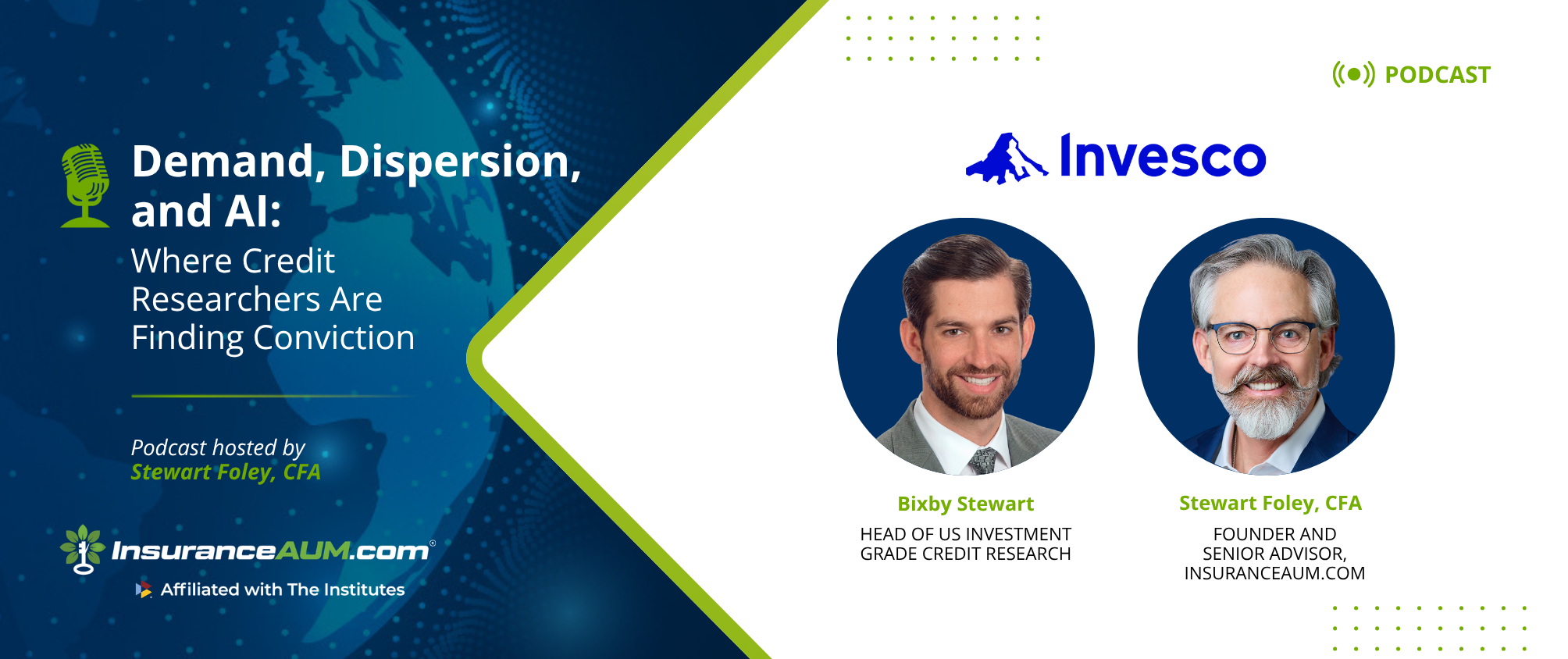
Demand, Dispersion, and AI: Where Credit Researchers Are Finding Conviction

Image
IAUM_Podcast_E381_Invesco_Web


Stewart: One of the most interesting aspects of today's investment environment is that the headlines and the valuations don't necessarily tell the same story. Investment grade credit spreads remain near multi-decade tights, yet demand from insurers, pensions, and global institutional investors continues to be remarkably strong. At the same time, artificial intelligence is driving one of the largest capital investment cycles we've seen in decades, raising important questions about leverage, relative value, and where real opportunities and risks may lie. For credit investors, this isn't simply about finding yield, it's about identifying where markets are properly priced and where they are not.

Today's episode is entitled Demand, Dispersion, and AI: Where Credit Researchers Are Finding Conviction. And I'm joined today by Bixby Stewart, Head of US Investment Grade Credit Research for Invesco Fixed Income. Bixby leads the team responsible for the fundamental research that supports investment decisions across Invesco's investment grade credit portfolios. Bixby, welcome to the show. We're very happy to have you.

Bixby: Thanks so much, Stewart. I appreciate you having me, and thanks for having Invesco on your show today.

Stewart: Absolutely. So, before we get going, the first place we go is, where'd you grow up? And if you weren't doing this job today, what job would you most like to have instead?

Bixby: To answer question one, I grew up in Asheville in North Carolina, so in the mountains of Western North Carolina.

Stewart: That place has gotten popular. That place has gotten hot.

Bixby: It certainly has. And I certainly hope that COVID would've pushed some more money management that way, but it hasn't happened yet. So, still here in Atlanta, but grew up in Asheville. And if I weren't working in the world of credit investing today, I would most likely want to be working in corporate development or M&A for something in the cycling ecosystem. So, there's online training platforms, Zwift and TrainerRoad. There's a lot happening there. There's these businesses normalizing post-COVID, integrating with the real world of cycling. So, I think that there's a lot of interesting things happening there, and I'd certainly love to work in that space. Also, might get me over to Europe a little more frequently to see bike races in person. So, that would be a nice perk too.

Stewart: Sounds like you're a fairly serious cyclist.

Bixby: I am serious about how much I love the sport. Not getting out as much as I wish I could these days, but that's okay.

Stewart: Yeah, I used to ride a fair amount. I'd see bike clubs and I'm like, "Yeah, I'm not as good as any of those guys."

Bixby: I think we're probably about the same then.

Stewart: They're flying by. I'm like, "Hmm, okay." So, the first part of this goes into: are investors being paid for the risk? And let's start with the big picture. I mean, investment grade spreads, we talked about this, remain tight. When you look across today's market, talk a little bit about the compensation for risks that are being taken in this environment.

Bixby: Sure, let me give some context for where we are right now, and then I'll share my view on this. The investment grade credit index that we look at is currently at 74 basis points over Treasuries today. Historically, that number has averaged a hundred basis points or more over long periods of time. And the 20-to-30-year tights on that index have been 67, which we touched in January and again in June this year. So, at seven basis points off of the multi-year, multi-decade tights, yes, the index is historically tight. The asset class is historically tight. Is that a bad thing? I would actually argue there's a reason for this, and it's actually quite justifiable. The structure of this market has fundamentally changed in recent years. So, while optically, yes, 74 is quite tight versus historical levels, I would actually argue that we should continue to trade at this historically tight level and could stay in this sort of range-bound level for a long period of time.

The reasons for that are many. But for one, when you look at the characteristics of this market, they're much, much better than they have been historically. So, the duration of the asset class has moved lower. Average dollar prices within this index have moved lower after COVID. We have increasing credit quality across the investment grade space. We have yields that remain as attractive as they've been in the last 20 or so years. But I would argue most importantly would be improved liquidity in this market. And that is owing to the advent of portfolio trading. So historically, there was an illiquidity premium that existed in our market because there were bonds that were very hard to transact in. Portfolio trading has changed that dynamic entirely. So, that illiquidity premium has shrunk over time. And all of these reasons put together, I would argue, support a tighter market than we've seen historically.

So yes, spreads are tight. Do they deserve to be tight? Yes. Are we being paid to take risk in this market? The answer there is yes, but not uniformly so. There are certainly pockets of opportunity. There's certainly pockets of value right now. But, I don't think that beta is the right call at 74 on the index. There's a lot of opportunity, but you sort of have to scratch beneath the surface to find it.

Stewart: Yeah, and that's kind of where I was going. I always say this, you call Progressive right now, you can get a policy. They don't go, "Hey, listen, rates aren't that great right now. We're going to start writing them again next week." Doesn't work that way. And so, CIOs have money coming in the door that has to be invested. There's no choice in the matter. They can't sit in cash. There's no choice. But I do think it's comforting. I do think that CIOs want to feel good about where spreads are and that it's not overbought. And I think the arguments that you made or the points that you made certainly were things that I hadn't considered. I didn't really understand the impact of portfolio trading as an example.

So, you talked about finding relative value. I mean, even when markets look expensive, there's usually pockets of opportunity, but that requires the resources. And what I mean by resources is analysts who are rolling up their sleeves. Where are you finding relative value?

Bixby: Being quite biased myself as the head of our research team, I would agree that having access to great research talent helps here. When we came into 2026, our view within the investment grade team is that, and the theme of our outlook was that this is a bond picker’s market. Meaning, that we were expecting that we would see record issuance this year, and we knew there was going to be record hyperscaler issuance. Along with that, that means that we as investors for the first time in a long time, actually have a little bit of pricing power, and we can pick and choose where we want to invest. That is exactly what we're seeing this year. And I would argue that the issuance numbers are probably going to be even higher than anybody expected. Not just because of the hyperscalers, but also because we have record capital market strength, record capital market activity, and the M&A pipeline continues growing.

So, for us, we are looking at any and every new issue that comes to market, but we're doing so in a very disciplined way. Our view is that we're constantly looking for downside protection, looking for catalysts, and that can be in the form of downside protection from the structure of a security, from the valuation of the security, idiosyncratic sector catalysts. Those are the things that we're focused on.

Where are we seeing value? We'll talk about tech more here shortly, I'm sure, but that space is undeniably cheap, but does continue to get cheaper. So, we can talk through why that is later. There's a sort of public-private dislocation, and there's some opportunities in the private space which we think are quite interesting. Other sectors as well. I mean, this is a technically driven market, and technicals are driving outperformance and underperformance. The underperformance coming from the heavy issuers this year, which is the banks and the tech names. So, we see value in banks. We certainly see value in tech. We see value in some of the privates. Again, for us, we're looking at every new issue that comes. And in a bond picker’s market, we have the luxury of being able to pick and choose where we deploy capital and where we think the best opportunities are.

Stewart: It's interesting that you talked about technicals. One of the themes that we've discussed on this podcast is the tremendous demand for long duration investment grade or investment grade privates from insurance companies. And I think you mentioned that the index in investment grade credit has actually shortened, which I'm keen to know about that. But how much of today's spread environment is driven by company fundamentals versus being the result of these technicals from exceptionally strong institutional demand?

Bixby: Timely question for this year. I would say that the technicals are without question in the driver's seat, but the strength of the corporate fundamentals in our market leave us comfortable being invested. To the technical side, you mentioned earlier — the overwhelming demand from insurance, from liability-driven investors, from pensions — that demand has not shifted and arguably is probably higher than it has been in years given the rate backdrop, given the fact that you can earn 5.4% on investment grade, high-quality paper these days. So, the technicals do continue supporting asset class inflows, and we've seen positive flows throughout the entirety of the year. I think that that's interesting in the context of this tension that we have between historically tight spreads and historically attractive and elevated yields, which again is thanks to the rate backdrop. So, 74 on our index, we're probably in the bottom fifth percentile if you look over a long 10-to-20-year timeframe. Contrast that with the yield backdrop for IG, 5.4% is the 90th-plus percentile over a long period of time. So, for the liability-driven investors, at the end of the day, they're buying yield. And that yield demand is what continues to drive this market, and one of the reasons that we think that spreads can continue to remain fairly tight for an extended period of time.

If you were to just look at spreads on their own, you would be inclined to say, yes, we should take a step back and we should be underweight because valuation is just too tight to earn any excess return. To my point about fundamentals, they are so strong right now that we are more than comfortable to continue owning high-quality investment grade credit even at tight spreads because fundamentals are as good as they have been in years. Balance sheets are healthy, margins are expanding, interest coverage is improving, revenue growth is positive. There's very little to complain about from a fundamental standpoint.

Stewart: You mentioned hyperscalers. It's funny to me because it seems like tech, at the beginning, there's a whole crowd of people running toward the door going “Tech!” And they're super excited. And then a little while later, the whole crowd is running away going “Tech!” And it's in fear. Because technology's tough. I mean, it changes. I don't know if it was this way for you, but it seemed like generative AI just arrived, and everybody went “Wow!” And it's a little like the internet was when it first came out. If it was internet related, it had crazy multiples and there were plenty of people able to raise cash and they weren't able to really grow real businesses out of it. And so, you saw this kind of whipsaw. Right now, artificial intelligence has become the biggest capital spend in a long time. And you mentioned the massive issuance from hyperscalers. And it would be helpful if you could give us a brief definition of what a hyperscaler is, in case there's folks listening that don't know. Sure. But talk to us about how you're evaluating relative value across the AI investment landscape.

Bixby: We think of the hyperscalers as being the largest tech companies in the world, all of which are in a bit of an arms race right now to invest in the AI ecosystem in a way that benefits their businesses, benefits industries across the world. And all of these businesses look at this as the primary, the key growth driver for the future. So, when we think about the terminal value of a tech company, the quality of the AI investments they're making is going to be a key driver of what happens with that terminal value. In terms of the opportunities that we're seeing in the AI space, there's multiple layers to the ways you can invest in this in investment grade.

Obviously, the first place is in your unsecured hyperscaler, your tech bonds. These are the ones that right now continue facing pressure, and I'm happy to talk about why that is, but those continue to come to market. We're seeing record issuance there this year. And again, that is to fund this AI build out. And we're not just seeing it here in the US. We're seeing it globally. So, these businesses, they are saturating any and every capital market to raise money to fund this spend.

Below that we have power generation, we have the power companies, we have the utilities. That's another interesting way to invest in this narrative. These are regulated businesses. These are investment grade companies, great management teams, long-standing track records. A lot of these companies have — they're called hybrid securities — where they're subordinated, but they do offer attractive yields and total return opportunities. So, we like that part of the capital structure and utilities.

There's banks as the funding intermediaries, let's say. Another sector that's faced a little bit of pressure this year, but that's another one where fundamentals are honestly as good as we could ask for. Capital markets continue to set new records by the week. Capital market activity is at all-time highs. So, the banks still remain quite attractive in our opinion.

And then you have the energy companies. You have the midstream providers. These are also businesses that we like. Durable cash flows, proven ability to maintain investment grade through the cycle. Again, great management teams, longstanding businesses.

And then even below that, you have the private opportunities. And this is a bit of a new market in terms of tech and AI and the investment grade market, but we continue to see a lot of these. And some of these have secondary market liquidity, which is new for these direct lending opportunities and some don't. But we think for sophisticated investors, the privates offer a really interesting way to capture attractive risk-adjusted yield. Be it better risk-adjusted yield thanks to the structure of a transaction, the tenant, the hyperscaler that's sort of backing the transaction. So again, I talk about the bond picker’s market, and this is just another example of that. I mean, there's so many different ways to deploy capital and then to invest in this narrative, and we're seeing any and all of them right now.

Stewart: Yeah, it's interesting. I'm a bond geek and I love the fixed income markets. And I think it's interesting. I've worked at a couple of shops, none of whom had the kind of credit resources that Invesco has. So, I can imagine that you're working feverishly on this. We've done almost 400 podcasts, and every asset class that is discussed typically has a somewhat bullish narrative. Nobody comes on and says, "Investment grade credit sucks. Run for the hills. Thanks for having me on." So, talk a little bit about the other side of it though.

When you look at AI-related investment grade credit, is there anything that concerns you? In the same way that AI showed up out of nowhere, it seems to me that we are one discovery away from going, "Oh, the amount of power that we need is one-tenth now." And everybody goes, "Ooh, what do you do with these giant behind-the-meter power plants sitting in the middle of Louisiana? What do you do with it?" And I know that's a concern of the CIO community. We talk to them, we have calls with them. Can you talk a little bit about what you think folks might be. Are there concerns, things that make you cautious when you look out there?

Bixby: You can appreciate this as a bond nerd that we are constantly thinking about what's the worst case scenario? What's the worst thing that could possibly happen here that's being underpriced by the market?

Stewart: That's the life of a bond person. It is the life of a bond person. You're a natural contrarian. Things take off and you're like, "No, no, no, there's something wrong there. I'll find it." It is true.

Bixby: We tend to rain on everybody's parade. We try not to, but that's just the way that we think. And look, we are generally a pretty bullish team. It doesn't pay overtime to be underweight credit. It pays to take calculated credit risk. That said, there are a ton of things, a ton of concerns on my mind, on the mind of our internal tech, AI affinity team, our macro team. I mean, the entire platform is having discussions around these issues daily, weekly, monthly. I'll throw a few out and happy to go deeper on any of these.

One is concerns around the speed at which this spend will be reflected in corporate fundamentals. So, the monetization. If that takes longer than expected and this capital cycle proves to be more intensive and takes longer than the market is expecting, that would be quite a negative for not just credit markets, but I think probably for broader capital markets. The issue we face right now is that bond markets are suffering because we know that there's going to be continued issuance from every one of these businesses. That's kind of pushing spreads a little bit wider right now. And if this were to continue for the next five years, you're sort of in limbo for the market because you can pick and choose what you want to invest in, but you know there's just going to be more and more coming. So, we are monitoring this. We're waiting to see the speed with which this investment turns into cash flow.

The other one for me is there's sort of two pieces of it. One is cross-asset correlation. So, equities and fixed income, very highly correlated right now. And that makes sense because the concentration of both equity markets and credit markets. They continue to move higher as hyperscalers issue more debt and equity values grow, and they become a larger part of equity indices. But if there were some type of — I'm not going to make a call on whether or not we're in a bubble — but if there's a valuation correction in equities, that certainly hurts in fixed income. If there's an earnings bubble that pops, that hurts in fixed income. But along with that is the interconnectedness of this AI ecosystem. I mean, you and I, we've all seen the charts in the Wall Street Journal of how these different players are all interconnected and how they all work together. Not to be Mr. Doomsday, but you see those pictures and it does remind you of the way the financial system was so tightly integrated back in 2005, six, seven, eight and nine. So, these are all things that I don't have an answer for right now. These are the things that we are concerned about, that we're watching for. And it's also the reason that we're not just blindly taking risk and maintaining a blind overweight stance to investment grade credit. But again, bond picker’s market, we're allowed to be pretty selective this year, and that's certainly how we're doing things here at Invesco.

Stewart: Yeah, that's interesting. You hear people go, "Maximize investment income." You go, "Sure." But nobody goes to the head of underwriting and goes, "Maximize premium volume." Because they're like, "Well, what are we owning?" And you're making that exact same point. I think it's interesting because a lot of times the concepts are a mirror image of each other between the asset and liability side of an insurance company, but the language is all different. But the concepts are the same. And it's like, yeah, there's opportunity, but yeah, you got to be selective. You got to do your underwriting, you got to do your work. And it's interesting. So, this is the part of the program, Bixby, where we ask you to dust off the crystal ball. And I know that you've got one there in your office. Certainly, you do. At least I hope you do. So, as you dust it off and you look out the second half of the year and into 27.

And the other thing is too, that it's not just economics. I mean, fuel prices are essentially a tax on a lot of folks. I work out of my house. It doesn't really impact me that much. But folks who work for a living and get out and drive and whatever, it's like some of the stuff that's impacting the economy is not economics. It's geopolitical, it's whatever it may be. So, when you look out six months at whatever, what are you watching right now? Is there anything that you see smoke, maybe not fire? Is there anything that you would point to?

Bixby: On the macro front, again, we have a fully staffed macro team that we are engaging with weekly, monthly, ad hoc. I mean, this team is constantly looking for these things on the economic side of our business. So, on that front, I actually feel fairly comfortable. If we think about all of the issues that have faced consumers in the US over the last five to 10 years, the consumer here has proven to be so much more resilient than I expected, than the market expected.

Stewart: 100%.

Bixby: And if you were to look at economist recession expectations back in 2021, 2022, the overwhelming majority of economists expected that we were heading straight into recession, which didn't happen. So, it's not even just the consumer that I think has proven to be a lot more resilient than we expected, but also the broader economy here in the US. So, we are watching all of these things. We are talking about these things weekly. The strength of the consumer continues to be something we are heavily focused on, but again, it's proven to be a lot more resilient than expected in recent years. Equity valuations, anybody and everybody is watching this as well.

I recently looked at equity valuation multiples for the S&P. This was six or nine months ago. And yes, they were close to cycle highs. When I reran that math a few weeks ago, valuation looks a lot better because earnings expectations, earnings growth expectations have ratcheted so much higher so quickly. And so, multiples have actually compressed a little bit and look a little bit more reasonable. So again, right now we are watching the consumer. We are watching the macroeconomy. We are listening to the Fed. We are watching technicals. We are watching issuance out of investment grade. We're watching the equity market. I mean, those are all areas where there could be smoke. And yeah, we're following each of those intently along with the AI build out. This is the dominant market driver, and it will be for the next one plus years.

Stewart: Or more.

Bixby: Or more. For the next decade it could be, right?

Stewart: I mean, it's like the industrial revolution for thought. I mean, I often say to people, I go, especially folks who are like, "That AI is evil." And depends on who's programming it, what answer you're going to get. I'm like, okay. But at the end of the day, I say to people, I go, "If you went out to the airport, you're going to fly to New York and that airplane looked like a bird and it flapped its wings up and down to take off." I go, "I'd be willing to bet you that you'd be hesitant to get on it." So, we've created a better way to fly than a bird. And we've created a better way to think than a human. And it's like the ramifications of that, I don't think we can know. I don't think it is knowable right now, but it has the potential for extreme levels of productivity increases. Being able to build a PowerPoint in two minutes is incredible. I mean, I've worked hours, days, weeks. You know you have too, and it's incredible. So, I'm optimistic. I do think that you've brought up a lot of great points here and it's been a great education. Bixby, what would you leave our audience with on a couple of takeaways that you wanted to remember from this podcast?

Bixby: Yeah, sure. And thanks again for having me on. Sometimes the market doesn't give you much to talk about, and we're certainly not in one of those times right now. So, a lot to think about. I continue to be really constructive on the strength of this market. We talked about the structure of this market, how it's improved over the last five to seven years. This market is arguably as high quality as it's ever been, and that continues to be reflected in double-digit earnings growth, stable credit fundamentals. So, the fundamentals should give us conviction and comfort in staying invested in this asset class. Couple that with the rate backdrop, which is juicing all-in yields for investment grade. And we haven't seen 5.4% sustained yields on this index in a very, very long time. So, the opportunity to invest in some of the best businesses in the world at historically attractive rates is really, really an interesting opportunity for us, especially from a multi-asset class standpoint.

And if you look at the earnings yield on the S&P, so the inverse of the PE ratio, and compare that to the yield you can get on investment grade credit, it's a pretty attractive opportunity right now. So, from a risk-adjusted standpoint, we still like the asset class. And for sophisticated, thoughtful, value-oriented investors, the bond picker’s market continues to give us a lot of opportunity. So, there's no need to own the asset class blindly, as I said earlier. But with historic issuance, these are some of the best businesses in the world, these hyperscalers, and they're giving us continued opportunities to invest in their companies in a variety of different ways. Through equity markets, through fixed income, IG, high yield, public, private. So, it's an exciting time.

Yes, spreads are historically tight, but that alone is not a reason to be negative on the asset class because, as I said, it's a very high-quality asset class. Yields are historically attractive. Fundamentals are as good as they've ever been, and we're going to continue to see a variety of new opportunities for investors. So for active investors like us, we love this type of market. But again, it takes a cautious eye and a lot of diligence to make sure that you're investing in the best places right now.

Stewart: That's awesome. All right, listen, great education. Couple of fun ones. You've got a team there, and you've hired a bunch of people. You've been at this for a minute. What characteristics do you look for when you're adding the members of the team at Invesco? The purpose of the question is really to get at the culture of what it's like to work there and what is valued.

Bixby: There are a lot of considerations here, Stew. Obviously, I'd love to have somebody who deeply understands financial statement analysis, has a background in credit investing, but you can't always find that depending on what role you're looking for. The first and most important thing that I look for in candidates is that they have a passion for investing and that they are market nerds like we are. It is those types of characters and those types of personalities that I find are the most driven to work with. They're the most excited to learn about our market. They're the fastest to learn. And those are the personalities that I think benefit the most and add the most value to a place like Invesco. The analyst's job isn't just to sit there and come up with ideas, it's to do that, plus engaging with our macro team, our other asset classes, other investors across the globe. And it's the constant curiosity that these types of personalities have. The people that love markets, that love investing. Those are the ones that, again, benefit the most, are easiest to work with or the most fun to work with as well and add the most value to our culture and our team.

Stewart: Yeah, that's awesome. I love that. It's interesting. I taught finance for about seven years, and there were students of mine that were just into it. It wasn't like they were taking this because it was like, "Yeah, I'm into this." It's like, "Yeah, I'm taking a lawnmower class and at night I take lawnmowers apart and put them back together, and I can't get enough."

Bixby: And you know it immediately. You know when you talk to them if they either have it or they don't. It's a hard thing to teach.

Stewart: Yeah. And I'm not that guy, honestly. I'm not a big markets geek, but I know markets, but I never wanted to work in research and do that. I was always more on the relationship side and working with clients. But at the end of the day, I have a lot of respect for folks who are really passionate about it, and it sounds like you've been able to find a number of them there. Last question, dinner for four. Dinner's on us. Okay. It's you and up to three guests. You don't have to take three. You can do one, two or three. Alive or dead, Bixby. Who's going to dinner with you?

Bixby: Thank you for treating us to dinner, Stew. We would do this at Peter Luger's in Brooklyn.

Stewart: Nice.

Bixby: And at my table, I would love to have my former boss who passed away earlier this year. He had been with Invesco for a very long time. He built an outstanding team, worked with an outstanding part of our company, and I wish I could have had more time to learn from him on the characteristics that he looks for when building a team. How to make a team work well together, grow together, add the most value to the platform. He just had this institutional knowledge and just a great human being as well. So, he would definitely be number one.

Number two, I would say someone in my family, which I would like to do that, a grandfather or something. But let's pivot. I would say that if I could have lunch or have dinner with a World War II veteran, specifically somebody that landed at Normandy on D-Day, some of the greatest heroes in the history of the world, and I would just love to just listen to them. I wouldn't even talk that dinner. I would just listen to any stories they'd be willing to share because that bravery and that level of strength and courage is something I don't know that any of us will ever actually be that close to.

And then third, I want to say it would be a famous pro cyclist that I love or one of my favorite soccer players, but I think maybe I'll go with similar but related, which would be Sir Alex Ferguson, so the longtime manager of my favorite soccer team, Manchester United.

Stewart: Wow. Okay.

Bixby: That might stir up some people on this podcast, so apologies to anybody that rubs the wrong way.

Stewart: That's okay. There's plenty of people who have sports affiliations that would debate the quality of the other person's team. So don't worry.

Bixby: Even for the Arsenal fans on this call, I think that they would agree that Alex Ferguson, he was manager for a number of decades. He led a variety of different teams to multiple different successes across the Premier League, the Champions League, the FA Cup. And he did this with a process that worked, and it worked not just for one group of people, it worked for so many different groups of people, of groups of individuals. And to understand how it is he approached leading those different people and those different personalities and those different talents over a three-decade career would really be fascinating. And it's different than what we're doing here at Invesco, but it's also somewhat related. At the end of the day, you're trying to build a great team, a great team of winners, and that they're going to win through the cycle, and they're going to win over a very long period of time. So yeah, I think that's the three I'd have dinner with at Peter Luger's.

Stewart: I think they'd love it. I dated a woman whose grandfather landed at Normandy. And he passed. I didn't know him well at all. He passed, and he was buried in National Cemetery, and it was pouring down rain, man. I mean sideways. It was raining like cats and dogs. And his hearse went around over there and there were six men in full dress uniform standing in the pouring rain waiting for him. And I mean, I had tears in my eyes. It was incredibly moving. The level of respect for those guys is unbelievable. Nobody's ever chosen that, and I think it's such an interesting choice. There's a lot of military in Texas. We have a lot of respect for those folks. But those guys in particular that landed there, that took incredible courage. And I think that that would be a super cool guest. I want to thank you so much for being on, Bixby. Yeah, absolutely. Thanks for great education on investment grade fixed income, and really appreciate your time.

Bixby: I appreciated this too. Great discussion. Great to talk to you about this. And again, for better or worse, there's a lot going on in this market right now, and there's a lot of opportunities. So happy to have the discussion, look forward to staying in touch. And yeah, thanks again for having me on. Very much appreciate it.

Stewart: My pleasure. We've been joined today by Bixby Stewart, Head of US Investment Grade Credit Research for Invesco Fixed Income. If you like what we're doing, please rate us, review us on Apple Podcasts, Spotify. If you want to watch us, you can catch us on our YouTube channel at InsuranceAUM Community. We're the home of the world's smartest money at InsuranceAUM.com podcast. My name's Stewart Foley. We'll see you on the next episode. Thanks for joining us.


For Institutional Investor Use Only

All data sourced to Invesco unless otherwise indicated.

Investment risks

Fixed-income investments are subject to credit risk of the issuer and the effects of changing interest rates. Interest rate risk refers to the risk that bond prices generally fall as interest rates rise and vice versa. An issuer may be unable to meet interest and/or principal payments, thereby causing its instruments to decrease in value and lowering the issuer’s credit rating.

Non-investment grade bonds, also called high yield bonds or junk bonds, pay higher yields but also carry more risk and a lower credit rating than an investment grade bond.

The risks of investing in securities of foreign issuers, including emerging market issuers, can include fluctuations in foreign currencies, political and economic instability, and foreign taxation issues.

The performance of an investment concentrated in issuers of a certain region or country is expected to be closely tied to conditions within that region and to be more volatile than more geographically diversified investments.

All material presented is compiled from sources believed to be reliable and current, but accuracy cannot be guaranteed. This is being provided for informational purposes only, is not to be construed as an offer to buy or sell any financial instruments and should not be relied upon as the sole factor in any investment making decision. This should not be considered a recommendation to purchase any investment product. As with all investments there are associated inherent risks. This does not constitute a recommendation of any investment strategy for a particular investor. Investors should consult a financial professional before making any investment decisions if they are uncertain whether an investment is suitable for them. Please read all financial material carefully before investing. Past performance is not indicative of future results. The opinions expressed herein are based on current market conditions and are subject to change without notice. These opinions may differ from those of other Invesco investment professionals.

Invesco Advisers, Inc. is an investment adviser; it provides investment advisory services to individual and institutional clients and does not sell securities.

NA5800250

Share this post

Sign Up Now for Full Access to Articles and Podcasts!

Unlock full access to our vast content library by registering as an institutional investor

Register

Contacts


Image
Invesco_logo_blue_pos_rgb-NEW-2021.png

Invesco is a leading independent global investment management firm, dedicated to helping insurance investors achieve their financial objectives. We understand insurers have unique investment needs, from optimizing capital efficiency and yield, to managing reserves and reporting. That’s why we offer specialized solutions across a broad set of asset classes and vehicles. With $2.2 trillion in total assets under management,[1] and $95.6 billion on behalf of insurance clients,[2] we strive to understand your distinct capital requirements, accounting tax treatment, and risk factors.

Invesco Advisers, Inc. and Invesco Senior Secured Management, Inc. are investment advisers that provide investment advisory services to Institutional Investors and do not sell securities. Invesco Distributors, Inc. is the distributor for Invesco's retail products. Invesco Advisers, Inc., Invesco Senior Secured Management, Inc. and Invesco Distributors, Inc. are indirect wholly owned subsidiaries of Invesco Ltd.

1 Invesco Ltd. AUM of $2,169.9 billion as of Dec. 31, 2025
2 As of December 31, 2025


Invesco
1331 Spring Street NW, Suite 2500
Atlanta, GA 30309


View the contributor page

Sign Up Now for Full Access to Articles and Podcasts!

Unlock full access to our vast content library by registering as an institutional investor .

Create an account

Already have an account ? Sign in

Ѐ Ё Ђ Ѓ Є Ѕ І Ї Ј Љ Њ Ћ Ќ Ѝ Ў Џ А Б В Г Д Е Ж З И Й К Л М Н О П Р С ΄ ΅ Ά · Έ Ή Ί Ό Ύ Ώ ΐ Α Β Γ Δ Ε Ζ Η Θ Ι Κ Λ Μ Ν Ξ Ο Π Ρ Ё Ђ Ѓ Є Ѕ І Ї Ј Љ Њ Ћ Ќ Ў Џ А Б В Г Д Е Ж З И Й К Л М Н О П Р С Т У Ф Х Ц Ч Ш Ā ā Ă ă Ą ą Ć ć Ĉ ĉ Ċ ċ Č č Ď ď Đ đ Ē ē Ĕ ĕ Ė fi fl œ æ ß