





New England Asset Management-

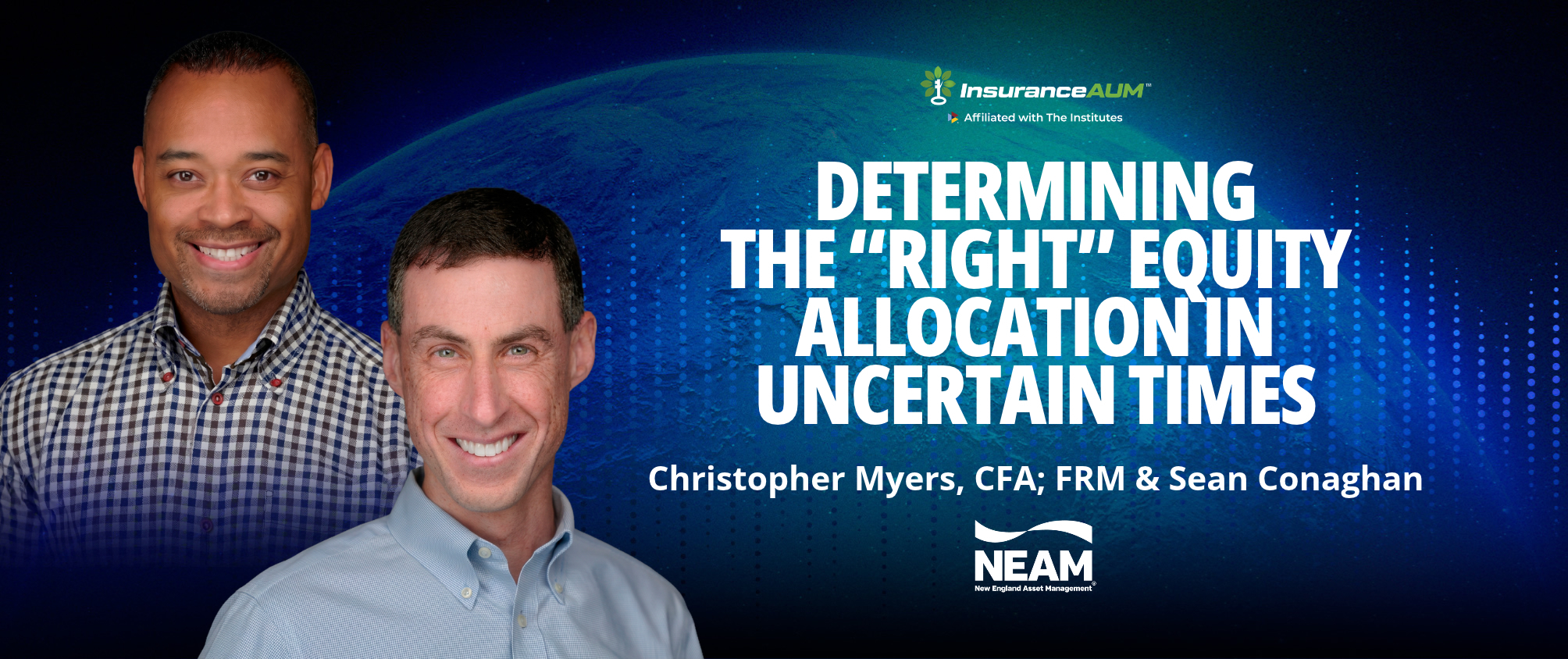
Determining the “Right” Equity Allocation in Uncertain Times

Image
IAUM_Podcast_NEAM-11.25_Web_2026


Stewart: Hey, welcome back to another edition of the InsuranceAUM Podcast. My name's Stewart Foley. I'll be your host. It's going to be interesting here because a question that sounds simple until you have to actually answer it is, how much equity risk should an insurance company take? Too little and you may be leaving returns on the table, and too much, a bad equity market can turn into a capital problem at exactly the wrong time. And so here's the interesting part. Even after you've figured out the right allocation, you can buy a broad equity index thinking that you're diversified only to discover that a meaningful portion of your risk is tied to a handful of companies making enormous investments in artificial intelligence.

So today we're going to tackle those two questions. How much equity risk should an insurer own? And once you've made that decision, what exactly are you buying? And I've got two terrific guests from NEAM, my old firm, proud to say, to help us sort through this. First, my longtime friend, although by looking at him you can't tell, is Sean Conaghan, Head of Corporate and Equity Securities at NEAM. Sean has been with the firm since 2001, working across corporate bonds, preferred stocks and common equities. He's a CFA charterholder, a mathematics graduate from Trinity University and a member of NEAM's Policy Committee.

And also joining Sean is Chris Myers, Enterprise Capital Strategist at NEAM. Chris brings experience from Standard & Poor's Insurance Ratings Group, Aon Benfield and more than a decade at NEAM. He's a CFA charterholder, FRM, CQF, and I'm going to ask you what those mean in just a minute, and holds a doctorate in finance and risk management. So we're thrilled to have you both on. Welcome to the show.

Sean: Yeah, thanks, Stew. Yeah, great to be able to chat with you again.

Stewart: Okay. Icebreaker. Chris, where'd you grow up and what's a fun fact that you'd want our audience to know?

Chris: So I'm a Philadelphia native, so that's my hometown. Diehard sports fan for all sports Philly. But I would say probably a fun fact about me that not many people know is that I make music and I've got—

Stewart: Oh, wow.

Chris: I've got an album and an EP, so it's like a half album, on all the major streaming services and probably another 15, 16 other single tracks that I've released over the past few years. So that's kind of a hobby of mine and one of my little passions that I take advantage of when I can.

Stewart: What's the genre?

Chris: It's primarily electronic, I guess you would call it electronic dance music. Some of it's more loungey.

Stewart: Is it dubstep? Not dubstep.

Chris: No, no, it's not dubstep, but you're right, similar line of thinking with that.

Stewart: Yeah. A friend of mine is Bear Grillz, not Bear Grylls. Bear Grillz is a dubstep DJ who goes by RJ. And I learned about dubstep from him, which was super cool. So congratulations on that. That's really interesting. Sean, same question for you. I know some of your background, but where'd you grow up and what's a fun fact?

Sean: Sure. Well, I grew up in western Massachusetts, Pittsfield, Massachusetts, so not too far from the Hartford area where I am now. And I don't know if I can compete with Chris on the fun fact. I learned something about Chris today as well.

Stewart: See there.

Sean: But while I've been at NEAM for 25 years, I did have an eclectic collection of jobs while in high school and college. I worked everywhere from a sporting goods store to a publishing company to even the county jail for a couple of summers while I was in college.

Stewart: What'd you do in the county jail?

Sean: I was effectively a junior correctional officer, so went out with the community service crew and supervised folks each day.

Stewart: Wow, that's good to know. All right, first of all, let's talk enterprise allocation. How much risk is enough, right? So when I talk to insurance CIOs, they're all trying to solve some version of the same problem, which is generate attractive returns, protect surplus and don't put the enterprise at risk. When you look across the industry today, what are you seeing in terms of equity and broader risk allocations, and are insurers putting on risk, taking off risk, or is it entirely dependent on the company?

Chris: I think when we look across this year in particular, but even going back to 2025, compared to years prior to that, I would say what we're seeing across the industry, in particular with the clients that we work with, is more of a status quo with regard to risk assets, in particular with equities. Meaning that there's not an explicit effort, or that's less common, to say, "Hey, I want to add more to this position." It's more of, hey, and that's not to say that equity percentages of a portfolio or even as a percentage of surplus haven't gone up because they have, but I would say that's been more of a valuation change as opposed to we're going to add to positions. I think companies are generally pretty comfortable with their risk asset exposure, particularly as it relates to their capital position.

But that said, when you look at what's under the hood with risk assets, and if we focus on equities, there have been some variations around that. So just throwing broad numbers out, let's say there's a 15 to 20 percent allocation to equities. Even if that percentage isn't changing significantly on a year-over-year basis, if you look at what that composition looks like relative to large-cap, mid-cap, small-cap, and how that distribution looks this year versus prior years, or looking at international equities and the role that has with an equity allocation, or maybe a focus on higher-dividend-type equities, all of those characteristics I think have evolved within that equity position.

But as far as just broader macro views around asset allocation, in particular with risk assets, I think it's definitely a focal point, but less of a, "Hey, we've got to add more to this position now." I think for some companies even there's a view that we might be at our comfort level as to what the overall target should be, and let's keep it there as opposed to pushing out targets beyond levels that they're comfortable with.

Stewart: So just quick, when you work with insurance companies and they've made an equity allocation and markets have moved their way quite a bit, are they gauging their risk metrics based on market value or book value? How do most of these folks think about that?

Chris: So STAT filers are probably looking at both, but I think when it comes to, and what we've seen anyway, with limits and targets, it's usually anchored toward a market value position for different reasons. Even external stakeholders are focused on that as well. I think AM Best, for instance, when they're looking at capital charges, market value is really what drives the boat there.

Stewart: And so if I'm sitting in an investment committee meeting today and somebody says, "What's our optimal equity allocation?" I mean, where would you even begin? So are there two or three things that you have to understand about the enterprise before you can answer that question, or what would be the process?

Chris: Risk preferences are key. Even if companies are trying to determine what those actually are, I think you've got to have a view around what you're comfortable with, particularly for insurance companies, around surplus and what you're wanting to put at risk from a surplus position. So we encourage a holistic perspective, understanding what's driving risk from assets and liabilities and how these things might be interacting with each other. And then take what we would call more of a risk-budgeting process to go through different layers to figure out how much of your risk capacity you're comfortable with exposing to different components of investments versus what might be happening on the underwriting side of things, and then getting that even more granular when you think about risk assets specifically.

Stewart: You have a very interesting perspective. You have been on the rating agency side of the table, which gives you a perspective that most investment managers don't have. And so how much of an insurer's equity allocation is driven as an investment decision and how much of it is driven by regulatory capital, rating agencies and management's tolerance for surplus volatility?

Chris: In our experience, the companies that do it particularly well put the second-order effect with rating agencies and regulatory requirements. It's really about what makes sense for the organization strategically. And that might involve some understanding of what the implications are, obviously, for a capital charge or solvency ratio, but I think also being mindful of what's happening with your peers and the broader industry, and making reasonable judgments of where you want to be compared against from that standpoint.

But ultimately, I think it comes down to what your preferences are, what your experience is like and where your expertise is. Those, in our view, make better metrics as far as driving decisions around any type of investment allocation, and working with thought partners like NEAM to help along the way with that. And then as a second-order effect, understanding what the impact would be from capital models or rating agency expectations.

Stewart: Super helpful. Thank you. Sean, I want to bring you in. It's great to see you, by the way. I had a really wonderful experience at NEAM and you were a big part of that. I think that one of your fun facts is that you're way funnier than you get credit for.

But Chris has helped us think about how much equity risk an insurance company should own. And I want to talk a little bit more about when you're putting that money to work because the equity market, and Chris touched on this, the composition of the equity market has changed significantly. It used to be the S&P 500 and now it's like the S&P seven. And so are we actually buying diversification or are we making a giant AI bet? So one of the things that kind of troubles me is I can buy a broad index, I've got all of this concentration risk. At what point does an index stop giving us the diversification that we think we're buying?

Sean: Yeah, it's a great point, Stew. It's one we've chatted about with our clients a lot over the last couple of years, and I think, as you mentioned, most folks are aware of that concentration. I'll give you one quick stat I was thinking about as I was looking forward to this conversation. Those top seven issuers in the S&P 500 now represent 36 percent of the index, and you're probably not surprised, and listeners probably aren't surprised, to hear that that's up from 10 years ago. It was less than 15 percent then, but it's also up dramatically even versus the peak of the dot-com boom, where the top seven issuers represented 21 percent of the S&P 500.

Stewart: That's an interesting comparison. As you can tell by looking at me, I was alive and well during that period. That's interesting. So it was the top seven are 36 percent today. Ten years ago they were 15 percent. And at the dot-com bubble, they were 21 percent.

Sean: That's right.

Stewart: Interesting.

Sean: And I guess just to underscore that point too is that all of those top seven companies, in fact, all the top 10 of the S&P 500 now, are tech or tech-related companies. But even at the end of 1999, you saw some old-economy-type companies, GE, Walmart, ExxonMobil, among those top seven S&P 500 constituents.

So yes, your point, Stew, there's certainly a lot of concentration, whether you're looking at it from a sector perspective, a top issuer perspective, the broader AI theme that you alluded to. There's certainly a lot of concentration. And I think that's a great point that you made, that folks who might've previously thought, "Well, I'm investing in a diversified portfolio because I have an index fund or because I'm investing in the S&P 500," maybe need to take a second look at concentrations in their portfolio and just make sure they have the diversification that they need or they expect within their equity portfolio.

Stewart: It's interesting because I never considered issuer concentration risk in an index, but it exists. I mean, you're proving the point that it exists. That's really interesting.

But let's talk about the amount of money being spent on artificial intelligence. And I do think it's fair to say that the mindset of the average insurance CIO is significantly different than the mindset of folks who are neck-deep in the technology space. I mean, not everybody in the insurance industry is convinced at all that this isn't like a giant boondoggle and a pending disaster. I mean, I think that there are folks out there who are like, "This is a pending disaster."

So the hyperscalers are investing staggering sums of money in data centers, chips, infrastructure. We've talked about it a lot on this show. Spending money and earning an attractive return on that investment are two different things. We saw that in sharp focus during the dot-com bubble. So how do you evaluate whether you're seeing sustainable earnings growth or an investment boom that might be getting ahead of itself?

Sean: Yeah, that's the $64,000 question. So I'll give you maybe, Stew, I'll try to give you quickly both sides of that story and then I'll tell you which way I lean. But I think the negative case is just about the declining free cash flow at some of these hyperscalers. Revenue earnings accelerating rapidly, supporting these strong price gains, these increasing concentrations in the index we were just talking about. But free cash flow for the four largest hyperscalers, Amazon, Alphabet, Microsoft and Meta, in aggregate looks set to end at just about zero in 2026.

Stewart: Wow.

Sean: So it's not end users of AI applications who are supporting the cash flows that the semiconductor companies and others who are benefiting from this AI boom are taking in. It's really the borrowing from the hyperscalers, the neoclouds, others that are really driving this AI investment cycle.

Stewart: There was a neocloud that went down the other day. I can't remember the name, but we talked about it on the show. I don't think that show's out yet, by the way, but definitely that was discussed. That's interesting to me. It sounds like they're growing themselves to death. How do you evaluate that?

Sean: Yeah, so that's the worry for sure. If the cash flows from their customers, from enterprises outside the technology sector, don't start to come through in the next year or two, then I think we're looking back at a situation that, as you alluded to, looks not dissimilar from the dot-com boom, companies investing in some very valuable technology but maybe getting ahead of end-user demand.

I think that the bull case, though, is just the broad uses, the broad potential uses of this technology across so many industries. We've heard anecdotes of oil and gas companies using AI to optimize artificial lift in their wells. We've heard about health insurers using AI to predict those more likely to be hospitalized within the next 30 days. So we haven't seen it yet, and that's the disconcerting thing as an investor in these companies, but we do think there is that potential for revenue to pick up sharply as enterprises start deploying this technology more broadly.

Stewart: It's interesting, and the way that my question is kind of worded here makes me sound like an AI bear. But because of the potential productivity gains, which could be extraordinary, and I mean in my own case, I am infinitely more productive than I ever have been, even though I just turned 62. So those that benefit, and you kind of made this point, that could benefit well beyond the tech sector. Is it possible to underestimate the earnings potential of AI? How do we guard against paying too much for what we're going to get later?

Sean: Yeah, it's certainly possible. That upside case, I think, is there. As I said, it's not just technology companies that might benefit from this, it's companies across a broad range of industries. And so when you think about the potential for that productivity boost that you mentioned, that increase in the supply side of the economy that then might lead to not only strong economic growth but disinflation, that's really, I think, the bullish case for AI investment and for some of these companies.

We would caution folks, though, that there's a wide range of potential outcomes here. There's a lot of uncertainty, and even in a positive case, we think there are likely to be winners as well as losers as this AI investment cycle matures.

Stewart: And so let's talk valuation for a minute because I know you well enough to know that you love valuations. So you've got forward P/E ratios and something I want you to explain to me called Shiller's CAPE ratio and all kinds of ways to argue about whether stocks are expensive or not. Do you believe that, first of all, you've got to define the ratio because I don't know what it is. Do you believe we're witnessing a durable step higher in corporate earnings or are we paying up for cyclical booms?

Sean: Yeah, so I lean toward the latter, that we probably are in a little bit of a boom here and we probably get some normalization, at least in the growth rate of earnings. But I think it is very interesting to compare those different equity valuation metrics you were alluding to right now, Stew, because earnings growth has just been so sharp over the last few quarters and analysts are expecting that very sharp growth rate to continue.

And so if you look at what I'd call a more traditional price-to-earnings ratio with analyst-projected earnings for the coming year in the denominator, that looks not unreasonable, around 19 times for the S&P 500. It's a little bit above historical averages, but it's well within the range that we've seen over the last five years, last 10 years, and you can certainly justify that by thinking about strong growth from here.

The Shiller CAPE, though, paints a little bit of a less encouraging picture. So you mentioned the definition of that ratio, Stew, and that's a ratio that's been a metric that's been popularized by Robert Shiller, Yale economist. And he came up with the idea of taking earnings over the last 10 years, inflation-adjusting them. So that means taking the earnings from 10 years ago and grossing them up to account for inflation over the last 10 years, and then taking those average inflation-adjusted earnings and using that as the denominator in the price-to-earnings ratio.

That'll naturally result in a little bit of a higher ratio as we're taking earnings over a 10-year period in the denominator, but it smooths out cyclical booms and busts. And so that's when I think it can be quite valuable in a period like this when you're thinking about if we're in a cyclical boom, if we were to see some normalization in earnings, what do valuations look like if earnings were to normalize?

And that's the part that's maybe a little bit less encouraging because the Shiller CAPE ratio is above 40 and it is back well above levels we've seen in recent history and back near the peak of the dot-com boom. So if you are a believer that it'll be difficult for corporations to sustain these earnings, then that Shiller CAPE ratio, I think, is a cause for a little bit of concern.

Stewart: So I want to go back to you, Chris, for a second. If you could just give us a couple of takeaways for our audience to take with them from the podcast, what would they be? And I want to go to you, Sean, next, and I've got a fun one for you and then we can close.

Chris: Sure. So yeah, one, we really advocate taking a holistic approach to this. Sean mentioned a lot of great points to evaluate or to consider with regard to risk assets, but I think stepping back to look at the investment strategy at a macro level and how that fits into what an organization is thinking of doing operationally. Modeling efforts help to bring some insights to that. We don't blindly follow models, but at least it gives you an idea where some sensitivities to assumptions and outcomes might be to make more informed decisions. So that holistic perspective, I think, is very important to bring that type of insight.

So that's one. And I would say another is to not necessarily assume what's worked in the past is going to continue going forward, whether it's how you're approaching developing an investment strategy, what the targets have been across asset classes, including equities, and just because it's done in the past doesn't mean we need to continue to do that going forward. So being a little more open-minded with that, understanding that markets, insurance markets and investment markets, are always dynamic and being able to have that fungibility and flexibility to respond accordingly. So those are a couple of points I would stress.

Stewart: How about you, Sean? What are a couple of takeaways that you'd like our audience to take with them today?

Sean: I'd really emphasize diversification within equity portfolios, and I know that sounds trivial in some ways. Of course, we should emphasize diversification within equity portfolios, but I just think it's so important right now to really look underneath the surface, as we were talking about earlier, to think about concentrations within not only an actively managed strategy but maybe concentrations you might have associated with some index funds, ETFs, mutual funds.

And so we've really tried to emphasize that in conversations with clients as we've structured portfolios for clients, looking under the surface, taking that second step of making sure we really have strong diversification within equity portfolios. We talked about some of the risks, some of the negatives, but we mentioned how there's some upside possible as well. And so we just think it's important to consider the broad range of outcomes that are possible here and have equity portfolios that have the diversification needed to continue to support an insurance business regardless of the type of outcome we see over the next couple of years.

Stewart: Super helpful. Really educational. I really appreciate it. I've got a couple of fun ones on the way out the door. Sean, I've known you the longest, so I can go to you first and then give Chris a second to think. Describe your best real or fantasy dinner.

Sean: Oh, wow. Whoa. Well, I guess I'll go the fantasy route in the sense that what immediately comes to mind are some historical figures, but I'd love to have a chance to meet with some of those important figures in American history, George Washington, Abraham Lincoln, Martin Luther King Jr. It'd just be great to hear. Obviously, they were very successful in many ways, but they went through a lot of adversity too, and I'd love to hear how they battled through that, what they were thinking about during some of the difficult times.

Stewart: It would be interesting if you could talk to them in the midst of it because they didn't know that they were going to be successful. They didn't know. George Washington never conceived of Abraham Lincoln, and Lincoln never would conceive of Martin Luther King. And I just think that's such an interesting perspective. I mean, it would be amazing to get those historical figures while they were in the midst of it and go, "What are you thinking?" They've got to be scared to death. I think we all would be, right? It's crazy.

Sean: Right, right. Yeah. While the Confederacy had the upper hand early in the Civil War, right? What was Lincoln thinking? Absolutely.

Stewart: Yeah, absolutely. All right, so it's your turn, Chris. Here we go. Best real or fantasy dinner?

Chris: Yeah, I think I would have to follow the theme, but maybe do a bit of both. So I think having a few of the Founding Fathers at dinner with some of the most recent presidents and just have a group kind of brain mash on what the Founding Fathers thought this country would be when they were setting the blueprint for that with the Constitution, and then how our current or recent presidents have viewed that. And I would love to be the fly on the wall and listen to that conversation.

Stewart: So you want to introduce Trump to George Washington and just see what happens?

Chris: Oh yeah, not just Trump, Obama, Bush, Clinton, all.

Stewart: All of the above. Wow. Well, one thing about it, you wouldn't have to worry about making a lot of conversation.

Chris: Yeah, absolutely.

Stewart: Plenty of opinions. I don't think you have any shortage.

Chris: They are not afraid to talk.

Stewart: That's true. All right, listen, it's been great to see you. Good to see you, Sean, again, and nice to meet with you, Chris. We've been joined by Sean Conaghan, Head of Corporate and Equity Securities at NEAM, and Chris Myers, Enterprise Capital Strategist at NEAM, which stands for New England Asset Management. Thanks for being on. Very much appreciate the education today, guys.

If you like what we're doing, please rate us, review us on Apple Podcasts, Spotify, or wherever you listen to your favorite shows. You can also listen and watch on our YouTube channel at InsuranceAUM Community. My name's Stewart Foley. We'll see you next time on the Home of the World's Smartest Money, the InsuranceAUM Podcast.

Share this post

Sign Up Now for Full Access to Articles and Podcasts!

Unlock full access to our vast content library by registering as an institutional investor

Register

Contacts


Image
NEAM_logo_horiz_RGB


New England Asset Management (NEAM) strives to be integral to the success of our insurance industry clients by providing investment management solutions through a team of skilled professionals dedicated to delivering exceptional client service. We aim to build true, enduring relationships with our insurance company clients by combining three core attributes:

Dedicated Teams    
NEAM is staffed with dedicated teams of knowledgeable insurance and capital markets professionals.

Actionable Tools    
Our combination of talent and technology is designed to support all aspects of your investment management.

Tailored Solutions    
We are acutely aware of the unique concerns and challenges insurers face on a daily basis and so these are reflected in our investment process.

Our comprehensive offering includes a wide range of services:

  • Asset Management Services
  • Enterprise Capital Strategy Services
  • Capital & Risk Analytics Platform
  • Investment Accounting & Reporting Services

www.neamgroup.com
74 Batterson Park Road
Farmington, CT 06032


View the contributor page

Sign Up Now for Full Access to Articles and Podcasts!

Unlock full access to our vast content library by registering as an institutional investor .

Create an account

Already have an account ? Sign in

Ѐ Ё Ђ Ѓ Є Ѕ І Ї Ј Љ Њ Ћ Ќ Ѝ Ў Џ А Б В Г Д Е Ж З И Й К Л М Н О П Р С ΄ ΅ Ά · Έ Ή Ί Ό Ύ Ώ ΐ Α Β Γ Δ Ε Ζ Η Θ Ι Κ Λ Μ Ν Ξ Ο Π Ρ Ё Ђ Ѓ Є Ѕ І Ї Ј Љ Њ Ћ Ќ Ў Џ А Б В Г Д Е Ж З И Й К Л М Н О П Р С Т У Ф Х Ц Ч Ш Ā ā Ă ă Ą ą Ć ć Ĉ ĉ Ċ ċ Č č Ď ď Đ đ Ē ē Ĕ ĕ Ė fi fl œ æ ß