





Centerbridge Partners, L.P.-

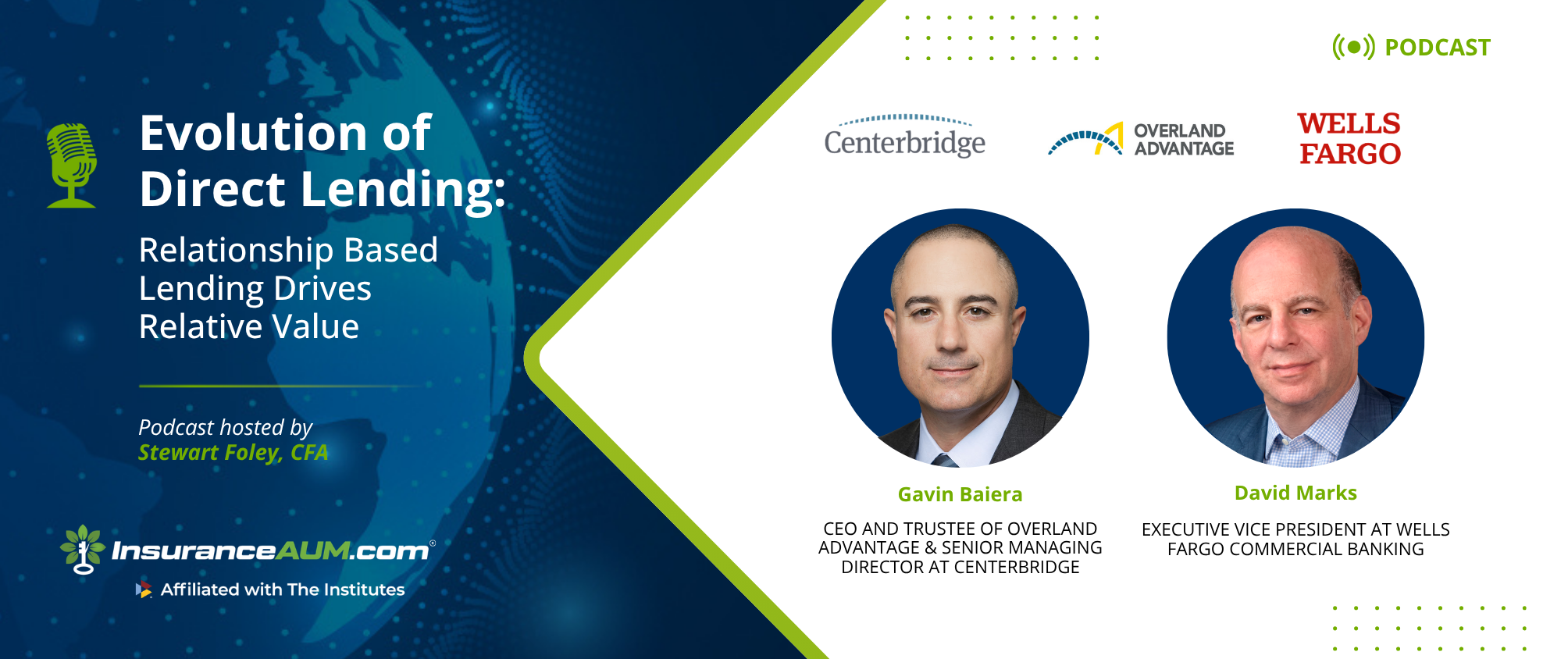
Evolution of Direct Lending: Relationship Based Lending Drives Relative Value

Image
IAUM_Podcast_E383_Centerbridge_Web


Stewart: Hey, welcome back to The Home of the World's Smartest Money. This is the InsuranceAUM.com podcast and I am Stewart Foley, CFA. I'm your host and we're thrilled to have you with us today. We are here to talk about private credit, but not in the usual manner. One of the biggest questions in private credit today is whether the asset class can continue to deliver attractive risk-adjusted returns as more and more capital flows into this market. This is absolutely, I think, on a lot of people's minds right now. And the question really gets down to if everybody is chasing the same sponsor-backed transactions, where does the next source of relative value come from? So our guests today believe the answer isn't simply better underwriting, it's better relationships, which leads me to the title of today's podcast, which is The Evolution of Direct Lending: Relationship-Based Lending Drives Relative Value.

And today I'm joined by Gavin Baiera, Senior Managing Director at Centerbridge and Head of Performing Credit and David Marks, Executive Vice President with Wells Fargo Commercial Banking. Together they helped build Overland Advantage, a direct lending platform that combines one of the country's largest commercial banking franchises with one of private credit's most experienced investment teams. Gavin and David, welcome to the show. We're thrilled to have you. I don't know how close we are to 400, but we're getting close to 400. So welcome.

David: Well, thanks for having us today.

Stewart: Yeah, we're thrilled. It's good. I'm going to start off this way with two guests. We always kind of run through the icebreaker fairly quickly. So I'll start with you, David. Where'd you grow up?

David: I grew up in Phoenix. I thought you were going to go alphabetical and go with Gavin first.

Stewart: Well, I can do that. So, Gavin...

David: We'll start. You've mixed it up already. You've mixed it up.

Stewart: Already. We'll go with you, Gavin. Where'd you grow up, and what job would you most like to be doing if not this one?

Gavin: These are easy questions. First one, grew up in Hartford, Connecticut, home of the Whalers. That's probably the only sports team that's ever been there on a professional level.

Stewart: I lived in West Hartford for a long time. I mean, honest to God, I know that area and you will see people, you correct me if I'm wrong, you will see people wearing Whalers T-shirts to this day.

Gavin: Technically, I grew up in Newington, but it borders Hartford and probably people know Hartford a lot better. And then listen, if I was not doing this and I could pick any job, I could pick any job. There's no rules.

Stewart: No rules.

Gavin: I'd be the GM of the Dallas Cowboys. I just need the first $15 billion to buy the team and then I could appoint myself GM.

Stewart: Well, you never know. We might have a source of capital here before it's over with. David, how about you? Where'd you grow up? I know some folks in private credit. So, where'd you grow up, David? If you're an executive VP at your place, I mean, that's a good gig, right? But if not that one, do you have any passions? GM of the Dallas Cowboys would be pretty fun.

David: Well, I'm a Vikings fan and I grew up, I was born in Minneapolis, but grew up in Phoenix, so I'm going to stay out of the front office of football because all I know is a lifetime of disappointment.

Stewart: Oh, Lord.

David: But my first job, Stewart, was actually being an umpire for baseball when I was growing up in Phoenix. And if I could go and do something all over again, I think I'd like to be a referee in basketball. I played a lot of basketball growing up and I'd love to be doing that versus some of the things I do here at Wells Fargo.

Stewart: That's awesome. It's funny, I'm somewhat familiar with the Minneapolis area. My daughter's mom and her family have a place, they're from Edina and they have a place up in Leech Lake across the bay from Walker, Minnesota. So I'm familiar. So let's talk a little bit about why now. So private credit has grown dramatically, which has been well documented on this podcast and others over the past decade. So can you talk a little bit about, first of all, what is relationship-based lending? And then why is it becoming more important? It's interesting that a lot of folks have come on this show and they've said some version of banks are out of this market, so all this private credit has rushed in. And so we know that bankers have a different relationship than that, and this seems like a natural fit, but can you talk to us about how it's evolved and exactly what we're talking about today?

Gavin: This took a long time in the making. So we had an idea around this. Actually, Jeff Aronson came up with the idea around relationship-based lending versus transactional. What does that mean? When you're a sponsor, you kind of go out, you do transactions to deploy capital, and at the end of the day, you make it as competitive as possible. You basically, what people call it is grid it up. You put all the terms that you want on a piece of paper and you ask everyone to match those terms or exceed those terms. Relationship lending is different in the sense that decisions are being made based on how you've been treated over a long period of time, what other products you're buying from the bank, they care a lot less about IRR because they're not looking to sell their business or be in the top quartile for a fund in order to raise the next round of money.

In a lot of cases, these businesses are not for sale. It's their most valuable asset. They've put all their sweat equity into it. They might be the first, second or third generation running the business. It's how they think about generational wealth for their family. And they actually care a lot more about having a partner who's going to help them grow the business, expand it in the right way, and they actually look at leverage as something that they usually want to minimize, not maximize. So private equity will lever it to the absolute max they think is prudent in order to generate the best IRR. These owners of businesses, they're actually trying to borrow the least amount they can in order to think about what I want to accomplish. That's why I'm borrowing the money, not necessarily generate a return.

Stewart: Yeah, I'm intimately familiar with this concept and I'm first generation college student, first generation entrepreneur, first generation a lot of stuff. And I think you're exactly right. The thing that I think is certainly lost on the financial institutions that I've worked with is that those folks are darn good banking customers. They are high net worth individuals and they are good business people. And the wealth management side of banks seems like there'd be a good opportunity there. So let's talk a little bit about, there's a lot of people that have come on this show and they say the following. We do sponsor-backed deals, da, da, da. So there's a lot of competition for sponsor-backed deals and folks will come on and say, "Hey, we've got great relationships with our PE folks and we've done a lot of these deals," and so forth. Talk a little bit about what investors are overlooking about founder and family-owned businesses.

David: I think that having been around the commercial banking client base for over 35 years, Stewart, one of the things that borrowers look for are more choices. And I think that's one of the things that's not well understood because why would a family-owned business want to borrow from a private credit lender? And the reason is over time, those companies have been like larger companies. They want more and more choices. I mean, it's actually no different than our own life as consumers. They want to know what's available. And so over time, what banks have been able to do is deliver more types of financing options. It started with traditional cash flow loans or real estate loans, and then the institutional markets became available to larger companies. But look at where we are today and you look at the growth in private credit. We had clients who look for more choices.

And I think that when we study what the market is, one of the things I think your listeners would benefit from is understanding what's in the head of the borrower too. Why do they want to enter into a transaction? And to Gavin's point earlier, they don't think about that last basis point of IRR. They're thinking about choices as they build that business, maybe even for the next generation of their family.

Gavin: They're running the business day-to-day. You're negotiating with a CEO and their allocation of time is much less focused on the financial transaction in terms versus actually running the business. That is the big part of their job. That's what they actually like doing. A lot of times they'll move out of speed to closing. That's way different than what you'd see in a sponsor deal because again, they're focused on day-to-day operations, not necessarily the financing transaction.

Stewart: Yeah. And I mean, I think one of the things that we do here is educational. And from an investor's perspective, I need to figure out what's different about one opportunity versus the other. And so one of you comes out of banking and one of you comes out of traditional institutional private credit. Can you talk a little bit about how combining those two perspectives produces a better outcome for or potentially a better outcome for an investor?

David: Maybe I'll start with how the transactions are actually originated. Think about a middle market business in Tacoma, Washington. They want to do a major expansion and includes buying out one of their shareholders, a family member, but also opening up a new manufacturing facility. And so if you think about how they used to do it, Stewart, they would say, "Well, I can go to my bank or I could maybe raise equity from myself or from my own family." But what we have today to offer that borrower is a choice. And what's the difference between a bank loan and a private credit loan when you put yourself in the shoes of that borrower? Well, generally it's covenants and it's also amortization. And so that borrower gets to look at a choice of how to finance that very, very important transaction. And then they get someone like Gavin and his portfolio team who do diligence side by side with a commercial bank.

And maybe Gavin, you want to hit on how that works and how investors think about that aspect.

Gavin: I think the key piece is you have to know how to work with middle market companies. It's different. In a sponsor transaction, there's an equity component that's being put in. And so a lot of people base their valuation based on the check that's being written by the sponsor. Here, there's not a check necessarily coming in or maybe it's only a portion of a check because they've already put money in or built this over time. And you have to really understand the questions to ask. You have to be able to do the data and break it down yourself. There's not usually a pretty CIM or package that necessarily comes with that like it does in a sponsor deal. You're not underwriting the sponsor thesis, you're actually underwriting the business. And the good news is that when you have a sector-focused underwriting model, which we do, I think it allows you to dig really deep into those sectors and be able to have an opinion on the stability, the durability of the business model and the cash flows, which is ultimately what we rely on to pay us back.

And then to David's point, we work side by side. You get one term sheet, one proposal, one diligence list. And I think that matters to the client experience. It looks coordinated, it looks like a partnership, and that's what I think they're expecting at the end of the day.

Stewart: Yeah, it's interesting. I mean, when you have a business and you own it or your family owns it, you are not going to leverage to the absolute max. I would argue, and believe me, I'm not getting paid one way or the other, but I do think that the risk profile, I mean, these folks have a lot of skin in the game and it's not just financial skin on a balance sheet. It's like the family depends on it. Several people in the family might work for it. I mean, who wants to fire their daughter-in-law? So it's no kidding.

Gavin: Well, Stewart — it's not a fund. This isn't a fund. You don't have 15 vintages, you don't have 15 investments in every vintage. If I don't do well on this investment, I can do well, make a two-bagger, three-bagger on the next investment. That's not what this is. This is your generational wealth across multiple families. Like you said, generations may be relying on you. A lot of times there's multiple ownerships across the family. One person in the family may have emerged as the leader of that and act as the operator day-to-day. But there's often brothers and sisters and cousins all relying on that family.

Stewart: Yeah.

David: And they have the benefit of having operated through cycles and oftentimes with the same bank through those cycles. So they're not trying to maximize leverage every single day, but they do want to pursue important strategic transactions. And bringing private credit to family-owned businesses is one way to do that.

Stewart: Yeah, it makes a lot of sense. Both of you have spent decades watching lending markets evolve, and we've all been at this a long time. And I have not in my entire career ever had anybody say, "Well, this is an easy environment. We're good here. This is super simple." Everybody always says the same thing, which is, "This is a challenging environment." But this is a challenging environment. You've got higher for longer is the way folks are talking. You've got geopolitical things happening that are difficult to predict to say the least. Do you see anything, any patterns that are repeating or anything that is fundamentally changing this time around versus other cycles you've seen?

David: Well, I'm the person, Stewart, who's predicted five out of the last two recessions. And I come at it from a credit background as does Gavin. So it's pretty interesting. But one of the things that I'm observing is the lack of talent that exists in a lot of places with people who've been through cycles. That's at the borrower level, that's at the bank level, that's also at the investor level. And so I worry about that longevity and the reliance of models more than people who've done liquidations or people who work with clients to get them to the other side and people who think about risk-return.

Gavin: The last real recession we really had was the GFC. I mean, COVID really wasn't that. Obviously the government stepped in and put so much stimulus in. You could argue consumers were spending more than ever before.

Stewart: Yeah. It turned out to be a stimulative event that resulted in a fair amount of inflation, which is—

Gavin: Tremendous amount of inflation on every asset class. But I think David's right, you have to live through some of those workout moments and have experienced it to understand how bad it can get and for how long where you have multiple years where things are depressed.

Stewart: And I think to David's point, and I'm a little bit of my heart on my sleeve here, but major corporations have a nasty habit of firing their most highly compensated employees and hire cheaper ones. And so when you do that, you're firing the experience that folks have earned over time. So I'm with you. I think that I got a lot of gray hair and obviously I value experience, but I think David's making a great point there about how many people... I mean, we talked about, I did a podcast yesterday, we talked about this. It's like how many folks were around during the GFC versus how many... And you look at it since the GFC, we've had a very benign credit environment and it's like it's easy to forget.

David: No, that's right. When you think about, again, that family business that's gone through multiple cycles and think about how they had to operate during COVID, they didn't know what was going to happen. None of us knew what was going to happen. But as the business has moved from one generation to another, not in all cases, but in a lot of cases that knowledge passes. And as people think about underwriting, you're underwriting the financial profile, but you're also underwriting that management team and how they've operated during those periods. I think that's super, super important.

Gavin: Yeah. I'll give you a little microcosm. Probably around February of this year up until maybe about a month or two ago, a lot of the founders kind of went like this to us. You know what? We're going to take a pause. We got a war going on. Oil's at 110. I'm not doing my expansion project. I'm not going to transact right now. I want to wait and see what happens. And now that people have gotten used to the on-and-off conflicts and oil's certainly way, way, way down now. But at the end of the day, now they're starting to say, okay, I know what the operating environment is going to be like. I'm willing to take a little more risk. But in moments where there's a lot of uncertainty, they're the first ones to dial back. And the reason why is, again, they don't get paid to do transactions.

That is not how they're rewarded. They're not making a management fee. There's no incentive fee. They don't have a deployment target. That's not the way they're operating. That is certainly the private equity model. There's nothing wrong with private equity, by the way. We finance private equity transactions. Of course. And Centerbridge has a private equity business. So there's nothing wrong with it, but it is a smaller part of the universe people don't appreciate. We believe there's 300,000 middle market companies out there in the US and maybe 15 to 20% are private equity-owned. And the rest of them are owned by founders and families. So big opportunity there.

Stewart: Well, you're touching on something that's very important, which is, and the Fed can't. I mean, when you've got PhDs in economics making, it's in the data, whatever. It's like, listen, man, at the end of the day, I know a bunch of people are just exactly what you're saying. People are not going to face a lot of uncertainty, that things are not forecastable. If inflation's going to be 27%, I can live with that. I can figure it out. But if I don't know what's going to happen next, I'm not going to risk my family's business. And the other thing that people lose sight of is that if people don't feel good about their job, they're not going to go buy a new F-250 either. They're like, "My truck's good enough. I can make it work." And so that uncertainty creates slowdown just by nature of people's risk tolerance changing a little bit.

I don't know how to quantify that, but what you're talking about is very real, at least in my opinion. And the way that I behave, the way that others behave is certainly consistent with that, I think.

David: Think about that from an investor's perspective when they're underwriting a transaction. And we both like private equity, we both like family-owned businesses, but take it down to financial covenants for a second. A family-owned business, when they think about EBITDA, it's EBITDA. A private equity firm has adjusted EBITDA. Take that down to a financial covenant. Why is a family-owned business comfortable with a covenant set at maybe four times EBITDA? Well, first of all, it's four times or four and a half times real EBITDA. Because in their mind, they're thinking of how do they operate that business? And they know if they get above four or four and a half times, that could be problematic. The mindset of a private equity firm is I want maximum flexibility. And so when you get to that period of uncertainty and when you start doing diligence, and again, I sound like a dinosaur credit person, but it's really peeling back those definitions, those terms, and asking yourself the question, well, why is it different and what should make me more comfortable or not?

Gavin: Founders never ask for... They never ask for, "I want the ability to do liability management." They never ask for that. Every sponsor wants that. They want to be able to move the collateral, be able to do something where they can borrow more money against the same assets. That doesn't come up when you're financing founders. They don't even think about that. That's not how they think about managing the business.

Stewart: Because at the end of the day, the founder's got a lot more risk on than you do every time.

David: That's right. And look, they're smart people. They're sophisticated at running their business. They run their business so well, but it's not about financial engineering.

Stewart: I think that's so true. And I think a lot of the things that we learn and teach in finance are not available without being a certain size. And so I think what you're saying there makes a ton of sense. I want to focus, and you touched on it, Gavin, a little bit. I want to focus a little bit about where the opportunity is. And so at our annual event that happened just in June in Chicago last year in '25, so the LP set the agenda entirely. And in '25, there was a lot about private credit, but there really wasn't anything about AI. This year, AI was all over this agenda. So the market is talking about AI. There has been a lot of insurance capital come into this market. I would argue that the insurance industry is financing the growth of the US economy largely because it's a good match for the...

Let's not forget, and I think there's a lot of folks who sit around going, we're running an investment vehicle here. It's like, no, you're not. You're running an insurance company and at the end of the day, you've got liabilities. But there's a tremendous amount of insurance capital that's come in here. There's been a big bunch of BDC growth and then there's changes in banking regulation. Where do you see the greatest opportunity, not only today, but if you can dust off your crystal ball and tell us where you think we're headed?

Gavin: In terms of markets or for insurance companies?

Stewart: Just opportunities.

Gavin: Okay. I'll break it down into a couple of things. Insurance companies, I think the opportunity to deploy into a new market is kind of attractive to them. I think the asset class, no question insurance companies like direct lending. They like the asset class, they like stability, they like the cash flows, like the current yield of the product. It rates out well for them. What they don't like, I think overall is just it's become very beta and a lot of overlap inside their portfolios. And so I think this opportunity to get to this non-sponsored marketplace, and I mean that in the broadest sense, I just mean companies that aren't necessarily in their portfolio today and just have more diversification is the biggest opportunity for them. And it's the biggest opportunity for direct lending. What makes it hard is getting to those companies.

Stewart: Exactly.

Gavin: David will talk about it, but in the commercial bank, they have thousands of customers. You can't just walk up and down Park Avenue and cover 50 people, 50 sponsors. You have to get out in the local market and deal with local players operating in those markets. That's very hard. And really the only reason why it works is because Wells Fargo's selling lots of different products to those customers. You can't just sell one product because they don't transact enough to make that one product work from a coverage model. So I think the biggest opportunity for insurance companies in the direct lending space is finding new customer bases and diversifying their portfolio and their risk away from beta. I think that is the biggest opportunity for them. In terms of the broader economy, I mean the biggest opportunity is clearly the expansion in AI and what it's going to mean to everyone.

And I think there's lots of confusion around whether it's going to mean nobody has a job anymore or it means you're about to have the biggest efficiency boom since the internet. And those are the two opposite ends of the pendulum, but I really do believe that's where the biggest opportunity is. I'm more on the efficiency side. I actually believe that humans will still have a job, but I think that is where the market is questioning today. And there's lots of fear that revolves around it every day, no bigger than probably in the software space where people have gotten very, very nervous about what they've lent, both on an investing side from the private equity standpoint, but also on the direct lending side.

Stewart: Yeah, I think it's really an important point that you make, which is it's an opportunity to diversify. And I believe your point is very well taken, which is that these are not companies that have been purchased by private equity. These are people who are running their own business. And commercial banks are great at those community relationships. I mean, there's banks all over the place. To your point, the whole concept of tying the two together, at least from my experience, makes a lot of sense. The other thing too, I suspect, and I don't want to put words in your mouth here, but when you've got a commercial banking relationship with a business over time, you know that business. It's not that you're just showing up one day and you're just looking at their financials and trying to make a credit decision.

The local bank has known that business for quite some time typically, I would think. Is that true, David?

Gavin: Our best deals come from a commercial banking deal that's been done by Wells Fargo that's on their balance sheet. They want a little bit more leverage and they want to move to a private credit solution. They want to get away from what David talked about, which is a straight line amortization model. Those are by far our best deals, no question about it from a risk-adjusted return standpoint. And David could tell you, but I believe it's something like 10 years on average is a typical relationship with the bank. So they're long, they're sticky.

Stewart: Yeah, it makes a lot of sense.

David: I mean you have a business, Stewart, put yourself or your listeners put yourself in the shoes of that borrower. So they want financing, but they also have a need for their treasury management, their operating bank accounts.

Stewart: Absolutely.

David: Well, that's a real pain to change, right? Because you're running your business, you're growing, you're trying to pursue a strategic transaction. And if you can't work with a commercial bank who works with a direct lender, well, you're forced to move those services. And that creates risk because a lot of times those are connected to ERP and accounting systems. And so how do you make it easy? And I think from an investor perspective, when you think about the opportunities and you think about, well, how do you look at all of these clients? They're all over the place. They're run by family/founder. Aren't they all different? Well, I think it comes back to just basic credit, doing the basic work. What pays back loans? Cash flow pays back loans. And in markets where there's such opportunity, sometimes I worry that people lose sight of that basic work.

And it's something where you have that banking relationship, you know that over time.

Stewart: Yeah. I mean, it's true that adjusted EBITDA is not the same as cash flow.

Gavin: Doesn't pay the bills.

Stewart: Does not pay the bills. So one of the things I like to ask... On this show is I know that sometimes I have a historical view of an asset class or a situation that isn't accurate anymore or has evolved. This segment has evolved and is evolving. So are there any common misperceptions about direct lending that you see that maybe they were true and aren't anymore or anything that has shifted that you'd want our listeners to be aware of?

Gavin: I think the biggest thing out there right now, the misconception is that portfolios are having problems because people want redemptions. That may or may not be true. It's certainly case by case and what is inside that portfolio. But I think if you really go back to what's happened there, a product was sold to the retail market where they probably didn't overemphasize the fact that you could be capped at 5% redemptions. They probably said you get invested immediately and you have the option for liquidity. And now there's a lot of noise around: was this a real problem? Is it a problem? What's happening? And I think there's a misconception. Nobody's changed the rules. People are gating because that's what the document allows them to do and they have really no other choice because there's no way to solve the rush on the bank. We've all seen it before.

It just keeps coming. People have tried to make above the 5% redemptions and all that happened was they got even more redemptions next time because they were the source of liquidity versus an alternative. And so there is a little bit of a misconception out there. It is not a liquid asset class. It is just not. It will never be. And so it was sold a little bit that way. I think it was called semi-liquid; that was the way people phrased it, but no one really knows what that is. You're either liquid or you're not liquid. And this is definitely an illiquid asset class. It doesn't mean it's not a great product and it doesn't mean every portfolio is going to have problems, but it does mean that institutional investors are probably going to stay away from anything that has retail investors side by side with them for a while.

Stewart: Well, I mean, we talked about this yesterday, which is folks view redemptions as a sign of distress. I would argue that there are a lot of people in these vehicles that shouldn't have been. They just shouldn't be there. It isn't appropriate. They don't have the staying power, whatever. But for the life of me, I can't figure out why anybody buys an asset that has an illiquidity premium and then somehow or the other expects it to be liquid. It's like it isn't liquid. You're getting paid for it not to be liquid. At the end of the day, you want your money back? You need to go someplace else because this isn't the place. And then people go, "Oh, well, there's all these redemptions." It's like, “There must be something wrong.” And it's like, I'm not sure that's the case. I mean, CNBC and Wall Street Journal, Bloomberg, they get paid for headlines like this.

Let's make this as salacious as possible so we can get people to tune in. Well, at the end of the day, you scared some people into redemptions and a lot of the market, boards of directors, whatever, they see that and they go, oh, but I'm kind of with you on the redemptions aren't necessarily, it could very well be that you had retail folks that shouldn't have been in there, wasn't appropriate, whatever, it wasn't properly explained, whatever it may be.

Gavin: And the markets are different. The big jumbo market, the beta direct lending market, they had a lot of exposure to software and AI because at the end of the day, software was the biggest part of private equity for a very long time at very high multiples. The '21, '22 vintage was extraordinarily high multiples and probably 40 or 50% of the deal flow that came out of private equity, which was financed by the direct lending market. In the middle market, in the core middle market, that's not really the case because the valuations never made sense. People just didn't do that. It wasn't the same sort of exposure. And I think that's a big difference between the two markets and one of the reasons why I think you're seeing more pressure on some of that upstream market right now.

Stewart: Yeah, I mean to your point, there's a lot of overlap in the largest BDCs in exposure. So if you bought three of them and you think I've got diversification, actually what you've got is 3X the exposure on 30% of the loans. We know that. And at the end of the day, when you've got billions and billions to deploy, you've got to do bigger deals. And so that all makes sense too.

Gavin: Easiest way to grow is to put more dollars out per deal, not find more deals.

Stewart: Right. Yeah. So just to wrap, what would you most want our insurance investor audience to understand about direct lending, where it's going to head over the next five years or whatever it may be?

Gavin: Yeah, for me, I mean, I think my view on direct lending is it's a really good asset class. It serves an important purpose in people's portfolios. It's a yield-oriented product. It's not a capital appreciation product. I think it fits very nicely in the insurance environment in terms of what should be part of their portfolio. And where do I think it's heading? I think there's just going to continue to be growth in the product and where the reach of it is. I think there's a pathway into this non-sponsored market. It's an enormous market. It's probably three to four times the size of the sponsor market. And ultimately we think that there's going to be an opportunity to deploy significant dollars there. So I think it's headed in the right direction. This vintage is probably better than the last vintage. If you're willing to not look at all the noise, you're probably going to have a lot less overlap.

You're probably going to have a lot less exposure to software. I think people are, because there are some portfolio concerns, they're probably going to be more diligent in how they think about underwriting and cushion and coverages. And so I think this is probably a better environment. We always tend to think that when everyone else is worried or running, at Centerbridge, we always view it as a better time to deploy than when everyone else is excited and spreads are tightening. So I actually think it's in a good spot right now if it's something that fits within your portfolio.

Stewart: That's what we call smart money, right? That's the way to do it.

David: Exactly. And I guess the question I would want them to answer is why? So why did direct lending grow as fast as it did? Well, there was a regulatory environment that fostered the growth of direct lending out of the banks. But looking forward, and I'd ask them to think about why does the borrower choose one option or another? And when we think about that non-sponsor market, which I can appreciate how it's so hard for insurance companies to touch in this type of activity, what I would tell them, the “why” is that borrower expects more choices. Not a desire to lever at the max point, but they want another choice. And that choice I think is going to drive more opportunities and more growth.

Stewart: Well, and here's the other thing I think founders and business owners value relationships and they value the relationship with their bank. And to your point about I've got my commercial banking with you. All my bill-paying stuff is connected to that account. All my accounting systems are connected to that account. And I know you. I know you, David. I'm going to come in, I'm going to shake your hand and whatever.

David: That’s part of the “why.” That's part of the why that's going to drive that growth.

Stewart: And there's comfort in that. There's comfort that feels like, hey, you're not going to do something that's going to damage our relationship. So makes a lot of sense. I appreciate the education. It's been a great education on this topic, and I really appreciate you both. I got a couple of qualitative and fun questions for you on the way out the door. So you both had a lot of experience in this space and in the financial services arena. What characteristics are most important when you're adding members to your team? And I'm not talking about what degree or GPA, but are there characteristics of people that you find that work out better in this industry than others?

David: Well, the single most important one to me is curiosity. Because the question that I ask whenever we're going through a credit is "How do you know?" Because that'll tell me the diligence, the thoroughness of the analysis, but also questioning what could go wrong versus telling me what could go right. And so that curiosity is at the very top of the list for me.

Gavin: I was going to say being a skeptic. In credit, at the end of the day, you're always looking to just get back par. You're not going to be able to make three times your money. No, that's right. And so making sure you're searching for all the reasons not to do a deal just as much as the reasons to do a deal are very, very important. And it's easy to get on board with what the company's saying or listen to the pitch and the story, but being a skeptic and a reporter and digging is really the most important part of the job because in credit, really, the goal is you just really can't lose a lot of dollars in order to make the model work.

Stewart: Yeah, you make it in basis points and lose it in percentage points. That's credit in a nutshell. So all right, last one. Dinner for four. You're both — the two of you. And when we have two guests, you get to each choose one person to join you. So dinner's on us. Who would you most like to have dinner with, alive or dead? And so Gavin, just so we're all, it's you, David. David's got one guest coming and you've got one. Who are you inviting? And by the way, your answer earlier about what job you would want, I suspect may have some influence on this answer.

Gavin: It does not sadly.

Kidding. Okay. No, it'd be Elon Musk for sure. No question about it. I think he is the smartest individual probably on the planet sometimes to a point where it can be scary, but I think literally being able to pick his brain and understand what he's thinking is going to happen would be the most interesting thing. He's been able to literally found four companies, all of which are leading in their category and the things he's been able to achieve where you look at and say, "Okay, yeah, sure, you're going to create an automobile company that's going to compete against these big existing platforms here in the US and outside the US." People were very skeptical; obviously, able to do that. PayPal, able to do that. And obviously now SpaceX. I don't know. I'd listen to everything he has to say. I'm not sure I'd agree with everything he has to say, but I'd be very intrigued to find out what he has to say.

Stewart: I've seen a video of those rockets re-landing on the pad. And I'm like, okay. The four-year-old in me goes, “Wow.”

Okay, David, who's coming? It's you, Gavin, Elon Musk. Not that Elon is going to influence your decision, but who's coming with you?

David: And I'm going to disappoint two people incredibly with this answer. I'm going to disappoint my oldest daughter and my son because I'd like to bring my youngest daughter who's 25, because she just is so unwilling to understand what it is I do. And I would like nothing more than for her to watch me. It's too much to ask that she say, oh, that's really cool and that's really good. But I would love my 25-year-old daughter, Eliza, to actually observe me in the work environment and hopefully something would rub off.

Stewart: I can really relate to that. Maggie is, and I told her to apply, but I did not do anything to get this done. But she's an intern at InsuranceAUM this summer. And she sent me a screenshot that she was watching an educational video that I had done. She took a screenshot and sent it to me. And I'm like, you know what? It is true that she's seeing me in a different light and it's super helpful. So I can really relate to that.

David: Well, what I can't do though now is ask Ella and Evan to watch and hear me calling out their younger sister, but I'll have to figure out something for them since they don't get to have dinner with Elon Musk or Gavin.

Stewart: The chances of them listening to the podcast to this point is reasonably low. So you're in good shape. I really appreciate you being on, both of you. Thanks so much for being on, guys. I really appreciate it. We've been joined today by Gavin Baiera, Senior Managing Director at Centerbridge and Head of Performing Credit and David Marks, Executive Vice President with Wells Fargo Commercial Banking.

Thanks for being on today, guys.

David: Thanks for having us.

Stewart: If you like what we're doing, please rate us, review us on Apple Podcasts, Spotify, or wherever you listen to your favorite shows. You can also see us on video on our YouTube channel, which is growing quite well. Thank you very much to everyone who watches at InsuranceAUM Community. My name's Stewart Foley. We're the home of the world's smartest money at the InsuranceAUM.com podcast.

Share this post

Sign Up Now for Full Access to Articles and Podcasts!

Unlock full access to our vast content library by registering as an institutional investor

Register

Contacts


Image
CBP_Logo_Transparent_2

Centerbridge Partners, L.P. is a global alternative investment manager founded on the complementary relationship between Private Equity, Private Credit and Real Estate investing through the full investment cycle, and has built a unified team to invest across asset classes, sectors and market cycles.
 

Adam Hamand
Director 
ahamad@centerbridge.com
212-672-4608


View the contributor page

Sign Up Now for Full Access to Articles and Podcasts!

Unlock full access to our vast content library by registering as an institutional investor .

Create an account

Already have an account ? Sign in

Ѐ Ё Ђ Ѓ Є Ѕ І Ї Ј Љ Њ Ћ Ќ Ѝ Ў Џ А Б В Г Д Е Ж З И Й К Л М Н О П Р С ΄ ΅ Ά · Έ Ή Ί Ό Ύ Ώ ΐ Α Β Γ Δ Ε Ζ Η Θ Ι Κ Λ Μ Ν Ξ Ο Π Ρ Ё Ђ Ѓ Є Ѕ І Ї Ј Љ Њ Ћ Ќ Ў Џ А Б В Г Д Е Ж З И Й К Л М Н О П Р С Т У Ф Х Ц Ч Ш Ā ā Ă ă Ą ą Ć ć Ĉ ĉ Ċ ċ Č č Ď ď Đ đ Ē ē Ĕ ĕ Ė fi fl œ æ ß