





Victory Park Capital Advisors, LLC-

Fraud Prevention in Private Asset-Backed Finance

Image
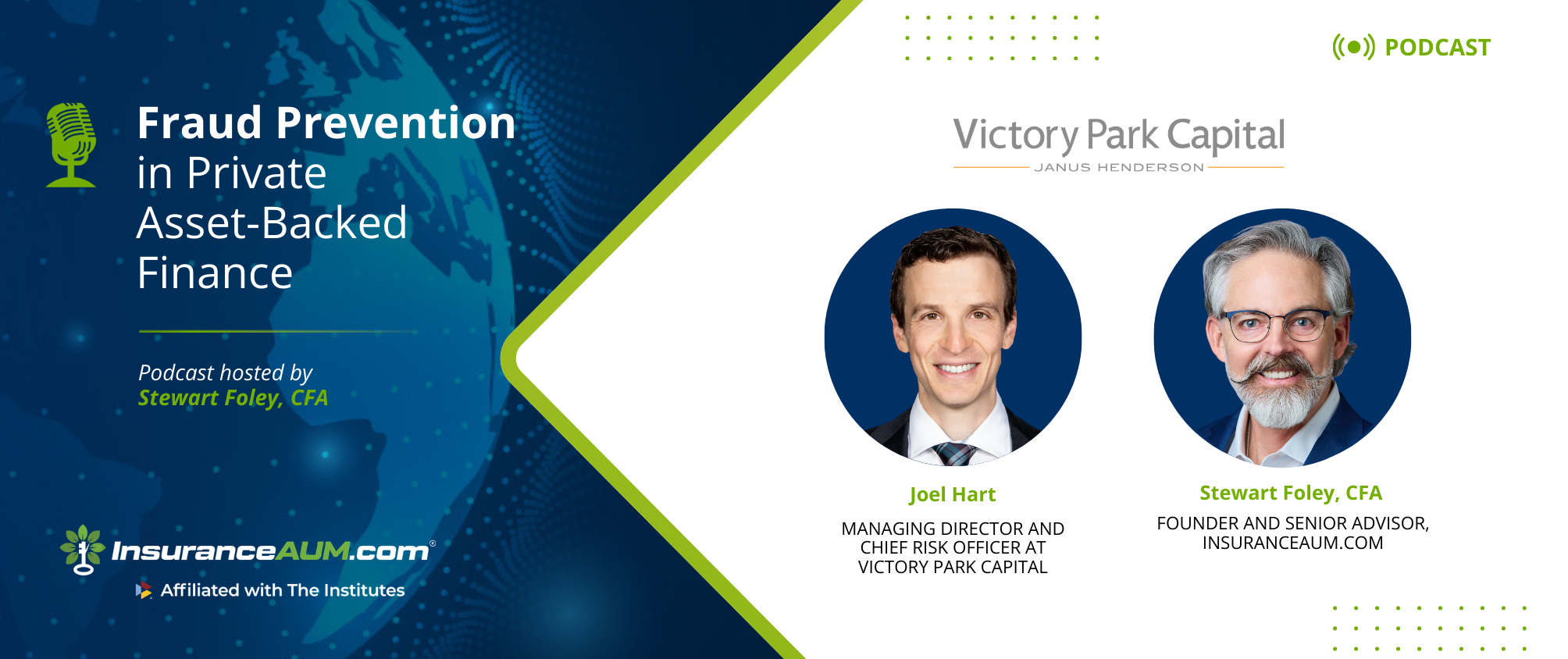
Victory Park Capital Podcast header image


Stewart: Hey, welcome back to the home of the world's smartest money. I'm Stewart Foley, CFA, Founder and Senior Advisor of InsuranceAUM.com and Principal Architect of the upcoming CIIM designation, which is the Chartered Insurance Investment Manager designation, which is the first time you've been able to really go out and I've been asked a million times like, "What can I read? What can I do to figure out how to run insurance money?" And this is really intended to be a 101, 201 kind of thing. It's going to be made up of a wide spectrum of assignments. The Institutes, our parent and educational partner, is going to be overseeing this designation. Should come out here in the first quarter of '26, and we're super proud to be bringing it to our audience and super proud to be doing it alongside The Institutes.

We're very, very humbled by that. So with that, let me get going to today's conversation, which is focused on a topic that has moved rapidly up the priority list for insurance investors allocating to private credit and asset-backed finance, our friend ABF, which is fraud risk. And I think if you ask a bunch of insurance investment folks out there and you said, "Would you rather have top decile, or would you rather have no losses and no fraud?" I think overwhelmingly the answer would be the latter because those things require detailed, extensive conversations with investment committees that can chew up a lot of resources and time, and frankly has career risk associated with it. So there's been recent high-profile cases involving double pledging, falsified collateral, manipulated reporting, which reminds us in the market that borrower misconduct tends to spike in frothy environments often right when capital is most plentiful and competition is the highest.

If that rings hauntingly familiar to today's situation, I submit to you that our subject matter expert, Joel Hart, Managing Director and Chief Risk Officer at Victory Park Capital is going to help us walk through this market. Joel oversees risk management across Victory Park Capital, otherwise known as VPC's portfolio companies from initial due diligence through the full investment lifecycle. Prior to VPC, he worked as credit risk and lender due diligence at Protiviti, advising on asset securitizations and structured finance transactions. Joel brings a rare combination of frontline risk experience and institutional discipline to this conversation, which is exactly what we need in this business. We welcome you to the show, Joel. Thanks for being on and taking the time.

Joel: Thanks, Stewart. Very excited to be here.

Stewart: We are excited to have you. We always start in the same way – actually not always the same. This is actually a little different. So the question on the table is, where did you grow up? This is a three-part question. You got to answer all three. Where'd you grow up? What was your high school mascot and what job would you like to have today if you weren't doing this one?

Joel: Okay. So I grew up just outside of Chicago. My high school mascot was the Warriors. And what job would I like to do today? It's funny. So I'm a bit of a hobbyist musician and actually in Chicago I live near a world-class guitar store called Chicago Music Exchange. And in the basement they have where they maintain old vintage instruments. And I always thought if I had six or 12 months off work, I could just go apprentice down there and learn to restore vintage instruments. It always seemed ... I don't know that I'd be any good at it to do it as a full-time profession for the rest of my life, but I always thought it'd be a great one to do just to really learn the skillset and the craft.

Stewart: Yeah, the craftsmanship. And if you've ever seen before and after pictures, like what those guys are able to do, guys in my world is not a gender thing. It's like the people who do that work, it's incredible, the craftsmanship and what they're able to do with beautiful old instruments that maybe have fallen into disrepair, but that's super cool.

Joel: Absolutely.

Stewart: Alright. So you're also an amateur rock climber, I believe. Is that a fair accusation?

Joel: That is a fair accusation. And as I joke around here, all risk professionals should have a chance to go out and go rock climbing and really appreciate that side of the risk environment.

Stewart: Yes, that is a different risk set than this. So let's just set the context. Why fraud is front and center. Recent fraud cases in asset backed lending have reinforced the idea that borrower misconduct tends to rise in stronger frothy markets. From your vantage point as CRO there, why does fraud risk escalate in these environments?

Joel: It's a great question. And I think we need to step back first and remember that at a big picture level, there's really nothing novel happening here. As long as there's been collateralized lending, there have been bad actors and there's been fraud. Just like the ones we're seeing today, though the means and the technologies and the exact modus operandi might be a little bit different. So as a lender, you really need to be constantly vigilant when it comes to risk management and collateral monitoring. And when we think at Victory Park Capital, our strategy, we've been around for just about two decades doing asset-based finance. It's what we wake up doing and we start and end our day with risk. And when you come to our meetings, you're going to feel that, that it really has to preclude through the process. And so I think it is important to say the fact that fraud exists is a reality.

And so if there was one button we could all push or one box we could all check and be sure that there would never be fraud in our portfolio, everyone would check that box and that would be wonderful. But unfortunately there isn't that box that you could check. And the only real way to minimize the incidence of fraud is maintaining discipline and a rigorous process across the board and staying constantly vigilant. And so when we think about it, I really like to start, when should we read signal and when should we read noise into what we're seeing in the broader environment? And I do think we've seen four or five examples, certainly within collateralized lending over the last several months. And to your point, it does suggest maybe a broader complacency in the market that historically you'd think is typical of a late stage bull market.

I think it's too early to say that conclusively, but definitely I think from our perspective, we're lenders, so we're always going to lean conservative and it tells us we just need to really have our antennas up and continue to be, again, constantly vigilant and avoid that complacency.

Stewart: And just for link, it's not my world. So some of these questions come from just me trying to learn. So it gets me to the types of fraud showing up today. So what are the most relevant types of fraud you're seeing and guarding against in today's ABF market?

Joel: Yeah. In terms of what we're seeing, maybe I'll hit on that and then circle back to our investment process and our risk management process. Because again, I really think it's critical for us in how we've built our processes to maintain that rigor across the board. But I think there are some themes we see across just the headlines that have come across over the last several months. And we've seen examples that someone's lending against collateral and the collateral existed, but that collateral was pledged to multiple lenders who all thought they had title to it, that they had liens over, that they had control over it, unbeknownst to them, not knowing that it was being pledged multiple places. We've seen other instances where collateral may have existed, but there was actual manipulation or fraudulent doctoring of documents to change what the value of that fraud or misrepresent the value of that collateral, including doctoring records to inflate collateral value.

And then we have other cases where you see collateral either never existed or no longer existed at the time that it was represented. And again, you look at first brands, you look at TriColor, you look at Carriox, we've seen multiple of these and the specific details may vary, but they all rhyme in a very significant way in the types of bad behavior that you're seeing.

Stewart: Yeah, it's super helpful. I do think that CIOs, when they're looking at strategies, I think sometimes the focus of the manager may be more on return and oftentimes, at least the folks that I'm familiar with are really looking at the risk and the potential pitfalls because you outperform, you're the number one performer, that gets you an added person, but it's the risk that becomes the problem. So one of the things that I think is interesting about Victory Park Capital is that you've emphasized this separation of having an independent risk function. And I don't want to speak for you. This is my understanding, but it may be different. Why is that separation between the investment side and the risk side critical in private ABF?

Joel: Yeah, it's a great question. And the reality is, at the end of the day, we have multiple mandates as an organization, as an asset manager, as do all, and that's we need to be able to deploy and earn that return, but we also need to be hyper focused on risk management and downside protection. At the end of the day, ABF is, in our mind, a defensive strategy. We are primarily focused on downside protection, resilience, and being able to provide a low volatility, consistent return to our investors through all cycles. And so that is where we need to focus. And at the end of the day, when we look at our investment and sourcing and business development teams, they absolutely are coming at an investment with a credit lens and trying to make good decisions, but they're also trying to deploy and put dollars to work.

And so having that separate function that is primarily just focused on what could go wrong, risk mitigation and downside protection, I think really allows us to be sober minded when we're going to investment committee and talking through, does this make sense at as a risk adjusted return basis? To your point, I think what we've seen others in the market, I think we really put risk management front and center when we talk to LPs. We love to talk about our processes because I agree, while we're really proud of our track record from a return standpoint, what we're even prouder of is the low volatility, the consistency, the low losses, and the ability to produce that over time that is emblematic of, I think, the processes we've built and the types of things we invest in. So that's asset selection, as well as structuring, as well as active management and monitoring.

So across the board, that's really central to what we do. So when I joined the organization back in 2014, the mandate was really to make sure that we had proper independent institutional risk management that started both in underwriting a deal upfront, but as well as continuing to monitor that deal over the life cycle.

Stewart: Yeah, it's an important point. I think sometimes you learn from what you didn't do. And my research tells me that you've spoken publicly about passing on opportunities several years ago that later became associated with falsified collateral. So I guess the question I get to is, how do the decisions to pass reinforce or does it fit with the firm's culture? And really, how do you predict that? I mean, looking forward is always hard in this business because there's things that are coming that you just don't know today. So how do you take that experience and maybe you can tell us about the story that you were speaking about publicly?

Joel: It's a great question. And I think there's a few aspects that you hit on that are really important. So first of all, I think it is important to look back and what can we learn? And for us, in terms of our process, it is iterative. It is never complete and we are always continuing to revisit. How can we learn, not just from things that go materially wrong, but even little foot faults along the way, "Hey, how do we improve our process and make sure we're iteratively getting better over time?" And so the next one continues to be better and tighter and more robust. And I think that's very important for us. And that's how we've developed both the processes as well as we've developed a lot of technology and systems and tools because we've realized over time that to really get to the level of monitoring our collateral that we need, there wasn't a system off the shelf that could do this for us.

So we ended up building out a lot of technology to assist and do that, which has also continued to evolve over time. But I think you hit on a really important point, which you can have great data and great reporting and great analytics and great tools and even a great investment process. But one of, I think the underdiscussed aspects of that is also just having the discipline to make a hard decision. And that might mean walking away from something even after you've committed significant time and resources to underwriting, and maybe you're going to get a little egg on your face with a potential portfolio company or an investor who thought that was going to close. But I think at the end of the day, you need to be willing to walk away and do that. You're correct in that, A, fortunately I can stand here and say, we've never had an incidence of in 240 transactions we've done in ABF, more than $11 billion that we've deployed in the space over the last almost two decades.

We've never had an incidence of double pledging or thinking we had collateral that was not there. And again, a lot of that is a testament to a process, not to say that it could never happen, but it hasn't. And I think we have had some situations where we have had the foresight to be able to walk away from something even when we have committed significant time. And to your point, one of the names that has shown up in the headlines was a deal that we looked at and underwrote and considered and it had some merits and a frankly, pretty attractive return. But at the end of the day, when we got to our investment committee, which is where we're deliberating, getting to that and saying, "Hey, we've done all this work and there's some things to like, and maybe it's an attractive return, but we don't think the risk profile is a fit for what we're doing." That's really critical. And being able to make that decision, I think is just from a culture standpoint, is sometimes easier said than done.

Stewart: Yeah. And I mean, I've run a fair amount of money over time in this business and even the best processes, there's still things that happen, right? I mean, things get downgraded, things go bump in the night. So what does fraud mitigation look like day-to-day at your shop once an investment is on the books already?

Joel: So one of the interesting things, and I think LPs who are doing diligence on us often are pretty surprised at just how active management of a strategy we're pursuing. They think of, especially in direct lending and BSL or broadly syndicated loans, you can write the check day one and maybe you're getting quarterly reporting, maybe monthly reporting, but there's only so much you could do at that point. Whereas in our world, we're getting data on an extremely frequent basis. We're managing these portfolios on an extremely detailed basis where we have a portfolio meeting every other week, we go through every single investment in the portfolio. What are we seeing in the data? Have we done a collateral audit, et cetera? We're very hands-on. And if we've learned one thing in our almost two decades here, it's that if there are situations where things are not going as underwritten, being proactive and reacting timely and heading it off before it becomes a real issue is critical.

And generally, we've had really good outcomes when we've needed to step in and protect ourselves or exercise our rights to foreclose or liquidate collateral because we've been timely, because we're monitoring. And so circling back to your question, again, it's a multifaceted approach, but really the honest answer is everything we're doing to underwrite that credit before close, we really just continue to do post close. And so we're doing a lot when it comes to data and analytics and reporting and slicing and dicing collateral. We're plugging into our borrower's servicing system. So whether it's a royalty deal or a small business lending deal or an equipment lease deal, we'll plug into the servicing system. So we're not just seeing a report that says, "Oh, I've got 10,000 pieces of equipment leases worth $200 million." We're seeing line by line each of the 20,000 leases and what's going on with that lease.

And we've built tools and systems internally so that we can slice and dice and monitor and manage and validate that. Now that's great, but a lot of that reporting and data might only get you so far. And so then you got to supplement that with collateral audits and really having boots on the ground where you can validate data integrity and really run that down to the studs. And I think there's been a lot of discussion there, but when we think of collateral audits, not all collateral audits are created equal, right? They're what accountants would call agreed upon procedures. So I can engage a collateral auditor and write an audit that says, go into the warehouse, look around, does it seem okay at a very high level? And they might just say, okay, without really doing the detailed work necessary to make sure you're really covering your bases.

An interesting thing that caught my eye when I was looking at the TriColor example is that they did collateral audits also, but TriColor was actually the engaging party when they engaged with a collateral auditor and they determined the scope of that audit on behalf of their lenders and then sent the report to the lenders. We're always the engaging party. When we're bringing in an auditor, we're not only the engaging party, but we're going to very specifically identify what are the things this auditor needs to look at. On my risk team, I've actually got two individuals who are prior collateral auditors that go through in detail and we will specifically look at, are they pledging collateral to multiple parties and looking at and testing out cash flows? And making sure we're looking at that, as well as looking at the internal controls of the business to make sure, do we have segregated cash and reporting requirements and best practices in place? So that you know those internal controls are sufficient on the front end.

So it's really, again, doing all the things and remaining vigilant. And it's not the one thing you could do, but when you add that all up and have that robust process happening iteratively over the life of that deal, there's a very high likelihood if there's something going on, you're going to see it and you're going to find it somewhere and see that anomaly and make sure when you see that, you need to make sure you're escalating and reacting to it appropriately and timely.

Stewart: Yeah. And so I kind of want to close with guidance for insurance allocators. And I coined this phrase, 
"home of the world's smartest money." And I sincerely believe it because it's not that insurance investors have a better crystal ball, but they have so many more externalities to consider than other institutional investment types. But even with that, nobody is an expert at everything. And so if I'm an insurance investor looking at an ABF strategy today, what are the most important due diligence questions and for the lack of a better term, watch outs that they should be focusing on? What should they be asking?

Joel: Yeah, it's a great question. And obviously a lot of our LPs come from the insurance world, and I think ABF in general really does play well to an insurance investor, but it's right. And I think if I'm coming into a new asset manager, I think a few things you really want to make sure you're focusing on. One is understanding the firm's investment process and how rigorous that underwrite is, how rigorous the due diligence is, and that they're monitoring those activities versus being passive. I think to really execute this strategy right is a really active management strategy. Secondly, I'd say, does the firm have a robust and independent risk management function? I do think that's really critical. Our management always says it's easy to put dollars out, it's making sure we get them back that's the hard part. And so I think we see folks who can deploy well, but making sure that you're pricing that risk well and you're able to recover on that, I think is important.

And having that independent institutional risk management function is really critical. And then I go back on the softer side to maybe a topic we were talking about a moment ago, which is understanding the risk culture and understanding the incentive structure for employees and understanding really, is this a shop that can demonstrate that they're willing to walk away or is it deploy, deploy, deploy? Or do they have that balance between the deployment side of the house and the downside protection side of the house to make sure there's a healthy equilibrium there? And I think going through case studies of when do you walk away from deals? When have you walked away from deals? When have you had to make a hard decision when it wasn't so obvious? And I think that can be very telling about a manager.

Stewart: Yeah, super helpful. So all right, so it's been extremely helpful, timely, a valuable discussion I think that helps our audience learn about what to ask and learn about potential sources of fraud. And so I really want to thank you for being on and lending your expertise. I've got a couple of fun ones for you out the door if you're willing, but thank you so much for being on.

Joel: No, thank you, Stewart. Shoot away.

Stewart: All right, here we go. What characteristics are most important at Victory Park Capital when you're adding members to your team?

Joel: Yeah, that's a great question. I think I'll always say intellectual curiosity because I think it is something where you've always got to be learning. But one thing I think we struggle with, to be honest, and it's hard to find folks that fit our team is a balance of technical analytical skills and real true credit chops, and understanding the fundamentals of the transaction and how to put those pieces together. And we've found that if you just get a lot of pure data scientists and then credit people and neither of them understands the other's role, it can be challenging. And so finding people that can really put both hats on, I think is often a balance we're really focused on when we're hiring.

Stewart: That's super helpful. So thank you for that. And really the purpose of the question is to get some insight into the culture of Victory Park Capital. So last one, fun one. Dinner's on us, you get up to three guests alive or dead. Who would you most like to have dinner with Joel? It's pretty wide open. I think Warren Buffett and Jesus are leaders in the clubhouse, but you can go any which way you want.

Joel: It's an investing show. So I feel like I'm supposed to say Warren Buffett or Howard Marx or something. But I have young kids, so if I can get home and have dinner with my wife and kids, I'm going to try and do that and that'll be the threesome I'll pick.

Stewart: That's awesome. How old are your kids and tell us a little bit about your kids.

Joel: I might've gotten ahead of myself. So I've got a three-year-old and actually another one on the way any day now.

Stewart: Oh, goodness sakes. Congratulations.

Joel: Thank you so much.

Stewart: Those are the days. If you look at me, it's the reason I'm gray. I'm kidding. No, it's good. My daughter's 20. She's wonderful. Just can't say enough good things about her. She's just back from a semester abroad in Austria and she's back, she's over at the University of Denver. But congratulations. That's great. Wish you all the best. Thanks so much for being on. We've been joined today by Joel Hart, Managing Director, Chief Risk Officer at Victory Park Capital. Thanks, Joel.

Joel: Thanks, Stewart.

Stewart: And to our audience, if you have ideas for podcasts, please let me know by emailing us at stewart@insuranceaum.com. Please rate us, like us, and review us on Apple Podcasts, Spotify, or wherever you're listening to your favorite shows. And you can also subscribe to our YouTube channel where you can listen and see us at InsuranceAUM Community for more great content. My name's Stewart Foley. I've been your host and we'll see you next time on the InsuranceAUM.com podcast.

Share this post

Sign Up Now for Full Access to Articles and Podcasts!

Unlock full access to our vast content library by registering as an institutional investor

Register

Contacts


Victory Park Capital Advisors, LLC

Victory Park Capital Advisors, LLC (“VPC” or the “Firm”) is a global alternative asset manager that specializes in private asset-backed credit. In addition, the Firm offers comprehensive structured financing and capital markets solutions through its affiliate platform, Triumph Capital Markets. The Firm was founded in 2007 and is headquartered in Chicago. In 2024, VPC became a majority-owned affiliate of Janus Henderson Group. The Firm leverages the broader resources of Janus Henderson’s 2,000+ employees across offices in 25 cities worldwide. VPC is a Registered Investment Advisor with the SEC. Registration with the SEC does not imply a certain level of skill or training.

Connell Hasten
Partner
chasten@victoryparkcapital.com
Direct: +1.312.663.7472
Mobile: +1.312.505.1457

Victory Park Capital Advisors, LLC
150 North Riverside Plaza
Suite 5200
Chicago, IL 60606


View the contributor page

Image
Victory-Park-Capital_icon

Sign Up Now for Full Access to Articles and Podcasts!

Unlock full access to our vast content library by registering as an institutional investor .

Create an account

Already have an account ? Sign in

Ѐ Ё Ђ Ѓ Є Ѕ І Ї Ј Љ Њ Ћ Ќ Ѝ Ў Џ А Б В Г Д Е Ж З И Й К Л М Н О П Р С ΄ ΅ Ά · Έ Ή Ί Ό Ύ Ώ ΐ Α Β Γ Δ Ε Ζ Η Θ Ι Κ Λ Μ Ν Ξ Ο Π Ρ Ё Ђ Ѓ Є Ѕ І Ї Ј Љ Њ Ћ Ќ Ў Џ А Б В Г Д Е Ж З И Й К Л М Н О П Р С Т У Ф Х Ц Ч Ш Ā ā Ă ă Ą ą Ć ć Ĉ ĉ Ċ ċ Č č Ď ď Đ đ Ē ē Ĕ ĕ Ė fi fl œ æ ß