


We're currently experiencing email delivery delays. For urgent matters, please contact us directly at lindsay@insuranceaum.com.

New England Asset Management -

From “Known Unknowns” to Quantified Risks: Enhancing Portfolio Construction & Rebalancing with Stress & Scenario Testing

NEAMFeatured

Tobias Gummersbach, Enterprise Capital Strategist at NEAM, Inc.
 

Executive Summary

Steep unrealized investment losses during the COVID-19 pandemic and the rapid rate increase in 2022 have led insurers and some regulators to refocus on stress and scenario testing. This article explores metrics for quantifying losses during periods of stress, suggesting that incorporating them into portfolio construction and rebalancing can lead to more informed investment recommendations that better align with insurers’ risk-adjusted return preferences.

Unaddressed risks in portfolio optimization: A focus on Stress & Scenario Metrics

Investment stress and scenario testing (SST) is essential for estimating potential portfolio losses and a crucial tool that supports insurers’ comprehensive risk evaluation and ongoing monitoring.1 SST metrics can combine various risk exposures – such as interest rate, credit spread, default, liquidity, foreign exchange rate, and equity risks – into a single portfolio loss estimate, despite potentially complex and scenario-specific risk dependencies.2 Although insurers are aware of these complex risk exposures, the difficulty in estimating them often leaves SST metrics unquantified in otherwise holistic asset optimization frameworks used for portfolio construction and rebalancing. When incorporated, SST can provide significant benefits, supplementing metrics like earnings risk, (Tail-)Value-at-Risk (T-)VAR, duration, credit quality, liquidity, default loss, regulatory and rating agency capital requirements and other “micro” risk metrics commonly used in asset allocation frameworks. This article highlights these benefits.

Quantifying Economic Risks with Stress & Scenario Testing

One application of SST is to quantify the expected mark-to-market (economic) loss of an investment portfolio under periods of either historical stress – such as the Global Financial Crisis, the COVID-19 pandemic or the rapid rate-rise of 2022 – or hypothetical stress scenarios that may affect insurance liabilities as well. These hypothetical scenarios are often incorporated into regulator-mandated, multi-year (liquidity) stress tests required for certain Life insurers  but are also used to assess outcomes for shorter time horizons relevant to P&C organizations. Hypothetical scenarios might include a U.S. recession, a major natural catastrophe event like an earthquake in California or geopolitical tensions, such as a military escalation between China and Taiwan. Sources for hypothetical scenarios may also be provided by Economic Scenario Generators (ESGs), where a stress scenario may reflect a particular economic or capital market simulation of interest. Since they are usually grounded in real or recognizable events, SST results are often intuitive and relatable. To illustrate, we present a case study applying both historical and hypothetical SST to a well-diversified investment portfolio of a sample P&C insurer. The insights gained from SST may uncover larger-than-expected – and potentially unacceptable – investment risk exposures, prompting the insurer to reassess and manage these economic risks as part of their strategic portfolio rebalancing.

Historical Stress & Scenario Testing

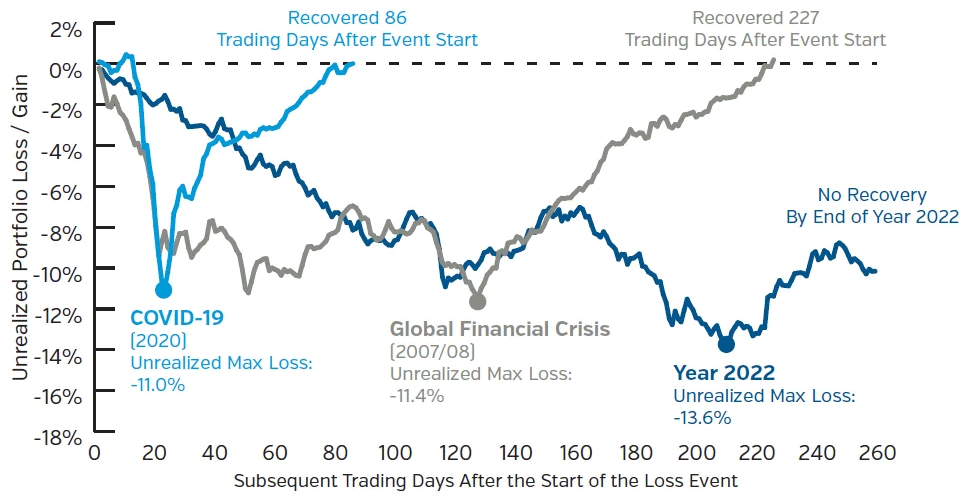
Graph 1 shows the results of a historical SST analysis conducted on the insurer’s current portfolio, with high level portfolio characteristics outlined in the first column of Table 2. The three lines in the graph track the deterioration of market value over subsequent trading days from the event start, assuming the portfolio had been held throughout the COVID-19 pandemic (light blue), the Global Financial Crisis (gray) and the Year 2022 experience of rapidly rising interest rates (dark blue). For a better comparison, all lines start at zero to indicate no loss at the start of the event, mark the maximum loss, and the time-to-recovery as the lines approach zero again.3  
 

Graph 1. Historical Loss Scenario Results for a Sample Insurer's Current Investment Portfolio
Image
Graph comparing historical loss scenario results

Source: NEAM
 

Hypothetical Stress & Scenario Testing

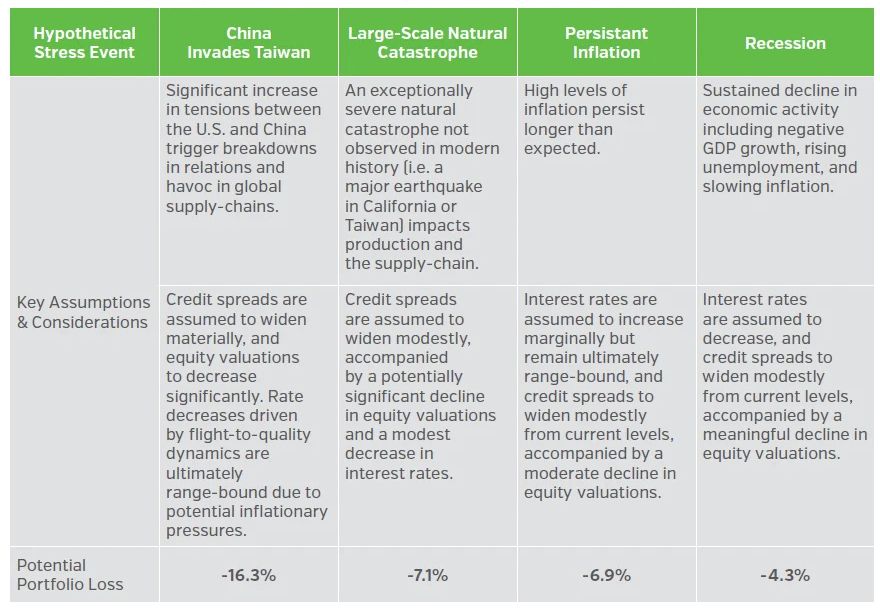
Table 1 summarizes potential losses for selected hypothetical geopolitical, natural catastrophe and economic stress scenarios.4 Each scenario estimates the portfolio’s expected market value impairment over a one-year time horizon, allowing for comparison with the historical loss outcomes discussed earlier.
 

Table 1. Potential Investment Losses for a Set of Hypothetical SSTs
Image
Table showing potential investment losses for a set of hypothetical SSTs

Source: NEAM
 

Stress & Scenario Insights Inform Portfolio Construction & Rebalancing

While commonly used in insurers’ risk management frameworks, SST can add benefits when integrated into portfolio construction and rebalancing. For example, SST can:

  • Quantify economic risks associated with different targeted levels of investment return
  • Enhance the understanding of risks that may be overlooked when relying solely on more established metrics used in portfolio optimization such as earnings risk, (T-)VAR, duration, credit quality, and risk asset exposure, among others
  • Identify key risks that are material to the insurer and refine risk tolerances to potentially better align investment strategies with liability risk exposures, and the insurer’s enterprise risk and return expectations

The next section builds on the earlier case study to illustrate these insights. We focus on historical SST outcomes as they are grounded in actual occurrences where model assumptions tend to be less subjective than those required for hypothetical scenarios.

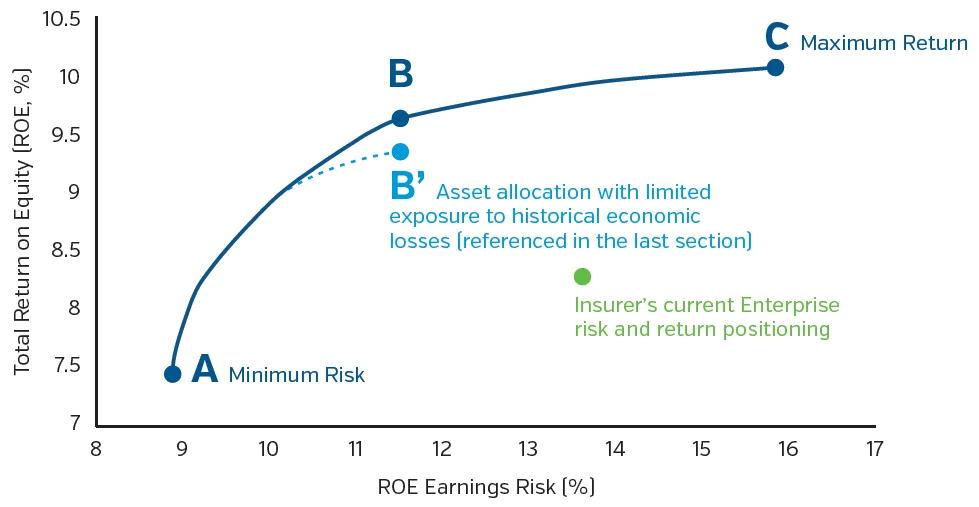
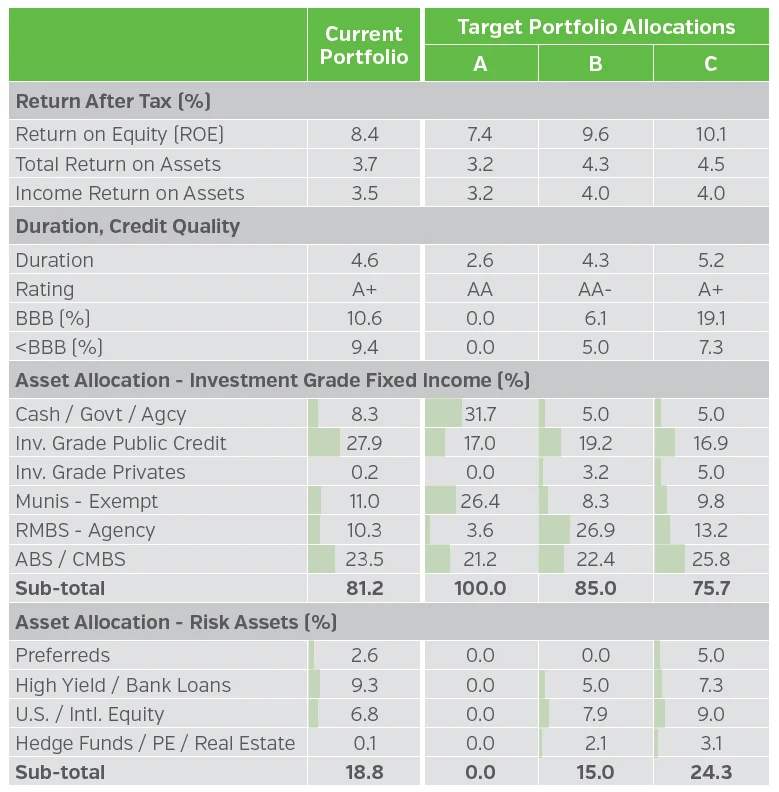
Graph 2 shows the results from optimizing the investment portfolio within the context of the insurer’s underwriting and operational profile relative to its current enterprise risk and return positioning. The blue enterprise efficient frontier identifies portfolio options that maximize return on capital for various levels of targeted enterprise risk – measured here as the insurer’s earnings volatility – and considering insurer-specific investment constraints. Tables 2 and 3 provide portfolio details.

In this analysis, Point A represents the portfolio that is expected to generate the lowest attainable earnings risk and return on equity (ROE), Point C the highest risk and ROE, and Point B an allocation in-between.
 

Graph 2. Enterprise-Based Asset Allocation Efficient Frontier
Image
Graph showing logarithmic curve between ROE and ROE Earnings Risk

Source: NEAM
 

Table 2. Comparison of Strategic Asset Allocation Results
Image
Table comparing strategic asset allocation results

Source: NEAM
 

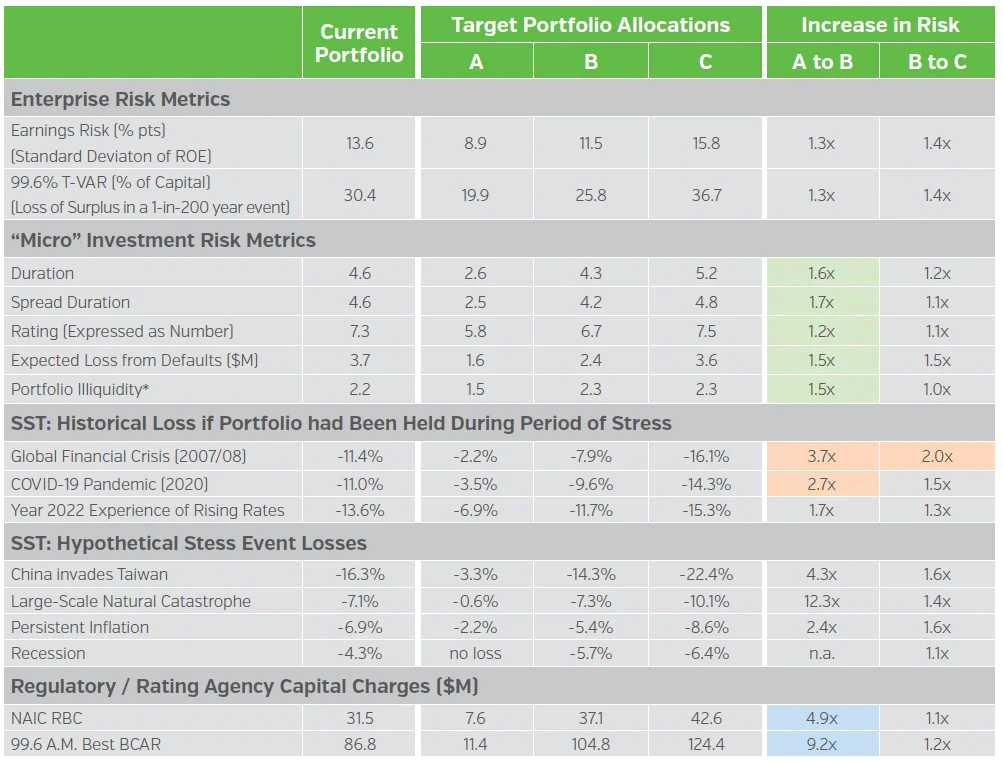
The efficient frontier shows that earnings risk increases with higher targeted ROE. This intuitive risk-return relationship varies by risk-metric and can be more pronounced when considering historical or hypothetical losses provided by SST, as shown in Table 3. Comparing Portfolios A and B, earnings risk rises from 8.9% to 11.5% (a factor of 1.3), while the risk of historical loss highlighted orange increases more significantly. The expected mark-to-market loss if the insurer had held Portfolio B instead of A during the Global Financial Crisis or COVID-19 pandemic increased by factors of 3.7 and 2.7, respectively. This increase also surpasses that of other, more fixed-income-focused “micro” risk metrics commonly considered in portfolio construction with factors ranging from 1.2 to 1.7, highlighted green in Table 3. Similarly, for Portfolio C versus B, the expected loss related to the Global Financial Crisis doubles, while earnings risk and other risk metrics increase by factors of only 1.0 to 1.5. We note that NAIC RBC and AM Best BCAR capital charges (highlighted blue) also rise significantly from Portfolio A to B. This is primarily driven by Portfolio B’s substantially lower allocation to short-term assets and U.S. Treasuries, which typically carry no capital charges.

In summary, relying on earnings risk as the primary measure of risk may have led the insurer to underestimate the increase in true economic risk and potentially – and inadvertently – exceed its risk tolerance.
 

Table 3. Risk-Focused Comparison of Strategic Asset Allocation Results
Image
Table comparing strategic asset allocation results

Source: NEAM
 

Managing Risk Exposures During Periods of Stress

An understanding of the investment risk “landscape” coupled with clear risk preferences can guide portfolio construction, asset rebalancing, and evaluating the “cost” of adhering to risk limits. Building on the earlier case study, we now assume that the insurer wants to evaluate the potential return trade-off associated with capping historical losses at 10% across all historical stress scenarios considered. All achievable portfolio options that meet the desired SST loss threshold are shown by the dotted light blue efficient frontier in Graph 2. The distance between the blue and dotted light blue frontier quantifies the return give-up, as the insurer may now target asset allocation B’ instead of B. Portfolio B’ generates the same expected earnings risk but limits the exposure to historical loss-event outcomes at the cost of a lower expected investment return and ROE. Higher returns past Point B’ are not attainable, as those allocations would exceed the allowed historical loss limits. A subsequent Perspectives will explore the differences between portfolios B and B’ that lead to the differing risk-return outcomes in greater detail.

Key Takeaways

Stress and scenario testing (SST) enriches insurers’ understanding of the investment risk landscape by measuring mark-to-market (economic) portfolio losses and quantifying often known but unquantified risks. Integrating these metrics into portfolio construction and rebalancing can result in investment recommendations that better align with insurers’ risk-return preferences. SST helps insurers to:

  • Quantify expected portfolio performance and loss during periods of pressure
  • Align investments to meet insurers’ expectations across various conditions of stress
  • Facilitate communication with boards, management committees, regulators, and rating agencies

SST transforms “known unknowns” into manageable, quantified risks. When integrated thoughtfully, it becomes a powerful tool for enhancing asset allocation recommendations, bridging the gap from risk awareness to strategic insight. NEAM can help!


Read More From New England Asset Management


Endnotes
1 SST may support insurers’ enterprise risk registers, inform Enterprise Risk Management (ERM) frameworks, and strengthen Own Risk and Solvency Assessment (ORSA) initiatives by stress-testing underwriting, investments, and operations individually or simultaneously.
2 For example, the COVID-19 pandemic presented a unique relationship between credit spreads, defaults, and (il-) liquidity: Observed credit spread widening did not coincide with an increase in actual, but rather the specter of potential defaults compounded by significant concerns about market liquidity.
3 For the sample portfolio provided, COVID-19 pandemic related maximum market value impairments happened swiftly over the course of just 23 trading days and recovered fast. Global Financial Crisis-impairments lingered longer but recovered within one year. The Year 2022 stress ended the calendar year with a loss without recovery. All scenario outcomes reflect investment income the portfolio would have earned during the duration of the stress and reinvestment of any portfolio proceeds.
4 Loss estimates consider gradual changes in key risk factors like interest rates, credit spreads, and equity valuations. Portfolio returns represent the difference between current and future portfolio market values, incorporating factors such as yield levels, the yield curve shape, and sector-specific changes in credit spreads. For fixed income instruments, returns are calculated at the security level and aggregated, while for equities, hypothetical valuation changes are assumed. All scenario outcomes reflect investment income and reinvestment of any portfolio proceeds.

Additional Disclosures
Historical Stress and Scenario Testing analysis maps Cusip level holdings of the sample P&C insurer to corresponding indices based on security characteristics such as sector, credit, duration, currency and country. Indices are weighted proportionally to the corresponding Cusips’ market values in the portfolio, and resulting weightings are held constant through the duration of the stress event. NEAM’s database of historically observable total returns for these indices, which reflect income and price changes, are then used to estimate how a portfolio would have performed if held during the analyzed stress event.​ Past results are not indicative of future results. Outcomes and drivers of portfolio gain or loss in an actual observed downside risk event could deviate materially in magnitude and relative proportions from the estimates shown.

Hypothetical Stress and Scenario Testing analysis outcomes are estimates based on a variety of potentially critical assumptions, including NEAM’s views of changes to the portfolio market value in different assumed interest rate, credit spread and equity valuation scenarios. Small changes to these assumptions may change results meaningfully.

Regulatory/Rating Agency Capital Charge analysis estimates and compares required capital across regulatory and rating agency regimes using publicly available frameworks and methodologies. While NEAM aims for a holistic reflection of regime-specific risk factors, certain elements may be excluded, and reasonable assumptions may be applied for comparability.

Strategic Asset Allocation results are estimated by applying constraints to the Current Portfolio to generate the hypothetical estimates of total returns, income returns, duration and other portfolio metrics shown in the Target portfolios. The tools’ objective is to maximize total return on equity under these constraints using a reinvestment set of generic securities and their attributes. NEAM makes no representation or warranty as to the constraints applied, or reinvestment universe, including the potential inability to execute the proposed portfolio repositioning.

The estimates shown herein are for illustrative purposes, may vary with each use of the tools used to calculate results and over time, do not take into consideration the effect of taxes, fees, trading costs, changing risk profiles, operating cash flows or future investment decisions and do not represent actual trades or the effect of material economic and market factors that are not explicitly modeled. NEAM makes no representations and warranties as to the reasonableness or completeness of any of the assumptions used in the analysis herein.


Originally published by NEAM in August 2025. This is not an offer to conduct business in any jurisdiction in which New England Asset Management, Inc. and its subsidiaries are not registered or authorized to conduct business.

© 2025 New England Asset Management, Inc.

All rights reserved. This publication has been prepared solely for general informational purposes and does not constitute investment advice or a recommendation with respect to any particular security, investment product or strategy. Nothing contained herein constitutes an offer to provide investment or money management services, nor is it an offer to buy or sell any security or financial instrument. The investment views expressed herein constitute judgments as of the date of this material and are subject to change at any time without notice. Future results may differ significantly from those stated in forward-looking statements, depending on factors such as changes in securities or financial markets or general economic conditions. While every effort has been made to ensure the accuracy of the information contained herein, neither New England Asset Management, Inc. (“NEAM, Inc.”) nor New England Asset Management Limited (together, “NEAM”) guarantee the completeness, accuracy or timeliness of this publication and any opinions contained herein are subject to change without notice. This publication may not be reproduced or disseminated in any form without express written permission. NEAM, Inc. is an SEC registered Investment Advisor located in Farmington, CT. This designation does not imply a certain level of skill or training. In the EU this publication is presented by New England Asset Management Limited, a wholly owned subsidiary of NEAM, Inc. with offices located in Dublin, Ireland and London, UK. New England Asset Management Limited is regulated by the Central Bank of Ireland. New England Asset Management Limited is authorized by the Central Bank of Ireland and subject to limited regulation by the Financial Conduct Authority. Details about the extent of our regulation by the Financial Conduct Authority are available from us on request. This is not an offer to conduct business in any jurisdiction in which New England Asset Management, Inc. and New England Asset Management Limited are not reigistered or authorized to conduct business.

Share this post

Sign Up Now for Full Access to Articles and Podcasts!

Unlock full access to our vast content library by registering as an institutional investor

Register

Contacts


New England Asset Management

New England Asset Management (NEAM) strives to be integral to the success of our insurance industry clients by providing investment management solutions through a team of skilled professionals dedicated to delivering exceptional client service. We aim to build true, enduring relationships with our insurance company clients by combining three core attributes:

Dedicated Teams    
NEAM is staffed with dedicated teams of knowledgeable insurance and capital markets professionals.

Actionable Tools    
Our combination of talent and technology is designed to support all aspects of your investment management.

Tailored Solutions    
We are acutely aware of the unique concerns and challenges insurers face on a daily basis and so these are reflected in our investment process.

Our comprehensive offering includes a wide range of services:

  • Asset Management Services
  • Enterprise Capital Strategy Services
  • Capital & Risk Analytics Platform
  • Investment Accounting & Reporting Services

www.neamgroup.com
74 Batterson Park Road
Farmington, CT 06032


View the contributor page

Sign Up Now for Full Access to Articles and Podcasts!

Unlock full access to our vast content library by registering as an institutional investor .

Create an account

Already have an account ? Sign in

Ѐ Ё Ђ Ѓ Є Ѕ І Ї Ј Љ Њ Ћ Ќ Ѝ Ў Џ А Б В Г Д Е Ж З И Й К Л М Н О П Р С ΄ ΅ Ά · Έ Ή Ί Ό Ύ Ώ ΐ Α Β Γ Δ Ε Ζ Η Θ Ι Κ Λ Μ Ν Ξ Ο Π Ρ Ё Ђ Ѓ Є Ѕ І Ї Ј Љ Њ Ћ Ќ Ў Џ А Б В Г Д Е Ж З И Й К Л М Н О П Р С Т У Ф Х Ц Ч Ш Ā ā Ă ă Ą ą Ć ć Ĉ ĉ Ċ ċ Č č Ď ď Đ đ Ē ē Ĕ ĕ Ė fi fl œ æ ß