




T. Rowe Price-

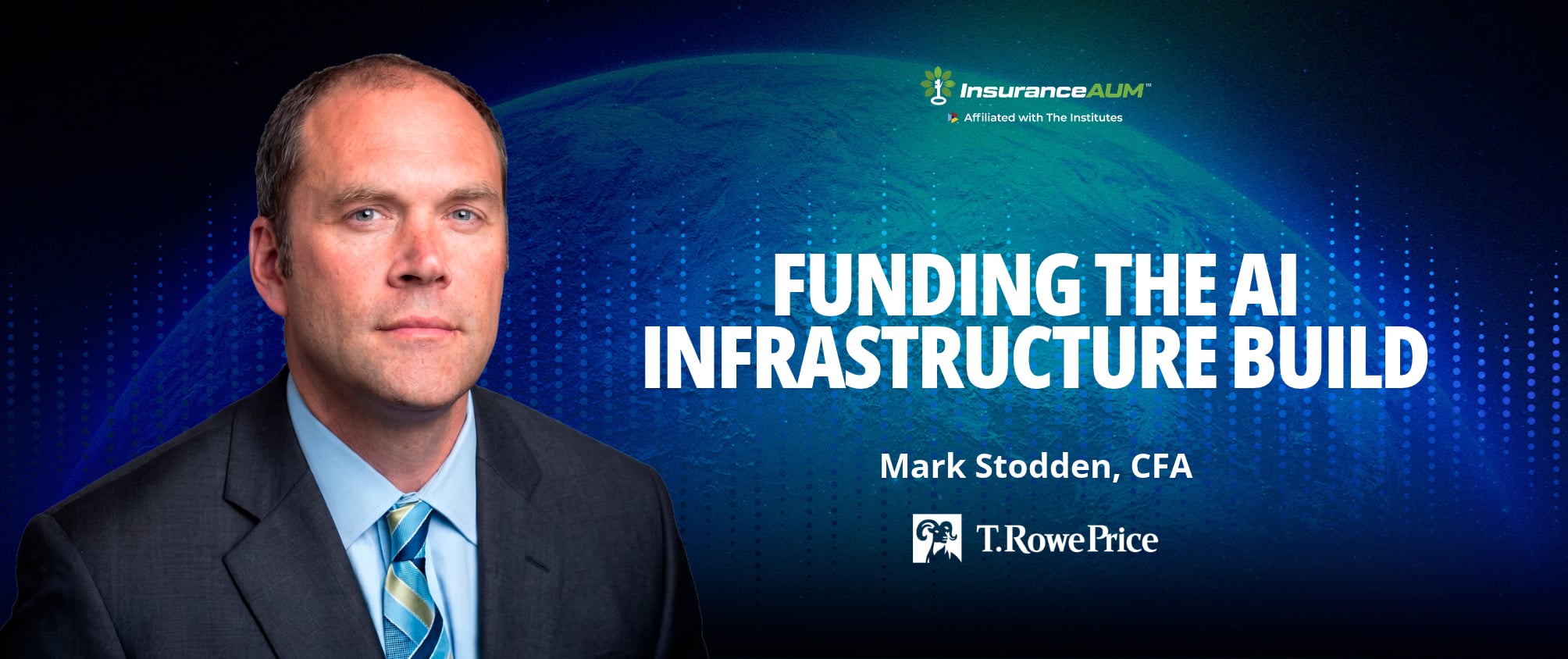
Funding the AI Infrastructure Build

Image
IAUM_Podcast_TRowe-11.18_Web_2026


Stewart: Hey, it's a beautiful day in Fredericksburg, Texas, 83 and sunny, and this is the Home of the World's Smartest Money, the InsuranceAUM.com Podcast. My name's Stew Foley. I'm very glad that you're with us today. Everybody wants to know the future of artificial intelligence (AI), but somebody has to finance it. Somebody's got to finance the data centers, the chips and the power to run it all. And this is the interesting question: What happens when the technology becomes obsolete before the debt gets paid off?

Today's episode is entitled Funding the AI Infrastructure Build. And today I'm joined by Mark Stodden, Credit Analyst at T. Rowe Price, where he covers the technology sector and leads a team of 16 credit analysts in the U.S. and the UK. Before joining T. Rowe Price, Mark spent eight years at Moody's and four years as a buy-side equity analyst. So this is what makes his background particularly interesting for today's conversation. He actually began his career as a planning engineer at AT&T in the '90s. And Mark, everybody I know that was at AT&T in the '90s retired with a mansion, but we can talk about that later. I'm thrilled that you're on. Welcome to the show.

Mark: Thank you, Stewart. It's great to be here.

Stewart: Plus, you have a great podcast voice, so this is great. So where did you grow up and what's a fun fact that your colleagues at T. Rowe would be surprised to know?

Mark: I grew up in Pittsfield, Massachusetts, which is in western Massachusetts in the Berkshires. A fun fact about me, I don't know, I did the Ironman Triathlon in 2017. It was a big accomplishment and I have not done a triathlon since, but that was something I'm proud of. So maybe that's something interesting to add.

Stewart: I'll never forget the first time I was sitting in Imperial, Missouri, and ABC's Wide World of Sports showed Dave Scott in a triathlon, and I was trying to wrap my head around that swim, that bike and that run back to back. I mean, I had never conceived of something like that. So hats off to you for sure.

Mark: Thanks.

Stewart: So the conversation starter is who's going to pay for all this? And the scale of the AI infrastructure buildout is extraordinary, I think by any measure. We're talking about the data centers, the semiconductor capacity, networking, power generation and all the infrastructure that makes AI work. How is the AI infrastructure buildout being financed today and how do you see the funding model evolving as the capital requirements continue to grow? And we've got a little bit of news in the market today. If you can wrap some of that in there, that would be super helpful.

Mark: Sure. Well, this journey began, I think it started to accelerate maybe a year ago, year and a half ago, where the scope of the investment started to come into focus. And what we observed, and this was on almost like a quarterly earnings cadence, is that the big players in AI were spending a lot of CapEx and their forward view of CapEx was rising at almost every opportunity for them to talk about guidance. They would increase the outlook, and it became clear quickly that this number was going to exceed their internally generated cash flows. So the big hyperscalers like Amazon and Microsoft and Google, et cetera, they began to shift their capital allocation. They started to reduce their buybacks and they started to lean on the debt markets to fund the cash deficit. So into the beginning of this year, we had this transition of these very lean, net-cash hyperscaler businesses transitioning to using debt and leverage, albeit at very, very low levels relative to their scale.

We also have seen capital formation through off-balance-sheet structures where a lot of the hard assets for the data center buildout, kind of like the concrete and steel part of it, are being financed as real estate investments. And these are special purpose vehicles and joint ventures that will lease the data centers to the compute operators like Microsoft or Meta. And that kind of channel has been growing throughout the year. It's gotten a lot of attention, and these are very complex, bespoke bonds that can be very big-ticket numbers, and they're sold to sophisticated investors who can really dig into the terms and conditions. And the next phase of this is, you've probably seen in the news or heard about the chip-backed funding, which is a collateralized borrowing that uses the graphics processing units (GPUs), which are the specific accelerator chips in the data centers, as collateral.

And so the chip-backed debt market is kind of the most nascent and could be the biggest segment when we're all said and done. About 60 percent of the CapEx in a data center or of a hyperscaler goes toward buying the chips and its associated hardware. And so kind of big picture, a one-gigawatt data center, which is a very large facility, costs about $15 billion to build the shell and get the power, and it costs about $30 to $45 billion to fill it with chips. So significantly more to fill the data center with all the electronics than it is to build the structure itself. And so that last channel of financing, the chip-backed debt market, is the one that's getting a lot of attention lately. It's going to be a very short-duration market because the chips have a very short economic life, and we're going to go through the pricing and the relative value, finding the clearing level on that over the next few months.

Stewart: And is that to say that if I'm a debt holder and the issuer defaults, that I'm literally going to repo the chips? That's my collateral?

Mark: Yeah, there'll be a servicer in the middle who will do that, and there'll be some rules as to how that process gets administered, similar to other securitized debt markets like rental cars or aircraft or other more seasoned markets. So the mechanisms to do this exist. We're just going to apply those rails to a new kind of underlying asset type.

Stewart: Where my brain went was exactly where yours was, which is the shelf life on a chip isn't the same as the shelf life on a Caterpillar tractor. But anyway, that's another day. One of the things that makes this interesting for our audience is that AI infrastructure is not a single investment opportunity. You can look at the company, and you kind of touched on this, the actual structure itself, the chips inside and so forth. How do you think about the different ways investors can play this infrastructure buildout and how does it change the risk profile as you move across those structures?

Mark: Well, I think a lot of this is very dynamic. So I'll start with the first funding channel, which is kind of the traditional plain-vanilla corporate bonds issued by the hyperscalers. So use Amazon as our example, a AA issuer that, because of the supply they're pumping into the market, they're printing bonds at single-A or maybe even triple-B spread levels. So this is a market technical that is flowing through pricing. The supply of bonds is driving yields and spreads wider. You can buy a 30-year Amazon bond that has a yield in the high sixes today, which is really attractive for a AA type of credit. But timing that market has been extremely difficult, and the ticket size that they show up with when they want to issue more debt is very disruptive because the scale of these companies is just so disproportionate to the credit market.

Amazon has a multi-trillion-dollar market cap, but they have $100 billion or so of bonds outstanding. So it's like a 20-to-one difference between the equity cap structure and the debt cap structure. For them, $25 billion is not a big number, but for the debt market, it's still a lot to take down in one deal. So it's been very challenging to have an accurate view of when they're going to show up and print another $25 billion bond because you don't want to buy before they issue, you want to buy after. We've ended up kind of taking more of a neutral stance on that trade because we acknowledge those yields are attractive for the credit quality, but the technical has become too difficult to get right.

On the data center piece, we actually think this is a very attractive part of the AI debt complex. These are relatively long-duration. They're kind of 15- to 20-year bonds. They have very attractive carry. So these are in the 7-percent-plus range today, and there's quite a bit of contractual protection in there. So we dig into the terms and conditions, and we have a framework where we analyze all the different characteristics, such as how long is the construction phase because that's where a lot of risk resides before rent commences. Who's the tenant? What are the terms of the lease? How easy is it for the tenant to get out of the lease, if at all? And all of those things, we kind of go deep into the weeds of all the agreements. And where we're comfortable, we think those are good bets.

On the chip-backed deals, we're having a hard time getting comfortable. There aren't a lot of deals to analyze, and I think the market is trying to really feel this out in aggregate. We've only seen one deal get syndicated in the investment-grade (IG) market, and it was a fairly well-structured deal. We ended up participating in a limited way, but that had a lot of contractual protections and actually a third-party guarantor behind it. And so that made us comfortable that we could step in, and that also priced at a significant discount to the underlying guarantor. So that's how we got there on that one. We'll see what the next generation of these deals looks like.

One strategy, we believe that the early deals in this asset class will have the most robust terms for lenders. And as more capital flows in, as investors get comfortable with the asset class, the quality will deteriorate, and then we'll be able to determine if that still meets our standards. And so that's part of our thesis on this, and the early data center deals have quite a bit of contractual protections for us. And so we think that's worthy of a basket-type approach. It's been volatile, I will admit, but we do think that the extra carry helps offset some of that.

Stewart: Yeah. I mean, I think that phenomenon is a pretty well-established phenomenon where being early in that market and rolling up your sleeves can often pay dividends. And I think that's pretty consistent with what we've seen elsewhere. So one of the things that caught my attention in the materials is that you talked about when collateral gets old before the loan does, which was a little sobering to me. We're accustomed to financing long-lived assets, and when technology gets outdated, clearly it is declining in its value. What happens when the economic life, the useful life of the technology is shorter than the debt financing it, and how should credit investors protect themselves? I know this is the center of the fairway for you, and I think it really helps our audience to understand this point.

Mark: Yeah, we've done a lot of work on this internally. My colleagues across the firm have a lot of expertise in different areas, and we have a lot of access to management teams and so forth. So very much a front-row seat as to how this is developing. And you've seen some announcements in the press from the semiconductor original equipment manufacturers like NVIDIA and Broadcom that are working to establish deep funding pools for basically chip-backed borrowing. And the way they're doing this is a combination of credit enhancement. So it's more than just asset-backed. There'll be other forms of credit enhancement that supplement the asset collateral. This could be in the form of a residual value guarantee from the chipmaker, which will cover maybe a first-loss position. You'll have subordinated tranches in the deal that'll absorb a loss and equity in the deal that will absorb loss.

And then you'll have a layer of contractual protections from the offtaker. And by that I mean the chip will be installed and then it will generate tokens, it'll process information and someone will lease that chip. That could be Anthropic, OpenAI or Amazon or Microsoft. The credit quality of the offtaker can actually offer a lot of credit enhancement as long as the contract is really tight and they can't get out of it. So a combination of all those support factors can get you to a financeable structure.

It will not be simply the collateral and the lease, like an aircraft lease, because aircraft have a very established secondary market. It's not difficult to repossess a plane, and we know what they should be worth because transactions happen and it has a 20-year economic life. A GPU has a three-year economic life, maybe, and a lot of that is very uncertain because of the pace of technological improvement and how fast new chips are versus old-generation chips. And so they could become technologically obsolete really quickly such that they're not even economic to plug in.

And that's part of where we will be very careful on what our collateral gap is in a transaction. So these deals will be amortizing deals such that they get to zero by maturity. So the refinance risk will be reduced dramatically. And really what you're trying to do is you're trying to get the amortization down fast to match that accelerated depreciation schedule on the economic life and use other credit enhancement to bridge the gap, to bridge that loan-to-value gap along the way. And there's a price at which you're willing to step into that risk, and that's what the market's going to figure out over the next six months, what that extra spread is. And it's going to be really interesting because this market could be hundreds of billions of dollars.

Stewart: Yeah, it's interesting. It's really instructive to hear you kind of step through it. You make it very clear, which really helps me. I learn it. I'm learning it too. There are other people on this podcast that go, "I'm glad you went through that." I'm like, "Me too." So let's talk about something that sounds like good news for all of us, which is the cost of compute continues to decline, which is a little like the cost of gas is declining, but I'm using seven times as much. So what is good for AI adoption maybe isn't good for everybody who finances the infrastructure. So as the cost of compute falls, who do you think captures the economic benefit and who could find themselves on the wrong end of that equation?

Mark: Yeah. Well, that's no small question for sure. And it gets to the central debate in the market today around the cost curve for compute, as you say, because in technology we have historically seen rapidly declining cost curves offset by rapidly increasing demand curves. We have very elastic demand. And so the bull case on this investment cycle is that as the cost of compute falls, so will the price, and the demand, the volume growth will still lead to overall revenue growth and profitability growth. And there's been a lot talked about this Jevons paradox, which to me is a fancy way of saying price elasticity of demand, which is a very traditional economic concept, just with a technology angle on it. And Jevons paradox is about steam engines in England in the 1800s or something.

Stewart: We can call this the Stodden paradox.

Mark: No, it's definitely not anything I invented. I only absorbed this from other conversations and smarter people at our firm. And so that's kind of the bull case, that we have the demand for intelligence and the utility or value of intelligence is such that people pay for it, but that the amount of value it delivers is compelling such that the demand continues to skyrocket. I think it's a believable case, but I think in the value chain, the timing of these shifts matters. So if you're a player that sells compute like Amazon and the cost of compute is declining, that's great, but it's a competitive market, so the price of compute will decline as well. So you've got to outrun your competition. You've got to be a low-cost provider in that market. And so someone like Amazon is very well positioned to be that, to be a low-cost provider in a commodity market that has a declining cost curve.

A smaller player would struggle in that environment, someone who has a higher cost of capital or less scale or some other constraint to having low unit costs. And then the AI model companies, Anthropic, OpenAI, Google, Meta, whomever, they will benefit from the declining cost of compute both for training and inference so long as the market will support a positive margin on price for compute. So those are the variables that we don't know how they're going to play out. We're very early in this cycle. So what we want to avoid are companies that lock in fixed costs, and leased infrastructure isn't the most flexible. It doesn't really help you when you have a declining cost curve. So companies that are leasing a lot of their infrastructure are going to have a less flexible unit cost than companies that own it, that have owner's economics and can really get the operating leverage on what they're investing behind.

I think that's a big distinction. And I think that the scale advantages in that market for compute are going to dominate and the big players are going to really... We're already seeing that to the extent that the current environment is in such a supply-demand imbalance that some of those companies with cost disadvantages can survive because the price of compute is so high today. But as that falls, we could see a shakeout. In fact, just this week, we're starting to see some pressure on the low end of the compute market. Companies that we call neoclouds, which are these smaller compute providers, because of the rate pressures in the market and their highly leveraged balance sheets, they're showing some signs of distress. I think there are some questions on that business model, basically kind of what I just laid out around, is this going to be a sustainable business in a market that's going to be so competitive in the future?

And so we've seen that create a lot of volatility this week. It's bleeding through not just in the high-yield market where these neoclouds are mostly capitalized, but even into the lower half of the IG market, we're seeing some spread pressure from this exact thing.

Stewart: Let me ask you this. Is it the decline in the price of compute or the increase in interest rates that's causing the issue there?

Mark: The rates move is the catalyst.

Stewart: Because they're highly leveraged because of the capital requirement to provide the compute.

Mark: Yeah, that's right.

Stewart: OK. That makes sense. So insurers talk, I mean the chief investment officer (CIO) community, everybody else, diversification's super important in the investment business, and diversification is really dependent upon correlation because at a correlation of one, diversification is irrelevant. So you can own this stuff, this AI infrastructure, a lot of different ways, but what the folks that show up on our CIO calls are really trying to figure out is how do I identify the concentration risk in AI infrastructure when it may not be obvious from the individual securities or borrowers? And honestly, this exact question was on our most recent CIO call because not everybody in the CIO community is convinced that this is a panacea. And a lot of them have seen this kind of thing before. They got a bunch of gray hair like I do, and they go, "I've seen this movie, and every time that somebody tells me it's different this time, it costs me money." And so can you talk a little bit about how to identify that concentration risk?

Mark: Yeah, I think it's a really important point. It exists and it will grow because a lot of the ways we manage portfolios are around ticker concentration. We have an individual bond with an issuer ticker, and we set ticker limits, and we diversify by company under the broad assumption that different companies have different fundamental risk factors and different default probabilities, et cetera. But in this case, we have a lot of special purpose vehicles being created to fund this infrastructure, and their credit enhancement or their underlying credit is coming from the offtaker. For example, Meta has a very large data center in Louisiana that they are building, a $30 billion, two-gigawatt data center, and they're partnered with PIMCO and Blue Owl to fund that. So there were a lot of headlines on that transaction. That ticker is different than Meta, but it's the same, it's Meta risk.

So as portfolio managers, we need to correlate those two tickers and kind of treat them as one security and set our issuer limits based on what those two positions are in aggregate and treat them as one. But we need to do that across the entire market. So we have to have a methodology to map these tickers to their underlying fundamental credit risk. And that's something we do through our systems. The analyst inputs the relationships and then our systems can aggregate. And then we can look at all of our positioning, market weight, net of benchmark, aggregated by the underlying ticker, and we can then determine how much of that Meta risk do we have versus the index. Now that special purpose vehicle bond for the data center is not in the index. And so by owning that, we're taking a fairly big active bet. It's not important for insurance accounts because they're total return accounts, but it still matters as far as the total position size being aggregated together and managed as one risk.

Then we have another cut at it where we look at AI factor risk and we map all of our tickers to different AI factors, and we can aggregate at the portfolio level using those factors, AI winner, AI loser, and then AI winner within the data center, the chips, the power, et cetera. And we can see where our exposures are to those factors. And that's something that we can do in the database. And then all of our risk reporting can flow downstream of that, which is helpful for a portfolio manager to see it. And that comes from our fundamental platform feeding into our internal systems and allowing all that to work. But it is tricky, and it took us a while to get that going, and I think we're up and running with it, but it is a lot of work to make it happen.

Stewart: It's one of those things that folks don't understand. When you go, "Hey, I'm going to hire an asset manager and look at the fees and whatever else," and you go, "Yeah." And when it comes time to building a system like that, you have got to have some scale and you have to have some folks with some smarts to even take that on. I mean, to have AI factors and to be able to map the portfolio back, that sounds like, I mean, what do I know? But at the end of the day, it seems like a reasonable approach. And the fact that you've thought it out, and it's not like that was an answer that came up on the fly. That's something that sounds like it's baked into your process, which is really, I mean, it's a great point.

So I want to finish with something that is particularly interesting in your background. You were a network planning engineer for AT&T in the '90s, and I wasn't kidding when I tell you that everybody that I know worked for AT&T in the '90s has got some fat house someplace. But when the telecom industry was building enormous amounts of infrastructure to support the internet, the demand was real, the innovation, and there were some painful outcomes. So what lessons from that telco buildout may apply to today's infrastructure boom, and where do you think the comparison breaks down?

Mark: So this is a really well-studied phenomenon, I think. I was in my 20s when I was at AT&T, so I was not on the right end of that.

Stewart: Oh, you didn't get the big options? I forgot that.

Mark: I didn't get the big house.

Stewart: That's right. Most of those folks I know are like, they're even older than I am, so there you go. OK. All right, you're off the hook.

Mark: But I would say in that case, the asset that drew the most investment dollars was fiber and big conduits full of fiber, both long-haul, metro, subsea, the bigger, the better. And then technology came along that could multiply that fiber really much less expensively than building it. And so it sat dormant because the electronics and the optics on either end could multiply it by a hundred times. And so the lesson there, the warning is that the pace of technological advancement can overwhelm the asset value. And if a cost curve is too steep, you can undermine the economics to finance it. So we see that with the GPU analogy today.

Now, the assets are different because fiber has a very long economic life, 20-plus years, and a GPU is, we think, three, maybe five. And so that's a difference. And then I think we're financing these structures with amortizing debt and not trying to extend the economic life. We're trying to shorten, as far as the business case, we're trying to shorten the case and get it paid off sooner. But still, those same economics matter. And I think the other part, and this is where I felt this very personally, I was working at AT&T Corp., which was the long-distance business. And when I started working there, long-distance phone calls were 28 cents a minute, if you remember those days.

Stewart: I do.

Mark: And it went to zero. So the analogy there is that was a really profitable business that was a monopoly almost, and it went to zero, and all that profit just spread out into other parts of the market.

So we have these big monopolies in search and social that generate massive profits, and that's bankrolling a lot of this investment. And so I don't know, so far, Google has done a really good job of protecting that search business. And same thing with Meta. They've done a good job of protecting social, but you see the urgency with which they're investing in AI, and you see how that is an existential threat to those legacy businesses. So we say they're legacy, they came within our lifetimes from zero, but they're still legacy businesses in an AI sense. And so the durability of those businesses to this disruptive threat, I think, is an interesting parallel to the long-distance phone business back in the day of how it wasn't enough. The runway was too short for AT&T to invest into something more durable, and they ended up merging with the local company.

And that's the business that exists today, is that local wireless business, not the long-distance business that I came up through. And so I think that's interesting, but if you push it too far, it starts to break down. And I think that we're still in the early innings here. And the utility of the product to me is the most compelling argument and how it's changing how you do knowledge work and even how it creeps into your personal life and how amazing it is. So that's a hard thing to forecast, but it's here. It's making this job fascinating for sure. It's the most interesting year I've had maybe since I've been working, the past 12 months.

Stewart: Wow. Oh, that's cool.

Mark: Yeah.

Stewart: Well, good. That's awesome. And what a great education today, Mark. I really appreciate it. It's been good to have you on. I got a fun one for you on the way out the door. We always ask this, a version of this: Describe your best real or fantasy dinner. Who's coming? What are you having? Where are you going to do it?

Mark: I would say I'm a Red Sox fan, and on Yawkey Way in Boston, right outside Fenway Park, they sell sausage and pepper sandwiches from those little carts. And that to me is maybe the best meal on earth. Maybe with my son and my father, I would think that would be an amazing experience.

Stewart: Wow. That's awesome. It's been great to have you on, Mark. We've been joined today by Mark Stodden, who's a Credit Analyst at T. Rowe Price, where he covers the technology sector and leads a team of 16 credit analysts in the U.S. and UK. Mark, it's been a pleasure. Thanks for being on.

Mark: Thank you, Stewart.

Stewart: I want to say a quick word to our audience. Our audience is so loyal and so faithful to us, and we certainly appreciate that. We have just been awarded another set of podcast awards, and there's going to be a more formal announcement, but I just want to express my gratitude to this audience and to everybody who listens. If you like what we do, and we certainly appreciate it, please rate us and review us on Apple Podcasts, Spotify, or wherever you listen to your favorite shows. You can also view us or watch us and see what we actually look like on YouTube, InsuranceAUM Community on YouTube. Thanks for listening. This is the Home of the World's Smartest Money on the InsuranceAUM Podcast.

Share this post

Sign Up Now for Full Access to Articles and Podcasts!

Unlock full access to our vast content library by registering as an institutional investor

Register

Contacts


T. Rowe Price

T. Rowe Price is a global asset management firm founded in 1937, with USD $1.8 trillion1 in assets under management and offices in 17 markets across four continents. Our investment philosophy is built on proprietary credit and equity research, disciplined risk management, and a collaborative, client-focused culture. We are dedicated to delivering investment excellence and tailored solutions for individuals, advisors, institutions, and retirement plan sponsors.

Since 1985, T. Rowe Price has managed insurance assets and currently oversees USD $35 billion1 in Insurance General Accounts for U.S. and international clients through T. Rowe Price and its subsidiaries.

Our deep fundamental expertise, combined with engaged and integrated relationship and investment management teams, enables us to provide insurance clients with thoughtful partnerships focused on compelling risk-adjusted outcomes. This highly interactive approach to client engagement is a key differentiator that reinforces T. Rowe Price’s service-oriented culture.

Ben Riley 
Head of Insurance 
benjamin.riley@troweprice.com
410-345-2223

Chase Uhlein, CFA
Senior Relationship Manager
chase.uhlein@troweprice.com
410-577-3077

Blayze Hanson, CFA
Senior Relationship Manager
blayze.hanson@troweprice.com

Taylor Davis 
Senior Relationship Manage
taylor.davis@troweprice.com
410-577-2054

1307 Point Street
Baltimore, MD 21231

 

View the contributor page

Image
trp_logo

Sign Up Now for Full Access to Articles and Podcasts!

Unlock full access to our vast content library by registering as an institutional investor .

Create an account

Already have an account ? Sign in

Ѐ Ё Ђ Ѓ Є Ѕ І Ї Ј Љ Њ Ћ Ќ Ѝ Ў Џ А Б В Г Д Е Ж З И Й К Л М Н О П Р С ΄ ΅ Ά · Έ Ή Ί Ό Ύ Ώ ΐ Α Β Γ Δ Ε Ζ Η Θ Ι Κ Λ Μ Ν Ξ Ο Π Ρ Ё Ђ Ѓ Є Ѕ І Ї Ј Љ Њ Ћ Ќ Ў Џ А Б В Г Д Е Ж З И Й К Л М Н О П Р С Т У Ф Х Ц Ч Ш Ā ā Ă ă Ą ą Ć ć Ĉ ĉ Ċ ċ Č č Ď ď Đ đ Ē ē Ĕ ĕ Ė fi fl œ æ ß