




Insight Investment-

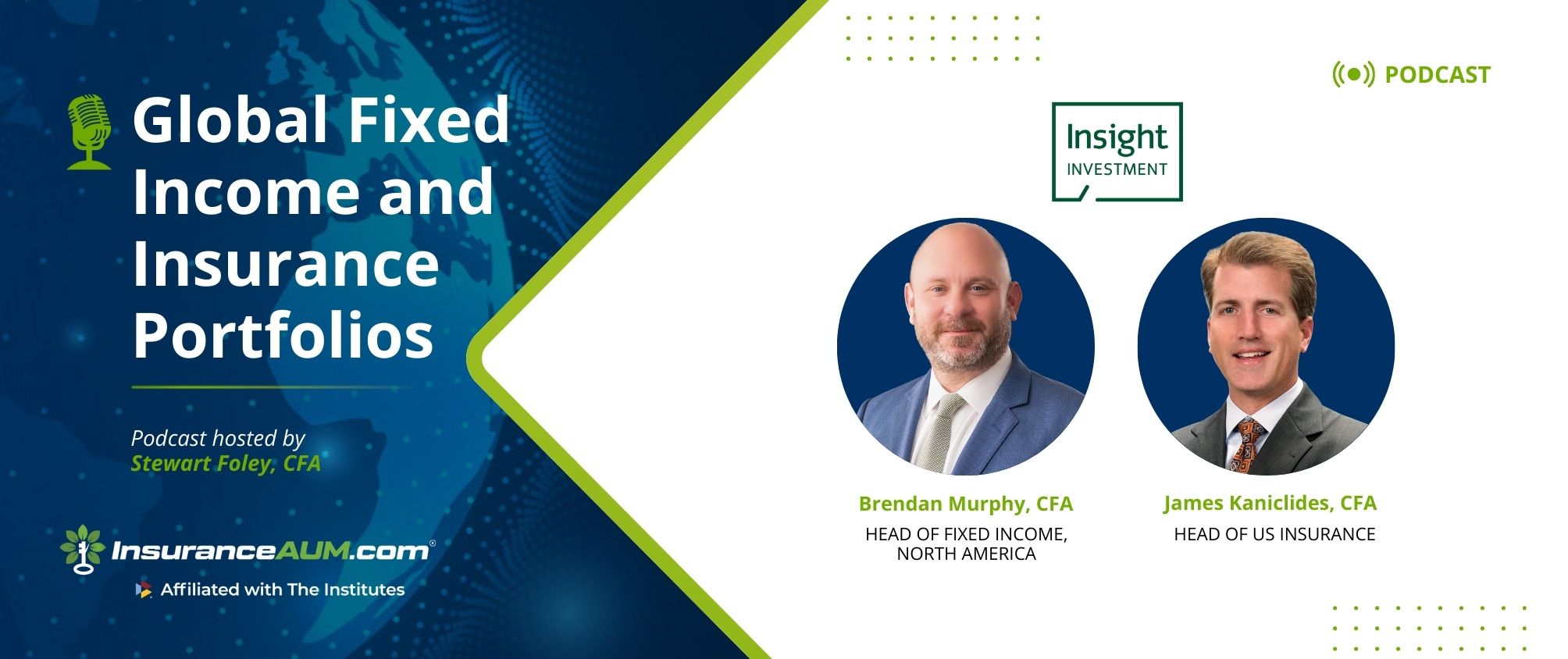
Global Fixed Income and Insurance Portfolios

Image
02.17.26 Insight Investment_Web


Stewart: My name's Stewart Foley, I'll be your host and we're thrilled to have you along today. Today is a very interesting podcast. It's on global fixed income and insurance portfolios. Today I'm joined by Brendan Murphy, CFA, Head of Fixed Income North America at Insight Investment, and Jim Kaniclides, CFA, Head of US Insurance and Senior Portfolio Manager. Brendan oversees implementation across US Core, Core plus multi-sector rates, mortgages, insurance and investment grade strategies, and serves as lead portfolio manager for the global aggregate strategy. Jim leads portfolio management and solutions designed for Insight’s US insurance clients and has spent decades focused specifically on insurance balance sheet management. Brendan and Jim, welcome to the podcast. We're thrilled to have you. Thrilled for you to be here. Really looking forward to a great education today on Global Fixed Income. Before we get going too far, we start them all the same way, which is can you tell us each where you grew up, what was your high school mascot and what job would you like to have, if not the one you're in today? Jim, we'll start with you.

Jim: Sure. I grew up in a little town in Ohio called Ashtabula.

Stewart: Wow, there you go. I've not heard of that. I have not heard of that town.

Jim: Not many people have heard of it unless you just sort of drive by it off the highway.

Stewart: Yeah.

Jim: High school mascot was a lion and job I'd like to have. I'm thinking about this a lot more, Stewart. I think AI's coming for me, so if I had the talent and skill, I think I would own a restaurant.

Stewart: Wow, there you go. I've owned one. I learned three rules. One is don't get into the restaurant business, and the second one is remember rule number one and the third one is remember rule number two. It was so difficult. I have so much respect for people who have successful restaurants because it is so hard. It is so hard. But anyway, I digress. Brendan, how about you, a hometown, high school mascot. What job would you like to have, if not this one?

Brendan: Sure, so my hometown is a small town in Connecticut called Wallingford, Connecticut, which is kind of midway between Hartford and New Haven.

Stewart: I know Wallingford, there was a go-kart track in Wallingford, a good indoor go-kart track that we would go to in the winter when it was real cold and we couldn't race, couldn't road race. We'd all go down there and so I've been to Wallingford a few different times.

Brendan: Nice. Yeah, it's a great town. So I grew up in Wallingford, Connecticut, so high school in mascot is actually called the Judges. So I went to private school in Wallingford, which is actually more of a boarding school. So that was an interesting experience in and of itself, being a day student or boarding school. But judges is the nickname. It's a little bit lame, doesn't exactly intimidate fear into the opposition, but so be it. That was our mascot. And then in terms of jobs I'd like to have, and this is as I get older, I've been thinking this through about things that I could do in my second life and what I have come to realize is. I've got three kids, the youngest of which is just got her driver's license and I'm shocked at how difficult it is to get a driver's license for kids. And I'm like, I think there's a market at least in Massachusetts for more driving schools because there seems to be a shortage of instructors and there's all kinds of kids looking to drive. So I think that's my second career if I get the opportunity is running a driving school.

Stewart: I think there's something to that, and I will say I believe there are state differences. I believe that the way I think that best practices in Massachusetts and best practices where I live in Texas are probably somewhat different.

Brendan: I can imagine that.

Stewart: There's a number of reasons why people do not blow the horn and flip you off in Texas and they don't. And there's good reason for that. But, so let's start right off here and talk about the global bond market and framing the opportunity. My question is to Brendan, let's start with the big picture. When we say global fixed income, what are we really talking about in terms of size, structure and the opportunity set?

Brendan: Sure, I mean it's an interesting one because I think to be honest, I think US investors, particularly in the fixed income space, are a bit spoiled. And what do I mean by that? I mean when you look at the US fixed income markets, they're exceptionally deep and diverse in terms of the access you can get to different types of instruments. And when you talk about the US and the context of global, it's interesting that the US is only about one third of the overall global universe, if you will. And when I talk to clients in non-US countries where their domestic fixed income markets are much smaller, their default is to think of global because their domestic markets aren't developed enough basically to rely on that. So to get proper diversification benefits, they think of global as the natural first step. US investors tend to be more skeptical about it.

They think about fixed income. This is the safe part of my asset allocation mix. I got a lot of options in the US. Why would I ever want to do global? Isn't that riskier and do I really want to take more risk with my fixed income component? And the reality is what we found is if you introduce that diversification level, remember you saw this particularly in years like 2021 and 2022 when the Fed was raising rates aggressively, that to be diversified in terms of your central bank exposure if you will, and have exposure more globally really helped from a total return perspective. And a common sort of misnomer around global is that if you look at particularly developed markets, the US is a relatively high yielder compared to other developed markets. The nuance to it though is when you hedge the currency risk associated with places like Europe, Japan, the UK who have lower nominal yields, you actually pick up a lot of carry by hedging back into the dollar because US short rates are so much higher than in these other countries.

So Japan for example, when you hedge a JGB back in into the dollar, you pick up like 300 basis points in terms of carry on that hedge, which is quite significant. So when people look at a JGB, which a 30-year JGB, which has been in the news recently, 3.41% is what you see on your screen. The reality is on a hedge basis you get something more like 6.41% when you hedge it back. And when you compare that to what you get in the US, which is about 4.7% today, obviously significant pickup, different level risks, different diversification get out of it, but potentially using hedging, which people typically when they hear hedging typically think, “Oh my god, I'm hedging. What's it going to cost me to hedge?”  In a lot of cases in global markets, you can hedge reduce risk and actually increase yield, increase return.

Stewart: It's interesting because I was thinking the way you were talking about which is hedging costs me money. And that's an interesting point that hedging in this case is positive carry and not a little bit, I mean 300 basis points is like when the basis is 300 basis points, it's a lot on a relative basis. And on top of the comment, I've got a question for you. So I kind of have the same perception about the US, that the US fixed income market is significantly more developed in terms of its diversification and different things that can be securitized, but that's a fairly limited not on much data. How would you compare the evolution of fixed income markets in the US versus others, if you could do it with big crayons?

Brendan: Well, I think the reality is particularly in the credit space, well there's two things that are going to drive supply in debt markets, and one is the sovereign dynamics which are frankly abysmal for everyone pretty much, right? Everyone's issued more sovereign debt, so that's becoming bigger parts of those universes, and those governments need to figure out how to fund that. But the insatiable demand has been on the credit side, and that's where I'd say part of it is the way that the financing markets work. IE in the US corporations and entities are just more comfortable securing financing through the bond markets, whereas they're using interbank channels in Europe and other places and maybe something different in places like Asia. So the US has definitely been at the forefront from an issuance perspective and a diversification perspective in that buyer base has moved along with that.

So I don't really see that changing anytime in the near future to be honest with you. I think the US is always going to be the leader from the credit perspective, but again, that diversification can work in multiple ways. One is your credit diversification where by taking advantage of some of those opportunities in Australia, Europe, UK, whatever, you're diversifying entities, but you can also diversify your interest rate risk. And that's important in a world where central banks are going to be correlated, but potentially some zigging when others are zagging when the US is hiking, maybe Japan's not, maybe they're cutting or maybe they're staying put. Or conversely, if there's a big slowdown, the US may be cutting more aggressively than other central banks. So that diversification of rate exposure and credit exposure should be thought of when you think about the holistic allocation.

Stewart: That's super helpful, thank you. So the next item up for a bit here is how insurers actually invest globally. And this is to you, Jim. How much of US insurers' assets are actually invested outside the US today?

Jim: It's a really small amount, Stewart. If we look at data that the NAIC aggregates and reports, it's only about 3% of invested assets. So it's tiny looking deeper below that. Now, that's all foreign investments. So looking deeper down to the next level, most of that is fixed income, about 85% of that. And then if we dig down below that, most of that is actually in corporate bonds. So this gets to sort of the thirst for yield that insurers have. And about 85% of the fixed income is in corporate bonds. The other interesting note is that most of that is investment grade, so more than 90% of that fixed income is investment grade bonds. So they're not looking to high yield in large parts, they're not looking to add what I would say add credit risk with respect to we think about public ratings or capital charges. They're doing all of this within the context of what I would consider is kind of a core allocation, but it's really small. So there's a big opportunity we think to add exposure.

Stewart: And if I combine your number with Brendan's, 97% of the insurance market is invested in one third of the global possible bond market. Where I'm coming from is you said that the US is something like a third of the global market and then Jim's saying that only 3% of it's invested outside the US. So I'm kind of putting some numbers together there, but am I kind of halfway right there? Our audience is only hoping for me to be halfway right, by the way.

Brendan: Yeah, no, I think you're a hundred percent right. Okay.

Stewart: Wow. Okay. Alright, listen, I'm on roll, I'm going to keep going. So let's talk a little bit about strategies for accessing global markets. And this one's really to Brendan, how are insurers able, how can I invest if I'm a CIO and I want to gain some global exposure? And to your point, outside the us the global market is actually thought of as de-risking, right? And in the US we don't necessarily think about it that way. So how if I'm an insurer, how do I do it?

Brendan: So pretty much all the typical flavors you'd get within US, fixed income we can offer in global format. So for us, the main product would be global aggregate, for example. So we actually run things that we call global core; global core plus is similar to what you do with your US core, US core plus. And it's really very similar just using the global aggregate as an index instead of the US aggregate. And that same one third two third ratio holds true. So you get global AG, you get everything that's in the US AG, but then you also get two thirds of exposure to these other sovereigns and credit markets. In the developed markets space, it's got a similar investment grade, only triple D minus or better. And it looks and smells very much like a US core plus portfolio when you hedge that currency risk, except you have much bigger diversification, potentially bigger alpha opportunities for an active manager that's managing in that space. And then the corollaries are all going to be the same. If you want something that's global securitized or global high yield, global credit is a popular product that we have as well where it's primarily US and European investment grades. So, you can essentially take just about any of the typical products you'd find in the US space, redefine them as global. You're still going to have the US is probably the biggest portion of those indices, but much more diversification by expanding the universe to global in nature.

Stewart: That's super helpful, thank you. So let's turn to yield relative value. So in this one I'm coming back to you Brendan, if you will. How do global yields compare to US bonds today across developed and emerging markets and across government, corporate and high yield sectors? And here's a fact check for me. I remember I was running money during the European debt crisis and Greek debt was like, forget it, nobody wanted it last time I checked. It traded inside US treasuries. Talk to us about the global yields in the US bond market today. Can you get us current on what those relationships actually are?

Brendan: Sure, happy to. And obviously it's going to vary through time, so there's not in any given cycle, you're going to see rates move a hundred basis points high, a hundred basis points low probably relative to each other depending on where they are in their interest rate cycle monetary policy cycle. So if you look at the current environment, you have us 10-year treasuries around 4%, Germany is about 2 75%. UK is a little bit higher at 4.4%, Japan's a bit lower at 2.1%. Australia is about 4.70, so a bit higher than the US. So the US is sort of in the middle to higher end, sort of that range. Now, this is where it gets a little confusing is just on that hedge component. So Japan, which I told you 2.1% for the 10 year, but again, when you hedge that Japanese bond back, you're picking up 3%.

Why are you picking up 3%? Because the short rates in Japan and the US are 3% apart. So in other words, Japan's closer to one, the US is closer to four in terms of short rates. So when I hedge it back, I pick up that three. So that means the JGB at 2.1 plus the 3%, I get a 5.1 hedge yield decent pickup, almost a hundred basis points higher than I get in the US. And people generally be like, well how does that work? Why does that? And it's really all about the shapes of the yield curves and the Japanese yield curve is much steeper than the US yield curve. So you hedge at the short end of the curve and then you lock in the investment in the ten-year and the thirty-year further out the curve. So it really depends through time, it really depends what the hedging costs are.

The hedging costs can move if the Fed is cutting rates aggressively that you'll get that hedge right now, but you may not be earning that a year from now if they cut rates aggressively over the course of the next year. Vice versa. If Japan's raising rates aggressively, it'll go against you. So the beauty of it is from an active standpoint, we have all these different levers that we can pull to try to figure out where central banks are in the cycle to manage around central banks that are hiking aggressively or to avoid them in portfolios and favor ones that are cutting or much easier in terms of their monetary policy.

Stewart: Yeah, it's interesting. It's the one thing we can always guarantee, right Brendan, is change. I mean for most of us it keeps you in the game for all these years, right? It is like I don't know what's going to happen tomorrow, but I can tell you it's not going to be the same as today. And for some however big those events are small, it's going to impact the markets one way or the other, and it just happens. It's just the way it is.

Brendan: I think Stewart, if you think about it simplistically, these are all developed markets that have reasonable correlation. The economies are relatively synced, the central banks are somewhat synced, they're experiencing similar growth and inflation challenges with some exceptions, but the magnitude's different and the response function is going to be different. Certain central banks may be more proactively tackling inflation; others may be less aggressive. So that creates the relative value dynamics that offer active managers potential value.

Stewart: Yeah, that's perfect. So, thank you so much. Alright, so let's shift over to portfolio construction for insurers and this one's going to Jim. Jim, how should insurers think about incorporating global bonds into their portfolios?

Jim: Stewart, from your podcast topics and the trends in that that insurers are looking for yield and anything private has been the hot topic and we've seen real strong growth in those asset classes, but they're really looking, they look for yield anywhere they can get it and 10 years ago within the US fixed income markets, there were pockets of illiquidity. I would say that insurers were happy to take advantage of things like taxable municipal bonds where high quality, but you could get paid a little bit more for illiquidity insurers. I think now one of the things within investment grade allocations insurers are doing is pushing into structured markets and making bigger allocations there and they're happy to accept and have to deal with the complexity and the modeling risk in those with global, it's still an investment grade asset class, so there aren't higher risk-based capital charges than they're getting within their investment grade US fixed income portfolio.

So, we do think it fits within core allocation. It's not what we would call, or many would call a risk allocation that requires higher capital charges. So, you can do this within your core allocation and you're accepting with respect to accounting treatment, which we haven't talked about, but you're accepting a bit more complexity with accounting treatment. Brendan's talked about hedging the exposure and the hedged yields. Insurers can get hedge accounting treatment for it, which is more favorable for them, but there is a bit more work involved to do that now. I think most insurance accounting vendors can support that. So I don't think that's a big hurdle, but I would say this is just another way for us insurers to think about opportunities to add yield without having to push out into more risk asset classes.

Stewart: Yeah, it makes sense. And I've got, my next question really comes from a LinkedIn poll that I did, which is asking our audience what question would they like me to add? And this is for either one of you or both. What scenario would create headwinds for a global fixed income allocation for an insurance portfolio? In other words, give me the scenario where I decide to invest globally and it doesn't work out for me what has to happen?

Brendan: Sure. So from my perspective, the main thing is the rate risk, right? So I referenced the 21-22 environment because that was one where global worked quite well. It was one where yet a super aggressive fed hiking rates, other central banks, mainly Asian ones weren't doing anything essentially, right? So that balance, that diversification really helped you in a rising rate environment where it could go against you in a relative basis is the converse of that one where let's say we're facing a global recession, the Fed is cutting rates aggressively for whatever reason, we're going back to 1% interest rates on the front end. That's one where the US is probably going to be a really good performer in a global context compared to some of these other markets that don't need to cut as much because rates are already lower and that's not necessarily a bad environment from a total return perspective, you'll do well, you just would've been better off probably if you were in the US relatively speaking. So that'd be the one that I'd point to.

Stewart: That's super helpful. Alright, Jim, last one here before we‘ve got a couple fun ones for you, but are there other considerations that insurers ought to keep in mind when they're investing globally?

Jim: Globally? Yeah, Stewart, I mentioned the accounting one. I think that frightens off some investors. I think they don't understand the hedged yields that Brendan explained. There is, as I mentioned, some additional accounting complexity to it. But I think in our world today that shouldn't be a big hurdle. There are state statutory limits on foreign exposure, but those generally range from 10 to 20% depending on the state. So there's plenty of room to add based on the numbers we saw from the NAIC with such a low exposure in the aggregate. And there are also some states also have limits on individual countries beneath that aggregate exposure of 10 to 20%. I think those are some of the considerations for insurance companies. But as I've said, I think those are easily surmountable and make this, I think make a lot of sense for their core allocations.

Stewart: It's been super helpful, and we had a great education today on global fixed income. I managed to learn a few things along the way here too, which is always helpful. I mean one of the things that we did, we put together CIIM, is we had to go find 40 subject matter experts because nobody knows the entire landscape of this business. And every time I have an asset class specialist or some subject matter expert on, I get to have a little bit more education too. So I want to say thank you to both of you. The one question that we've been asking of late, it really attempts to get at the culture at Insight Investment, and it goes something like this. What characteristics, and not only for your time now, but also you've both been at other places and you've been at this for a minute, what characteristics do you look for when you're adding to members of your team? Brendan, I'll take this one to you and just what characteristics are you looking for when you're interviewing?

Brendan: So I'll start with a little bit on Insight Investment, which is what I would describe as a specialist fixed income manager. So we only do fixed income. It's very much a specialist model. So we're looking for deep subject matter experts. Jim would be one for insurance; I'd be one for global, whether it's corporate credit securitized markets, right? We're looking for deep subject matter experts that know that go as deep as possible and understand everything there is to know about those worlds. Now that's a great model in and of itself. I think the challenge of it, and this is what I look for, is obviously we want subject matter experts, but we also want subject matter experts that can work across teams. I think if you create that specialist model too far, you end up with a bunch of silos that do well with someone that wants a single sector type product.

But when you're trying to create multi-sector products and you need that cooperation, collaboration, being able to work across teams, that's something that I greatly value, particularly from my oversight function within the firm. So I want someone that is going to be a deep subject matter expert, but is also interested in how other teams are put together and willing to work with them to create multi-sector products which are going to resonate with clients and not just sort of in their own bubble, working in their own space. So it's that delicate balance between being a deep subject matter expert and a team player, team collaborator that I'm trying to identify.

Stewart: That's awesome. Alright, when we have two guests, our last question goes like this. You can have dinner with up to four people, including the two of you each get one guest dinner's on us. I always say that we have a new owner and nobody's yelled at me yet, but in this hypothetical dinner you can have one guest, it can be anyone alive or dead. So I went to Brendan first last time. Jim, I'll come to you. Who would you most like to have dinner with, alive or dead?

Jim: Well, Stewart, you kind of ruined my pick. Oh no, I'm going to go with it anyways. And it's probably someone given your locale. My guest would be Aaron Franklin. Do you know Aaron Franklin?

Stewart: No.

Jim: Aaron Franklin runs what many believe and has been rated as well as the top-rated barbecue joint.

Stewart: There you go.

Jim: So again, along the lines of needing a second career, but I also took his masterclass on barbecue and mine doesn't turn out his, I think he left a few things out that I'd like to talk to him about.

Stewart: That's interesting because there's a place near us that got voted best barbecue in Texas, and I'll tell you what, it is some stiff competition down here. There's a lot of folks that really take it seriously, but it's an interesting one from my perspective. Super cool. All right, Brendan, how about you? Who's joining? Jim, the king of all barbecue and you, who's the lucky fourth?

Brendan: All right, so I'm going to start with this. So I'm a bond nerd, number one, but I'm a baseball nerd. Number two is what I'll say, and I'm a big believer in the baseball as a metaphor for life thing, if you will, right? This idea that being successful is only being successful one third of the time is you're the greatest player ever. And that two thirds of the time you're failing the fact that the seasons are so long and that they're a bear to go through the nuance, all the subtleties that go into it. My daughter and I, same daughter I referenced with driving lessons, we're on a mission to see every major league, baseball park in the US, which has been a really fun thing to do and educational thing to do. And we got about six or seven more to go. So all that said, I'm setting up for my pick is David Ortiz.

Stewart: Wow.

Brendan: Why David Ortiz? A, because I'm in Boston and I think he's a tremendous player. B, never have I seen a more clutch player. That's why I'd like to have dinner with him, to meet him is just to understand how you can be so clutch in a sport like that, which is so built around failure. That's always super impressed me. And he just seems like a super fun guy that I think would enjoy barbecue as well. He'd be my guest.

Stewart: I got to think that you better go on the family plan there. I mean, there's going to be some food consumed before.  

Jim: Well, we're not paying for it Stewart. So...

Stewart: Yeah, I kind of hung myself there. So, listen, thanks so much for being on. I really appreciate you both and certainly we've benefited from your expertise. So, thanks so much for being on.

Jim: Thank you, Stewart.

Brendan: Thanks Stewart.

Stewart: We've been joined today by Brendan Murphy, CFA, Head of Fixed Income at North America at Insight Investment, and Jim Kaniclides, CFA, Head of US Insurance and Senior Portfolio Manager, both at Insight Investment. If you like what we're doing, please rate us and review us on Apple Podcast, Spotify, or wherever you listen to your favorite shows. It means a lot to us. We look at the ratings, we appreciate the comments and all sincerity, it matters. And we also, this one is not a video podcast, but oftentimes they are. And you can catch it on our YouTube channel at InsuranceAUM Community. My name's Stewart Foley, I've been your host. This is the home of the world's smartest money at InsuranceAUM.com. 

Share this post

Sign Up Now for Full Access to Articles and Podcasts!

Unlock full access to our vast content library by registering as an institutional investor

Register

Contacts


Insight Investment

Insight is a global asset manager specializing in fixed income and risk management strategies with $836.1bn in AUM1. We have been working with insurers since 1934 and manage $32bn for over 80 insurers globally. Our investment philosophy offers clients innovative yet practical investment solutions. We manage custom fixed income strategies to help meet clients evolving needs, such as liquidity, principal preservation, earnings stability, tax minimization and total return.

Insight is subsidiary of BNY, which offers insurance clients additional services and access to boutique investment management teams. These services offer the potential for deeper collaboration across your portfolio.

As of March 31, 2026. Assets under management (AUM) are represented by the value of the client’s assets and liabilities Insight is asked to manage. These will primarily be the mark-to-market value of securities managed on behalf of clients, including collateral if applicable. Where a client mandate requires Insight to manage some or all of a client’s liabilities (e.g. LDI strategies), AUM will be equal to the value of the client specific liability benchmark and/or the notional value of other risk exposure through the use of derivatives. Where the methodology defines it, some asset reporting focuses on cash securities only. Insight North America (INA) is part of ‘Insight’ or ‘Insight Investment’, the corporate brand for certain asset management companies operated by Insight Investment Management Limited including, among others, Insight Investment Management (Global) Limited (IIMG), Insight Investment International Limited (IIIL) and Insight Investment Management (Europe) Limited (IIMEL). Advisory services referenced herein are available in the US only through INA. Legal entity Insight North America LLC’s AUM is $164.5bn as of March 31, 2026. Figures shown in USD. FX rates as per WM Reuters 4pm spot rates. 

1 Includes $32.1bn following the completed transition of BNY Wealth’s municipal bond and taxable fixed income team to Insight on October 1, 2025, assets stated as of December 31, 2025 and includes $3.8bn  attributable to certain accounts managed by Insight’s affiliate, BNY Mellon, National Association, for which certain Insight investment personnel act as dual officers. Such accounts pursue the same or similar investment strategies to those pursued by Insight clients. 2 Includes employees of Insight North America LLC and its affiliates, which provide asset management services as part of Insight, the corporate brand for certain companies operated by Insight Investment Management Limited (IIML).


Jeffrey Berman

Head of North America Distribution 
Jeffrey.Berman@insightinvestment.com
+1 212 365 3341

Ryan McMurdie 

Director, Insurance Solutions
Ryan.McMurdie@InsightInvestment.com 
+1 917 208 0115
 
200 Park Avenue, New York, NY 10166 
www.insightinvestment.com


View the contributor page

Sign Up Now for Full Access to Articles and Podcasts!

Unlock full access to our vast content library by registering as an institutional investor .

Create an account

Already have an account ? Sign in

Ѐ Ё Ђ Ѓ Є Ѕ І Ї Ј Љ Њ Ћ Ќ Ѝ Ў Џ А Б В Г Д Е Ж З И Й К Л М Н О П Р С ΄ ΅ Ά · Έ Ή Ί Ό Ύ Ώ ΐ Α Β Γ Δ Ε Ζ Η Θ Ι Κ Λ Μ Ν Ξ Ο Π Ρ Ё Ђ Ѓ Є Ѕ І Ї Ј Љ Њ Ћ Ќ Ў Џ А Б В Г Д Е Ж З И Й К Л М Н О П Р С Т У Ф Х Ц Ч Ш Ā ā Ă ă Ą ą Ć ć Ĉ ĉ Ċ ċ Č č Ď ď Đ đ Ē ē Ĕ ĕ Ė fi fl œ æ ß