

Invesco -

Global Fixed Income Strategy Report | October 2026

Fixed Income
 
Global macro strategy
Europe’s fiscal challenge: debt sustainability in a higher-rate world
Key takeaways
  • Rising sovereign yields are refocusing investor attention on debt sustainability, with France emerging as the eurozone’s key fiscal risk.
  • Fiscal trajectories are diverging across Europe, favoring countries such as Spain and Portugal, while exposing weaker sovereign credits.
  • France and the UK require substantial fiscal consolidation, but success is sensitive to political constraints and the risk of fiscal slippage.
  • Higher interest rates could worsen Europe’s debt dynamics, increasing the risk of spread volatility and sovereign market repricing.

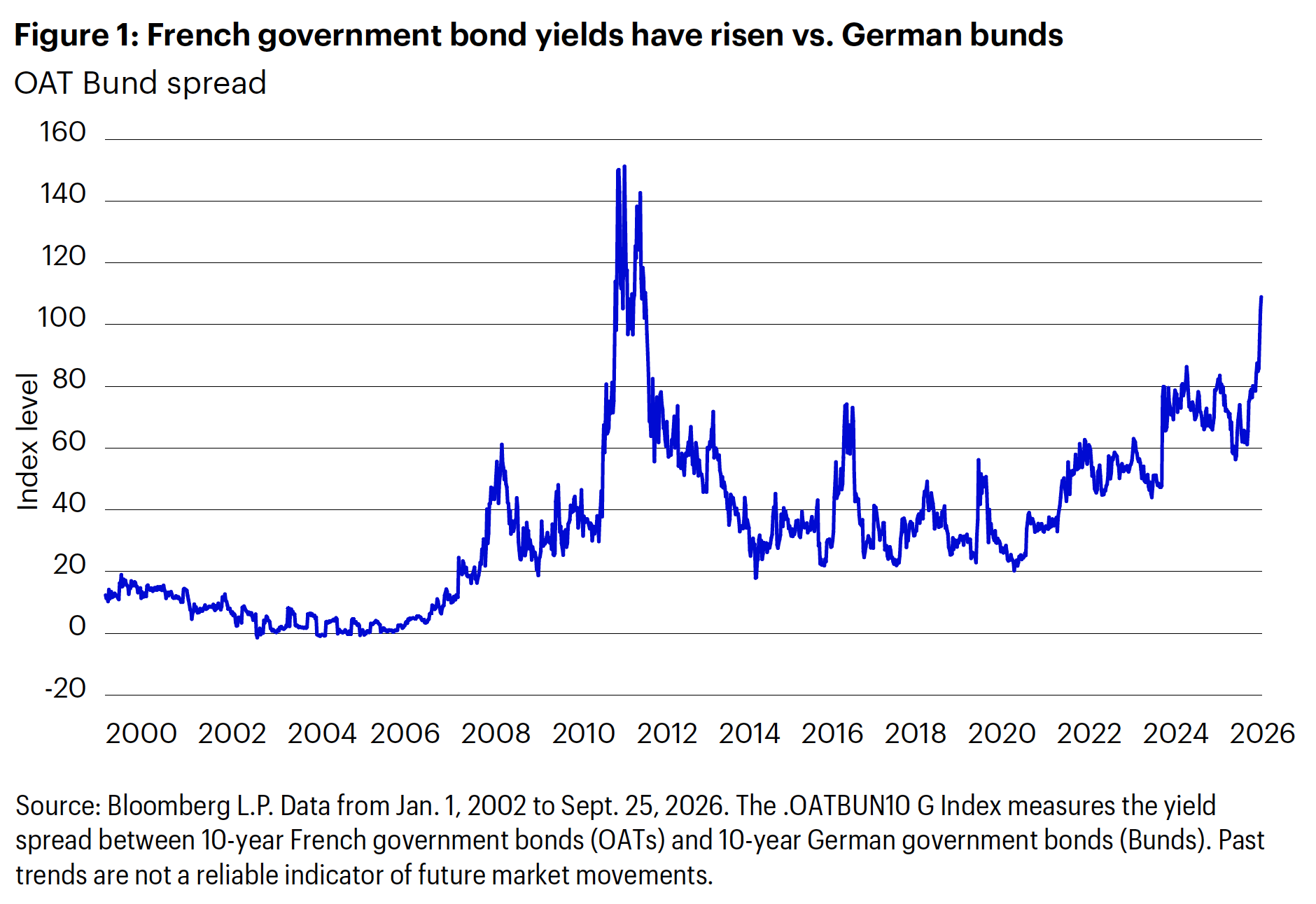
Recent developments in global bond markets have revived concerns about sovereign debt sustainability, drawing comparisons to the debt crises that unsettled markets in the 2010s. Government bonds have sold off across major developed economies, driving yields and borrowing costs sharply higher, as investors reassess the outlook for inflation, interest rates, and fiscal policy. The pressure has been particularly visible in France, where concerns over the fiscal and political outlook have driven a marked widening in the spread between French and German government bond yields, to levels not seen since the sovereign debt crisis.

Invesco chart showing the spread between French government bond yields and German bund yields


Politics may limit policy

Most industrialized economies face pressure due to increase spending on defense, infrastructure and AI, as well as healthcare and pensions. However, policies that could help address these challenges—such as greater immigration and reforming pension systems- are becoming harder to enact, as populist support rises and support for centrist parties declines across the eurozone’s major economies—making debt sustainability important to assess.

Europe’s diverging fiscal performance

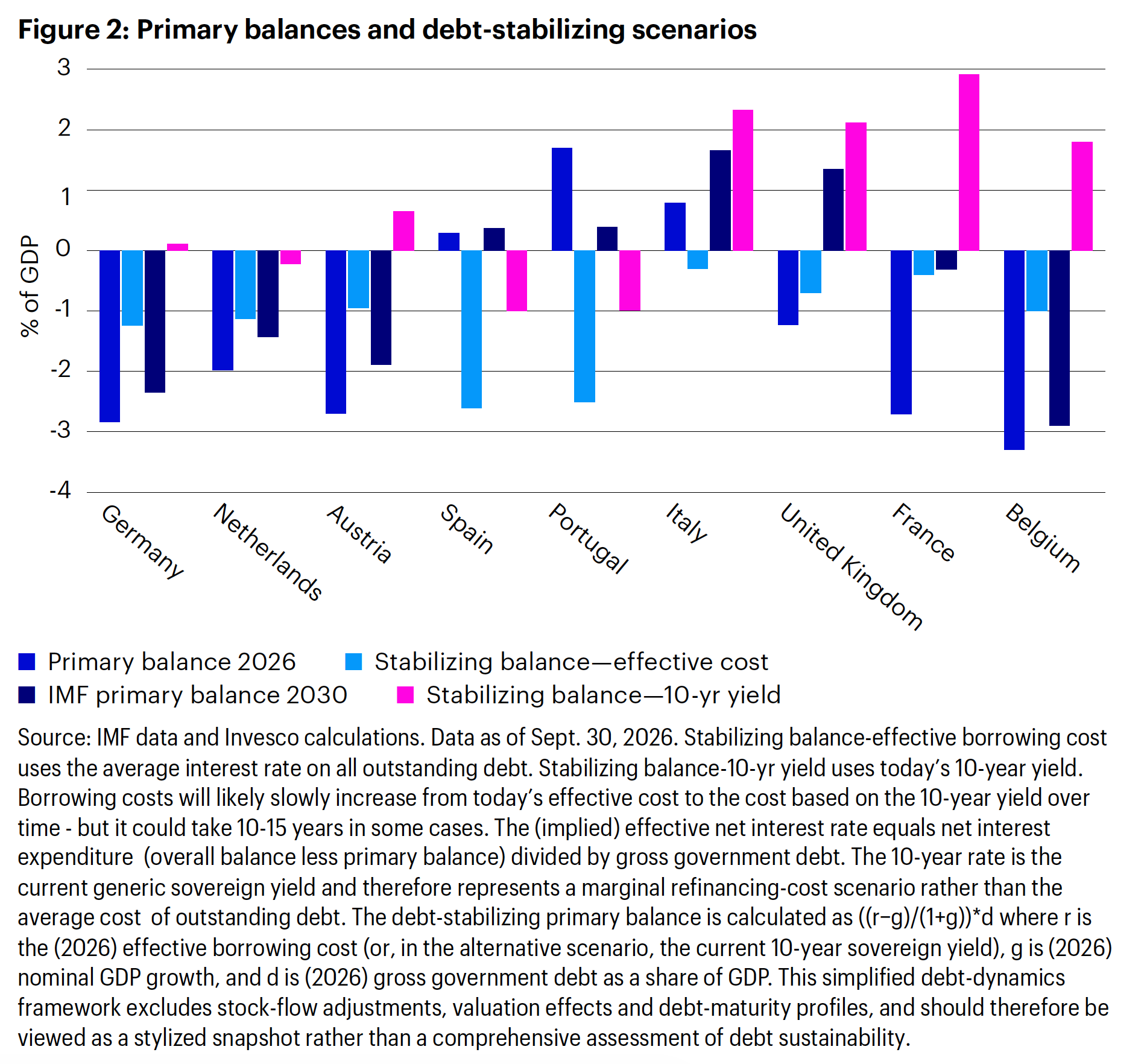
The interaction between borrowing costs and economic growth is central to assessing debt sustainability. Put simply, nominal growth must be strong enough to offset the cost of servicing the existing stock of government debt. Another useful measure is the debt-stabilizing primary balance, which is the budget balance, excluding interest payments, that a government needs to achieve to prevent its debt-to-GDP ratio from rising.

The weaker the growth outlook or the higher the cost of servicing debt, the larger the primary surplus that is required to stabilize the debt ratio. Countries facing this challenge can broadly be divided into three categories.

First, some countries have taken the medicine and are now reaping the rewards

Having endured the sovereign debt crisis just over a decade ago—and a painful internal devaluation to re-establish competitiveness—countries such as Italy, Spain and Portugal are now running primary surpluses. Spain and Portugal stand out in particular: their strong nominal growth means that the primary balances required to stabilize their debt are less onerous than Italy’s. The combination of primary surpluses and robust nominal growth is helping both countries restore their fiscal positions rapidly.

Second, some countries have saved for a rainy day

Countries such as Germany, the Netherlands and Austria have relatively low debt-to-GDP ratios and, therefore, greater capacity to run deficits. Past prudence has given them room to invest in defense, infrastructure and other priorities that warrant additional funding.

Third, for some countries, actions speak louder than words

Some countries, including Belgium, are running unsustainable primary deficits and taking few steps to stabilize debt. The outlook is therefore concerning. Others, such as France and, to a lesser extent the UK, are also running unsustainable primary deficits but based on IMF forecasts, are projected to move toward their current debt stabilizing primary balance by 2030. The UK deserves credit for its lofty ambitions: it is expected to undertake one of the sharpest fiscal consolidations and eventually run a meaningful primary surplus. Under IMF assumptions, France comes close to achieving a debt-stabilizing primary balance by 2030. However, the margin of safety is limited, and the debt trajectory remains highly sensitive to fiscal slippage and adverse macroeconomic shocks.

For both countries, we believe delivery will be crucial. The evidence for the UK is mixed. On the positive side, it has already delivered a significant share of its tax consolidation through frozen income-tax thresholds and will likely deliver on most of that tax consolidation. There is less room for optimism on spending; the UK has delivered little, if any, expenditure restraint and the new prime minister appears more inclined to spend than to save.

The situation in France looks more concerning, partly because of the political backdrop, partly because taxes are already much higher, and partly because the government has failed to deliver even modest consolidation. The political outlook adds to the risk; it appears increasingly possible that the presidential contest could pit a far-left candidate advocating debt cancellation against a far-right candidate proposing unfunded tax cuts.

Higher rates are pushing up borrowing costs—and requiring even larger consolidations

The debt-stabilizing primary balance is calculated using the average effective cost of debt—which reflects the borrower’s average interest rate, not just the interest rate on new debt. In many cases—particularly in countries with long debt maturities—that cost remains low, partly because substantial amounts of debt were issued when interest rates were near the zero lower bound. But since then, conditions have changed.

Effective borrowing costs are rising almost everywhere, leaving countries essentially running to stand still in their efforts to consolidate the public finances.

If the debt-stabilizing primary balance is recalculated using current ten-year borrowing costs rather than the effective cost of debt, Spain and Portugal are the only two countries projected to stabilize their debt. This poses a particular challenge for countries such as the UK: if existing plans are already unrealistic, an even sharper fiscal consolidation would be required to put debt on a stable path.

Central banks do have some tools

Central banks will likely continue to set interest rate policy in response to inflation and the wider economy, rather than to backstop sovereign borrowers. Nonetheless, they retain some tools that can help at the margin. The Bank of England, for example, has recently adjusted its balance sheet policy to support the gilt market: it is no longer actively selling gilts and has halted sales at the long end altogether, providing some respite. Similarly, the European Central Bank (ECB) could deploy instruments such as the Transmission Protection Instrument (TPI) to contain unwarranted spread widening.

However, such support is not unconditional. The ECB must be satisfied that a country’s debt remains sustainable and that it is in broad compliance with the European Union’s (EU) fiscal and macroeconomic framework. Under an anti-EU Marine Le Pen presidency, investors could increasingly question whether France would meet those conditions, potentially limiting the credibility of the ECB backstop and setting the stage for a volatile 2027.

Invesco chart comparing European primary balances and debt-stabilizing scenarios


Global credit strategy
US high yield at 8%: higher income, better structure
Key takeaways
  • Today’s US high yield market offers an attractive level of income, in our view, without the credit quality or interest-rate risk that many investors still associate with the asset class.
  • The approximately 8% yield currently offered by the US high yield index (ICE BofA US High Yield Constrained Index, as of Oct. 5) would have historically suggested a stressed market, but today that income is generated against a fundamentally different market backdrop.
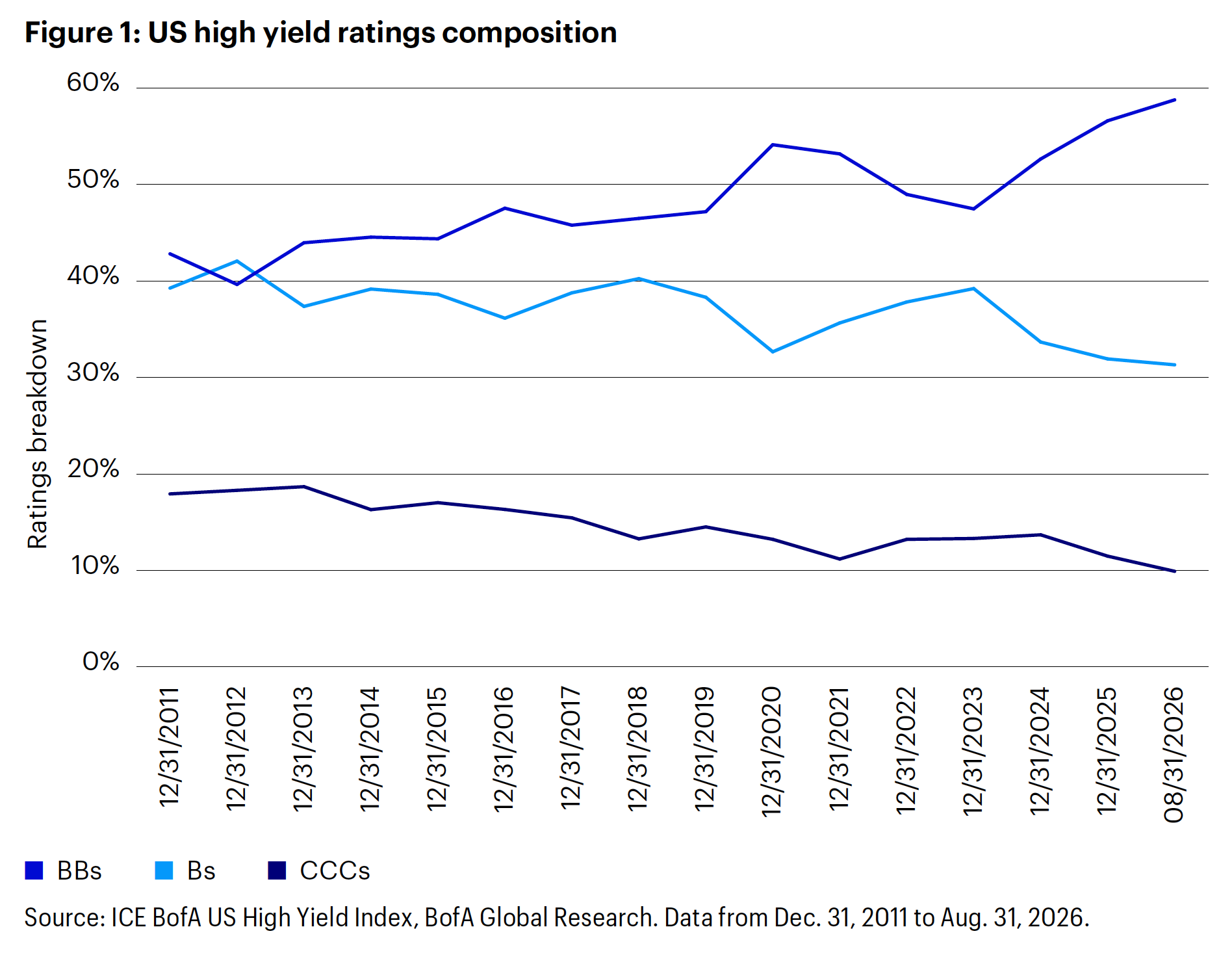
  • More than half of the high yield universe is BB rated, only about 10% is CCC rated, and duration is roughly three years, meaning investors are being paid meaningful income by a market with a stronger quality mix and lower sensitivity to interest rates than its reputation would imply.
A market that has moved up in quality

US high yield is no longer dominated by deeply speculative issuers. Approximately 55% of the US high yield index is rated BB—the highest-quality segment of the market—while CCC exposure represents only about 10%.1 The result is a broader opportunity set of established businesses, many with durable cash flows and improving balance sheets, alongside a smaller distressed tail.

Income with less duration risk

At roughly three years of duration, US high yield carries substantially less interest-rate sensitivity than other core bond benchmarks and is lower compared to its 15-year average.2 Its shorter maturity profile can also allow a high yield portfolio’s income stream to reset more quickly, as bonds mature or are refinanced. Investors therefore do not need to make an outsized duration call to access an attractive level of yield.

Invesco chart showing the ratings composition of the U.S. high yield market

An 8% starting yield provides a potential cushion

Starting yield has historically been an important driver of longer-term fixed income returns. At a yield of approximately 8% (ICE BofA US High Yield Constrained Index, as of Oct. 5), US high yield can potentially generate an attractive return without requiring significant spread tightening or capital appreciation. That income may help offset the impact of moderate spread volatility and credit losses. Put differently, the asset class does not need a perfect economic outcome to perform well.

AI is creating opportunity—and a new fault line

Artificial intelligence could become the dominant theme in credit markets over the next two years. It brings both a growing financing need—across data centers, power, compute and related infrastructure—and a widening risk of disintermediation of existing businesses. We believe credit investors will need to evaluate whether new AI-linked issuance offers adequate structural features while also identifying incumbent business models whose cash flows, competitive positions or capital needs may be disrupted by AI.

The index is stronger—but selection still matters

Better aggregate quality does not eliminate issuer-specific risk. Leverage levels, refinancing needs and business-model durability vary widely beneath the surface of the index averages—and AI is likely to widen that dispersion. We believe active management can allocate toward compelling risk-adjusted opportunities, demand appropriate structural features in new issuance transactions and limit exposure where disruption risk is considered underpriced, especially within the CCC rated segment.

Bottom line

At a yield of approximately 8%, we believe today’s higher-quality, shorter-duration high yield market potentially offers a compelling combination of income and market resilience. We also believe that a key differentiator going forward will be asset managers' ability to finance AI’s growth selectively, while avoiding the businesses it may disintermediate.

Rates and currency outlook
Interest rate outlook

US: Neutral

The Federal Reserve (Fed) hiked 25 basis points in September, citing sticky inflation, elevated energy prices and resilient growth, bringing the cycle total to two hikes. The market has repriced aggressively, now discounting close to four additional hikes through 2027, a pace we believe overstates the likely path; our base case remains one more hike in December as a risk management exercise, not the start of a sustained tightening cycle. Ten-year yields have surged above 5.2%, the highest since 2007, driven by upside PMI surprises, elevated energy prices on Strait of Hormuz concerns, and position liquidation amplifying the move. The curve has bear-flattened rather than bear-steepened as we had expected, reflecting the structural increase in risk premium at the front end. We maintain our neutral stance on the 10-year and continue to express constructive views via front-end positioning and curve steepeners, where risk premiums now appear excessive relative to our growth and inflation outlook.

Europe: Overweight

The European Central Bank (ECB) hiked rates at its September meeting in response to higher inflation prints and recent resilient growth data and indicated a willingness to raise rates further if the inflation outlook deteriorates. The market has extrapolated the policy stance to price multiple further rate hikes. While we do not rule out further policy adjustment, we disagree with the extent of monetary tightening priced into the market. Further hikes would likely take the policy setting into restrictive territory, which the economy does not require at this stage. When compared to other markets, European valuations are attractive, in our view, and we have moved overweight on a cross market basis. Higher energy prices will likely necessitate fiscal support measures from eurozone governments and calls for greater defense and energy transition-related spending have intensified - all of which would likely increase long-end bond risk premia vs shorter dated bonds, and we are anticipating a steeper curve.

China: Overweight

We remain positive on Chinese onshore government bonds and expect the bonds to outperform developed market peers in the coming months. Supportive macro policies, still relatively lukewarm domestic demand and strong export growth are expected to contribute to demand for central government bonds. The central bank has started overnight reverse repurchase operations and highlighted that loan growth is expected to be of lower quantity but higher quality. Overall financial conditions need to be assessed with the combination of both loans and bond issuance. The housing provident fund has recently been allowed to invest in policy bank bonds for the first time, which continues to show policy makers’ supportive stance. We view Q4 as a potential window for further easing measures if needed.

Japan: Neutral

10-year Japanese government bond yields have risen by approximately 18 basis points over the last month to 3.08%, their highest level since 1997.3 Despite the sell-off, the rise in yields has been more modest than in major US and European markets.

The Bank of Japan (BoJ) hiked rates in September alongside the Fed and ECB, although two BoJ board members voted against the move. Significantly, both were recent appointments of PM Takaichi, reinforcing the perception that the government is uncomfortable with a rapid rise in interest rates. This has tempered expectations of an acceleration in the hiking cycle, despite Governor Ueda’s relatively hawkish press conference comments.

Inflation and wage data continue to point toward further hikes. The BoJ appears likely to hike again, potentially in December or January, with a terminal rate of 2% now realistic by the middle of next year. This should support JGB yields, particularly at the short end. Long-end yields are likely to be more sensitive to upcoming budget negotiations and the prospect of the Government Pension Investment Fund (GPIF) increasing its JGB allocation, although both factors remain somewhat unclear. The Takaichi administration continues to pursue a high-growth strategy, which is not particularly conducive to lower bond yields. GPIF reallocation could provide some support to the market, but is likely to be a slow-moving factor, particularly if global yields remain elevated.

UK: Overweight

10-year gilt yields have jumped 37 basis points to 5.36%, driven by resilient domestic growth, higher energy prices and the global repricing of interest rates.4 Gilts have outperformed US Treasuries and major eurozone markets during the sell-off, which has been unusual. This reflects the Bank of England’s (BoE) relatively dovish stance compared with the Fed and ECB, as well as the announcement of a pause in the BoE’s active quantitative tightening gilt sales, which should reduce upward pressure on longer-dated gilts.

Although BoE Governor Bailey has warned that sustained higher energy prices will necessitate some tightening of monetary policy, it seems unlikely that the BoE will deliver the 110 basis points of rate hikes currently priced by the market, unless the inflation outlook changes substantially. The BoE’s relatively dovish stance is underpinned by the UK’s soft labor market and limited signs of second-round effects from higher energy prices in recent inflation data. The market is currently pricing rates based on the BoE scenario of sustained higher energy prices, creating some downside for yields if energy prices subside.

In the near term, market attention is likely to shift from monetary to fiscal policy ahead of the 28th of October Budget. The government appears keen to make the Budget as little of an event as possible, with only minor policy tweaks necessary to meet the fiscal rules. However, it remains to be seen whether the market will view this minimalist approach as sufficiently reassuring, given a deteriorating global backdrop of higher yields and inflation alongside increased defense spending demands.

Australia: Overweight

The combination of hawkish Reserve Bank of Australia (RBA) rhetoric, higher global interest rates, rising energy prices and resilient domestic data has driven an approximately 30 basis points of repricing of Australian government bond yields over the last month.5 Valuations now look attractive on a longer-term basis, in our view, with current pricing reflecting a meaningful risk premium for stronger growth and/or higher inflation. The market is pricing 40 basis points of hikes to year-end 2026 and a further 25 basis points in 2027, taking the RBA’s Official Cash Rate to 5%, around 1.5% above policymakers’ estimate of neutral. 10-year and 30-year yields of 5.35% and 5.75% respectively, imply long term forward rates of close to 6%.6

Should the RBA and consensus expectations play out—with a moderate softening in growth, some loosening of the labor market and a gradual moderation in inflation back towards the RBA’s 2.5% target by late 2027/early 2028—bond yields are likely to decline. Australia remains a relatively interest-sensitive economy, which should limit the extent of any further repricing of rate hikes. Australian markets have recently outperformed US Treasuries, somewhat reducing their cross-market attractiveness, but retain the advantage of strong fiscal fundamentals and institutional credibility.

Currency outlook

USD: Overweight

The Fed hiked rates in September and is expected to raise them further. With the US leading global growth, enjoying a relative terms-of-trade advantage from higher energy, and interest rates poised to increase further, we think the backdrop has become more supportive for the US dollar. We are overweight the US dollar versus European currencies.

EUR: Underweight

We expect European currencies to be laggards, as growth in the region continues to be lackluster and energy prices present downside growth risks.

RMB: Overweight

We are overweight the renminbi over the medium term. Recent developments in the US and Europe are likely to further support the renminbi’s strength. Central Bank Governor Pan said at the China Development Forum that China has no need or intention to use currency depreciation to gain a trade advantage. We expect China to facilitate more international investment in Chinese capital markets and further improve arrangements for renminbi cross-border use. This is in addition to the substantial Chinese trade surplus recorded year-to-date.

JPY: Neutral

The yen is around 1% stronger against the US dollar over the last month, although this masks significant volatility.7 Ahead of the September Fed and BoJ meetings, the yen was around 2.5% stronger against the US dollar than current levels. The retracement from the yen’s recent highs reflects some disappointment that the BoJ was not as hawkish as the Fed and ECB. Expectations for future BoJ hikes have not repriced to the same extent as elsewhere, widening interest rate differentials between Japan and other developed markets.

The Japanese authorities continue to use verbal intervention to support the yen, but there have been few signs of further actual intervention since the USD/JPY exchange rate reached 160. This has created some perception that Ministry of Finance US dollar selling remains some way from current USD/JPY levels. However, the authorities have shown clear intent and maintain a credible cap on USD/JPY above 160.

A larger move toward 150 will probably require some moderation in interest rate expectations in the US and elsewhere and/or a deterioration in global growth expectations. At present, both interest rate expectations and risk sentiment remain relatively well supported.

GBP: Underweight

The British pound has lagged both the US dollar and euro over the last month, reflecting the BoE’s relatively dovish policy stance compared with the Fed and ECB, as well as the negative impact of higher energy prices on the UK’s terms of trade.

Pound valuations continue to look unattractive, in our view, given tighter interest rate differentials, relatively weak growth prospects and ongoing concerns about the UK’s fiscal credibility.

Fiscal policy will likely receive greater attention heading into the 28th of October Budget. The government’s preference for growth-negative tax hikes over substantial spending cuts will probably weigh on the currency, reinforcing perceptions that the UK is not investor-friendly and faces poor long-term growth prospects. The pound also remains pro-cyclical and would likely suffer if Fed hikes trigger a sell-off in risk assets.

AUD: Overweight

The Australian dollar remains relatively well underpinned by high commodity prices, high short-end rates relative to other developed market currencies and positive absolute and relative growth dynamics domestically. The biggest downside risk for the Australian dollar, in our view, is a global tightening of financial conditions due to a rise in bond yields or a surprisingly hawkish Fed reaction function. If the market perceives the Fed to be over-hiking, risk sentiment could suffer, creating a more negative dynamic for pro-cyclical currencies like the Australian dollar.

The bottom line: Global securitized debt: A new opportunity for fixed income investors

European policymakers are increasingly turning to debt securitization as a tool to support economic growth, capital formation and investment. We speak with Invesco Fixed Income’s Co-Heads of Structured Investments, David Lyle and Kevin Collins, about how regulatory reforms in Europe are reshaping the securitized asset class, why investor perceptions may be changing, and where they see the most compelling opportunities in today’s securitized debt markets.

Q: Securitized debt still carries some stigma from the global financial crisis. Why should investors revisit the asset class today?

David: Many investors still associate securitized debt with the complexity and market failures that emerged during the financial crisis. But today’s market is very different. Over the past decade, underwriting standards have improved significantly, transparency has increased, mandatory risk-retention rules have been introduced, and investor protections have strengthened. These changes have made securitized markets considerably more robust and resilient than they were before the crisis.

At the same time, Europe is introducing a series of regulatory reforms that could become an important catalyst for the asset class. By reducing some of the operational and capital burdens associated with investing in securitized assets, policymakers are aiming to encourage broader institutional participation. That could increase demand, issuance, market liquidity and ultimately the opportunity set available to global fixed income investors.

Q: What’s driving the shift in thinking among European policymakers?

Kevin: After the financial crisis, European regulators implemented extensive requirements around disclosure, due diligence, risk retention and capital treatment. While these measures improved investor protection, they also increased the cost of owning securitized assets, particularly for insurance companies. Under Solvency II, many insurers found it difficult to justify securitization exposure compared with traditional corporate credit, even when the underlying assets performed well.

The result was a significant under-allocation to the sector. By the end of 2021, securitization represented just 0.33% of total investments among insurers and reinsurers using the Solvency II standard formula, and only a small minority had any exposure at all.8

Today, policymakers increasingly view securitization as a tool for supporting economic growth, infrastructure investment, innovation and the energy transition. Through the European Union’s Savings and Investments Union initiative, regulators are looking to remove barriers that may no longer be justified by the actual risks of high-quality securitizations while preserving the safeguards established after the crisis.

Q: What specifically changes under the Solvency II reforms?

David: The most important change is the recalibration of spread-risk capital requirements for insurers, scheduled to take effect in January 2027. Under the revised framework, senior STS, or Simple, Transparent and Standardised, securitizations will receive capital treatment broadly comparable to covered bonds. Highly rated senior non-STS assets, including many AAA rated collateralized loan obligations (CLOs), are also expected to benefit from meaningful capital relief.

More broadly, regulators are working to simplify due diligence and transparency requirements, reduce unnecessary operational frictions and make the STS framework more effective. Together, these reforms signal a policy objective of revitalizing Europe’s securitization market and increasing the flow of capital into the real economy.

It’s important to note that mezzanine and subordinated positions will continue to face significantly higher capital requirements, so the benefits are likely to be concentrated in higher-quality senior securitized assets.

Q: Beyond capital relief, why should investors consider securitized debt as part of a fixed income allocation?

Kevin: The key point is diversification. Better regulatory treatment allows investors to assess securitized assets on their investment merits rather than excluding them because of punitive capital charges.

Securitized debt provides exposure to very different underlying sources of risk than traditional corporate bonds. Investors can gain exposure to residential mortgages, consumer loans, commercial real estate and diversified pools of corporate loans. These assets often respond differently to economic conditions than conventional corporate issuers.

The structure of securitization also offers flexibility. Through tranching, investors can target specific levels of credit risk, duration and cash-flow stability. In many cases, senior securitized assets can provide attractive spreads and strong structural features that are difficult to replicate through corporate credit alone.

Q: How large is the investment universe, and where do you see the strongest opportunities?

David: The global market is substantial. The US securitized market alone is approximately USD14.4 trillion in size and generates roughly USD2.5 trillion of annual issuance across Agency and non-Agency RMBS, ABS, CMBS and CLOs.9 Europe adds another EUR1.3 trillion in bonds outstanding across similar sectors.10

Not every US transaction qualifies under European or UK regulatory frameworks, but investors still have access to an enormous range of collateral types, structures and relative-value opportunities.

In our view, the European reforms are likely to be most supportive for senior residential mortgage-backed securities, prime consumer asset-backed securities and AAA-rated CLOs. These sectors combine strong credit quality, robust structural features and improved capital treatment. CMBS can also present opportunities, although security selection remains critical, given the wide variation in underlying properties, tenants and cash-flow profiles.

Q: Does the friendlier regulatory environment mean securitized investing becomes easier?

Kevin: Not necessarily. Securitized debt remains a highly specialized asset class that requires rigorous analysis. Investors still need to understand the underlying collateral, underwriting standards, transaction structures, servicing arrangements, prepayment behavior and payment waterfalls. European investors must also continue to meet risk-retention, due diligence and monitoring requirements.

Regulatory reforms reduce some of the capital and operational obstacles, but they do not eliminate the need for fundamental credit expertise. Proper security selection remains essential.

That said, the broader direction is encouraging. If lower capital requirements attract more insurers and banks into the market, we could see higher demand, greater issuance and improved secondary-market liquidity. This would help deepen Europe’s securitization ecosystem while creating a larger and more dynamic opportunity set for global fixed income investors. For the first time in more than a decade, regulation is likely to support, rather than discourage, allocations to the asset class.


READ MORE FROM INVESCO


1. Source: Bloomberg US Corporate High Yield Bond Index. Data as of Sept. 29, 2026.
2. Source: Bloomberg US Corporate High Yield Bond Index, Bloomberg US Corporate Index, Bloomberg EM USD Aggregate Corporate Index. Data as of Sept. 29, 2026.
3. Source: Bloomberg L.P. Data as of Sept. 25, 2026.
4. Source: Bloomberg L.P. Data as of Sept. 25, 2026.
5. Source: Bloomberg L.P. Data as of Sept. 25, 2026.
6. Source: Bloomberg L.P. Data as of Sept. 25, 2026.
7. Source: Bloomberg L.P. Data as of Sept. 25, 2026.
8. Source: EIOPA, The EUROFI Magazine. Stockholm 2023.
9. Source: SIGMA. Data as of August 2026.
10. Source: BofA. Data as of August 2026.

Investment risks

The value of investments and any income will fluctuate (this may partly be the result of exchange rate fluctuations) and investors may not get back the full amount invested.

Fixed-income investments are subject to credit risk of the issuer and the effects of changing interest rates. Interest rate risk refers to the risk that bond prices generally fall as interest rates rise and vice versa. An issuer may be unable to meet interest and/or principal payments, thereby causing its instruments to decrease in value and lowering the issuer’s credit rating.

Non-investment grade bonds, also called high yield bonds or junk bonds, pay higher yields but also carry more risk and a lower credit rating than an investment grade bond.

The risks of investing in securities of foreign issuers, including emerging market issuers, can include fluctuations in foreign currencies, political and economic instability, and foreign taxation issues.

The performance of an investment concentrated in issuers of a certain region or country is expected to be closely tied to conditions within that region and to be more volatile than more geographically diversified investments.

Important information

This marketing communication is for Institutional Investors in the USA. It is not intended for and should not be distributed to, or relied upon by, the public or retail investors. Please do not redistribute this document.

This is marketing material and not financial advice. It is not intended as a recommendation to buy or sell any particular asset class, security or strategy. Regulatory requirements that require impartiality of investment/ investment strategy recommendations are therefore not applicable nor are any prohibitions to trade before publication.

This overview contains general information only and does not take into account individual objectives, taxation position or financial needs. Nor does this constitute a recommendation of the suitability of any investment strategy or product for a particular investor. Investors should consult a financial professional before making any investment decisions. It is not an offer to buy or sell or a solicitation of an offer to buy or sell any security or instrument or to participate in any trading strategy to any person in any jurisdiction in which such an offer or solicitation is not authorized or to any person to whom it would be unlawful to market such an offer or solicitation. It does not form part of any prospectus. While great care has been taken to ensure that the information contained herein is accurate, no responsibility can be accepted for any errors, mistakes or omissions or for any action taken in reliance thereon.

The opinions expressed are that of Invesco Fixed Income and may differ from the opinions of other Invesco investment professionals. Opinions are based upon current market conditions, and are subject to change without notice. As with all investments, there are associated inherent risks. Please obtain and review all financial material carefully before investing. Asset management services are provided by Invesco in accordance with appropriate local legislation and regulations.

This material may contain statements that are not purely historical in nature but are “forward-looking statements.” These include, among other things, projections, forecasts, estimates of income, yield or return or future performance targets. These forward-looking statements are based upon certain assumptions, some of which are described herein. Actual events are difficult to predict and may substantially differ from those assumed. All forward-looking statements included herein are based on information available on the date hereof and Invesco assumes no duty to update any forward-looking statement. Accordingly, there can be no assurance that estimated returns or projections can be realized, that forward-looking statements will materialize or that actual returns or results will not be materially lower than those presented.

By accepting this document, you consent to communicate with us in English, unless you inform us otherwise.

All information is sourced from Invesco, unless otherwise stated.

All data as of September 29, 2026, unless otherwise stated. All data is USD, unless otherwise stated.

Restrictions on distribution

United States

Issued in the United States by Invesco Advisers, Inc., 1331 Spring Street, N.W., Suite 2500, Atlanta, Georgia, 30309.

II-IFIMKT-BRO-10-E | NA6044444

Share this post

Sign Up Now for Full Access to Articles and Podcasts!

Unlock full access to our vast content library by registering as an institutional investor

Register

Contacts


Image
Invesco_logo_blue_pos_rgb-NEW-2021.png

Invesco is a leading independent global investment management firm, dedicated to helping insurance investors achieve their financial objectives. We understand insurers have unique investment needs, from optimizing capital efficiency and yield, to managing reserves and reporting. That’s why we offer specialized solutions across a broad set of asset classes and vehicles. With $2.2 trillion in total assets under management,[1] and $95.6 billion on behalf of insurance clients,[2] we strive to understand your distinct capital requirements, accounting tax treatment, and risk factors.

Invesco Advisers, Inc. and Invesco Senior Secured Management, Inc. are investment advisers that provide investment advisory services to Institutional Investors and do not sell securities. Invesco Distributors, Inc. is the distributor for Invesco's retail products. Invesco Advisers, Inc., Invesco Senior Secured Management, Inc. and Invesco Distributors, Inc. are indirect wholly owned subsidiaries of Invesco Ltd.

1 Invesco Ltd. AUM of $2,169.9 billion as of Dec. 31, 2025
2 As of December 31, 2025


Invesco
1331 Spring Street NW, Suite 2500
Atlanta, GA 30309


View the contributor page

Sign Up Now for Full Access to Articles and Podcasts!

Unlock full access to our vast content library by registering as an institutional investor .

Create an account

Already have an account ? Sign in

Ѐ Ё Ђ Ѓ Є Ѕ І Ї Ј Љ Њ Ћ Ќ Ѝ Ў Џ А Б В Г Д Е Ж З И Й К Л М Н О П Р С ΄ ΅ Ά · Έ Ή Ί Ό Ύ Ώ ΐ Α Β Γ Δ Ε Ζ Η Θ Ι Κ Λ Μ Ν Ξ Ο Π Ρ Ё Ђ Ѓ Є Ѕ І Ї Ј Љ Њ Ћ Ќ Ў Џ А Б В Г Д Е Ж З И Й К Л М Н О П Р С Т У Ф Х Ц Ч Ш Ā ā Ă ă Ą ą Ć ć Ĉ ĉ Ċ ċ Č č Ď ď Đ đ Ē ē Ĕ ĕ Ė fi fl œ æ ß