

TCW -

Hiding in Plain Sight: The Key to Success in Middle Market Direct Lending

TCWFeatured

Richard T. Miller


What has emerged from that experience is neither a complicated principle, nor an inspired one. It is an unwavering, consistent focus on risk mitigation applied with the same discipline during competitive, capital-abundant markets as during stressed capital-starved ones.

Private credit’s current challenges

Much has been written about private credit’s current challenges: valuations, fund liquidity structures, leverage, and software and AI-linked exposure. While these concerns deserve attention, they are, in many cases, addressable. We believe the more consequential risk to investors is that the private credit market has been quietly dismantling the very protections that made it, and should still make it, an attractive destination for institutional capital. We say this because we have been doing this long enough to know how important these protections are to managing a portfolio of loans and avoiding principal loss. We entered the middle market direct lending business 25 years ago in 2001, before it was called direct lending or private credit. Now beginning our 26th year, we have watched this market develop from a niche strategy into a multi-trillion-dollar asset class. In that time, not much has changed about how we approach lending. We execute the same strategy of requiring a first-lien, senior secured collateral position, including full and actionable financial maintenance covenants, with meaningful restrictions on borrower behavior. What has changed, substantially, is the lending approach and discipline of many in the market around us.

Twenty-five years of a front-row seat to the evolution and maturation of this market has afforded us not just a longer performance track record than most, but a time-tested perspective on what matters to lenders when conditions deteriorate. Firms and strategies have come and gone in the past quarter century. We have made mistakes and watched others make theirs, and we have tried to learn from both. What has emerged from that experience is neither a complicated principle, nor an inspired one. It is an unwavering, consistent focus on risk mitigation applied with the same discipline during competitive, capital-abundant markets as during stressed capital-starved ones.

To understand what matters, and why it’s important, it helps to return to first principles.

The senior secured position is almost always the lowest cost of capital among the participants in any capital structure. This is because the senior secured position normally has the most protections available to investors relative to junior positions. In exchange for providing a reasonable return, investor protections include a first-lien on the borrower’s collateral, a first-out and last-to-lose position in any distribution of value, interest payments based on a spread over a floating base rate, priority treatment in bankruptcy proceedings, and most importantly, a loan agreement governing what the lender can expect from the borrower in terms of performance and conduct.

We view the loan agreement as the asset class’s hedge. Few asset classes give the capital provider the right to intervene if a company materially deviates from expected performance. It is, in effect, a contractual do-over, allowing the lender to change the economics, reduce exposure, or seek more significant remedies depending on the severity of the underperformance. Nearly all of the provisions in a loan agreement act to limit borrower behavior and reduce the risk that a company would look or act materially different over the life of the loan than it did when the loan was originally made. What other asset class provides the investor with the ability to re-assess an investment if a company deviates materially from expected performance? Unfortunately, these protections have been diluted over the past decade by many lenders.
 

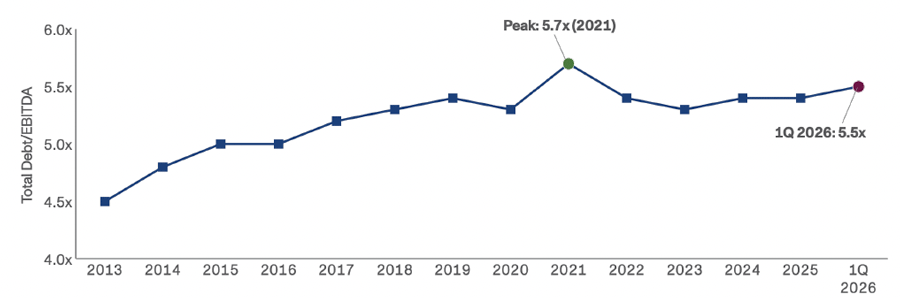
Figure 1: Middle Market Leverage Has Climbed From 4.5x to 5.5x Since 2013

Average total debt-to-EBITDA, U.S. middle market sponsored loans (2013-1Q 2026)

Image
Graph

Source: LSEG LPC; 1Q 2026 preliminary.
 

Since the Global Financial Crisis, investor protections have been eroded steadily. Leverage levels climbed as low interest rates and rising valuations made higher debt loads appear manageable (See Figure 1).

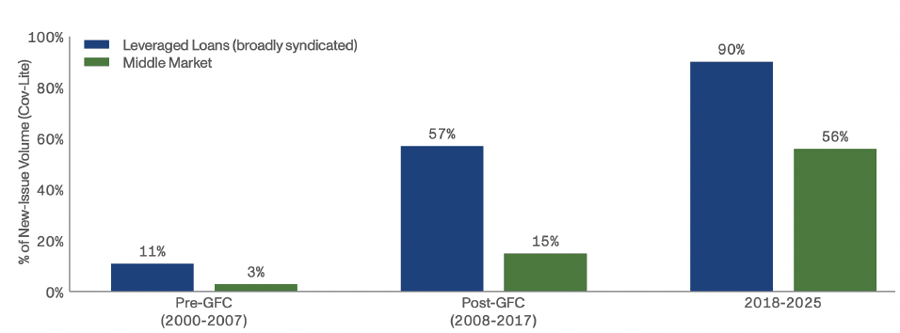
Covenants weakened, with covenant-lite and covenantloose structures becoming the norm rather than the exception (See Figure 2).

Liability Management Exercises (“LMEs”), a maneuver that effectively removes collateral from original lenders, entered the broadly syndicated loan vocabulary. In a benign credit environment, these concessions went largely unpunished. Due to a combination of extraordinarily forgiving conditions and a highly competitive market, lenders elected to reduce or remove historical loan protections in order to compete for the opportunity to deploy capital. That environment is now changing.
 

Figure 2: Cov-lite Has Gone From Rare Exception to Market Norm 

Volume-weighted average share of new-issue volume documented as covenant-lite, by era

Image
Graph

Source: Pitchbook LCD Comps Interactive Volume Report (deals > $100mm); era values volume-weighted
 

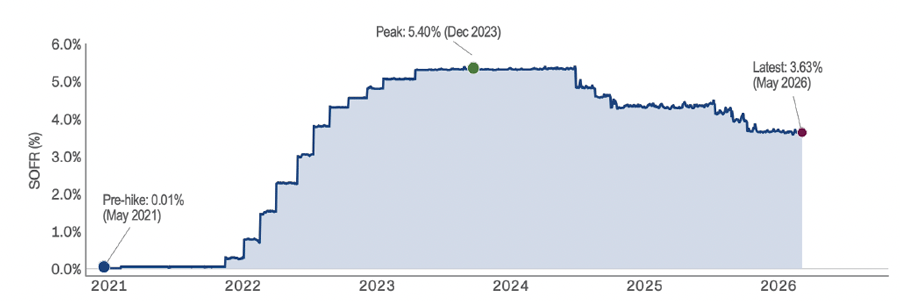
Over the past several years, base rates have normalized as SOFR is no longer hovering near zero (See Figure 3).

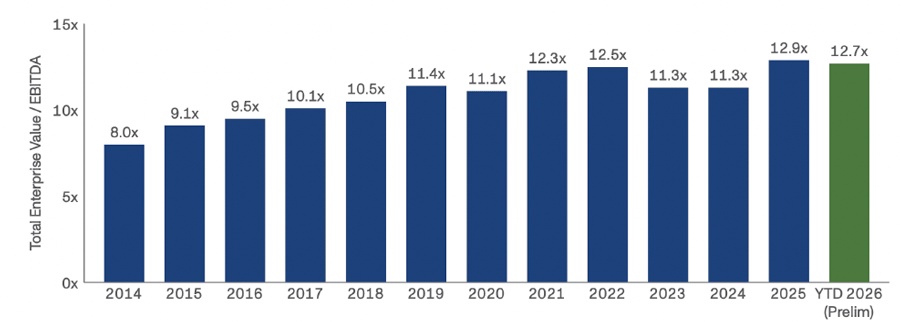
Economic uncertainty and volatility have returned. Rising enterprise value multiples, which provided a comfortable cushion for many years, are being questioned (See Figure 4).

Lenders who deployed capital at peak leverage, assuming enterprise value multiples were sustainable and rates would stay low indefinitely, and who accepted weaker documentation, are now facing a reckoning.
 

Figure 3: Base Rates Have Normalized – SOFR Is No Longer Near Zero 

Secured overnight financing rate, daily (May 2021 - May 2026)

Image
Graph

Source: Federal Reserve Bank of New York – Secured Overnight Financing Rate (Daily).
 

Figure 4: Purchase-Price Multiples Have Climbed Steadily Over the Past Decade 

Total Enterprise Value / EBITDA transaction multiples since 2014

Image
Graph

Source: Lincoln Lens – Private Market Intelligence; YTD 2026 represents data collected as of 3/31/26.
 

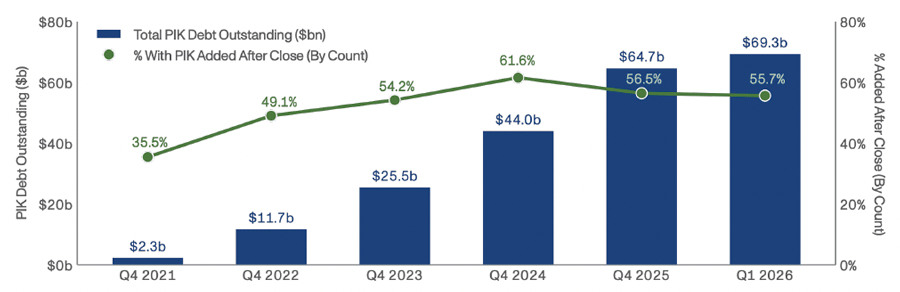
Figure 5: PIK Is Rising – and Most of It From Loans That Didn’t Have It at Close 

Total amount of PIK debt outstanding and % of names that didn’t have it at close

Image
Graph

Source: Lincoln Lens - Private Market Intelligence
 

The evidence of stress is already visible in market data. Rising payment-in-kind (PIK) provisions signal that cash interest can no longer be fully serviced, a sign that borrowers are straining under their debt loads. (See Figure 5).

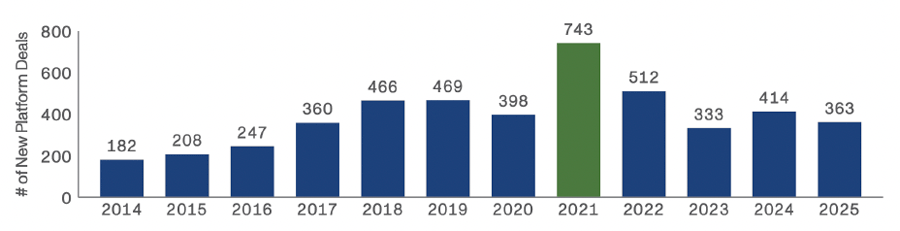
Weaker interest coverage and fixed charge coverage ratios1 confirm that many borrowers are operating with very little financial cushion. According to Lincoln International, over 20% of the investments they track have fixed charge coverage less than 1.0x. The dramatic decline in private equity new platform acquisition activity since 2021 may imply sponsors’ lack of interest or confidence in paying elevated and possibly unsustainable enterprise value multiples. (See Figure 6).

These are not future risks; they are present realities.

The combination of excess leverage, weakened documentation, and uncertainty around enterprise value multiple sustainability means that if companies disappoint (and more than a few will) many lenders will find themselves with lower recovery rates than the asset class has historically delivered. We believe the private credit market could be entering its first serious test of underwriting decisions made in recent years under unusually favorable conditions. We expect outcomes to diverge meaningfully across managers, with the degree of dispersion reflecting the degree to which standards were compromised during the years when compromising them was easy and went unnoticed.
 

Figure 6: M&A Platform Buyouts have Fallen Sharply from Their Peak in 2021 

Number of new platform LBO transactions per year

Image
Graph

Source: Lincoln Lens - Private Market Intelligence.
1 Fixed Charge Coverage = (LTM EBITDA - Taxes - Capex) / (Interest Expense + (1% * Total Debt))
 

So, what is an investor to do?

Investing is almost always about trade-offs. Lower return usually means better downside protection and less risk is expected. Less liquidity is expected to lead to a higher return expectation. There are no perfect investments or investment vehicles; each choice has advantages and disadvantages

1. Focus on the basics of this asset class. First-out, last-to-lose, senior secured and floating rate, with a loan agreement designed to protect the lender from material changes in the borrower’s behavior or performance; those are powerful and enduring characteristics of an investment, and they are only as valuable as the degree to which a manager insists on them. Not every manager who has delivered strong historical returns did so. Many benefited from a rising tide that obscured the risks they accepted. Look for a manager who can document these attributes consistently, including during the years when the market moved aggressively in the other direction.

2. Invest in fund structures that respect the illiquidity of the asset class. Illiquidity is neither a virtue nor a flaw; it is a trade-off. The illiquidity premium in private credit is real and justified. Vehicles offering redemption features inconsistent with the characteristics of the underlying investments they own introduce structural mismatches that tend to surface when market stress makes both the loans and the liquidity provisions most difficult to honor simultaneously. Look for structures that align with the realistic duration of the underlying portfolio and hold realistic expectations of tail risk events.

3. Recognize that outperformance requires avoidance of principal loss. In credit investing, the asymmetry of outcomes is fundamental: the upside is capped at par, while the downside can be everything. Outperformance is therefore generated not by finding great deals, although that helps, but by avoiding bad ones. Risk mitigation must be at the heart of every lending decision, not a priority adopted only when conditions change, but a discipline maintained throughout and especially when competitive pressure makes it most tempting to abandon. Credit mistakes are commonly made during the most optimistic of times. A manager who has tightened standards only in response to the current environment is one who likely loosened them when it was easy to do so. Look for a demonstrated record of consistent underwriting across a full credit cycle.

4. Understand that mistakes happen and companies underperform. There is no better position in a capital structure from which to manage a problem than the senior secured lender position. But that position only delivers its potential when the historical protection characteristics are included, such as documentation that provides genuine enforcement rights, collateral that is accessible, and a manager that has both the operational expertise and the institutional willingness to act when conditions warrant. The last point is underappreciated. Some lenders have the legal right to intervene but lack the organizational capability or appetite to do so. Look for a manager with a demonstrated record of managing troubled credits through to resolution, including, where necessary, taking control of businesses and managing them to recovery. This is not a theoretical capability; it requires real infrastructure, experienced personnel, and a firm culture that does not flinch from hard situations and difficult decisions.

5. Finally, look for managers who are willing to show their work. Every investment manager presents their strategy from their own vantage point, and allocators should calibrate accordingly. The distinction that matters is whether a manager can clearly articulate the trade-offs of the investment they are asking you to make, including the constraints, the scenarios under which their approach could be challenged to perform, and the risks they are choosing not to take. That quality is both rare and revealing. A manager who can name the vulnerabilities of their own strategy forthrightly is one who truly understands these risks and recognizes the trade-offs. There is always a trade-off; the question is whether your manager understands theirs and is willing to discuss it candidly.

A final word

Over the past 25 years, we have learned most of these lessons the hard way. Credit investing is a humbling business. The discipline that sustains performance through a cycle is not complicated to describe, but it can be difficult to maintain. Deployment slows during the periods when others are moving fast. Your investors may ask why you are not putting more money to work. The honest answer is that we have seen this before. Markets that appear forgiving eventually are not, and the managers who survive the correction are usually the ones who did not cut corners when cutting corners was easy and went largely unpunished. We have maintained our standards across multiple cycles, and we enter this one the same way we entered each of the others: knowing that we did not loosen our approach when the environment rewarded loosening it. There will be mistakes in our portfolios in the years ahead as there always are. But we will endeavor to manage those underperformers back to health, as we have seen this playbook before and have successfully navigated it. This is not our first cycle, and it will not be our last.


Read More from TCW
 

Disclosure
This material is for general information purposes only and does not constitute an offer to sell, or a solicitation of an offer to buy, any security. TCW, its officers, directors, employees or clients may have positions in securities or investments mentioned in this publication, which positions may change at any time, without notice. While the information and statistical data contained herein are based on sources believed to be reliable, we do not represent that it is accurate and should not be relied on as such or be the basis for an investment decision. The information contained herein may include preliminary information and/or “forward-looking statements.” Due to numerous factors, actual events may differ substantially from those presented. TCW assumes no duty to update any forward-looking statements or opinions in this document. Any opinions expressed herein are current only as of the time made and are subject to change without notice. Past performance is no guarantee of future results. All investing involves risk including the potential loss of principal. Market volatility may significantly impact the value of your investments. Recent tariff announcements may add to this volatility, creating additional economic uncertainty and potentially affecting the value of certain investments. Tariffs can impact various sectors differently, leading to changes in market dynamics and investment performance. © 2026 TCW

Share this post

Sign Up Now for Full Access to Articles and Podcasts!

Unlock full access to our vast content library by registering as an institutional investor

Register

Contacts


Image
TCW_Logo_Black


TCW has a dedicated insurance platform that is fully integrated with our dynamic investment management platform, which has served investors for over 50 years, enabling clients to evaluate opportunities through both an investment and insurance lens. The firm’s insurance portfolios incorporate a full range of solutions that can be customized as individual strategies or designed to function together within a diversified general account framework.  

Combining insurance-focused expertise, specialized infrastructure, and analytical capabilities, the platform helps insurers address portfolio construction, capital efficiency, regulatory considerations, statutory reporting, and balance sheet optimization as part of the investment process. By integrating these capabilities into a single client experience, TCW provides insurers with a more comprehensive approach to managing assets and liabilities. In a market where many managers offer insurance-compatible products, TCW distinguishes itself through the depth of its insurance-focused resources and its ability to support insurers holistically as regulatory, reporting, and capital requirements continue to evolve.

TCW is a global asset manager with $200 billion in assets under management as of June 30, 2026, offering innovative strategies across fixed income, equities, and alternatives to diverse insurance clients. 
 

TCW
515 South Flower Street
Los Angeles, CA 90071
insurancesolutions@tcw.com
 

View the contributor page

Sign Up Now for Full Access to Articles and Podcasts!

Unlock full access to our vast content library by registering as an institutional investor .

Create an account

Already have an account ? Sign in

Ѐ Ё Ђ Ѓ Є Ѕ І Ї Ј Љ Њ Ћ Ќ Ѝ Ў Џ А Б В Г Д Е Ж З И Й К Л М Н О П Р С ΄ ΅ Ά · Έ Ή Ί Ό Ύ Ώ ΐ Α Β Γ Δ Ε Ζ Η Θ Ι Κ Λ Μ Ν Ξ Ο Π Ρ Ё Ђ Ѓ Є Ѕ І Ї Ј Љ Њ Ћ Ќ Ў Џ А Б В Г Д Е Ж З И Й К Л М Н О П Р С Т У Ф Х Ц Ч Ш Ā ā Ă ă Ą ą Ć ć Ĉ ĉ Ċ ċ Č č Ď ď Đ đ Ē ē Ĕ ĕ Ė fi fl œ æ ß