





Fidelity-

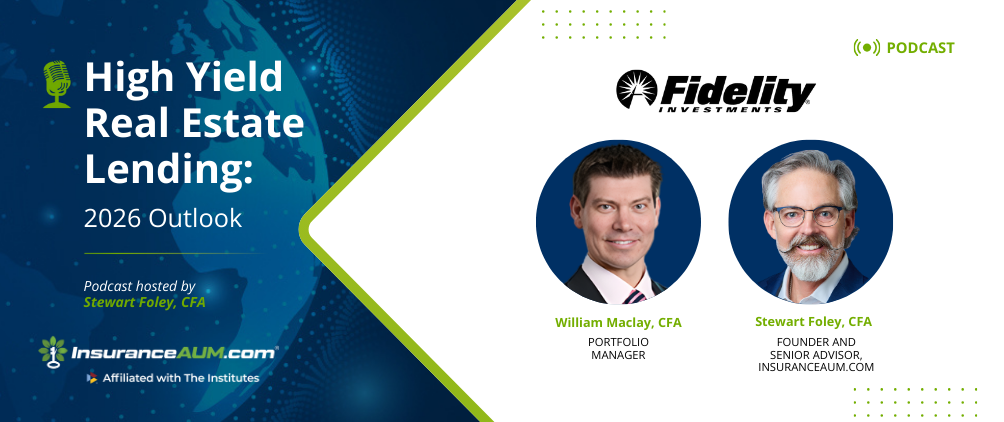
High Yield Real Estate Lending: 2026 Outlook

Image
01.21.26 Fidelity_Web_NEW


Stewart: Hey, welcome back to the Home of the World's Smartest Money. Very glad to be with you. My name is Stewart Foley. I'm your host. I'm also the Founder and Senior Advisor at InsuranceAUM.com and the Principal Architect of the upcoming CIIM designation. More to come on that. So today we're talking about a forward-looking view on a corner of the real estate market that continues to evolve quickly, which is high yield real estate lending with banks, retrenching, construction activity, recalibrating and capital structures. Adjusting the 2026 Outlook for this market is top of mind for insurance investors looking to balance yield, structure and risk. My guest today is back for another time with us, which I'm thrilled to say. My guest is Bill Maclay, Portfolio Manager in Fidelity's High Income and Alternatives Division. Bill manages several of Fidelity's real estate income and opportunistic strategies and brings more than two decades of experience across real estate equity and debt markets. Bill, welcome back. How are you? Thanks for taking the time.

Bill: Thank you. I'm doing great and I'm excited to be here.

Stewart: It looks like a sunny day out your window. It looks like a nice sunny day out there. So, we've got some clouds today. We'll see how we shape up, but it's supposed to get cold down here. We're not looking forward to that. But we start this the one the way we always do, which is where'd you grow up? What was your high school mascot? That's fairly new. And then if you weren't doing this job, what job would you most like to have instead?

Bill: Let's see. I grew up in the San Francisco Bay Area up in the Oakland Hills in the 1980s and early nineties. That was actually a great time to be in the Bay Area. I'm a huge sports fan and we had the Oakland A’s dynasty at the time with Jose Canseco and Mark McGwire. We also had the 49ers dynasty with Joe Montana and Jerry Rice. And then on the music front we had Green Day, who I noticed is playing at the Super Bowl this year.

Stewart: Wow.

Bill: And then mascot, I went to Piedmont High School and our mascot was the Highlander.

Stewart: And if you weren't doing this job, what would you be doing if not high yield real estate?

Bill: So I'm going to list two quickly because one is somewhat unrealistic. So my unrealistic job, I think I'd like to play Stryker for a Liverpool in the Premier League, but I think I'm too old by at least two decades. And more importantly, I do lack the skill.

Stewart: Yeah, I was going to say for me it's not age.

Bill: Maybe more realistically I would love to be a college professor and teach real estate or finance.

Stewart: That's interesting. I did that job for about seven years. It is super satisfying and I still have a lot of former students who were on LinkedIn were connected and so forth. And actually, believe it or not, Bill, I'm starting to have grand students where my students are having children. And so that's super cool. It is really, if you do it right, it is a lot of work, but it's super satisfying. So that one's well within reach and if you want to talk about that offline, I'm happy to tell you about how maybe it gets started with that. But let's talk a little bit about an overview of Fidelity's real estate debt platform. Can you give us an overview of the platform and how it fits within Fidelity's broader real assets and fixed income capabilities? And maybe just a little bit about your background and how you got there.

Bill: Absolutely. So Fidelity is a big place, which is one of the reasons why I've enjoyed working here. We have investment teams that cover just about every asset class and these days that includes both public securities as well as private markets. In real estate, specifically, we invest in all four quadrants. So that includes private and public equity, that includes private and public debt. Now I manage our real estate debt funds, which includes our liquid strategies as well as our private lending strategies. And Fidelity has been around a long time, but the real estate debt group here at Fidelity was formed about 30 years ago, and we started off as a buyer of the subordinate portion of the securitizations from the Resolution Trust Corporation coming out of the S&L crisis. And then as the CMBS market formed, we set up a dedicated high-yield CMBS strategies, and from there we expanded into all forms of real estate securities.

Then in 2007, we stood up our private lending platform and we've been active in the real estate private lending market for close to two decades now. And what is great about Fidelity is that we have such a broad platform. So we're investing in every flavor of real estate, whether it's on the public side or the private side. On the public side that includes RE equities, RE bonds, CMBS. And then on the private side we're buying buildings and we're originating loans on commercial real estate. If there's something happening in one of the real estate markets, we're seeing it and we're analyzing it. And one of my favorite meetings here, internal meetings at Fidelity is when we bring all of our real estate teams together and we have an open discussion on what we're seeing in the different markets, what excites us, what worries us, and all those great resources are just one reason why I've enjoyed being at Fidelity. I'm in my 25th year now here.

Stewart: Yeah, there's a lot of folks that have been with Fidelity for a long time, which I think there are other firms like that too. And I think it really reflects really well on the firm's culture, right, to keep people in a place for a long time, obviously because everybody's got options and I think it is indicative of a firm that has a really healthy culture. So let's talk a little bit about high yield lending in the CRE ecosystem, if you will. How do you define your role as a high yield lender and where do you fit within the broader commercial real estate lending market today?

Bill: Many of your prior guests have pointed out that the commercial real estate debt market is large. There's
$6 trillion of outstanding debt, and there's many flavors and many segments and different dimensions to lend across. We lend in a pretty specific niche. We're a high yield lender, so we're either originating subordinate debt or high yielding first mortgages. So our loans typically have yields that are north of 10%. We're also focused on the middle market. And the middle market can mean different things to the different people. And what it means to us is that we're lending on properties that have values that range from say 50 million to $150 million. And that's large enough that the properties are institutional quality, but on the smaller end of the spectrum, and this portion of the lending market is highly fragmented. So there's a mix of regional banks, some insurance companies, CMBS, and then private lenders like us.

As you go up in size, the lender base does consolidate because you do need larger pools of capital. But the nice part of lending in a fragmented market is there's lots of opportunities with a lot of variety and that can create some pretty unique situations. One other dimension that we invest across are the types of loans. So a big piece of the high yield lending market is bridge loans where a developer may take a B-quality property upgraded to a quality property, and we do bridge lending, but we also like to mix other types of loans as well. We like having different types of loans as the other types tend to stay outstanding longer. And we find that beneficial as we don't have to recycle our capital as fast. So for example, gap financing on stabilized assets is nice. You can get longer term, you can get longer prepayment protection. And then we're also quite active in construction financing. And I think actually that's one of the more interesting parts of the lending market right now.

Stewart: Yeah, I was just going to ask you about that. So construction lending today, right? What are you seeing in construction lending and why in your mind does this part of the market remain interesting despite lower volumes?

Bill: Absolutely. So I mentioned that we've been quite active over the past year and it is an interesting part of the market right now, and this might sound counterintuitive, but there is less flow of construction opportunities. But that is one of the reasons that we think it's pretty interesting. Now there's less flow because developers are having a hard time making the numbers pencil. So generally a developer wants to build to a return on cost of about a hundred basis points over the cap rate. But there's a couple pressures that have been building in the multifamily space as an example. Rents have been generally decelerating, but construction costs continue to rise. So all things being equal, those two things mean a lower return on cost. Now, at the same time, interest rates have increased compared to a few years ago. So the hurdle rate of moving forward is higher.

As an example, a couple of years ago for multifamily cap rates were say three and a half percent. So a developer would try to build to a four and a half percent return on cost. Now cap rates might be five. So a developer needs to build to a return on cost of six. So with property level income, flattening costs rising and the cost of capital rising, it makes many projects not feasible. Now, markets are generally autocorrecting and there's some input costs that could adjust. Land as an example, tends to be 10 to 20% of the cost, and land tends to get cheaper when construction starts fall. Labor costs in theory could also adjust, but labor markets are actually pretty tight. And then hard costs are definitely not declining. So it doesn't feel like construction costs will get cheaper anytime soon. And that means less projects could get started. That does mean lower deal flow, fewer deals. But the other side of the coin is that also means new supply is coming down, which is good for the underlying fundamentals of commercial real estate. And with a higher bar for the projects that do get funded, it means that those projects that do pencil really do have better underlying credit characteristics. And that's not a bad thing if you're a lender.

Stewart: So it leads me to benefits and the risks on construction lending. It sounds like, I don't know want to put words in your mouth, but it's like in this environment, deals that get done, it's a higher bar, meaning that potentially the quality of the deal is better than in a frothy market where a lot of stuff's getting done. But that doesn't necessarily mean it's good, right? So how do you think about the balance between risk and return and construction lending as we look into 2026?

Bill: Construction lending does come with additional risks compared to other types of lending, but there are a lot of aspects that we like a lot. And right now is really not a bad time to be a construction lender from a lender's perspective, and I'll circle back to some of the risks, but one of the positives for construction loans is that you get a premium or more yield compared to bridge lending or lending on stabilized assets. Another benefit is that we found is that construction loans tend to stay outstanding longer than say bridge loans, for example. Many apartment developers hope to complete their project in 18 months, but developers tend to be an optimistic bunch that we find it really takes more like two years and then it takes another year to lease up, but which tends to mean that your loan stays outstanding for say, three years, which is longer than what we see in the bridge space.

Another aspect that you like about construction financing is that when completed, we have the newest building in the submarket, and that should compete really well compared to the older buildings in the market. And as a lender, if our basis is 70% of the construction costs, that's a nice spot to be in. Now there are risks to construction lending. Cost overruns is an important one. They do happen to mitigate the cost overrun risk. We're pretty careful about who we lend to. We want developers that have shown that they know how to build, they know how to execute, and they've been successful in the past. We also build a solid contingency line item into the budget. So if there is a cost overrun, there is cash in the budget to handle it. And we also like developers that have the financial wherewithal if the unexpected does happen.

So they have the ability to put in more equity if it's needed. And then one other way that we manage risk is the timing of when we fund. The equity capital does have to be spent before the debt capital and the budget does have to be in balance before we fund our first dollar as a lender. And then lease up risk is another key risk for construction lending, and that can vary by quite a bit depending upon the property type. So for construction lending, we mainly focus on multifamily and pre-lease industrial buildings. Now, pre-lease industrial is pretty simple, as long as the tenant doesn't file for bankruptcy and the building is properly built, they're obligated to pay rent when their lease starts. Spec industrial of course, is a different story, much more subject to market conditions. And then multifamily, you can't really pre-lease, so you're subjected to market conditions.

But in most major metropolitan markets, there are a lot of renters. So the pool of people that lease an apartment is really deep. And then a well-built apartment building should get to 90% plus, at least in a reasonable amount of time, assuming supply is not an issue. And that rental rate could be a little bit more of what's at risk. But again, in major metropolitan areas, there should be a lot of comparable buildings to comp out to. So unless your product that's being built is very different from the market, it's hard to miss by a lot. And this is where it's helpful to be a lender if there's a modest miss in occupancy or rent the debt, if it's only 70% of the construction costs, there should be enough cushion that the debt should be fine. Now of course, if the project's a home run, equity gets all the upside.

Stewart: Sure, yeah, that's always the way, right? So I mean the old saying goes, Bill, in real estate, it's location, location, location in which gets me to the geography and regional opportunity. How do you approach geography as a high yield lender? And are there regions of the US that look more compelling today? And is there anywhere that you're more cautious?

Bill: We lend across the whole country and we do tilt towards and away from different regions. Over the past few years, we have been more positively inclined on the coast and a little less positively inclined on the Sunbelt. That's always changing and evolving though. There's several important factors that help us think about geography. On the demand side of the equation, it is very important to follow positive demographics. The Sunbelt has fantastic demographics. Growing population is beneficial to commercial real estate. More people means more demand for space for all types of property. More people means more housing is needed. More people means there's more places to shop, are needed more people means there's more office space that's needed, but there is a lot of nuance to it. So it might sound funny, but people don't occupy apartments, households do. So household growth is actually more important for multifamily and more meaningful than just raw population growth.

And households are actually growing faster than the general population. People work in office buildings only if they have office jobs. So growth of office jobs is very important for office buildings and isn't perfectly correlated with population growth. And then having the right segment of the demographic also matters. I'm going to state the obvious here, but for seniors housing, you need older people and for student housing that's occupied by younger people. So we spend a lot of time thinking about the demographics and different segments of each of the metropolitan areas. More people, more households, more jobs are great, but that's just one side of the equation. The other side of the equation is supply and oversupply is the enemy of good credit and can overwhelm good demographics. And I think it's really important to marry supply and demand together. So in commercial real estate, one of the nice things is that we can see in the future of what future supply might look like a year or two out to build a building. It does take time to build a building, you do need a permit and permit data and construction starts are all available. And these days it's so much easier to access data than say, 20 years ago. So we should have a pretty good idea of what future supply looks like. Stewart, can I actually give you a pretty specific example of what I'm talking about, about coupling supply and demand together?

Stewart: Yeah, absolutely.

Bill: Okay. So I'm going to compare two metropolitan areas that are in the middle portion of America, and my two cities are Chicago and Austin, Texas.

Stewart: Alright, I moved out of one and into the other. So this ought to be, I'm keenly interested here, Bill.

Bill: Alright. So I think it's well known that people have been migrating from the colder states in the north to the warmer states in the south. And that trend has been present and it did accelerate during COVID. That migration trend is quite obvious when you look at the data. So these numbers are from the census. So if you look at the population for Chicago from 2020 to the end of 24, it was actually more or less unchanged. Austin, Texas, on the other hand, saw a tremendous population growth in the metropolitan area grew by 11%, and that equates to 270,000 people. However, developers got excited to do what developers do and they built. And so using some of the data from CoStar, you can see that over that same time period, about 90,000 apartment units were delivered in Austin, Texas, and Austin's not a gigantic metropolitan area.

So that actually expanded the inventory for apartments by 50%. Now, 270,000 people is a lot of people, but again, people don't live in apartments. Households do. And there's really roughly about two people per household. Additionally, for a percentage of renters, only about 40% of people rent. The other 60% live in a home. And so it turns out that more units were built than were needed. And so if we were to look at some of the CoStar data on where vacancy rates were in 2019, the vacancy rate for Austin, Texas for multifamily was 8%. But by the end of 24 it grew to 15% and rents did grow during that time. So if we looked at the Rent Index from CoStar, it shows about a cumulative growth of about 8%. Now, if we look at Chicago, which is a much bigger metropolitan area, it added only 50,000 units, which was only about 8% of inventory.

Now you could ask why build anything if population is flat? And the really short answer is that there was household growth as people spread out more, so more housing units were needed. And I'll skip right to the punchline rather than doing some extra math. The vacancy rate for Chicago at the end of 2019 was about 6.5%, and by the end of 2024, it fell to just above 5%. And using the rent index from CoStar, the cumulative rent growth was about 17%. So Chicago had no population growth, but very limited supply growth and the vacancy dropped and rents actually grew at twice the rate of Austin while Austin had huge population growth, but also had huge supply growth and the vacancy rate almost doubled. So I think the lesson is that supply does matter.

Stewart: Yeah, I mean it's interesting. I live out here in the Hill Country and everyone, a lot of people built a house and then seven tiny houses thinking that they were going to be an Airbnb guru or something. And a lot of that stuff is just sitting and nobody wants to buy it. And it's not the same example, but there was over exuberance that the population growth coming out of COVID was going to happen forever. And as well as I do that when markets make assumptions like that, it's almost always wrong. So I'm not terribly surprised by that even though people still say to me like, oh man, people are really rushing down there and it's like they're not rushing down here as much I think as they were after COVID. Interesting example. I really appreciate that. Let me talk a little bit about partnering with insurance companies. If I'm a CIO and I want to partner on high yield real estate loans like Fidelity is making, where is the strongest alignment between the two?

Bill: Yeah, so what's interesting is insurance companies are big owners and lenders of commercial real estate themselves, but there are multiple ways that insurance companies can partner with high yield lenders like ourselves. The one way is that insurance companies are sometimes the equity capital, whether it's through direct ownership or partnering through a local developer. Another way is we could also partner with an insurance company and be co lenders on a building. So an insurance company might originate a lower levered first mortgage and maybe that might not be enough proceeds for the sponsor or the borrower. And that's where we could come in and partner with the insurance company and offer subordinate debt to fill out the capitalization. So for example, an insurance company might offer to originate a loan through the first 50% of the value of the property. We could come in and offer the next 20% of the capitalization as subordinate debt, and of course the final 30% would come as equity capital.

Then there's one other way that insurance companies can partner with high yield lenders that they can partner. We invest through the asset managers that have the high yield lending platform, and that can occur with insurance companies of all sizes. So smaller insurance companies may not have the high yield lending platform or even the mortgage origination capability, but still might want access to that return profile. But larger insurance companies with full real estate platforms also invest through high yield lenders that just to gain more access to the market, those companies might want to allocate their real estate resources to owning buildings or originating more on the run commercial real estate lending. So there's actually quite a few ways that insurance companies can partner with higher lenders like ourselves.

Stewart: That's super helpful. You mentioned 70% LTVA couple of times. Is that sort of the ceiling where you go, we're good here at 70, but we don't want to go, we're not doing 80. Can you talk a little bit about, do you have LTVA guardrails?

Bill: Yeah, so we tend to be flexible, but I would say that would be generally where we think our averages over the long run, but there's absolute dispersion. So for the right deal that has the right characteristics, would we go a little higher? Absolutely. Or if there's a transaction that we think we need to mitigate risk, and maybe it does need some additional equity capital, it could be lower. So if I had to ballpark the middle portion, I would say 70. But I think there is real variability rate around that based on the individual transaction.

Stewart: It has been a tremendous education on real estate high yield lending. I really appreciate you being on. I've got a couple of fun ones for you on the way out the door if you're willing. And the first one really talks about the culture at Fidelity, and the question is what characteristics and really over the course of your career, I mean everybody that's on this show has been at it for a minute, right? What characteristics do you think are most important when you're adding to members of your team? Talk a little bit about that if you would.

Bill: We do think about that a lot since people, as you mentioned, people stay quite a while at Fidelity. And over time I think I've come to realize that the best fit at Fidelity, that people have several common characteristics, and for young people, it's not necessarily what school they went to or what they did for a year or two. What we want is people that are very bright, have an analytical mind, are hardworking and have a deep passion for what we do. I think that last one is a real difference maker. The people that can't stop thinking about our work are the ones that do have some of the biggest impact. And I'm actually pretty surprised at how many young people are so passionate about investing in real estate at such a young age. Now, experience does matter for the more senior roles, but for younger employees, I'd say that we care most about those characteristics that I just mentioned. An experience can build over time.

Stewart: See those students have a good professor like you and they got fired up. And it's funny, over the course of my career, you meet students who are just into it. It's not that they can learn better than the next student necessarily, but they're super passionate about it. So that's interesting because it's not exceedingly common. And so it's cool that you recognize that. The last one I've got for you, you may have heard before, which is who would you most like to have dinner with? Dinner's on us, by the way, who would you most like to have dinner with alive or dead? And the reason we ask this question is because, I mean, you mentioned you're a big sports fan, we've had Buffet a lot, we've had, I think Buffet's the leader of the clubhouse. I think Jesus is behind him, believe it or not. But talk to us a little bit about who you think would be an interesting dinner table.

Bill: So I've been very fortunate to work with and meet many legendary investors here at Fidelity. So I'm not going to pick anyone in finance. I think my first pick, I'd pick Neil deGrasse Tyson, who I think is an amazing advocate for science. And I do find astrophysics quite fascinating. And then I think the second person, as you mentioned, I do like sports would be Emma Hayes. She is the US Women's National Team head coach. I love soccer and I have three daughters and I would love to see women's soccer continue to gain more fans, and I'm hoping that the US will win the next Women's World Cup.

Stewart: By the way, she's super interesting just to interject, that's a very interesting woman to say the least, but that's a cool story. Okay. Sorry, go ahead.

Bill: Absolutely. And her resume is incredible coming from Chelsea. But my third, I would pick my mother who passed away 30 years ago. I would love to tell her about her grandchildren.

Stewart: That's nice. That is really touching. I mean, my mom is 88 and she's struggling, and I can really appreciate that. So you know what, Bill, thanks so much for being on again. I really appreciate it. We've gotten a great education today and just wanted to say thank you so much.

Bill: Absolutely. Thank you for having me.

Stewart: We've been joined today by Bill Maclay, Portfolio Manager in Fidelity Investments, high income and alternative division. Thanks for listening. If you have a moment, please rate us, like us and review us on Apple Podcast, Spotify, or wherever you're listening to your favorite show. We do have a new YouTube channel that is at Insurance AUM Community. My name's Stewart Foley. This is the Home of the World's Smartest Money at InsuranceAUM.com.


Unless otherwise expressly disclosed to you in writing, the information provided in this material is for educational purposes only. Any viewpoints expressed by Fidelity are not intended to be used as a primary basis for your investment decisions and are based on facts and circumstances at the point in time they are made and are not particular to you. Accordingly, nothing in this material constitutes impartial investment advice or advice in a fiduciary capacity, as defined or under the Employee Retirement Income Security Act of 1974 or the Internal Revenue Code of 1986, both as amended. Fidelity and its representatives may have a conflict of interest in the products or services mentioned in this material because they have a financial interest in the products or services and may receive compensation, directly or indirectly, in connection with the management, distribution, and/or servicing of these products or services, including Fidelity funds, certain third-party funds and products, and certain investment services. Before making any investment decisions, you should take into account all of the particular facts and circumstances of your or your client’s individual situation and reach out to an investment professional, if applicable.

The views expressed are as of the date indicated and may change based on market or other conditions. Unless otherwise noted, the opinions provided are those of the speaker or author, as applicable, and not necessarily those of Fidelity Investments. The experts are not employed by Fidelity but may receive compensation from Fidelity for their services. Fidelity Investments is not affiliated with any other company noted herein and doesn’t endorse or promote any of their products or services. Please determine, based on your investment objectives, risk tolerance, and financial situation, which product or service is right for you.

Fidelity Investments® is an independent company, unaffiliated with InsuranceAUM.com. There is no form of legal partnership, agency affiliation, or similar relationship between InsuranceAUM.com and Fidelity Investments, nor is such a relationship created or implied by the information herein.

Third-party trademarks and service marks are the property of their respective owners. All other trademarks and service marks are the property of FMR LLC or its affiliates. All other trademarks and service marks are the property of FMR LLC, or its affiliated companies.

Fidelity Investments® provides investment products through Fidelity Distributors Company LLC; clearing, custody, or other brokerage services through National Financial Services LLC or Fidelity Brokerage Services LLC, members NYSE, SIPC; and institutional advisory services through Fidelity Institutional Wealth Advisor LLC, copyright 2026 FMR LLC, all rights reserved, 1247142.1.0.
 

Share this post

Sign Up Now for Full Access to Articles and Podcasts!

Unlock full access to our vast content library by registering as an institutional investor

Register

Contacts


Fidelity Investments

Fidelity Institutional offers investment insights, strategies, and solutions as well as trading and prime brokerage services, to a wide range of wealth management firms, asset managers, and institutional investors. Fidelity’s mission is to strengthen the financial well-being of our customers and deliver better outcomes for the clients and businesses we serve. With an AUA of $18.0 trillion, including discretionary assets of $7.1 trillion as of December 31, 2025, we focus on meeting the unique needs of a diverse set of customers. Privately held for 80 years, Fidelity employs 78,000+ associates who are focused on the long-term success of our customers.

William Johnson     
Head of Institutional Large Market Sales     
William.R.Johnson@fmr.com     
773-454-4100

245 Summer Street
Boston, MA 02210


View the contributor page

Sign Up Now for Full Access to Articles and Podcasts!

Unlock full access to our vast content library by registering as an institutional investor .

Create an account

Already have an account ? Sign in

Ѐ Ё Ђ Ѓ Є Ѕ І Ї Ј Љ Њ Ћ Ќ Ѝ Ў Џ А Б В Г Д Е Ж З И Й К Л М Н О П Р С ΄ ΅ Ά · Έ Ή Ί Ό Ύ Ώ ΐ Α Β Γ Δ Ε Ζ Η Θ Ι Κ Λ Μ Ν Ξ Ο Π Ρ Ё Ђ Ѓ Є Ѕ І Ї Ј Љ Њ Ћ Ќ Ў Џ А Б В Г Д Е Ж З И Й К Л М Н О П Р С Т У Ф Х Ц Ч Ш Ā ā Ă ă Ą ą Ć ć Ĉ ĉ Ċ ċ Č č Ď ď Đ đ Ē ē Ĕ ĕ Ė fi fl œ æ ß