

Alliance Bernstein -

How AI Is Changing the Landscape for Insurers

Abstract digital network with floating data, documents and information displays.

Bob Sharma
Global Head—Insurance Client Group

Gerry Anderson
Portfolio Manager—Insurance Allocation and Strategy


As AI’s pace of change accelerates, insurers must adapt their businesses and investments.

AI is reshaping the outlook for insurers as both risk carriers and investors. At AB’s April 2026 Rethinking Insurance Forum, guest speaker Dex Hunter-Torricke and AB’s Inigo Fraser-Jenkins examined how it could alter underwriting assumptions, claims patterns, and the long-term return environment, with implications for liabilities, capital allocation and portfolio strategy.

 
AI Is Driving an Unprecedented Expansion of Knowledge

AI models have become dramatically more powerful, even in the last 12 months. Experts forecast that tech companies will achieve the next step—artificial general intelligence (AGI)—by 2030 at the latest, and possibly as early as the next 12 months. The tech industry is spending more than US$600 billion to develop new models in pursuit of AGI’s human-level understanding. That’s equivalent to expenditure on the US space program and interstate highway network combined. The roll-out of AGI will represent the largest expansion of knowledge in human history.

Healthcare is a notable example of AI’s potential. For 50 years, researchers struggled to decode the genetic sequence of over 200 million proteins, the microscopic building blocks of life on earth—and completed fewer than half a million. In 2022, Google’s AlphaFold substantially completed the task within a year and made the data freely available. Now, every pharmaceutical lab in the world is using this information to seek new drugs and treatments for diseases. The implications for health and human longevity could be startling.

 
Potentially Huge Labor Cost Savings

Even without the advent of AGI, AI is already handling vast numbers of routine clerical tasks. In the US, an estimated 95% of customer service interactions now involve AI at some point in the chain. And recently, software stocks have struggled as AI agents have displaced many coding tasks and threaten others.

AI-driven robots are displacing blue-collar roles too. Robots are already fully staffing some factories in China with no human intervention (dubbed “dark factories”), which enable Xiaomi to produce a smartphone in seconds. Elsewhere in Asia, building sites are deploying bricklaying robots that are six times more productive than humans and rebar-tying robots that are eight times more efficient. The competitive advantages from these new technologies may determine which businesses will succeed and which will fail.

Advances in battery technology may soon drive much greater use of AI-powered robots in the workplace. Faster battery charging and longer battery lives are a huge research focus—and are prerequisites for widespread use of energy-intensive mobile robots. That synthesis of AI and robotics means that even professions like plumbing could be automated before long.

From an aggregate perspective, a 2024 IMF report suggested that about 40% of workers worldwide and 60% in advanced economies are in “high-exposure” occupations (potentially vulnerable to disruption): recent advances suggest those numbers may be underestimated. But while AI could displace jobs, especially for high-wage earners and skilled professionals, it also offers potential job enhancement and creation, particularly in roles where AI complements human labor. And if productivity gains from AI are big enough, overall income levels for most workers could rise, potentially offsetting some of the income inequality exacerbated by AI.

 
The AI Wave Could Increase Business Disruption

In an AI-powered world, very small companies that leverage AI effectively could swiftly disrupt incumbents. For instance, in 2024 a non-technical entrepreneur spent US$20,000 on AI agents to help create and run a business selling compounded GLP-1 weight-loss drugs to cash-paying customers, bypassing insurance. Two years later, the company is on track for US$1.8 billion in sales and has hired another employee to manage operations.

But the same potential for disruption applies across many industries. The question isn’t whether disruption arrives but whether organizations are positioned to navigate it.

For insurers, the challenges are both practical and strategic. On the liability side, AI may change the frequency, severity and correlation of risks across multiple lines at once: climate volatility is already repricing property and casualty books; autonomous vehicles could alter motor insurance economics; AI-enabled medical advances may affect longevity assumptions in life and annuities; and cyber risk is scaling as AI strengthens both attackers and defenders. On the asset side, insurers may also have to invest through greater uncertainty about inflation, growth and market leadership. That combination could make traditional siloed approaches to underwriting, reserving and portfolio construction less effective, increasing the value of cross-functional insight and faster decision making.

In the face of sudden disruption, companies with a culture of openness to new ideas and internal sharing of IP will have a better chance of prospering, in our view. Meanwhile, early movers that achieve huge scale may create unassailable monopoly advantages.

 
The Macro Perspective on AI and Productivity

In our view, deglobalization, climate change and demographic trends create a drag on growth and cause structurally higher inflation. AI could both mitigate and exacerbate those trends: its productivity impact could alleviate forecast shortfalls in working-age populations (excluding Africa), but climate stress could increase with AI data centers’ enormous power and water consumption.

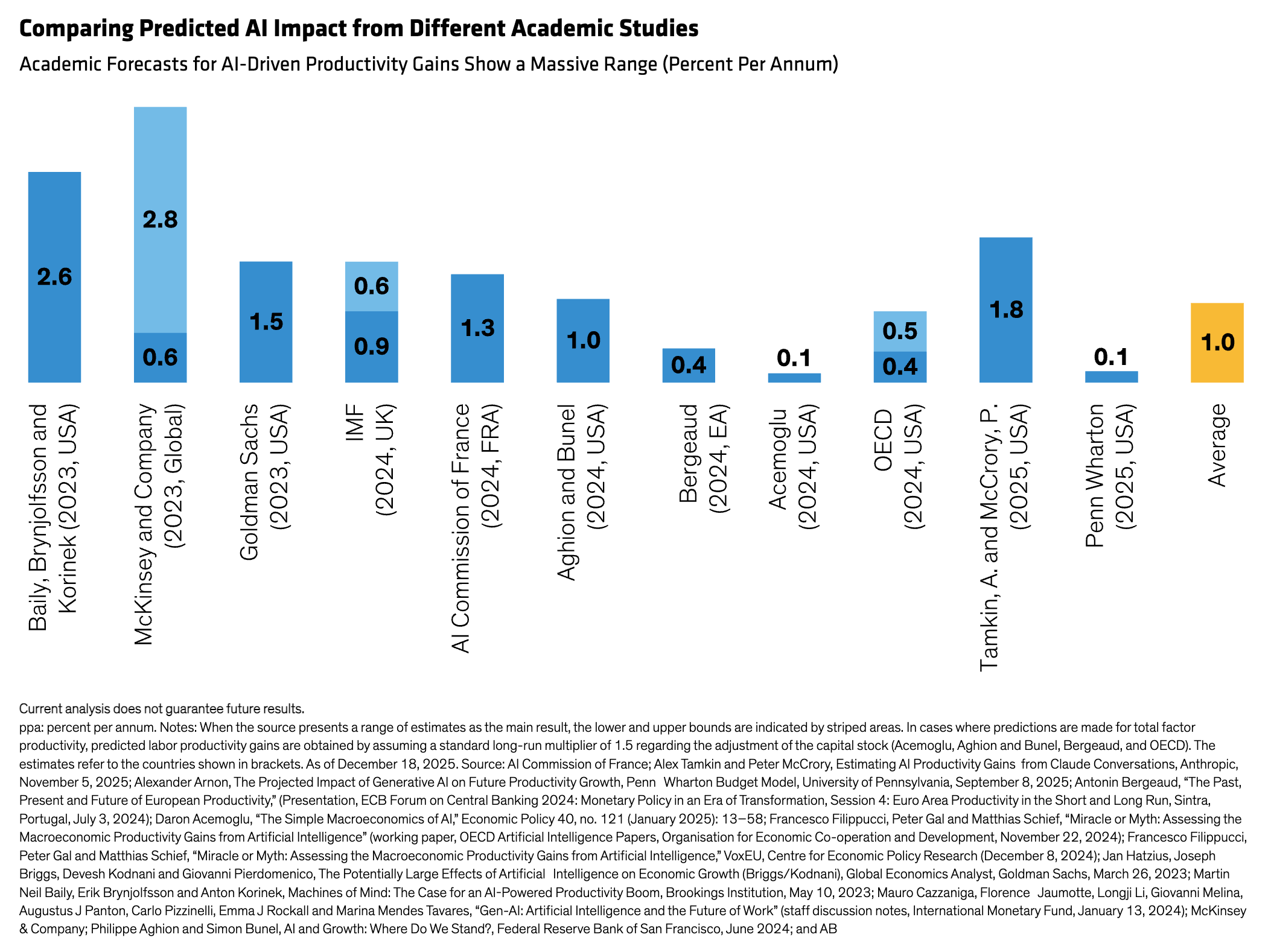
What could the productivity boost from AI be? Opinions vary widely (Display). Any offsetting effect may not last if there’s a mismatch between these forces from a geographic or timing perspective—and history offers no precedent for them balancing out naturally. Our research suggests that the mid-range AI productivity forecasts may only be enough to offset downward forces, not overcome them—and probably not by enough to shrink sovereign-debt burdens.

Chart comparing academic forecasts for annual productivity gains driven by artificial intelligence

US exceptionalism still has strong structural support, thanks to a larger service economy, faster AI adoption and more favorable demographics. But fiscal sustainability concerns remain, and the dollar's reserve status is under pressure. For the rest of the developed world, even optimistic AI productivity scenarios may not offset demographic and climate drags on growth.

Political and regulatory constraints will likely affect AI-driven productivity, too. Surveys indicate that 70%–80% of consumers view AI negatively, more so as familiarity grows. US consumers are protesting the environmental and electricity-cost impact of data centers, and three quarters of populations in Europe and the US believe their societies are heading in the wrong direction, notably through much more inequality. AI’s rising power demands threaten net zero goals, and greater climate and business volatility may be inevitable, absent government intervention. Against that background, AI’s full benefits may not be realized.

 
A Likely Compression in Risks and Returns for Investors

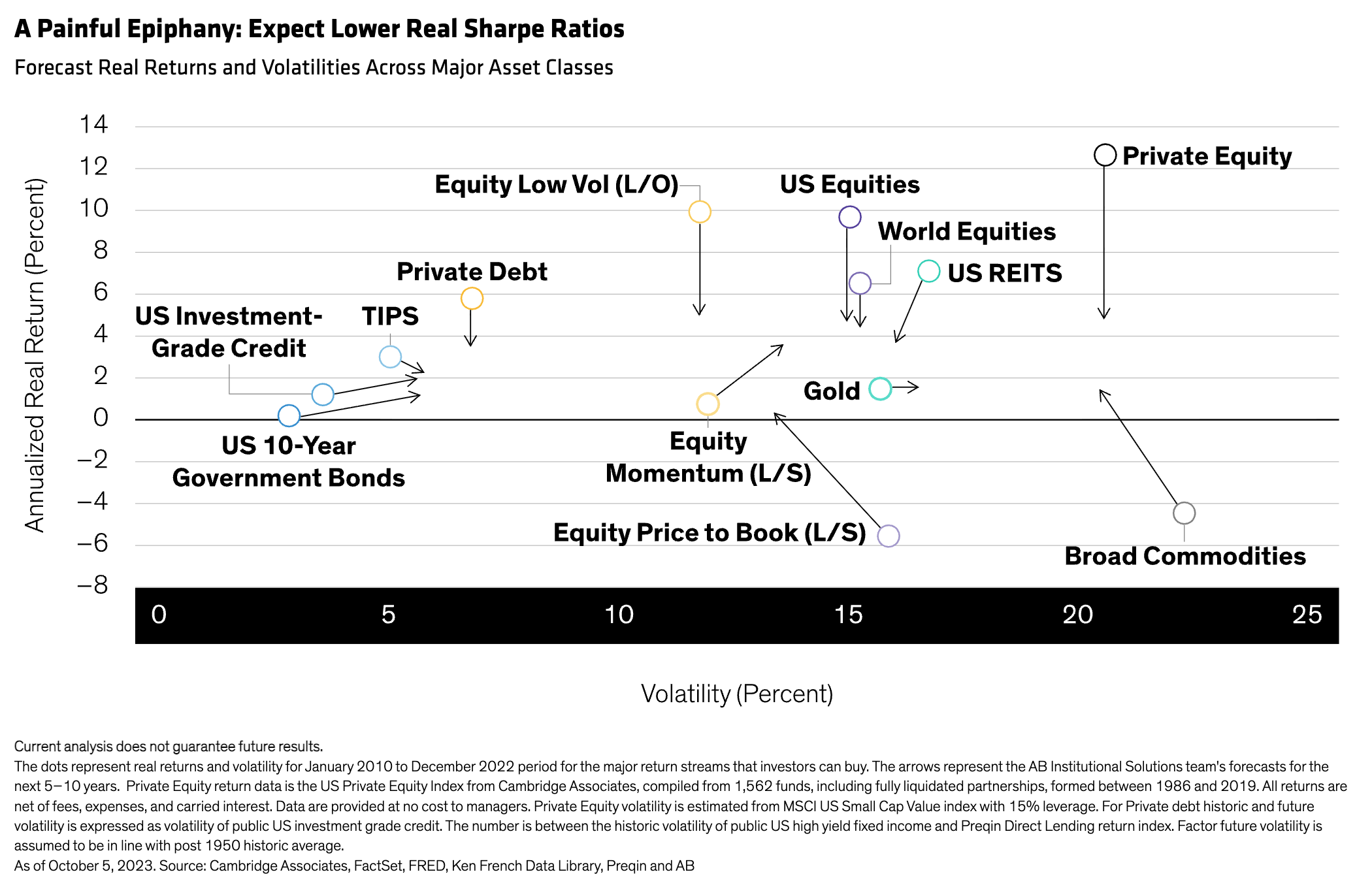
A less supportive macro backdrop, in our view, creates a new investment regime with a less favorable risk and return landscape (Display).

Chart comparing historical and forecast real returns and volatility across major asset classes

Insurers seeking nominal returns may still be able to pursue low-risk strategies using familiar publicly traded assets. But for those seeking real returns, the potential for higher structural inflation suggests the need to pivot to higher allocations to real assets and inflation hedges. That’s why we see a strong case for higher exposure to private assets to achieve real returns and diversification. Incorporating factor-risk strategies, leverage and more active management may also help.

AI has vast potential to expand knowledge and benefit humanity. In the hyper-competitive world of the near future, we believe corporates need to move much faster and be more ambitious in harnessing AI to create a better world—and business advantage. Insurers will need to be very nimble—and leverage diverse insights—to keep pace with tech-driven changes and their underwriting implications.


READ MORE FROM ALLIANCEBERNSTEIN

Share this post

Sign Up Now for Full Access to Articles and Podcasts!

Unlock full access to our vast content library by registering as an institutional investor

Register

Contacts


AllianceBernstein

At AB, insurance is in our DNA. We understand insurance investors’ biggest challenges because we’ve lived them from the inside out. For more than a half century we’ve managed insurance client assets. Our dedicated vertical, deep resources, distinctive investment capabilities and forward platform are designed with insurers’ needs in mind. With an uncommon approach, a collaborative culture and a commitment to innovation, we drive flexible solutions that unlock potential across balance sheets and the full market spectrum- from fixed income to private markets and equities. We’re built to be long-term partners in the evolution from traditional asset-liability management to the new reality of strategic portfolio construction. AllianceBernstein (AB) is a leading global investment-management firm serving institutional investors, individuals, and private-wealth clients in major world markets. Our diverse, connected, collaborative culture encourages different ways of thinking and differentiated insights. We embrace innovation to address increasingly complex investing challenges. And we pursue responsibility throughout our firm- from how we work and act to the distinctive solutions we design for clients.

https://www.alliancebernstein.com/

AllianceBernstein
501 Commerce Street,
Nashville, TN, 37203

Robert Amberger
Client Advisor – North America
robert.amberger@alliancebernstein.com
+1 212-823-2890

Bob Sharma
Global Head of Insurance Client Group
bob.sharma@alliancebernstein.com
+44207-170-0688


View the contributor page

Sign Up Now for Full Access to Articles and Podcasts!

Unlock full access to our vast content library by registering as an institutional investor .

Create an account

Already have an account ? Sign in

Ѐ Ё Ђ Ѓ Є Ѕ І Ї Ј Љ Њ Ћ Ќ Ѝ Ў Џ А Б В Г Д Е Ж З И Й К Л М Н О П Р С ΄ ΅ Ά · Έ Ή Ί Ό Ύ Ώ ΐ Α Β Γ Δ Ε Ζ Η Θ Ι Κ Λ Μ Ν Ξ Ο Π Ρ Ё Ђ Ѓ Є Ѕ І Ї Ј Љ Њ Ћ Ќ Ў Џ А Б В Г Д Е Ж З И Й К Л М Н О П Р С Т У Ф Х Ц Ч Ш Ā ā Ă ă Ą ą Ć ć Ĉ ĉ Ċ ċ Č č Ď ď Đ đ Ē ē Ĕ ĕ Ė fi fl œ æ ß