
Alliance Bernstein -

How Insurers Can Tailor Private Credit to Fit Their Needs

Rows of colorful thread spools arranged by color.

Geoff Cornell, CFA
Chief Investment Officer—Insurance


For insurance investors, value in private credit is defined by more than an attractive yield.

Private credit isn’t a single asset class for insurers. It’s a broad set of tools that spans assets from fund finance to real estate debt. Each investment offers a different mix of income, duration and risk. As we see it, the key for insurers is to identify the best match between these tools and liabilities—while making sure the yield justifies the balance-sheet cost.

Insurance companies talk about private markets often—but they’re not always talking about the same things. The private credit opportunity set is vast, ranging from private placements and fund finance to direct lending, asset-based finance and private real estate debt—each with a different mix of investment characteristics. Collectively, they give insurers a wide-ranging toolkit to deploy in portfolio construction.

The starting point for selecting private credit investments isn’t usually the asset label but rather the insurer’s liability profile—the timing, duration and liquidity of the obligations that need to be funded. These considerations help determine an asset’s fit, while asset quality and regulatory treatment determine whether the yield is worth the cost of carrying it on the balance sheet.

That’s why we think private credit decisions for insurers need to go well beyond asset class exposure, identifying the most appropriate tools for the portfolio and when to use them.

Three Needs Guide Insurance Investment Choices

Choosing private credit investments is a balance among three portfolio needs. Long-term cash flows must match distant claims, cash has to be readily available for hedging and other near-term payments, and relative value assessments indicate opportunities to add income and diversification. The balance is distinct for every insurer—and it shapes which investments fit.

For insurers with the longest liabilities, such as long-term care, the supply of private assets may be limited. As one insurer told us, “There are only so many 30-year first mortgage bonds or stadium financings with good 20- or 30-year cash flows.” For others, cash needs are more prominent. Variable annuity reinsurers, for example, hedge market risk with contracts that may call for substantial margin payments at short notice. Cash held for that need influences how much can be committed to less-liquid private investments.

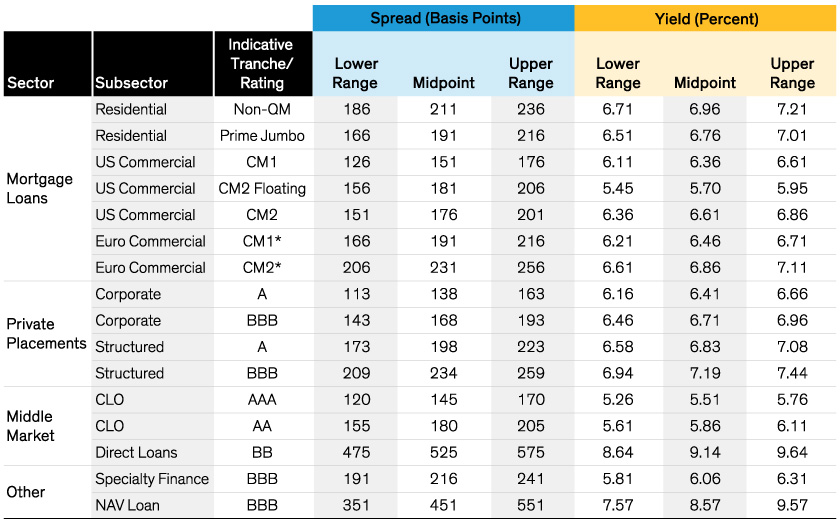
After covering cash needs, insurers may look for more creative balance-sheet solutions, such as investment-grade private placements. But these corporate bonds, sold directly to a small group of institutional investors, offer a slender yield spread over public corporate debt today. This narrow yield is leading some insurers to look further afield for relative value, including private mortgages, commercial real estate loans and asset-based finance. Investors with the expertise to assess the underlying assets, cash flows and legal protections may be able to earn additional yield for the complexity of the structures (Display).

Sizing Up Private-Asset Opportunities for Insurance Balance Sheets
Current Spreads and Yields for Private Sectors

Table comparing spread and yield ranges across mortgage loans, private placements, middle-market lending and other private credit assets.

Current and historical analysis do not guarantee future results. 
Non-QM: non-qualifying mortgage; NAV: net asset value 
*Reflects loans with credit risk similar to a CM1 or CM2 designation from the National Association of Insurance Commissioners. 
Corporate private placements and middle-market collateralized loan obligation (CLO) data is based on a spread premium to comparable public market equivalents. Residential mortgage loan spreads include an adjustment for assumed servicing fees, losses and prepayment speeds. 
As of October 28, 2026
Source: AllianceBernstein (AB) 

An insurer that provides employee benefits and long-term-care coverage may require long-dated assets to back claims stretching decades into the future. But other parts of the insurer’s portfolio may have room for structured assets, such as a three-year debt investment backed by payments from a portfolio of equipment leases or other short-term asset-based finance. Finding room for shorter-duration opportunities in structured private debt may add income and diversify allocations without replacing longer-term assets.

Identifying Private Credit Value: What’s the Source of Yield Premiums?

It’s well known that private assets, broadly speaking, offer additional yield over comparable public debt investments. But the source of the yield premium isn’t the same for every investment.

For example, corporate private placements offer an illiquidity premium over public corporate debt yields. More complex types of investments may also compensate investors for the expertise that’s needed to assess the underlying assets, legal protections and cash flows. Sources of additional yield often overlap, so investors can’t always measure each one precisely. However, they can estimate their relative size and whether the total compensates for the added risks and costs.

Asset-based finance is a good example that broadly illustrates the trade-off. Structural protections in asset-based finance often kick in when underlying assets underperform. But cash flows in this segment may be less predictable than those of traditional corporate bonds, making it harder to match liabilities. Investors must also be able to assess leverage and understand how the underlying assets generate cash.

Direct origination is another potential premium source. By making loans and negotiating terms directly with borrowers, asset managers can tailor lender protections and potentially deliver additional income to insurance investors.

Corporate direct lending, for example, offers attractive income potential and diversification, in our view. But much of the asset class is rated below investment-grade. That makes it a return-seeking allocation for many insurers, not a replacement for core investment-grade holdings.

Managing Private Credit Risk: Beyond Labels and Ratings

We think recent concerns about private credit have been overstated, but risk management is still as important as ever. There are indeed pressures in the market. For instance, some loan portfolios are experiencing rising non-accruals—loans on which lenders stop recording interest as income because repayment is in doubt. These developments signal pockets of borrower stress, though non-accruals have risen from very low levels.

Some investors responded to private credit market pressures by upping withdrawal requests at non-traded, retail-oriented private credit funds. These requests have exposed the limits of offering access to cash when the underlying loans are illiquid. For insurers with long-term horizons deploying capital, however, those outflows may create opportunities if reduced competition leads to higher lending spreads.

Higher private credit spreads don’t obviate the need for careful credit analysis. Investors must understand borrowers’ ability to repay loans, the protections in those loan agreements and how stress may alter cash flows. Sector expertise may help lenders assess which essential software solutions are likely to remain essential in the age of AI and which businesses face greater disruption. Relying on an asset label or credit rating alone may not be enough.

Building the Insurance Private Credit Portfolio: Fit Defines Allocation

From our perspective, the right private credit allocation is determined by an insurer’s specific obligations, how much cash it has available and the investment opportunity—not a peer’s allocation or industry target. Getting it right, in our view, requires having enough readily available resources to meet claims and, where relevant, hedge payments. Additional flexibility can help when market dislocations create attractive opportunities, but each investment should earn its place through appropriate yield compensation after considering fees, expected losses and capital costs.

As we’ve noted for some time, allocation decisions increasingly require a holistic view across public and private holdings. Investments may have different labels on the surface but share underlying risks. To invest effectively, we believe investment teams must coordinate views on diversification and liquidity. The goal: a portfolio with income and cash flows to support policyholder obligations and risk that’s well-compensated. How much an insurer allocates to private assets should depend on how well the investments serve the portfolio, not building a bigger private asset allocation for its own sake.

Private credit offers insurers a broad set of tools with diverse underlying economic exposures. The opportunity, as we see it, lies in determining which investments can strengthen insurance portfolios while continuing to meet policyholders’ needs.


READ MORE FROM ALLIANCEBERNSTEIN


The views expressed herein do not constitute research, investment advice or trade recommendations, do not necessarily represent the views of all AB portfolio-management teams and are subject to change over time.

Share this post

Sign Up Now for Full Access to Articles and Podcasts!

Unlock full access to our vast content library by registering as an institutional investor

Register

Contacts


Image
alliancebernstein desktop logo

At AB, insurance is in our DNA. We understand insurance investors’ biggest challenges because we’ve lived them from the inside out. For more than a half century we’ve managed insurance client assets. Our dedicated vertical, deep resources, distinctive investment capabilities and forward platform are designed with insurers’ needs in mind. With an uncommon approach, a collaborative culture and a commitment to innovation, we drive flexible solutions that unlock potential across balance sheets and the full market spectrum- from fixed income to private markets and equities. We’re built to be long-term partners in the evolution from traditional asset-liability management to the new reality of strategic portfolio construction. AllianceBernstein (AB) is a leading global investment-management firm serving institutional investors, individuals, and private-wealth clients in major world markets. Our diverse, connected, collaborative culture encourages different ways of thinking and differentiated insights. We embrace innovation to address increasingly complex investing challenges. And we pursue responsibility throughout our firm- from how we work and act to the distinctive solutions we design for clients.

https://www.alliancebernstein.com/
 

AllianceBernstein
501 Commerce Street,
Nashville, TN, 37203
 

Robert Amberger
Client Advisor – North America
robert.amberger@alliancebernstein.com
+1 212-823-2890

Bob Sharma
Global Head of Insurance Client Group
bob.sharma@alliancebernstein.com
+44207-170-0688
 

View the contributor page

Sign Up Now for Full Access to Articles and Podcasts!

Unlock full access to our vast content library by registering as an institutional investor .

Create an account

Already have an account ? Sign in

Ѐ Ё Ђ Ѓ Є Ѕ І Ї Ј Љ Њ Ћ Ќ Ѝ Ў Џ А Б В Г Д Е Ж З И Й К Л М Н О П Р С ΄ ΅ Ά · Έ Ή Ί Ό Ύ Ώ ΐ Α Β Γ Δ Ε Ζ Η Θ Ι Κ Λ Μ Ν Ξ Ο Π Ρ Ё Ђ Ѓ Є Ѕ І Ї Ј Љ Њ Ћ Ќ Ў Џ А Б В Г Д Е Ж З И Й К Л М Н О П Р С Т У Ф Х Ц Ч Ш Ā ā Ă ă Ą ą Ć ć Ĉ ĉ Ċ ċ Č č Ď ď Đ đ Ē ē Ĕ ĕ Ė fi fl œ æ ß