





Ares Management Corporation-

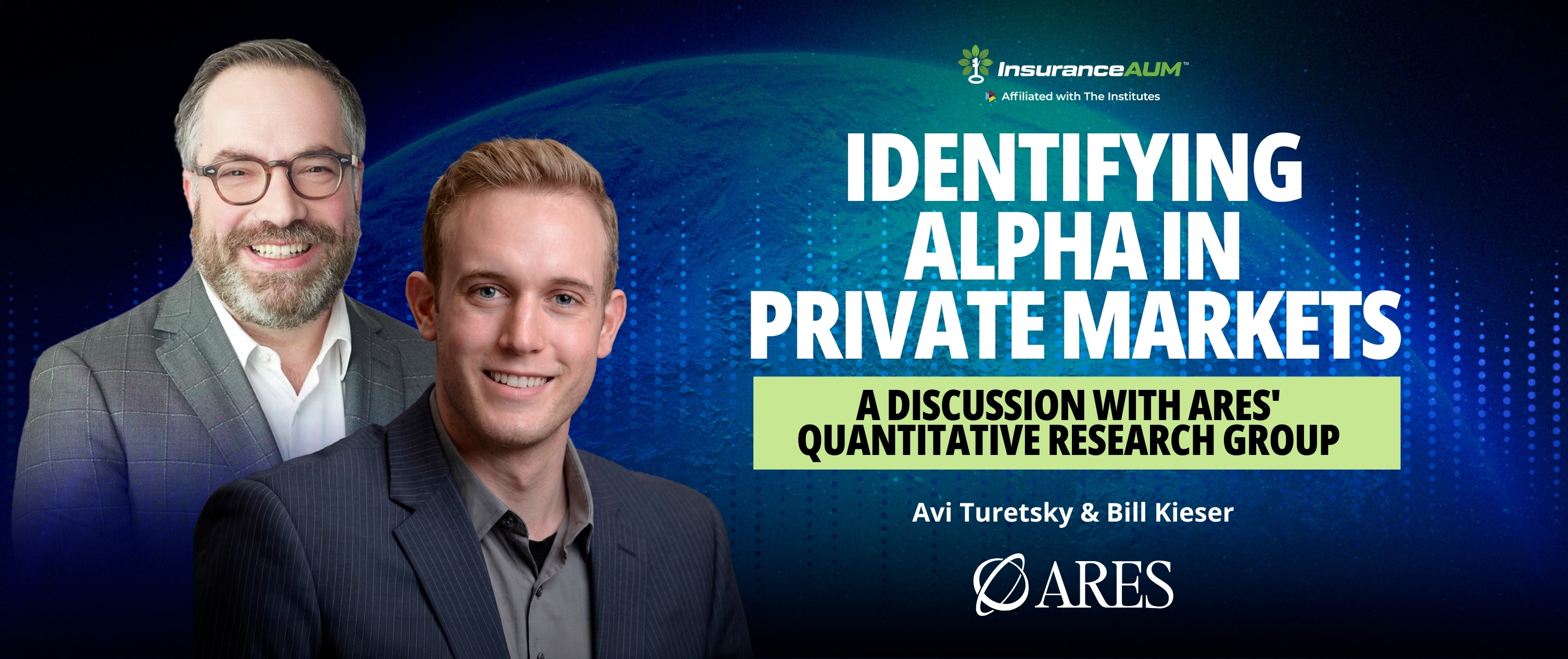
Identifying Alpha in Private Markets: A Discussion with Ares' Quantitative Research Group

Image
IAUM_Podcast_Ares-9.9.26_Web_2026


Stewart: My name's Stewart Foley. I'll be your host today. We're thrilled to have you. For decades, private markets were often described as opaque. Information was scarce, data was fragmented, and manager selection was viewed as more art than science. And today, that's changing. Technology, data science, and quantitative research are giving institutional investors entirely new ways to understand where alpha comes from and perhaps more importantly, where it doesn't.

Today's episode is entitled Identifying Alpha in Private Markets: A Discussion with Ares’ Quantitative Research Group.

Today I'm joined by Avi Turetsky, Partner and Head of the Quantitative Research Group at Ares Management and Bill Kieser, Principal and Co-Head of Research and Data Science. Together, they lead one of the industry's most sophisticated quantitative research platforms, helping investment teams and institutional investors better understand performance, dispersion, pricing, and risk across private markets.

Gentlemen, welcome. We're thrilled to have you. Welcome to the show.

Bill: Thanks for having us.

Stewart: We are thrilled. We have two guests in the same location. They each have a mic, and we're not doing video today, so that's all good. And we always start them off the same way, right? So, I should mention that your earlier podcast became the number one InsuranceAUM podcast of 2025, earning both a Gold Hermes award and an honorable mention at the Marcom Awards. So, no pressure, gentlemen. So, let's get started. I want to start with you, Avi. Where'd you grow up? And if you weren't doing this job today, what job would you most like to have instead?

Avi: Sure. Well, first it's a pretty high bar, that award. So hopefully Bill and I will do reasonably well. I grew up in Connecticut in a town called Fairfield, Connecticut. And if I wasn't doing this, I have a 12-year-old daughter who says that I would be doing something space-related. She's been going to Space Camp since she was seven, and we spent a lot of time at the U.S. Space and Rocket Center down in Huntsville, Alabama. So, I'll go with her and say, if not for this, I'd probably be doing something related to that.

Stewart: That's super cool. My daughter is 21, and she told me, "If you shaved your beard, you'd look younger, but worse." So, I'm not exactly sure what to do with that, but I love her, and she's become famous for that line.

How about you, Bill? Where'd you grow up, and what would you most like to be doing if not this job?

Bill: Yeah, so I'm from a great town called Morgantown, Pennsylvania. It's a small town about an hour to the west of the city of Philadelphia. And if I wasn't doing this, I would say if it was a job at any point in time, I would've loved to have been an actor in old Hollywood. I think I would've made a great TV cowboy. If it was another job more in present times, I would probably be a commodities trader just because I love studying financial markets and economics. And at the end of the day, finance, no matter what you do, it's really about moving paper, where in commodities it's about moving molecules. So same type of concepts, but a very different market.

Avi: Bill, I'd say we sound like a couple of 10-year-olds where you'd be an actor, I'd be an astronaut.

Stewart: Yeah, I will say astronaut has been named before, which is kind of cool. I don't think anyone has said actor, but—

Bill: Especially in old Hollywood.

Stewart: Yeah, especially in old Hollywood. So that's really cool. All right, so let's get to the business at hand here. Private markets have grown dramatically over the past decade. That is an understatement. There has been a massive move toward private markets. Can you talk a little bit about why quantitative research has become so important today?

Avi: Sure. I could take that. When you're building portfolios, you're building especially diversified portfolios, and we started as part of a secondaries group. The same principles that matter for public market investing matter for private market investing. So, talking about things like portfolio construction, asset allocation, understanding alpha, and being able to measure alpha. And for a long time, those were really the domain of public markets, not the domain of private markets. And I think you still see today if you look at academic research, for example, you'll see that research into public markets is far more numerous, far more common than research into private markets is. And people have increasingly, people on the LP side, but also the GP side, have increasingly become aware of how important it is to get that level of understanding into your portfolio.

Stewart: I don't want to put words in your mouth, but I do think that on our show in particular, there's more emphasis on underwriting than portfolio management. And I think that the quantitative aspects of private markets have got to help you in the portfolio management, monitoring, care and feeding after you've acquired it. Is that a fair assessment there?

Avi: Yeah, that's a theme that is coming up a lot, and I think coming up a lot both among GPs, so asset management firms, but also among the LPs, the institutional investors, is you can kind of separate those and think of the underwriting as doing good deals, making good investments. And then the portfolio management as putting together a portfolio where you understand the exposures that you're getting, you understand the diversification versus the concentration, how you're using capital markets. And that can be, I think it's fair to say that can be equally important to doing good deals, but it's not something that historically people have paid as much attention to.

Stewart: Yeah, I think it's a cornerstone of your risk management, your ongoing risk management. I guess the second section here is really on what are people missing? And so when investors and particularly insurance investors think about alpha in private markets, are there things that you think are oversimplified and are there things that folks are missing?

Bill: So, I would define all of the models that we find useful and that insurance investors and other investors would find useful into three broad categories. So, number one, Stewart, you mentioned alpha. So really understanding past performance. This begins with techniques like direct alpha and other PME measures. Also, I'll make a plug for excess value, which is really trying to answer the alpha question, but rather than a percentage rate of return, the actual dollar value of that management. And so, the idea of really understanding the past using alpha is to be able to first understand who performs, how they perform, and importantly, to what extent does that performance persist? And one of the things that we found and others have found is that generally speaking, alpha is a much stronger signal about future performance vis-à-vis typical nominal return measurements like, "What's your IRR quartile?" just because measurements like that are so easy to game.

So when we look at our own portfolio or the performance, the historical performance of counterparties, really trying to get at, do they generate attractive performance relative to other things that you could have been doing with your money? And then where does the performance come from? Is it picking the right geographies, the right sectors, the right assets, right cap structure, as well as deal timing and deal sizing, which are often random.

And the funny thing that we joke about a lot is if you ask any diversified GP what's part of the keys to their success, they will almost always say, "Picking the right sectors," and they'll say, "We have a demonstrated track record of this." But I would say, what, probably three or four out of five times we find that sector bets typically work against a manager.

Avi: Or it’s that the manager doesn't realize what sector bets they're doing.

Bill: Exactly. So again, it's first said as understanding the past as a signal for the future and just so you know how you're doing. The second broad category is, and this goes to both transacting as well as portfolio monitoring, understanding the relative value between public and private markets. You understand that valuation level. If you see $1 of NAV, would that likely transact for 80 cents or a buck 20 in public market in an orderly sale process? And then finally, that more leaning towards the future, whether that's cash flow modeling, most people start with something like the Yale model and build onto that. Whether it's using a nowcasting model, which we do, and I'm sure we'll talk about in feeding in future scenarios in addition to the management aspect, coming up with an actual portfolio construction process that works. And I think one of the things that we've been doing within secondaries is risk budgeting for years.

And so it's really, I think, a combination of all three. That's at least what I think are the most helpful for people.

Avi: And if I could add something there, I think you're absolutely correct that investors tend to think in terms of IRRs, TVPIs, and quartiles often when they're evaluating private managers. And alpha we've certainly found is better, or in our work is better, because it separates out the macro effects, the hold period effects that you'll get in those. There's also, I think, another interesting piece to it, which is—

Stewart: Before you go, what's TVPI?

Avi: Oh, total value to paid-in capital. That's the multiple. So if you paid $100 for an investment and you got $300 back, that's a 3X TVPI.

Stewart: Okay.

Avi: Got it.

Stewart: Thank you. I've never heard the term.

Avi: Thank you for that question. Also sometimes called MOIC, multiple on invested capital. Another interesting issue though, I think, is that when private market teams, when investment teams, think in terms of IRRs and TVPIs and quartiles, they can get very far off from how CIOs or strategy teams within organizations think about the world, which is more in terms of time-weighted returns or the wealth that they create. So, if you have a private market team that's saying this fund produced a top quartile IRR, which is a way that they will think about the world, you could have a CIO who wants to know, okay, but did it add to the time-weighted returns of my portfolio? And that's a very different question and it's a place where we spend a fair amount of time.

Stewart: And so when I think about alpha, I think about return over a benchmark. I don't think that's really private markets. What's the benchmark? I guess when we say, "Hey, here's alpha," it's alpha against what?

Avi: So we absolutely do measure alpha against a benchmark. So the method that we use or the methods that we use, direct alpha, excess value, there are other PME methods are generally based—

Stewart: What's PME?

Avi: PME, private market equivalent.

Stewart: I got it, got it. Okay.

Avi: Or public market equivalent. So you're looking for a benchmark that you can use that has equivalent or similar factor exposures, as best as you could tell, to the private market investment that you're trying to evaluate. So, the purpose there or the goal in choosing a benchmark is to find a benchmark that you believe roughly approximates what you're getting in private markets. So, for example, if you're trying to benchmark private equity, you might try to build yourself a benchmark that's in similar sectors, similar geographies, uses a similar amount of leverage that gets you something that ideally looks similar to private equity. But from the investor's point of view, that's also very useful because the investor might say, "Well, if I wasn't invested in this private equity fund, I would have put my money into public markets in the same sectors, maybe the same leverage. So, I want to know, did this manager perform better or worse than that?"

Bill: And I would add to that too. I think the important part is that the benchmark reflects the opportunity cost of the investor. So in the case of private equity, it's easy because you have the natural counterpart in public equities, and that's an actual parallel trade that investors could have done. Every time there's capital called, you could have bought an S&P 500 ETF, for example. But in the case of other asset classes like private real estate, for example, again, sticking with the thought process that you just want the benchmark to be the opportunity cost, you could mix and match. You could use public REITs for certain things, you could use private core funds for other things. So again, it's really about the opportunity cost of the investment.

Avi: And there are also asset classes where it's an easier or more difficult exercise.

Stewart: Sure. Yeah, yeah, yeah. I mean, it makes sense to me that if you say, I think Avi, you touched on this, exposed to similar factors. To me, it has similar risk triggers or factors.

Avi: No, that's right. And there are places where that might be harder. So for example, if you're looking for airports, you just might not be able to find the public equivalent of privately owned airports. So that would be a more difficult place.

Stewart: Yeah, that makes sense. Okay. So, one of the things that is interesting to me about your team is that you're not simply analyzing investments, you're analyzing markets themselves. So, can you walk us through how the Quantitative Research Group thinks about identifying alpha across markets from secondaries, private credit, infrastructure, real estate? How do you use your capabilities in that way?

Avi: So, tools that we use can be similar for different asset classes. So for example, the alpha tool that we mentioned, we use that not only to measure the alpha or the outperformance relative to a benchmark that a manager or an investment has produced, but we also use that to pull apart the sources of a manager's return. So we want to understand historically, has this manager generated value because of what the market did broadly? Or was it because they picked sectors well? Or was it because they picked geographies well or used leverage at the right time? That works across all, at least I'd say all equity asset classes where you can get good benchmarks. So that works across private equity, private real estate, private infrastructure. Some asset classes, credit asset classes, become different and probably some parts of infrastructure as well. Where one of the interesting things about equity asset classes is oftentimes they're right-tail driven.

So, alpha's useful in finding investors who are better able to get exposure to that outperformance. By right tail, I mean investments that do extremely well. In credit, oftentimes the game is more about avoiding the left tail. So, the tools there are a little different. So, in equity, you might want to look for managers who are better able to get exposure to the right. In credit, you might want to look for managers who are better able to get exposure to the left, who are better able to avoid exposure to the—

Stewart: Avoid exposure to the left.

Avi: Avoid exposure to the left. Yeah. So that's one example. But then there are other tools that play into it as well. So, for example, Bill mentioned cash flow modeling. If you're a private market investor and you're committing capital every year, but then capital is called and distributed over time, the more accurate you could be at predicting when those contributions and distributions are going to take place, the better you can be at building a portfolio that meets what you want.

That's a place where we spend time. And then we have other tools that we use with investment teams and investors in predictive analytics and a number of other areas. Do you want to talk, Bill, maybe about how different asset classes perform over time?

Bill: Yeah, sure. So I would add there, once you have a good estimate of alpha, like Avi mentioned, that's an important input in terms of projecting cash flows. In addition to that, if you look at something like nowcasting returns, and nowcasting for anybody unfamiliar is a play on words between now and forecasting. So for example, we're taping this at the end of July. Most investors would not have their valuations as of 6/30 yet, but we already know what's happened in the world. We already know what's happened in public markets. So with a reasonable degree of accuracy, we can estimate by how much our GP is going to react to the volatility experienced in public markets. So that's both helpful on a market-wide basis looking at, let's say, different indices for different geographies and sectors. In addition, if we're looking at actual portfolios, we're working, let's say with the secondaries team, right now they're probably working off 3/31 NAV, so we can update all those.

If it comes to marking a registered product, we have a tool that we could mark things not only quarterly, monthly, daily. And then when it comes to the actual individual alpha estimates, if you want a specific estimate on an individual manager and you know, hey, they're either a 5% alpha producer or they're a 2% alpha destroyer, you can layer that on. So there's different ways of triangulating what value should be.

Stewart: That's interesting. So if you think you have to be a geek to be in the insurance asset management business, trust me when I tell you, you got to be a mega geek to be in the insurance asset management media business. So I happen to know that your paper IRRational Thinking, that's a play on IRR, it’s Irrational Thinking, but the first three letters are capitalized IRR, became one of the five most downloaded papers on InsuranceAUM last year. What surprised you most when you were doing that research? And talk about your collaboration and what it taught you about insurance investing.

Bill: Yeah, sure. So I'm happy to start there. So I want to say this is, I think, by far my favorite paper, not just because of the content in it, but the backstory behind it and how it came to be. So basically every year we host an event for insurance investors. And so both Avi and I and a lot of other people were there presenting our latest research and findings. And so the funny part is there was a dinner after that I wasn't even originally supposed to be at, but I met our co-author, Eyal Karsh, and we got to talking and I got invited to the dinner and I gladly accepted. And so Eyal and I were talking about research, a number of things. And then Eyal asked the table, "Hey, what do people think? Does the internal rate of return require a reinvestment rate assumption?" Now, apropos of an insurance dinner, this created a very spirited debate that was by no means settled by the end of the dinner.

And it was probably a couple few months later Eyal called us up and he said, "Hey, that was a really interesting conversation that we had. I find myself having the same conversation with many people over and over again. How would you guys feel about writing a white paper on it?" So we said, "Sure." I mean, candidly, at the time, I don't think it was clear to any of us how popular it would've been. And so it's great to hear, Stewart, that it’s one of the top five papers. I know shortly after we put out the paper, our internal comms team came to us and said, "Yeah, this was one of the most downloaded papers." So we certainly trusted Eyal when he said this was an important topic, but I had no idea that this was going to be one of the top papers. So I don't want to spoil the paper for anyone, but I'll give some of the highlights there of things that we cover, which I think are really interesting.

So first we start out with a bit of history and just the idea that cash flow-based thinking and cash flow-based performance measures, whether we're talking about financial investments in the 1500s or today, whether you're thinking about private funds or if you're in a corporation thinking about capital budgeting decisions, cash flow-based investing, which naturally leads itself to measurements like the internal rate of return or net present value or so forth, really are the norm. But, yet because many of us came up in a time that time-weighted returns were popular, and again, we cover some of the history there that really kicked off in the 1960s. We were trying to figure out a way to compare the performance of mutual funds without penalizing the manager for capital flow decisions that were not under their control. But because time-weighted returns are so much more mathematically convenient to work with, people kind of look at that, that's like the norm.

And we do in private markets at the exception; we first make the point that no, it's actually the other way around. Public markets and those return measurements like time-weighted returns are the special case. Now, to see why the internal rate of return does not require a reinvestment rate assumption, we do cite some papers, and we're happy to provide papers that look just at the pure math. We chose to approach the problem more simply with a counterexample. So, in the paper, as I recall, we have two projects, A and B. So, Project A was very simple. It required a $50 million outflow today and an anticipated $100 million inflow a year from now. So, in expectation, a 100% IRR. Project B was very similar, required $50 million outflow today, expected $100 million inflow in a year. But the difference with Project B is that there was an additional cash flow of $1, 100 years in the future, so 99 years after that first $100 million inflow.

Now, if you pulled any kind of random person off the street and you said, "What are the differences between these projects?" most people would probably say economically these projects are the same.

Waiting for a dollar in a hundred years, who knows what's going to happen a hundred years from now.

Stewart: Yeah, that cash flow matters though.

Bill: But now if you truly believed in the reinvestment rate assumption, let's say you weren't able to take Project A, say somebody else did that project, you may pass on Project B because you may be saying, "Hey, I cannot continue to invest for 99 years at a 100% rate of return." So it's very easy to see from that example why the reinvestment rate assumption is actually not required by the IRR calculation. And I'll say more specifically, at the time, the conversation was around private funds and insurance. And so one of the specific things that came up is that we were hearing from insurance investors that, "Hey, if I earn, let's say, a 12% IRR in a private credit fund, but I can't instantly redeploy into another credit asset class earning 12%." Many people were thinking because of this reinvestment rate fallacy that, oh, well, I have to discount those IRRs.

Then when you do your strategic asset allocation model of whatever type, it may lead to an under allocation. You may end up penalizing asset classes for just faulty mathematics. So again, IRR we're not claiming is perfect, just that it's misunderstood. And also at the point that you were talking about reinvestment rate assumptions, you've gone from a single project or a single investment metric into now you're talking about a portfolio. Now, obviously, the portfolio and considering what you do with the cash flows is very important, but we point out in the papers that a lot of textbooks, particularly older finance textbooks, conflate this idea of thinking about what you're going to do with distributions with the mathematics behind IRR. We argue these are really different. And so to summarize, it's like, yeah, IRR is a valid single project calculation, but it does not necessarily correlate in intuitive ways to time-weighted rates of return.

So, to Avi, to what you said earlier, a lot of CIOs say, "Hey, if I'm invested in private equity, I have all these managers reporting to me 15% to 20% IRRs, but my book only moved by 6%. What gives?" So again, both are important, not always correlated in intuitive ways, but long live IRR because it doesn't require a reinvestment assumption.

Avi: And I also like that study because when Eyal first approached you, and that was Eyal Karsh from American Family, when he first approached Bill or us and the question was, does IRR have a reinvestment assumption? My first reaction to Bill, which I think was your reaction also was, "Well, per the math, no, but who cares? Is this something that anyone practically cares about?" And it turns out that this is something that a lot of people practically care about. And I think that we do a fair amount of work with investors on projects that we do together. And this is a fascinating one because I don't think Bill or I on our own ever would've thought to make this into a project and it was Eyal who sparked it.

Bill: Yeah, exactly. And so from that, I think if there are other people listening, if you have important questions, feel free to reach out. We'd love to talk about it.

Stewart: Yeah. I mean, it really illustrates an important aspect of insurance asset management that people miss. And we get calls and people are like, "Hey, man, insurance is really hot." I'm like, "Yeah, I know. I mean, the first 97% of my career it was a backwater." But the collaboration between LPs and GPs on some of these issues and some of these questions, where you have the resources necessary to conduct something like this where maybe an LP doesn't have the team or doesn't have whatever, but not all of your collaborations are, "I'm going to allocate AUM to you." Some of those collaborations are like, "I think this matters." And to the point of it's interesting to me because I taught IRR and as you were walking through this, I was whirling it through my head going, "That's interesting." I mean, your example is well taken, but it's also CIOs going, "I need to see in black and white that I'm creating value here that I can count on, not just a number on a report." So super interesting.

So let's go to the next little part here, which is what is the opportunity? And as we know, markets move in cycles, real estate, infrastructure, private credit, secondaries. How does your team, and this is a little bit of an aside, but we have a call that we do with a number of CIOs ahead of the end of the quarter to talk about things that may be coming up with the board. And on that call, some folks viewed volatility, this volatility in headlines, as stay away. And some folks viewed it as this is a great buying opportunity. I had to buy it priced to perfection before, and now I can buy it back from those levels or wider spreads. So how do you determine when to lean in or when to back away from markets?

Avi: So, we happen to just have done a study on that but not yet published on volatility and whether higher-volatility periods are better times or have historically been better times to invest in private markets or not. This is part of, I guess you could say, a series that we've done on the broad question of historically, could investors have timed the market? Could investors in private markets have timed the market? The volatility, I'll start there because, Stewart, that's the first one you asked about. What we have found is historically, I think it was over the last 25 years or so, higher, more volatile environments as measured by the VIX. Investors who committed to private markets, and this goes pretty much across all private market asset classes, have outperformed investors who weighted their investments more towards less volatile markets, which I think is already, that gives an answer at least historically to the question that you've had.

And something that might be related to is earlier work that we did on the question of could investors have outperformed by unfollowing the herd, we said. And I don't remember if it was Bill who came up with that term.

Bill: I think it was.

Avi: So the question there was, if investors look back at the last 12 months and see that the institutional investment community in general has decreased their allocations to private asset classes, if you do the opposite, if you increase basically in the same proportion that everyone else has decreased, or if you do the opposite, when everyone else is increasing their allocation to private markets, if you decrease, do you do better? And the interesting finding there is that historically across most, not across all asset classes, and these differences are interesting also, across most asset classes, if you had done the opposite of everyone else, you would have outperformed. And I think especially interesting, it's not only on a TVPI, so on a multiple, you put 100 in, you get 300 back, or on an IRR basis, but also on an alpha basis, that private markets have tended to outperform publics more in vintages that people stayed away from.

Bill: Yeah, and I would add there too, just a few other lenses. Number one, we do look at the cycle dynamics of individual asset classes. I'll make a shameless plug for a paper we just put out on the website about why commercial real estate is one of the cheapest asset classes. And there we look at how competitive are the yields. Also long-run economic dynamics. For example, in real estate over long horizons, real estate valuations tend to keep up with things like growth as well as inflation. And over the last couple years, it's been lagging both of them. We also look at things like average returns after large drawdowns. We see that real estate is perhaps more prime for a bounce back relative to many other asset classes. Similarly, if we look and compare across different asset classes at how have valuations been since their 2021 or early 2022 peaks, so far real estate as well as venture are the only ones who have not recovered to those prior peak levels.

We also look at things like supply and, as Avi mentioned, fundraising. Another lens, and actually I think this is actually one of my most favorite because, as we know, the headlines are changing constantly. One day it's growth and then it's inflation, interest rates, so on and so forth. So last year, we also put this paper up on the website recently. We did a study of macro drivers and asset prices over the last 150 years. And we examined five macro drivers in particular: the impact of growth, inflation, money supply. I know a lot of people conflate inflation, money supply. I would argue they're really not that correlated, especially in the short to medium term. We also looked at changes in long-term government bond yields. When you go back under 50 years, you're a bit limited on data on short rates, but we just have long rates.

And then finally, changes in trade policy. And I think the findings were really interesting. So number one, I'll give people the headline. Over the last 150 years, inflation was by far the most important macro driver. So in other words, if the last 150 years are any guide to the future, it would suggest that as an allocator, if you can just figure out for the countries that you're investing in, are they heading towards inflation versus deflation? If you get that right, that's way, way more important than, hey, were you X percent exposed to this sub-industry or Y percent exposed to this factor?

Stewart: That's interesting.

Bill: That was the big one.

Stewart: So which way? Which way is it? Are you looking for inflation or deflation?

Bill: So you are generally looking to, in the case of inflation, you're looking to avoid it at all costs. So we examined four asset classes, equities, real estate, government bonds, as well as gold. I'll say an interesting little factoid is that gold was not an inflation hedge. It did seem to be a hedge against monetary policy. So it's a hedge against the printing press, not so much a hedge against inflation. Inflation was kind of bad news bears for everybody and you should avoid it. Deflation tended to look positively, and I'll back up and say how we measured it. We set up this study like a pharmaceutical trial. We have a treatment group and a control group. So how it worked is in the case of high inflation, would look at what are all the countries that had at least two years in a row of CPI prints of greater than 4%?

How did their returns over the next 10 years compare to all other countries that did not have high inflation? Same thing for deflation, rinse and repeat for all the other macro factors. So again, inflation was very symmetric. Inflation, very bad. Deflation, again, deflation often occurs after bad things happen, asset prices come back. I would say one of the surprising things, in addition to gold not being an inflation hedge, is that in my experience, when you typically just ask people conversationally what are the most important macro drivers? They usually say growth and/or interest rates. Now to be clear, we did find that those were important, but they were not symmetric in the same way that inflation was. So in other words, if you were investing in countries with high growth, you tended to have abnormally high returns. However, if you got that wrong, low-growth countries over the long run didn't actually suffer that much in terms of asset prices.

Similarly, when it came to interest rates, if you were investing in countries that had declining interest rates, that was good. But I was really surprised that even asset classes like real estate were actually not that sensitive in the long run to long rates going up. And then finally, when it came to trade, again, last year, tariffs were a big thing. What we found is there was no clear pattern with changes in import-export policy. So, people love to get excited about it and argue about it, but our research shows that at least over the last 150 years, a lot of smoke, not a lot of fire.

Avi: Yeah. So to add something here, something that I find really interesting about private markets, some of what Bill and I have spoken about in the last few minutes is harder to execute on. So as Bill said, historically, if you could have anticipated inflation, there are moves that you can make. Anticipating inflation could be somewhat difficult, but there are — very difficult. But there are things that we've spoken about that you can just at least in principle execute on. So if we're talking about a more volatile environment, you could measure that and increase your allocations. If we're talking about unfollowing the herd, investing, increasing when everyone else is decreasing, decreasing when everyone else is increasing, that's something that you have the information for, you should be able to do. And I find it fascinating to ask, how could you have what look like investible anomalies like this that have existed for 25 years or for at least 25 years?

You would think that after that length of time that would've been traded away.

And it seems that, this is something Bill had mentioned, for example, people tend to probably think more about GDP growth even though inflation is more impactful. When it comes to market timing, increasing your allocations when other people are decreasing, I think everyone intuitively knows that. When you have a conversation with people, they say, "I know that the 2009 vintage was a lot better than the 2007 vintage. And I believe that the vintages raised in the depths of COVID are going to do better than the vintages that were raised before." And then you could ask, "Well, then why didn't you increase your allocations then?" And people will say, "I kind of intuited that, but now I see the results of the paper and I see that that's true." And the answer is because it's really hard to do. When everyone else is pulling away, that's because people are having liquidity issues, that's because psychologically people are worried.

It's like, Stewart, what you were saying before, it's this is a high volatility market. I want to stay away. Even if the evidence is pretty strong that historically that's when you should have gone in, it's really hard for people to do it. But for at least a quarter century, that's been the case.

Stewart: Well, I mean, let's not forget this. Career risk is real. You know what? It is. And I know for a fact that there are CIOs that go, "You know what? If it was my money, I'd be doing this. But given the investment committee I'm in and the board and we've had this hiccup and whatever, I'm not going to take the career risk to present this at a time when the wind is blowing in my face pretty hard." So, it makes sense to me because finance theory says that those anomalies can't exist over time. But I think there's more at work there too, because I think sometimes institutional capital tends to be structurally less opportunistic. How about that?

Structurally less opportunistic because boards don't want to go, "Yeah, let's take a bunch of risk." Because essentially that's what you're doing. You're stepping in when volatility goes up, and that requires you to increase risk. And it makes sense. What gives me comfort is that risk and return are inextricably linked, and your paper proves that. But the fact that it persists tells me that there's some external force there where people who, like you said, intuitively, I feel like this is a good time to get in, but I ain't going to the investment committee with that. I think there's some of that. But let me get to this next point here, which is the future. And so, as you know, we have an annual meeting, which is really well attended by a bunch of CIO folks and insurance investment professionals. And we have the LPs and the insurance investment professionals create the agenda and the topics and everything else.

And in 2025, AI was not on the agenda, but in 2026, it was all over it. And AI is quickly becoming part of every investment conversation. Your team has its initiatives like Project Canary, which I'd love to hear more about. And you're already applying AI inside Ares. There are folks, and I met them, there are folks who are in very senior positions who are like AI is the third rail and you're outsourcing these investment decisions to some guy sitting in a dark room and I don't like it. But for those of us who use AI, we know how powerful it can be when applied properly. So where do you believe AI will genuinely improve investment decisions and where do you think people might be expecting too much?

Avi: Yeah, so I could talk about Project Canary. Canary is a project that we've done, our team has done or is doing together with our Credit Secondaries group and looking at it with other credit teams as well. And this uses the wealth of data that we're able to have at Ares. So something like 3,300 securities, I think 41,000 financial statement data points that we have. And we're able to essentially put that into a machine to identify historical predictors of default or non-accrual or issuers not being able to pay their loans. This is not something that replaces an investment team by any means, but it is something that provides another view. So when we're looking at underwriting a portfolio, the investment team will do a bottom-up underwrite. Canary will do its underwrite based on the data that we have. You could think of it as a different way of getting the same experience.

If someone is on an investment committee, that typically means they have 20, 25 years, let's say, experience looking at investments. You can now get a machine to have that same depth of experience but structured in a different way. So the machine will remember all of the data points that were there in a way that a human wouldn't. The human, though, will get nuance that a machine wouldn't. And we find that when the two disagree, when the humans say, "We're not worried about this, but the machine says we are," or vice versa, that's an important place to dig into. I think that's an interesting early use case of machine learning AI, but there still is, personally, I feel like we still are at the tip of the iceberg. For the most part, I feel like you find people who have become personally maybe 20% more efficient, 30% more efficient in their jobs.

I don't feel like you've seen, yet, AI really be transformative in a way that you could say, "Here's a fund, or here's a product, or here's a business that couldn't have existed before AI." Maybe that's to come, but it's not here yet.

Bill: Yeah, and I would just add there too. I'll make a bold prediction that I think the future of quant is going to be driven largely by unstructured data. So at this point, every math, every finance textbook has been analyzed by AI. So it's very easy for people to operationalize mathematically complicated models. However, if you think about just your own inbox, all of us get tons of junk that's sent. White papers, obviously not our white papers. Those would go to the top pieces.

Stewart: No, other white papers.

Bill: Yeah, other white papers.

Stewart: Not ones that InsuranceAUM sends. Open those.

Bill: Those conference invites, intermediary reports. There's tons of stuff that people are not really viewing systematically. So, for this next phase, what we're gearing up to and what we are doing is to analyze all of this unstructured information, including media that's printed online, including things like podcasts so that if somebody's going into a meeting or looking at an asset, and let's say it's an apartment in the West Coast, we can look at, hey, four people in the area, what are the top concerns? Who are the major counterparties? And so, I think, Stewart, if you're kind enough to have us back in two, three years, I think that's really where we're going to see the most gains from AI and quant.

Stewart: Well, I'm glad you asked because this is our final question. What do you think insurance investors should be thinking differently about over the next five years as quantitative research becomes a larger part of private markets investing?

Avi: I'll give one that I think applies to investors generally, but insurance would definitely be in this too. A lot of investors, it seems to me, are concluding that, this is back to the beginning of the conversation, they need to be more methodical, more strategic, more quantitative in how they construct their portfolios. That you’ll find a lot of investors who say, "I have a certain allocation to private equity or a certain allocation to private credit or private real estate because it feels right or because that's what everyone does." And I think a place for the future is, "Okay, I'm going into secondaries. Why am I going into secondaries? I'm going into private real estate. What is it giving me in my portfolio that I'm not getting elsewhere?" And I feel like that's a huge area for research, but also a huge area for practice.

Bill: Agreed.

Stewart: Super helpful. Thank you so much. It's been an amazing education today and I really appreciate you both being so generous with your time. I want to wrap with our signature question on the way out the door, which is when we have two guests, you get to each have one guest for dinner. This is dinner on us. You can have one guest alive or dead. So it'll be the four of you, Bill, Avi. And we started with Avi last time, so let's start with you, Bill. Who's joining this table for dinner as your guest?

Bill: So I would invite Jim Grant. I love reading Grant’s Interest Rate Observer. I just think in terms of newsletters, it's the best in the business. And I think really what I enjoy the most is Jim's historical perspective. I think for a variety of reasons, data availability, we tend to look at the last 50 or so years. But the old saying goes, "History doesn't repeat, but it rhymes." And I think that when the history books are written, I think more from this period in the next couple decades will rhyme with things from the 1800s, early 1900s, Industrial Revolution, all that kind of stuff. And I would really just enjoy Jim's perspective on that.

Stewart: That's cool. Avi, how about you?

Avi: Yeah, I think we're going to have a really interesting dinner, Bill. I was thinking about should it be someone far back in history? But I think I'd probably choose one of my great-grandparents, I'm thinking who immigrated to the US if it was from Poland or Russia or Hungary. I think it would be interesting to hear what motivated them, what that transition was like. So I guess you, me, Jim, and one of my great-grandparents, that would be—

Bill: Sounds like a fun dinner. Yeah.

Avi: It'd be an interesting dinner.

Stewart: That's awesome. I really appreciate you being on today. We've been joined today by Avi Turetsky, Partner and Head of the Quantitative Research Group and Bill Kieser, Principal and Co-Head of Research and Data Science at Ares Management. Thanks for joining us. We're thrilled to have you on today, guys, and thanks for taking the time.

Avi: Thank you.

Bill: Thank you.

Stewart: If you like what we're doing, please rate us, like us, and review us on Apple Podcasts, Spotify, or wherever you're listening to your favorite show. If you want to watch us, you can catch us on our YouTube channel at InsuranceAUM Community. My name's Stewart Foley. This is the InsuranceAUM.com podcast, which is the home of the world's smartest money. We'll see you next time.

Share this post

Sign Up Now for Full Access to Articles and Podcasts!

Unlock full access to our vast content library by registering as an institutional investor

Register

Contacts


Image
ARES Logo

Ares Management Corporation (NYSE: ARES) is a leading global alternative investment manager offering clients complementary primary and secondary investment solutions across the credit, real estate, private equity and infrastructure asset classes. We seek to advance our stakeholders’ long-term goals by providing flexible capital that supports businesses and creates value for our investors and within our communities. By collaborating across our investment groups, we aim to generate consistent and attractive investment returns throughout market cycles.

Ares manages over $62 billion on behalf of 282 third-party insurance companies globally (as of March 31, 2026). For more information, please visit www.ares.com.

Robert Torretti  
Partner, Co-Head of Insurance, Americas Relationship Management  
rtorretti@aresmgmt.com
212-515-3385

Amanda Healy   
Partner, Co-Head of Insurance, Americas Relationship Management   
ahealy@aresmgmt.com
212-515-3351

Ares Management
245 Park Avenue, 44th Floor,
New York, NY 10167

View the contributor page

Sign Up Now for Full Access to Articles and Podcasts!

Unlock full access to our vast content library by registering as an institutional investor .

Create an account

Already have an account ? Sign in

Ѐ Ё Ђ Ѓ Є Ѕ І Ї Ј Љ Њ Ћ Ќ Ѝ Ў Џ А Б В Г Д Е Ж З И Й К Л М Н О П Р С ΄ ΅ Ά · Έ Ή Ί Ό Ύ Ώ ΐ Α Β Γ Δ Ε Ζ Η Θ Ι Κ Λ Μ Ν Ξ Ο Π Ρ Ё Ђ Ѓ Є Ѕ І Ї Ј Љ Њ Ћ Ќ Ў Џ А Б В Г Д Е Ж З И Й К Л М Н О П Р С Т У Ф Х Ц Ч Ш Ā ā Ă ă Ą ą Ć ć Ĉ ĉ Ċ ċ Č č Ď ď Đ đ Ē ē Ĕ ĕ Ė fi fl œ æ ß