




Nuveen-

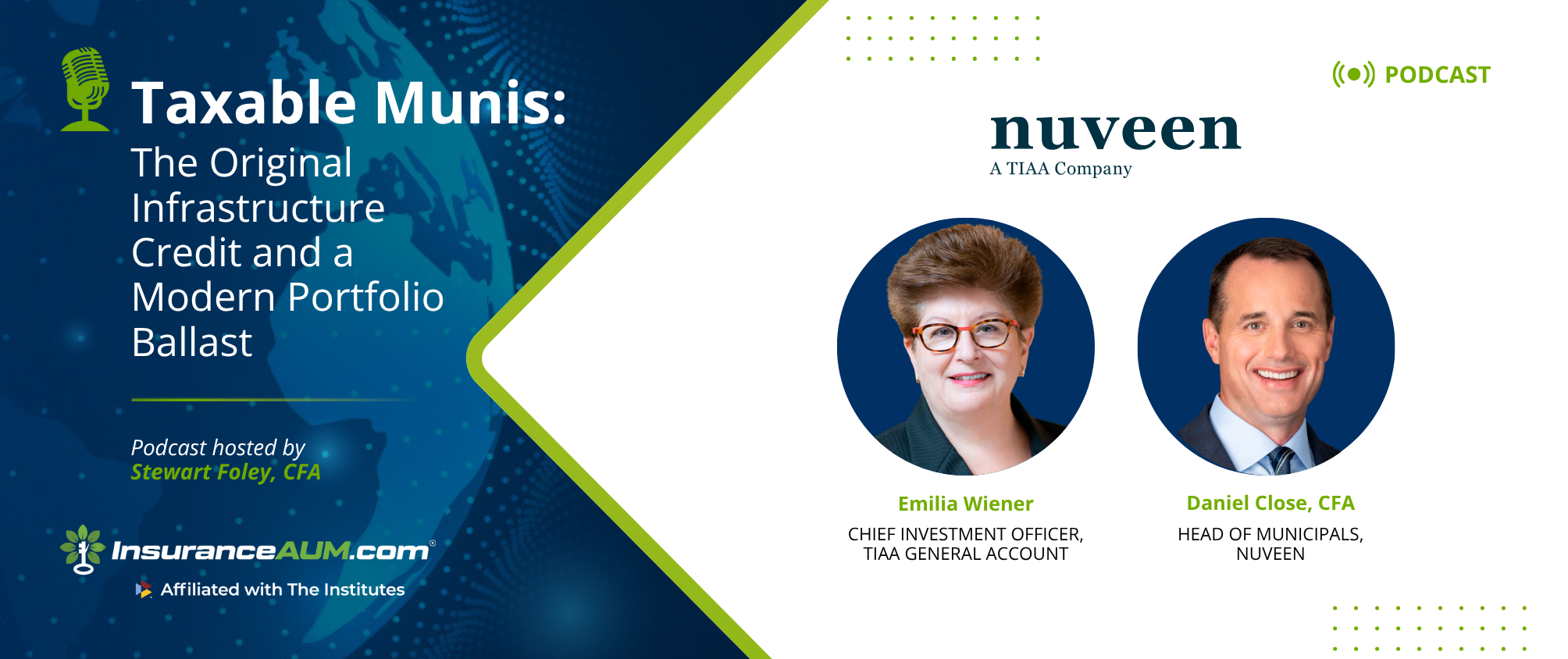
Taxable Munis: The Original Infrastructure Credit and a Modern Portfolio Ballast

Image
IAUM_Podcast_5.22_Nuveen_Web


Stewart: And I'm Stewart Foley, CFA, and I'm your host, and I'm thrilled to have you with us today. A little different story. I've got some skin in the game on this one, which I rarely do. And I'll tell you about that. I was a municipal treasurer. I was the city of Columbia, Missouri's treasurer from the ripe old age of 27 to 30 years of age. And I didn't know beans from apple butter when I started that job, I swear to you. And we were an issuer of tax-advantaged municipals and a buyer of taxable municipals. And we funded two pension plans. We had bond defeasement accounts, we had general account assets, so on and so forth.

So, one of the things that I found fascinating about municipal bonds is that this was the original infrastructure. This is the original infrastructure for schools and hospitals and roads and airports and public utilities. You haven't lived until you've owned a sewer plant, which the city of Columbia did. But long before, this is long before “infrastructure investing,” and I've got my air quotes on, became a dedicated asset class. And so at the same time in today's market, taxable munis still seem to offer relative value characteristics that many insurance investors may not fully appreciate, which leads me to the title of today's podcast, Munis: The Original Infrastructure Credit and a Modern Portfolio Ballast. And today I'm joined by a very special guest, Emily Wiener, who's the chief investment officer of the TIAA General Account and Dan Close, who's the head of municipals at Nuveen.

Emily oversees portfolio strategy, asset allocation, and risk-adjusted targets for TIAA's more than $300 billion general account across public and private fixed income, private equity, real estate, and real asset alternatives. She brings 30 years of investment management experience across insurance and fixed income. Emily, we're thrilled to have you and thanks for being on.

Emily: Thank you, Stewart. Happy to be on.

Stewart: And Dan Close leads Nuveen's municipal fixed income business, one of the largest and most established municipal platforms in the industry. And he also oversees taxable and tax-exempt municipal strategies across institutional portfolios, mutual funds, and closed-end funds. Dan, welcome to the show. We're thrilled to have you.

Dan: Thank you so much for having me, Stew. Really happy to be out today.

Stewart: We are thrilled to have you. Before we get going too far, we always ask a little background. Where did you each grow up? And if you weren't doing this job today, what job would you most like to have instead? So I'm going to go to Dan first because I'm going to give Emily a second to think.

Dan: I grew up in Columbus, Ohio, and my first job and the job that, besides doing what I'm doing right now, that I still love the most was I was a caddy, someone who schlepped around golf bags at Muirfield Village Golf Club. I did that for seven years, and by far the best job you could ever have. When we hire new people on our desk at the least experienced position, we try to hire people that are caddies, waitresses, but caddy really gives you this sixth sense of being able to immediately read a room. There are a lot of foursomes that you're carrying golf bags for where they want you to be part of the group and tell jokes and very much be the entertainment, or you have other foursomes where you're just reading yardage and reading putts and you might say two words in an entire round.

So that job was all cash, which was fantastic. And it was the greatest job in that it really, really developed this sense as to how to quickly read a room that I'm still using today. You sometimes go into pitches or you're talking to issuers or you're talking to maybe insurance prospects, and you could very fast read what they want to discuss, how they want to discuss it, and if you need to be a storyteller, if you need to just get to the facts of the asset class. So I still think that today if I wasn't doing munis, I love being outside. I'm a horrible golfer, but I still love to be on a golf course. And at some point my career might just go back to Ireland and schlep around bags for the last part of my career.

Stewart: That's super cool. I'm sure that you were compliant with all IRS tax reporting regulations in that. I want to make sure it's a family show, Dan. So okay, Emily, here we go. So where'd you grow up and what job would you most like to have right now if you weren't knocking the cover off the ball in this one, right?

Emily: So I grew up in the New York, New Jersey area, and certainly my journey to the CIO seat took a lot of twists and turns along the way, but I've always been focused on insurance company general account investing. It just happened to be where I ended up when I first got out of school working for an insurance company, and I really loved the work. And so a lot of hard work, a lot of focus and dedication and sacrifices along the way, but that was my journey to the CIO seat. If I wasn't doing this, I really have had ... Thank you for giving me a few minutes to think about it because I really hadn't thought about that, but I think I'd like to be a scientist. I love all things science. I'm very curious about how things work and what makes them work and why they work that way. So I think if I wasn't doing this job, I'd be somewhere being a scientist doing research.

Stewart: Oh, wow. Very cool. Okay. So, let's start with you on the topic at hand here. So you now oversee one of the largest and most respected insurance general accounts in the world. What originally drew you to fixed income and credit investing? And I will confess to you that my inside insurance investing job, I started as what was effectively the chief investment officer of a company that had about $4 million in assets, which is a question I forgot to ask in the interview, by the way. My bond coverage said to me, "What's your big asset allocation decision, checking or savings?" And so it was a very humble start for me. You said you started at an insurance company. What were you doing there and what was it that you were like, "This is cool," because I've always thought it was cool too, even way, way before anybody else thought it was. So I'd love to hear that story.

Emily: Sure. When I graduated from college, I went to Wheaton College in Massachusetts and when I graduated, I was hired off campus to go work for Mutual of New York. So Mutual of New York was a relatively small mutual insurance company, but they were very innovative and they were very ahead of their times, I think. I started working in the management training program and very quickly talked my way into the investment department because I was an economics major and I really wanted to work in the investment field. I kind of knew that from the start. So I was able to get into the investment department.

I started doing private placements, private placement debt investing. Now, that was private placements way back then. As you noted in your intro, I've been around for over 30 years. So that was way back when we were doing private placements. We were negotiating the terms. We were negotiating the pricing. We were coming up with the underwriting to establish what kind of risks we were getting paid for. And I found that whole process fascinating, probably appealed to my economics background and the fact that I really enjoyed, again, figuring out how things work. And so the work that I was doing there is then it got expanded into, they were doing private equity back in the early 80s, investing in Silicon Valley; private partnerships. So it was just an amazing place to learn and work. And so I think that's what really sparked my love for working within an insurance general account and kind of taking it to where I could in terms of the asset strategies that we were pursuing.

Stewart: It's interesting, you're not alone in people in this business who have done extremely well, who started in the private placements area of a pretty good size insurance company. And it's interesting for younger folks or people who are earlier in their career, it's a good tip. Dan, same question for you. How did you find your way into municipals, specifically, and help us understand the relationship between Nuveen and TIAA, because I think that relationship is central to today's discussion.

Dan: Yeah, certainly. We often say, Stew, that you don't find municipals, municipals finds you. It's this kind of part vocation, part capital markets. But for me, I started my career right out of school from Ohio to Chicago and I started at Bank of America and the asset-backed securities making pitch books till the wee hours in the morning. And Nuveen, which is a Chicago-based firm, had an opening, and I started out as an analyst and I was instantly hooked. I mean, this idea of infrastructure being financed at the local level is just this radical concept that is not really present in any other part of the world. So, Emily and I both travel a decent amount. My travels take me to Japan, to Germany, to Korea, to Switzerland, and they're blown away by this concept that if you want a new high school, let's say, you're not going to Tokyo, you're not going to Berlin to ask for the funds, you're going to your local voters and asking to tax them and to pay higher property taxes to finance this local infrastructure.

And to me, that was just one of the coolest things to really sit and to contemplate that you have this $4 trillion asset class whose roots are in infrastructure development and at the hyper-local level. So for me, I fell in love. I've been in the municipal department for more than 25 years and we at Nuveen, I think, really do have such a deep connection with TIAA. The general account at TIAA actually owns Nuveen. And so we work so very closely with Emily, with her entire team, for the general account in managing their portfolio and really trying to achieve the outcome of income for our participants. And so it is a very, very tight relationship for our part, taxable munis are a large part of the general account, which I know we'll get to, but it's a very good and symbiotic relationship we have with the general account. And it's one that I think is unique in its own way just given the history of ... Emily, it was 2014 that the general account bought Nuveen, thereof.

Emily: It was 2014 and finished the acquisition around 2015. I joined TIAA in 2016 and we were right at the tail end of that transformational change where TIAA, as you recall, Dan, took the in-house investment teams and re-badged them to Nuveen to expand Nuveen's investment platform. At the same time, they understood they needed to have a general account team that would oversee the general account and set strategy and long-term allocation and do all that internal work that we needed to do. Nuveen was given the mandate to continue to add third-party clients and then expand and grow their business. And so that was what gave me the opportunity to join TIAA, because that general account team had been set up. I joined in 2016 and that was just happening at that time. And so I came in as head of fixed income. So munis were a big part of how we were looking at it. And wasn't it around that time that it was a big Build America Bond thing going on?

Dan: Yeah. That's right.

Stewart: I remember that well, as well. Yeah, it's interesting. So Dan, municipal bonds have really been a part of Nuveen's DNA in a way that isn't true for many firms. And I'd love for you to talk a little bit about that heritage and then bring us to today, what does that municipal bond franchise look like now with the additional resources that Emily just laid out?

Dan: Yeah. And this is a story I just really do love to tell. I mean, it starts all the way back in 1898 with John Nuveen Jr. hanging a shingle out in Chicago to really finance infrastructure, public infrastructure that was really booming at the time. I mean, if you again, rewind back to any other country's development, there's been these strong central governments that certainly help out with the infrastructure side, but 1898 before even the tax code came into existence, infrastructure was being funded at the local level. And it started with New York City water in the 1830s developing sewer to really fight yellow fever that was going on. And so you transport that to 1898, John Nuveen Jr. wanting to finance all of this essential service infrastructure in the United States and he underwrote this $7,000 water and sewer deal in Bemidji, Minnesota. And from there it started as this underwriting powerhouse that really got its roots at a very local level.

So financing roads and schools and bridges and really the infrastructure of the Midwest. And from there we've just really taken those underwriting roots, and we were still a municipal underwriter into the 1980s. But along the way, we found that we wanted to also start an asset management side or allow not just underwriting, but really have this income be something part of what we're offering to clients. And so then we went and really transitioned from this underwriter, sole underwriter to one of an asset manager. And that's where we are today. We have a $200 billion franchise. We have more than $20 billion with our general account with Emily and taxable municipals. We have other institutional accounts, we have funds, we have separately managed accounts, we've transitioned into ETFs.

Stewart: Well, it's interesting because there's a couple of things in there, right? The credit, and this is me talking personal opinion, not putting words in your mouth at all, but when I was a municipal treasurer, one of the things that's interesting, and you mentioned it, is you cannot easily change the capital structure. It's not like the city of Fort Worth is going to lever up and take over Dallas. It just doesn't happen. In the corporate world, in the private sector, you can materially change the capital structure, but let me tell you firsthand that issuing debt, like you mentioned for a school or whatever, there's an incredibly dedicated population that is not going to vote for anything that's going to look like cost to them. And so it is a very interesting market in that it's not “go, go” and you have incredible credit rating stability over time as a result.

So that was my little editorial. I'm sorry. So Emily, I want to come back to you. I'm sorry, I just got a little bit of a ... I was on my soapbox for a second, but when you look across the investible universe today, what are you most excited about? And I know that we're here to talk about taxable munis and help me understand and part of it is also like what's the supply side? Is there enough supply for folks? You guys have a very large portfolio, but there are others that also have very large portfolios. I know that that's always on your mind. I'd love for you to include that, if you could, in your answer.

Emily: Sure, sure. Happy to. So we're a long-term investor because we look to allocate in a way that supports the requirements of the liabilities and the liabilities are pension liabilities, basically the retirement savings. And so long and sticky, if you will, liabilities, which works great in terms of giving you flexibility about how you can invest on the asset side. When we look across the investible universe, there are a few areas that I think, especially in this environment of such uncertainty and volatility, there are several areas that I think are genuinely compelling. One we've been talking about: infrastructure, and infrastructure comes in many flavors. Yes, municipal bonds play into that. As you've said earlier, Stewart, the roads we drive, the airports we fly in and out of, the power generation, all of that financed and has been financed for a long time by the municipal space. And so infrastructure has come to mean something broader, but I think that municipal has a place within your infrastructure allocation because that is essentially what it is and it is a very stable element that you can add to your infrastructure allocation.

I also like asset-backed securities, especially if you have the capacity to originate your own whole loans that then you can turn around and securitize. That gives you a lot of good economics if you're able to do that. And yes, I love private credit. It's where I started my career. I believe in the value of private credit. I believe there are elements of private credit that if you underwrite the right way and you structure it the right way, it will take you through cycles in a very defensive way. And so I feel very strongly that private credit is still one of the most attractive opportunities we can have. And the more the headlines create fear, the more opportunity for long-dated investors like us to take advantage of some of the dislocation that that fear causes. So the way I think about it is we have a very uncertain and unstable environment and you're looking for asset strategies that will bear through that kind of volatility.

So again, just to reiterate some of what you've said, Stewart, it's the combination of credit quality, the combination of duration, which municipals can give you and the relative value that we can find in that space is really difficult to replicate elsewhere in the corporate environment or in the investible universe, if you will.

Stewart: Yeah, it's interesting. And Dan, I want to come to you. Sometimes investors forget that municipal bonds are a different animal. Now I'm going to tell you, I'm going to insert a story here. We issued debt on a parking garage in downtown Columbia, Missouri. The first hour was free. The second hour was 25 cents. I'm like, how in the world is this thing going to pay? Sure enough, pays like clockwork, cash flows were ... But it's like I'm driving in this thing. I'm like, why are these rates so low? Come on. But so when you're looking at these, they have to be analyzed differently than corporates. And one of the things that's interesting, too, is that these securities are bespoke. Each one of these requires a look and it requires a lot of infrastructure in terms of analysts that are doing this work. So what happens when investors apply a traditional corporate framework to municipal issuers? Can you talk about the differences there in how you look at those two securities?

Dan: Yeah. And just kind of drift, one of your points, Stewart, that you had made is the municipals are just so different than any other asset class. You're not going to merge Fort Worth with Dallas. I think the reason in talking to Emily and speaking for you for a second here, Emily, one of the attractiveness for the general account is it's a very simple balance sheet. Assets equal liabilities. There's not an equity component, there's not going to be an LBO, there's not going to be a merger between municipalities. So as we're trying to immunize long-term liabilities for our general account, you know you have low downgrade risk, very low default risk, long duration vehicles. And so it's a fascinating part.

Emily: Right. And it's that lived experience really matters. That's what we've learned about municipals operating in a stress environment. And so it's the discipline also about what you put into the portfolio. So credit to the market research and the deep understanding of the space that has allowed us to perform as well as we have through multiple market cycles, we've seen muni bonds perform very differently from corporate credit. And corporate credit, as you said, you see the downgrades very quickly. You see fallen angels piling up. You see all sorts of spread widening that kind of can be both sharp and pretty persistent. Municipal bonds, I'm not saying that dynamic doesn't exist, but it's much more muted in a stress situation. The underlying revenue streams that support most muni issuers are going to be much more resilient than corporate cash flows are in a downturn. And so that is what attracts us, because I see it as a ballast.

It's a high-quality, long-duration ballast to the rest of the corporate portfolio, which is very large that we have in the general account. And I think muni issuers also have levers that the corporates don't have, including the ability to adjust rates and fees, in some cases, tap reserves or state support.

Dan: Yeah. And I think that was for some of our ... When we started building our taxable municipal book and really bringing our show on the road for insurers abroad, it was fascinating because with COVID, everyone there was the assumption with a lot of different corporate credits that immediately had distress. I think of the leisure, especially cruise lines—

Emily: Retail.

Dan: Yeah, retail. And I think a lot of our clients were of the opinion, "Oh my gosh, I'm going to see spreads blow out. I'm going to have all these difficulties." But I think we doubled our external book in the year or so after COVID because of how resilient the asset class was and how much support that we got from the federal government to support these essential service monopolies.

Emily: That’s exactly right.

Dan: Yeah, it's been a fascinating journey. But Stew, to your question, these are different animals. And I think the biggest change we've had since I've become in the municipal market, going back to a quarter century, was the demise of the monolines. The monolines were these AAA insurers that would go to your parking garage and if you had a single A rating, XLCA, MBIA assured and make it a AAA rating. In 2008, these failed in a spectacular way and what happened to the muni bond market was it was this homogeneous rate-driven market that had little difference in credit to this exploded heterogeneous Balkanized market that had 60,000 different issuers. And I think the biggest difference between our market and corporates is that there are just so many issuers and it's really tough to paint a broad brush stroke on those different issuers. And it really speaks to the need for credit research.

You could have one community as a AAA entity right next to a BBB entity, and they have all the same characteristics, but because of governance, because of different idiosyncratic credit features, might be different. And so for municipals, there's just a need to really understand what you own. There's a lot of new issue in any given week. I think for our general account, again, I'm sorry, Emily, I'm speaking for you for a second, but a lot of the interests that our general account likes to have is municipalities differ from a $2 million renovation of a library to the state of California, which is the fourth largest economy in the world and everything in between. And so for our general account, there's a lot of interest in not just the big issuers, but also the $50 million issuer, the $20 million issuer that is just as creditworthy, but that offers this additional spread to the larger issuer because it's not as well known in Düsseldorf or in Tokyo.

And we have the ability to look at smaller issuers, understand their creditworthiness, pocket the spread, and then just know that we have a long-term client who is more than willing to put this on its balance sheet and collect that extra spread over the life of the bonds.

Emily: Yeah. And that really goes to the supply question that Stewart asked. You're able to, because of the relationships and the experience that you have and the deep credit bench that you have in terms of underwriting, you're able to find these opportunities that maybe others might not find for us. And so I think that goes directly to the supply question that Stewart had asked.

Stewart: So Emily, every insurance investor I've ever met is interested in relative value and that has to do with not only the yield spread, but also how it's treated on the balance sheet. And I know that you deal with this every day. When a fixed income investor compares taxable munis to investment grade corporates, it seems like a mistake to just simply compare spreads and stop there. What else belongs in that framework?

Emily: Right. So again, the focus on doing your homework going in, number one, making sure you have the right credit research and you've made the right selections, at least with the available information you have informed by your lived experiences. So, when you think about relative value in a holistic way, I think it's important in a fixed income portfolio to protect your downside risk because you're stretching to get basis points, but when you have an impairment, you're losing whole points. So the key is to protect your downside risk, that is I think for me, a key, in how you diversify a fixed income book. So an allocation to taxable muni bonds could help to stabilize a fixed income portfolio in particular during periods of stress. You don't underwrite for the good times, you underwrite for when things are going to go wrong and so that is what you're protecting in a fixed income book.

When uncertainty is elevated like it is now and the search for high-quality long-duration assets really intensifies, I think that munis can serve a really important role in an insurance company portfolio and it's also important how you access the market and that you do so with someone who, as with Nuveen, I'm not going to apologize for the ad. Nuveen is a strong partner with us in selecting and providing the supply and access to the market. So I'd love to have Dan's thoughts, though, on this too, since you're talking to a lot of other CIOs, not just me.

Dan: Yeah, I don't think there's much to add except I'm not competing one asset class in an RGA versus the other, but if you look right now, you're picking up more spread for AA and single A munis versus equivalently-rated corporates. The default rate for a single A muni, at least going back to a survey from Moody's going back about 55 years, a single A muni is going to have a lower default experience than a AAA corporate. And Stewart, it's to your point, bad economic times, you might drop your gym membership, but you're not going to stop using water or flushing your toilet. And if you do have an issue with the municipal credit, historically speaking at least, your recovery experience is that much higher. The latest numbers we have is about double the recovery in a stress or default experience. I think all of those together, and then I think you have this desire as a municipality for your citizens, for your reputation to not have defaults.

I look at North Carolina. Before they can issue any debt, you have to go through what's called the LGC, the local government commission. And they are making sure if you're an issuer that you have all of your I's dotted, your Ts crossed. So there's all of these extra protections, if you will, where states don't want to have their subdivisions go bankrupt. They don't want to have a reputation for a municipality within the state that has issues and that it impacts the ability for others in the state to access capital markets. So for all of this, again, it's not just spreads, but I think it's all of the other idiosyncratic nature of munis and understanding what you're buying when you do buy them.

Emily: That's right.

Stewart: You touched on this, but how is TIAA actually using ... I mean, I think we all know that dependable long duration is the north star for a lot of life carriers. I mean, everyone that I've ever met. And you've used taxable munis over the years. Has supply ever been a challenge given the size of your balance sheet?

Emily: Well, I think that sometimes it's ebbs and flows. There's more issuance, there's less issuance. And so we do understand that and we work closely with our portfolio manager within Nuveen to help us understand when is a good time. There is a lot of issuance. We have approximately 14% of our invested public market fixed income assets at TIAA invested right now in munis. It's been pretty stable around that 14%, 13%, 14%, 15%. And again, we lean into it because it gives us a duration that we need because we have such long duration requirements. In terms of supply, again, I rely on Nuveen to give me the supply that I need. And so I give them a mandate and I'm like, okay, can we do this? And we actually set our investment program at the beginning of the year, we communicate our needs and our specific allocation to the different asset strategies.

So when I speak with my muni PM, I will explain this is what we need this year. And then we let Nuveen make the asset selection, make the specific selections that fill up those buckets. But we check in on a monthly basis and we're like, how's it looking? Does it look like you can? And to the extent that they can do more and we are having other asset strategies that are investing slower, we might reallocate to munis, but I think there's also a communication issue that has to keep going back and forth with your asset manager to make sure you are getting the best supply and that you're present in the market with capital to invest when the supply is good. And so I would answer it that way. I've never had a situation recently where I was told, “Emily, I don't think I can put that money to work.”

Having said that, if that is the answer, I'm fine with that because I don't like to push money into the market because that's when you make mistakes.

Stewart: Yeah, that's so true.

Dan: Yeah. I think it's a really good dialogue because I think the cool part about our general account having such a lived experience with municipals is they understand that the flow of new issue deals is just sometimes unpredictable. And you'll have states like Michigan, for whatever reason, beginning of May is when they do all their school district financing, they jam it all into a really short window and there's just a lot of spread opportunity. Texas PSFs, which are school district bonds in Texas, has a very tight issuance window of about three or four weeks. And we find that if we have really good outbound communication to the general account and we can have a discussion, "Hey, I know this is our budget. We're seeing a lot of opportunities due to a supply glut." I think last year, a good example, a lot of Ivy League schools were issuing this time last year to try to build a fortress of their balance sheet because of uncertainty from the administration.

We can have a dialogue and say, "I know our allowance is this and what you want to put to work, Emily, but these are, I think, extraordinary times. We're not going to see this type of AAA long duration issuance up here again for a very long time."

Emily: Yeah.

Stewart: Dan, you've got the CIO of the parent company of your firm sitting next to you, which is a powerful endorsement. One of the things that I think third-party clients wonder about, and I know the answer to this, but I think it's important to say it directly. What would you say to an investor that said, "I'm always going to be second fiddle to TIAA in my allocations." And there's a lot, a lot of legalities around the requirement for fairness. I worked at a firm that was owned by an insurance company, I know the answer. And it gets into this idea of partnering with an asset management firm that is neck deep in this space. You talked about some of the scale advantages and research bench, but can you talk too about the allocation process?

Dan: When we're speaking with our clients or prospective clients, I think one of the most powerful things that we could chat about is buy-in from our own general account. I think as we're speaking with any other insurer, knowing that our general account is very involved with this asset class, believes deeply in it, has a 14% allocation, right Emily, to taxable munis. I think that is very helpful so that they understand that for our organization, we deeply believe in the asset class and we're allocating to it. For the allocation process, we have so many processes and procedures to make sure that everyone is treated fairly on allocations. And I would also argue that us having the general account being a consistent presence in the market is also an advantage to the broker-dealers that bring deals because they know that every single deal that they're bringing, there's likely going to be an interest from Nuveen, either from our general account or from any of the third parties that we have as clients.

And so I think we see more deals as a result of having both the general account and third-party clients. And I feel very good about our allocation process and procedures if any specific client does come in and becomes someone that we have on our third-party book.

Emily: Not to speak for you, Dan, but I think that having capital available and those who are issuing your issuers, your brokers, who are bringing you the transactions, knowing that you have capital, that drives more opportunity, that drives deal flow to you, I think that's been my experience in the market.

Stewart: You're going to get a call. You're definitely going to get a call. I mean, anybody, they'd be crazy not to call you. I mean, you're going to get a call on everything, but you don't have to buy everything, but at least you get a chance to look at a lot of things.

Emily: Look at it. Exactly.

Dan: And I think to Emily’s point, we get to see more deals because of the general account, knowing that no matter the market conditions, we're always going to have some sort of allocation and we were able to see many more deals than we otherwise would without the general account.

Stewart: All right, Emily, last word for you. You are the boss at TIAA, the chief investment officer, and we have a number of CIOs that listen to this podcast. Our audience is very small in terms of numbers and it's very large in terms of AUM. And the reason is we bring really high-quality guests and they have deep, deep expertise. You've been in this business a long time, you know it very, very well. What would you say to other CIOs and many of them are going to be with us in June at our annual meeting in Chicago. There will be 80 to 90 CIOs. What would you say to that crowd today when you're looking out at the opportunity set?

Emily: Well, I think I'd focus on a couple of things with them and I'd ask them to weigh certain things as they're thinking about their investible universe. They have to think about their liabilities, obviously, and whether the asset mix and the ALM works appropriately given their book. I would say that as a regulated entity that cares about ratings and capital and preserving capital and efficiently deploying capital, that you need to consider the broad spectrum available in fixed income to generate the income that you need and that because of the lived experiences we've had in munis, munis deserve a place in the portfolio. How big that place is, how much duration you need, that's all an ALM story, but the fact that in a performance in a stress environment, the flight quality that we've seen happening with munis, the low default rates, the ability to have levers that corporate cash flows don't have to defend themselves in a downturn, those are all elements that need to be properly weighed in deciding your allocation.

So I would ask them to think about, as I mentioned before, relative value, but in a very holistic way, thinking about the importance of protecting your downside risk and having in a stress environment, in particular, a ballast in your fixed income portfolio that you know will hold and be stable while the rest of the portfolio might be experiencing more stress. And finally, I'd say it's important to access the market with folks who are seeing the broad array of opportunities and have the credit research capability to understand the risk that you're buying and that they're bringing to you. So I would say be careful who you partner with, make sure you're partnering with people who can bring you the best opportunities in this space. And that's true of all fixed income, but in particular, I think in the muni space because it's such a specialized area. And so that's what I would say to my CIO friends.

Stewart: Okay. So I'm going to stay with you here and this is really intended to get at not only the culture of Nuveen, but culture of a very large, highly regarded insurance company. Over the course of your career, what characteristics have you looked for when you're adding to members of your team?

Emily: The willingness to work really hard.

Stewart: Work ethic is a popular answer here!

Emily: Attention to detail. Very important. And the ability to fit into a culture like ours that is very mission driven. We are about delivering value to our participants and making sure that we are working every day to give them the best experience.

Stewart: I've got one final one for you on the way out the door and that is you get to have dinner for four, dinner’s on us. And when we have two guests, then each person gets to have one invitation. Who would you most like to have dinner with, alive or dead? Dan, I'm sorry, I'm going to you first again. Who's coming to dinner with you and Emily?

Dan: We got to pick the venue first, but I would say just because it's top of mind, I'd love to have dinner with John Nuveen Jr. And just would love to pick his brain. There's nothing more permanent than a temporary solution. I think that was what probably he would've thought 125 years ago that this is just a temporary solution. The US is clearly going to get its infrastructure financed at a federal level at some point, but just to understand what he thinks about a market that's turned into a $4.2 trillion size and a small one room shop in the north side of Chicago's loop turning into a $200 billion management firm just for municipals and what he would think about our market today and Nuveen's place in it.

Stewart: It's interesting you say that. My caution to you, speaking from personal experiences, that sometimes founders can be a little cantankerous. All right. Emily, it's you, it's Dan and it is John Nuveen Jr. Who is your guest?

Emily: Warren Buffett.

Stewart: He is the leader in the clubhouse. Yeah, he's super interesting.

Emily: Yeah. Would love to sit down with Warren Buffett. I love his just fundamentals, think about the fundamentals and would love to have dinner with Warren Buffett. That would be great.

Stewart: It's so interesting. I was fortunate enough to work at a company that Berkshire owned and had a chance to be in the room with him twice. And it is so fundamental. It is so fundamental the way that he comes at things and it has worked so well. He understood in 1964 when he bought half of the governmental employees insurance company, which is obviously Geico, he understood the concept of float way before anybody else did. And I think he also knows an incredible amount of things of these different companies he owns, or Berkshire owned, and just has an incredibly ... He has a number of business models that just run in his head and he knows how to identify value and I think that's probably something that you would share with him. And so I wanted to say thank you so much for being on the show today and Dan, you as well. Thanks so much for taking the time.

Emily: Absolutely. Thank you for having us.

Stewart: My pleasure. We've been joined by Emily Wiener, Chief Investment Officer of the TIAA General Account and Dan Close, head of municipals at Nuveen. If you like what we do, please rate us, review us on Apple Podcasts, Spotify, or wherever you listen to your favorite shows. If you have ideas for podcasts, please shoot me a note at stewart@insuranceaum.com. My name's Stewart Foley. This is the home of the world's smartest money at the InsuranceAUM.com podcast.


DISCLOSURE

Disclosures for podcast on InsuranceAUM.com

AUM as of 31 Mar 2026. Nuveen assets under management is inclusive of underlying investment specialists. Totals may not equal 100% due to rounding.

Before investing, carefully consider fund investment objectives, risks, charges and expenses. For this and other information that should be read carefully, please request a prospectus or summary prospectus from your financial professional or Nuveen at 800.257.8787 or visit nuveen.com.

This material, along with any views and opinions expressed within, are presented for informational and educational purposes only as of the date of production/writing and may change without notice at time based on numerous factors, such as changing market, economic, political, or other conditions, legal and regulatory developments, additional risks and uncertainties and may not come to pass. There is no promise, representation, or warranty (express or implied) as to the past, future, or current accuracy, reliability or completeness of, nor liability for, decisions based on such information, and it should not be relied on as such. This material should not be regarded by the recipients as a substitute for the exercise of their own judgment. It is important to review your investment objectives, risk tolerance and liquidity needs before choosing an investment style or manager.

This material is not intended to be a recommendation or investment advice, does not constitute a solicitation to buy, sell or hold a security or investment strategy and is not provided in a fiduciary capacity. The information provided does not take into account the specific objectives or circumstances of any particular investor, or suggest any specific course of action. Investment decisions should be made based on an investor's objectives and circumstances and in consultation with their financial advisors. Financial professionals should independently evaluate the risks associated with products or services and exercise independent judgment with respect to their clients.

This material may contain “forward-looking” information that is not purely historical in nature. Such information may include, among other things, projections, forecasts, estimates of yields and/or market returns, and proposed or expected portfolio composition. Moreover, certain historical performance information of other investment vehicles or composite accounts managed by Nuveen may be included in this material and such performance information is presented by way of example only. No representation is made that the performance presented will be achieved, or that every assumption made in achieving, calculating or presenting either the forward-looking information or the historical performance information herein has been considered or stated in preparing this material. Economic and market forecasts are subject to uncertainty and may change based on varying market conditions, political and economic developments. Any changes to assumptions that may have been made in preparing this material could have a material impact on any of the data and/or information presented herein by way of example.

IMPORTANT INFORMATION ON RISK

Past performance is no guarantee of future results. All investments carry a certain degree of risk, including the possible loss of principal, and there is no assurance that an investment will provide positive performance over any period of time. Certain products and services may not be available to all entities or persons. There is no guarantee that investment objectives will be achieved. See the applicable product literature for details.

Investing in fixed income investments involves risks such as market risk, credit risk, interest rate/duration risk, call risk, tax risk, political risk, economic risk, and income risk. Typically the value of, and income generated by, fixed income investments will decrease or increase based on changes in market interest rates. As interest rates rise, bond prices fall and as interest rates fall, bond prices rise. Income is only one component of performance and investors should consider all of the risk factors for an asset class before investing. Credit risk refers to an issuers ability to make interest and principal payments when due, as well as the prices of bonds declining when an issuer’s credit quality is expected to deteriorate.

Nuveen, LLC provides investment solutions through its investment specialists. Nuveen Securities, LLC, member FINRA and SIPC.

5703257

Share this post

Sign Up Now for Full Access to Articles and Podcasts!

Unlock full access to our vast content library by registering as an institutional investor

Register

Contacts


Nuveen

Nuveen is the asset manager for TIAA, one of the world’s most highly rated and financially stable insurance companies1. We leverage our deep expertise in partnering with insurance clients to tailor capital-efficient solutions to meet complex portfolio construction needs. Our platform of $1.4 trillion in AUM2 offers differentiated investments across private credit and private equity, real assets, fixed income, and responsible investing focused strategies. For more information, please visit www.nuveen.com/insurance.

1. For its stability, claims-paying ability and overall financial strength, Teachers Insurance and Annuity Association of America (TIAA) is one of only three insurers in the United States to currently hold the highest rating available to U.S. insurers from three of the four leading insurance company rating agencies: A.M. Best (A++ as of July 2025), Fitch (AAA as of August 2025), Standard & Poor’s (AA+ as of November 2025), and the second highest possible rating from Moody’s Investors Service (Aa1 rating affirmed as of February 12, 2026). There is no guarantee that current ratings will be maintained. The financial strength ratings represent a company’s ability to meet policyholders’ obligations and do not apply to variable annuities or any other product or service not fully backed by TIAA’s claims-paying ability. The ratings also do not apply to the safety or the performance of the variable accounts, which will fluctuate in value.

2. Assets under management as of 31 Dec 2025. Nuveen assets under management (AUM) is inclusive of underlying investment specialists. Totals may not equal 100 % due to rounding.


Joseph Pursley, CIMA  
Head of Insurance, Americas  
Joseph.Pursley@Nuveen.com  
445-245-1063

Nuveen, a TIAA Company  
333 W. Wacker Drive  
Chicago, IL  60606

 

View the contributor page

Image
nuveen_icon

Sign Up Now for Full Access to Articles and Podcasts!

Unlock full access to our vast content library by registering as an institutional investor .

Create an account

Already have an account ? Sign in

Ѐ Ё Ђ Ѓ Є Ѕ І Ї Ј Љ Њ Ћ Ќ Ѝ Ў Џ А Б В Г Д Е Ж З И Й К Л М Н О П Р С ΄ ΅ Ά · Έ Ή Ί Ό Ύ Ώ ΐ Α Β Γ Δ Ε Ζ Η Θ Ι Κ Λ Μ Ν Ξ Ο Π Ρ Ё Ђ Ѓ Є Ѕ І Ї Ј Љ Њ Ћ Ќ Ў Џ А Б В Г Д Е Ж З И Й К Л М Н О П Р С Т У Ф Х Ц Ч Ш Ā ā Ă ă Ą ą Ć ć Ĉ ĉ Ċ ċ Č č Ď ď Đ đ Ē ē Ĕ ĕ Ė fi fl œ æ ß