




Eagle Point Credit Management-

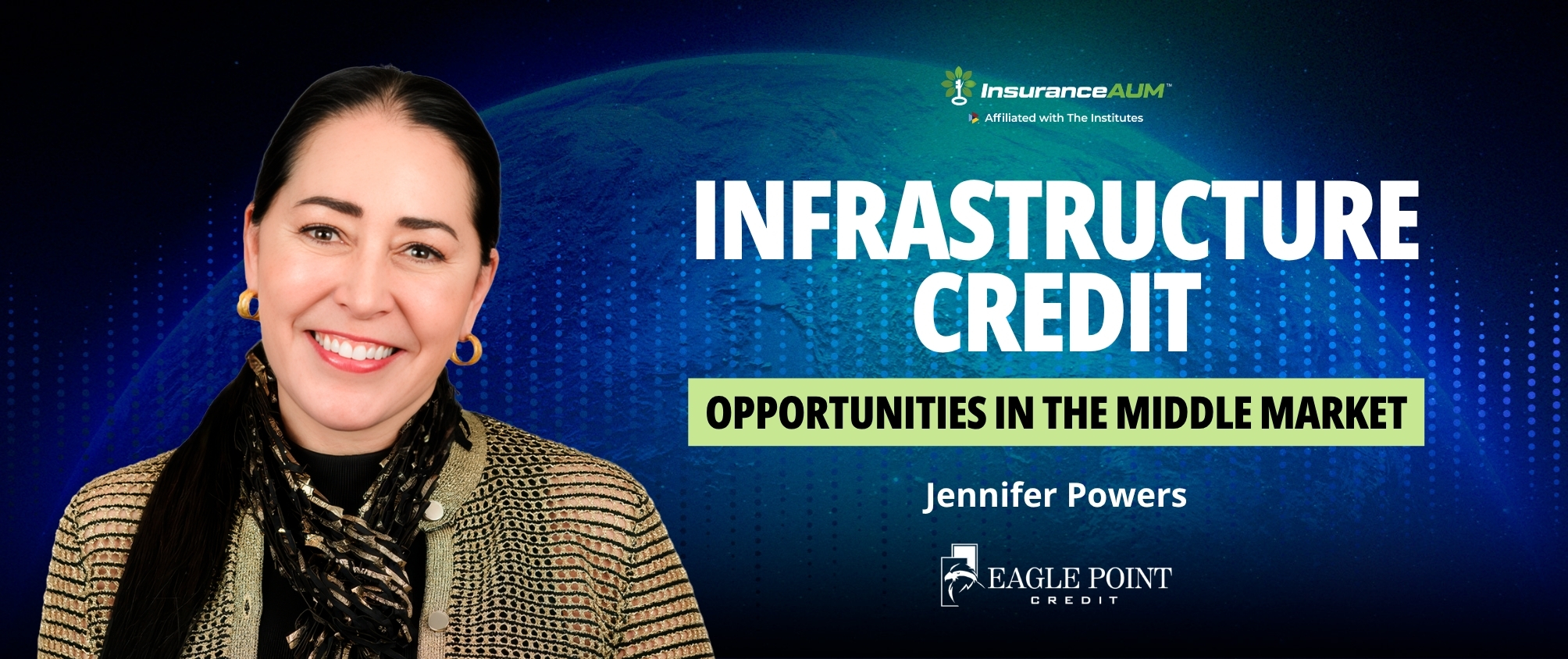
Infrastructure Credit: Opportunities in the Middle Market

Image
IAUM_Podcast_EaglePoint-10.01.26_Web_2026


Stewart: Hey, welcome back to The Home of the World's Smartest Money. This is the InsuranceAUM.com podcast. And I don't say that lightly, by the way. I do think that while the rest of the institutional investment community is playing checkers, the insurance investment community is playing chess.

So, I'm Stewart Foley. Most of you know that, and I'm really happy to have you with us today. I really appreciate this podcast audience, and it's really nice to be able to visit with you. I really appreciate the kind words from time to time out of here, and I really appreciate the community that's here and listening.

So just to kind of get into it right now, when most people think about infrastructure, they picture highways and airports and pipelines and electric utilities, but to some extent that's yesterday's economy. So, today's infrastructure is being built around artificial intelligence, data centers, fiber, battery storage, distributed power, and the modernization of our electric grid.

And it's a transformation that's creating one of the largest financing opportunities that we've seen in a long time. What's particularly interesting is that many of the best opportunities are not necessarily the mega projects that dominate the headlines, but they're middle market opportunities, companies and projects that need flexible capital, thoughtful structuring, and experienced lenders who understand both infrastructure and credit, which leads me to the title of today's episode, Infrastructure Credit: Financing the Next Economy.

And today I'm joined by Jennifer Powers, who goes by Jen, Principal and Head of Infrastructure Credit at Eagle Point Credit.

Jen, welcome to the show. We're thrilled it's your first podcast. We're thrilled to have you. Welcome.

Jennifer: Thank you so much for having me, Stewart. I really appreciate it and looking forward to our conversation.

Stewart: Yeah, it'll be good. I don't think this is correct. It says that you have spent nearly four decades in financing infrastructure through multiple market cycles. I bet that's right. And you've been in the investment banking world, you've been in infrastructure, you've been in debt capital markets, you've done sustainable infrastructure. You've got a really interesting background, and I can't wait to get into it because I love learning from people like you.

But before we go too far, where'd you grow up? And what, by the way, this is interesting. Brand new questions today. Not the usual questions. Look, I'm bored to tears with the usual questions. We did new ones. Here you go. You're not the first on this one, but you're going to be the first on the last one. What is something that your colleagues would be surprised to learn about you?

Jennifer: Oh, that is an interesting question. Surprised to learn about me.

Stewart: First of all, where'd you grow up?

Jennifer: I grew up in upstate New York. And for purposes of upstate, it's not way upstate, as some folks like to think of upstate, but basically the Hudson Valley in Ulster County in a tiny little town called Oliverea. Not even a town, a hamlet. Population, probably 52. And I went to high school up there and really just benefited from being tucked away in a world that had the best of the country and access to New York City and just a very broad exposure to the Northeast.

Stewart: That's awesome. All right, so what's the fun thing that you're... Or we'll take a fun fact.

Jennifer: A fun fact, well—

Stewart: A fun fact.

Jennifer: I think a fun fact that probably not a lot of people know about me is I used to be very, very interested in extreme sports and did some skydiving, did a lot of ice climbing, mountaineering, rock climbing.

Stewart: Oh, wow.

Jennifer: So, just a lot of higher-risk sports, which is kind of interesting because I'm not fundamentally a risk-oriented person. I'm a credit person. I'm all about protecting risk. But then I transferred my risk focus to having kids, and that's by far and away the highest-risk activity that I've undertaken. So I don't think people really know that about me from my earlier years.

Stewart: That's super cool. That is really interesting. Ice climbing, that's all its own thing. And the people who really, really are into it, I'm a motorcycle guy and people who are really, really into that, you just go, okay. And people who are really into some of that stuff, I mean, they are seriously, it's their whole lifestyle. Their whole lifestyle is built around it.

Jennifer: Well, speaking of motorcycles, my very, very first bonus, I bought a Kawasaki Ninja.

Stewart: 600?

Jennifer: No, it was a 250 because I—

Stewart: Oh, okay.

Jennifer: Had to lift it myself if I dumped it. But that was part of my high-risk background.

Stewart: Yeah. I mean, it's interesting. When you drop one of them, you suddenly have this superhuman strength and you can just snap that thing back up on its wheels and not even know how you did it. But if you really take your time, I went to a BMW riding school and they taught us how to pick them up. The really heavy bikes, how to pick them up. You kind of do it backward. You're going to have to pick them up. It isn't super intuitive.

Jennifer: I don't think I got that lesson, but I think my boyfriend at the time, his 750 Interceptor was just beyond me.

Stewart: Yeah. Oh, yeah, yeah, yeah, yeah. Yeah, that's cool stuff though. I mean, those are cool bikes.

So, Jen, when most investors hear the word infrastructure, they're still thinking about roads and bridges and airports and utilities. That is really not the opportunity set, as I understand it, from briefing on this podcast. Can you help us understand how infrastructure credit has evolved and why you think it's an interesting dynamic today?

Jennifer: Well, I love the fact that you've flagged that, that "not your father's Oldsmobile" sort of concept, not your father's infrastructure concept. And I like to think of it as Infrastructure 1.0 and the evolution from there.

And you're absolutely right. Infrastructure to many people still means bridges, tunnels, airports. And when you think about the evolution of infrastructure as an asset class in the late '90s, early aughts, that's what it was. And then something interesting happened on the way to the forum. Global Infrastructure Partners, my alma mater, and others like Brookfield and other of the really big GPs today redefined what infrastructure was. And I call that Infra 2.0.

And that broadening of the bookends around infrastructure included midstream assets, pipelines, gathering systems, unregulated power plants, non-utility power, LNG vessels. And that broader definition had an incredible impact on the industry, on the capital formation industry, because it really made infrastructure an asset class to which institutional investors primarily could allocate.

And the success that the GIPs and the Brookfields and the Ares and the like had with building their infrastructure equity businesses really fueled that capital formation and allocation strategy over the past 20-plus years. And along the way, you saw the success of infrastructure equity strategies look to expand through the capital stack and begin to include infrastructure credit along the way.

What I have found is that Infra 2.0 definition has continued to evolve, and I really pinpoint COVID as a seminal moment where the understanding of energy transition really caught fire. And to me, that was the beginning of Infrastructure 3.0. And I try to frame it in the context of the three Ds of energy transition: digitalization, decentralization, and decarbonization.

And those three Ds really cross so many areas of the economy. You're highlighting power, energy, the data center revolution. And when you think back a mere six years, the beginnings of that phenomenon and the early days of AI, but certainly cloud computing well underway, really was taking hold in the 2019, 2020 timeframe.

The work-from-home phenomenon, being on Zoom, all of the things that we think of as really powering the AI revolution were grounded in that time period. And for me, that's when I saw this opportunity to reframe how we think about infrastructure and what I see as the early innings of a decade-long, multi-decade phenomenon of how capital formation across energy transition really unfolds.

And if you were there back in the day of the beginnings of Apple or the chip manufacturers, and you said this is the tech revolution, you would've wished that you bought Apple early on. And I see the whole infrastructure opportunity in the middle market space around this energy transition theme as being that early-days moment, where the ability to make very attractive above-trend returns is something that we're going to see, as I said, for decades to come.

And in particular, we're dialed into the middle market, and I can unpack why that's the case, but let me pause there and see if you have any questions around how we're seeing the evolution of the infrastructure opportunity.

Stewart: That's super helpful and a really great answer. I just want to, just for definitional purposes, you used the term LNG early on in your answer, and that stands for liquefied natural gas, I think.

And so one of the things that stood out to me, and you just mentioned it, was your focus on the middle market, right? I think a lot of people think infrastructure projects are all ginormous, but Eagle Point deliberately focuses in a niche or in a different market. Can you talk to us about both segments of that? There's got to be an advantage to having less people focusing on a particular opportunity. It's got to help you. So walk us through that.

Jennifer: That is so much central to our strategy. I could go on and on about it, but in a nutshell, big GPs want to raise mega funds. Two, three, four, $5 billion funds. The phenomenon around the go-big-or-go-home fundraising nature of the business is that if you raise a $4 billion fund, you have to deploy it in two, two and a half years, and you've got your team, and it pretty much dictates that you only chase the mega deals.

And sure, they're out there, but when everyone's raising mega funds and chasing the same deals, you do see a race to the bottom in spread compression. And the big GPs won't get out of bed, to use the supermodel phrase, for less than $300 million, $400 million because they have to deploy, and they have to not only deploy into their fund but also feed their co-investors.

So it really becomes a catch-22 in that yields come down for the bigger projects and there's more competition. What we're seeing around energy transition and this emphasis on middle market companies is $75 million to $200 million deals are really going begging. Anything that's sub-index eligible is going begging because it doesn't fit where the big players want to go.

And when you look beyond private credit funds and you think about the broader capital markets or the bank market, those same issues also apply. Banks don't want to be banks anymore unless they're for the true upper, upper tiers of the middle market, and they're doing mega deals with lots of fees and M&A and advisory and equity and derivatives.

And so that has really pushed the banks to chase the biggest data center deals, the biggest alternative energy platforms. And then you have the broader capital markets that really need ratings and they need liquidity.

So they're looking for bigger deals. So, the nut of all of this is when you look at banks, capital markets, big infrastructure funds, big infrastructure GPs, they really don't have the time or the inclination to focus on those true middle market transactions.

And more generic private credit folks, the very well-respected private credit sponsor-driven firms, they don't have the domain expertise and the years in the industry to really originate and not only originate, but structure and diligence these highly complex opportunities.

So that's really where Eagle Point comes in. Our firm is focused 100% on the less competitive and inefficient parts of the markets where we can earn better risk-adjusted returns, better market premiums, and not only that, load the boat with lots of protective structuring. No such thing as a covenant-lite deal in my world. We have so much structure from reserve funds and amortization and cash flow sweeps and all kinds of covenants that we like to build into our structures to really de-risk the opportunity.

Stewart: Hopefully the crayons aren't too big here, but when you say covenant-lite, that means that it has fewer restrictive covenants than other deals. And so I believe that sometimes with large mega deals, you end up with less covenants because it's harder to get those folks to all agree.

Jennifer: And it's competitive. The big equity sponsors are bidding it out to a term sheet and trying to get away with as little as possible. And when multiple firms are competing for an opportunity, the sponsors have an opportunity to really get a very seller-friendly deal.

Stewart: Yeah. So, one of the things that we return to in this podcast is that sourcing is a big source of alpha in private markets. And having an origination platform is no small feat. It's not. And so having an origination competitive advantage is something that I believe is fair to say that is durable.

So how have you built an origination platform that consistently produces differentiated opportunities instead of simply competing for the same transactions that go on elsewhere? You've touched on this in your last answer, but I think that people would benefit from understanding the sourcing side of it a little bit better.

Jennifer: Well, first of all, there's no substitute for actually having done this for decades and the relationships that you build across industry, lawyers, advisors, and having that network. I mean, there's just no substitute for it. And I've built a team with similar depth of experience. Several of my key team members have worked with me for literally decades. So that is in and of itself a multiplier effect on the opportunity set that we can go after.

But you are honing in on something that I think is the virtuous circle of our strategy, which is because we have fundamentally less competition in this sub-index eligible $75 million to $200 million deal size, we're able to really let our transactions speak for themselves.

And that truly produces reverse inquiry. Developers, middle market sponsors, energy transition-related companies are looking for this capital, and there is a capital gap, a last-mile capital gap, for this type of transitional credit.

And when I say transitional credit, I mean my developer, my borrower wants to get from point A to point B. No one wants to pay 12%, 13% forever, and yet they need that capital in order to get to the promised land to scale and grow their business.

They have all the accoutrements of infrastructure, of the long-term contracts, high barriers to entry, inflation protection built into the contracts, supportive regulatory regime, but it's hard to find $100 million. So that's where we come in.

And our ability to be nimble, flexible, and meet their need for speed to market with our ability to deliver efficient solutions is really what makes us, I think at this stage, very much a preferred capital provider. And the proof is in the pudding, in that many of our borrowers come back to us for additional financings. And that in and of itself, that low-hanging fruit that is a result of our ability to deliver on this strategy, creates its own pipeline of opportunities.

Stewart: It's interesting, and I don't know, I couldn't back this up with data, but if you ask CIOs that I know, would you rather have 50 more basis points or would you rather have no OTTI discussion at your next board meeting? So downside is always top of mind for folks in the insurance investment arena.

And so that gets into underwriting infrastructure credit. How do you know that you're being compensated appropriately for the risk? And then I think part of this is also, this was brought up on a different podcast, but it's like underwriting's part of it, but ongoing portfolio management and monitoring is part of it too. So, can you talk a little bit about that?

Jennifer: So, in reverse order, our team is very much a cradle-to-maturity portfolio team. And when we originate something, we don't hand it off to someone to monitor or manage as an asset in the mid or back office. Our team lives with the deal and really works with the borrower throughout the life cycle of the credit to manage the loan, think through covenant compliance, think through consents, amendments, and the whole nine yards.

So, it's a very hands-on approach to private credit. And it by definition has to be because these are complex transactions, and you have to understand the underlying drivers of the credit. If the borrower comes back to you and needs to have a modification, you have to be able to really pull that thread through in terms of the broader ramifications and the model and the documents and so forth. So, that's how I think about the big question around asset management.

In terms of protecting the transaction, and again, this is all part of the fundamental strategy in my view, if I'm in a less competitive arena and I can get like-for-like risk versus a much larger transaction at two, three, often 400 basis points more because I'm the only game in town, so I'm starting with the ability to create alpha relative to risk.

And then, and this is key, I look to de-risk through structure. So what we're trying to do is look at a transaction, earn that premium return against an infrastructure, better loss-given-default rates, better recovery-rates thesis. And then I use the term load the boat with those covenants, cash flow sweeps, debt service reserve funds, operating reserves, liquidity reserves.

I remember taking a deal to investment committee, and it was a battery storage and fuel cell deal with a long-term contract with an investment-grade utility. It was not a huge deal, less than $100 million. And we were like-for-like risk, probably 200, 300 basis points more than what that deal would've commanded if it had been a $300 million deal.

And we had built in operating reserves, debt reserves, amortization against the utility contract, MOIC protection, informational reporting, control over budgets, just as much structure as you can think of.

And Tom Majewski, our CIO, is like, "Well, hold on a second. Let me look at this. The reserves I see here, the loan is half cash collateralized by the debt service reserve fund and the operating reserve and the liquidity reserve."

And I was like, "Well, yeah, that's what we do. We are looking to massively de-risk through the ability," I don't want to say to dictate terms because we have less competition, but to really de-risk transactions for borrowers that are in real need of capital and can't find it elsewhere.

And, you know, how do you know if you're getting the right return? I think we always look at that. We look at what the comp sets are. We look at the premium to the comp sets, and we're threading the needle between having a credit solution, a non-dilutive credit solution for a borrower whose other opportunity, if we're charging 12%, 13%, is to go get equity.

And without covenants, without some of the bells and whistles and reserve funds that we're going to impose upon them, but they don't want to be diluted. So, we try to thread that needle and find that, I don't want to say breaking point, but find that point where we are being compensated for the risk and the borrower sees real value to the type of capital that we're providing and doesn't feel like, "Well, my more effective option is to go raise equity."

Stewart: Yeah, that's interesting. The agenda for our annual meeting is set by the LPs. And in 2025, AI did not make the list. In 2026, it was all over it. And so, everybody's talking about AI. You can't talk about anything without talking about AI.

Everybody talks about the chips, but there's also a significant amount of need toward power, cooling, connectivity, physical infrastructure. As you look across that ecosystem, where do you think the most compelling financing opportunities are beginning to emerge?

Jennifer: Well, let me take a step back and tell you to be afraid, be very afraid. There is a bubble out there. There is too much capital being raised to chase these opportunities. And bubble sectors tend to misprice risk and, again, have their own economic imperative to deploy.

And some of the folks that are raising this capital and looking to deploy do not have the requisite infrastructure experience to know the difference between Stewart and Jen's excellent data center adventure and a real opportunity that is properly structured with the right type of management team and contracts.

So, I do expect over the next couple of years to see some epic fails. We've already seen some. And again, you're pointing out that the rearview mirror of 2025, it feels like another century. Three months ago, I didn't really know how to use Claude or ChatGPT, and now it's an indispensable part of my life.

And I think those comments from you, from me, indicate that in a year from now, we're not going to recognize the landscape yet again.

Stewart: No, that's right.

Jennifer: But there are a lot of wannabes chasing this space. And how to sort the wheat from the chaff is something that I think allocators and investors have to be very, very thoughtful about.

And I think you're honing in on how to be thoughtful about it, which is data centers are really giant Quonset huts that have expensive GPUs inside and are hooked up to power and water. And when you really pull the lens back, what we're talking about here is power and water infrastructure connected to buildings to power computer equipment.

And from my perspective, when we look at the three, four, five opportunities that come in every week, do we pursue or not pursue? Most go into the wastebasket because there are just not enough that check the right boxes. The management team doesn't have experience in building large data centers.

And let's focus on large for a moment because there are smaller, but the hyperscalers and the large language model folks are all moving big.

So, we have to start talking not about data centers in the 30, 40 megawatt zone, but the three-gigawatt zone. And when you're seeing these opportunities, really honing in on what the management brings is key. That's probably the most important thing.

We want to see real equity, real skin in the game. I've got a buck twenty-five for every developer who comes, who's looking to contribute equity from the sweat equity that they've put in, but doesn't really have cash on the barrel. We want to see some real risk money from the equity.

Land, power, data center land. A lot of people are running around trying to put options on land that they think are going to be good sites connected to interstate gas pipelines. So, land is definitely a predicate.

Probably the most significant part of a development package right now is access to equipment. And if you pick up any turbine manufacturer phone or genset manufacturer, Caterpillar, Cummins, Siemens, GE, any of those folks, they're going to start telling you 2028, 2029 delivery slots.

Hyperscalers have no interest in that discussion right now because they're focused on speed to market 2027, maybe early '28. So, tell me that you control equipment, and then the conversation starts to get interesting.

The next really critical piece, often overlooked, is water. Everyone focuses on the power and tends to say like, "Oh, we have a water strategy." And that's where they can get tripped up, is how are you dealing with a closed-loop cooling system? Where are you getting your water from? Your controlled water, municipal water. And that starts to play into what we're seeing as the NIMBY issue, which I'll come back to.

And then finally, LOI, letter of intent, is becoming somewhat of a joke. Hyperscalers view LOIs as free options. They're going to throw everything against the wall to see if Stewart is better at raising capital than Jen, is Jen better than John.

And they're papering the landscape with LOIs. An LOI with an Anthropic or a Meta or an OpenAI doesn't mean anything. It's just an opportunity to keep talking.

I don't really start to take an LOI seriously unless the hyperscaler has entered into a CRA, a cost reimbursement agreement, with the LOI so that they're starting to be very financially pregnant because otherwise LOIs are a dime a dozen.

And then finally, we really look at the state- and municipal-level backdrop. We've seen states come out very, very prominently against data centers almost on a daily basis. So, what's your strategy for that? Are you connecting to the grid? Are you behind the meter? And what's your community relations strategy? So, there's a lot of ways to screw this up.

Stewart: That's interesting. So, let's finish with the big picture. And you know, like you go five years from now, but really five years seems like 50 to me. How different do you think infrastructure credit looks and where should insurance investors be paying attention in the next, I don't know, 12 to 24 months? Just in the next little bit here, it's changing so quickly.

Jennifer: Are you talking specific to the AI data center space or more broadly?

Stewart: No, I think more broadly about infrastructure credit, period. What trends do you see and where do you think the insurance investment community should be paying attention?

Jennifer: Well, I'll come back to my three Ds: decarbonization, digitalization, and decentralization. And that is really all around the efficient production and use of power and related resources.

And decarbonization speaks for itself. That does not mean that we're only interested in renewables. If we're going to win the AI global battle as a national economy, it's an all-power, all-sources. It's repowering coal plants, it's nuclear, it's renewables, it's batteries, it's natural gas. But decarbonization and thinking about the more efficient forms of power is the only pathway to long-term success.

Digitalization speaks for itself, but decentralization, pushing the end use of products down to the consumer-level decision-making, how do you want to consume your power? Thus, the rise of microgrids and smart grids.

And when you think about infrastructure in that big-picture, 30,000-foot view, everything that we're focused on in some way is about energy efficiency, security, supply-chain security.

And as a general theme, yeah, sure, you can still go do infrastructure toll roads or prisons or social infrastructure, but it's very hard to identify an infrastructure asset now and not have it tied back to the energy molecule.

So how we as investors think about that trend and where to latch onto it, I come back to the core of infrastructure. Show me the contracts, show me the high barriers to entry, show me the supportive regulatory regimes, show me the proven technology. I don't want to be a venture debt technology guy out there on a limb with serial number one.

So, stay close to the fundamentals of infrastructure when we're looking to capitalize on this very massive opportunity that's driven by energy transition, the AI revolution, what I think of as really the energy transition revolution. AI is touching so many different sectors of our economy.

Stewart: What a great education on infrastructure credit from you, Jen. Thank you so much. Couple of quick ones on the way out the door. You've been at this for a minute, not only at Eagle Point Credit, but also elsewhere. What characteristics are important to you when you're adding members to your team?

Jennifer: Well, that is something that is very near and dear to my heart because there's a lot of talking the talk and not a lot of walking the walk. And culture really does matter. And that's one of the reasons I brought my strategy, my business, my team here to Eagle Point.

And I've benefited from having several of my team work with me for literally decades. And I think the key to making that all work as a manager and a leader is transparency and clear definition of the strategy and being able to show a team member where they fit into that strategy and how they add value and can grow within the strategy.

And what I then look for in a team member is someone who has that fire in the belly and the intellectual curiosity and the fundamental interest in what it is we're doing, because you can't fake that.

You can't be like, "Oh yeah, I'm into infrastructure because that's trendy right now." And I think that building that team is probably one of the hardest things that we do. We, again, separate a lot of wheat from the chaff.

And when we are building our team, hiring one person can take six, seven, eight months because it is so hard to find that combination of intellectual curiosity, expertise in this domain, fire in the belly, and a desire to really move the meter.

And that really brings me to my favorite way to answer the question, is my number one metric is, can they impact the outcome? Does a team member impact the outcome? And that can be both a positive and a negative. A team member can negatively impact, let's hope not, but are they moving the meter? And do they become a change agent, a driving agent, or are they a cog in a well-oiled machine?

And I really look for folks that not only can, but want to drive the outcome, impact the outcome, in a positive way.

Stewart: Super helpful. That's a cool answer. All right, here's a new question. You ready? Drum roll, please. And I can't really do a drum roll, so just in your head, there's a drum roll. Describe your best dinner ever. How about that?

Jennifer: My fantasy best dinner, or?

Stewart: No, one you can recall or your fantasy best dinner. But give me a best dinner or a favorite meal, either way.

Jennifer: So, one that I've actually, because I have my fantasy dinners, but I'll go with it.

Stewart: All right, do a fantasy dinner. How about that?

Jennifer: Okay. I'd love to have dinner with my mother, now deceased, but not as her daughter. As someone who knows her and is deeply interested in her, but doesn't have the familial baggage, if you will, and to really know her in a non-mother-daughter way.

Stewart: Like somebody who went to grade school with her or something.

Jennifer: Yes, exactly.

Stewart: Yeah, yeah, yeah, yeah.

Jennifer: I think that would be absolutely fascinating because I think there were parts of my mother that were unknowable to me.

I would also love to have dinner with Marie Curie. Reason why, when we think about perseverance, fire in the belly, incredible women, which I have a passion for incredible women, she remains the only person to have ever won a Nobel Prize in two separate disciplines, physics and chemistry. And she did it at a point in time when there were no other female scientists of her stature, and she was competing in a very male-dominated world, and overcame incredible challenges.

And I would love to know what that was like. I'm not a scientist, but I love that kind of incredible education and intellect. So those are my fantasy dinners.

Best dinner I ever had was at The French Laundry.

Stewart: Oh, wow. Okay.

Jennifer: In Napa for my sister's 30th surprise birthday party. And that was many years ago, but it was still at a time when what Thomas Keller was doing with food was unheard of and just mind-blowing. I mean, he's been copied endlessly, but the ability of food to shock, I think that ship has sailed with all the cooking shows and competitions and the explosion of uber, neo-culinary innovation. But he was the first. He was amazing.

Stewart: That's super cool. You know, there's a lot of people who think that you're an amazing woman, Jennifer, and you did a great job today. I'll tell you, it was great education and really, really appreciate you taking the time to be on.

Jennifer: Well, I appreciate the questions, Stewart. These are some of the best questions that I've had. This has been really fun.

Stewart: Well, it's my pleasure, and we're thrilled to have you, and you're welcome back anytime. We've been joined today by Jennifer Powers, Principal and Head of Infrastructure Credit at Eagle Point Credit.

Thanks for joining us. If you like what we're doing, please rate us, like us, and review us on Apple Podcasts, Spotify, or you can watch us on our YouTube channel at InsuranceAUM Community. This is a video podcast, so you can check us out and watch us as we do it.

So, thanks for listening. This is The Home of the World's Smartest Money on the InsuranceAUM.com podcast.

Share this post

Sign Up Now for Full Access to Articles and Podcasts!

Unlock full access to our vast content library by registering as an institutional investor

Register

Contacts


Eagle Point Credit Management

Eagle Point Credit Management is a specialist investment manager focused on niche, income-oriented credit strategies. Founded by Thomas Majewski in partnership with Stone Point Capital in 2012, Eagle Point manages approximately $8.8 billion in AUM as of September 2023. Eagle Point is based in Greenwich, Connecticut, and employs approximately 70 professionals. Investment strategies pursued by the firm include collateralized loan obligations, portfolio debt securities and other opportunities across the credit universe.

We believe we are:

  • The largest holder of CLO Equity in the world
  • One of the largest holders of CLO BBs
  • One of the largest non-bank lenders focused on providing financing solutions to credit funds

AUM as of September 30, 2023, includes committed but undrawn capital and assets managed by Eagle Point Credit Management LLC and certain of its affiliates.


Kyle McGrady
Senior Principal and Head of Client and Partner Solutions
kmcgrady@eaglepointcredit.com
(203) 340 8552

www.eaglepointcredit.com
600 Steamboat Road, Suite 202
Greenwich, CT 06830


View the contributor page

Image
Eagle-Point

Sign Up Now for Full Access to Articles and Podcasts!

Unlock full access to our vast content library by registering as an institutional investor .

Create an account

Already have an account ? Sign in

Ѐ Ё Ђ Ѓ Є Ѕ І Ї Ј Љ Њ Ћ Ќ Ѝ Ў Џ А Б В Г Д Е Ж З И Й К Л М Н О П Р С ΄ ΅ Ά · Έ Ή Ί Ό Ύ Ώ ΐ Α Β Γ Δ Ε Ζ Η Θ Ι Κ Λ Μ Ν Ξ Ο Π Ρ Ё Ђ Ѓ Є Ѕ І Ї Ј Љ Њ Ћ Ќ Ў Џ А Б В Г Д Е Ж З И Й К Л М Н О П Р С Т У Ф Х Ц Ч Ш Ā ā Ă ă Ą ą Ć ć Ĉ ĉ Ċ ċ Č č Ď ď Đ đ Ē ē Ĕ ĕ Ė fi fl œ æ ß