





First Eagle Investments-

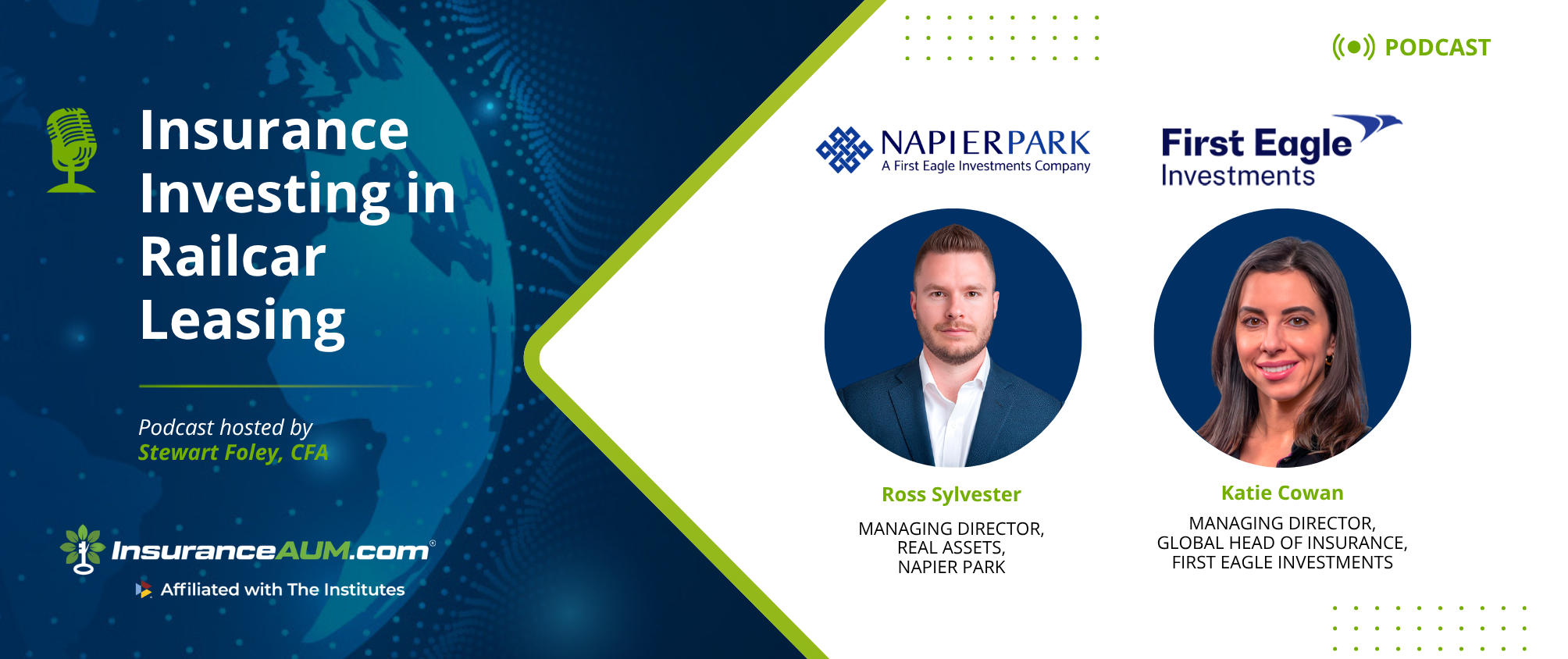
Insurance Investing in Railcar Leasing

Image
IAUM_Podcast_E379_FirstEagle_Web


Stewart: Hey, welcome back. It's nice to have you on The Home of the World's Smartest Money. This is the InsuranceAUM.com podcast. My name's Stewart Foley, CFA. I'm your host. We're thrilled to have you with us. There's a reason that trains show up so often in American culture. From Folsom Prison Blues to the Midnight Train to Memphis to the City of New Orleans, for over 150 years, rail has been the backbone of how goods move, how industries scale and how the economy grows. Today we're here to talk about how insurers can actually invest in that system through railcar leasing. The title of today's podcast is Insurance Investing in Railcar Leasing. And I am joined today by Ross Sylvester, Managing Director of Real Assets at Napier Park Global Capital, and Katie Cowan, Managing Director and Global Head of Insurance at First Eagle Investments.

Welcome to the show, Katie and Ross. How are you doing?

Katie: Doing well, thanks for having us.

Stewart: We are thrilled to have you. Ross, you focus, as I understand it, on sourcing, underwriting, and structuring real asset investments across transportation, renewable energy, including railcar leasing. And prior to Napier Park, you worked at Macquarie Capital and the financial institutions group. Katie is our resident insurance... Geek is not the right word — I don't know, insurance expert, Katie.

Katie: I take it as a compliment.

Stewart: Guru. I think insurance asset management geek is a term of endearment.

Katie: I agree.

Stewart: Listen, I'm telling you, I will say it's a reasonably small room of people if we were to gather everyone who thought so, but it's a fun room anyway. So, you lead insurance business development and strategy at First Eagle. You partner with insurance investment teams to deliver solutions to insurers. And prior to joining First Eagle Investments, you were at Guggenheim Investments focused on insurance relationships. So just as background, we always get into this the same way, which is Katie, I'm going to start with you. Where'd you grow up? What was your high school mascot? And if you were not doing this job being an insurance investment geek — you and I share that esteemed title — what job would you most like to have instead?

Katie: Thanks again for having us, Stewart. I grew up outside of Cleveland, Ohio, west side of Cleveland, for those of you that know the area. I went to a small Catholic all-girls high school called Magnificat and our mascot was The Blue Streaks.

Stewart: There you go.

Katie: So, I'll leave that to the imagination.

Stewart: The Blue Streaks.

Katie: Blue Streaks.

Stewart: Did the West Side of Cleveland have any sort of sign? Did anybody yell, “West Side!” at the games or anything?

Katie: I sure did.

Stewart: Is that right?

Katie: Sure did.

Stewart: I love that.

Katie: Yeah.

Stewart: Alright. So what job would you most like to have if not this one?

Katie: I’d definitely do something in the wellness or longevity space, which I know is very trendy right now, but it's something I spend a lot of my free time when I have it on. And I think there's a huge opportunity there for advancements in healthcare in a more proactive and preventative way.

Stewart: There was an article that came out today actually on scientists reporting on how Alzheimer's moves through the brain, which is super interesting to me. My family has that heredity, if you will. And so, Ross, same for you. So where'd you grow up? What was your high school mascot? And what job would you most like to have if not this one?

Ross: So, I grew up in the San Francisco Bay Area, a little town about halfway in between San Francisco and San Jose, so down the peninsula as they call it. I went to the local public high school and our mascot was the Bears. So not nearly as exciting as the Blue Streaks, but there we go.

Stewart: I don't know. Bears are good.

Katie: Yeah.

Stewart: There's nothing wrong with the bear.

Ross: Cuddly, cuddly, hopefully. Cute.

Stewart: Cute.

Ross: And in terms of a job other than this one, I would be an airplane pilot. You guys can be the insurance asset management geeks. I am the airplane geek resident and train geek for that matter. But I love airplanes. I've always been fascinated by them and I think flying them would be great fun.

Stewart: I wanted to take private pilot lessons. I wanted to learn to fly. I thought I did. And I went out to this place that did it. And I was shocked that the guy let me take off. He's like, "You're going to take off." And I'm like, "Oh, this is amazing." And I was good up until we got to the ceiling. And when he started to nose the plane over, we had to go down. Going down, I was not as enthused. Going up, I was fine. But that small plane, to land it, you got to basically point it at the ground and then change your mind at the last minute. And I was like, "Okay, enough of that. I'm back on the motorcycle." So Ross, I want to start with you. And I mean, I think one of the things that we try to do a good job of is education.

And InsuranceAUM 2.0 is an educational nonprofit. And so we want to get into rail leasing 101. And so for listeners who may not be familiar, this is a fascinating world that, and I say that with all sincerity, I think this sort of stuff is super interesting. Things that are so common to us, we see all the time, but for me at least know very little about. So railcar leasing and how does that whole thing work?

Ross: So very simply, we own the physical railcars themselves that you put various industrial commodities in. It can be dry stuff, it can be liquids. The dry stuff goes in what are called freight cars, which are the steel boxes. Some of them have a top on them, some of them don't. The liquids go in tank cars, which are the long tube-like cars. And we lease those cars to shippers of industrial commodities. So think big diversified industrial companies like Archer Daniels Midland or Dow Chemical or ExxonMobil, people like that. And they lease cars from us, they load them up, and they contract with the railroads to move them and move their commodities inside from point A to point B. And it's typically moving stuff into their factories for production or moving finished goods out of their factories to market. That's really what we do. And we are a, just like you go to the car dealership and decide to lease your car because maybe you just want a little more flexibility in terms of being able to hand it over at a point in time and give the keys back, or you don't want to pay for it all upfront and you'd rather get some financing.

Those are key reasons why people and these big companies lease railcars. The last one that's a little bit more specific to rail is that we are largely responsible for maintaining the cars for the customers. So we do the maintenance to keep the car running for them because it just doesn't make sense for them to bring that cost and that expertise in-house. And so that's a big part of why Exxon, for example, leases cars from us. It's not because we are the cheapest form of financing for them, but it's because of that sort of maintenance expertise, which is hard for them to get and not really sensible for them to bring in-house if they do it. That's really what we do. It's pretty simple. It's we own the railcars, we lease them out on fixed rate, fixed-term contracts to the customers. When the lease comes up, we either renew the lease with them or we find somebody else to take the car and we do that for as long as the car is around and then we scrap it.

Stewart: Weird questions coming because I'm a little bit mechanical. So you're actually doing the maintenance physically on those cars in a service facility, right? Because maintaining those cars, they have a really long useful life, but they have to be maintained properly to achieve that life. So you guys are actually doing that as well?

Ross: Yeah, that's exactly right. And that's a big part of the value proposition to the customer is that many times these are specialized pieces of equipment that take a lot of technical expertise to actually maintain effectively. And the customer just isn't really set up to do that. Or even if they are set up to do it, in many cases, it's just not sensible from a cost standpoint. There just aren't that many guys out there who are really good at sulfuric acid tank car maintenance and understand how to do it. So instead of hiring that guy, you just outsource it to us and pay us a fraction of what it would cost to bring that guy in as an employee of Dow Chemical. And so it's part of what makes the world go around here is that we get these really strong high-quality counterparties and part of it is a finance charge, but part of it is a service aspect as well because these are living, breathing pieces of machinery that need to be maintained so that they can perform their mission effectively.

Stewart: Yeah, I haven't cleaned out a sulfuric acid train car in weeks. You know what? It's not easy to bring humor into that, but I managed to get it done. So it's one of those parts of the economy that is essential and yet virtually invisible. When you see a train going down, it's like, oh, there's a train. And you go, okay, yeah, there's another one. Whatever. But so that sort of boring, dependable stuff is super attractive to insurers. I think nobody loves it in boring, dull, click-it-down-the-tracks investments more than in the insurance industry. So how has railcar leasing performed historically, and what makes it attractive? I think I've described why. What makes it attractive from an investment standpoint?

Ross: Sure. So I'll take the first part of that and talk about it from sort of an operational standpoint, let Katie touch on it from the client's point of view. And Stewart, you really hit the nail on the head there. This is a resilient, predictable asset class. You don't get a lot of surprises here. Railcars in the railcar industry hasn't changed much in the last 40 years and it's probably not going to change much in the next 40 years. That goes for the railcars, but it also goes for what they carry and how much of it. This is not a high-growth industry. There's not a lot of technological innovation here. And that's honestly part of what we think is great about it because we know what we're going to get and the range of outcomes is relatively narrow. So from an investment standpoint, we're not hitting home runs.

We're not trying to hit home runs, but we're also not striking out a lot, to use a baseball analogy for you there. And we think that's really attractive, particularly for the insurance client base. You also touched on a key part of this, which is that these are critical use assets through the most difficult economic periods in the last number of decades — the financial crisis, COVID-19 pandemic, dot-com bubble burst — rail has performed very consistently and predictably because these assets play a key essential role to the everyday operations of their user base, our customers. They're either moving things into the factory to produce it into goods that they sell, or they move things out of the factory and take them to market. And in general, if the railcars stop moving, the business stops moving. And that's a really nice place to be from a customer standpoint.

The last point I'll make there is that it's an extraordinarily diversified exposure as well. You could think of railcar leasing as being a bit nichey. I imagine not too many people are super familiar with this among your listener base, but the exact opposite is true in terms of the composition of our customer base. It's incredibly diverse. We span something like 25 or 30 different industry verticals across the North American industrial economy. And many of those are in no way correlated with one another. And we have an extraordinarily diverse customer base. We have something like 450 customers in our 30,000 railcar portfolio, so less than 1% average exposure to a customer. And so, because of that, you get this really, really nice diversification factor within the investment because you have all of these diversified exposures, most of them don't move in lockstep with one another.

And even within those, you have a ton of diversity in the customer base. And so we think all in all, it creates a really resilient, predictable investment exposure. And one, importantly, that is not terribly correlated with what's going on in equity or credit markets versus around the latest AI trend or some dislocation in structured credit or something like that. Those things just don't really affect our ultimate end user base and the demand for our product.

Stewart: Yeah, it's interesting. I mean, of all the things that AI can do, carry a hundred tons of steel isn't one of them. And so, insurers own a ton, a ton of bonds. It's the predominant asset on the balance sheet and bonds do not like inflation. How should insurers think about and, by the way, many insurers' claims profiles are heavily exposed to inflation, not only goods inflation, but the one that runs double to everything, which is medical inflation. Your workers' comp carriers are exposed to medical inflation for years on end. How should insurers think about return profiles on railcar leasing? And is there an inflation component that makes it particularly compelling?

Ross: So these are very much inflation interest rate sensitive assets. We have the periodic ability to reset our contract levels. These are fixed rate, fixed-term leases, but in the context of a railcar's 40 or 45-year life, the leases are pretty short. Secondly, at the end of the day, we are providing physical railcars and railcar capacity to the customer. And so replacement cost matters. And new railcar prices are very highly correlated with inflation and indeed the rates that you can charge for them are correlated with the price of new railcars. And so both of those flow through and make this a really nice inflation sensitive, rate sensitive, in a good way, investment exposure. And it's something that we think is really nice complement in the context of a broader fixed income private credit portfolio where you may have a little bit of negative correlation there to your point.

And Katie, do you want to touch on the way you feel like your client base views this and how it fits into a portfolio more broadly?

Katie: Yeah. Yeah, absolutely. And I agree with everything Ross said. I mean, there's a few other aspects looking at it from a more macro level, Stewart, that we find particularly compelling for insurers. I mean, one that Ross touched on briefly is the alignment with the duration profile of an insurer's liabilities just given the long lives of these assets, particularly on the life company side. Secondly, the returns are primarily driven by these contractual lease cash flows rather than capital appreciation. So it's giving stable income-oriented performance, which for us insurance savants on the line obviously know how important that is in the insurance market. And importantly, there is the potential tax benefit from the depreciation of the railcars themselves coupled with the capital efficiency of the structure that we're investing in. So it's differentiated in a few ways. I mean, the strategy itself, of course, that Ross mentioned is a bit nichey and unique, but also in how we're delivering that exposure to our insurance partners, which is presenting really a scalable way for investors to go into the asset class over time.

Stewart: That's super helpful. I appreciate that. There's things that are going on that are macroeconomically linked. And then there are things going on that are less so — geopolitical kinds of things. Can you talk a little bit about how our current economic environment or our current situation looks to support this asset class?

Ross: Yeah, great question, Stewart. So I mean you already hit on one of them in terms of rates and inflation. And for much of the current decade we've been in, I'll call it a more normalized rates and inflation environment at odds with the 2010s, which were remarkable in their persistently low levels of both coming out of the financial crisis. But I think there are a number of other things that we view as frankly tailwinds for rail, both on an absolute basis and on a relative basis. So a clear trend and one that seems to be accelerating for a whole variety of reasons is onshoring and nearshoring of supply chains.

Whether it was the pandemic or the more recent crisis in the Middle East or some of the disruption in trade with Asia and particularly China, it's just becoming increasingly, increasingly clear to our client base that the more that they can do to bring supply chains into North America, whether that be in Mexico or in the US or Canada or a combination of all three, even if it's modestly more expensive, it is just very prudent because one significant disruption event can scrap any cost savings of focusing on longer, lengthier, more complicated logistical exposures. Equally so, you touched on geopolitics and that's a significant one. Rail is a purely North American ecosystem, but really, it's US-centric. I think upwards of 85% of our total railcar mileage is run in the US, about 10% is in Canada, about 5% is in Mexico. But just the amount of geopolitical exposure you have relative to more global activities, whether that's within the transportation space, aviation or shipping or shipping containers or whatever the case may be, you just have a lot less exposure there.

And we think that is a real attractive characteristic on a relative basis of rail. On a more micro basis, rail, relative to a lot of other themes driving markets right now, is not exposed to AI broadly defined. It's not particularly tied into the AI supply chain directly. We haven't seen a ton of run-up and growth over these last two, three, four years driven by demand for AI commodities. GPUs don't move by rail. And equally so, rail is not particularly ripe for disintermediation by AI. We're certainly hopeful there will be improvements to be made around the edges around things like maintenance predictability and data analysis. But to your point earlier, an AI large language model can't move 200,000 pounds of freight a thousand or 1500 miles over rails. And in that way, we think rail is going to be really resilient and also just uncorrelated with a lot of what is going on in broader markets right now.

And we think that's interesting from an investor allocation standpoint. The last point I'll make is a specific transportation one. We've seen a lot of disruption in the trucking market in particular recently. And we think that combined with some of the broader geopolitical upheaval that has driven improved competitiveness for North American industry is something that's going to be a real sort of call it near and medium-term tailwind for rail. In the trucking market, one, there's a big landmark ruling that changed the liability structure for freight brokers that has meaningfully taken supply out of the market. And incrementally, the current administration has cracked down a lot on illegal and semi-legal drivers, which has just incrementally contracted that supply of transportation as well. And so, all of these things generally favor rail relative to other transportation allocations, but also just from a broader market standpoint. And we think it's something that can play a really attractive role in a client's investment portfolio if allocated correctly.

Stewart: We talked about this in a different podcast, which is when you start talking about asset-based finance alternatives, I think the market has gotten much smarter about what is diversification and what isn't. What may just sound like diversification but isn't. So can you talk a little bit, and I think you've just covered some of this just now, but how do you differentiate railcar leasing versus other alternatives that insurance investors have, whether those are ABF or private credit or whatever they may be? Are there a couple of things you could point to that highlights the differentiation?

Ross: Good question, Stewart. In terms of the real differentiation of the opportunity set here. One, rail is a hard-to-access space. There just aren't that many folks doing it. In some ways it's very simple and hasn't changed much, but in some ways it's quite complex. And we haven't seen, I think, the same really pervasive flow of institutional capital into the space that you've seen in some other ABF asset classes. And so I think that is an attractive feature here, that it's differentiated and it's not something that is going to get run over and have a meaningful cost of capital shift. Incrementally, I think it's really differentiated from a duration standpoint, both in terms of the underlying assets themselves. These are steel boxes, steel tubes, they last 40 to 45 years, but also in terms of the duration of an investment exposure that you can take.

Whether you're doing loans or buyout private equity or whatever the case may be, these are largely cycle-driven and they have a natural maturity on them in the way that these investments necessarily don't need to. Back to the historical performance comments, these are resilient, predictable exposures. We are trying to build and manage and optimize a portfolio that will perform through market cycles. What we've heard from our clients is they want exposure here that they can count in decades, not in a handful of years or because they're trying to play some specific market cycle. Like, oh, I think the coal market is going to be attractive because there's a ton of AI power demand and the current administration is relaxing environmental regulations. That may help the small piece of our portfolio in coal, but what we are trying to do is build a portfolio that will be resilient and attractive and consistent in its performance over the next 15 or 20 years.

And that I think is what's differentiated about this opportunity more than anything is that you can make an allocation here both from a structural product standpoint in what we're offering and from the assets themselves. And 15 or 20 years from now, you'll own many of the same railcars and the performance should be very resilient and consistent with what you expected it to be 15 or 20 years ago. And there just aren't that many spaces today that you can say that about with a lot of confidence. And so I think that's really more than anything where rail shines in its predictable, somewhat sleepy, you know what you're getting and you know it's not going to change much, but there's a lot of actual beauty in that simplicity because it's something that you can push out really far from a duration standpoint.

Stewart: Well, Katie, here's some good news. You and I are not the only insurance investment geeks that listen to this podcast. So with that in mind, let's bring it back to the insurance investment community. And if I'm a CIO and I like this story and I want to access this market, how should I think about accessing it? And you know as well as I do, there's a litany of considerations there. Talk us through it.

Katie: Absolutely. And Ross touched earlier on the importance of and the distinction of rail’s diversification at the underlying asset level, but for insurers and those that are listening, Stewart, the portfolio construction perspective of diversification is also extremely important. And at face value, railcar seems somewhat nichey as we've talked about, but it's sitting at this really unique intersection in a portfolio of infrastructure, real assets and private credit. So that gives investors this really unique diversification, not only within the asset class, but at this broader strategic asset allocation perspective, which is one of the things that we think is really compelling about it when we're talking to our insurance partners about where and how this can fit. And it absolutely can sit within the broader asset-based finance bucket that everyone is talking about and the press is writing about and can be defined many different ways. But when insurers think about it through that portfolio construction lens, they're really getting down to the question, what does this investment add that I don't already have in the portfolio?

And it really comes down to in this space offering predictable contractual cash flows, hard asset collateral and diversification relative to more of a traditional credit exposure. And sitting at that intersection, we think it can really complement those allocations rather than compete with them, which is one of the things that we think makes it a really interesting addition to an insurance portfolio.

Stewart: Yeah, that's interesting. So as we wrap up, I want to go to Ross first and I want to close with Katie. What would you say are one or two takeaways that you'd want our audience to keep with them when they think about railcars in their portfolio or as an asset class by itself?

Ross: I think the biggest thing is that this is an excellent way to take a resilient, downside-protected, diversifying exposure to the North American industrial economy and do so in a way that is inflation sensitive and rate sensitive. And I think that is ultimately what we are seeking to deliver to investors. And I think in my completely unbiased view, Stewart, all of that is very consistent with what insurance investors are trying to construct from a broader investment portfolio standpoint. Trying to think about how can I take premium from my customers and how can I invest it thoughtfully and appropriately in a way that doesn't over-index myself to any one specific risk and it aligns myself well with the underlying risk profile of my underwriting business. And I think rail is an excellent way to do that and very, very complementary with what I'd call the more foundational core exposures of the insurance portfolio.

And so, insurance investors are a core part of our client base for this strategy and we're always focused on adding to that.

Stewart: Thank you. Katie?

Katie: Yeah, Ross, I agree with everything you said, and I think you said it really well. The fundamentals of this asset class are a natural fit for insurance portfolios and complementing the existing variety of credit exposures that they have.

Stewart: Okay. So, it's been a phenomenal education on railcar leasing. I know a lot more than I did. I'll say that. Let's talk about something a little bit more qualitative. You've both been in business a long time. You both have been in this industry for a long time. What characteristics do you think are most important when you are adding to members of your team? We went with Ross first last time, so we'll go to Katie first this time. We're all about fairness here at InsuranceAUM. Go right ahead, Katie.

Katie: Thank you, Stewart. For me, in thinking about this question, it's really the traits that you can't teach on the job, intellectual curiosity, work ethic, attention to detail, just those things that are innate in who someone is, which is quite hard to interview for, unfortunately.

Stewart: How about you, Ross?

Ross: So, I think the biggest thing from our standpoint on the investment side of the business is increasingly, and with the progress of AI and everything else, the more sort of technical side of this business, building models, investment analysis, data analysis, pretty PowerPoint presentations, all the things that you traditionally think about being a core part of a role are more and more going to be commoditized. And it emphasizes, I think, the importance on people that have thoughtful opinions and are willing to share them in sometimes challenging environments to really develop that, I'll call it judgment and decision-making capability, because I think more and more the role of human beings in these processes is synthesizing complex amounts of information and making judgment calls about them where there isn't a sort of black or white right or wrong answer. But that is a skill that needs to be developed over time.

And while to Katie's point, it's hard to interview a 25-year-old and say, "Oh, this person's going to make a wonderful investor by the time they're 40." What I think you can do is identify that they have the personality traits, whether that intellectual curiosity, outgoing nature, willingness to speak up, and willingness to go out on a bit of a limb and state opinions and identify that they have the foundational pieces that can help them develop that skillset over time. And how it ends up, you'll never know until you get there. But you can, I think, at least get a sense for whether someone is a good candidate to really just get the repetitions required for that or if they're just not going to be assertive enough to necessarily do that. So that's certainly something that I look for and is important when we look at adding new people to the team.

Stewart: Last one, signature question. When we have two guests, you get to each invite one guest to dinner. So there's dinner for four. Dinner's on us. Who would you most like to have dinner with, alive or dead? Ross, we'll start with you. It'll be you, Katie, Katie's guest and your guest. Who's coming with you?

Ross: So the answer for me, this is a remarkably immediate response, but it's Muhammad Ali.

Stewart: Oh, wow.

Ross: I'm a big sports fan. I like boxing, but I think more than anything, he is a sort of transcendent individual that really bridged sports, culture, politics in a way that very, very few other people have and certainly was one of the major ones that I didn't overlap with in my lifetime, unlike somebody like a Michael Jordan or something like that. And most of all, I think he would be a wonderful and hilarious dinner companion. So that's my pick. Don't ask me who's number two, but that's my number one.

Stewart: All right, good deal. So Katie, it's you, Ross, and Muhammad Ali. Who's the fourth?

Katie: My grandmother and she would love Muhammad Ali.

Stewart: Oh, wow.

Katie: It would be a fun foursome.

Stewart: Okay. So, tell us about your grandma.

Katie: Well, she has since passed and it was hard to pick one of the four grandparents that's passed when thinking about answering this question, but I went with her just because she's someone who is extremely influential in my life and didn't get to see a lot of the life milestones that I've had in my adult life with getting married and having my four kids and all of those things that you kind of hope your elders see. So, it would be nice to have that experience.

Stewart: And being on this podcast, there’s that.

Katie: Absolutely. Absolutely. Life milestone.

Stewart: Absolutely. It's been a great education today. Thank you so much both of you for being on. It's great to appreciate your expertise. We all benefit and learn from you, so thanks for being on.

Katie: Thanks for having us.

Ross: Thank you, Stewart.

Stewart: We've been joined by Ross Sylvester, managing director of Real Assets at Napier Park Global Capital and Katie Cowan, managing director and global head of insurance at First Eagle Investments. If you like what we do here, please rate us, review us on Apple Podcasts, Spotify, or wherever you're listening to your favorite shows. You can also watch us because we video these as well on our YouTube channel at InsuranceAUM Community. My name's Stewart Foley. This is the home of the world's smartest money on the InsuranceAUM.com podcast.

Share this post

Sign Up Now for Full Access to Articles and Podcasts!

Unlock full access to our vast content library by registering as an institutional investor

Register

Contacts


Image
FEI-Stacked-Color-sidebar

First Eagle Investments is an independent, privately owned investment management firm headquartered in New York with approximately $217 billion in assets under management as of June 30, 2026.* Dedicated to providing prudent stewardship of client assets, the firm focuses on active, fundamental, and benchmark-agnostic investing, with a strong emphasis on downside mitigation. With over 15 years of experience managing assets on behalf of insurers, First Eagle is focused on meeting their unique portfolio and servicing needs through bespoke investment solutions and a dedicated insurance coverage team. The firm’s investment capabilities for the insurance market include alternative credit, fixed income, and global equities.
 

All figures related to assets under management (AUM) are preliminary figures based on management’s estimates and as such are subject to change. Some offerings may not be available in all jurisdictions.

As of 30-June-2026.

*The total AUM listed above represents the combined AUM and assets under advisement of First Eagle Investment Management, LLC, First Eagle Separate Account Management, LLC, Napier Park Global Capital (Napier Park), First Eagle Alternative Credit (FEAC), and Diamond Hill Capital Management, LLC as of 30-Jun-2026. It includes $3.1 billion in committed/non-fee-paying capital from Napier Park, inclusive of assets managed by RLM and CMV, and $0.8 billion in committed/non-fee-paying capital from FEAC. For CLO warehouses, AUM represents maximum commitment (loan par value). As of 5-Sep-2025, Napier Park and FEAC investment activities are unified under Napier Park’s brand and management. First Eagle Alternative Credit, LLC is a distinct registered investment advisor within the Napier Park platform, acting in sub-advisory capacity to a number of First Eagle’s registered funds.
 

Katie Cowan   
Head of Insurance Client Solutions
katie.cowan@firsteagle.com
(310) 893-2440
 

View the contributor page

Sign Up Now for Full Access to Articles and Podcasts!

Unlock full access to our vast content library by registering as an institutional investor .

Create an account

Already have an account ? Sign in

Ѐ Ё Ђ Ѓ Є Ѕ І Ї Ј Љ Њ Ћ Ќ Ѝ Ў Џ А Б В Г Д Е Ж З И Й К Л М Н О П Р С ΄ ΅ Ά · Έ Ή Ί Ό Ύ Ώ ΐ Α Β Γ Δ Ε Ζ Η Θ Ι Κ Λ Μ Ν Ξ Ο Π Ρ Ё Ђ Ѓ Є Ѕ І Ї Ј Љ Њ Ћ Ќ Ў Џ А Б В Г Д Е Ж З И Й К Л М Н О П Р С Т У Ф Х Ц Ч Ш Ā ā Ă ă Ą ą Ć ć Ĉ ĉ Ċ ċ Č č Ď ď Đ đ Ē ē Ĕ ĕ Ė fi fl œ æ ß