


Ares Management Corporation -

“IRRational” Thinking: How the IRR Reinvestment Rate Myth Is Distorting Investment Decisions

Chess pieces on board

From the Desk of Ares’ Quantitative Research Team

At a Glance

  • In public markets, instant price discovery and time-weighted returns represent standard features. Historically, however, capital formation1 primarily occurred through private, opaque, relationship-driven transactions, where cash-flow metrics like the internal rate of return (IRR) have long dominated.
  • The myth that IRR inherently assumes interim reinvestment at the same rate of return is just that—a myth. IRR is purely internal and project specific, measuring only what happens within the boundaries of a single investment.
  • Recognizing the limited relationship between investment-level IRR and portfolio-level TWR may help investors better evaluate the performance of their portfolios and aim to use them more effectively in portfolio management.
  • In a world where private markets play an increasingly important role, getting the measurement right directly impacts financial outcomes for millions.

Prologue
We began writing this article after a spirited discussion over dinner. It was one of those evenings where no one remembers the appetizer, but everyone remembers the argument. The argument centered on the Internal Rate of Return (IRR) calculation, and whether it embeds a reinvestment assumption that distorts private market investment allocations. Some of us left business school believing that IRR carries a reinvestment rate burden; others were convinced that believing this was itself the burden. Somewhere between course and discourse, the seeds of this article were sown.

Executive Summary
In public markets, instant price discovery and time-weighted returns represent standard features. Historically, however, capital formation1 primarily occurred through private, opaque, relationship-driven transactions, where cash-flow metrics like the internal rate of return (IRR) have long dominated. These cash flow metrics remain the norm in contemporary private markets, particularly within the general partner/limited partner (GP/LP) structure2 that governs the institutional private equity and private credit markets.

Our central argument is this: the widespread belief that IRR calculations require reinvestment assumptions is simply incorrect. A persistent myth suggests IRR is only valid if you can reinvest distributions at the same rate of return, which may lead to a systematic under allocation to private markets. This misunderstanding may inadvertently lead investors to dismiss legitimate IRR performance or to resort to other metrics, such as time-weighted returns (TWRs), which were designed for different contexts and come with their own limitations.

Furthermore, high IRRs of individual investments do not necessarily translate into higher TWR at the portfolio level. In this article, we aim to dispel the myth about reinvestment rate assumptions, and to illustrate the differences between IRR and TWR. Understanding these differences is essential for making informed investment decisions — and avoiding costly mistakes.

Instant Price Discovery: The Exception, Not The Rule
Throughout history, real-time price discovery has been remarkably uncommon. Ancient financial systems, from Mesopotamia and Greece to Rome, relied predominantly on privately negotiated arrangements. Medieval and Renaissance financiers in Florence, Venice, and Amsterdam similarly prioritized relationships and trust over market-based transparency, conducting business through personal networks built over generations.

Even in modern times, public market exchanges like NYSE and LSE, though substantial, are dwarfed by the scale of privately held capital, which includes private equity, private debt, real estate, infrastructure, natural resources, family businesses, partnerships, and lending from one neighbor to another.

Why does private financing continue to flourish despite the advent of sophisticated public exchanges and remarkable technological advancements? Several factors explain the persistence of private market dominance.

First, real-time public pricing requires a robust regulatory regime and a significant investment in technology, which are features often unique to developed economies. Second, many assets that change hands in private markets are inherently complex and difficult to value through standardized mechanisms. Consider the challenge of establishing an instant market price for an airport or a professional sports franchise. These assets require expert evaluation, detailed due diligence, and negotiated transactions.

Finally, private entities may prefer limited disclosure to maintain a competitive advantage or to focus on long-term strategic objectives rather than succumb to short-term market pressures that often characterize public company management.

Time-Weighted Returns: An Exception, Not A Rule
As mutual funds gained popularity in the mid-20th century, regulators and industry groups like the CFA institute faced a critical challenge: how to create a standardized way to compare portfolio managers’ investment skill. In public markets, investors rather than portfolio managers control the timing of cash inflows and outflows in public markets. It would be misleading to reward or penalize portfolio managers for timing decisions beyond their control.

Thus, the Global Investment Performance Standards promoted the time-weighted return (TWR) as the default approach for presenting public-market track records. By removing the effects of investor deposits and withdrawals, TWRs create an ideal framework for assessing the performance of publicly traded portfolios like mutual funds, where portfolio managers only control their period-to-period investment decisions, not the capital flows.

However, in most other investment contexts — particularly for those involving irregular or uneven cash flows — TWRs become less relevant than cash-flow-based metrics like the IRR, net present value (NPV), or multiples on invested capital (MOIC). The reason for this is cash flow-based return metrics focus on the actual economic outcome for investors by factoring in the precise timing and amount of each cash flow, both contributions and distributions.

Proponents of TWRs may argue that IRR is too influenced by the timing and sizing of cashflows. This impact is real and must not be ignored, but other metrics can be examined alongside IRRs to create a balanced view of performance. Duration2 is one such measure, as it provides important context and is usually calculable using information provided by private capital managers.

Why IRR Does Not Require a Reinvestment Rate Assumption — And Why It Matters
A common misconception pervades some finance literature and business school classrooms: the belief that IRR calculation implicitly assumes the reinvestment of interim distributions at the IRR. However, the mathematical solution to the IRR algorithm is simply the discount rate that equates the present value of future (expected) investment cash flows to zero. This definition of IRR is strictly internal to the specific investment (hence the name) and is independent of subsequent investment decisions. IRR measures what happened within the boundaries of one particular investment — nothing more and nothing less.

The confusion originates from literature that discusses reinvestment rates in the context of total realized returns over extended periods. This is relevant when evaluating an investor's overall performance across multiple investments but does not pertain to the IRR calculation itself, which is a project-specific measure devoid of any reinvestment assumptions.

Many practitioners learned from older finance textbooks that discuss the “reinvestment rate assumption.” These texts sometimes state: “If you want to measure your total realized return over time — including what you do with distributions — the rate at which you redeploy those payouts will affect your overall return.” This statement is undeniably true, but fundamentally different from claiming that “the IRR calculation itself requires you to assume a particular reinvestment rate.”

The IRR is simply a solution to a present-value equation; it does not embed any assumption about what you do with the distributed cash beyond the project’s boundaries. The distinction between measuring individual investment performance and measuring overall investor performance across multiple investments is crucial — confusing them leads to flawed decisions.


By the Numbers
To illustrate this distinction, let us imagine two hypothetical investments being contemplated by two investors, each investment requiring $50 million initially and returning $100 million in one year. Project 1 ends with this payout, while Project 2 also has a negligible $1 payout in year 100. Both projects have an IRR of approximately 100%.

Investor One correctly recognizes both projects as equivalent economically. Understanding that IRR does not imply reinvestment requirements, this investor, picking first, randomly chooses Project One. Meanwhile, Investor Two, misunderstanding IRR, incorrectly believes Project Two necessitates reinvesting the initial $100 million payout at 100% annually for the next 99 years to receive the stated IRR. Viewing this as impossible, Investor Two declines to invest in the remaining Project Two.

This error underscores the need to separate a project’s IRR from any reinvestment assumptions. Investor Two missed an opportunity to double their money based on a fundamental misunderstanding of what IRR measures.


In the modern private capital universe, investors sometimes argue that while the IRR of a private fund might reach 12%, they should discount this reported return because they cannot necessarily reinvest distributions at 12%. This conflates the actual performance of the fund (which may truly generate a 12% IRR on deployed capital) with the investor’s overall realized return across multiple investments (which depends on how the investor redeploys the proceeds).

This incorrect assumption can have significant practical impact. Investors may extrapolate these perceived lower fund returns to the asset class level, perhaps using a modified IRR function with a lower reinvestment rate. All else being equal, a lower expected return for a given asset class may lead to a reduced allocation in a strategic asset allocation exercise, potentially costing investors substantial returns over time.

We argue that the fund’s IRR remains valid as a performance metric for that fund’s capital usage. Including a reinvestment assumption necessarily introduces the performance of a second investment into the equation. While this approach may be meaningful from a portfolio standpoint, where one may want to form a holistic view of all investments combined, we should avoid doing so when considering only one investment in isolation.

IRRs and TWRs at the Portfolio Level
If we move beyond the decision of one investment and instead consider the performance measurement of a portfolio of investments, it is worth considering how IRR and TWR relate. One observation is that investors (limited partners) may be graded on their TWR production while they assess managers (general partners) based on IRR production. This begs the question of whether and to what extent these two measures correlate.

We argue that this relationship is not necessarily intuitive and – performance persistence issues aside – IRR may not be the best proxy for TWR, and vice versa. Understanding this distinction becomes crucial for both investment selection and performance evaluation.

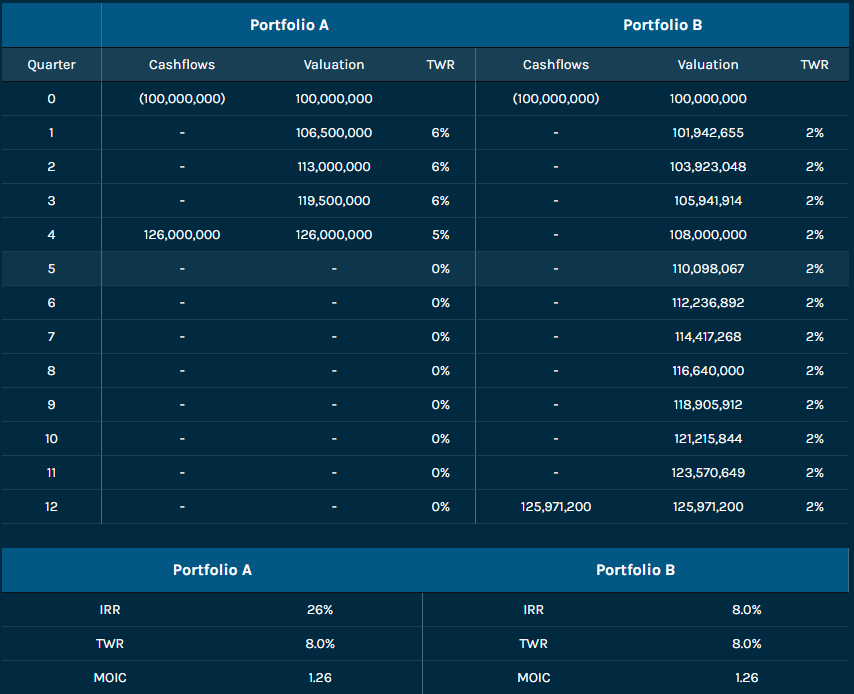
Consider two portfolios to illustrate this point: Portfolio A generates a 26% IRR by returning $126 million from an initial $100 million outflow after one year and does not reinvest. Portfolio B returns a modest 8% annually over three years, but capital remains invested the entire time.

Despite Portfolio A's significantly higher IRR, the portfolio's overall TWR is the same as Portfolio B’s due to the latter’s continuous compounding of returns. Portfolio B may in fact be more attractive to a portfolio manager due to its consistent cashflows over a longer time horizon and because it obviates the need to reinvest cashflows. However, this preference does not negate the objectively higher IRR of Portfolio A.

This example demonstrates that IRR and TWR do not necessarily correlate intuitively at the portfolio level, which highlights the distinct roles and interpretations of these metrics. No single perfect metric exists, but an understanding of their behavior can create a balanced view of performance.

Image
Screenshot 2025-10-29 095656

Conclusion
Instant price discovery and TWRs are modern constructs that are predominantly observed in specialized public market contexts. Contemporary private equity and private credit, which often feature large, complex, and unique transactions, as well as the global market for private financing more broadly, tend to rely on cash flow-based metrics like IRR, and for good reason.

The myth that IRR inherently assumes interim reinvestment at the same rate of return is just that—a myth. IRR is purely internal and project specific, measuring only what happens within the boundaries of a single investment. Misinterpreting IRR can lead investors to underestimate the true effectiveness of private funds and make suboptimal allocation decisions.

Additionally, recognizing the limited relationship between investment-level IRR and portfolio-level TWR may help investors better evaluate the performance of their portfolios. Investors making allocation decisions should accept IRR without reinvestment assumptions and be mindful of its relationship with TWR, despite what they may have learned in business school.

In a world where private markets play an increasingly important role, getting the measurement right directly impacts financial outcomes for millions. Clarity in performance measurement leads to better investment decisions — a recipe that everyone at the dinner table can agree on.

William P. Kieser, Ph.D., Principal, Quantitative Research Group within Ares Global Client Solutions; Eyal Karsh, Head of Private Markets, American Family Investments; and Jane Carpenter, Associate, Quantitative Research Group within Ares Global Client Solutions contributed to this piece.


Read More From Ares Management Corporation


1. Capital formation refers to the transfer of wealth from households, institutions, and governments into the business sector.

2. The GP/LP structure refers to when limited partners (i.e., investors) commit capital to a private fund where investment decisions are made at the sole discretion of the general partner (i.e., manager).

Disclaimers

This document is distributed for informational purposes only and is neither an offer to sell, nor the solicitation of an offer to purchase, any security, the offer and/or sale of which can only be made by definitive offering documentation. Views expressed are those of the named authors as of July 10, 2025, are subject to change at any time, and may differ from the views of other portfolio managers or of Ares as a whole. Although these views are not intended to be a forecast of future events, a guarantee of future results, or investment advice, any forward looking statements are not reliable indicators of future events and no guarantee is given that such activities will occur as expected or at all.

Information contained herein has been obtained from sources believed to be reliable, but the accuracy and completeness of the information cannot be guaranteed. All investments involve risk, including possible loss of principal.

These materials are neither an offer to sell, nor the solicitation of an offer to purchase, any security, the offer and/or sale of which can only be made by definitive offering documentation. Any offer or solicitation with respect to any securities that may be issued by any investment vehicle (each, an “Ares Fund”) managed or sponsored by Ares Management LLC or any of its subsidiary or other affiliated entities (collectively, “Ares Management”) will be made only by means of definitive offering memoranda, which will be provided to prospective investors and will contain material information that is not set forth herein, including risk factors relating to any such investment. Any such offering memoranda will supersede these materials and any other marketing materials (in whatever form) provided by Ares Management to prospective investors. In addition, these materials are not an offer to sell, or the solicitation of an offer to purchase securities of Ares Management Corporation (“Ares Corp”), the parent of Ares Management. An investment in Ares Corp is discrete from an investment in any fund directly or indirectly managed by Ares Corp. Collectively, Ares Corp, its affiliated entities, and all underlying subsidiary entities shall be referred to as “Ares” unless specifically noted otherwise. Certain Ares Funds may be offered through our affiliate, Ares Management Capital Markets LLC (“AMCM”), a broker-dealer registered with the SEC, and a member of FINRA.

In making a decision to invest in any securities of an Ares Fund, prospective investors should rely only on the offering memorandum for such securities and not on these materials, which contain preliminary information that is subject to change and that is not intended to be complete or to constitute all the information necessary to adequately evaluate the consequences of investing in such securities. Ares makes no representation or warranty (express or implied) with respect to the information contained herein (including, without limitation, information obtained from third parties) and expressly disclaims any and all liability based on or relating to the information contained in, or errors or omissions from, these materials; or based on or relating to the recipient’s use (or the use by any of its affiliates or representatives) of these materials; or any other written or oral communications transmitted to the recipient or any of its affiliates or representatives in the course of its evaluation of Ares or any of its business activities. Ares undertakes no duty or obligation to update or revise the information contained in these materials.

All charts, graphs and images are shown for illustrative purposes only. The recipient should conduct its own investigations and analyses of Ares and the relevant Ares Fund and the information set forth in these materials. Nothing in these materials should be construed as a recommendation to invest in any securities that may be issued by Ares Corp or an Ares Fund or as legal, accounting or tax advice. Before making a decision to invest in any Ares Fund, a prospective investor should carefully review information respecting Ares and such Ares Fund and consult with its own legal, accounting, tax and other advisors in order to independently assess the merits of such an investment.

These materials are not intended for distribution to, or use by, any person or entity in any jurisdiction or country where such distribution or use would be contrary to law or regulation.

These materials contain confidential and proprietary information, and their distribution or the divulgence of any of their contents to any person, other than the person to whom they were originally delivered and such person’s advisors, without the prior consent of Ares is prohibited. The recipient is advised that United States securities laws restrict any person who has material, nonpublic information about a company from purchasing or selling securities of such company (and options, warrants and rights relating thereto) and from communicating such information to any other person under circumstances in which it is reasonably foreseeable that such person is likely to purchase or sell such securities. The recipient agrees not to purchase or sell such securities in violation of any such laws, including of Ares Corp or a publicly traded Ares Fund.

These materials may contain “forward-looking” information that is not purely historical in nature, and such information may include, among other things, projections, forecasts or estimates of cashflows, yields or returns, scenario analyses and proposed or expected portfolio composition. The forward-looking information contained herein is based upon certain assumptions about future events or conditions and is intended only to illustrate hypothetical results under those assumptions (not all of which will

be specified herein). Not all relevant events or conditions may have been considered in developing such assumptions. The success or achievement of various results and objectives is dependent upon a multitude of factors, many of which are beyond the control of Ares. No representations are made as to the accuracy of such estimates or projections or that such projections will be realized. Actual events or conditions are unlikely to be consistent with, and may differ materially from, those assumed. Prospective investors should not view the past performance of Ares as indicative of future results. Ares does not undertake any obligation to publicly update or review any forward-looking information, whether as a result of new information, future developments or otherwise.

Some funds managed by Ares or its affiliates may be unregistered private investment partnerships, funds or pools that may invest and trade in many different markets, strategies and instruments and are not subject to the same regulatory requirements as mutual funds, including mutual fund requirements to provide certain periodic and standardized pricing and valuation information to investors. Fees vary and may potentially be high.

These materials also contain information about Ares and certain of its personnel and affiliates whose portfolios are managed by Ares or its affiliates. This information has been supplied by Ares to provide prospective investors with information as to its general portfolio management experience. Information of a particular fund or investment strategy is not and should not be interpreted as a guaranty of future performance. Moreover, no assurance can be given that unrealized, targeted or projected valuations or returns will be achieved. Future results are subject to any number of risks and factors, many of which are beyond the control of Ares. In addition, an investment in one Ares Fund will be discrete from an investment in any other Ares Fund and will not be an investment in Ares Corp. As such, neither the realized returns nor the unrealized values attributable to one Ares Fund are directly applicable to an investment in any other Ares Fund.

An investment in an Ares Fund (other than in publicly traded securities) is illiquid and its value is volatile and can suffer from adverse or unexpected market moves or other adverse events.

Funds may engage in speculative investment practices such as leverage, short-selling, arbitrage, hedging, derivatives, and other strategies that may increase investment loss. Investors may suffer the loss of their entire investment. In addition, in light of the various investment strategies of such other investment partnerships, funds and/or pools, it is noted that such other investment programs may have portfolio investments inconsistent with those of the strategy or investment vehicle proposed herein.

This may contain information obtained from third parties, including ratings from credit ratings agencies such as Standard & Poor’s. Reproduction and distribution of third party content in any form is prohibited except with the prior written permission of the related third party. Third party content providers do not guarantee the accuracy, completeness, timeliness or availability of any information, including ratings, and are not responsible for any errors or omissions (negligent or otherwise), regardless of the cause, or for the results obtained from the use of such content.

THIRD PARTY CONTENT PROVIDERS GIVE NO EXPRESS OR IMPLIED WARRANTIES, INCLUDING, BUT NOT LIMITED TO, ANY WARRANTIES OF MERCHANTABILITY OR FITNESS FOR A PARTICULAR PURPOSE OR USE. THIRD PARTY CONTENT PROVIDERS SHALL NOT BE LIABLE FOR ANY DIRECT, INDIRECT, INCIDENTAL, EXEMPLARY, COMPENSATORY, PUNITIVE, SPECIAL OR CONSEQUENTIAL DAMAGES, COSTS, EXPENSES, LEGAL FEES, OR LOSSES (INCLUDING LOST INCOME OR PROFITS AND OPPORTUNITY COSTS OR LOSSES CAUSED BY NEGLIGENCE) IN CONNECTION WITH ANY USE OF THEIR CONTENT, INCLUDING RATINGS.

Diversification does not assure profit or protect against market loss. References to “downside protection” or similar language are not guarantees against loss of investment capital or value.

Graphs are shown for illustrative purposes only.


Share this post

Sign Up Now for Full Access to Articles and Podcasts!

Unlock full access to our vast content library by registering as an institutional investor

Register

Contacts


Ares Management

Ares Management Corporation (NYSE: ARES) is a leading global alternative investment manager offering clients complementary primary and secondary investment solutions across the credit, real estate, private equity and infrastructure asset classes. We seek to advance our stakeholders’ long-term goals by providing flexible capital that supports businesses and creates value for our investors and within our communities. By collaborating across our investment groups, we aim to generate consistent and attractive investment returns throughout market cycles.

As of March 31, 2026, Ares Management Corporation’s global platform had nearly $644 billion of assets under management, with operations across North America, South America, Europe, Asia Pacific and the Middle East. Ares manages over $62 billion on behalf of 282 third-party insurance companies globally. For more information, please visit www.ares.com.

Robert Torretti  
Partner, Co-Head of Insurance, Americas Relationship Management  
rtorretti@aresmgmt.com
212-515-3385

Amanda Healy   
Partner, Co-Head of Insurance, Americas Relationship Management   
ahealy@aresmgmt.com
212-515-3351

Ares Management
245 Park Avenue, 44th Floor,
New York, NY 10167

View the contributor page

Image
ARES Logo


Sign Up Now for Full Access to Articles and Podcasts!

Unlock full access to our vast content library by registering as an institutional investor .

Create an account

Already have an account ? Sign in

Ѐ Ё Ђ Ѓ Є Ѕ І Ї Ј Љ Њ Ћ Ќ Ѝ Ў Џ А Б В Г Д Е Ж З И Й К Л М Н О П Р С ΄ ΅ Ά · Έ Ή Ί Ό Ύ Ώ ΐ Α Β Γ Δ Ε Ζ Η Θ Ι Κ Λ Μ Ν Ξ Ο Π Ρ Ё Ђ Ѓ Є Ѕ І Ї Ј Љ Њ Ћ Ќ Ў Џ А Б В Г Д Е Ж З И Й К Л М Н О П Р С Т У Ф Х Ц Ч Ш Ā ā Ă ă Ą ą Ć ć Ĉ ĉ Ċ ċ Č č Ď ď Đ đ Ē ē Ĕ ĕ Ė fi fl œ æ ß