




17Capital-

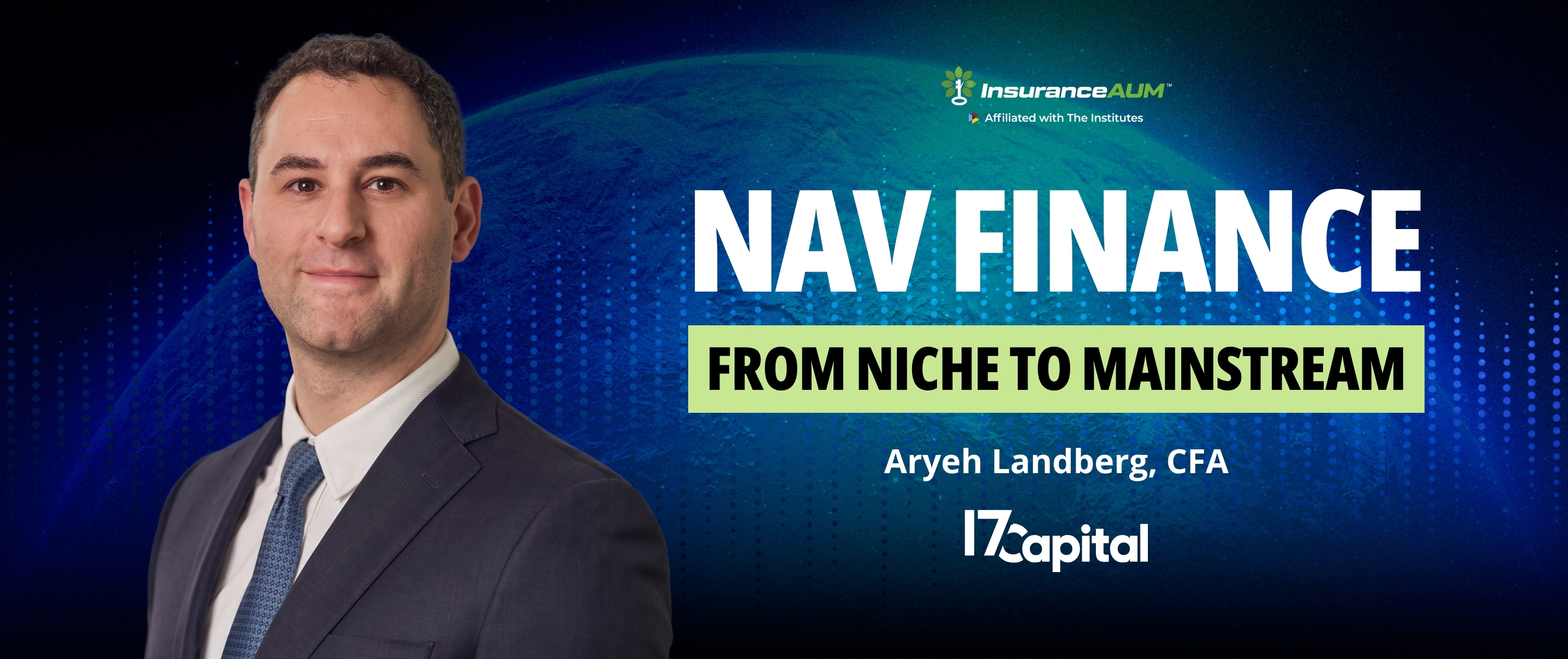
NAV Finance: From Niche to Mainstream

Image
IAUM_Podcast_17Capital-9.16.26_Web_2026


Stewart: I'm Stewart Foley. I'll be your host, and I'm glad you're with us today. Some of the most important innovations in institutional investing don't begin as headline stories. They begin as specialized tools used by relatively small groups of sophisticated investors. And over time, as those tools prove their value, they become accepted as best practices in mainstream asset classes. NAV finance, N.A.V., NAV finance, appears to be following that path, at least in my opinion. And what was once viewed as a niche solution for private equity sponsors is increasingly becoming an important component of portfolio management, capital allocation, liquidity management, and at the same time, insurance investors are beginning to recognize that NAV finance may offer a compelling combination of investment-grade characteristics, diversification, and capital efficiency along with attractive yields.

And the title of today's episode is NAV Finance: From Niche Tool to Core Allocation. And my guest today is Aryeh (Ari) Landsberg, Managing Director at 17Capital. Ari is responsible for sourcing, underwriting, and executing preferred equity and NAV loan facilities for private equity firms, funds, and institutional investors. Before joining 17Capital, he spent nearly 14 years at Barclays structuring fund finance transactions across private equity and alternative asset portfolios. Ari, you are a CFA charter holder. We share that. Welcome to the show.

Ari: Thanks so much, Stewart. Great to be here.

Stewart: It's great to have you. I mean, the way we always start them off is, where'd you grow up and what job would you most like to have, if not this one?

Ari: Well, the first part's easy. I grew up in Baltimore, Maryland. So that affords me, I think, a unique set of local sports teams to root for. I'm a Ravens and Orioles fan. In terms of dream job, it's essentially an impossible question for me to answer because I've been doing this for almost 20 years and the bulk of my adult life. So, it involves some imagination to think of what else I might do. If I could fabricate a skill set I don't have, and we chatted about this a bit, I'd probably, in a fantasy world, be a professional golfer.

Stewart: There you go.

Ari: But unfortunately, that's probably not in the cards at this stage. But what I find interesting about this job, and I think would need to be parallel in any other career pursuits, is the problem solving. There's a new challenge every day. Every situation we address is unique, and so it keeps everything challenging and different. And so, it's impossible to get bored and it's impossible to stop honing your technical skills. So, I enjoy it quite a bit and I haven't found anything that beats it yet.

Stewart: That's great. So, tell us a little bit about, for folks who don't know 17Capital, can you tell us a little bit about the firm and just sort of who you guys are?

Ari: Yeah, absolutely. So 17Capital's a specialty private credit manager, and we really focus on one, what we find interesting and unique segment of the market, which is NAV financing primarily to private equity firms. And so, what that means is we lend against diversified portfolios of mature private equity companies and the investment managers. And so, we have two solution sets for what we think is really a holistic set of capital needs that the largest private equity firms are really increasingly relying on. And so, what we're not doing is we're not lending to single companies, and we're not lending against LP commitments or subscription lines. We've been doing this for nearly 20 years now. The firm was launched in 2008, and so, we have a really substantial track record in doing this. Over 130 transactions, about 65 or so of which have fully exited. And so, it's a really unique proprietary track record of not just how to structure these transactions in an efficient way and how to deliver solutions for our clients, but what to look out for and areas I think that have evolved over time for us to focus on going forward with our new transaction opportunities.

Stewart: And so, a lot of times I think, and I get comments from our listeners saying, "Hey, I like it when you unpack stuff." And so, when we're talking, just back the lens out just a little bit, what exactly is NAV finance? I mean, from the basics, somebody's not familiar. And you guys are specialists at this, this is your world. Talk us through with the big crayons.

Ari: Yeah, absolutely. And I don't know if this is still a common exercise, but in kindergarten when you write what you're going to be when you grow up, probably very few kids choose NAV financing. Ironically, I think I chose I wanted to be a radiologist or something. So close second is what we do. And so, I think a bit of the mystery goes away in the name. NAV financing stands for net asset value. And so, what we're doing is we're lending against the value of a portfolio of private companies. And so, there's variations and different iterations of how investors buy and sell companies, but in a simple version, a private equity sponsor will raise a fund and they will deploy capital on a predictable schedule. And so, a standard fund, maybe 10 to 12 years, the first four or five years they'll deploy capital. The next few years, next three or four years, they'll start selling down, and then the last few years they'll sell their last couple of investments.

And that historically has been the life cycle of a private equity fund. And what we do is provide two core solutions. One, we will make loans to that fund for further investments in that portfolio. And so, some of those investments might be additional M&A activity for a specific portfolio company. And the way we'll underwrite that and get comfortable from a structural perspective is we will have support from that portfolio. And so, we'll look towards the entire portfolio to repay us. And so, there are elements of flexibility there because we're not tethering our repayment timing to a single company, and also the benefit of diversification, and we can discuss that further as well. And then on the other side, we're supporting the investment managers themselves. In a private equity firm, that's the general partnership, maybe an investment advisor, or in some cases it's family offices and other sophisticated investors, including insurance capital.

And that solution set's a bit different, but it's really getting at the same underlying need, which is further investment in their platform. And so, one of the dynamics we see in the broader market is a little bit lower liquidity than has historically been the case. It's a much broader topic, but there's been fewer exits in private equity. I think that's been well covered and is certainly a very topical financial story and driven by a lot of factors. But the investment managers themselves have the vast majority of their own personal capital and of their balance sheets invested in their own funds. And our GP solution, as we call it, helps support that continued investment as they raise new funds and as they continue to try and achieve the highest returns on their existing investments.

Stewart: That's super helpful. One of the things that caught my attention, and I sit at a fairly unique seat, my visibility is different than a lot. I'm kind of backstage passes on about 70 asset management firms and then somewhat a backstage pass with some insurance companies. And I get a chance to see trends, identify trends. And I kind of started here, like NAV finance has evolved fairly quickly. It wasn't that long ago that it was super specialized and now it seems like it's become more, and you alluded to this, more standard private equity toolkit. What is driving that change? You touched on a couple of things a moment ago, but is there more to it?

Ari: I would say if I were giving a bit of a history of the adoption of this as a tool in the toolkit for private equity managers, that you're right. I think it's existed in various forms going back a long time. And as I mentioned, I've been doing this for nearly 20 years. And there are groups that have provided this type of financing going back to 2006 through the financial crisis. And I think there's been multiple catalysts that have really supported the rapid adoption that we've seen over the last five or so years. Obviously, coming off the back of the financial crisis, which is a long time ago, and for your younger listeners probably is more of a history lesson than a learned experience. But the market for not just this type of financing, but the need for this type of financing was, I think, less potent in the 2010 to 2015 range.

It was more of a liquidity and LP solution, which is something that 17Capital has always been active in providing. What I think changed was the disruptions around COVID in 2020. There was a bit of a necessity to help find sources of capital and liquidity given the disruptions across not just labor force participation, changing dynamics there, but also supply chain disruption, customer access disruption. Think about retail stores being closed. Think about their warehouses that provided goods having labor shortage issues. And that list goes on and on. And I think where NAV came in and was an important part of that story was there were a number of businesses, not just on Main Street and in the sponsor community, but the large corporations that were on the brink of default, had facilities and credit obligations that they were not able to support, not just their monthly rents and mortgages, but loans they'd taken out for inventory and things as granular as that.

And so, NAV financing at a portfolio level really went to help shore up those companies that were most directly exposed using the overall diversification from those that weren't, such as software or online retail and things that were better prepared. So that I think was probably the biggest catalyst in the market, taking this from something that was very episodic and not well understood to the early stages of it being more of a mainstream solution. Next, I would say, and less impactful but helpful, was guidance put out by ILPA, which is the LP trade association for institutional investors, providing guidance on how to best use NAV. And I think there was an emerging trend that NAV was something that was happening and the LPs should be better educated about what it was and what to think about when analyzing the benefit. And so, that guidance, I think, codified best practices and put it really front and center for a lot of institutional allocators.

Lastly, I'd say the proof has been in the pudding. Firms that have done this and deployed it in their portfolios have performed better. And there's a number of reasons, but I'd say the primary ones would be the assets that they've helped support using NAV have had more flexible outcomes. They've not been forced sellers, and they've had more flexible and often cheaper capital. And so, that's really helped differentiate early adopters versus those who hadn't. And I think when managers are going out and raising new capital, they're considering that at the onset, building in, providing the flexibility that when the opportunity or need arises, they can deploy NAV financing as they would any other type of accretive financing for their portfolio. And so, with that abbreviated history, I think we've seen a massive expansion. And just to put some stats around it, the market's currently probably about $100 billion for NAV financing today.

And we've estimated that we think that market grows to probably close to $700 billion over the next decade. And inside of probably the next six or seven years, we'll see the bulk of that. There's a lot of capital lining up to help support that. And I think on the investor side, given the risk dynamics and the return profile and how capital efficient those investments can be, it's going to become, I think, not just mainstream, but a tool used by every suitable institutional investment manager with a private asset portfolio.

Stewart: And our audience, as you know, is insurance investment professionals. And risk is always the first question. You make it in basis points and you'll lose it in percentage points. Everybody in fixed income knows that. So, walk us through how you underwrite a NAV financing transaction and how that differs from lending directly to a single operating company.

Ari: So first, we're very fortunate in that the core focus of our product is based on diversification and it's based on seniority. And so, we're not lending against a single portfolio company, and so, we're not entirely reliant on repayment on the performance of any single company. Generally speaking, and again, I mentioned our large track record of transactions that we've not just deployed capital into, but that we've been repaid by. And so, we have a real unique insight into the historic cash flows in terms of what's likely to pay us back and what's not. And so, we're able to structure around that. An addition is seniority. And so, what that means is that we get repaid based on exits of those underlying companies, generally sales, but it can be other forms of liquidity. It can be minority exits, it can be restructurings, it can be recaps or dividends issued by portfolio company debt.

From an underwriting perspective, we're actually doing a lot of the same work that a direct lender would, that a bank would do in a syndicated corporate loan, which is very granular. It's fundamental valuation analysis. The benefit we have is we're not doing it just on one company, we're doing it on a portfolio. And historically across our private equity and portfolio financing solutions, we've been lending at low LTVs. So that's the loan-to-value ratio, and it's tended to be around 10% or 11% historically. And it's been against, with the support of, I should say, 10 to 11 portfolio companies. And so, what that allows us to do is maintain very low net leverage and very low risk compared to a diversified and generally well-performing portfolio. Additionally, we know what we're lending against on day one. We're lending to mature portfolios that are several years, if not fully, into their investment life.

And so, they have fully deployed capital or significantly deployed capital that we can look at and analyze each company. And we can do a granular fundamental analysis through multiple lenses, bottoms-up LBO valuation, top-down macro market comps valuation, cash flow analysis, and decide whether we like the performance and we like the risk profile on a company-by-company basis and then aggregate it up to the portfolio level. So that's how we underwrite. From a risk perspective, we are acutely focused on how things are performing on an ongoing basis. And we're monitoring them not just based on quarterly reporting marks, on intra-period trends that we see in the public markets, on live news that we're tracking with underlying portfolio debt. We're keenly aware of what's going on in the broader macro ecosystem, while at the same time knowing that we're very well protected from an equity cushion, which is the difference between our loan and how much the portfolio's worth.

Stewart: Ari, if you think about insurance companies, there's a lot of talk, and we've talked on this show lots and lots about underwriting discipline and underwriting methodology and whatever else. But what you're talking about, the monitoring, which is I would categorize as portfolio management. Yeah, you're protected on the downside, but you'd rather not get there. You'd rather have an early warning to say, "Hey, you guys need to be looking here. There's cracks in the foundation," which I think is a really good point, is that it's not just the buying of the instrument, it's the monitoring of it over time as well.

Ari: Yeah, I'm going to steal this line from one of our partners, but you don't learn much from funding a transaction. You learn everything from being repaid. And I think that's what's helpful given the number of full exits we've had. But we do maintain a watch list for each of our transactions. We do an initial robust underwriting, and then we essentially amend on period over period the updates. And so, given our granular initial underwriting, we're tracking on a company-by-company basis, not just how the value of the equity has performed, how the debt is trading, how the debt is behaving. Is it going up? Are they making their interest payments?

Have they refinanced and with whom? Have they executed on their business plan? Have their margins changed? And so, we're able to see on a company-by-company basis how they're doing. Now, your point is well taken. You could track these things and start to see cracks in the foundation, and then you have to analyze what are our remedies? Are we still comfortable? Are we still happy with the transaction? What are our structural protections in the document? And we think about all of that. We have the benefit of, I think, working with really top-tier sponsors who won't get everything right every time, but over time will find ways to support their best investments and salvage value in their worst ones. And so, what that's really meant is we have essentially a 0% loss ratio across our portfolio and fund NAV solutions. We call it our credit product suite, and nothing on our watch list.

Yeah. It's a great job if you can get it. But I think we're aware that the macro backdrop has been very favorable, and that won't always be the case. And so, I'm going to steal your word. There needs to be a focus on consistently adhering to your own rules. And so, we have to maintain that discipline from an allocation perspective, not stretch from our initial risk parameters, and make sure that the toggles that help us get repaid are always there. And so, I think what really helps us in that regard is that we're at the top of the market. We're working with larger managers who have significant franchise interests and have a massive obligation to deliver for their investors. And then we benefit from being senior from a repayment perspective.

Stewart: You guys, we mentioned the growth of the asset class, your firm has grown significantly. And sometimes investors, that raises the hair on the back of the neck of some investors. Can you talk a little bit about the growth of 17Capital and how the evolution of NAV finance, has it changed the kind of people that you're seeing that want to join your team? Or is it the same MO of folks who have been in this business for a minute?

Ari: It's a great point. From a talent retention and attraction perspective, it's been very helpful. I think we recruit very heavily, I think, from the strongest institutions across investment banking, across asset management, from the private equity sponsor community, and from reformed fund finance folks like myself. So, our growth from an asset perspective has definitely helped. What we're doing on the investment side is essentially servicing larger and larger private equity managers. And to give maybe a bit of context to that, we've worked with more than half of the publicly listed private equity and alternative management platforms across the space. And so, when we're speaking to on the junior side, when we're looking for analysts and associates, we're pulling from top-tier investment banks, from their financial sponsors groups, from their sector-specific groups, and we're relying on their underwriting ability from a sell-side advisory perspective. We're also pulling from advisory places that have worked on secondaries transactions and have connectivity with the investor bases there.

And so, it's been massively helpful. Additionally, we have a really great culture, and I think that that's a huge benefit. It's extremely collaborative. As I mentioned, I'm a reformed banker at heart. I was never an investment banker, but I spent a lot of years in huge multinational corporate banks. And it's very different at a smaller firm. Despite our size, we're pretty lean. And in that, the rewards are not personal, they're team-based. And so, we have a universal approval rating for folks who no longer feel like they have to fight for their own dinner because if someone hunts and brings back dinner, we all eat. And so, it's been great from my perspective, and I am an evangelist for the benefits of a team environment that actually works with shared upside, shared benefit, and true collaboration. And so, that's been a huge tailwind as we bring on these young analysts and associates coming out of, I think, a more complex political corporate environment.

Stewart: That's very well put and exceptionally diplomatic. So, let's finish with the big picture here. So private credit has grown at an extraordinary pace. And what I'm hoping you'll do, Ari, is dust off your crystal ball over there at 17Capital and tell us where you think NAV finance is five years from now and what this market looks like. I mean, without putting words in your mouth, this is becoming much more mainstream, this asset class. And as you know, history will tell you that being early in something like that is helpful. It tends to be the more folks in the trade, the skinnier the margins get. So where do you think this is going five years from now?

Ari: Yeah, there's an interesting element. I think given our scale, we're able to provide scaled solutions, which is a non-intuitive way of saying there are actually fewer folks out there that can execute a large transaction at the speed and with the certainty that we can. So, there is a bit of a buffer from full spread compression that I think we're thankful to have. But you're right, I think the adoption, and we as a firm think that the continued adoption from across the sponsor universe is going to continue. I'll steal this factoid from Fitch, but the size of private credit itself is expected to essentially double over the next four or five years. And I think that that growth rate will be even quicker for NAV financing. And part of the reason is the liquidity backdrop. Counterintuitively, the fact that, and this is an empirical observation, but it's backed up by the facts of current private equity portfolios, is the holding times have gone up.

Values have continued to increase. So, there's a ton of—

Stewart: Can I ask a question? Hang on a minute. Yeah, please. Can I ask a question? Holding period getting longer. I think you mean that private equity firms are holding portfolio companies longer. That's right. Is that right? Okay, go ahead.

Ari: That's right. And I'm going to steal this line from, or I'm going to steal this concept from Bain, who essentially said 12 is the new five. And what that means is if your target as a private equity firm is to make two and a half times your initial investment over a five-year holding period, which has historically been a fairly reasonable target, where previously you might have needed a 5% EBITDA growth or bottom-line earnings growth maybe 10 years ago, given the liquidity environment, given the cost of capital, and given growth expectations, that number is now 12% just to reach the same return. And that's because there's higher borrowing costs, less availability of leverage, and values are higher. So, you've bought at a higher price than you would've 10 years ago. So, in order to get to that same return, you have to grow faster or you have to hold longer and grow for longer.

And so, that's putting pressure, I think, on the cadence and on the velocity of exits. Private equity firms are holding their strong performers longer than they initially underwrote. And in order, I think, to justify the exit assumptions that their investors expect, which they view as quite reasonable, they're investing additional capital. And NAV financing in a way goes to support that through add-on M&A, through talent acquisition, through strategic refinancing if your capital structure is expensive in a number of ways. And so, from a macro perspective, the longer that hold period for the private equity firm, the less liquidity back to their LPs. And this is what I mentioned as counterintuitive. What we're actually not seeing is requests to accelerate those distributions. So, we're not seeing private equity folks borrow to then make a distribution. What we're seeing, and I think LPs are supportive of this, is continued investment to optimize and maximize the exit values. And so, further investments, a very common use case is platform expansion or roll-ups where you'll buy lower multiple companies folded into a more efficient, larger platform. The more you do that, the higher multiple you can demand, and the larger the enterprise value.

And so, we've been very active supporting those investment strategies. So, I think that that's an important tailwind. Prognosticators from investment banks and advisors think that we're at that fulcrum and IPOs are picking up and the exit pipeline is building. I think we've seen signs of that, but there's a lot of volatility in the world across a number of shocks, tariffs, Middle East, and all of that taps the brakes a bit on potential buyers. And so, while there'll always be some sort of market volatility or macro or political volatility in the world, this is an all-market product. We're accretive when values are low; we're accretive when values are high, and when there's a backdrop of uncertainty. And I think that that adoption amongst the blue-chip managers is very likely to continue and increase.

Stewart: Yeah, super helpful. Thank you. It's been a great education on NAV finance, and I've got a couple fun ones for you on the way out the door. We talked about growth and adding new members of your team. What characteristics do you look for when you're adding, and it's not the major or the skill set or the school, but what characteristics are important or have you found over your career that make good careers in this business?

Ari: I think there is a soft analysis needed in that it's culture, it's fit. If you're working long hours, it's a lot easier to be collaborative with someone who you get along with regardless of how strong their Excel skills are. Now that said, I think there's a baseline for technical competency that we'll—

Stewart: Sure.

Ari: We'll take for granted, but it's a curiosity. Are they driven to want to continue to learn something new? And it's rare to find someone young coming into their career that has the experience in the topics we've discussed. So, it's an expertise that takes years to build. You have someone that's intellectually curious, that's driven, that wants to acquire skills across a number of different applications and that isn't afraid to be vocal. We celebrate and demand people raise their hand if they see something that they're uncomfortable with. And so, a lack of conformity, I think, to mainstream perceptions. In addition, I say this myself as, was I approaching dinosaur, being able to adapt to the new universe of accessible tools, AI and all the platforms that can aggregate and access information and really streamline workflows. I know that sounds cheesy, but the way we put together marketing decks and investor presentations is different now than it was even two years ago or less.

And so, that's something that though I'm an imperfect arbiter of those skills, I think is very important because that's where young folks are really going to prove themselves valuable in an ecosystem, is not producing grunt work, but being the efficient, tech-savvy contributor to assembling things, to getting information quickly, to championing AI as a productivity booster. So again, I feign ignorance a lot. It's not necessarily feigning. I have some ignorance on that point, but it's an important metric that we now look at and make sure that they're able to use and deploy efficiently.

Stewart: Yeah, it's interesting. Younger folks are often discouraged at the university and college level, but I don't understand why. To me, AI is here, it's here to stay, and it's a matter of using it to increase your productivity. It's not that this thing is going to take over your job, but I can use Gamma and build a PowerPoint deck in two minutes that would've taken me a week to do, and it wouldn't look as good. And that's the kind of thing that I'm adding no value, moving little boxes of text around a PowerPoint. What's on it, there I can add value. And so, there's a lot of things like that that I think make a ton of sense. And so, I'm happy to hear you say that. Last question, it's a fun one. You can have dinner with up to three people. Dinner's on us. I've never gotten permission for that, but I always just say it.

Dinner's on us. Who is coming to dinner with you, Ari, alive or dead? You can have. Oh, hell, there's other things. One, two, or three guests. You don't have to have all three. Could be one, two, but the three is the max. Who's coming to dinner with you?

Ari: I'm going to simplify it and keep it with people who are alive. What are we having? Is it my choice?

Stewart: Absolutely. Okay. I've never been asked that before, by the way. Nobody's ever asked in 400 podcasts, what's for dinner? I have no idea. We can make it whatever you want. You pick the restaurant.

Ari: All right. We're having pizza. Everybody loves pizza. Nice.

I'm going to make this entirely selfish then and pick people who I find immensely interesting, and then I'm going to add hopefully no content and just be a voyeur. But I'm going to invite Martin Scorsese, because he's my favorite director. I'm going to invite Wright Thompson, who's one of my favorite authors and a fantastic profiler of athletes and other interesting topics, and also a lover of Southern cuisine and has a great show on ESPN about the South. And then I'm going to invite, and he'll probably turn me down, Larry David, who did a wonderful bit on Curb Your Enthusiasm about the pivotal role of the center guest at a dinner table and their role in mediating. So, he wouldn't come, but if he would, he could kind of moderate the dinner.

Stewart: I love it. That's great. What a great education on NAV finance. I really appreciate you being on, Ari. Thanks for taking the time.

Ari: Thanks so much, Stewart. This was great, and I appreciate it, and happy to talk whenever you have time.

Stewart: I appreciate that very much. We've been joined today by Ari Landsberg, Managing Director at 17Capital. If you like what we're doing, please rate us, review us on Apple Podcasts, Spotify, or wherever you listen to your favorite shows. You can also see us and watch us on our YouTube channel at InsuranceAUM Community. My name's Stewart Foley. This is the Home of the World's Smartest Money at InsuranceAUM.com.

Share this post

Sign Up Now for Full Access to Articles and Podcasts!

Unlock full access to our vast content library by registering as an institutional investor

Register

Contacts


Image
17Capital-Burgundy-Black-RGB-Large

Founded in 2008, 17Capital is a private credit manager specializing in NAV finance for the private equity industry, operating primarily from London and New York.

17Capital specializes in providing non-dilutive capital to established private equity management companies, funds and institutional investors as part of a toolkit for value creation and portfolio management.

At 17Capital, we address the growing NAV finance market through two core platforms: Credit and Strategic Lending. Our Credit platform provides NAV loans to buyout funds, while Strategic Lending offers flexible, non-dilutive capital solutions to private equity management companies.

Since inception, 17Capital has raised $24 billion across eight successive funds and mandates, completed 135 investments and 65 exits. 

*Figures as of March 2026 and include fund commitments, SMAs and co-investments.

Tyler Dziama, 
Director, Investor Relations
Dziama@17capital.com

17Capital
452 Fifth Avenue, 
29th Floor,
New York, NY 10018


View The Contributor Page

Sign Up Now for Full Access to Articles and Podcasts!

Unlock full access to our vast content library by registering as an institutional investor .

Create an account

Already have an account ? Sign in

Ѐ Ё Ђ Ѓ Є Ѕ І Ї Ј Љ Њ Ћ Ќ Ѝ Ў Џ А Б В Г Д Е Ж З И Й К Л М Н О П Р С ΄ ΅ Ά · Έ Ή Ί Ό Ύ Ώ ΐ Α Β Γ Δ Ε Ζ Η Θ Ι Κ Λ Μ Ν Ξ Ο Π Ρ Ё Ђ Ѓ Є Ѕ І Ї Ј Љ Њ Ћ Ќ Ў Џ А Б В Г Д Е Ж З И Й К Л М Н О П Р С Т У Ф Х Ц Ч Ш Ā ā Ă ă Ą ą Ć ć Ĉ ĉ Ċ ċ Č č Ď ď Đ đ Ē ē Ĕ ĕ Ė fi fl œ æ ß