

Manulife Investment Management -

Opportunistic Credit in an Evolving Market: How Structural Dislocations and Market Inefficiencies Can Create Attractive Entry Points for Active Managers

Curved pink concrete structure framing a clear blue sky.

Charles Asfour, Partner | Tom Goila, Partner and Head of Originations | Derek Gould, Managing Director


Opportunistic credit is gaining relevance as higher rates, uncertainty, and tighter capital strain middle-market balance sheets. Refinancing maturities and longer PE hold periods are expanding complex, bespoke financing needs—creating attractive entry points for active managers with restructuring and structuring expertise.


Complexity is driving demand for flexible capital

At a high level, opportunistic credit is most effective in environments where complexity limits access to traditional financing. Today, that complexity is driven by a convergence of pressures on businesses, particularly in the middle market.

While opportunistic credit strategies aren't dependent on periods of dislocation, the current backdrop – marked by higher interest rates, persistent cost pressures, elevated macroeconomic uncertainty, and more selective capital markets – has increased the frequency and scale of situations requiring flexible, solutions-oriented capital.

Many companies are navigating a mix of challenges, including elevated debt service costs, margin pressure, trade-related disruptions, and earnings volatility. As a result, a growing number of businesses are operating with capital structures misaligned with their current performance.

In these situations, traditional lenders and equity providers are often less willing – or less able – to provide incremental capital, leaving a gap that requires more tailored financing solutions.

Against this backdrop, several structural dynamics are shaping the opportunity set for opportunistic credit:

 
Capital structure strain

A meaningful segment of the middle market is underperforming relative to its initial underwriting expectations, resulting in higher leverage and reduced financial flexibility. Though not necessarily distressed, these companies often need proactive balance sheet solutions to stabilize operations, fund growth initiatives, and reposition capital structures in anticipation of longer-than-expected hold periods.

One indicator of rising stress is the growing use of payment-in-kind (PIK) features. PIK allows borrowers to preserve near-term liquidity by paying interest with additional debt – accruing it to the loan principal – rather than in cash, with repayment deferred until maturity. The rise in PIK usage – from 7% of private credit deals in Q4 2021 to 11% in Q4 20251 – suggests that, in many cases, capital structures are being extended rather than fundamentally addressed.

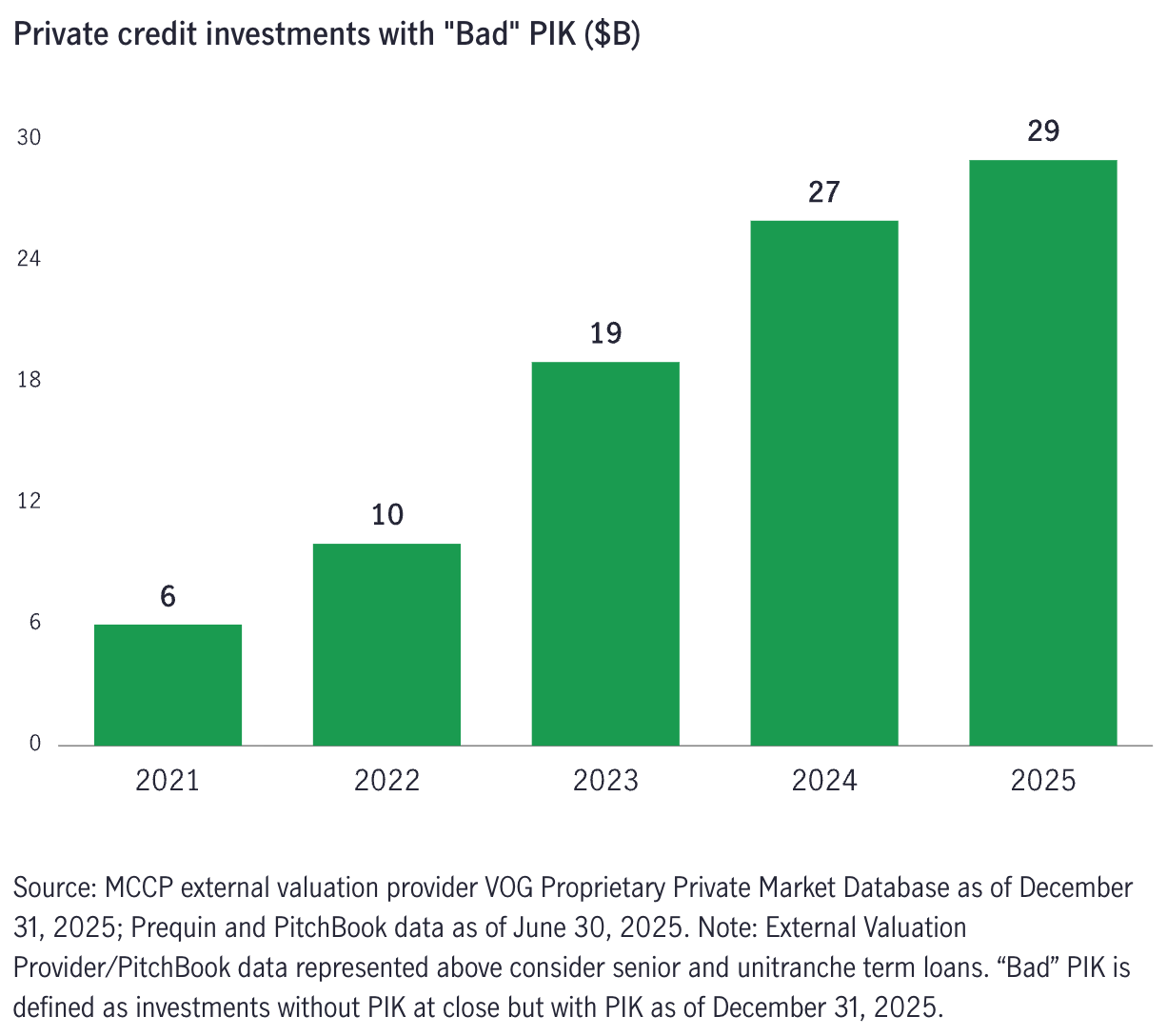
Crucially, not all PIK is created equal. “Good” PIK is deliberately incorporated into a deal from the outset. “Bad” PIK is introduced later as a reactive adjustment, typically through amendments to a loan agreement when a borrower faces cash flow constraints. To put it another way, "Bad" PIK was never supposed to be PIK. The share of private credit deals with "Bad” PIK rose from 2.5% in Q4 2021 to 6.4% in Q4 2025.1

The rise in PIK usage – particularly “Bad” PIK, an estimated $29 billion market – suggests a significant increase in opportunities for opportunistic credit investors. With flexible investment mandates, restructuring expertise, and a tolerance for complexity, managers can provide structured capital better aligned with a company’s current performance, often securing enhanced economics, stronger protections, and greater control.

Bar chart showing private credit investments with bad PIK increasing from 2021 through 2025


An approaching refinancing wave

Many businesses now operate and finance in a different environment than the one in which their debt was originally underwritten.

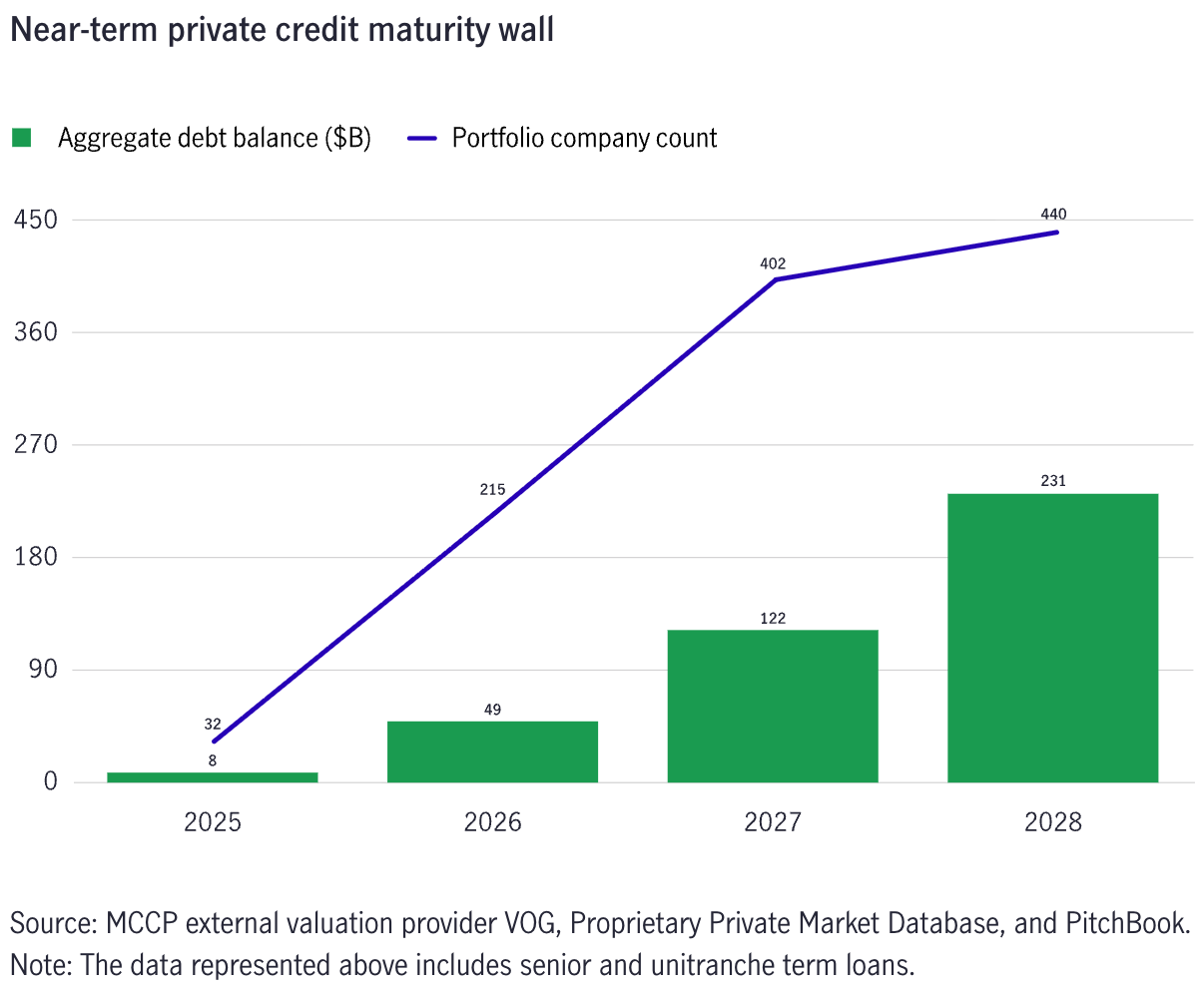
The 2021–2022 period saw a peak in private equity activity, marked by elevated purchase price multiples and increased leverage. A substantial volume of debt issued during this period is now approaching maturity, with most scheduled to come due between 2027 and 2029. Given the leverage profile of many of these loans, it is unlikely that much of this debt will be easily refinanced with traditional direct lending solutions.

The chart below shows the volume of outstanding private credit loans coming due over the next three years. This is creating a growing pipeline of complex refinancing needs, including amend-and-extend transactions, incremental capital infusions, liability management exercises, and structured recapitalizations. These scenarios often fall outside the scope of traditional lending but are well suited to opportunistic credit strategies that can underwrite downside risk and provide creative, tailored capital.

Bar chart showing the volume of outstanding private credit loans approaching maturity

 
Private equity portfolio pressures and extended hold periods

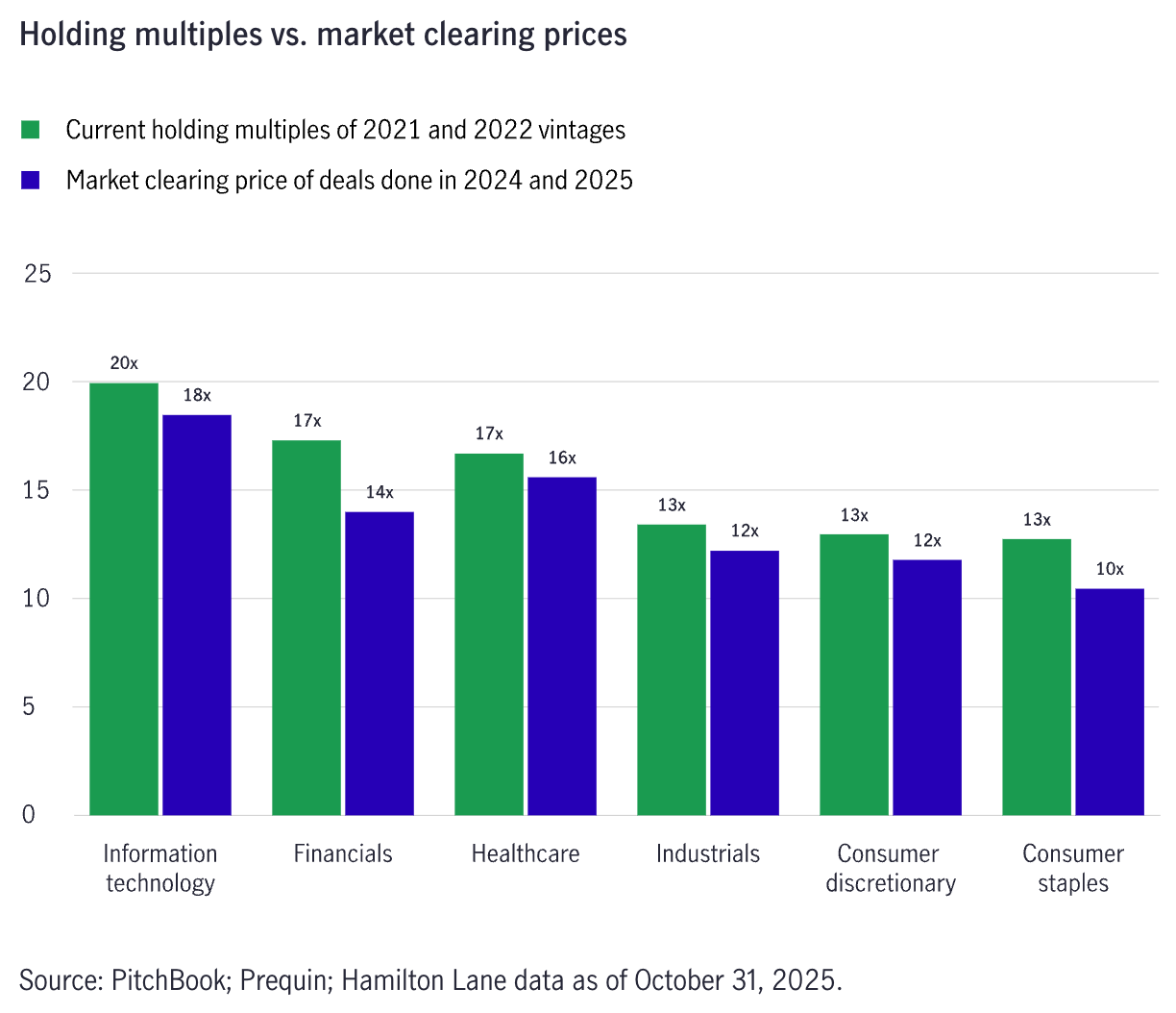
Valuation pressure on privately held companies has slowed exit activity and extended hold periods for private equity-backed companies. Assets held by private equity sponsors at higher valuations are, in many cases, not yet able to exit at those levels, resulting in delayed realizations.

The sector-wide gap from 2021 to 2025 is shown in the chart below. Over that time, the average hold length for private equity-backed investments increased from 5.3 to 6.4 years.2 While extending hold periods can be a rational response, it creates an ongoing need for capital to fund growth initiatives, acquisitions, and operational improvements.

Sponsors must balance supporting portfolio companies with managing fund-level liquidity and return objectives. This dynamic creates a natural role for opportunistic credit, which can provide structured capital solutions that extend runways, support value creation, and help companies reach a more favorable exit environment, while offering investors downside protection and selective upside participation.

Chart comparing private equity holding multiples with market clearing prices across sectors


Persistent need for complex, solutions-oriented capital

Beyond cyclical factors, a more durable driver of opportunity is the ongoing need for capital providers capable of addressing complex, nonstandard situations. Many of the most compelling investments arise not from distress, but from companies at inflection points – where capital requirements don't fit neatly into traditional debt or equity frameworks.

These situations may involve complex capital structures, competing stakeholder interests, covenant constraints, or strategic transitions such as acquisitions, carve-outs, or repositioning initiatives. Addressing these challenges requires investors who can underwrite both credit risk and enterprise value and structure solutions that balance protection, flexibility, and alignment.

Opportunistic credit strategies are well suited to this role. By combining elements of debt and equity—through preferred instruments, convertible structures, or bespoke tranches – investors can tailor capital to the specific needs of each situation. The focus isn't only on providing capital but on structuring it to support long-term value while maintaining strong contractual safeguards.

 
Opportunistic credit opportunities sustained beyond today’s cycle

The current environment underscores the relevance of opportunistic credit but doesn't define it. Although market conditions have broadened the opportunity set, the underlying drivers – complexity, capital constraints, and the need for flexible solutions – are structural and enduring.

For investors, this translates into a broad and evolving pipeline of opportunities, spanning balance sheet optimization, growth financing, and strategic repositioning. The ability to navigate these situations selectively and to structure capital accordingly remains central to outcomes.

Discover our bespoke opportunistic capital financing solutions.


READ MORE FROM MANULIFE INVESTMENT MANAGEMENT


1 MCCP external valuation provider VOG Proprietary Private Market Database as of December 31, 2025. 2 PitchBook; Preqin; Hamilton Lane data as of October 31, 2025.

Important disclosures

This material was prepared solely for informational purposes, does not constitute a recommendation, professional advice, an offer or invitation by or on behalf of Manulife Wealth and Asset Management (“Manulife WAM”), Manulife | Comvest Credit Partners, or its affiliates, to any person to buy or sell any security or adopt any investment strategy, and is no indication of trading intent in any fund or account managed by Manulife WAM or its affiliates. No investment strategy or risk management technique can guarantee returns or eliminate risk in any market environment.

The information in this material may contain projections or other forward-looking statements regarding future events and is only current as of the date indicated. Information concerning financial market trends is based on current market conditions, which will fluctuate and may be superseded by subsequent market events or for other reasons.

This material has not been reviewed by, is not registered with any securities or other regulatory authority, and may, where appropriate, be distributed by Manulife Wealth and Asset Management and its subsidiaries and affiliates, which includes the Manulife John Hancock Investments brand.

5382856

Share this post

Sign Up Now for Full Access to Articles and Podcasts!

Unlock full access to our vast content library by registering as an institutional investor

Register

Contacts


Image
Manulife Logo 6.5.24


Manulife Investment Management is the global wealth and asset management segment of Manulife Financial Corporation. We draw on more than a century of financial stewardship and the full resources of our parent company to serve individuals, institutions, and retirement plan members worldwide. Headquartered in Toronto and Boston, our leading capabilities in public and private markets are strengthened by an investment footprint that spans 19 countries and territories. Our private markets strategies include private equity and credit, real estate, infrastructure, timber, and agriculture. Responsible stewardship is integral to our business and culture, and we seek to be a global leader in creating long-term, sustainable, value for our stakeholders.
 

Amy Theuninck
Managing Director, Insurance Solutions
atheuninck@manulife.com
857-328-6425
 

197 Clarendon St, Boston, MA 02116
United States
 

View the contributor page

Sign Up Now for Full Access to Articles and Podcasts!

Unlock full access to our vast content library by registering as an institutional investor .

Create an account

Already have an account ? Sign in

Ѐ Ё Ђ Ѓ Є Ѕ І Ї Ј Љ Њ Ћ Ќ Ѝ Ў Џ А Б В Г Д Е Ж З И Й К Л М Н О П Р С ΄ ΅ Ά · Έ Ή Ί Ό Ύ Ώ ΐ Α Β Γ Δ Ε Ζ Η Θ Ι Κ Λ Μ Ν Ξ Ο Π Ρ Ё Ђ Ѓ Є Ѕ І Ї Ј Љ Њ Ћ Ќ Ў Џ А Б В Г Д Е Ж З И Й К Л М Н О П Р С Т У Ф Х Ц Ч Ш Ā ā Ă ă Ą ą Ć ć Ĉ ĉ Ċ ċ Č č Ď ď Đ đ Ē ē Ĕ ĕ Ė fi fl œ æ ß