





General Atlantic-

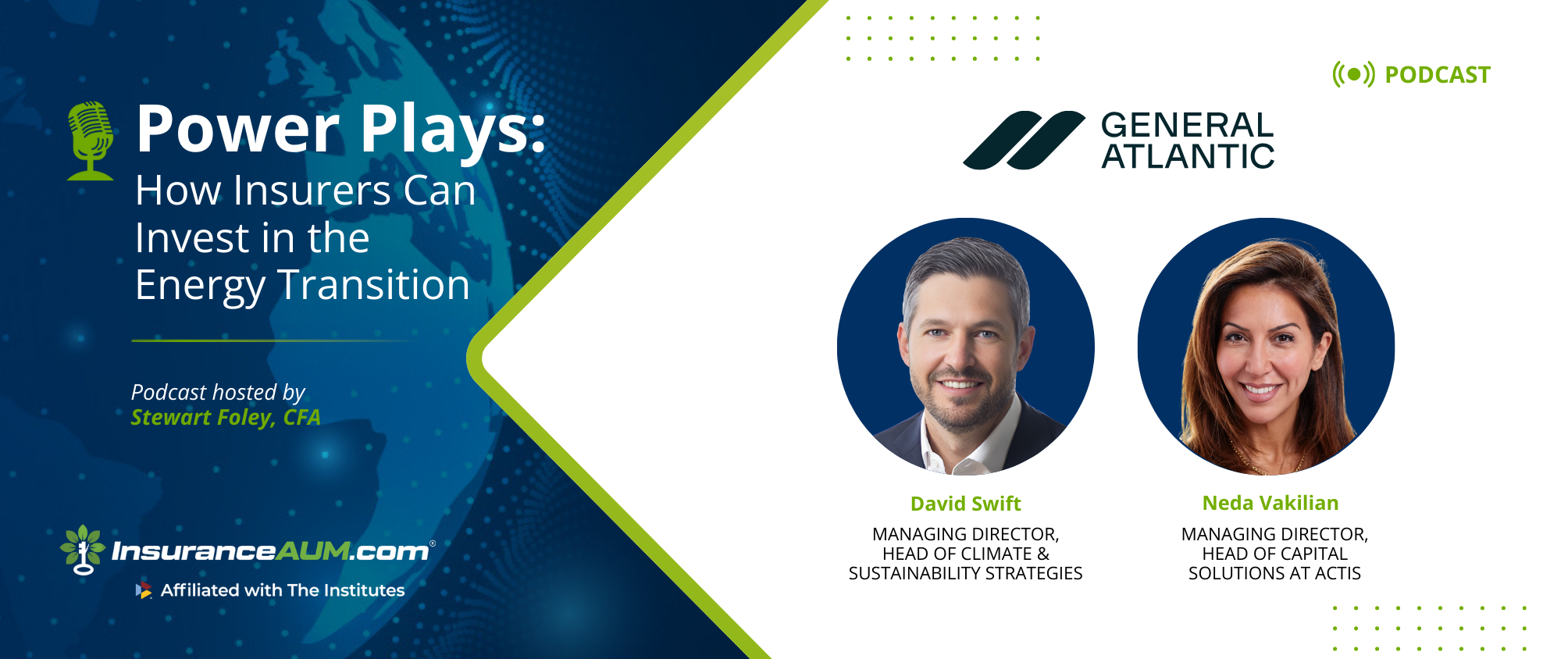
Power Plays: How Insurers Can Invest in the Energy Transition

Image
General Atlantic Podcast header


Stewart: Welcome to another edition of the InsuranceAUM.com podcast. My name's Stewart Foley. I'll be your host. And now on to today's podcast. We're going to discuss a topic that's becoming increasingly relevant for insurance investors, but is still under allocated and often misunderstood. The opportunity for insurers and growth equity tied to energy transition and enabling infrastructure. Insurers have long participated in this space through infrastructure debt and project finance, but there is a growing universe of capital efficient, scalable businesses and essential service platforms that sit outside traditional credit and may offer compelling risk-adjusted return potential when approached with the right discipline. And I'm joined today by Neda Vakilian, Managing Director and Head of Capital Solutions at Actis and David Swift, Managing Director and Head of Climate and Sustainable Strategies at General Atlantic . Together, they bring deep experience across global markets, infrastructure, sustainability, and long-term capital formation. Neda, David, welcome to the show. We're thrilled to have you.

Neda: Thank you. Thank you for having us. It's lovely to be on.

David: Thanks, Stewart. We're really excited to be here.

Stewart: Thank you so much. I'm thrilled to have you. We started off always the same. A little bit of difference lately, but here we go. Neda, of you first, where'd you grow up? What was your high school mascot? And if you weren't doing this job, what job would you most like to have instead?

Neda: I'm so excited that you asked me these questions, Stewart. So I'll start with where I've grown up. I've grown up in London, which is home of Big Ben, of Buckingham Palace, Hyde Park, the Beatles, which is what I'm very proud of. In terms of school mascots, we don't really do mascots very well in the UK, apart from probably in sport, which I'm not very good at knowing about. David is, I'm sure, covering that. But I love a mascot. So I'm going to pretend that my school mascot was a posh, sarcastic, British pigeon with a side eye, a daunty scarf, and a pipe. And the job that I most wish that I had if I wasn't doing this one is that I wish I was an astronaut. And you'll learn through the podcast, I think, I hope, Stewart, that being an astronaut, much to your surprise, is not so different than being an infrastructure investor because there's zero tolerance for risk. We're scientific about all the assumptions that we make. We're obsessive about checklists. There's no room for redundancy. So lots to talk about, but thank you for asking.

Stewart: Very nice. David, how about you? Where'd you grow up? High school mascot, and what job would you most like to have, if not this one?

David: So I grew up in the suburbs of Atlanta, Marietta, Georgia. Our high school mascot was the Blue Devil. We had a terrific football team. As Neda mentioned, I'm a big sports fan, which I'm sure will come up on this podcast. And if I wasn't working at General Atlantic and focused on energy transition, I would hope to be a fly-fishing guide, very passionate about fly fishing, love to be on the river. And I can't translate that back to how that applies to energy transition investing like Neda did, which is something that I one day hope to be doing as a profession.

Stewart: I hired a fly-fishing guide once and it was like, I mean, it would've made an amazing comedy reel, but against all odds, and I mean all odds. I mean, the guide was so frustrated. I ended up catching some massive trout that changed his attitude toward me in an instant and suddenly he had something to go talk about like, "Hey, I'm a guy that caught that fish." It's like, okay. It's just good stuff. I love that icebreaker. I mean, it gives a sense of kind of how you think outside of the world of investing. And so, I'd love to just kind of start with the big picture here. And if you would, David, if you could give us a quick overview of General Atlantic, and then I want to get into really my first question.

David: Sure. So General Atlantic is a global alternatives asset manager. We manage over $100 billion, $118 billion to be precise, focused on a growth equity, climate solutions that we're going to talk about today in the energy transition, credit and sustainable infrastructure Actis that Neda and I are going to talk about on this podcast. So those are the four strategies that we have at the firm. The history of the firm I think is very unique. It was actually started by a man named Chuck Feeney. Chuck was an entrepreneur at heart. He started the duty-free business that you see in the airports all over the globe. And he really was a very unique entrepreneur in being able to grow a global business. And the reason he started General Atlantic is to effectively find capital partners for other entrepreneurs in that growth equity stage. GA is credited by many in the industry with pioneering the growth equity asset class, the phase of growth that happens after the venture investment and before a traditional private equity buyer would come into the business.

And Chuck really was just looking to be a capital provider to entrepreneurs like himself. When he was building that business, he didn't have a true growth equity provider that would partner alongside him. And so he wanted to fill that gap and he slowly built this business over the course of time and was able to really pioneer that asset class, which I think is very unique. And it's very ingrained in the DNA and the culture of General Atlantic today. We're very focused on partnering with our entrepreneurs and unique businesses and growing those businesses and getting them to scale. So I think it's a really unique culture and background to a firm.

Stewart: Yeah, I can relate to the difficulties in finding capital as an entrepreneur, and it's real. It's just a really cool story. It's touching to me because I've kind of been there, so it resonates. You've identified a set of structural forces accelerating the energy transition, electrification, digitalization, energy security, efficiency, resilience, and the need to build baseline infrastructure, particularly in growth markets. My question is, how have these forces combined to create a durable long-term investment opportunity that you believe is relevant for insurance capital?

David: We divide the world into two parts. So I'll talk about what we do on the growth equity side with the beyond net zero strategy that I work with, and then turn it over to Neda to talk about Actis and what they're doing in infrastructure. But beyond net zero, our strategy is really focused on asset light or capital efficient technologies that are proven. So they've made it past the venture stage, and they are ready to scale and be deployed into this really large opportunity set around the energy transition. You highlighted those four really driving forces that we see that are presenting the opportunity set for us. Energy security is a huge deal for nations. We're seeing movement geopolitically even early this year as different countries evolve and pursue more secure sources of energy. They don't want to rely on importing energy. They want to be able to produce power themselves.

That's going to drive the AI revolution that's taking place and sort of the technology arms race that many countries are going after today. And you combine that with electrification, which is the need for power supply for artificial intelligence, but also powering all the things that we plug in every day. Peak power supply in the US or peak power usage used to be midday when everybody had their air conditioning on. And today it's closer to 6:00 or 7:00 PM when everybody comes home and plugs in their devices. And so you're seeing this non-linear demand in electricity taking place at the same time that everybody's moving around for energy security. And then on the opposite side of that, you look for different efficiencies in different ways to apply technology to make things more efficient, whether it's energy efficiency or material usage, and then resilience. We're seeing continued disruption as we strain the grid. We're seeing rolling blackouts. In some cases, we've seen where I live in California, a wildfires result in grid strain. And so you have all these different forces moving around to combine for a really unique investment opportunity set driven by the AI revolution and electrification and this need for energy security going forward.

Stewart: It is interesting when you compare the energy needs for what I assume is a lot of AI to the air conditioning load is astonishing. I've always heard about the need for power and blah, blah, blah. But when you put it in those terms, that's really interesting. So Neda, to you, and I think it's helpful, right?  Can you tell us a little bit about Actis and how you fit together with General Atlantic? And then talk about how insurers have traditionally have typically accessed this market through debt and project finance. How is that different today? And talk about the role of equity strategies that can compliment their existing allocations.

Neda: That's a really well phrased and important question, Stewart. Thank you. Okay. So Actis being part of the General Atlantic family is a wonderful fit for all the reasons that David outlined in that we're following the same tailwinds as David is, which I'll come onto towards the end of my answer. But what Actis does is we invest into critical, defensive, essential infrastructure, sort of baseline infrastructure. We power people's homes, we connect them to the grid and to the internet. We're building from the ground up. And as a result of that, these investments are as defensive as you could possibly imagine. While they are equity investments, to your point, Stewart, they are as adjacent rubbing shoulders with project finance in many ways. Now, we're a firm that's been around for many decades, but 20 years as Actis, now Actis is part of the General Atlantic family, and we've been doing growth markets infrastructure, and that's really important to our business model.

And the reason we do growth markets infrastructure is because it is where there is only a third of the capital chasing two thirds of the global opportunity set. Now, that's an incredibly interesting entry point because the best way to make attractive returns, of course, is to buy well, and that's our first principle, is to buy well. And when you combine that with an incredibly defensive investment strategy, you realize that that's actually something that's reasonably compelling. I'd like to think to the insurance listeners of your podcast. Now, to the question around perhaps even touching a bit on your question to David, we've got in our markets, industrialization, urbanization, electrification, digitization, right? They're all accelerating at the same time, all creating this demand, this need for baseline power, baseline infrastructure, the need for data centers that service cloud rather than the AI.

We're not even there yet, right? People need to be able to operate their mobile phones and connect to the internet. That's the stage that a lot of these markets are at. And the need to build this baseline infrastructure means that you're building things that don't yet exist. You're not displacing already existing energy systems, you're creating new ones. And when there's immediate access to uninterrupted electricity, guess what, Stewart? It's not going anywhere. So that's the point of defensive critical infrastructure, right? That's the point of thinking, okay, if I'm an insurance company and I want to invest into infrastructure that generates an alpha return. You can do it one of two ways. One way is to invest into our markets and do baseline infrastructure, and the other is to invest into North America or Europe and take more asset level risk.

Like a lot of people will say that the collection and distribution of cooking oil is infrastructure or fish farms are infrastructure. That's everyone's perspective, that's value add infrastructure too, but ours is very, very low risk core infrastructure in our markets. And as a result of that, everything that we invest into isn't cyclical, Stewart. That's really important, I think, hopefully for your insurance listeners is to say that it's non-cyclical, which again, builds a further defensiveness and resilience to the investment proposition. And if you compare it to project finance, if you compare it to debt-like investments, the great thing is when you're an equity control investor, there's lots of the room for the upside, but you're still actually capitalizing on the long-term long-dated cash flows, the stable regulatory environments, and you're investing into countries that we invest into where foreign direct investment has been proven to have been safe and well-received, and there's a track record for it.

Stewart: Yeah, it's interesting. I'll throw out one little tidbit. I was at the ... This is many years ago, I was at the bar the Four Seasons in Chicago, and the gentleman that sold net jets to Buffett said to me, "Well bought is half sold." And I thought, "Man, that's a pearl I'm taking with me forever." Very well done. So okay, you've talked about parts of this market as structurally undercapitalized, especially growth equity businesses that are commercially proven, but too small or specialized for traditional buyout capital. And the infrastructure equity and growth markets is where the demand has risen the fastest. What makes these segments particularly compelling from a supply and demand perspective, which is, I think we'd agree, is really the driver of investment performance.

David: A great question. I think for the markets that we focus on with the beyond net zero strategy at General Atlantic, which are predominantly the US and Europe, so North America and Europe, we've seen a tremendous amount of investment go into this space to develop new technologies from the venture community over the last five years. And so you've seen the capital flow in and some of these startups and these new technologies develop and mature into proven economically viable businesses that are ready for scale. On the opposite side of that, in the developed markets, North America and Europe, you've seen quite a bit of capital move into the infrastructure space as well to address some of that supply demand need from an energy perspective. But the missing component from a capitalization perspective really sits in the growth equity space. There haven't been many dedicated growth equity firms taking those proven technologies that the venture community is back and bringing them to scale.

So one of the things that we've done really more recently was find a business, a software business that focused on wildfire mitigation. So really relevant to the insurance space. It has predictive analytics on when a wildfire might occur. It advises many utilities as clients. It takes a look at that, runs the analytics and notifies the utility on when there's elevated fire risk. So the idea here is that you have a proven technology that can be brought to many markets in the US. It's predominantly folks on the West Coast today, but is moving to the East Coast and to Canada. And we've invested in that business to bring it to scale, to bring it to other markets and to allow for more customer adoption and to grow that business into a more mature business.

Stewart: Yeah, it's so important. I mean, it's certainly an issue here in Texas. I mean, we are dry and wildfires, that's a really interesting technology. I think we talk a lot about insurance investors. And I mean, my friends in this business are always concerned about risk and downside issues. I think if you ask them, "Okay, would you rather be top decile or have no losses and no OTTI to talk about with your board? Which would you prefer?" And so the downside of it is always top of mind for these folks whenever they're considering an investment. So in both growth equity and infrastructure equity, can you talk a little bit about your risk management process in a way that kind of addresses insurers need for capital preservation and long-term stability?

Neda: And it's true in our markets. It's almost more true in our markets because as I say, you might in Western Europe be thinking about displacing fossil fuels for renewables. Feels like it's not a luxury, but if the fossil, if the renewables don't work, you've always got something to fall back on. When you go into the growth markets and you're intelligent about the markets that you're selecting and you're providing access to electricity for the first time, that's not going to go anywhere. And to your point around that, I'm not going to use Instagram. What about, I'm not going to turn my lights on again?

I mean, once you can power your home, you're not going to turn that off. And guess who votes? It's the electorate. Guess who needs power? It's the electorate. It's not a political policy, hot potato, it's there to stay. And that's the amazing thing about infrastructure, and it's particularly amazing in growth markets. The trick is to select the right growth markets, which of course requires a knowledge and a skillset. And it's important to partner with people that have things like macro teams and monitor particular markets and know how to bucket these markets and the various risks so that you attribute the appropriate premium for investing into them. And what makes it really exciting is that that misperception of risk in our markets is exactly why it's underserved by long-term institutional capital, generally speaking. These markets are not flooded with capital, which means that as we discussed, and to your amazing quote, that's why we're able to buy well.

And what's really cool then is that the demand visibility is unusual high. So you've built this thing that you know you're going to service a certain number of homes and you can bet on that demand visibility, not least because you're minimizing your merchant exposure through really attractive PPAs, your power purchase agreements that you're setting up, and also the general regulatory framework in the background. On top of that, as well as all this downside protection, there's asymmetry in the upside as well. So you've got access to the equity and the equity is what drives the potential for the upside. So you've got a secure market with a proven track record of foreign direct investment. You're going where there's less capital, you're investing in baseline critical infrastructure.

And then in terms of how we assess risk, it's not without complication, right? We have something called the Actis Risk Engine, which is something that we've developed over the decades that we've been around in terms of how to assess infrastructure through the various facets. And it's the risk framework that we apply within our investment committees. And I've no doubt that similar risk frameworks have to be deployed to do what we do by other investors as well.

David: So I'll jump in and talk about risk from our perspective, which is more focused on, as I said, the developed markets of North America and Europe. I think a lot of investors are particularly focused on policy risk. They're divergent policy mandates in those respective regions. And so people get concerned about what does this policy mean or what does that rhetoric mean for your investments in your businesses? And I think what we've done a really good job of at General Atlantic is finding growth equity businesses that are policy agnostic. They're not exposed to the changes in policy, either headwinds or tailwinds. They're really just great technologies that are proven. We don't want to take technology risk, so we're past that venture stage. And we really just want to take execution risk is that founder or entrepreneur is ready to scale his business to markets who are underserved.

And so there's quite a few tailwinds that we talked about at the beginning of this podcast, the need for more energy efficiency, the need for more energy period, the need for more resilience. And we talked about that wildfire business. So all of these needs are out there and they're agnostic to policy changes and we're looking for those businesses that are serving those needs and really just underwriting to execution risk as we grow the business. And so that's what we really want to focus on.

Stewart: Yeah, that's very helpful. I appreciate the explanation. On our final thing here, sustainability and impact are core themes here. You frame them as outcomes of solving economic problems as opposed to overlays, which I think is interesting. How do growth equity and infrastructure equity strategies support measurable impact? And also, I think insurers are often like, "Hey, happy to do renewables or whatever." But at the end of the day, and there's lots of people who think this way, "I'm a fiduciary and it's all about return." So how do we align those where we say, "Hey, we want to talk about sustainability and impact, but also with regard to performance, long duration liabilities we talked about, but the enterprise risk management priorities of a typical insurer." If there's no such thing as a typical insurer, but there's some generalizations.

David: I'll get started and then turn it over to Neda. So when we underwrite a growth equity investment in this strategy and the beyond net zero strategy, it's underwritten to the exact same criteria and standards that every growth equity investment is made at GA. So whether it's a consumer investment or a healthcare investment or something to do with the energy transition, the return expectations are the same, the IC approval process, the questions that come up from a return expectation, they're all the same. There's no conciliatory return expectation for our strategies. In fact, we think that the energy transition is such a predominant and durable tailwind that it's a tremendous economic opportunity. When we make the investment, we do track KPIs associated with some of the impact our companies will have. So just to give you a tangible example, we invested in a software company that does supply chain analytics, helps companies like Nike and Apple optimize their supply chain.

There's an economic benefit to supply chain optimization, but there is also an environmental benefit to that as well. So we can track both of those things, measure that and deliver it back to the investors that are interested in those KPIs. But the economics drive the decisions at the investment level for each company that we make an investment in.

Stewart: And that's interesting. So supply chain, so logistical optimization reduces carbon footprint, doesn't it?

David: It does, right? If you can make something more efficient, if you can ship goods more efficiently, the right goods to the right markets, then you're going to reduce the energy usage that it takes to get there, the resulting carbon footprint that you're going to have when you make that shipment. But most importantly, you're going to save money.

Stewart: Yeah, I was going to say that. I mean, usually hear something like that, you think it's a cost savings, but actually the knock-on benefit is it's almost a byproduct. The sustainability angle is almost a byproduct of it, which is really interesting.

David: We look at the economic output first and then the impact is a byproduct.

Stewart: That's interesting. Yeah. Neda, go ahead. I'm sorry. I didn't mean to ramble on there.

Neda: So the committees we have, the bylaws we have, these are tried and tested across every single one of the platforms that we've built since inception, and we've had over 112 exits alone. So you can only imagine how many investments, I think it's over 230 investments we've made since inception. This is tried and tested across all of those. So this governance framework is really crucial to building a trusted sustainable investment. Now, how we then take sustainability as seriously as we do is that we've sustainable investing and sustainability into the way that we present our deals at IC, we view it as part of the downside protection analysis, and we view it as part of the potential for the upside too. And we do that by thinking about emissions avoidance, reliability and availability, health and safety performance, governance standards. This is all about taking businesses in lesser known parts of the world to a globally recognized standard.

And that way, when it comes to exit, as one of the very large bulge bracket banks once told us when a deal goes onto the market that has this level, whether it's ours or otherwise, these institutionally recognized credibilities and the ability to sort of assess the sustainability credentials, there are more bids in the first round from a non-binding offer perspective than deals that perhaps Don't strive for this level of performance. So how we then do that, we establish a clear baseline on entry and we track our improvements through our ownership and we have a consistent internal framework that's been improved over the course of the decades that we've been around. And we make sure that what we're sharing with our investors is transparent. We hold ourselves accountable. And we know that this creates long-term asset resilience that any buyer of assets from us also view to be a very attractive series of characteristics.

Stewart: It's interesting. It's not lost on me that some of the things you're talking about are important to insurers when they're underwriting a risk. It's not that dissimilar. So interesting. So great conversation and great education from both of you. We've got a couple of fun ones on the way out the door. And if you don't usually listen to this part of the podcast, I would just say, give us another two minutes and see if you like it. So the first one really goes to the culture of your respective firms. And the question reads like this, what characteristics that you find attractive when you're adding to members of your team? Which is really a question that says, over the course of your career, what characteristics in new hires translate into success in the business? Neda, I'd love to start with you on this.

Neda: My view on the characteristics that we look for is that we're uncompromising on intellectual curiosity and engagement because it's only through knowing as much as you possibly can that you can take a relative view as to whether you're offering what you're offering to your clients, in our case, our investors, whether that is of a sufficiently high enough caliber, if it ticks the boxes that they want. And it's that intellectual curiosity that allows us to be advisors to our clients, not just pushing things onto people without due a consideration of what else they might be looking at as well. So that intellectual curiosity to my mind is an absolute necessity. There's also something about resilience. I found that the general Atlantic family that we're in, everybody's extremely tenacious. Everything that we do requires a degree of resilience. You have to be pretty intellectually charged to do growth equity, to do infrastructure.

Obviously, I mean, from a climate perspective as well as beyond the other strategies that we have within GA. But you also have to be resilient because these are not necessarily particularly easy things to do. They're very logical things to do with really attractive investment profiles, but they're not easy to execute well. So being able to go and find the right deals and then to execute them requires a degree of, I would say, tenacity of resilience.

Stewart: That's very cool. David, how about you?

David: I'd build on the concept of tenacity, grit. I think that as we talked about at the beginning of this podcast, this is a culture of entrepreneurs. The firm itself was built by an entrepreneur. We partnered with entrepreneurs. And so I think that idea of success driven by tenacity and grit and passion for everything that we're doing, it permeates throughout the entire organization, whether it's some of the things that we work on on the growth equity side or the infrastructure of business that Neda talked about today. All of that embedded in that is that passion and tenacity that you find in entrepreneurs, which I think GA has done a tremendous job of preserving as they built the firm.

Stewart: Yeah, that's super interesting. I think so often firms say they want entrepreneurs, but they don't. They want somebody to execute somebody else's vision. And for entrepreneurs, that's really hard. And it's interesting that you've been able to maintain that culture. So my hands off to you as an entrepreneur. So the last one is kind of fun. Dinner for four. I always say dinner's on us. We've got new owners, so I got to clear that. But so if you could have one guest each, who would you most like to have dinner with alive or dead? We started with you last time, Neda, so I want to go to David. 

David: Well, Neda's going to laugh at me because she knows I'm passionate about American sports and particularly college football. We talked about where I grew up. And so I'm a big Georgia Bulldogs fan and Kirby Smart who's the head coach at the University of Georgia has been very successful, won a couple of national championships in the last few years. He would be my pick. I think he's done an excellent job of building a championship culture, a team first culture within the University of Georgia system. I think we try to emulate in a lot of ways with our teams. You want to put the team first, you want to be execution oriented and have the mindset of doing the best you can and letting the outcomes take care of themselves. And so that would be my pick and everybody can laugh at me, but I'll turn it over to Neda.

Stewart: You know what? I think that's a great answer. I would say I don't have a dog in the fight in any way, but I would say congratulations to Indiana University on their win last night. It's a tremendous sports story. But okay, Neda. So I have to confess to you that I am not a huge sports guy. I'm a racing guy. I'm racing all the way around. So that conversation between David and Kirby Smart will be fast and furious. You need a guest that you can converse with. Who is coming with you?

Neda: I mean, seriously, Stewart, I don't know what I'm going to be talking to that other bloke about, but I'm going to have to swat up on some American football. Although David does take a lot of time out of his day to teach me about it and send me quotes from maybe this guy. Is this one of the guys you've sent me quotes from before, David? Yes, it is.

Stewart: Yeah. Yeah.

Neda: Thank you. That's very helpful. That will help with the dinner table conversation. But I was taught, you see, because I was torn between if David doesn't pick someone that's going to play music for us, I'll pick someone musical. But otherwise, I think my number one pick is probably Maggie Thatcher, Margaret Thatcher.

Stewart: Oh, wow. There you go.

Neda: Yeah, it's a good one. And the reason is she's controversial. She's strong as hell. Am I allowed to say hell? She's strong as hell. And she has immense courage in her convictions. It doesn't matter if she's unpopular. She holds a room. She's the first woman to have done it, certainly in this country. And I almost want to have her over for dinner just to ask her, what's that like? How did you do that? How do you hold your own when the entire country might be against you when you occasionally were so incredibly unpopular? And yet we now, I don't know about you at Stewart and David, but there's such a nostalgia for me around politics of those days when the polarity that existed, the divisiveness of politics as it was then, and it continues to be today, was around such different topics. So it's quite interesting to have someone like that come over for dinner and then we can talk about, how do you feel about politics today? It's not about her political leanings at all. So relevant. It's more about just asking how she might feel about how things look today. Totally different than David's answer.

Stewart: I got to think, David, that would be a pretty interesting conversation between Kirby Smart and Margaret Thatcher.

David: Right? I think they would surprisingly have quite a bit to talk about.

Stewart: I think so too. I think so too. Me too. So very cool. I really appreciate you both being on. I just want to say thank you. Thank you to you both. Thanks

David: For having us. Thank you so much. Yeah, we're super grateful to be on.

Stewart: That's great. Yeah, we're happy to have you. So we've been joined by Neda Vakilian, Managing Director, Head of Capital Solutions at Actis and David Swift, Managing Director and Head of Climate and Sustainability Strategies at General Atlantic. Thanks for being on. If you have ideas for podcasts, please shoot me a note at stewart@insuranceaum.com. Please rate us like us and review us on Apple Podcast, Spotify, or wherever you listen to your favorite shows. You can also watch us on our YouTube channel at InsuranceAUM Community. My name's Stewart Foley. This is the home of the world's smartest money at InsuranceAUM.com.

Share this post

Sign Up Now for Full Access to Articles and Podcasts!

Unlock full access to our vast content library by registering as an institutional investor

Register

Contacts


Image
General Atlantic 100px logo

General Atlantic is a leading global investor with more than four and a half decades of experience providing capital and strategic support for over 830 companies throughout its history. Established in 1980, General Atlantic continues to be a dedicated partner to visionary founders and investors seeking to build dynamic businesses and create long-term value. Guided by the conviction that entrepreneurs can be incredible agents of transformational change, the firm combines a collaborative global approach, sector-specific expertise, a long-term investment horizon, and a deep understanding of growth drivers to partner with and scale innovative businesses around the world. The firm leverages its patient capital, operational expertise, and global platform to support a diversified investment platform spanning Growth Equity, Credit, Climate, and Sustainable Infrastructure strategies. General Atlantic manages approximately $114 billion in assets under management, inclusive of all strategies, as of June 30, 2025, with more than 900 professionals in 20 countries across five regions. For more information on General Atlantic, please visit: www.generalatlantic.com 
 

Lara Devieux
Managing Director
ldevieux@generalatlantic.com
+1 (917) 328-8650
 

View the contributor page

Sign Up Now for Full Access to Articles and Podcasts!

Unlock full access to our vast content library by registering as an institutional investor .

Create an account

Already have an account ? Sign in

Ѐ Ё Ђ Ѓ Є Ѕ І Ї Ј Љ Њ Ћ Ќ Ѝ Ў Џ А Б В Г Д Е Ж З И Й К Л М Н О П Р С ΄ ΅ Ά · Έ Ή Ί Ό Ύ Ώ ΐ Α Β Γ Δ Ε Ζ Η Θ Ι Κ Λ Μ Ν Ξ Ο Π Ρ Ё Ђ Ѓ Є Ѕ І Ї Ј Љ Њ Ћ Ќ Ў Џ А Б В Г Д Е Ж З И Й К Л М Н О П Р С Т У Ф Х Ц Ч Ш Ā ā Ă ă Ą ą Ć ć Ĉ ĉ Ċ ċ Č č Ď ď Đ đ Ē ē Ĕ ĕ Ė fi fl œ æ ß