
Private Market Priorities for Insurance Investors
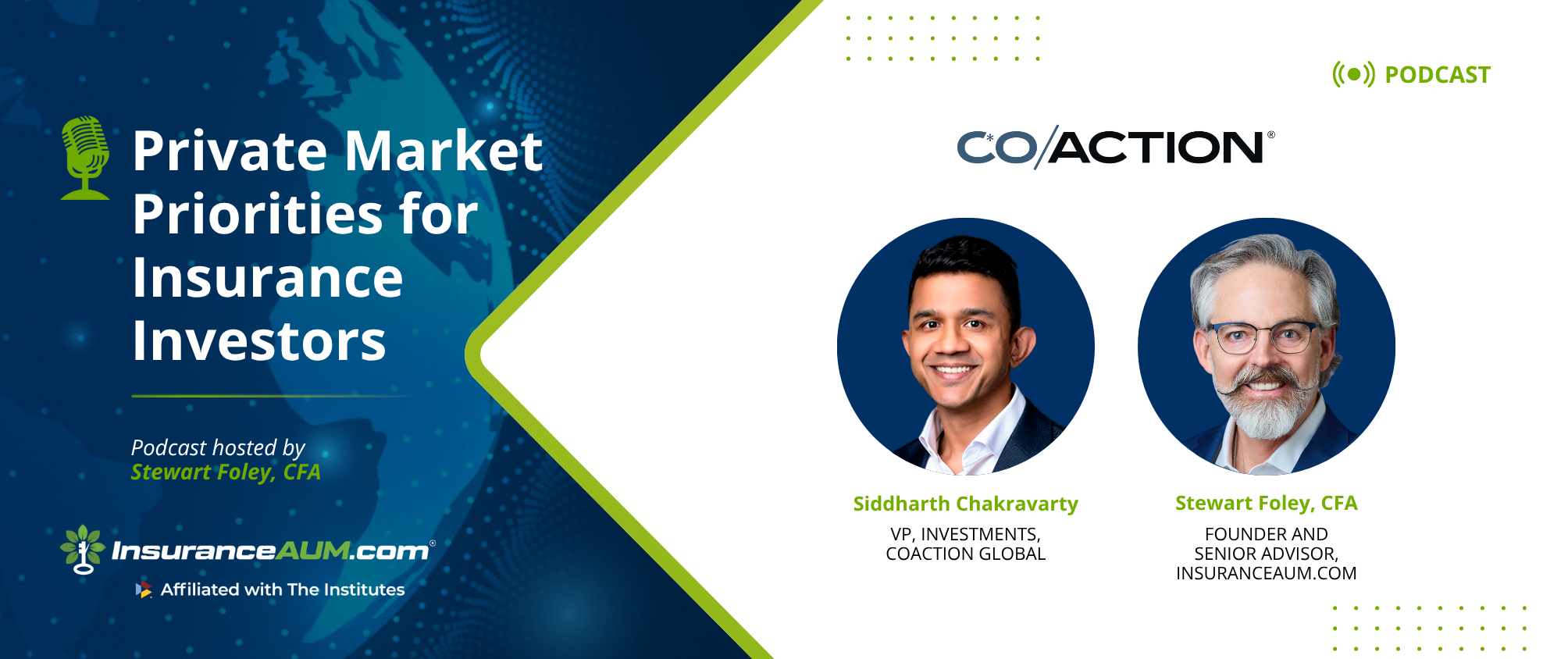
Stewart: My name's Stewart Foley. I'm your host, and we're thrilled to have you with us today. I have sat in this seat since March of 20. We have done almost 400 podcasts on insurance asset management. I got a job as CIO when I was 30, a small Midwestern mutual. I've been at this a long time. And I've had really a good seat at seeing this industry from a bunch of different angles. I've been on the buy side of it. I've managed money in an asset management firm, two of them that specialized in insurance, and I've also worked as a consultant. And then doing all these podcasts with different topics and so on and so forth. And one of the things that you get a chance to see from this perspective is up-and-coming talent.
And every so often, somebody shows up that really raises their hand and really wants to get involved and really wants to learn. And it isn't just lip service. And our guest today is absolutely one of those people. He is thoughtful, he is curious, he's technically excellent. And perhaps most importantly, he's willing to challenge conventional thinking. Our executive spotlight guest today is Sidd Chakravarty at CoAction Specialty. And the title of today's podcast is Private Market Priorities for Insurance Investors. Sidd, long intro, but well deserved. Welcome to the show.
Sidd: Stewart, it's a pleasure to be back. It's always great to see you. Before we get started, I definitely want to give a great shout-out to your entire team, both at The Institutes as well as InsuranceAUM for hosting such a fabulous event in Chicago. It was truly one of the best events I have attended in a really long time. So, kudos, keep up the good job. You guys do phenomenal work. It's not easy, but you guys somehow managed to make it sound like it is the easiest thing ever done. So, kudos to Kate, kudos to everyone. You guys are rocking it. Keep up the good job. So, Stewart, pleasure to be here again.
Stewart: I appreciate it, man. You're a repeat guest. The team does do a great job. Kate's amazing. And Lynde and Jennifer and Lindsay. And we have a new intern named Maggie who may or may not be my daughter. And we're thrilled with everything with how that went. It was a record number of LPs by a pretty significant number. And so, I really appreciate the kind words. I really do. I mean, it's people like you. We have, just for people who don't know. So, our executive council is made up of CIOs. This year we had our co-chairs, TC Wilson from Doctors Group and Janelle Woodward from Allstate did an outstanding job providing leadership, but the agenda and the topics and who's speaking and all that stuff is decided entirely by our executive council. So, I think it's super important to be talking about things that are most important to the folks who are actually investing and allocating those assets.
I referred to CoAction as CoAction Specialty, which is an old name. CoAction Global is your new name. You oversee some version of $3 billion across public and private markets. You've got a layered core, core plus, and private credit framework. You're also the co-chair of this year's Real Assets Forum back in Philadelphia. You've been on before, so I don't need to do the usual walk through the garden on background, but what is something, and I know one of the things is interesting, but tell us something about you that people in the industry would be surprised to learn.
Sidd: I mean, I mentioned this once before in passing. The biggest thing about me is that I did not come from a traditional finance background. That was never my thing. I came from an engineering background. And I can't even imagine eight, nine years back, I was sitting inside a yellow light in a semiconductor manufacturing facility in Taiwan looking at wafers and chips getting processed. That was my background. So, coming from there, from an engineering perspective and now sitting on the other side of the fence and financing those same deals for GPUs and chips, it's like a full circle for me. So anytime everybody talks about it, I always mention that because it's interesting to see how the whole investment landscape has changed. And it's not just about financing credit cards, it's become much more exotic. So, for me, that's probably the one thing that not everybody knows about, but I guess after this podcast, most people will know.
Stewart: Well, that's true. And I mean, it's interesting because I kind of in my head have this idea that my Mac Studio is somehow or the other relatively new. And I looked at it the other day and it's a 2022. And I'm like, huh, how'd that happen? So, I went to get on, and I went to go get a new one, and it turns out that there's a global RAM shortage, and you can't place an order for a new Studio right now with the way I wanted it configured. So, it's interesting that you've got a background in that business because I don't understand the ins and outs of it, but I do know that it is crazy that I can't upgrade my computer. And Apple is not available for delivery, not available for pickup.
Sidd: I know. It's definitely RAM. We can talk at length about what's driving the shortage, everything else, but the industry definitely has become a new giant in terms of financing and in terms of performance as well. So, I'm very excited. Semiconductor wasn't the biggest and hottest topic, but today it is.
Stewart: That's super cool. All right, so here we go. Private markets continue to evolve rapidly, as we all know. From your seat as the CIO of a carrier, what are the most important themes that you think folks in your seat ought to be paying attention to as we head into 27?
Sidd: So, take a step back over here. When we first started, not when I say we, I mean the entire insurance industry started their private credit journey. It was a very monolithic block. It was like private credit and direct lending. That changed and that ship moved very fast. Today we are looking at a much more sophisticated block of private credit. And within the entire sphere of private credit, ABF has emerged as the true element of diversification. And as this spread compression continues versus the, let's say, plain vanilla corporate credit or even private credit, it's forcing allocators like us to think about the complexity, the structure, the illiquid premium that we demand. And ABF is increasingly becoming that one answer to the solution. And it's just not just because it is diverse. Yes, it is diverse. You can do everything from consumer credit, specialty financing, infrastructure-related assets, and it is quite attractive spreads versus duration, which is very attractive for P&Cs.
And the last few conversations we had with your folks at InsuranceAUM, even life companies are getting excited about this space as well. So ABF, I think, has become the topic of the day. Any conference without ABF is almost incomplete. And if you look at the whole ABF space, there are two things which pop up. First is your non-agency market. That market has really blossomed, and that's driven by very, very strong credit fundamentals. So, you look at second-lien loans, HELOCs, non-QM, everything is quite attractive from an insurance perspective. The second segment that has become, and which I think is probably the biggest home for ABF, is digital assets. And that's where I think is the second biggest issuance coming from. But as you think about the entire ABF space, specifically within the AI space, it's not just a small block of digital infrastructure. Think about this thing as a part of a whole.
You can pick and choose what you want. You can do fiber, you can do behind-the-meter financing, you can do GPU financing. Take your pick. I mean, everything is there for the taking for you.
Stewart: So let me ask you some questions. I need to unpack some of the stuff on that answer. So, when you talked about non-agency and non-QM and so forth, just keep in mind that we've got some folks who are a little less senior, and so I just want to unpack some of that. So, in those cases, that is residential mortgage collateral that did not find its way into a Fannie or Freddie pass-through for some reason or the other.
Sidd: Exactly. So, think about this thing. Think about an entrepreneur. Think of a person like Stewart.
Stewart: Oh, believe me, brother. I could write you a book. I mean, I could write you a book. It is crazy to me. And I mean, I can tell you, you can have contracts with big companies that have very specific terms and so forth, and bank lenders don't give a hoot. They don't.
And at the end of the day, it's like you've got contracts and income that is guaranteed by the company anyway. And you have somebody who's got a W-2 job that could end any instant, but that checks the box. It does. And I can tell you that the vast majority of the lenders that I spoke with did not care about anything that didn't check the box. The underwriter needs it to check the box. And you go, "Holy smokies." So, I get this. It's not just me. I mean, I had folks, I had mortgage brokers essentially suggest that I commit mortgage fraud and create a W-2 job and just turn that in. And I'm like, "I'm not doing that. That's mortgage fraud." But to your point, that market has blossomed. And partly I think because there's more and more folks who are working independently and maybe not for a big company.
Sidd: Yeah, exactly. The whole spirit of entrepreneurship and capitalism is driving a lot of the businesses and a lot of people to have their own jobs, non-W-2 income. And so, for them, to your point, they're exactly in your seat. How do we get a mortgage? So, this is why companies like Rocket Mortgage, Mr. Cooper, they step in to fill the gap in. And they're just one part of the equation. So non-QM borrowing has literally become the next biggest elephant in the room, and not many people talk about it.
Stewart: And the other thing that you talked about was different than that, a different set of collateral.
Sidd: Exactly. So, you have the non-QM, and then you have HELOCs and second-lien loans. HELOC is basically you saying that, "Hey, I have equity built up in my house. I want to do X, Y, Z project. I'll take out a loan based on the LTV." These are really low LTVs. Some cases 60, some cases 70, very strong LTVs, take out a loan, do some work, and pay the loan back. I mean, that's a very good use of the equity that I have built up. And if you look at it, and this is me preaching to the crowd, is that post-COVID crisis, people have built up a lot more equity in their houses. People who refinance their markets are up 2% have close to 60, 70% equity built up. How do you capitalize on that? And so, the HELOC, the second-lien loans, they offer a good opportunity for you to tap into that market.
Stewart: You also mentioned technology as the other big one. So, can you unpack that? And we got lots of good questions here, but I just want to make sure that everybody knows what segment of the market you're really focused on. So, talk about the technology side of it.
Sidd: So, the technology side is probably the most exciting for me, I would say, not just because I'm an engineer, because it also has blossomed so much. So just take the AI technology landscape just as one block, but then flip it on a side. What you have is a first block, which comes land. Next comes the actual housing for it. Next, what you need is GPU financing. Next, you need fiber. Next you need is behind the meter. Next, what you need is actual off-taker. And now you can cut and slice this thing into multiple smaller blocks. So as insurance capital starts to go towards this, you can decide to finance this particular object, not just in the public markets, but also in the private markets. And within the public market themselves, you can go IG corporate, you can do high yield, you can do convertibles.
And on the private side, you can do a private placement, you can do infrastructure, you can do real estate, you can do private equity, you can do secondaries. And then again, within subclasses, literally, if I block this whole thing out, there's 200 ways that you can invest into a digital infrastructure, literally 200 ways. That's the number of options you have.
Stewart: Yeah. I mean, I assume that one of the considerations is how crowded a particular segment may be. So, I mean, I'll give you an example. Usually, the earlier you are in the asset class, the better the opportunities. If you're the 58th person in, it's different than being the third person. Correct. So, it's interesting that I don't think anybody has ever come on and talked about all of those nuanced ways. And to be very specific about the risk that you're taking, right? Yeah, exactly. And what you're exposed to. And importantly, what you're not exposed to.
Sidd: Yeah. And you can take this thing and you can skin the cat in one more way and you can say, okay, if I'm financing a data center today, am I financing an inference or am I financing a training data center? Those are two different animals altogether. Am I financing a data center which is on the edge or I'm financing a data center which is in the middle of Nebraska, which has a technology risk? Because guess what? 10 years down the road, that data center may not be worth its money today. So, there's so much going on to you. Stewart, you are absolutely correct. There's a lot more money chasing deals. And so, we as allocators have to be one step ahead. We are not just underwriting from looking at cash flow. We are trying to understand how this space is evolving because this is huge financing.
We are talking trillions of dollars that are getting financed into the market. You can either decide to stay out of it, which I think is almost impossible, but if you plan to step into it, you should know what you are buying. It's one of the key mantras right now of underwriting, that know what you buy. That's what I would say. And understand where the technology is heading for us right now.
Stewart: Yeah. And what are the threats? So, what are the things that... It's sort of like what are CIOs wrestling with? And I kind of want to tack onto that answer. So, when you sit down with your peers, and you just did in Chicago, and I don't know, there were just about 90 LPs registered. We had some folks that had some conflicts, but it was a really big crowd of folks. And I think TC had a picture taken, it got posted someplace, but it was really cool to see everybody get together like that. But what are you focused on when you look at portfolio construction and asset allocation that people are wrestling with? And kind of tangential to that is when you're buying these private assets, there is some care and feeding involved. There's more to it than just saying you're done and you buy it.
There's considerations about making those allocations of, I mean, operational considerations. So, can you talk a little bit about portfolio construction and asset allocation questions that you guys talked about in Chicago?
Sidd: Yeah. I mean, Stewart, I think this first half of the year has left us with more questions than answers. That's how I'll start to answer it. And it's just because these are different times. That's all I'll say. So, if I have to summarize everything that we sort of captured over the two events, both in Chicago as well as in Philadelphia, there's five top things that come to my mind. Let's go one by one. The first thing I call is the higher for longer, which is wrong. I think this is the normal for longer. People should, and we, as most of the insurance allocators, agreed that this is where everyone is supposed to stay. Forget about the 0% interest rate environment. Forget about the Fed 2% target. We need to construct our portfolio, assuming that this is a normal going forward. We should not be pricing at excessive lower rates because we are stepping into an inflationary environment, period.
That's where it is. So now with that being in mind, how should we think about asset allocation? Should we be pricing in Fed cuts, Fed rates? I don't think that's our job anymore. Our job is to build up healthy portfolios. So, we assume that, yes, for rest of the year and foreseeable future, we should expect higher rates coming in. That's the first thing. But that brings up a next problem, which I call as the spread zip code, which means that spreads are just moving laterally. They haven't moved up, they haven't moved down. The markets just haven't priced at big spread movements, but that could change, but don't expect spread to become a generator for total return. That's not how this is going to play out. Unless there's a big credit event, the spreads are going to be pretty benign, I would say. So, I would expect that as a book-yield-focused insurance portfolio, think that this is your spread zip code and now plan around that.
75, that's where it's going to be. There might be some element of broadening, but don't expect too much of that coming through. So, if you look from that point of view, you are getting four and a half to 5% in investment grade corporate versus a private credit. So that changed the equation. Do you want to now leg into an environment where we are seeing some amount of stress? And that brings the next point is the concept of SaaS apocalypse. How real is that? Is the stress that we are seeing in private credit, BDCs, redemptions, how does that impact our portfolios right now? And the InsuranceAUM event we had in Chicago, we actually spent a lot of time talking about it, trying to get some answers from our GPs to see how they are thinking about it. The bottom line is that every insurance portfolio is constructed so differently.
It's almost very difficult to get a one solution for it, but we got at least some ideas in terms of how we should be thinking about the SaaS exposure, whether that be percentage exposure to software companies, what's in BSL, what's in private credit. Everyone is going to be different. I think next year when we all come back together, we'll have much more better idea on how this whole SaaS apocalypse plays out, how the AI or bubble story plays out. It's too soon to say, but it's on everyone's radar that everyone kept talking about.
Stewart: Yeah, it's interesting. I mean, that topic was not really on the 25 agenda, and it was all over the 26 agenda.
Sidd: Exactly.
Stewart: And that's the beauty of it, Sidd, from my perspective. From our seat, we're not close enough to that market or to those issues to really go, "This is what we should focus on." And it's got to be super challenging. It's not just, I mean, AI has changed the game. It has changed the game in so many ways, and we don't even know how many ways. But there's also geopolitical stuff that keeps happening, that is. I mean, it used to be back in the day. We looked at economic data and made some forecasts, and you go, "Okay." But now everything, there are whole industries that are being changed and there's geopolitical stuff going on that has real market—
Sidd: Impact. But the questions to that is that if there is impact, why is it not showing up in the data right now? Why are markets being so sanguine? Why is the volatility so capped out? Forget the equity market. We are credit investors. In the credit markets, why hasn't the geopolitical risk shown up? Why hasn't the risk of cash economy showed up? Why hasn't risk of inflation showed up yet? It is surprising, but the answer that I have with the question is because there's still money left to be deployed.
Stewart: Oh, yeah, yeah, yeah. I'm 100% with that.
Sidd: Whether it be institutional investors or whether it be investors from the retail side, people are still deploying money. And that's what's keeping the cap on, let's say, volatility. Once that starts to ebb, we might see pockets of volatility, but as of now, that's what's keeping everything contained.
Stewart: Well, it's interesting. We were at the NASCAR event in San Diego, which is super cool. It was on a base, never been done before, blah, blah, blah. I went to the gas station to fill up my rental car and paid $6.99 a gallon. I got on a plane, landed in Texas, driving back to my house, $3.17. What interests me is that there is such a disparity. I believe my thing is gas prices are a bit of a tax. Because it's not like if you're going to drive X amount of miles to work, you're going to drive those miles, whatever it is. It is interesting to me that it seems like, I don't know how the gas prices at that level doesn't have an economic impact. Now that there was some relief, you saw prices fall. Now things are sparking back up again. It's interesting because there's things impacting this economy that aren't.
I think it's difficult to draw a direct correlation between gas prices are up a lot. What does that mean to me as a private credit investor in an insurance portfolio?
Sidd: Yeah, exactly. The gas price is basically, I would say, is one of the things in which you will have to spend. It is part of your disposable income. You will spend it no matter what's going to go towards it. But anyways, back to topics, the next thing we talked a lot more about was the beta exposure. How much are we getting exposure through, let's say, the bigger managers in the ecosystem versus looking at smaller managers? And which brought the conversation was tourism in the space as well. We're seeing a lot more new managers coming into the space, which is very healthy. I think we need some more diversity coming in through different managers coming with different strategies. But there is a gap, and that gap is basically the manager literacy for insurance asset management because insurance asset management is very, very specific. It's everything from liquidity, RBC charges, note structures, STAT GAAP.
It's a whole new ball game. Most of these managers don't understand it. So, there's a literacy component to it. I'm more than happy to work with a new manager if I find the strategy well, but it's a learning cycle. So that was one topic. And then of course, last but not the least, RBC. Everything from CLO capital charges, the C1 factors came up, the private letter ratings came up, the credit rating providers information came up. So, all in all, there's a lot of things going on. It's going to keep us busy for rest of the year. But I think that the overarching theme is all about is spread, what happens with the Fed, what happens with inflation, how should think about it? But the bottom line is that we as allocators, I think, are almost in the same understanding that this is the normal for longer.
Let's now think about constructing the portfolio around this new normalcy.
Stewart: I'm glad you brought up these new managers coming in and their need for insurance expertise, because it reminds me that there is the CIIM designation being offered by The Institutes, which is to do exactly that. It is fundamentals on insurance asset management in a variety of ways, and it includes some case studies that were done by some of the folks that you and I both know. So, there's my shameless plug for that. Let me get to this. One of the things I think we've done a decent job of is building a community. And it's super important, I think, because more than people realize, guys like you are somewhat on an island. There's nobody else really, I wonder, how many other people can you run out the door in your office and go have a quick conversation about insurance asset management issues? It's like there's not that many CIOs, period.
And so, what we tried to do is create an environment where you can discuss this stuff. And one of the things I'm always impressed with is how open people are and how willing they are to say, "Hey, here's what we did about..." Somebody raises their hand and say, "Hey, what's everybody doing about issue A?" And somebody will put their hand up, and they'll talk like, "Well, here's what we did." And they're very transparent and open. Because as you pointed out, it's not like there's one answer. There's not one answer. There's as many answers as there are carriers in the room. So, can you talk a little bit about the value of the community when you are trying to figure stuff out?
Sidd: Oh, yeah. I mean, let's start with the first thing. When we are at these events, it's like us being on a Gilligan's insurance island. We are there for two days talking about insurance. This is when everyone—
Stewart: Sidd, this is an opportunity for us to... Now, this is going to put you on the spot. Who is Gilligan?
Sidd: TC.
Stewart: That's hilarious.
Sidd: No, no, no. I'll tell John Patton.
Stewart: See, that's where I thought everybody was going too. All right. So is TC, I guess that person is maybe more closer to Thurston Howell. I don't know. We can talk about that, but it's a great analogy. It is Gilligan's Island for insurance investing.
Sidd: It is Gilligan's Island, pass.
Stewart: Because everybody's geeked out and nobody. It's like if you wore a giant orange hat and everywhere you went, people just looked at you like, "What are you doing?" But if you went to a place where everyone wore a giant orange hat, you'd feel like, "Wow, this is awesome."
Sidd: Exactly. So, I think we are on the small Gilligan Islands. To your point, everyone's wearing this orange hat. But guess what? The insurance is now a DNA. We want to talk about insurance. Everyone from the GPs to the LPs, everyone; the conversations are so much more sophisticated because this is a very insurance-focused conversation. We can get straight to the nuances and cut the BS. We're talking about an RBC, not-admitted assets. This is all like we understand this thing from the get-go. So, for us to have conversation, it's a very high-level conversation, but also very in-depth. The peer learning, people underestimate how much amount of peer learning can get from this conversation because whether it be a P&C company talking about ABF or an insurance company talking about infrastructure, we are all sort of learning from each other. This is not a pitch. It's not a case study.
This is real-life examples on what's going on in the portfolio. This is very valuable for all of us. And then when GPs know that they are in a room filled with LPs who are that sophisticated, they come prepared to have this kind of conversation. So, they're on a much more mentally higher bandwidth to accommodate such intense conversation because they're going to get a lot more questions. They'll get pulled and tagged on much more different topics than they were ever possibly challenged on. So, you get a lot more from this one. And then the networking, it has a compounding effect because you're talking to people from so many different areas. The insights come in both formally and informally. You can be having conversations over coffee or drink and something might just spark an idea that you never thought happened before. So, I think the compounding effect of networking is just invaluable.
And it's just not conversation we have at the conference. Beyond the conferences, these relationships live on. I can still call people up from a different conference. I can still call them up. We can still catch up. And this is what I'm talking about is the compounding effect happens both in and outside the conference as well. So, for an InsuranceAUM event, that's what I think, at least personally for me. When I first joined the industry, this was my thing. Okay, this event we have to go because this is where we sort of level set of expectations on what's going on in the industry as a whole.
Stewart: Well, it's interesting. I mean, the timing is interesting because as you well know, there's been a lot, a lot of headlines around private credit. And we have our next event is the Private Credit and ABF Insurance Investors Forum in Austin in November. What do you think those discussions are going to look like? And I mean, I don't know, and if you can talk about, it seems like headlines have kind of halfway died down a little bit, but can you talk a little bit about how you're looking at it too?
Sidd: No, I think that the conversations when the private credit and the ABF conference in Austin are going to be very, very specific because, A, we sort of will be on the tail end of the year. A lot of things would've passed, so there'd be a lot of hindsight 2020 conversations. But I think the first thing is going to be that the emerging valueability of ABF as asset class is going to come up a lot more because some insurance companies have been on the, let's say, leaders in this one and who have done meaningful allocations and others in which they're still trying to figure out in terms of where do they stand. So, for them, it'll be a good conversation to have in terms of how do they think about allocation, what they should consider. The second one is the tariff and trade uncertainty, because by the time the midterms would have finished off, we would have a much better understanding of where do we stand with that.
But because of this whole uncertainty, there's much more opportunity, especially it comes to onshoring activities. So, we have more domestic manufacturing logistics and how that can help to boost the ABF space is going to become more interesting conversation. And then how we think about AI financing, because we know that SpaceX came public, Anthropic OpenAI has the latest IPO, but Anthropic might come public. So, with that being public, there'll be a lot more information coming in. We'll also have a better understanding of how the AI landscape has shaped up because we saw some volatility coming to market as well. So, to understand how to think about the AI within the ABF space will be another big topic which will come up in the conversation as well. And then the rate environment, depending upon how the Fed decides to do the rate environment path moving forward, what kind of guidance which they will stop giving moving forward, which will be interesting to see is that how does that change the allocation between ABF versus IG corporate?
Because then you're competing for capital between these two buckets. Are you comfortable taking a risk in ABF with some complexity and liquidity or you'd rather prefer stay in IG corporate? So those will be the conversation that'll happen. And then just to sum it up, Austin is a hub. The Texas insurance market has really grown, especially when it comes to the specialty insurance company. So, I think it'll be a great watering hole conversations that'll happen both in terms of how are we seeing the assets evolve, but also the laboratory involved. So, I think it'll be a good mix of folks coming in from both sides of the segment to talk about a quite lot of things. And so, the timing of this thing is just impeccable. You're seeing midterms go through. We'll see the AI thing have played out a little bit more. So, there'll be more mature conversations that I think we'll have for this event.
So, I'm really looking forward to it.
Stewart: No, it'll be good. I appreciate that. It's been a really interesting conversation. I covered a lot of ground. And I guess if you were going to wrap here, from being a college prof, my head is always with folks who are younger and newer in the business. And to your point, like you pointed out top of the show, you weren't an analyst and then you became a this and a that. You were an engineer. But for somebody who was newer or earlier in their career, what advice or what skills do you think are going to be important to the next generation of CIOs?
Sidd: You do have to be intellectually curious. Yeah. You just have to be so much more curious to understand what's going than not. You cannot take things solely on word of mouth anymore. I feel that me being in the seat for the last year and a half, I've learned so much by just being curious, picking up the phone and calling my peers up. One thing that I feel that as new insurance allocators come into space is to really spread your networking. That's going to play such a big role because I think if it hadn't been for the InsuranceAUM event, which is a very shameless plug I'm doing here, but I'll still go do it, it helps us to network. It helps us to reach out to folks that we otherwise wouldn't have been able to connect. So, I think we as allocators need to put a lot more effort into networking and understand what is everyone else doing on their books.
We can't be so, I just said, in our own little island and wait for that one event to come through to form our own little personal Gilligan Island. We can't wait for that one-year event. So, I think we need to be more curious. We network out more. We have to understand what's going on in the capital markets. It's a very evolving field. Insurance, as I said before, is a new sexy money. With sexy comes responsibility. So, you got to be more responsible. You have to really make an effort to make sure that you're understanding how the market's evolving in space. And last but not the least is the regulatory framework is also ever-changing. So, it's like playing chess in four dimensions right now for you. That's how I think insurance is right now is it's getting complicated, it's getting interesting, it's getting beautiful. You're getting to learn a lot more thing, but at the same time, it's also getting very challenging.
Stewart: Yeah, that's super interesting. We are trying to bring sexy back to the insurance asset management space. I will say that.
Sidd: So, I would say that next time we do the event, we probably need to get Justin Timberlake to come in and perform, bring sexy back.
Stewart: There you go. Listen, we got to talk to The Institutes about budget on that one. That's above my pay grade. All right, last one. Who do you want to most. You've answered this before, but I want to ask you again. Today, who would you most like to have lunch with or dinner with alive or dead? You can have one, two or three guests, but that's our closing question.
Sidd: Messi.
Stewart: Oh, great answer.
Sidd: And I was so impressed. His father being so sick and he's still showing up for the game. How does he have the courage to do it? I mean, the amount of emotional and mental stability you need to perform at that level, I just understand what goes in guys' mind. I was mind-blown and I heard the background story, what's going on in his family, but the person still showed up for the World Cup representing his country. Kudos to you, man.
Stewart: Yeah, absolutely. Anybody else or just you and Messi?
Sidd: Just me and Messi right now. I'm big in football right now. It's football season. I really can't think of anything else. I think that's one guy I really want to have conversation today with for sure.
Stewart: Oh, I love it. All right, that's great. I really appreciate you being on, Sidd. Thanks so much for taking the time.
Sidd: Absolutely, Stew. Pleasure to be here.
Stewart: We've been joined by Sidd Chakravarty, Vice President of Investments at CoAction Global. You've been listening to InsuranceAUM.com's podcast. If you like what we're doing, please rate us, review us on Apple Podcasts, Spotify, or wherever you're listening to your favorite shows. You can see us at our YouTube channel at InsuranceAUM Community. My name's Stewart Foley. This is the home of the world's smartest money on the InsuranceAUM.com podcast.
The InsuranceAUM podcast is available on




Share this post


Sign Up Now for Full Access to Articles and Podcasts!
Unlock full access to our vast content library by registering as an institutional investor
Sign Up Now for Full Access to Articles and Podcasts!
Unlock full access to our vast content library by registering as an institutional investor .
Create an accountAlready have an account ? Sign in