






Adams Street Partners -

Private Markets 2027 Outlook: Selectivity and Fundamental Value Creation Are Paramount

IAUM_Article_Banner_AdamsStreet-PrivateMarkets2027Outlook_1004x422
Key Takeaways
  • Primary Investments: We believe buyout returns will increasingly depend on revenue and EBITDA growth, sector expertise and operating capabilities, as higher rates reduce the contribution of leverage and multiple expansion
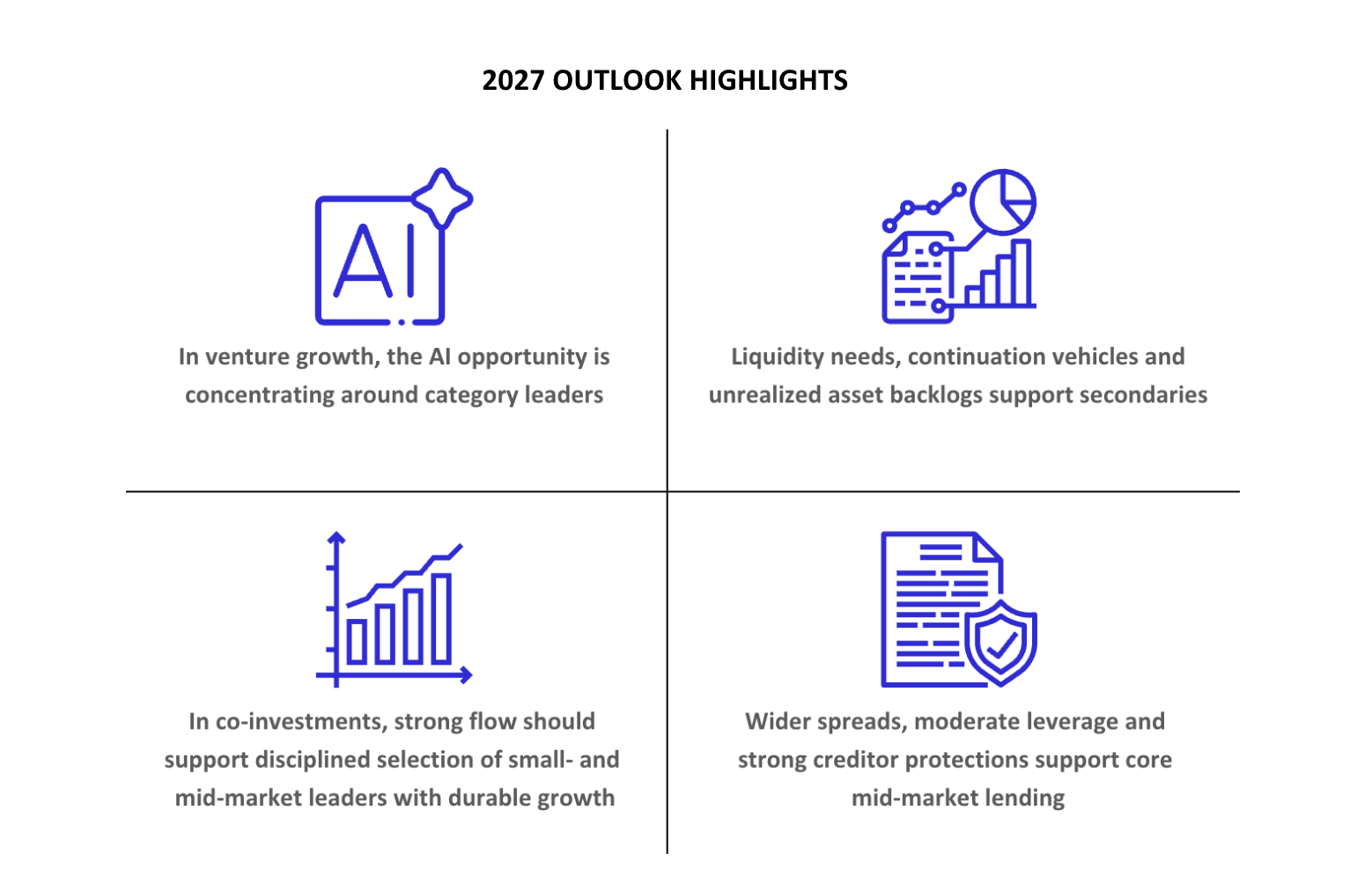
  • Secondary Investments: Secondaries remain structurally supported by liquidity needs, increased use of continuation vehicles, a backlog of unrealized assets, and the value of established relationships
  • Co-Investments: Recent high rates of opportunity flow should support disciplined co-investment selection, including targeting category-leading businesses with durable growth characteristics, particularly in the small- to mid-market
  • Venture Growth: AI opportunity is concentrating around category leaders that are demonstrating exceptional growth, defensible customer relationships, and teams capable of compounding data, usage and talent advantages
  • Private Credit: Core middle-market direct lending remains attractive, generally supported by wider spreads, moderate leverage and stronger creditor protections, while manager and underwriting differentiation remain critical
Image
Screenshot 2026-11-23 at 1.18.41 PM

Executive Summary

Access, Selectivity, Execution Shape the 2027 Opportunity

Across strategies, Adams Street sees opportunity in 2027 for private markets managers who combine differentiated access with selectivity, disciplined underwriting, and the ability to create fundamental value.

In primary investments, we anticipate a gradual recovery in deal activity, although disruption caused by artificial intelligence (AI), along with higher rates, inflation, tariffs, and geopolitical risks, will remain important considerations. In our view, future buyout returns will depend more on revenue and EBITDA growth, sector expertise and operating capabilities than on leverage or multiple expansion.

The secondary market appears positioned for continued growth as limited partners (LPs) seek liquidity, general partners (GPs) make increased use of continuation vehicles, and buyers benefit from durable supply, favorable capital dynamics, and the value of established relationships.

We experienced record co-investment opportunity flow in 2026, and believe similar trends entering 2027 should help support continued disciplined deployment into many category-leading companies, particularly in the small- to mid-market.

In venture growth, we see AI moving from broad enthusiasm toward clearer category leadership; investors should strive to identify companies with exceptional growth, defensible customer relationships and teams capable of attracting talent and capital.

And finally, in our view private credit remains attractive in the core middle market, where wider spreads, moderate leverage and stronger creditor protections have supported returns. Across all five strategies, we believe performance will increasingly depend on access, selectivity and careful execution.

“In our view, future buyout returns will depend more on revenue and EBITDA growth, sector expertise and operating capabilities than on leverage or multiple expansion.”

Jeff Diehl
Managing Partner & Head of Investments


Primary investments outlook architectural image.

Primary Investments

The Increasing Importance of Sector Expertise, Operating Capability

New deal activity slowed after the market peak in late 2021 and early 2022, when the US Federal Reserve aggressively raised interest rates in response to inflation. Since then, higher financing costs and greater uncertainty have contributed to slower deal volume and exits. With strong public market performance, low unemployment and healthy GDP growth, we are cautiously optimistic that deal flow will pick up more meaningfully during 2027. However, tariff uncertainty, interest-rate concerns, geopolitical risks and AI’s disruption continue to weigh on activity.

Valuations for completed private equity transactions remain elevated. This reflects a selective market in which primarily the highest-quality companies are being sold, alongside continued levels of private equity dry powder. The exit environment also remains muted, while fundraising has become increasingly bifurcated. High-quality funds with strong track records may be oversubscribed, while many other managers—including first-time funds—are taking longer to raise capital. Many LPs continue to seek greater liquidity before making new commitments.

Buyout portfolios that have held up well during this period have been supported by manager selection, portfolio construction, and an emphasis on companies with modest leverage and solid revenue and EBITDA growth profiles, all attributes that Adams Street aspires to maintain throughout its portfolio. However, the environment ahead is different from much of the past decade. Higher interest rates mean buyout returns are less likely to benefit from declining or unusually low rates. Instead, we believe returns will increasingly depend on a manager’s ability to drive revenue and EBITDA growth through deep sector expertise and operating capabilities.

In our view, risks include higher interest rates, sticky inflation, tariff and geopolitical uncertainty, margin pressure, and continued weakness in exits. We remain cautiously constructive, particularly where disciplined managers can create fundamental value rather than rely on leverage or multiple expansion.

“We believe returns will increasingly depend on a manager’s ability to drive revenue and EBITDA growth through deep sector expertise and operating capabilities.”

Brijesh Jeevarathnam
Partner & Global Head of Fund Investments


Secondary investments outlook architectural image.

Secondary Investments

Structural Demand Supports Continued Growth

We believe the secondary market enters 2027 well positioned for continued growth across both LP-led and GP-led transactions. With 2026 expected to mark a third consecutive year of record transaction volume,1 we see momentum extending into 2027 as secondaries become an increasingly established tool for managing portfolios and generating liquidity. This growth reflects both the ongoing need for distributions and a durable shift in how LPs and GPs manage their investments.

We expect several themes to shape the opportunity set:

  • Continuation vehicles become a more established exit alternative. Alongside M&A and IPOs, continuation vehicles are becoming a core liquidity option for GPs, accounting for an estimated 14% of global sponsor-backed exit volume.2 Continuation vehicles allow managers to provide liquidity to existing investors while retaining ownership of high-conviction assets with further value creation potential.
  • Repeat GP activity increases the value of longstanding relationships. High-quality managers are increasingly pursuing multiple continuation vehicle transactions across their portfolios. We believe buyers with existing LP relationships, deep knowledge of the underlying managers and a demonstrated ability to execute will be well positioned to secure access and assess opportunities.
  • Capital availability remains favorable for buyers. Available buyside capital is estimated at approximately 1.2x trailing annual transaction volume, near historical lows.3 With supply of opportunities outpacing the growth of dedicated capital, we expect disciplined buyers to continue finding attractive opportunities.
  • A gradual exit recovery supports continued secondary activity. Even as traditional exit markets improve, the substantial backlog of unrealized investments will likely take years to work through. Persistent demand for liquidity should support both LP-led sales and GP-led transactions, while a recovery in realizations could accelerate distributions from acquired portfolios.
  • Active portfolio management sustains LP-led supply. We see LPs increasingly using secondaries to rationalize manager relationships, rebalance allocations, and wind down mature portfolios. These motivations broaden the seller base and reinforce transaction activity beyond periods of market stress.
  • Small and middle-market buyouts offer compelling opportunities for selective buyers. We believe these segments remain particularly attractive, where differentiated sourcing and manager relationships provide access to high-quality companies. Less well-known assets and greater variation in asset quality increase the value of deep diligence and investment selectivity.

Against this backdrop, we believe access, underwriting discipline, and translating longstanding GP relationships into investments will remain central to performance.


Co-investments outlook architectural image.

Co-Investments

Early Signs Support a Cautiously Constructive Outlook

We are optimistic about the outlook for co-investments in 2027 and believe it is one of continuity rather than departure. Differentiated access, selectivity, and a portfolio comprised of category-leading businesses remain some of the most significant defining characteristics of co-invest strategies that have demonstrated durability across market cycles. Adams Street seeks to anchor its co-investments philosophy in a similarly disciplined, fundamentals-driven approach.

Co-investment remains among the most efficient means by which LPs can attain private equity exposure, providing diversified participation across managers, sectors, and vintages typically at a reduced fee burden, while affording enhanced visibility into the underlying businesses in which capital is deployed.

Co-investment pipelines have expanded in recent years, with some managers reaching record levels of opportunity flow in 2026, providing a wider opportunity set from which to source transactions. This generally supports greater selectivity in underwriting which, in turn, enhances the ability for capital to be deployed at a measured, disciplined pace in high-quality opportunities.

Though liquidity remains at historically low levels, the private equity co-investment market saw broadening liquidity in 2026 across multiple channels. We expect this trend to continue in 2027, particularly within the small- to mid-market segment, where exit pathways have historically demonstrated greater variety and durability relative to the upper end of the market.

Notwithstanding the macroeconomic volatility that characterized the market in the early part of 2026, the performance of many co-investment portfolios remains resilient, reflecting a deliberate underwriting discipline. We see many iconic market participants maintaining a philosophy that tries to concentrate co-investment activity across market-leading businesses operating within industries characterized by durable structural growth and strong fundamentals, which is expected to position such companies well to compound value across economic cycles regardless of prevailing macro conditions. This discipline underpinned the investment philosophy of a number of leading managers in 2026 and is expected to remain central to investment positioning in 2027.

“Expanded co-investment pipelines generally support greater selectivity and disciplined deployment into high-quality opportunities.”

Michael Taylor
Partner & Co-Head of Co-Investments


Venture growth outlook architectural image.

Venture Growth

AI Leaders Pull Away

For the past three years, the central question in venture was binary: AI vs. everything else. Hundreds of companies raised significant capital across every AI-enabled vertical at premium valuations on early traction alone. Simply being “AI-native” was enough. In our view, 2027 will look different. The question has moved from whether AI wins to which company in each vertical wins, and by how much.

Part of the answer is being written by enterprises themselves. After years of AI pilots, companies are rationalizing vendor stacks and standardizing around single platforms. Procurement decisions are becoming permanent, accelerating “winner-take-most” dynamics from the demand side. We believe the power law in AI is more pronounced than in prior waves. Unlike earlier SaaS cycles, AI-native applications compound on data and usage, which should make early leaders structurally harder to displace. In most categories, we expect the vast majority of value will accrue to the leader.

For growth investors, the companies we think are most likely to break away often share a distinct set of traits: growth in a class of its own, customer relationships structurally hard to replicate, and teams with a real edge. In our experience, team quality is especially telling. The ability to attract top-tier talent and raise large sums from the best investors while burning capital aggressively to capture share is itself a signal of durability.

Terminal market structures in AI are still forming, with more unknowns than knowns, but 2027 should bring meaningful early clarity. For investors with the access and conviction to back the companies that check these boxes, we believe the return profile is among the most compelling we have seen.

The question has moved from whether AI wins to which company in each vertical wins, and by how much.”

Robin Murray
Partner & Head of Venture Growth Investments


Private credit outlook architectural image.

Private Credit

Core Middle Market Remains Attractive

We believe this continues to be an attractive vintage period for direct lending in the core mid-market (Adams Street’s main focus).

Redemption activity in the retail channel continued to pressure business development companies and interval funds in the third quarter of 2026, causing them to largely withdraw from the market. Their absence has lessened the overall level of competition and created an attractive investment environment with generally wider credit spreads, moderate leverage levels and more robust creditor protections.

Key dynamics supporting our outlook include:

  • Private credit continues to offer premium all-in yields relative to most credit alternatives, supported by elevated base rates and wider credit spreads.
  • The Federal Reserve’s 25 basis point rate increase in September 2026, which lifted the target range for the federal funds rate to 3.75% to 4.00%, amid persistent inflation and broader macroeconomic uncertainty, reinforces our expectation that interest rates will remain elevated, bolstering overall private credit returns.
  • Although M&A activity remained subdued during the first half of 2026, sponsor pipelines generally increased early in the second half of the year, offering an early indication of improving deal volume.
  • Overall borrower performance remains resilient, but results are increasingly diverging by manager, sector and underwriting vintage. Pressure appears to remain concentrated among select borrowers and managers, often those that pursued more aggressive lending strategies during the 2021 to 2023 period.
  • The core middle market continues to offer wider spreads, more conservative leverage, and stronger creditor protections than the more competitive upper mid-market segment. Against a backdrop of persistent economic and geopolitical uncertainty, we believe disciplined underwriting, differentiated sourcing and active portfolio management will remain critical drivers of performance.

“The core middle market continues to offer wider spreads, more conservative leverage, and stronger creditor protections than the more competitive upper mid-market segment.”

Bill Sacher
Partner & Global Head of Private Credit


Footnotes

1. Jefferies, Global Secondary Market Review, July 2026, Fig. 1, p. 4

2. Jefferies, Global Secondary Market Review, July 2026, Fig. 8, p. 8

3. Jefferies, Global Secondary Market Review, July 2026, Fig. 11, p. 12

Important Considerations: This information (the “Content”) is provided for educational purposes only and is not investment advice or an offer or sale of any security or investment product or investment advice. Offerings are made only pursuant to the applicable offering document(s), which contain important information. Statements in this Content are made as of the date of this Content unless stated otherwise, and there is no implication that the information contained herein is correct as of any time subsequent to such date. Statements made herein generally represent a mixture of either (i) objective data attained through a variety of sources which is believed to be reliable and current, but accuracy cannot be guaranteed, or (ii) Adams Street’s analysis and related beliefs, opinions and views based on market observations, historical deal flow, experience and/or other factors; provided, however, that there can be no guarantee that this represents a complete universe of relevant data or opinions. All information has been obtained from sources believed to be reliable and current, but accuracy cannot be guaranteed. References herein to specific strategies, sectors, geographies, general partners, companies, or investments are not to be considered a recommendation or solicitation for any such strategy, sector, geography, general partner, company, or investment. This Content is not intended to be relied upon as investment advice as the investment situation of individuals is highly dependent on circumstances, which necessarily differ and are subject to change. The contents herein are not to be construed as legal, business, or tax advice, and individuals should consult their own attorney, business advisor, and tax advisor as to legal, business, and tax advice. Past performance is not a guarantee of future results and there can be no guarantee against a loss, including a complete loss, of capital. There can be no guarantee (i) that future transactions will demonstrate similar characteristics as those described herein (ii) that Adams Street will be successful in generating liquidity opportunities for any of its portfolios, or (iii) as to the timing or attractiveness of any such liquidity opportunities that are generated. Certain information contained herein constitutes “forward-looking statements” that may be identified by the use of forward-looking terminology such as “may,” “will,” “should,” “expect,” “anticipate,” “estimate,” “intend,” “continue,” or “believe” or the negatives thereof or other variations thereon or comparable terminology. Any forward-looking statements included herein are based on Adams Street’s current opinions, assumptions, expectations, beliefs, intentions, estimates or strategies regarding future events, are subject to risks and uncertainties, and are provided for informational purposes only. Moreover, actual events are difficult to project and often depend upon factors that are beyond the control of Adams Street. No forward-looking statements contained herein constitute a guarantee, promise, projection, forecast or prediction of, or representation as to, the future and actual events may differ materially, either positively or negatively, from those described or contemplated in such forward-looking statements. Adams Street neither (i) assumes responsibility for the accuracy or completeness of any forward-looking statements, nor (ii) undertakes any obligation to update or revise any forward-looking statements for any reason after the date hereof. Also, general economic factors, which are not predictable, can have a material impact on the reliability of projections or forward-looking statements. Adams Street Partners, LLC is a US investment adviser governed by applicable US laws, which differ from laws in other jurisdictions.

Share this post

Sign Up Now for Full Access to Articles and Podcasts!

Unlock full access to our vast content library by registering as an institutional investor

Register

Contacts


Image
Adams-Street-Partners_Logo_Color_RGB


Adams Street Partners is a global investment firm managing a comprehensive suite of private markets investment solutions. The firm provides private equity and private credit strategies to institutional investors, growth capital to innovative companies, and evergreen funds that offer access to multiple strategies through a single, investor-friendly commitment. The firm also supports wealth advisors with private markets solutions structured to be more flexible and accessible than traditional closed-end funds. With over 50 years of experience, Adams Street leverages deep market insights, global relationships, and proprietary data as it seeks to help investors achieve long-term investment goals. The firm is 100% employee-owned, manages $82 billion in assets,* and operates out of 15 offices globally. Visit adamsstreetpartners.com

*As of September 30, 2026. Adams Street Partners’ methodology to calculate Assets Under Management (AUM) is based on fund net asset value (NAV), plus unfunded commitments, plus leverage, but excluding the effect of subscription lines of credit. The prior AUM methodology was based on investor commitments minus commitments to fully liquidated underlying partnerships. Such change in methodology was effective July 2026; however, for periods shown prior to December 31, 2025, Adams Street continues to use the previous methodology. This updated methodology more closely aligns with (i) the amount of assets managed on behalf of investors and (ii) the amount of capital available to make direct and/or partnership investments. Amounts stated by investment advisers in regulatory filings (“regulatory AUM”) have a prescribed methodology, which may, in some circumstances, differ from the methodology such adviser uses for other purposes, including marketing efforts. Additional information is available upon request.


Neelm Hameer
Vice President, Investor Relations
nhameer@adamsstreetpartners.com
+1 773 720 9748

Adams Street Partners, LLC
One North Wacker Drive, Suite 2700
Chicago IL 60606-2823


View the contributor page

Sign Up Now for Full Access to Articles and Podcasts!

Unlock full access to our vast content library by registering as an institutional investor .

Create an account

Already have an account ? Sign in

Ѐ Ё Ђ Ѓ Є Ѕ І Ї Ј Љ Њ Ћ Ќ Ѝ Ў Џ А Б В Г Д Е Ж З И Й К Л М Н О П Р С ΄ ΅ Ά · Έ Ή Ί Ό Ύ Ώ ΐ Α Β Γ Δ Ε Ζ Η Θ Ι Κ Λ Μ Ν Ξ Ο Π Ρ Ё Ђ Ѓ Є Ѕ І Ї Ј Љ Њ Ћ Ќ Ў Џ А Б В Г Д Е Ж З И Й К Л М Н О П Р С Т У Ф Х Ц Ч Ш Ā ā Ă ă Ą ą Ć ć Ĉ ĉ Ċ ċ Č č Ď ď Đ đ Ē ē Ĕ ĕ Ė fi fl œ æ ß