
TCW -

Repair and Prepare: Investing for the Next Natural Disaster

TCWFeatured

Cindy Paladines
Eli Horton
Keith Luna, CFA


Key Takeaways

01

Markets have swung between extreme narratives, most recently the Iran war, but history shows long-term results are driven by diversification, disciplined positioning, and patience, especially during periods of heightened geopolitical risk

02

The current geopolitical landscape reinforces the need for balance. The longer the conflict persists, the greater the probability that demand destruction becomes the dominant macro force, with meaningful implications for earnings growth expectations

03

Periods of high uncertainty, leadership shifts, and wide dispersion are where active management adds value; distinguishing between companies, allocating deliberately across the value chain, and staying grounded in fundamentals to drive durable returns


A year ago this January, vast swaths of Los Angeles County were engulfed in flames, fueled by dry brush, 60-80 miles per hour Santa Ana winds, and conflagration conditions that quickly spread fire from building to building. By the time the final embers were put out, more than 16,000 structures had been destroyed. The event led to roughly $65 billion in losses, making it the costliest wildfire disaster in U.S. history.

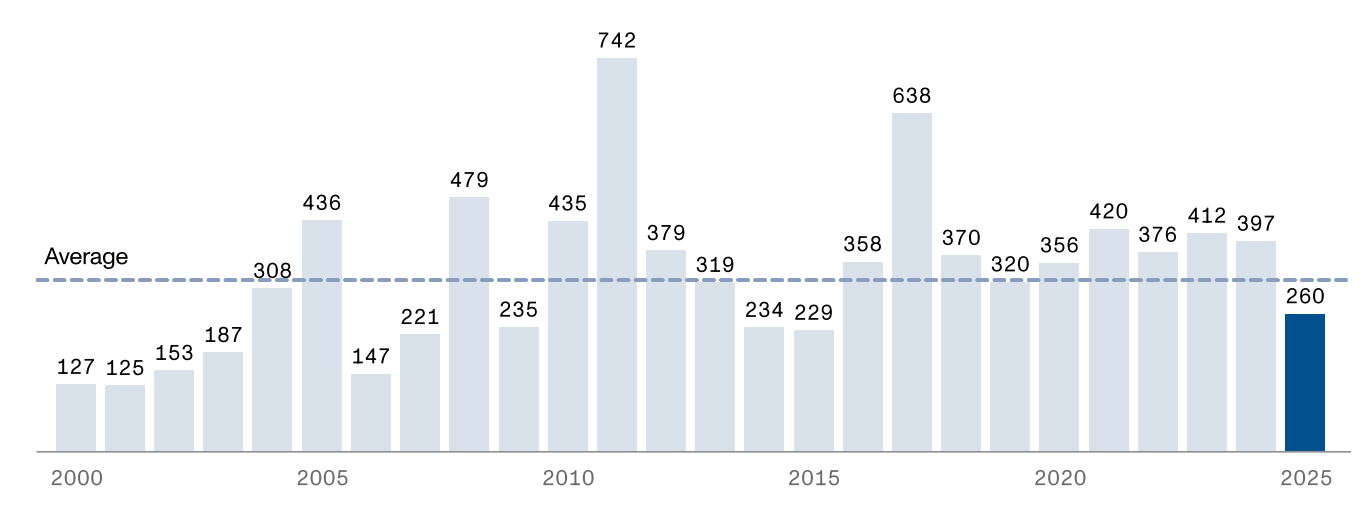
Natural catastrophes like wildfires are rising in frequency and in their destructive potential. Globally, economic losses from natural disasters in 2025 reached about $260 billion, with the 5-year annual average loss for insurers from natural disasters alone having reached $155 billion given changes in hazard type, societal factors, and economic behavior diving more expensive per event losses. (See Figure 1.)

In the U.S. alone, the picture is similar. Between 1980-2025, the U.S. experienced an average of nine weather-related disasters annually with losses that each exceeded $1 billion (in inflation-adjusted terms). That average occurrence nearly doubles to 19 billion-dollar events per year if one analyzes only the most recent decade of activity.1

For investors, it’s important to understand both the current nature of these risks as well as how these risks might evolve over time. It is also essential to classify assets and economic activities in terms of their exposure to these perils, including evaluating how companies and other issuers have mitigated (or not) these exposures before events occur.

It’s not all bad news – companies and other issuers that are helping households and businesses prepare for coming disasters may also see an uplift from increased natural disaster-related impacts. Total spending on disaster recovery in the U.S. has increased significantly in recent years, and now amounts to about $1 trillion, or 3% of GDP.2 The financial implications on households has been significant – in recent survey evidence, the Federal Reserve Board found that about two in ten adults reported financial impacts from natural disasters in 2024, including 8% who were moderately or severely affected.3

Overall, these trends represent an emerging investment theme that can have important implications on client portfolio management in the future.
 

Figure 1. Global Economic Losses from Natural Disasters
Image
Bar chart

Source: Aon 2026 Climate and Catastrophe Insight. Charts in 2025 billions of dollars
 

Catastrophe-Aware Investing to Hedge Disaster-Related Liabilities

Certain clients, such as insurers, may have liabilities tied to natural hazards or extreme weather conditions. For these clients, ensuring that investment portfolios also take these non-financial exposures into account is one way that we can minimize potential “double balance sheet exposure” to these same risks. While no asset is entirely immune to extreme events, relative exposure, geographic diversification, and cash-flow resilience can materially affect outcomes during and after disasters.

Constructing portfolios that are tilted towards resilient assets may be an option to express this view. For clients with significant real estate related liabilities, for instance, focusing on those companies or credits backed by building collateral constructed after 2001, the dawn of the U.S. resilient building code era, would likely be advantageous. Another avenue would be to prioritize credits from sectors that are negatively correlated or uncorrelated with prominent hazards. National hotels and hospitality issuers, for example, may benefit from acute disasters that affect a concentrated region of the country. Off-grid solutions providers, like residential solar credits, may benefit from increased storm activity, as households and businesses may be cut off from reliable on-grid electricity.

In the U.S., increased natural disaster activity may also benefit companies and other issuers who may see a boost from increased policy and regulatory attention on boosting investments in risk mitigation and prevention. At least 20 U.S. states now offer active grant, reimbursement, or cost sharing programs to households and/or businesses that invest in property resilience. Prominent examples include the Strengthen Alabama Homes program which has helped support the strengthening of over 35,000 coastal Alabama homes against wind events in alignment with the FORTIFIED standard introduced by the insurance-industry funded think tank, the Insurance Institute for Business and Home Safety. Insurance regulators in at least 18 states – including California, Georgia, and Texas – have mandated that insurers provide at least some property insurance premium credits for risk reduction. Insurers themselves are also increasingly mandating investments in resiliency activities before they will continue to offer relevant property insurance coverage.

For issuers delivering the goods, services, and technologies that enhance asset resilience, supportive policy frameworks and rising disaster-related demand can provide a meaningful uplift by accelerating adoption, shortening payback periods, and improving demand visibility, especially in housing, materials, and distributed energy.

Investing in Companies that Support Disaster Prevention and Repair

As natural disasters become more frequent and severe, investors should look beyond loss exposure to companies that are developing the goods, services, and technologies that support disaster prevention, preparedness, and recovery. These activities are increasingly central to how households, businesses, insurers, and governments manage risk in a more hazard‑prone environment.

In the U.S., rising investment in disaster preparedness and ex‑post repair has already supported growth among companies aligned with the “repair and prepare” theme. According to Bloomberg Intelligence, an equity index of roughly 100 large public companies focused on disaster preparedness and response has outperformed the S&P 500 Index by approximately 6.5% per year over the past decade.4 This performance highlights the potential for resilience-related demand to translate into durable return potential.

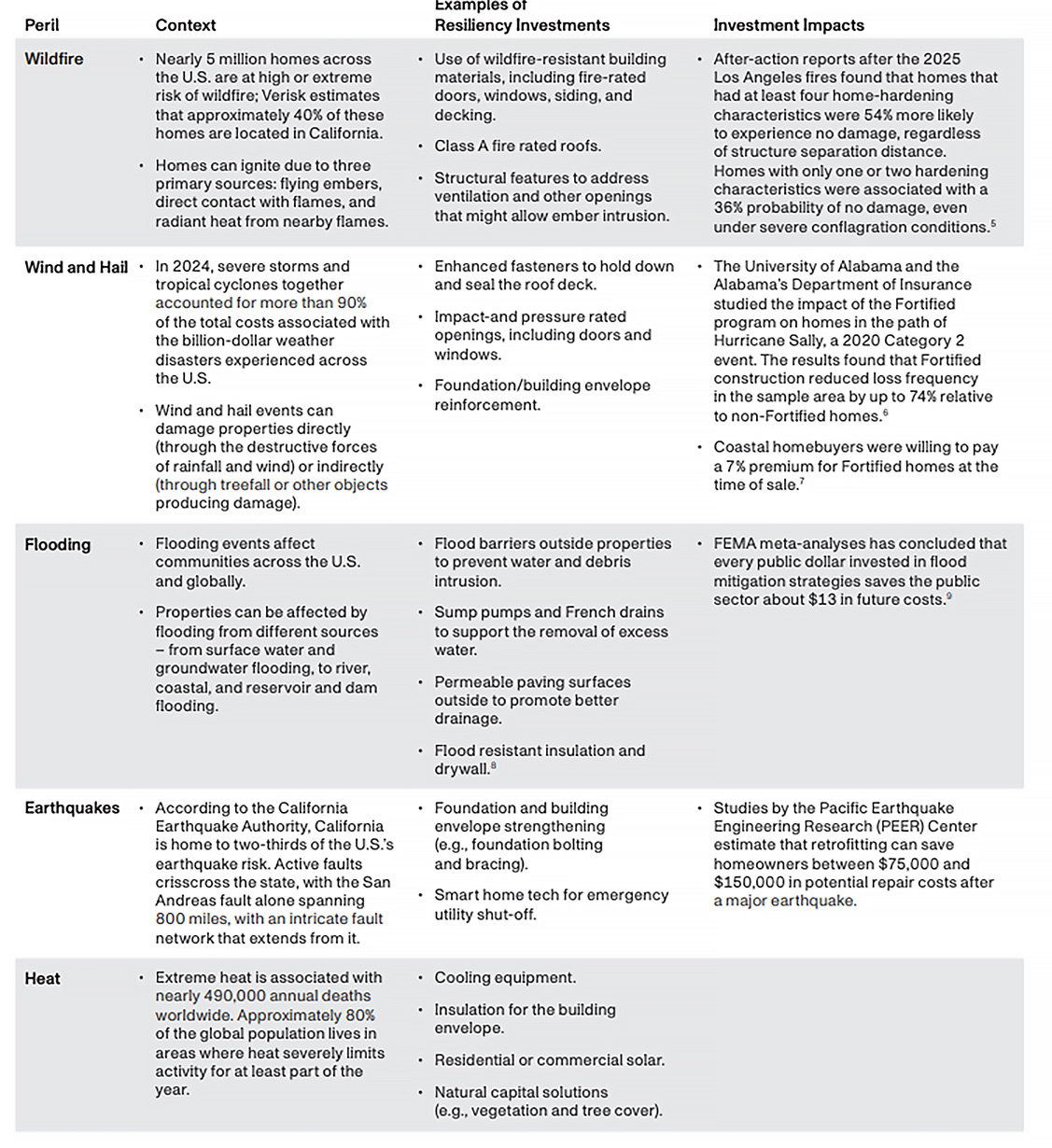
We apply a resilience-related taxonomy across asset classes to identify issuers positioned to benefit from these trends. The framework distinguishes between prevention, adaptation, and recovery activities and is informed by active research and engagement with issuers, industry participants, policymakers, and academia.

For issuers delivering resilience-related solutions, rising disaster-related investment and supportive policy frameworks can accelerate adoption, shorten payback periods, and improve demand visibility, particularly across housing, building materials, and distributed energy. As disasters grow more costly, resilience is likely to shift from a thematic consideration to a core input into risk management, asset allocation, and security selection.
 

Figure 2. Resilience Investment Universe – Opportunities and Potential Impact
Image
Table

Source: TCW
 

Considerations for Resilient Portfolio Construction

Investors face unique risks to natural disasters. Take, for example, insurance clients that underwrite property risk. Insurers with a significant underwriting book in California will be far more exposed to wildfire, heat, and earthquakes than will an insurer underwriting risk in Florida. To build a portfolio that mitigates and/or offsets these insurance losses, specific analysis would be needed to quantify the risks faced by an individual insurer. There is no one-size-fits-all solution. However, there are certain principles that form the basis for an investment portfolio solution:

1. Fixed Income investments are unlikely to provide portfolio gains to offset losses, but should focus on uncorrelated positioning. Fixed income investments, by their nature, are capped in terms of potential capital appreciation. Insurance investors, who tend to be buy-and-hold-focused, are particularly susceptible to downgrades and defaults due to low turnover in the portfolio. In constructing a resilient fixed income allocation, it is important not to double down on the same risks that exist on the liability side of the balance sheet. Identifying corporate and real estate exposures that could be negatively impacted by a natural disaster in an insurer’s coverage area allows those exposures to be avoided in bond portfolio construction. The focus of the portfolio should be on steady income with stable capital charges that will not result in an unnecessary hit to capital just at the time when liability payments need to be made.

2. A carefully constructed equity portfolio can provide both offsetting and independent returns. Property and casualty insurers tend to hold a greater percentage of their portfolios in equities. Equities provide higher expected returns, while maintaining liquidity necessary to meet uncertain liability payments. A properly constructed equity portfolio can benefit investment returns in three possible ways. First, the portfolio can take positions that lack correlation to losses that occur from insured natural disasters (i.e., no earning correlation to disaster events). Second, as mentioned previously, the portfolio can actually take negatively correlated positions in companies that will benefit once a disaster strikes (e.g., national hotel chains that see increased occupancy or environmental remediation firms that will see improved earnings). Lastly, investments can be made in companies where insurers and policymakers are creating their own demand. By requiring hardening of homes in California or Florida, or improving the flood resistance of properties along the Gulf Coast or Eastern Seaboard, property owners are being compelled to buy certain products from particular companies, which will improve the earnings for those companies and likely result in higher equity valuations.


Read More from TCW


1 U.S. Billion-Dollar Weather and Climate Disasters | Climate Central
2 The Climate Economy: 2025 Outlook | Bloomberg Professional Services
3 The Fed - Report on the Economic Well-Being of U.S. Households in 2024 - May 2025
4 Ibid.
5 FINAL-The-2025-LA-Conflagrations-IBHS-ExecSummary.pdf
6 Fortified Performance in Hurricane Sally
7 Estimating the effects of wind loss mitigation on home value
8 U.S. FEMA guide: PROTECT YOUR PROPERTY FROM FLOODING UK Flood guide: floodmary.com/wp-content/uploads/2025/12/Householders-Directory-of- PFR_12-25_v6.pdf
9 Hazard Mitigation Value


Disclosure
This material is for general information purposes only and does not constitute an offer to sell, or a solicitation of an offer to buy, any security. TCW, its officers, directors, employees or clients may have positions in securities or investments mentioned in this publication, which positions may change at any time, without notice. While the information and statistical data contained herein are based on sources believed to be reliable, we do not represent that it is accurate and should not be relied on as such or be the basis for an investment decision. The information contained herein may include preliminary information and/or “forward-looking statements.” Due to numerous factors, actual events may differ substantially from those presented. TCW assumes no duty to update any forward-looking statements or opinions in this document. Any opinions expressed herein are current only as of the time made and are subject to change without notice. Past performance is no guarantee of future results. All investing involves risk including the potential loss of principal. Market volatility may significantly impact the value of your investments. Recent tariff announcements may add to this volatility, creating additional economic uncertainty and potentially affecting the value of certain investments. Tariffs can impact various sectors differently, leading to changes in market dynamics and investment performance. © 2026 TCW

Share this post

Sign Up Now for Full Access to Articles and Podcasts!

Unlock full access to our vast content library by registering as an institutional investor

Register

Contacts


Image
TCW_Logo_Black


TCW has a dedicated insurance platform that is fully integrated with our dynamic investment management platform, which has served investors for over 50 years, enabling clients to evaluate opportunities through both an investment and insurance lens. The firm’s insurance portfolios incorporate a full range of solutions that can be customized as individual strategies or designed to function together within a diversified general account framework.  

Combining insurance-focused expertise, specialized infrastructure, and analytical capabilities, the platform helps insurers address portfolio construction, capital efficiency, regulatory considerations, statutory reporting, and balance sheet optimization as part of the investment process. By integrating these capabilities into a single client experience, TCW provides insurers with a more comprehensive approach to managing assets and liabilities. In a market where many managers offer insurance-compatible products, TCW distinguishes itself through the depth of its insurance-focused resources and its ability to support insurers holistically as regulatory, reporting, and capital requirements continue to evolve.

TCW is a global asset manager with $200 billion in assets under management as of June 30, 2026, offering innovative strategies across fixed income, equities, and alternatives to diverse insurance clients. 
 

TCW
515 South Flower Street
Los Angeles, CA 90071
insurancesolutions@tcw.com
 

View the contributor page

Sign Up Now for Full Access to Articles and Podcasts!

Unlock full access to our vast content library by registering as an institutional investor .

Create an account

Already have an account ? Sign in

Ѐ Ё Ђ Ѓ Є Ѕ І Ї Ј Љ Њ Ћ Ќ Ѝ Ў Џ А Б В Г Д Е Ж З И Й К Л М Н О П Р С ΄ ΅ Ά · Έ Ή Ί Ό Ύ Ώ ΐ Α Β Γ Δ Ε Ζ Η Θ Ι Κ Λ Μ Ν Ξ Ο Π Ρ Ё Ђ Ѓ Є Ѕ І Ї Ј Љ Њ Ћ Ќ Ў Џ А Б В Г Д Е Ж З И Й К Л М Н О П Р С Т У Ф Х Ц Ч Ш Ā ā Ă ă Ą ą Ć ć Ĉ ĉ Ċ ċ Č č Ď ď Đ đ Ē ē Ĕ ĕ Ė fi fl œ æ ß