





GCM Grosvenor-

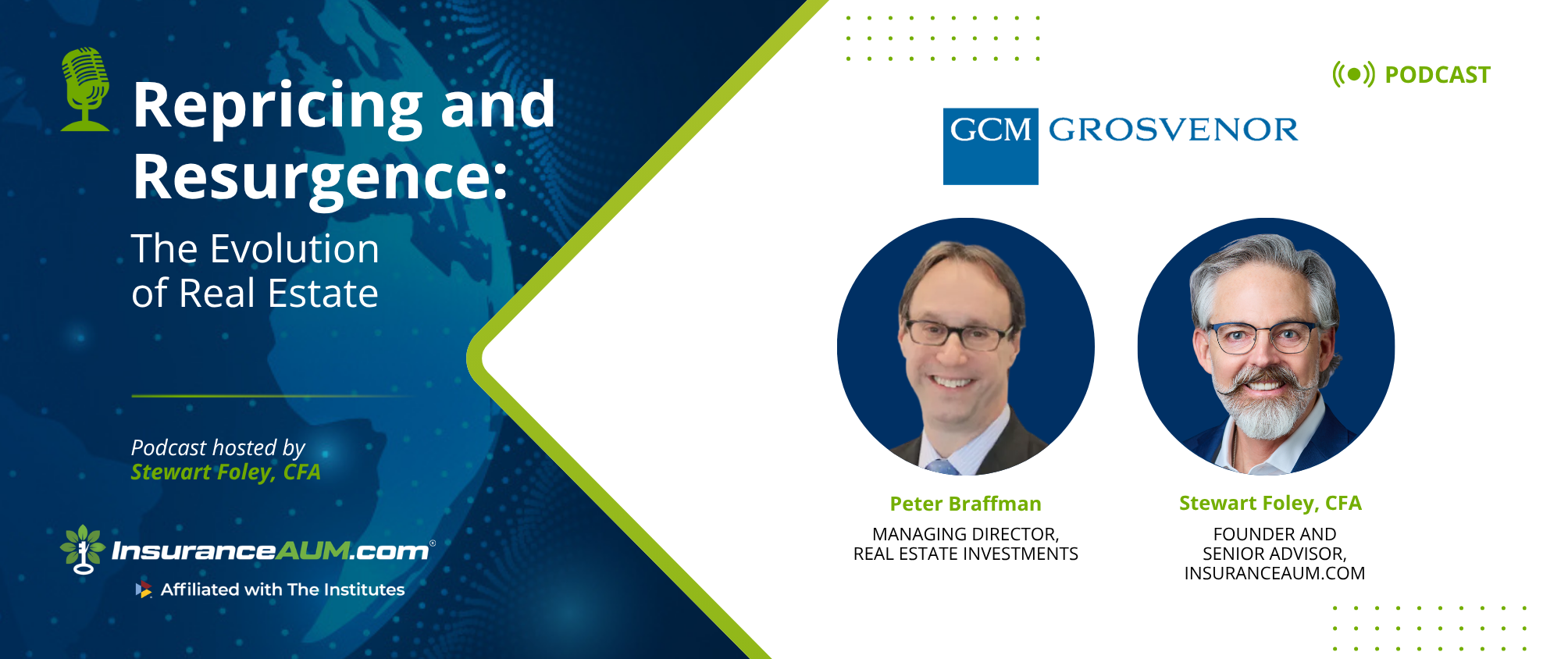
Repricing and Resurgence: The Evolution of Real Estate

Image
03.31.26 GCM_Web


Stewart: Hey, welcome back to the home of the world's smartest money. This is the insuranceaum.com podcast. My name's Stewart Foley, CFA. I'm your host and I'm thrilled to have you with us today. I want to make mention of something. We just had an event in Philadelphia and it went very well. In fact, our guest was there. And we’ve got these—this is a video podcast—Rubik's cubes, and they have all of the constraints around insurance asset management.

And if you provide an idea for a podcast for stewart@insuranceaum.com and if we take it, we'll send you one of these. They're super cool. And here's the interesting thing. Jennifer, who most of you who have been on our podcast know, is at Insurance AUM. She's invaluable to us and she does so many different things. But one of the things, she has a 17-year-old son who actually did this Rubik's Cube and he solved it, but the words didn't line up. So it turns out that those cubes rotate. So he went in and figured out and he actually solved it back to where the words add up. So I was super impressed with that. So huge shout out to him and kind of a cool little leave behind. And we got a couple of extras. And so we want to reward folks who are participating in our podcast, so to speak.

So the title of today's podcast is Repricing and Resurgence: The Evolution of Real Estate. And my guest today is Peter Braffman, who's Managing Director in Real Estate Investments at GCM Grosvenor. Peter is a member of the Real Assets Investment Committee, Infrastructure Advantage Investment Committee, and he leads the firm's real estate practice overseeing investment activities, product development, and -growth. Prior to joining GCM Grosvenor, he was the Senior Vice President at Zurich Alternative Asset Management, where he focused on US real estate investments earlier in his career. He worked at Goldman Sachs advising on structured real estate transactions and began as an attorney at Kirkland and Ellis. You have an MBA from Kellogg, what we call the other school in Chicago. A JD from Northwestern and a BA from the University of Rochester. Peter, welcome to the show.

Peter: It's great to be here, Stewart. I enjoy it. Thanks for that lovely introduction.

Stewart: Thank you so much. It's so nice to have you and we're thrilled. It's great to get to know you in Philadelphia and great to get to know you here. So before we dig in to the subject at hand, we always start with a little background. So where'd you grow up? What was your high school mascot? And if you were doing this job, running the wheels off money at GCM Grosvenor, what would you be doing today instead?

Peter: So I'm from here. I'm from New York City. I grew up in Queens, a suburb called Forest Hills. And I'm one of four siblings. All my siblings are doctors. We could talk about that if you want. And there's something there. And then I went to a school called Stuyvesant High School in Manhattan. It was a great school, but our sports were great. I wouldn't say it was our priority, but it was great. Our mascot with the Peg Legs.  

Stewart: Nice.  

Peter: Yeah, named after Peter Stuyvesant. But we had actually some very good teams and I loved it there.

Stewart: That's awesome.

Peter: And the last thing, what I would want to do ... That was funny. I was thinking about that when you told me that was going to be a question. And I love history, but not just static history. I just love exploring all forms of history, history of cities, history of architecture. I also love film. So this is going to sound pretty boring, but I probably would be focused on making documentaries of unusual histories. That would be a fun thing to do.

Stewart: That's interesting. I'm always amazed at documentaries that they explore things really well that I've never heard of. And I was at a doctor's office and there was some sort of documentary on these animals that live deep in the ocean. And I was like, what in the world? As hard as it is to fund a small business, I want to know who's funding that stuff, right?

Peter: No. 100%. It gets you into weird places, but you're right. You take you into some fascinating areas like talk about business. You can learn a lot about the history of business or why businesses evolved from history.  

Stewart: Yeah, so true. It's phenomenal. Alright. So for listeners who are not familiar with GCM Grosvenor, I suspect that there are some, can you give us a quick overview of the firm and talk a little bit about leading the real estate investments area?

Peter: Sure. Yeah. So GCM Grosvenor is about a $90 billion alternative asset management firm. And by that, I mean, we're focused on all forms of alts, everything from hedge funds to all forms of private markets, activities, private real estate, obviously, of course, private equity, infrastructure, private credit. So pretty diversified. Our capital is almost exclusively institutional. At least that was the heritage of it. And it really started as two firms. One was Grosvenor, which was a hedge fund out of Chicago. They really grew in the ... Started in the '70s, I believe, and then grew dramatically over the years and then acquired an analogous private markets business that I came from at Credit Suisse. But both sides of the business and acquired it about 11 years ago and we became a large diversified firm. Both sides of the business though have that same common DNA, which is we are managing capital for large institutions and creating solutions in the alternatives market.

And by that, I mean, we find a lot of interesting middle market opportunities to invest in. We work with managers. So we act like an LP in the market. We manage money and create customized solutions for a lot of our investors. For real estate, what that really has meant is we are very, very focused on, one, getting or building really interesting opportunities in the growing part of or the deepest and the deepest part of the real estate market. And by that I mean the alternatives within real estate. We do everything. So we invest in across the board, but I really like focusing on smaller asset classes or smaller opportunities. I think there's more value there, but we're a private equity investor. And by that I mean, we find interesting teams to back. It is our heritage as a firm to focus on emerging teams that spin out of other firms.

We back them, we grow them. And in real estate in particular, we share in the upside of those firms. So we are kind of a platform builder, for lack of a better word. And therefore we provide a connection between institutional capital as looking for that kind of strategy and managers that are looking for that kind of strategic partner. Hopefully that explains it.

Stewart: Yeah, super helpful. So let's talk about the evolution of real estate as an asset class. So real estate's been a core institutional asset class for a long time, but it's clearly evolved. How do you think about how the market has changed and where you're focused today? And if you can, and I don't know if you're going to mention this later, but I'd love to get your thoughts on what some believe is a bubble in data centers. And I'd love to kind of talk about that. We had a call with about 30 CIOs and several of them mentioned it. And so I just feel like it's something that I'd love to be able to cover today with you.

Peter: Sure. So both are great topics. You're right, real estate's been around ... It's a truism. It's been around forever. It houses our economy and people invested in all sorts of ways. We've invested individually and institutionally, and I think insurance companies particularly were early movers in the asset class. It's a great income provider and appreciation provider that helps match against short-term needs and long-term liabilities. So it's great. It changed from an evolutionary perspective in the early '90s and it became a much broader institutional asset class and that stemmed from a moment of dislocation. And I think that's a theme that runs through real estate for sure, but I think the broader alternative is investing as well. So the early '90s, we had a big moment. There was a savings and loans crisis here in the United States. Resolution Trust Corporation was established to kind of work out that problem and a whole bunch of teams left banks or other institutions and used a private equity model, like a fund model to aggregate capital and then invest in the asset class.

And kind of an industry was born. Groups like Blackstone and others were nascent back then. They were small and all of a sudden capital was pouring in, buying real estate at cents on the dollar, selling it at higher values, and getting really interesting opportunistic return. And we could talk about it later, because I think you may ask some questions later, but there were a reason why capital was looking for the alternatives, but bottom line, it was looking for higher returns they could get from the other financial markets. And so we just saw a flood of capital. I think by our numbers, something like $55 trillion of institutional capital poured into the markets, and then allocations to alternatives rose. And a big part of that was real estate. So the first, from an evolutionary perspective, the first border way was get access, access to distress, access to all forms of real estate.

And by then it was like the four major food groups like office, industrial, retail, and multifamily. Multifamily, the biggest. So it was all getting access to this stuff. And then over time, it was growing. It started saying, "You know what? It's not just an access play. It's now more of also a portfolio construction play." And over time, what started happening was LPs who had no allocations started filling up their book, probably were over diversified, started getting smarter and saying, "You know what? We're going to be more about portfolio construction." And they become more sophisticated. They started saying, "We can do some of these things too, and we could be an originator like many way the insurance companies were before." And the GPs became bigger and they became more sophisticated. So it became a much more matured asset class with lots of different asset types, lots of different products, lots of different structures, and a very large and growing, sophisticated group of participants.

So that's the big picture. And now we find ourselves at another moment. During that time, there were three other moments of great dislocation. So the RTC we started with our savings and loan, .com, another moment in time, another rash of groups spinning out to start new firms, then the great financial crisis. Each of these moments were repricing moments and a new moment to evaluate the overall market and new participants coming in. And the same thing is happening now with interest rate movements. I'll touch a little bit on, if you want me to hit it now a little bit on data centers, but I think data centers represent a lot of confluence of things that are happening all at once. But I guess the thing you hit on at first is, is it a bubble? And I'd say from a capital allocation and capital migration perspective, it has all the signs that there's a lot of capital flowing into this.

And there's a question about what's the exit, because all capital is flowing in a one time and a lot of that capital's going to need to exit and you have a tremendous fundamental supporting it, but we know that technology's going to change and we don't know what that future looks like. So it's definitely a fraught moment, but a lot of capital's chasing this stuff.

Stewart: Yeah, it's interesting to me. I mean, I look back at when IBM invented the mainframe and there's a room that was specially constructed and designed and cool and it had 1K. And my phone's got 512 gigabytes and it's like, you know what I mean? And I just feel like the power ... I mean, I can understand both sides of it, right?  

You spent a lot of time at Zurich. And so we created the CIIM designation, which is the Chartered Insurance Investment Manager designation because this is such an important pool of capital in the insurance space, something like 30% of the world's invested assets, and yet there's no textbook. And so we created one, and it's being offered through The Institutes, and we're happy about that. But that designation is intended to provide a framework and a foundation, but is certainly not a PhD in insurance asset management.

How did the experience that you had at Zurich help shape how you think about real estate investing, particularly from an insurance perspective?

Peter: So this is going to be a ... It's interestingly profound, that's the blunt line. It was a profound change. And it reminded me, and I don't think you and I talked about this, actually my business, even before I was a lawyer, even before I was a banker at Goldman, I started at a small investment bank boutique that was actually a subsidiary of insurance company called a subsidiary of commercial union out of London. And it was called CU Capital, and they were kind of the investing arm of commercial union. By the time I got there, it was just managing other capital. So just acted like a bank or a small investment bank for other institutional capital, including insurance companies. I bring that up because I learned early that insurance money was very sophisticated and was a financial player in multiple ways. And Zurich was pretty far ahead of that.

They developed lots of different, interesting subsidiaries providing different insurance solutions. When I was at your conference last week or two weeks ago, I saw it there. I think I told you, I had eight meetings and every meeting was different. Each one of them were coming in with different ways ... It was just one kind of insurance business. They all had different insurance solutions. And I found that at Zurich, there were multiple subsidiaries I worked at at different points with different names, doing very different things, very creative things, and then ultimately became part of what was called Zurich Alternative Asset Management. So that's the backdrop. For me personally, the way it changed me was I went from being a financial advisor to being an investor and because we were a principal, like we, it was our capital. Yes, I was still advising our different subsidiaries so that I still had that kind of hat on, but it was our money and it was our money and we had to invest it.

It wasn't us going to some bank, which is where I was from. And I think my experience is I loved Goldman, I loved Kirkland, some incredibly smart people. I actually love CU commercial union capital. It's great. I was always an advisor. You do a deal, then you're done, you move on to something else. Now this is like, we have to live with this stuff. And so I went there and we had a lot of different balance sheets, someone who had built up large portfolios of direct investments where they were buying assets. We had to manage those assets. We had to redeploy capital in new assets. We were building a large book of net leased assets. We're doing lots of different things and we needed to build up our own asset management team and actually realize and kind of embrace the fact that these were living, breathing assets that every day required care and attention, and it was us.

And so I became a real estate investor, and that was really remarkable. The other thing that was really kind of profound, and I think it affected my career, was that I was there at an interesting point in time. So I was there starting around 2003, or no, it was earlier, 2001, and I was there till 2010, so nine years. And during that time, there was like that second wave of things that were happening. Remember I mentioned before, there was the RTC in the early '90s. Now we're talking about this post .com, and all of a sudden there was a great proliferation of new capital coming into the real estate sector, and new managers popping up all over the place. A lot of them were operators of other fund managers, and they were decided to build up their own business. And then again, there were a whole bunch of new teams spinning out of other firms saying, “I want to start my own.”

And we, again, were creative places. We were backing a range of teams, teams that were pretty well established and teams who were getting going, and sometimes partnering with them in very creative ways. And I think that instilled something else in me that I didn't quite see before. You usually see real estate as a product, okay, here's a building to invest or here's an instrument to create, but there's a counterparty and there's a group that you're working with typically. And as investors, I was looking for these teams and I realized these are businesses that were growing and building and we were not just investing in assets, but we're investing with these teams and we had to underwrite not only these teams, but the growth. And we were like the engine behind those teams. So I started to understand real estate as both an asset class that required care and attention in terms of how its various assets were moving, but also as a business and people and businesses to support and that our capital was the engine behind all of it.

And honestly, what I built the business here at GCM Grosvenor, is very much focused on that. It's that kind of private equity model to say like, "You know what? If we're going to be the engine of these businesses, we're going to participate in the growth of those businesses.” So that's a long-winded way of saying how it changed me.

Stewart: Yeah. I mean, it's a really good ... It flows. The story makes sense, right? There are so many facets to insurance asset management, and real estate investing is the same. And putting those together, you can create some very interesting solutions, but you have to spend time with the insurance company figuring out what their issues are and what they're trying to solve for. And to your point, I'm thrilled to hear that you had eight meetings in Philadelphia, and I'm also thrilled to hear that they were different because that allows a solutions provider to work. If it's just like, "I want this specific exposure and that's all I care about and who can give it to me and blah, blah, blah, blah, blah" That's different than “I'm trying to solve this problem, help me.” And that's a way more interesting conversation. So let's talk a little bit about allocations in the macro environment today.

Obviously right now there are macroeconomic factors at work. There are also what is affectionately known in the economic profession as exogenous shocks, to say the least. How have real estate allocations evolved for institutional investors, particularly insurance companies, and how does today's macro environment influence those decisions in your mind?

Peter: Well, there are a couple ways to attack that. I'll start with how it's evolved. And again, I think the broad answer is it's a movement towards greater and greater sophistication and asset allocation as opposed to, "Hey, I need to solve just a more discreet problem." I look at insurance capital as incredibly vital to the health of the real estate industry because the health of the real estate industry is honestly about the flows of capital and particularly about mortgage flows and credit. More than anything, more than any exogenous shock is that the values of real estate are correlated to the flow of capital and particularly the flow of low origination. More than even interest rates, if you look and take mortgage flows and then map it against cap rates, which is like kind of the yields that real estate trades, they are perfectly correlated.

So when real estate capital flows and mortgage flows dry up, cap rates blow out dramatically, meaning the real estate prices plummet and then the inverse is true. And you can look that over a 30 year period, you can pull it up on your Bloomberg and you'll be shocked at the correlation. And increasingly, as a banking system has off balance sheeted, a lot of investment activity in real estate, the insurance companies have been the leading investor in the space in one way or another, providing financial solutions to the acquisition, disposition and maintenance of real estate assets. And so that's really grown and sophisticated, but there's another thing that's happening as well when you think about from a pure allocation perspective, our business is consolidating, meaning the industry broadly is consolidating. And one of the biggest players in that is the insurance companies. Insurance companies are out acquiring meaningful pieces of platforms.

If you look at, I can name, I'll just bring an example, KKR, and not to pick on them, it's great. And by the way, they're not unique in this regard, but 10 years ago, maybe a little bit more, about 70% of their capital, I'm making this up, but it's directly right, was institutional capital. Today, meaning just traditional institutional capital that they're managing. Today, the biggest pool of capital that they manage is insurance capital. That's a sea change, and you're seeing more and more of that happen. So again, that just goes to the overall sophistication. And I think it goes to the second part of your question, like, what's happening out there? What's going on? We were the beneficiary, I say we as an industry of a great, great tailwind that for the last 30 or 40 years, we had tremendous stability of inflation, tremendous stability of monetary policy, that was obviously correlated, but also an incredible decline in interest rates during that period of time.

So that’s tied to kind of a much stricter form of monetary policy that was driving inflation to be low and steady. And that coupled with that, capital flowing into the markets. So you think about a time where if you were buying anything when interest rates were 15 or 10 or seven and rates kept declining and capital kept flowing in, I mean, you could see why one great industry rose around that, but why also asset values grew and blossom. Today, we have a very different environment. And by the way, during that time, as interest rates were declining, that was driving allocations into real estate to get better returns because you couldn't get it elsewhere. So you had to be creative, you had to come up with interesting structures. Insurance companies benefited tremendously from that, but so did the whole market. But today, you have a very different scenario.

You find interest rates are not declining. In fact, we don't know where they're going and they're elevated and they may go higher. We have an unsure inflationary environment. We have an unsure monetary environment. So now you have environment where things are just different. And so when you think about how you're going to allocate as an investor in that moment in time, it opens up the floodgates. You have to be pretty creative. So I think that's why what's driving a lot of conversation today. It's why I think I had eight distinct meetings the other week because everyone's looking for different solutions in a very unusual time. Doesn't mean it's a bad time, but certainly a moment, a very unusual moment where real estate has repriced, where the macro environment has changed and the future exit environment comes back to your opening question about data centers, we're not sure.

So in that environment, how do you structure, how do you allocate, how do you invest? You have to be a lot more creative and you have to be much more focused on portfolio allocation and risk. So it's a mouthful, but it's definitely an interesting reflective time in our market. And I think it kind of permeates in terms of how we're all investing today.

Stewart: Yeah, it's interesting. So there was a real estate panel at our annual meeting in Chicago, and there were five people in that panel, which is probably too many, and we're making adjustments this year, just for whatever it's worth.

Peter: I've done the same thing.

Stewart: And it was all on real estate. Nobody mentioned office and nobody asked, which is like, I'm like, okay, how far have you got your head stuck in the sand? And so office has dominated the headlines since COVID, but it's changed, right? It's changed, it's evolved. And do you think that that's been an accurate representation of the asset class and how do you see this segment evolving?

Peter: So I do not see it as a reflective of the broader asset class, but I don't blame anyone for looking at it and saying, "Whoa, what's going on? " And when we all started back in the '80s and '90s, and I'm dating myself, but I go back to the '80s.

Stewart: You're not alone, brother. Trust me, you're not alone. Don't worry.

Peter: And I appreciate that. That's why I liked you from the beginning.  

Stewart: Oh, I've been there. Trust me. I mean, I remember in 87 when the market crashed and my Quatron that I split with my cubemate, we had a cutout and the Quatron would swing back and forth and the thing was reading, it was like up 500, down 600, up 400, down 300. It was like the data was all over the place. Trust me when I tell you, I was there in the 80s.

Peter: I love it. I love it. I was in the building next to you.

Stewart: Exactly. I was like, oh my God, what's happening?

Peter: I remember 87. That was getting big moments.

Stewart: You couldn't mention equities to a prospective client. Nobody wanted anything. And it turned out to be one of the greatest times to buy in history.

Peter: I know.

Stewart: But people, fear dominates at times. And office is a great example. I mean, people go, "Oh my goodness." It does. And it creates opportunities when people exit, right?

Peter: It does.

Stewart: So how do you see this asset class right now? And I live somewhat close to Austin, Texas, and there was a sale of a building, I think it's called a sale building here for a pretty good market price. It wasn't a distressed sale, it was an actual sale. So it seems like this market has evolved. What's the current state?

Peter: Yeah. So I'll start with the first part of your question. It's very different than other asset classes. And I think, and more than any other cycle, if you look at how each of these assets classes has evolved, they're moving in very different ways. And office has almost the worst of it because it is what I would call a very capital inefficient asset. It requires tremendous amount of capital to keep it up, to attract tenants, and then to renew those tenants and keep them in place. So the result is it's much more expensive to hold and own than just about any other asset class, even though it's actually a very simple asset class in many ways, and we all learned on it, and it represents 30% of the market. It's a big part of the market, but as an asset class, as a core instrument, it's really mislabeled.

It's really a trading asset. You need to buy it super cheap, you need to put your capital in, and then you need to sell it because over time that continual capital expenditure will degrade your return. A good metric I use is sort of like how much of your net operating income goes towards capital to feed it and generate return? Because real estate's just about income generation. You just want to generate long-term income. Well, guess what? An office on average, about half of your NOI goes to capital. So if you think you're generating a 7% yield, you're feeling great, guess what? It's really three and a half on average. Other asset classes are much less. Long story short, in a moment like this where the fundamentals get really challenged, you can't really lease it because how we use office is changing dramatically. It puts so much pressure on the ability to generate that income and the capital you need to acquire new tenants or keep them in place.

So look, the asset class, because of its nature was right for disruption, and then we had the mother of all fundamentals challenging its efficacy. And now you're like, "Well, what do we do with this stuff?" So the good news, this is a hard thing to say, but the good news is broadly speaking, we're going to get rid of a bunch of it. A bunch of it's being converted, torn down, doing something else. So let's just say you get rid of like 20, 30%, that's a huge number. Let's just say you do. Now you say you rationalize the asset class a little bit. Bottom line is some stuff that's functionally obsolete, so a lot of people have lost and will lose money and some of that is not going to come back. But as your point saying before, as an opportunistic asset class, in some ways there's no better time to buy it than a moment like now because capital scared crapless and you guys say, "Well, I'm going to go and buy this stuff." So those people are going to do incredibly well at this moment.

Stewart: Yeah, that's a great point. So let's talk about opportunities a little bit as we wrap here. Real estate's much broader than office, obviously. Where do you see the most compelling opportunities today? And can you talk about, and it's a little self-serving, but nevertheless, where is GCM Grosvenor best positioned in this? I mean, where do you see opportunities? How are you positioned? And then where are you cautious? I always like to add the cautious part because it seems as though if you cover the entire market, I know you do, some things you like and some things you may not. So give us an overview and then we'll ... I got a couple fun ones for you on the way out the door.

Peter: I love that. Okay. So where do I think it's going? I mean, in a moment like this where we don't have the same tailwinds that we had before, where I think a lot of capital is focused on is how do you generate alpha in an environment where you don't have declining interest rates and capital uncertainty. And the only place to do it, real estate's pretty simple. You have to buy it well, you have to sell it well, you have to operate it well. Well, unclear in a very competitive environment how you can buy it well, maybe you can. You don't know what your future is. The only thing you could control is how you could operate it, how you could improve it as you own it. That's where I think real estate's headed. It's going back to its basics. How do you really generate income and how do you generate excess income in a moment like this?

So I think there's a lot of focus on operational outperformance and focus on specialty operators that could deliver that kind of performance. So a lot of fund managers are out there buying interesting operators because a lot of fund managers, quite frankly, are allocators. They work with operators. Well, they're going to go buy platforms. And then there are a lot of interesting niche plays out there. And niche doesn't mean small. It just means like some people say data centers niche. They're just vagaries of real estate that have not been institutionally managed and not commoditized. So there's a rush to try and find that stuff. That's where I think it's interesting. And these are things that you could get asymmetric upside returns by not having to have a lot of capital in, but generate a lot of operational outperformance and deliver better returns. So that's a broad answer.

You could find that stuff in residential, you could find that stuff in industrial, words like outdoor storage, which are basically parking lots, but you know what? They're really important parking lots and we need them. And interesting residential plays, honestly, interesting office plays, interesting other housing plays, interesting hospitality plays. There are lots of things out there that are being viewed that were not looked at before. And again, it comes down to the operator. So where do we play? Happily, so thank you for that self-serving question. That's kind of where we play, honestly. But I believe it. There are a lot of what I'd call platform investors that are growing today, groups that are looking to find and scale interesting platforms that have typically some kind of specialty operator or operational capability that you could build a property and investment business around. And so when I talked before about us being a private equity investor, look, we invest in assets, that's what we do, but we do it through building up these specialty operators and they could grow investment management businesses, they could raise funds, you could raise separate accounts around them.

There's a lot of interesting capital strategies, so it doesn't preclude anything, but the core of it is finding these teams that have been percolating over time and backing them. I'll just give you a stat and then we could finish up. Over the past three years, I've seen nine, my whole team and I have seen 985 separate teams. So we see a ton of flow and we've backed 18 of these businesses. And over the past 15 years, we've backed about 50 platforms, 52. Some of them have grown up to become household names. And that's our thing. We're finding these teams. And now there's a moment where we got to capitalize on where's capital going to go and how are we going to deliver that kind of better operational performance? And that's what we're focused on.

Stewart: Yeah. And I think your point earlier, which is there are good opportunities that are smaller, that some very large firms cannot ... Either they can't get in there or the incremental contribution to return is so small that it's not worth the not worth the brain damage, right? Correct. And so I think it's a great point. So all right, so you and I have both been around since ... I used to tell my class when I was teaching, I'm like, I go, "Listen, it was scary when the dinosaurs were running around." Back when the earth was cooling, I said, "You had to be careful." And they were like, "You're funny." So what I realized too is that when I would say, "Well, in the mid '90s," and I'm like, "Oh, that's 10 years before you were born. I forgot." But it definitely changes your perspective.  

So the question is, what characteristics you've hired and added a lot of people to teams over the years, and at GCM Grosvenor, you've built a business, as you mentioned. What characteristics are you looking for when you're adding to members of your team? It's not coding or Excel skills or whatever else. Those are technical skills, but what characteristics are you looking for?

Peter: Imagination and creativity, which goes with it, and kind of a lack of fear of trying. So maybe that encapsulates someone who's entrepreneurial, but I really love people who could see a blank slate and imagine how to fill it and look around them and be curious all the time. You're right, I'm not looking for a coder, but I'm looking at for someone who's not afraid to code or learn it.  

Stewart: Right. It's facing what I need to do to solve the problem and knowing I'll figure it out.

Peter: I'll learn how to do it. I'll figure it out. Right. Exactly. And they see it. I'm going to give you a funny analogy, but I do want people who can see the problem and attack it as opposed to like, it's not my problem. No, it becomes their problem because they want to figure this out. Remember the movie, this also date us a little bit. To me, it's not even that old, but with everyone else it is. The very first Star Trek movie that came out. So this is kind of silly, but it was like 1980 or something like that.

Stewart: I used to watch the TV show.

Peter: Okay. Okay.

Stewart: So that's really when the earth was cooling. That's when you had the antennas sticking up on the back of the TV and you had the hoop. And then depending how far out you lived, you may go to aluminum foil, which was a black art. The aluminum foil on the antenna to optimize reception. It's like insurance asset management is hard to teach. It's hard to teach. It's just going to hurt. It's hard to teach. Right. So no, but go ahead. I'm sorry.

Peter: No, I love that analogy. Well, it's kind of like that. It's exactly like that. So the premise of the movie is super simple. Remember when we send up Voyager, like real story, we sent up Voyager and it kind of left our universe. We didn't what hell went. Movie's about, it comes back, but it comes back as the brain of a super entity that's bigger than our galaxy. It's massive and it's evolved over time. So what the hell does this have to do with what I'm talking about? When I started the business here 15 years ago, I kind of like said, it was a blank slate. And I said, "You know what? There's certain things I want from all the teams that we're looking at and I want to get them periodically." And there are like six or seven, maybe eight variables like entry yield leverage, NOI, whatever.

What are you doing? For every deal that they're doing, I want to follow six things, seven things over time. And it was a very simple Excel. I put it together, two fingers, whatever, and it was like there. Send it out, get it back, get it back every quarter. I have a team and they took that very simple thing and had made it into something beautiful. It is elegant. It involves tremendous forms of technology and allows us to talk to our managers and our operators in a very different way. So what you see now, you could get so granular with so many different variables. We now, not six or seven, we now track a million different data points and we do it with a bunch of a button. We didn't outsource that. They did it. I didn't ask them to do it. That's kind of what I look for.

Stewart: Yeah. I mean, that's a great example. All right, last one. Who do you want to have dinner with? You can have up to three guests if I can get it out. You can have three guests, dinner's on us. Who would you most like to have dinner with alive or dead?

Peter: Alright. Oh gosh. I'm going to be regret this because I know I'm going to come up with three better ones later.

Stewart: Of course. You can come back, Peter. It's okay. You can come back. Don't worry. We have repeat guests and this is not your final answer necessarily.

Peter: Okay. Well, I appreciate that. So I'm going to blow it. But here, I don't know why, but the guy was so funny. I would love to have dinner with Mark Twain.

Stewart: Oh, wow. There you go.

Peter: Right? I mean, just kind of an interesting, interesting, irascible person who I think would be just a blast to talk to. I'd probably want to talk to someone pivotal bull or in our country's creation. And of all of them, I probably would pick Hamilton just because the guy was a nut, but he was brilliant. I mean, brilliant and something very special there. And I think I'd want someone who, I mean, I just don't know how they did it. Probably someone like Booker T. Washington or just someone like that who would just like, how? How did they do what they did when at that time?

Stewart: That's super cool. Mark Twain's funny to me because I grew up in Missouri and Missouri claims Mark Twain. In Hannibal, Missouri, he was born in Hannibal, Missouri, moved to West Hartford. They've got a Mark Twain house and I'm like, "What are you doing claiming Mark Twain? He's ours." I took it quite personally, but it's a super interesting, that's a super interesting combination, Peter. I appreciate you being on. We've learned a lot today. I have. I just really appreciate it. I mean, we're trying to educate folks here and you did a great job today, so thanks for being on.

Peter: I love the questions. Thanks for being provocative and being awesome. And it's great getting tonight.

Stewart: Appreciate it very much. We've been joined today by Peter Braffman, who's the Managing Director of Real Estate Investment at GCM Grosvenor. If you like what we're doing, please rate us, review us on Apple Podcasts, Spotify, or wherever you listen to your favorite shows. If you want to watch us, and this one's on video, it is on our YouTube channel at InsuranceAUM Community. If you have ideas, I'm going to stick this Rubik's Cube up one more time. If you have ideas for podcasts, please shoot me a note at stewart@insuranceaum.com. And if we take it, we're going to send you one of these insurance asset management Rubik's Cubes that has six sides of different constraints insurance companies have. We are the home of the world's smartest money at insuranceaum.com podcast. Thanks for joining us.


Important Risk Information:

Investments in alternatives are speculative and involve substantial risk, including market risks, credit risks, macroeconomic risks, liquidity risks, manager risks, counterparty risks, interest rate risks, and operational risks, and may result in the possible loss of your entire investment. No assurance can be given that any investment will achieve its objectives or avoid losses. Past performance is not necessarily indicative of future results. The investment strategies mentioned are not personalized to your financial circumstances or investment objectives, and differences in account size, the timing of transactions and market conditions prevailing at the time of investment may lead to different results. Unless apparent from context, all statements herein represent GCM Grosvenor's opinion.

Share this post

Sign Up Now for Full Access to Articles and Podcasts!

Unlock full access to our vast content library by registering as an institutional investor

Register

Contacts


GCM Grosvenor

GCM Grosvenor (Nasdaq: GCMG) is a global alternative asset management solutions provider with approximately $91 billion in assets under management across private equity, infrastructure, real estate, credit, and absolute return investment strategies. The firm has specialized in alternatives for more than 50 years and is dedicated to delivering value for clients by leveraging its cross-asset class and flexible investment platform.  

GCM Grosvenor’s experienced team of over 550 professionals serves a global client base of institutional and high net worth investors. The firm is headquartered in Chicago, with offices in New York, Toronto, London, Frankfurt, Tokyo, Hong Kong, Seoul, and Sydney.  

For more information, visit: gcmgrosvenor.com

Tom Hobson 
Managing Director 
thobson@gcmlp.com 
(484) 800-5073

900 N. Michigan Ave, Suite 1100,
Chicago, IL 60611


View the contributor Page

Sign Up Now for Full Access to Articles and Podcasts!

Unlock full access to our vast content library by registering as an institutional investor .

Create an account

Already have an account ? Sign in

Ѐ Ё Ђ Ѓ Є Ѕ І Ї Ј Љ Њ Ћ Ќ Ѝ Ў Џ А Б В Г Д Е Ж З И Й К Л М Н О П Р С ΄ ΅ Ά · Έ Ή Ί Ό Ύ Ώ ΐ Α Β Γ Δ Ε Ζ Η Θ Ι Κ Λ Μ Ν Ξ Ο Π Ρ Ё Ђ Ѓ Є Ѕ І Ї Ј Љ Њ Ћ Ќ Ў Џ А Б В Г Д Е Ж З И Й К Л М Н О П Р С Т У Ф Х Ц Ч Ш Ā ā Ă ă Ą ą Ć ć Ĉ ĉ Ċ ċ Č č Ď ď Đ đ Ē ē Ĕ ĕ Ė fi fl œ æ ß