


We're currently experiencing email delivery delays. For urgent matters, please contact us directly at lindsay@insuranceaum.com.

New England Asset Management -

Risk-Averse by Design: Workers’ Compensation Insurers’ Strategy in a Volatile Market

NEAMFeatured

Phil Lee, Enterprise Capital Strategist at NEAM, Inc.
Eric Huang, Enterprise Capital Strategist at NEAM, Inc.


Workers’ compensation insurers have adopted more conservative asset investment strategies compared to the broader property and casualty industry,1 a trend that continued into 2024.

Executive Summary

This article examines the enterprise profile of U.S. workers’ compensation (WC) insurers and evaluates their investment performance relative to the broader U.S. property and casualty (P&C) industry. WC insurers tend to carry more invested assets than other P&C insurers and typically exhibit lower premium-to-surplus ratios, reflecting the longer-tailed nature of the WC business. They have adopted a more conservative investment approach, reflected by lower allocations to risk assets, which has resulted in net investment income (%) trailing that of the broader P&C industry over the past decade. Within fixed income portfolios, despite maintaining comparable average credit quality and longer duration relative to the P&C industry, the WC composite generated lower book yields. A focused assessment of sector allocations and duration/quality strategies may reveal opportunities to enhance fixed income portfolio performance. Notably, WC insurers that assumed greater investment risk, particularly larger firms, generally achieved higher book yields, suggesting that selective risk-taking may serve as a lever for improving investment outcomes.

Scope of Analysis

We use a composite of 80 firms that primarily or exclusively underwrite WC insurance.2 This WC composite is compared to the broader U.S. P&C industry which consists of 1,036 companies underwriting all P&C lines of business, excluding those in the WC composite. All exhibits are based on statutory filing data as of December 31, 2024, sourced from S&P Capital IQ Pro and supplemented by data from NEAM and ICE BofA.

WC Composite's Enterprise Profile

Greater Invested Assets and Lower Premium Leverage

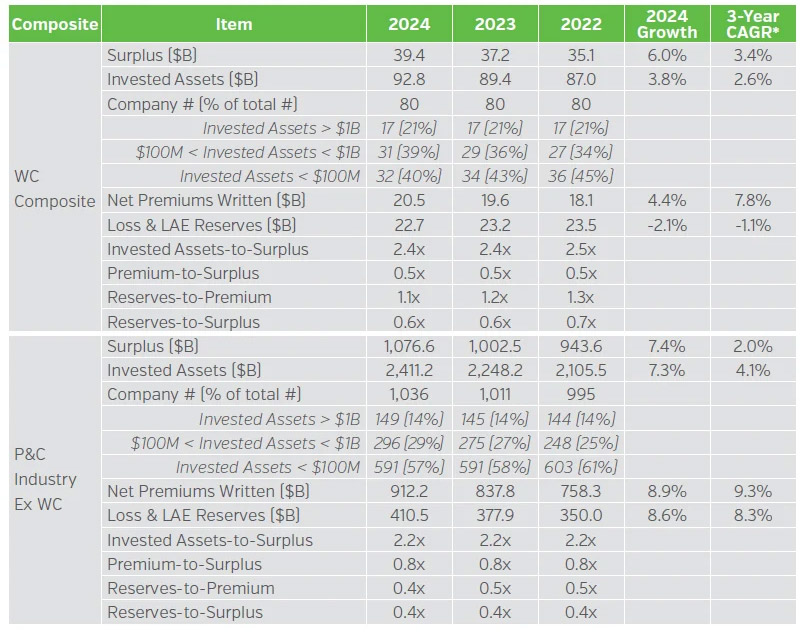
Exhibit 1 compares statutory surplus, total invested assets, net premiums written, and loss reserves between the WC composite and the P&C industry from 2022 to 2024. While the WC composite’s investment leverage (invested assets-to-surplus ratio) was slightly higher than that of the P&C industry, it maintained a lower premium leverage (net premiums written-to-surplus) and a higher reserves-to-premium ratio, reflecting the longer-tailed nature of the WC business. WC writers were generally larger in terms of invested assets, with 60% holding more than US$100m as of 2024, compared to 43% of other P&C firms. Over the past three years, the WC composite experienced more pronounced growth in surplus, while the P&C industry saw higher growth rates in invested assets, net premiums, and reserves.
 

Exhibit 1. Surplus, Invested Assets, Premium, and Premium Trend 2022-2024
Image
Fig1

*Compound Annual Growth Rate
Source: NEAM, S&P Capital IQ Pro
 

WC Composite's Asset Characteristics

Net Investment Income3 (%) Trailed the P&C Industry

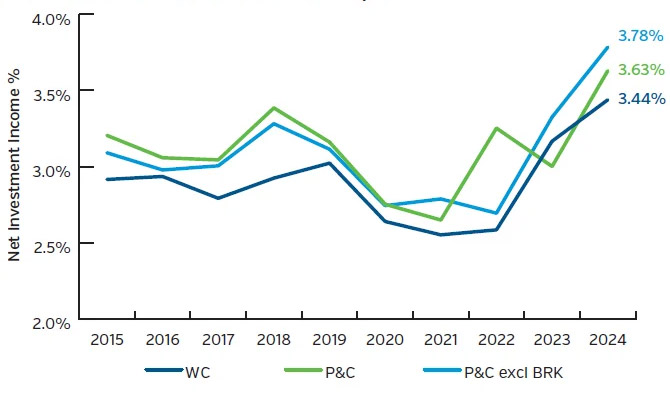
Exhibit 2 shows the net investment income (%) for the WC composite and the P&C industry. Over the past decade, the WC composite surpassed the P&C industry in this metric only in 2023, when the latter experienced a dip due to significant reallocations by Berkshire Hathaway (BRK).4 These reallocation activities caused a noticeable divergence in the P&C industry’s net investment income, depending on whether BRK is included in the analysis. When excluding BRK, the WC composite’s net investment income trend was more in line with that of the P&C industry, although the gap between the two groups widened in 2024.
 

Exhibit 2. Net Investment Income (%) Comparison
Image
NEAMgroup_02_net_investment_income

Source: NEAM, S&P Capital IQ Pro
 

More Allocations to Bonds and Less to Equities

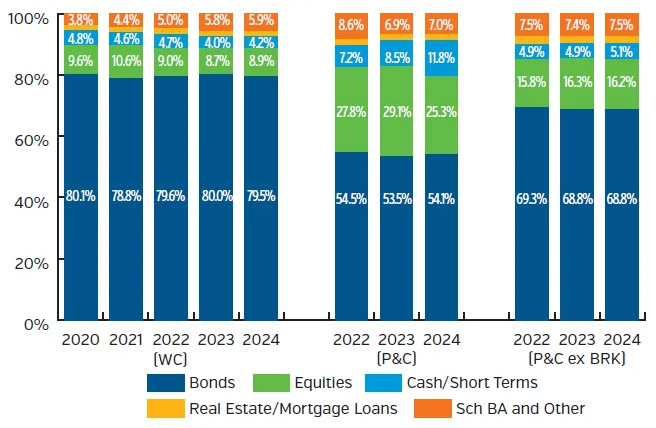
Exhibit 3 illustrates the broad asset allocations of the WC composite compared to the P&C industry. The WC composite was significantly overweight in fixed income and underweight in equities relative to the P&C industry. Though the WC composite’s allocation to Schedule BA assets gradually increased, accounting for 5.9% of invested assets as of 2024, it was still below the P&C industry’s 7.0%. These differences in sector allocations became slightly less pronounced when BRK was excluded from the P&C composite.
 

Exhibit 3. Invested Assets Sector Composition
Image
NEAMgroup_03_invested_assets_sector_composition

Source: NEAM, S&P Capital IQ Pro
 

Lower Risk Assets as a Percentage of Surplus

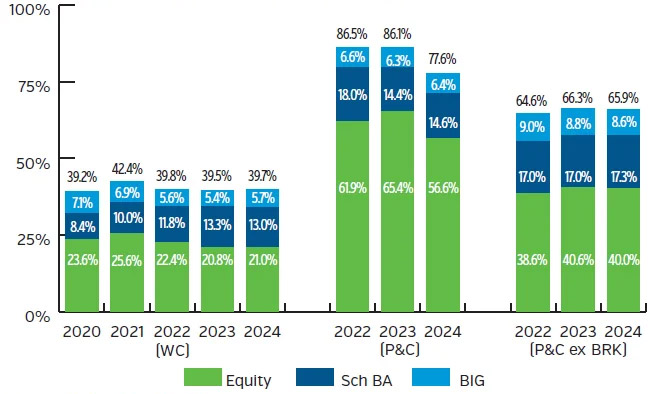
Exhibit 4 displays risk assets, defined as equities, fixed income assets rated below-investment-grade (<BBB), and Schedule BA assets, as a percentage of surplus for both the WC composite and the P&C industry. The WC composite’s risk asset allocations declined since 2021, reaching 39.7% of surplus as of year-end 2024, well below the P&C industry’s 77.6%. While allocations to Schedule BA assets and below-investment-grade bonds were relatively comparable between the two groups, the equity allocation was the primary driver of the difference. When excluding BRK, the P&C industry’s risk asset allocation dropped to 65.9% of surplus in 2024, still significantly higher than that of the WC composite.
 

Exhibit 4. Risk Assets as a Percentage of Surplus
Image
NEAMgroup_04_risk_assets_percentage_surplus

Source: NEAM, S&P Capital IQ Pro
 

Gap in Fixed Income Book Yield Widened in 2024

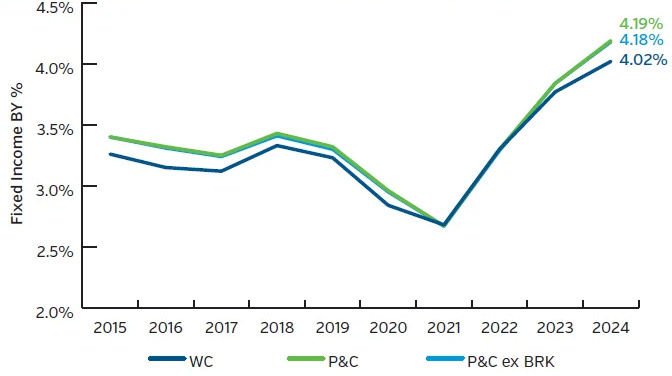
Exhibit 5 shows that the WC composite’s fixed income portfolio had lower book yields than the P&C industry’s over the past decade. The gap between the two groups narrowed in 2021 and 2022, with virtually no difference during that period. However, the WC composite trailed the industry again in 2023, and the gap widened to 17 basis points (bps) in 2024. BRK did not have as much influence on the industry’s fixed income portfolio as it did on equities and alternative assets,5 and its exclusion did not materially impact the industry’s overall book yield.
 

Exhibit 5. Comparison of Fixed Income Portfolio Book Yield 2015-2024
Image
NEAMgroup_05_comparison_fixed_income_portfolio_book_yield

Source: NEAM, S&P Capital IQ Pro
 

Overweight in Agency Residential Mortgage-Backed Securities and Underweight in Tax-Exempt Municipal Bonds

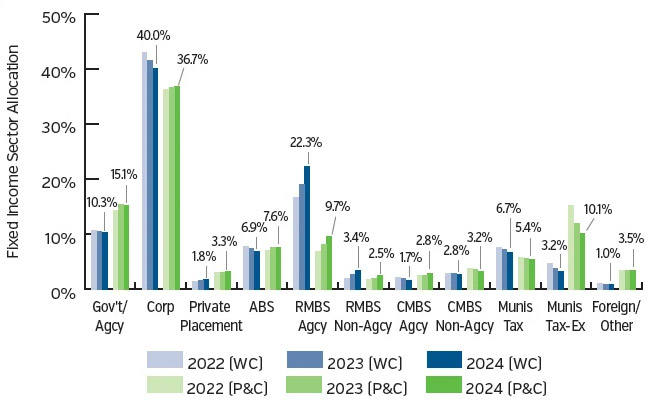
Exhibit 6 shows the fixed income sector allocations for the WC composite and the P&C industry. The most notable difference was in agency residential mortgage-backed securities (RMBS), where the WC composite was overweight, with more than double the allocation of the P&C industry. This trend was particularly driven by the largest writers in the WC composite, with the top five companies increasing their allocations from 20% in 2022 to 27% in 2024. In contrast, the P&C industry held higher allocations in tax-exempt municipal bonds and government/agency bonds. Over time, both groups increased their allocations to structured securities, particularly agency RMBS, while reducing their holdings in tax-exempt municipal bonds.
 

Exhibit 6. Comparison of Fixed Income Sector Allocations
Image
NEAMgroup_06_comparison_fixed_income_sector_allocations

Source: NEAM, S&P Capital IQ Pro
 

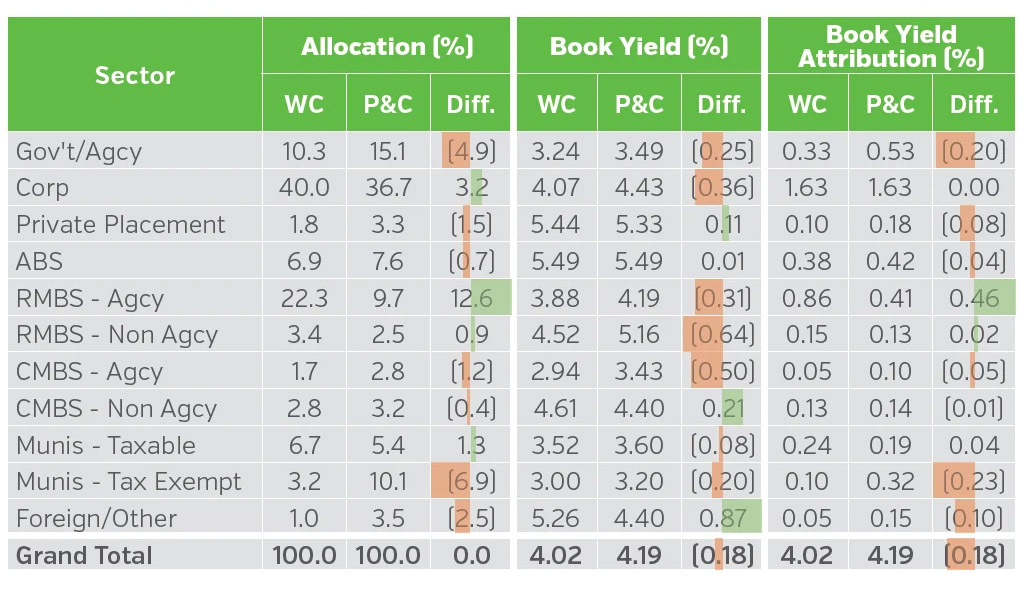
Exhibit 7 illustrates fixed income allocation and book yield by sector in 2024 for both the WC composite and the P&C industry. Book yield attribution was calculated by multiplying each sector’s allocation percentage by its respective book yield, with the sum representing the total book yield. While corporate bonds were the largest source of book yield for both groups, the WC composite saw higher attribution from agency RMBS and taxable municipal bonds, driven by larger allocations to those sectors. In contrast, the P&C industry recorded greater attribution from most other sectors, particularly tax-exempt municipal bonds and government/agency bonds, due to both higher allocations and stronger sector yields.
 

Exhibit 7. Comparison of 2024 Fixed Income Allocation and Book Yield by Sector
Image
description

Source: NEAM, S&P Capital IQ Pro
 

Similar Average Credit Quality to the P&C industry

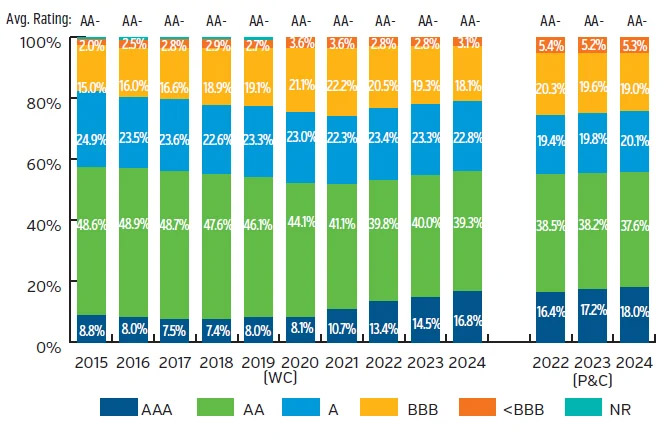
Exhibit 8 presents the fixed income credit quality trends over time for the WC composite and the P&C industry. In 2024, the WC composite’s allocation to AAA-rated bonds continued to rise, while its allocation to BBB-rated bonds declined. Prior to 2022, amid a prolonged low-yield environment, WC writers increased their allocations to BBB and below-investment-grade bonds, likely in pursuit of higher income. However, since the Federal Reserve’s tightening policy took effect in 2022, the WC composite has shifted toward higher-rated bonds, particularly AAA-rated securities, to capitalize on favorable yields in sectors like MBS and asset-backed securities (ABS). While average credit quality remained at AA- for both groups, the WC composite held lower allocations to below-investment-grade bonds and higher allocations to AA and A-rated bonds relative to the P&C industry as of year-end 2024.
 

Exhibit 8. Fixed Income Credit Quality Distribution
Image
NEAMgroup_08_fixed_income_credit_quality_distribution

Source: NEAM, S&P Capital IQ Pro
 

Fixed Income Duration Longer than the P&C industry

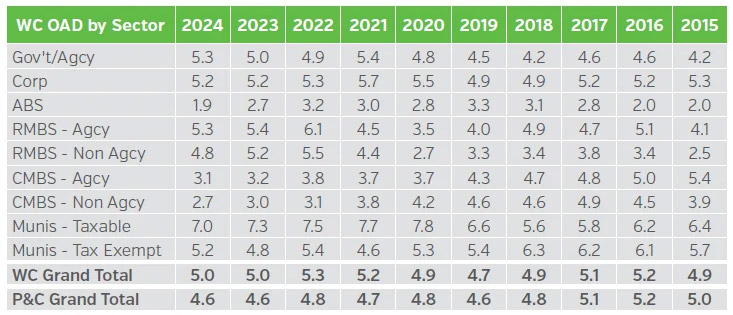
Exhibit 9 shows the option-adjusted duration (OAD) of the WC composite’s fixed income portfolio by sector, alongside the total OAD for the P&C industry. Over the past decade, the OADs of the two groups remained relatively close, particularly through 2020. The gap began to widen in 2021, when the WC composite’s OAD extended to 5.2, while the P&C industry’s OAD remained relatively stable. The WC composite’s higher allocations to agency RMBS, combined with duration extension in the sector, drove the divergence. In 2024, both groups maintained the same total OADs as in the previous year, with the gap holding steady at 0.4. Within the WC composite, sector-level duration was longest in taxable municipal bonds and shortest in ABS.
 

Exhibit 9. Comparison of Fixed Income Portfolio Option-Adjusted Duration (OAD) by Sector
Image
NEAMgroup_09_comparison_fixed_income_portfolio_OAD

Source: NEAM, S&P Capital IQ Pro
 

Greater Risk-Taking Led to Higher Yields for Larger WC Writers

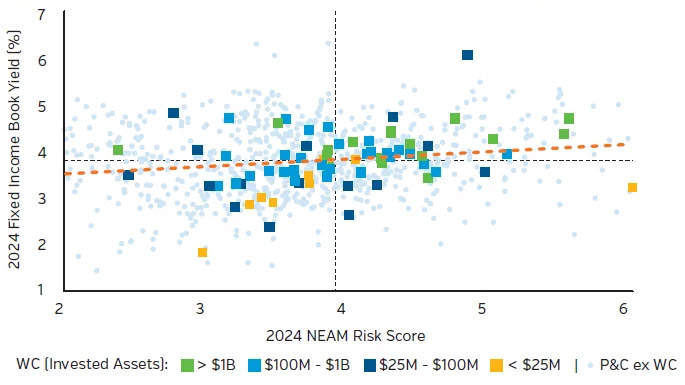
NEAM estimates a Risk Score based on duration, credit quality, and convexity to provide a unified measure of investment risk for fixed income portfolios. Exhibit 10 illustrates how individual WC writers’ book yields varied relative to this Risk Score in 2024. Individual WC writers are represented as squares, color-coded by invested asset size. Smaller gray dots represent other P&C writers, with the industry median Risk Score and book yield marked by the two green dotted lines. The red regression line shows the relationship between book yield and Risk Score across the entire P&C industry, including WC. Its positive slope indicates that, generally, higher Risk Scores were associated with higher book yields across the industry. Large WC insurers (green), with invested assets over US$1b, tended to occupy the upper-right quadrant, achieving higher yields while assuming greater risk, reflecting exposure to lower-rated, longer duration, and more negatively convex credit. Medium-to-large (dark blue) and medium-to-small (light blue) insurers, with invested assets between US$25m and US$1b, were broadly dispersed without a clear pattern, displaying diverse approaches to balancing risk and return. Small insurers (yellow), with invested assets under US$25m, were concentrated in the lower-left quadrant, exhibiting lower book yields and lower Risk Scores.
 

Exhibit 10. WC Writers' 2024 Fixed Income Book Yields against NEAM Risk Score
Image
NEAMgroup_10_workers_comp_writers_fixed_income_book_yields_risk_score

Source: NEAM, S&P Capital IQ Pro
 

Key Takeaways

  • The WC composite maintained an investment leverage comparable to the broader P&C industry but exhibited a lower premium-to-surplus ratio and higher reserves-to-surplus ratio, reflecting the longer-tailed nature of the WC business.
  • WC insurers generally lagged the industry in net investment income (%), partly due to lower exposure to risk assets, such as equities, below-investment-grade bonds, and alternative investments.
  • The WC composite’s fixed income book yield remained below that of the broader industry; although the gap narrowed in 2021 and 2022, it widened again in 2024.
  • Among fixed income sectors, WC insurers were overweight in agency RMBS and underweight in tax-exempt municipal bonds relative to the P&C industry.
  • Average credit quality remained at AA- for both groups and the WC composite’s allocation to AAA-rated bonds continued to rise, while its allocation to BBB-rated bonds declined.
  • Fixed income duration for WC insurers extended in 2021 and remained longer than that of the broader P&C industry.
  • Larger WC firms (with over US$1b in invested assets) typically held riskier fixed income portfolios than their smaller peers and achieved higher book yields.

Read More From New England Asset Management


Endnotes

1 Perspectives, “Navigating Workers’ Comp Investment Portfolios: Threats & Opportunities” (March 2024)
2 P&C insurers operating as of year-end 2024 whose business focus was ‘Commercial Workers’ Compensation’ according to S&P Global, where workers’ compensation represents the highest net premiums written among their lines of business, and where the difference between workers’ compensation and the second-highest line is at least 15% of total net premiums written.
3 Includes income earned from all investments, such as interest and dividends from bonds, stocks, mortgages, and real estate, excluding realized or unrealized capital gains.
4 The significant reduction in equities and increase in cash/short terms in 2024 was driven primarily by BRK, whose equity holdings declined by US$69b and cash/short terms increased US$83b. Also, the company’s Schedule BA investments decreased from US$56b in 2022 to US$27b in 2023.
5 As of year-end 2024, BRK’s bond holdings were ~US$8b, compared to stocks of US$302b and other investments of US$25b. Given its limited impact, we will not include the ‘P&C industry excluding BRK as a comparison in the subsequent exhibits related to the fixed income portfolio.


Originally published by NEAM in October 2025. This is not an offer to conduct business in any jurisdiction in which New England Asset Management, Inc. and its subsidiaries are not registered or authorized to conduct business.

© 2025 New England Asset Management, Inc.
 
All rights reserved. This publication has been prepared solely for general informational purposes and does not constitute investment advice or a recommendation with respect to any particular security, investment product or strategy. Nothing contained herein constitutes an offer to provide investment or money management services, nor is it an offer to buy or sell any security or financial instrument. The investment views expressed herein constitute judgments as of the date of this material and are subject to change at any time without notice. Future results may differ significantly from those stated in forward-looking statements, depending on factors such as changes in securities or financial markets or general economic conditions. While every effort has been made to ensure the accuracy of the information contained herein, neither New England Asset Management, Inc. (“NEAM, Inc.”) nor New England Asset Management Limited (together, “NEAM”) guarantee the completeness, accuracy or timeliness of this publication and any opinions contained herein are subject to change without notice. This publication may not be reproduced or disseminated in any form without express written permission. NEAM, Inc. is an SEC registered Investment Advisor located in Farmington, CT. This designation does not imply a certain level of skill or training. In the EU this publication is presented by New England Asset Management Limited, a wholly owned subsidiary of NEAM, Inc. with offices located in Dublin, Ireland and London, UK. New England Asset Management Limited is regulated by the Central Bank of Ireland. New England Asset Management Limited is authorized by the Central Bank of Ireland and subject to limited regulation by the Financial Conduct Authority. Details about the extent of our regulation by the Financial Conduct Authority are available from us on request. This is not an offer to conduct business in any jurisdiction in which New England Asset Management, Inc. and New England Asset Management Limited are not reigistered or authorized to conduct business.

Share this post

Sign Up Now for Full Access to Articles and Podcasts!

Unlock full access to our vast content library by registering as an institutional investor

Register

Contacts


New England Asset Management

New England Asset Management (NEAM) strives to be integral to the success of our insurance industry clients by providing investment management solutions through a team of skilled professionals dedicated to delivering exceptional client service. We aim to build true, enduring relationships with our insurance company clients by combining three core attributes:

Dedicated Teams    
NEAM is staffed with dedicated teams of knowledgeable insurance and capital markets professionals.

Actionable Tools    
Our combination of talent and technology is designed to support all aspects of your investment management.

Tailored Solutions    
We are acutely aware of the unique concerns and challenges insurers face on a daily basis and so these are reflected in our investment process.

Our comprehensive offering includes a wide range of services:

  • Asset Management Services
  • Enterprise Capital Strategy Services
  • Capital & Risk Analytics Platform
  • Investment Accounting & Reporting Services

www.neamgroup.com
74 Batterson Park Road
Farmington, CT 06032


View the contributor page

Sign Up Now for Full Access to Articles and Podcasts!

Unlock full access to our vast content library by registering as an institutional investor .

Create an account

Already have an account ? Sign in

Ѐ Ё Ђ Ѓ Є Ѕ І Ї Ј Љ Њ Ћ Ќ Ѝ Ў Џ А Б В Г Д Е Ж З И Й К Л М Н О П Р С ΄ ΅ Ά · Έ Ή Ί Ό Ύ Ώ ΐ Α Β Γ Δ Ε Ζ Η Θ Ι Κ Λ Μ Ν Ξ Ο Π Ρ Ё Ђ Ѓ Є Ѕ І Ї Ј Љ Њ Ћ Ќ Ў Џ А Б В Г Д Е Ж З И Й К Л М Н О П Р С Т У Ф Х Ц Ч Ш Ā ā Ă ă Ą ą Ć ć Ĉ ĉ Ċ ċ Č č Ď ď Đ đ Ē ē Ĕ ĕ Ė fi fl œ æ ß