


TCW -

The Case for Residential Loans for Insurance Investors

TCWFeatured

Gordon Li, CFA
Eddie Wang, CFA, FRM
Jeffrey T. Katz
Powell Thurston


Key Takeaways

01

The National Association of Insurance Commissioners (NAIC) adopted a change in Risk-Based Capital (RBC) rulesin December 2025: Residential Mortgage Loans held in qualified Statutory Trusts can be reported on Schedule B on a look-through basis.

02

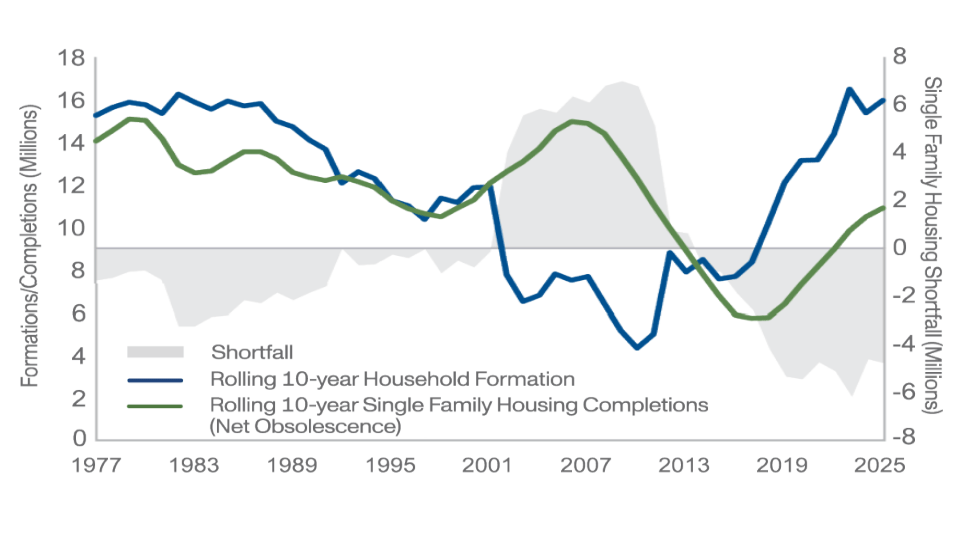
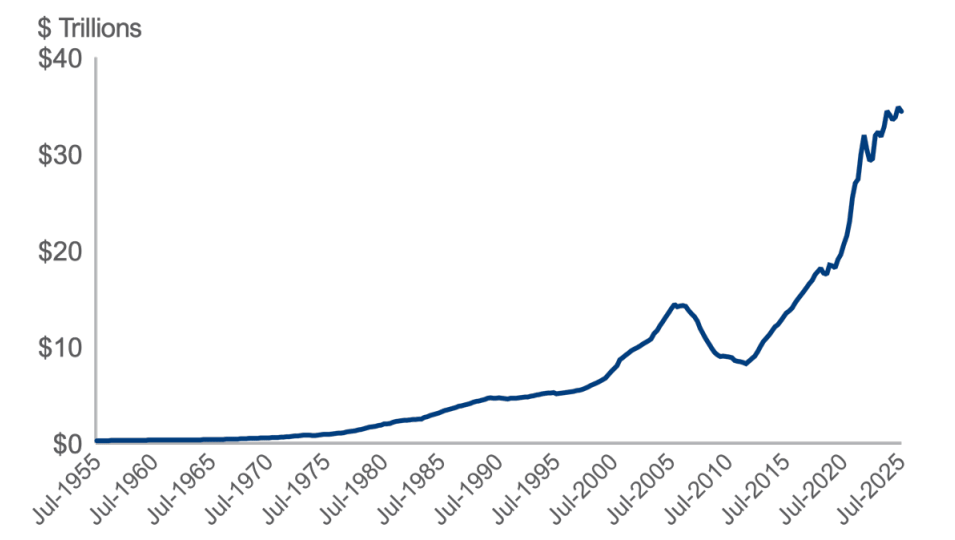
The U.S. housing market is home to strong fundamentals, bolstered by a record $34 trillion in home equity and a shortfall of almost 5 million units of single-family homes.

03

Residential mortgage loans offer insurance investors access to a highly scalable asset class with attractive spreads and favorable capital treatment, supported by strong fundamentals.


Residential Mortgage Loans in Statutory Trusts for Insurers: Q&A

What’s new for insurers?
  • The National Association of Insurance Commissioners (NAIC) adopted a change in Risk-Based Capital (RBC) rules in December 2025: Residential mortgage loans held in qualified Statutory Trusts can be reported on Schedule B (mortgage loans) on a look-through basis.
  • The change is effective on January 1, 2027. Early adoption is permitted.
  • Before the change: Commingled investments are treated like equities. RBC capital requirements are high. For life insurers, RBC is 30%.
  • After the change: Mortgage loans held in qualified Statutory Trusts get look-through treatments, RBC capital requirements are the same as mortgage loans held directly, which are much lower. For life insurers, RBC is 0.68% for mortgage loans that are not guaranteed or insured by the Federal Housing Administration (FHA) or the U.S. Department of Veterans Affairs (VA).
What are the advantages of investing in a Statutory Trust versus owning the loans directly?
  • For insurers: Bypasses the requirement for insurers to obtain individual state lending licenses. There are also structural and tax advantages.
  • For asset managers: Use separate series in the Statutory Trust rather than creating multiple separately managed accounts (SMA). See additional details below.
What are NAIC’s criteria for qualified Statutory Trusts?
  • Legal structure
    • The Statutory Trust must be domiciled in a U.S. state. A common example is Delaware Statutory Trust.
    • The trust must maintain all requisite documents and records according to the applicable state statutes.
  • Insurer’s ownership
    • Insurer must hold 100% undivided beneficial ownership interest of the trust, or 100% of a specific series of the trust.
    • All cash flows from the single residential mortgage loan agreements must flow through the Statutory Trust directly to the insurer, with the exception of fees.
  • Statutory Trust’s investments
    • The Statutory Trust may only hold the following assets: Residential mortgage loans, real estate received through foreclosure, and cash and cash equivalents.
    • The Statutory Trust has no transactions of its own other than transactions associated with the insurer’s ownership.
What are NAIC’s criteria for Designated Series in Statutory Trusts?
  • Designated Series in Statutory Trusts should maintain distinct and separate records, assets, and liabilities from the overall trust and other series in the trust. The separation can be either direct, or indirect through a nominee or other approaches.
  • Insurer must own 100% undivided beneficial ownership interest in all assets of the series. In other words, the insurer owns each single mortgage loan in the Series, and has ability to divest without contingency upon other series in the trust.
  • For example, a Statutory Trust has separate Series A and B.
    • Insurer owns 100% of Series A and 50% of Series B: Only the investment in Series A qualifies.
    • Insurer owns 50% of Series A and 50% of Series B: Neither investment qualifies.
Can a REIT be structured as a qualified Statutory Trust?
  • Yes, if the REIT satisfies NAIC’s criteria for qualified Statutory Trust.
What are NAIC’s criteria for residential mortgage loans?
Do multi-family loans qualify as residential mortgage loans?
  • 1 to 4 family residences qualify: Single family homes, condominiums, townhouses, and HELOC mortgages.
  • 5 or more family residences do not qualify: NAIC treats them as commercial mortgages rather than residential mortgages, therefore they are out of scope of this change.
Can the residential mortgage loans be securitized into a few tranches?
  • No. Securitizations are not in scope of residential mortgage loans, they are categorized as asset-backed securities (ABS).
Can multiple residential mortgage loans be grouped into a pass-through security?
  • No. Must be individual loans rather than a security.
How can TCW customize the Statutory Trusts for insurers?
  • The Statutory Trusts can be actively managed across the full lifecycle of the loans.
  • The Statutory Trusts support both capital additions and redemptions.
  • The Statutory Trusts can be structured as evergreen; pre-fixed termination date is not required.
  • The Series in the trusts can be designed to meet each insurer’s specific needs.
Image
Photo of exterior house

Strong Fundamentals

Residential mortgage loans offer insurance investors access to a highly scalable asset class with attractive spreads and favorable capital treatment, supported by strong fundamentals.

The U.S. housing market today is home to a record $34 trillion in home equity. This is, in part, due to over 15 years of home price appreciation supported by quantitative easing policies paired with severe underbuilding that has restricted supply. Currently, the U.S. housing market is facing a shortfall of almost 5 million units.

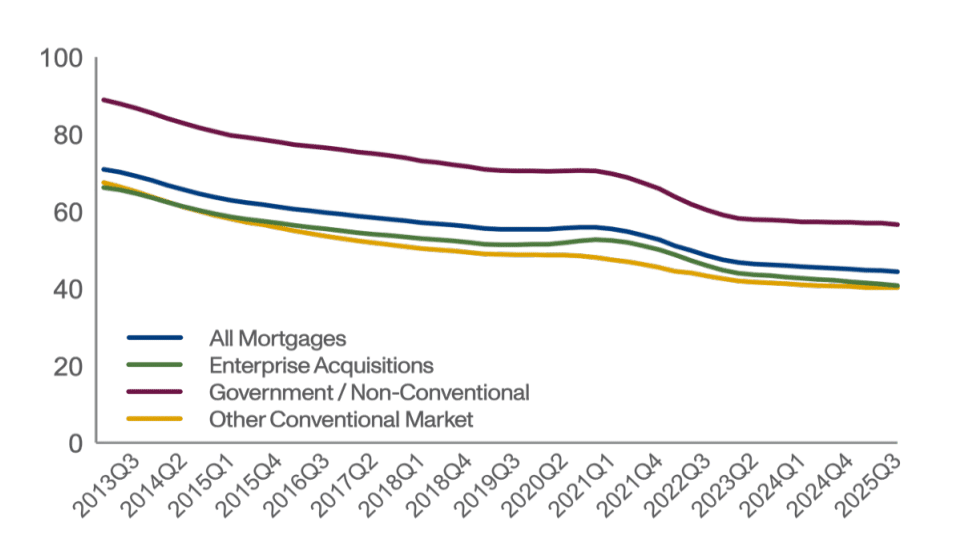
As such, the aggregate loan-to-value (LTV) of the U.S. housing market has fallen to a record low. According to data from the Urban Institute, the total value of the U.S. single-family housing market is $49.3 trillion, while mortgage debt outstanding is $13.5 trillion, implying an average LTV ratio of just 27%. The LTV ratio of mortgage borrowers has similarly improved. Based on data from the Federal Housing Finance Agency (FHFA), the average mark-to-market LTV of the entire mortgage market is 52.6%, down from 80.5% in 2013.

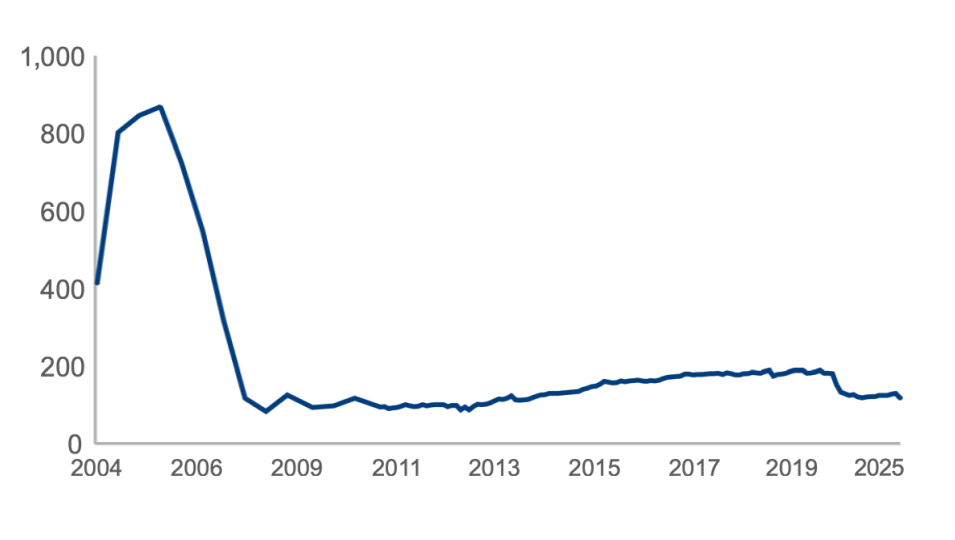
At the same time, mortgage underwriting standards remain at close to historically tight levels, representing a substantial U-turn from the pre-Global Financial Crisis era. As a result, fundamental performance across mortgage products remains strong. Aggregate serious delinquency rates (loans that have missed a payment for more than 3 months) are currently under 0.5% for Jumbo and Investor 2.0, and 2.6% in non-qualified mortgages (non-QM).
 

Household Formations vs. Single Family Completions
Image
Graph

Source: TCW, JP Morgan, U.S. Census
 

Average Mark-to-Market LTV of Mortgage Market
Image
Graph

Source: TCW, Federal Housing Finance Agency
 

Owner’s Equity in Real Estate
Image
Graph

Source: TCW, Federal Reserve Bank of St. Louis
 

Mortgage Credit Availability Index
Image
Graph

Source: Bloomberg
 

Scalability, Attractive Spread Pickup, and Favorable Capital Treatment

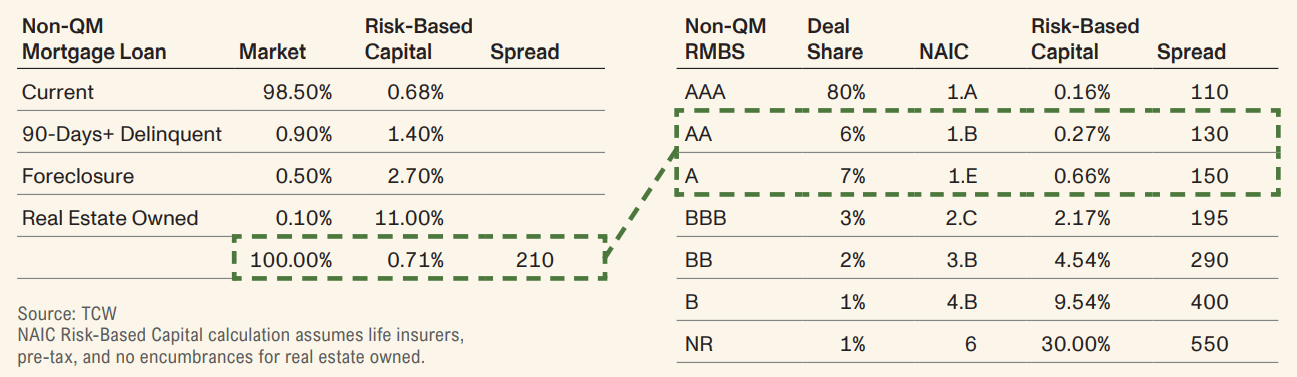
Investing in residential mortgage loans offers a substantial spread pickup versus non-QM mortgage-backed securities (RMBS) for comparable rating and risk-based capital charges. Looking at an illustrative example below, a non-QM mortgage loan offers 200 basis points (bps) of spread over Treasuries, a 60 to 75 bps spread pickup over AA- or A-rated RMBS at comparable risk-based capital charges.

Moreover, the residential mortgage loan market offers the advantage of scalability when compared to the market for mortgage securitizations. Indeed, 2025 saw an estimated $561 billion mortgage loan originations. By contrast, single-A to AA rated RMBS saw only $25 billion in gross issuance in the full year, or roughly 4% of the supply of mortgage loans. For context, in a typical $400 million RMBS transaction, the single-A to AA rated tranches would account for only $50 million in bonds. In the residential mortgage loan market, pools in the $100 to $200 million context would be regularly transactable.

Image
Table


Read More from TCW


Disclosure
This material is for general information purposes only and does not constitute an offer to sell, or a solicitation of an offer to buy, any security. TCW, its officers, directors, employees or clients may have positions in securities or investments mentioned in this publication, which positions may change at any time, without notice. While the information and statistical data contained herein are based on sources believed to be reliable, we do not represent that it is accurate and should not be relied on as such or be the basis for an investment decision. The information contained herein may include preliminary information and/or “forward-looking statements.” Due to numerous factors, actual events may differ substantially from those presented. TCW assumes no duty to update any forward-looking statements or opinions in this document. Any opinions expressed herein are current only as of the time made and are subject to change without notice. Past performance is no guarantee of future results. All investing involves risk including the potential loss of principal. Market volatility may significantly impact the value of your investments. Recent tariff announcements may add to this volatility, creating additional economic uncertainty and potentially affecting the value of certain investments. Tariffs can impact various sectors differently, leading to changes in market dynamics and investment performance. © 2026 TCW

Share this post

Sign Up Now for Full Access to Articles and Podcasts!

Unlock full access to our vast content library by registering as an institutional investor

Register

Contacts


Image
TCW_Logo_Black


TCW has a dedicated insurance platform that is fully integrated with our dynamic investment management platform, which has served investors for over 50 years, enabling clients to evaluate opportunities through both an investment and insurance lens. The firm’s insurance portfolios incorporate a full range of solutions that can be customized as individual strategies or designed to function together within a diversified general account framework.  

Combining insurance-focused expertise, specialized infrastructure, and analytical capabilities, the platform helps insurers address portfolio construction, capital efficiency, regulatory considerations, statutory reporting, and balance sheet optimization as part of the investment process. By integrating these capabilities into a single client experience, TCW provides insurers with a more comprehensive approach to managing assets and liabilities. In a market where many managers offer insurance-compatible products, TCW distinguishes itself through the depth of its insurance-focused resources and its ability to support insurers holistically as regulatory, reporting, and capital requirements continue to evolve.

TCW is a global asset manager with $200 billion in assets under management as of June 30, 2026, offering innovative strategies across fixed income, equities, and alternatives to diverse insurance clients. 
 

TCW
515 South Flower Street
Los Angeles, CA 90071
insurancesolutions@tcw.com
 

View the contributor page

Sign Up Now for Full Access to Articles and Podcasts!

Unlock full access to our vast content library by registering as an institutional investor .

Create an account

Already have an account ? Sign in

Ѐ Ё Ђ Ѓ Є Ѕ І Ї Ј Љ Њ Ћ Ќ Ѝ Ў Џ А Б В Г Д Е Ж З И Й К Л М Н О П Р С ΄ ΅ Ά · Έ Ή Ί Ό Ύ Ώ ΐ Α Β Γ Δ Ε Ζ Η Θ Ι Κ Λ Μ Ν Ξ Ο Π Ρ Ё Ђ Ѓ Є Ѕ І Ї Ј Љ Њ Ћ Ќ Ў Џ А Б В Г Д Е Ж З И Й К Л М Н О П Р С Т У Ф Х Ц Ч Ш Ā ā Ă ă Ą ą Ć ć Ĉ ĉ Ċ ċ Č č Ď ď Đ đ Ē ē Ĕ ĕ Ė fi fl œ æ ß