





Peachtree Group-

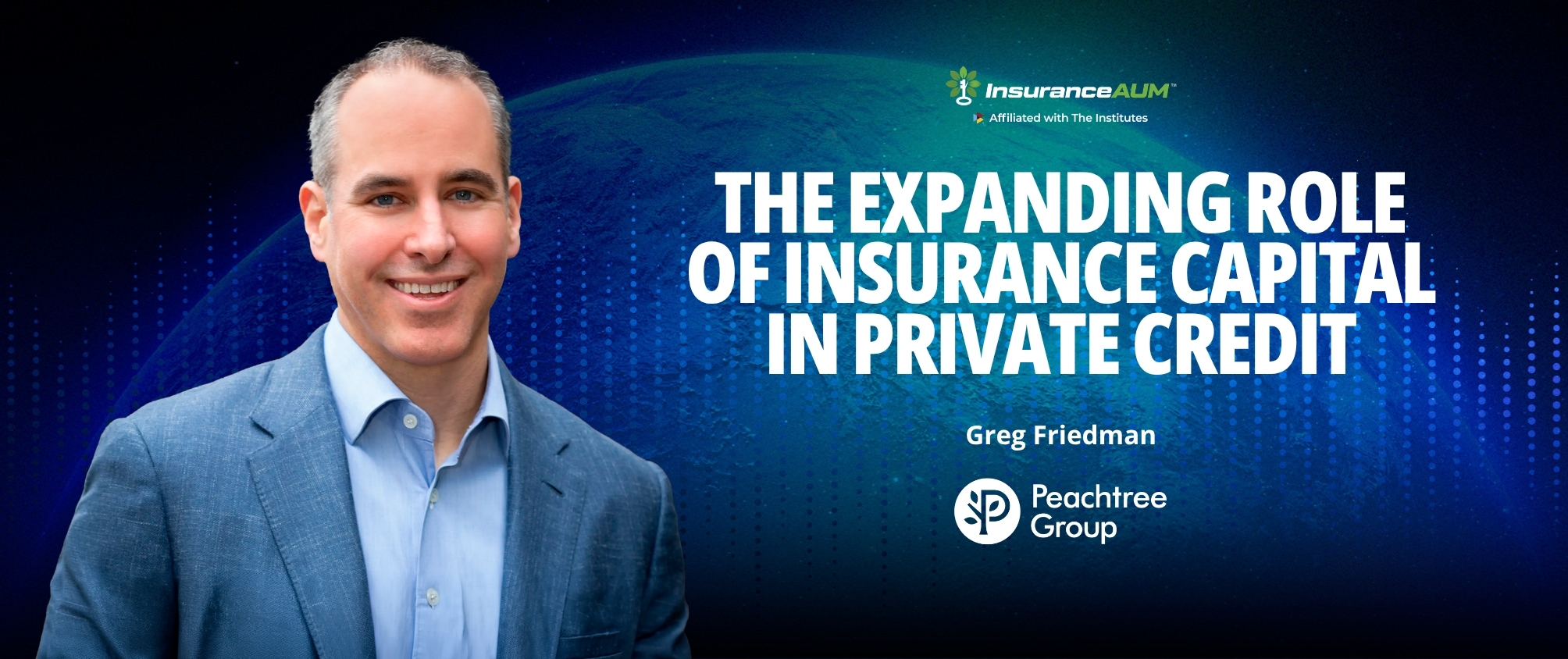
The Expanding Role of Insurance Capital in Private Credit

Image
IAUM_Podcast_Peachtree-11.26_Web_2026


Stewart: Hey, welcome back to another edition of the InsuranceAUM Podcast. My name is Stewart Foley. As you probably know after 400 podcasts, you're probably sick of me saying it. I'll be your host.

And here's something I've been thinking about. Everybody, as we all know, wants insurance capital between private credit managers, specialty finance companies, and real estate lenders.

We all know that, and we know why. The insurance industry has 30% of the world's invested assets, based on my research, approaching $40 trillion, approaching $10 trillion here in the U.S.

And these are very, very sophisticated investors with varying liabilities and an appetite for predictable cash flows.

But just because somebody can originate a good loan, does that mean it's a good investment for an insurance company? Because those are two very different things.

So today we're going to talk about how insurance capital is finding its way to some interesting corners of private credit, from commercial real estate lending to C-PACE and government-supported financing.

And more importantly, we're going to talk about what an insurance investor needs to understand before writing the check.

I'm delighted to welcome Greg Friedman, Managing Principal and CEO of Peachtree Group.

Greg co-founded Peachtree in 2007 and has overseen more than $14 billion of investments across commercial real estate and other businesses.

He's got more than 26 years of experience in credit and equity investing, including substantial experience in hospitality finance.

Before Peachtree, he held senior positions at Specialty Finance Group and GMAC Commercial Mortgage.

He's a University of Texas graduate, which rings so well in my ears out here in Fredericksburg, Texas, and serves on the Real Estate Fund Advisory Board at UT's McCombs School of Business.

Greg, welcome to the show. It's great to have you.

Greg: Yeah, thank you, Stewart, for having me. So I'm super excited to be on this podcast with you.

And with your opening, we're super excited to be involved with your organization, just given our focus on insurance companies.

Stewart: And it's interesting. I sold the company a little over a year ago, and the owners now, The Institutes, are very focused on the... They're a massive part of the insurance industry, and they're the purveyor of the CPCU designation as well as the CIIM designation.

And so we're basically all insurance all the time.

Can we start with the same two questions? Where'd you grow up, and what's a fun fact that you'd be willing to share?

Greg: Yeah, so I grew up actually in a small town outside of Tuscaloosa.

So I lived in this town called Fayette, Alabama, until I was 10 years old. And my parents got divorced, and when my parents got divorced, fortunately and unfortunately, I moved to Texas.

So I ended up moving to Dallas, Texas, and ended up going to high school at Plano Senior High.

And the only reason I mention all that is that's what caused me to actually go to the University of Texas at Austin. So that's my connection.

And so the fun fact, I guess getting to that part of the question, is because I get asked this all the time, I grew up being a huge avid fan of University of Alabama football.

So I always loved Alabama football. As any child that grows up in Alabama, either you're an Alabama fan or an Auburn fan.

And I grew up as an Alabama fan wanting to play for Bear Bryant one day, which I was never good enough to play college football, but I'm still a huge Alabama football fan and a Texas fan.

So I'm probably one of the few out there that love both teams.

Stewart: Wow, that's a tightrope to walk.

I mean, the thing I didn't appreciate moving down here is the rivalry between UT and A&M. It's similar to Alabama and Auburn. It's like you're one or the other.

And it's interesting. It is. And those regional alliances are powerful, but great programs all the way around.

But everybody's talking about private credit and asset-backed finance. We've done a number of podcasts on those topics, and insurance companies are major... They used to be bit players in this space.

Life carriers have been in it for years and years, but it has become much more prolific after a decade of essentially zero rates.

So what, though, is driving insurer demand today, and how has what insurers want from managers, what the carriers want from you, changed?

Greg: Yeah, so it's a great question.

So to start out with private credit, why insurance companies like it, and really why a lot of other investors like it, is you're getting paid extremely well for the risk as an investor into private credit, assuming it's structured correctly and you have the right manager that is generating those opportunities for you.

But you're getting paid very well. You're getting paid a much better yield than if you're investing through maybe public bonds or whatever the case is.

And private credit, and when I'm talking about private credit today, just to be very clear, I'm primarily talking about private credit within commercial real estate because that's primarily where we focus.

And then our discussions with insurance companies and with other investors tend to center around private credit backed by some level of commercial real estate, if it's through our first mortgage bridge lending programs, our C-PACE lending programs, or even some of the government lending programs like SBA and USDA and things like that.

So with that said, I mean, you have real assets that you're secured against. You're getting much better yields in a lot of cases than what you can get by investing through other types of products, and you're getting very predictable cash flows.

And as you mentioned at the very beginning, insurance companies want to invest where they have very predictable cash flows, and it works very well in private credit because generally speaking, again, if it's structured correctly, you can have very predictable cash flows.

So that's a big reason insurance companies love private credit.

With that said, I mean, just from a standpoint of what they're looking for as it relates to managers, because the reality is this: anyone can go buy public bonds, and in some cases they can buy bonds secured by real estate at some level or in these different components, or they can just allocate into different vehicles that are then going to turn around and allocate to different managers.

But what I'm finding is a lot of insurance companies like the ability to invest directly with the institution, the private credit investor that's actually originating the products, that has the originations, underwriting, servicing, asset management in-house.

And I think that's what really makes it something that insurance companies are starting to value more, are the groups that can actually originate the product versus the groups that are just allocating capital out to other organizations that are actually originating the product.

And that's sort of what makes Peachtree unique as an organization because, as I started the business back in 2007, originally we were primarily focused on investing equity across real estate with a large focus toward hotels.

We quickly shifted into focusing on credit investments because of the great financial crisis.

We had bought a bunch of distressed debt, very successful in restructuring those loans. We bought over 50 first mortgage loans secured by all commercial real estate property types: hotels, busted subdivisions where these were land lot loans, small office, and retail.

We were very successful in restructuring over 90% of those loans and getting paid off through the borrowers.

And so as an organization, we used that as a springboard back in 2010, 2011 to set up our credit platform that does direct lending.

We do all the underwriting. We have an origination team that's actually finding the opportunities for us to provide these bridge loans or to originate SBA loans or C-PACE loans.

And we underwrite everything in-house, as I mentioned, as well as we're doing the servicing.

And when there are issues, which insurance companies, I believe, love along with a lot of other investors out there, is our ability to work out those problems when they do occur.

Because unfortunately, nothing ever goes according to plan.

And when things do go bad, as an organization we're able to step in and be able to work through those problems and to help mitigate any losses through our asset management team.

Stewart: It's interesting, and I want to learn more about C-PACE. I know it tangentially, but not well enough.

And so I would appreciate some education there, and we can get to that.

But one of the things that it's hard to miss is the relationship, sometimes the relationship between insurers and private credit is changing.

And you kind of just touched on this a little bit, but it's not always an insurer just making an allocation to a fund anymore.

You've got direct loans, participations, co-investments, and rated securitizations.

How should an insurer think about choosing among those structures, and what capabilities should it expect from a specialized origination partner versus keeping it in-house?

Greg: Yeah, I mean, it really comes down to the actual organization itself.

I think in a lot of cases, insurance companies are large enough, they have their own team in-house that can originate and underwrite.

So they're able to execute a direct loan or potentially even do A/B loans very successfully internally without outsourcing that to another organization because they have the team in-house to handle that transaction.

And then in other cases, it's better, just depending on the size of the pipeline or the amount of opportunities out there, it's better for them just to do loan participations or even co-investments.

So we're seeing a lot of situations where there's insurance companies that like just to participate with us or co-invest with us because they can latch onto our origination side.

They're still able to do their own underwriting analysis and review the underwriting analysis that we're doing internally, which is very robust.

But we find that some of the insurance companies that don't have as large of a team, they prefer the co-investment loan participation side because it makes it easier for them to scale with us if they're investing with us or even other organizations that are focusing on the real estate side.

And obviously rated securitizations offer a lot of regulatory capital efficiency and, in some cases, some liquidity.

So it really depends on what they're trying to accomplish.

Just one thing to sort of mention that's tangential to your question, one thing unique that I'm starting to see is a lot of insurance companies, they're still allocating capital into funds.

In a lot of cases they're saying, "I'll allocate into your current fund, but I also want exposure in other areas of your platform."

And that may mean they'll invest strategically on the corporate side or do JVs or even they'll invest in some of the other products.

We have several organizations that have invested directly into different vehicles that we've created on the credit side, on the senior debt credit side, and then they'll invest with us on the C-PACE side and so forth, or even in some of our securitizations on the SBA side.

And so they're definitely very... I would say the one thing that I think is changing in the insurance world, they're becoming more and more relationship-driven, and they're trying to find ways to be more strategic in who they work with.

And so similar to us as an organization, we're trying to find fewer partners, not more partners. So we're trying to be strategic in who we partner with.

And that's one thing I do appreciate about the insurance side, is that they're, in most cases, looking really to partner with organizations.

They're not looking just to allocate and move on. They want to have partners that they can actually do multiple things on the investment side with.

Stewart: Yeah, it's funny.

I mean, I'm blessed to know a pretty significant number of CIOs, and I've been in other segments of the institutional space, and it is much more a relationship in the insurance industry.

Partly because insurance companies sell promises, and the wind blows and they take a big loss. They'll be back next year. It may not be at the same price, but they'll be back.

And they're long-lived organizations and really smart money.

And so I think this business, and I've been fortunate to be in it for a long time, I think that this is one of the best groups of investors, particularly if a manager can demonstrate the ability to work inside an insurance construct and understand, because as you kind of alluded to, the structure of the investment can create very different results for two insurance companies that can look a lot alike on paper.

But we talked a little bit about this just a moment ago. Peachtree operates in several specialty lending markets, so C-PACE, SBA, and commercial real estate credit.

I'd love to start with C-PACE. As I mentioned, I'd love to know more about this.

What makes those long-duration, property-assessed cash flows attractive to insurers?

And what does the investor need to understand about property risk, lien protections, and other things that maybe could influence the investment outcome?

Greg: Sure.

So C-PACE, I think, is extremely unique.

It's a very conservative way to invest into commercial real estate from my perspective, just given the fact that it is effectively like a property tax on the property.

So it's collected through the property tax bill. So it's super senior to any of the debt outstanding on the property.

So you are in a very protected position for the most part.

It's not to say that you couldn't lose money, but I think it's very unlikely as a C-PACE lender, if it's structured correctly.

You should have a very low loss ratio, if any loss at all, but you're secured by the actual property.

And again, you're in that super senior position.

And so insurance companies love it because A, it's very protected. B, it's long-duration paper.

In most cases, this is fixed-rate paper over 20 to 30 years, so it should be outstanding for a relatively long period of time.

Usually on average, I think five to 10 years should be the actual outstanding date for that C-PACE loan.

In some cases it can run longer or it could come shorter, but in most cases it's in that five-to-10-year cycle that the C-PACE loan will be outstanding, and you're getting paid for the risk.

So it's very well priced for where you sit in the capital stack.

That's why I've found insurance companies really love it.

In a lot of cases, you can invest into these securitizations that you set up for C-PACE that we've set up, where we do securitizations.

In other cases, you can invest directly into a specific deal, especially on larger transactions.

The securitizations are very effective because it gives diversification for the insurance company, and also there's ratings associated with those securitizations that offer just a lot of capital market efficiency for the insurance company as well.

So those are some of the reasons that they really appreciate the position.

And C-PACE is super unique because there's only so many organizations that are actually focused on C-PACE.

We're one of the top originators, underwriters, and servicers of C-PACE loans.

We'll originate a little under a billion dollars of C-PACE loans this year. I think we're closer to $800 or $900 million of new C-PACE loans, and we're continuing to grow our book.

We have approximately $2 billion of C-PACE loans today, really over $2 billion that we've invested in, that we're currently servicing.

So we're very well skilled and have a lot of experience in the C-PACE space.

Stewart: Am I right that the C-PACE proceeds, and if I've got this goofed up, please don't laugh out loud at me.

Greg: Sure.

Stewart: Isn't it for energy efficiency in the building? Is there some sort of... It has to be used for that purpose.

Is that right, or have I got it goofed up?

Greg: Technically, you are 100% right.

It's commercial property-assessed clean energy.

And I probably gave a very simplified answer when I answered. I didn't really cover that piece of it.

It is for clean energy, and approximately, call it 20 to... typically, depending on the state, you can put a loan of, call it about 20% to 40% of the total project costs for a new construction project, or you could even do a retroactive C-PACE loan.

So about 20% to 40% of the costs or value of the project can qualify as a C-PACE loan.

But any project that is based on just code today to build any new project, it will qualify under the C-PACE program.

So it's a little bit misunderstood in the sense that a lot of times you see today there's a lot of politics around clean energy, and I don't want to make it a political discussion, but there is a lot of politics around clean energy.

This is a little bit different.

This is truly, from my perspective, C-PACE is an incredible program because it's driving economic development.

It's helping drive new development of commercial real estate projects.

And the clean energy aspect to it is not as meaningful as most would expect because, again, if anyone's building any new project, I would say it's very likely and very unlikely they wouldn't qualify.

Very likely they will qualify for C-PACE if they're building any new project based on the code required by pretty much all states in the U.S. today and all local jurisdictions.

Stewart: Yeah, that's super helpful.

And that helps me a bunch. I think insurers, with all due respect to everybody, I mean, I think a lot of these investors love boring.

They love boring and predictable, right? They do.

Greg: Yeah, no, they absolutely do.

Stewart: They're not looking for the hot dot.

The other side of this thing is they've made promises to policyholders.

And so to me, it's been discussed on this show before, and it seems like an interesting niche.

Greg: It's a very interesting niche, and it's the reason we love it as an organization, the reason we even focus on it.

It's a very defensive way to invest in real estate and to get outsized returns.

It's mispriced risk. You're getting paid very well for the risk you're taking because you're at a very...

I mean, again, don't ever want to say you couldn't lose money investing in a C-PACE loan, but it's very unlikely given where you sit in the capital stack.

Stewart: So let's stay with the underlying credit for a minute.

And this is where every now and then we get a guest that has a particular set of experiences that are unique, and we can learn some of the behind-the-curtain stuff.

So you've spent a substantial amount of your career in real estate, particularly hospitality, and that's an interesting niche.

So beyond conventional commercial mortgages, where do you see the most interesting specialized lending opportunities?

And I think you're going to explain this, but what are the characteristics that you think make a deal attractive?

Greg: Yeah, so specialized, probably the most attractive area is when you think about property types, I think hotels are very unique because there is an underallocation of capital chasing hotels compared to some of the other property types.

You look at what's happening in data centers today.

I mean, there is a large amount of capital chasing data centers and trying to provide capital for data centers on the equity side, even the credit side and so forth, and there's a large amount of new capital.

I think about a third of the new capital raised over the last year in commercial real estate has actually been allocated to data centers, and I'm just using this as an example.

Data centers only make up 2% of the commercial real estate ecosystem, as an example.

Hotels make up roughly about, call it 5% of the commercial real estate ecosystem, and only roughly 4% of the new capital raised is allocated to hotels.

So hotels are underallocated.

It's very specialized, to your point, because it's an operating business and it's a real estate business, and you've got to understand how to underwrite both those components.

There's complexity to it. That's why we love that business.

We happen to own a bunch of hotels. We happen to operate a bunch of hotels across the U.S., so we own and operate over a hundred hotels across the U.S., close to 115 assets.

We have a lot of knowledge of how these assets work from an operational perspective.

We understand how different markets behave from a labor perspective.

So we understand the operating component to hotels.

We also understand the real estate component, what it takes to underwrite a good piece of real estate because that's part of our DNA as well as an organization.

We're able to take that expertise of that industry, and because there's less capital chasing that, it becomes a supply-and-demand thing.

Again, we're able to get outsized yields in a lot of cases by doing direct lending across hotel properties.

We're also very successful at buying debt secured by hotel properties as well as other commercial real estate assets.

So we have a lot of success doing that, buying these loans at discounts because you find a lot of other lenders really don't understand certain pieces of real estate, specifically hotels.

And because of our knowledge, we're able to really step in and get very gritty, and also we're able to get in and help structure...

When we're making a loan, structure something that makes sense for the borrower and makes sense for us as a lender to protect our interests.

And so we find just a lot of great opportunities on the lending side.

But hotels, outside of office today, are probably the most mispriced piece of real estate to invest into because hotels reprice daily from a lodging perspective, so it's very hard for people to understand how to underwrite the cash flows.

Fortunately, we have a lot of experience.

We know how to analyze the data, look at not only the historical data, but we have a lot of ways to look at what's driving demand and the sustainability of those demand drivers.

And we underwrite a lot of other components to it that give us the ability to figure out which ones we feel very comfortable making loans to and which ones we end up passing on.

You can see it in our track record.

We've had an incredible experience in being able to not only deploy capital into the hotel space, but to drive incredible returns on the debt side of the house as well as the equity side.

Stewart: I had the opportunity to be on the consulting side for a minute, and managers come in and the presentation's always good.

The presentation is, the track record's good. People are smart.

I've never seen... It's rare, and it's a blessing in this business.

I mean, there's a lot of really smart people, but how do you distinguish between genuine origination and an underwriting advantage from just somebody who's willing to take more risk?

In addition to underwriting, there's portfolio management after you own it.

How does that play into the ultimate return on a given investment or a given strategy, if you will?

Greg: From my perspective, I mean, I think it does come down to how you actually underwrite these investments because anyone can go originate loans.

Anyone could technically go out to the marketplace and say, "I want to provide loans for any type of product."

But having that discipline on the underwriting side, understanding historical trends as it relates to...

And each property type is unique in itself.

So I'll use just the hotels as an example of a property type without running through it, but we see opportunities across multifamily, industrial, retail, hotels.

We own a business that invests on the equity side where we buy industrial properties with investment-grade tenants.

We invest on the equity side, for instance, where we aggregate land parcels and we'll develop effectively these land lots that we'll sell off to public homebuilders and to other groups that are looking to develop home lots or develop homes on those lots.

And that's been a very successful business.

So we understand a lot of the different components of real estate.

The one thing is having that knowledge of being able to underwrite as going in and underwriting the actual investment almost as an owner of that real estate, realizing most cases are loans that we're making.

These are three-to-five-year terms on our bridge lending product versus our C-PACE product, which is longer term.

So understanding where we sit in the capital stack, underwriting how we're exposed and how we feel as an investor taking that wherever our last dollar is being cut off at, underwriting it based on using the...

Again, I'm going back to the hotel piece, but how sticky are the cash flows on that hotel? What's actually driving demand?

So when we're underwriting a hotel, using that as an example, sort of similar to multifamily, what are the actual demand drivers in the market?

What supply is coming in the market?

We're looking at those kinds of components, the stickiness of those demand drivers.

Is it artificial demand? Is there some type of one-time event that drove demand for hotels in that submarket?

For instance, is there a hurricane that came through that market?

Even though you may be on the coast of Florida, there's no way to underwrite or anticipate that you'll constantly have hurricanes every year.

And hurricanes tend to induce demand for a period of time as the areas are redeveloped, but you can't latch onto that as permanent demand.

And so you have to back out some of that artificial demand.

So as we're underwriting investments, we're looking at those components, looking at our basis relative to...

When we're making a loan, we're looking at our basis relative to the comp set.

And then to your question, so we're doing all those kinds of underwriting components, but as you're looking at just the actual origination itself, we're very big on...

Although a lot of third parties will bring us business, it's really these loan brokers will originate loans and they'll bring them to us.

And we do business with a lot of different organizations, third parties that will bring us potential opportunities.

But where we find a lot of success is through our ability to develop true direct relationships with borrowers that are repeat borrowers of Peachtree.

So I'm very big on having direct relationships with borrowers.

I think that pays dividends on the asset management side.

So if something doesn't go according to plan, I find that when you have a direct relationship with the sponsor, it's much easier to work out those loans.

And that's where I think our platform really shines, beyond just having direct origination channels ourselves where we can originate directly with sponsors that own real estate.

We have the ability to asset manage very, I would say probably better than most groups out there on the private credit side today from what we've seen, just given how proactive we are on the asset management side and how we have so much experience working through different cycles.

Stewart: Yeah, I mean, and this is the tail end of it, but it's the part of the show where we ask you to dust off your crystal ball and look forward.

They say 50 is the new 40. One to three is the new three-to-five-year outlook because things seem to be changing more quickly than ever before.

So if we were advising an insurance investment committee considering a larger allocation or an initial allocation, I mean, I think as prolific as private credit is, there are still plenty of carriers who have yet to make an allocation in that space.

And so if you're looking to make an initial allocation or grow it, what would you suggest that they prioritize, and what would you say is one thing to avoid?

Greg: Sure. I think prioritizing the manager.

I mean, we prioritize... I'm very big on the sponsors we lend to because effectively your borrowers are the sponsors, but you're effectively getting married to these sponsors and borrowers.

Same thing if you're allocating capital to a private credit manager, you're effectively entering into this marriage, and you want to make sure you have someone that you have a lot of conviction in and their ability not only to originate and service and underwrite, but you want to make sure they have the right temperament to lead through cycles.

And it's one of those that you want to make sure you have a manager that culturally you get along with, that sees the world very similarly to the way you see the world, and is going to really respect the fact that they're a fiduciary to your capital.

So I would be very focused on underwriting the actual sponsor you're allocating capital to, looking at their track record, looking at not only...

Because everyone has incredible stories about how they've outperformed, but you want to look at the situations that haven't worked out.

And how did they perform in those situations, and what did they do?

Did they do the right things to try to fix that situation?

Because some of the best outcomes are when you get back your money. You may have underperformed on the actual returns, but you didn't lose any money.

But there's a lot of lessons learned in those situations.

And you can see, or even if you took a small loss, for instance, you learn a lesson through those situations and you can learn a lot about that manager and about how they went about making sure that they protected and they were a fiduciary to whoever's capital was involved in that transaction.

And that's probably the biggest thing I would focus on.

I would probably avoid chasing yield.

I think in today's space, I see it too often through retail channels and through even institutional channels, people get so focused and fixated on yield.

Like everyone else, we want to drive as big of a yield as we can, but I'm more focused on the risk to get that yield.

What risk are we taking to drive that yield?

And I think sometimes that gets lost in the picture.

So really understanding the risk that's being taken, what are you really investing into? Where do you sit in the capital stack? What's behind you? What's in front of you? Understanding what could go wrong.

Those are the things that probably are bigger than chasing the actual yield because the reality is, I mean, if your last dollar is 20% of the total capital stack and you're getting paid a 7% yield or 7% interest rate, I'd much rather be there than chasing and going to 75%, and only going to 75% and making a 9% yield.

So you're not getting paid enough potentially for that risk.

So you need to look at what's really happening and how the back-leverage facilities work.

That's one thing in private credit today.

There's a lot of market facilities, these repo facilities, and understanding just all those kinds of components and how that could be impacted in a very volatile environment.

Because there's no question today is one of the most challenging environments to invest capital across any asset type, including real estate.

Real estate's probably even more problematic to a certain degree, but those challenges are what create the opportunity today as well.

So there's no question there's a lot of opportunities, but there's a lot of trapdoors if you're not careful.

Stewart: Yeah, it's interesting.

An insurance CEO would never go to the head of underwriting and go, "I want you to maximize premium volume."

Because they'd be like, "No."

But it's more common, they'll say to the CIO, "I need you to maximize investment income."

And it's like, now you want to maximize investment income with an acceptable level of risk.

I mean, risk and return are inextricably linked, to quote my old friend Jim Bachman.

And I have to say, I do believe that insurance investors are very sophisticated and good at pricing risk.

It's been a great conversation today. I really appreciate it. I learned some stuff today, which I really appreciate.

I got a fun one for you on the way out the door, which is describe your best real or fantasy dinner.

Who's coming? What are you having, and where is it?

Greg: Okay. Probably fantasy dinner.

That's a tough one. I'll go with that one because real, I'm not sure where I would even go there.

But fantasy dinner, I would tell you I'm a huge college football fan, so I've always been a big fan, obviously, of Alabama football.

We talked about it at the beginning.

Always wanted to have dinner with Nick Saban and actually did have dinner with Nick Saban because he happens to live right next to where my parents live in Tuscaloosa.

So they happen to be friends.

So last year I actually had the benefit of having dinner with Nick Saban and had an incredible conversation about real estate because he invests across real estate and hotels, and he invests in car dealerships and everything else.

And I also was able to talk to him about football.

So I had some incredible stories that came out of it as well.

So my fantasy dinner, to answer your question, if you asked me that question a year ago, it would've been Nick Saban.

So today there's no one else out there that I fantasize about having dinner with.

I'm sure there'll be somebody in the future, but I was able to sort of check that one fantasy off, I guess.

Stewart: All right. So where was the dinner with Nick?

Greg: It was in Tuscaloosa because my parents, my mom and my stepfather, still live in Tuscaloosa on Lake Tuscaloosa.

So we actually went to dinner right off Lake Tuscaloosa, and it was an incredible time.

Stewart: That's amazing.

All right, listen, so this is fun. You are a UT guy, and for those who don't know, Texas calls their alumni group Texas Exes, which I think has got to be the best alumni group name anywhere.

So we've been joined by Greg Friedman, who's the Managing Principal, CEO, and Co-Founder of Peachtree Group.

Greg, thanks so much for taking the time.

Greg: Yeah, thank you, Stewart. I really appreciate it.

Stewart: If you like what we do, please rate us and review us on Apple Podcasts, Spotify, or wherever you listen to your favorite shows.

You can also watch this podcast on our YouTube channel at InsuranceAUM Community.

Thanks for joining us. We'll see you next time at The Home of the World's Smartest Money, the InsuranceAUM Podcast.

Share this post

Sign Up Now for Full Access to Articles and Podcasts!

Unlock full access to our vast content library by registering as an institutional investor

Register

Contacts


Image
PeachtreeGroup_PrimarySingleLineBrandmark_Blue (1)

Peachtree Group is a vertically integrated investment management firm that identifies mispriced risk and capitalizes on dislocated market opportunities, primarily across commercial real estate. The firm invests across the debt and equity spectrum through direct lending, acquisitions, and development, serving borrowers, developers, and investors. Its integrated platform combines investment management, capital markets, asset management, construction, and property operations to support disciplined execution throughout the investment lifecycle.

Peachtree Group
100 Congress Ave. Suite 1440
Austin, TX 78701

Jeremy Stoler
EVP
jstoler@peachtreegroup.com

Mike Morey
EVP
mmorey@peachtreegroup.com


View the contributor page

Sign Up Now for Full Access to Articles and Podcasts!

Unlock full access to our vast content library by registering as an institutional investor .

Create an account

Already have an account ? Sign in

Ѐ Ё Ђ Ѓ Є Ѕ І Ї Ј Љ Њ Ћ Ќ Ѝ Ў Џ А Б В Г Д Е Ж З И Й К Л М Н О П Р С ΄ ΅ Ά · Έ Ή Ί Ό Ύ Ώ ΐ Α Β Γ Δ Ε Ζ Η Θ Ι Κ Λ Μ Ν Ξ Ο Π Ρ Ё Ђ Ѓ Є Ѕ І Ї Ј Љ Њ Ћ Ќ Ў Џ А Б В Г Д Е Ж З И Й К Л М Н О П Р С Т У Ф Х Ц Ч Ш Ā ā Ă ă Ą ą Ć ć Ĉ ĉ Ċ ċ Č č Ď ď Đ đ Ē ē Ĕ ĕ Ė fi fl œ æ ß