




Loomis Sayles-

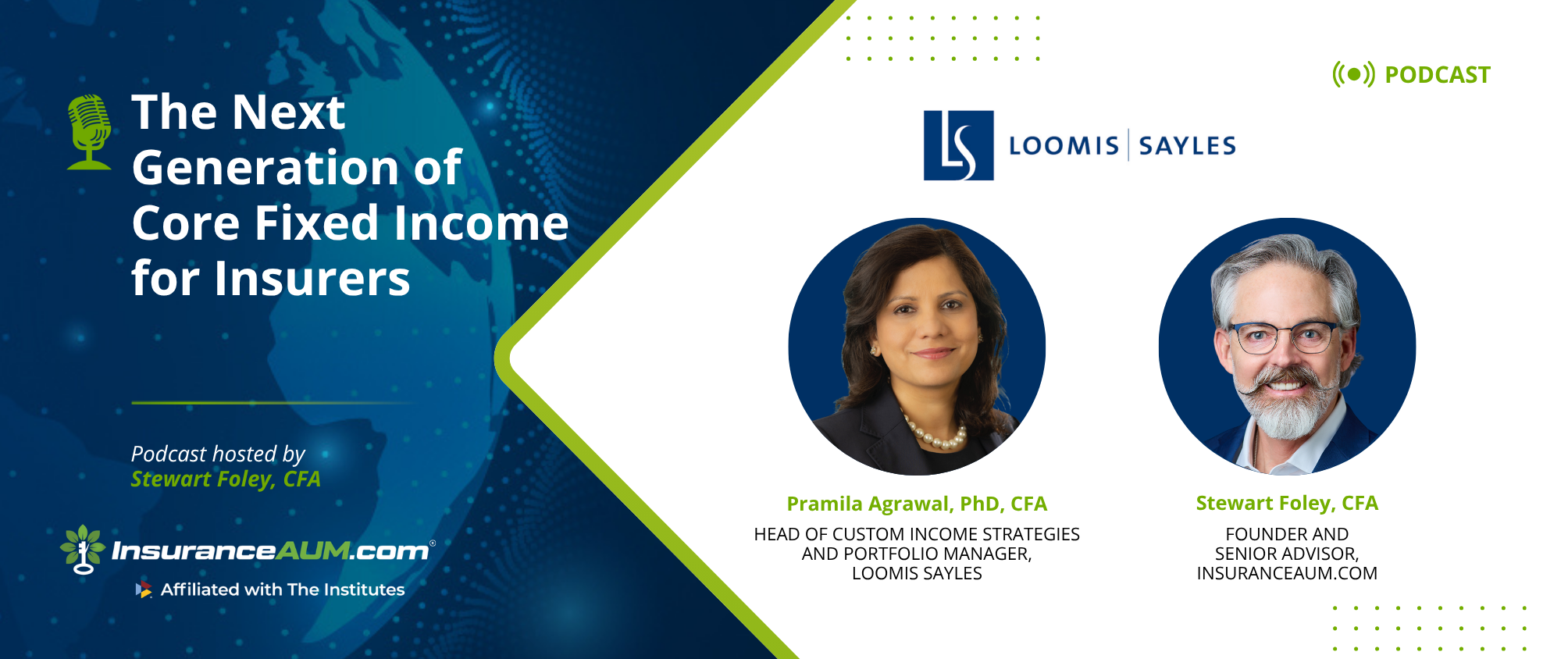
The Next Generation of Core Fixed Income for Insurers

Image


Stewart: Hey, welcome back to The Home of the World's Smartest Money. This is the InsuranceAUM.com podcast, and my name's Stewart Foley. I'm your host. We're thrilled that you are here with us today. This podcast is applicable to, I would venture to say, every single insurance company. For decades, core fixed income was almost synonymous with stability, liquidity, and benchmark relative investing. But in today's insurance portfolios, they look very different. Private credit has become mainstream, structured products have expanded, and technology is transforming portfolio construction. And perhaps the biggest question of all is this. If core is the insurer's largest investment or their largest asset class, why should we keep relying on the same approach? And wouldn't it make sense to take a differentiated approach to core fixed income?

And as you might imagine, the title of this podcast is called The Next Generation of Core Fixed Income for Insurers. And we're joined today by Pramila Agrawal, PhD, CFA, senior insurance portfolio manager at Loomis Sayles. Pramila, welcome to the show.

Pramila: Thank you, Stewart. I'm so excited to be here.

Stewart: We're thrilled to have you, and we're blessed on this show. You serve on the board of directors, and I mean this in the warmest possible terms: You are a fellow insurance investment geek. It's great to have somebody who's really senior who can really see the big picture here that we're talking about because core fixed is so important to insurance companies for lots of reasons, but one of them is that the capital charges on core fixed are very low, which pushes a lot of the assets of our audience into that asset class. But before we get going too quickly here, I want to go back and ask, where did you grow up and what job would you most like to have if you weren't doing this one?

Pramila: Oh, sure. So I grew up in India, and when I was 22, I came to the US to go to graduate school and I went to Vanderbilt and I did my master’s and PhD. And I have come a long way from where my education was. I'm an electrical engineer by training and never in a million years I thought I would be sitting here talking to Stewart Foley about core insurance asset management. But life is funny and beautiful that way. I did take a turn from engineering to asset management and ended up doing insurance asset management at Loomis Sayles. I've been there 20 years and I have never looked back.

Stewart: Well, it's funny because earlier this week we had Siddharth Chakravarty on, who's at CoAction Global, and he too is an engineer and is now chief investment officer. So it's not a completely unfamiliar path because, I think, core fixed is so quantitative and I'm comfortable in that environment. And I think maybe we share that. So let's talk a little bit about the central question here, which is if core fixed is where the majority of insurers allocate their assets, why is it important to rethink it? This industry, wow, as someone who's tried to innovate over the years, I've heard many, many, many times, "Well, we've always done it this way and I don't see really any reason to change and whatever." And so I think to some extent, low interest rates for a really protracted period pushed some insurers out of that comfort zone, but it really is, and in talking with, and I know Loomis well, in talking with you, there really is a different way of thinking here. Can you just back the lens out and give us the big picture of how you're rethinking core?

Pramila: 100%. And Stewart, what bothers me is just this asymmetry between importance and attention. So if we think about core fixed income in insurance, that's where the majority of the insurer assets are sitting, as you pointed out. For many clients, 70% to 80% of the dollars invested are core fixed income. That is the engine of book yield that is being generated, that's the anchor of liability match, and that's really the foundation of regulatory capital management, even. Yet historically, it has received the most commoditized treatment. It’s the most benchmark hugging, most fee compressed, and most “set it and let it be” kind of treatment. And I think it kind of made sense when the opportunity set was genuinely narrow. When we thought about core fixed income, we said IG corporates, some Treasuries, some agency mortgages, and that's it. But as you will surely appreciate, the world has changed.

And if we think about the gamut of instruments that now fall under core fixed income, we are talking structured credit, we are talking emerging market debt, private placement, CLOs, esoteric ABS. These are all mainstream allocations for insurance now, and they're not outliers. So the core manager that an insurance company hires needs to be capable of doing far more than the one that was hired two decades ago. And the insurer deserves just more than allocation to a commoditized approach and just thinking about what is important, how do we look forward and how do we get most of this core allocation?

Stewart: Yeah. I mean, unsolicited testimonial here as someone who is the chief investment officer of a very small portfolio. Accessing some of these asset classes benefits from scale. And one of the things I think that folks miss that are looking to outsource is bonds are priced on a bid-ask spread and the difference there is not fully understood by some investors. And getting access to this full spectrum of asset classes efficiently… lots of folks look at fees, but they don't have as easy a time looking at the differential in execution. And so that really matters here. And the scale that a manager brings can help a carrier because the manager is investing at much larger scale, typically, than the carrier is itself. So when investors think about core fixed the way that they did 10 or 15 years ago, can you talk a little bit about the fundamentally different things in this market?

You mentioned it a moment ago, but what is different? And just to give you some context, I literally stopped managing money, actively, 16 years ago. And to some extent, some of my reference point is outdated. So, I need to learn this stuff too.

Pramila: Absolutely. And we touched on one key aspect of core fixed income allocation, which is just that the opportunity set has changed. And many of these asset classes, emerging market debt, I know you have done a few very interesting podcasts on emerging market debt, that becoming a bigger part of the insurer's toolkit. And then, we haven't yet started talking about private placements, but we know private credit, private placements, they have become a big portion of core fixed income allocations. So just the opportunity set is one of the biggest changes that have happened. The second thing to think about is that we are in a fundamentally different market. There is a lot of background volatility that is here to stay and the reasons for volatility are different, but nonetheless, we have geopolitical volatility. We have energy supply shocks. We are seeing trades and tariffs. We are seeing other sources that ebb and flow, but that's not an episodic once-in-a-time volatility. It's just a background noise for us.

All this is happening in a very tight spread environment. When you look at where the investment grade sectors are trading, where the high yield sectors are trading, where the securitized sectors are trading, everything is at historically tight spreads even in this volatile macro environment. And what that means is that we need for core fixed income managers who have a lot of depth and a lot of breadth in terms of credit capabilities. That is not easy to find. And the last one, which you touched quickly upon was scale. And I could not emphasize that enough that when we are talking about scale, that is not a simple point to address. We not only need managers who have depth and breadth and trading capabilities and efficiencies. We are talking about the use of technology and we can talk more about it as we go on.

A couple of decades ago it was not a differentiator between managers, but right now the managers who are using technology efficiently, not just for risk management operations, but also for day-to-day investments and for scaling and for generating bespoke solutions for their insurance clients are the ones who are really differentiating themselves. So these I would say are the big evolution factors in the landscape. And as we think about all of these, we cannot have a commoditized core fixed income allocation.

Stewart: Yeah, it's interesting you say that. I saw someplace that there's a differential of something like 90 basis points between large and small carriers returns year over year, which is an astonishing number. And I think there is a difference in the sophistication, to some extent, because it's harder for small carriers to have the same size teams and the same size resources, but I also think it's access to its scale. But it's funny, we were on a podcast, we've had some folks on about tourism in insurance asset management. And what I mean by that is that there are folks who have shown up that aren't typically in this world. And I will tell you, I have had over the course of my career an innumerable set of conversations with folks who think that their performance against some benchmark is going to win the day as it does in other institutional asset management sleeves. And I've said many times, this isn't a different channel. This is a different world. And it is.

So you've talked about a next generation before of insurance asset management. How does this breadth of credit you've mentioned, underwriting liquidity technology and scale, how do you fit that together? It is a very, very difficult question. It is a massive question, but talk us through it.

Pramila: That's actually a very, very good question. And I totally hear what you are talking about in terms of the tourism because this particular channel is indeed a different world. It needs a dedication that is like none other. It is not easily fungible from channel to channel. And the institutional focus that is there is easy to detect. So let me expand on that. So when we are thinking about insurance asset management and we are talking about breadth and depth of underwriting, that is definitely a table stakes. Has to be there because that's what we are buying and managing. When we think about other ancillary services, when we think about institutional advisory groups, how are we supporting our insurance clients in terms of analyzing portfolios for capital charge efficiency, for book yield optimization, for any other kind of regulatory support that they need from time to time?

You mentioned some smaller insurers who may need handholding in terms of asset allocation, both strategic and tactical, and helping them think through major regulatory changes. So one of the things is for the insurer to estimate is that is the asset manager committed to providing that kind of support? It cannot be grown overnight. These are technical skills which are honed over decades by firms. When we talk about risk management and insurance-centric asset management, that is again, something that cannot be grown overnight. That is something that asset managers develop over decades by speaking with insurance clients and by really understanding what they need. We also have seen that there has been a real need for developing proprietary tools and relative value measures to meet the growing needs of insurers. And for Loomis, we were lucky that when we started this, we had been managing insurance assets for a while, but we in earnest stepped into this business in 2018 and we have very intentionally developed every part of our business to support our asset managers.

And it is not just providing performance over a bench. When we think about insurance asset management, we are thinking, "Hey, are we able to do relative value between public and privates in a way that makes sense to an insurance client? Are we able to do asset allocation and do capital optimization? Are we able to provide the servicing in terms of relationship management, strategic partnership to that client not once or twice, but through the year, year after year? And at the end of the day, we are also constantly looking at what investment we are providing and our investment philosophy, does that sit well with what the client needs? Because their needs change and there's no one size fits all. And it changes with business cycles, it changes with the rate cycle, it changes with the market set of opportunities. And so when we look at all of these, to your point earlier Stewart, they all need to work together.

There's nothing that we are doing by itself that stands out and says, "Hey, look at us." When the whole thing works together, our clients get what they need from us.

Stewart: Yeah, it's really interesting. When you are managing core fixed, you're very close to the operating layer. And what I mean by that is you'll occasionally get a call from somebody saying, "Hey, we had a big claim. I need to raise some money." So I mean, you're in it with them and that servicing component. And I really do think this, I think just my personal opinion, Loomis is absolutely one of the real steeped-in-the-tea insurance asset management firms that can really go deep in these areas that are like, it's nuanced and it's not only understanding the underlying operation of the company, but it's being able to understand what issues your client is trying to explain to you. It's like, "Hey, munis are great value. Okay, fine, but we're writing at a 104 and we can't use them.” So it has to be in the context of everything else.

One of the things I think would be helpful to know, and you've spent a lot of time in your career working with corporates and munis and securitized and customizing insurance portfolios and so forth. Are there lessons or a lesson that you've learned that you think folks who are earlier in their career would benefit from knowing?

Pramila: That's a great question, Stewart. And I think that when we are training people for asset management, we want people to follow a book where we say, "Hey, this is how you think about relative value. This is how you think about risk. This is how a balanced portfolio looks like. This is how you run a strategy with minimum dispersion. This is how you get good operational and execution efficiency." I feel like insurance asset management is like a 3.0 version of that where you take all that and then you just turn the book so that it faces the client. And now everything comes from the client side. And you just made a point that you live their life with them, and we really do. And we feel their pains and we feel their joys. And the way it reflects is there is no one static strategy and way of doing things.

When our clients are facing a liquidity squeeze as a core fixed income manager, I get the call first where they say, "Hey, we need money or we need you to stop investing. This is what needs to happen." And we have to rise to it immediately. And we have to do it in the context still of providing the best outcome for the portfolio that remains with us.

Stewart: Absolutely.

Pramila: We get a call when we hear that there are parts of businesses that need to be offset by the investment outcome and this is what we need to do. It's not the same thing. We may have to offset losses. We may have to offset gains. We may have to de-risk the portfolio because some other risk was taken in another portion of the balance sheet. And so we are true partners in that. And so this concept of managing portfolios gets flipped a little bit because now we are in tune with how and what the client needs. And we are doing this still with the main objective that they may have given us three, four, five years ago. That would be my biggest piece of advice that we learned everything about asset management and the standard things that we should be focusing on. And then when you're working with a highly regulated capital-aware, cashflow-aware insurance company, you have to turn it a little bit and make it very centered on the client.

Stewart: Yeah. I mean, it's funny because it's like performance versus a benchmark for an insurance company, it's not even relevant because those are unconstrained portfolios that can trade against a benchmark. They can trade as much as they want, fine and dandy. And an insurance investor, to your point, it almost gives me PTSD to get... It's like we need to raise money. Well, it's okay, we need to raise money, but here's the other thing. We need to raise money, but is this the last time or are we going to go back? Because I can sell the most liquid thing in your portfolio and get you cash and we can refill that position when you got cashflow the other way. But if you need liquidity three or four more times, I can't erode the liquidity that much. So if you can give me some insight that you're going to need more later, we can sell less liquid things at good prices and get you out of there.

But it's not only a point in time, as you well know, it is an ongoing conversation and the level of service and what's required is so far beyond just asset management. It's asset management, but in the context of an operating entity that is the needs of which are paramount.

Pramila: That is absolutely right.

Stewart: You can't say, "Hey, listen, I know you burnt your house down, but can you wait a couple weeks because I need to raise some money out of the portfolio?" It doesn't work that way for them.

Pramila: It totally does not, Stewart. And the other thing I would point out here is you had mentioned technology earlier, and technology is no longer the siloed overlay side consideration for insurance asset management. The way we manage assets at Loomis, we are using technology every day for relative value, for portfolio construction, for portfolio turnover. So this request that you gave an example of is a great one because we would get these requests where we say, "Hey, now I need to balance giving liquidity to my client while balancing the income of the portfolio. I don't want to erode the income and liquidity. I also want to still outperform my bench and I want to make sure that I'm not giving up all my best ideas." So this is a multifactor optimization, which believe it or not, as smart as human beings are, we are not capable of doing multifactor optimization in our head.

And that is when we need very advanced portfolio construction tools and platforms which help us through the inputs. It is part art, part science, where we are able to now find an optimal solution for the client which can do multiple things and we have to do it time and again. And so that takes us back to the other question you asked that for when we are doing core fixed income for an insurance asset management, what is the differentiating part? How do people make sure that it is not tourism? These are the things you look out for and say, "Hey, when this need arises, how would you deal with that?”

Stewart: And I mean, I think for a lot of carriers, they cannot afford to make the kind of investment that you and others have to make that technology. And it's not that, oh, well, AI's making all the decisions. It's like that's not it at all. There's a lot of different factors. There's capital position, tax position, state of domicile, blah, blah, blah, lines of business, loss trends, all that stuff comes into it. So one of the things that we've talked about on this show before, not us necessarily, but generally, is the convergence of private and public markets. And the idea about, and I believe that you've talked about this, the need for the underwriting discipline to be consistent. Can you talk a little bit about that when you think about the relationship between public and private credit today? And is there one place that you're finding opportunities to be more compelling than the other?

Pramila: I think this is the most important subtopic to cover on public and private. So first, insurance is no newbie to privates. Insurance companies have been investing in all forms of private debt, private credit or private equity even for a very, very long time. What we are seeing, the big change that we are seeing is one that has been an explosive growth in the private credit market. So earlier when only the most sophisticated and biggest insurance players were able to access this market, it is now more accessible. We are also seeing that overall the lines between public and private credit are blurring.

And what I mean by that is that the difference between them is dissolving along many different dimensions. So the first one is liquidity. And even though private credit is inherently less liquid, we have recently seen and we continue to see more and more of deals which are in large sizes. They are settling as 144As and in general trading on the secondary market. Now that is raising the liquidity profile of some of the private credit instruments. On the other hand, we do have some publics which are highly illiquid. So this spectrum, instead of being a black and white where you classify one as liquid and another as liquid is now becoming more of a continuous spectrum. The same thing if you think about credit, one of the big ideas and talking points that we have at Loomis is that credit is credit. So whether you are looking at private or public, we need to put it through the same lens. What are the fundamentals? What's the free cash flow? How's the leverage? What's the complexity? What is the tenor we are talking about? They all do get ratings by agencies. We rate them all internally. And so even on credit, there is a spectrum.

And we do need to then put both public and private through the same rigor and in fact put them next to each other and say, "What am I getting paid for? How much illiquidity risk, complexity risk that I'm taking versus a public? And am I getting paid adequately for that?" Even in the portfolio, there can be multiple ways of decision-making. Either an insurer can make a decision and say, "Hey, this is my private bucket goes to this manager, and this is my public bucket goes to this manager." Or they can to a certain extent give their core managers the flexibility and say, "Hey, you can use 10%, 15%, 20% of privates within your core allocation where you see value." And what that means is that now we have to be very nuanced. We are not talking about private and public going in two separate buckets.

We are thinking about risk. We are thinking about relative value. We are thinking about diversification in the context of both public and privates. And it's actually very interesting to see that pickup to public is not a single number. So when you have a very high-quality, short, liquid private, its pickup to public may only be 25 basis points and that may be totally okay. On the other hand, if we are looking at a very complex, longer, highly illiquid private, we may demand 150, 200 basis points, maybe even more to a similar public security. And that is the way we end up going. So when we think about public and private in the core portfolio, we think about these parameters, which is liquid credit complexity, and try to make a relative value assessment of where we think we are better off by going in privates.

Stewart: Yeah, we did a really well-attended webinar with IASA, which is another entity owned by The Institutes, that also owns InsuranceAUM.com. And so somebody asked the question, essentially, when I go to private credit, am I going down in credit? And I said, basically, there's two different risks here. One is liquidity risk and you need to figure out, you need to assess that. And then the other is credit risk. And it doesn't necessarily, to your point, I think it's really well put, just because it's in category A doesn't mean that it has all these things lockstep. You got to look more than that. There's more to it than that, like everything else in the insurance asset management business. So let's talk a little bit about technology, which is something I think that really folks ought to know. So as you pointed out, it's not an overlay anymore.

It's not a support function. It's integrated into the investment process itself. And the question is, how has technology changed portfolio construction, trading, risk management, and ultimately the client outcomes where you are... And I mean, the thing that I get at this was even as something is pre-trade and post-trade compliance and then there's ratings migrations and so forth, just managing to the bespoke investment policy guidelines of all the clients, that's a considerable undertaking, just that alone.

Pramila: 100%. And that really speaks to ability to be sophisticated and the ability to scale. I would say that those are the two main advantages of having a solid technical foundation in all aspects of investment management and servicing. And I would put it in a few different categories. One is that as we have well established now that insurance asset management is complicated. There are many competing goals. The needs of the clients are evolving, the market is evolving. And what that lends itself to is creating bespoke portfolio solutions becoming a very hard task. And we employ many sophisticated portfolio construction tools for precisely that. And that is not just for relative value, but also just meeting the risk and return requirements of our clients. Again, can be done manually. There are asset managers where somebody's actually looking at it bond by bond and trying to do that construction, but the scale, the speed, the accuracy that you achieve using these high-tech portfolio construction tools is immeasurable.

The second thing I would say is in just relative value comparisons. So portfolio construction is sort of downstream from that. When we are looking at a taxable municipal or we are looking at a CLO instrument or an emerging market instrument, just doing an apples-to-apples comparison across a credit quality complexity liquidity is not easy. And you throw in privates in it, it becomes even more sophisticated. So we do need pretty advanced tools and platforms for that, which can do real-time comparison of the market opportunity through the lens of how we investment managers think about risk adjustment. So that is again, someplace where if we are not using the state-of-the-art technological tools, you can be severely handicapped. The other place I would say is risk analytics. So that is an area that has really expanded over the last two decades. And so through our affiliate, which is the NIM-os Global, it's a SOC 2 certified platform, we are able to operate a risk analytics platform that covers both private and public sectors.

And that has again become a very key necessity because that is how we are actually visualizing the portfolio. We are looking at risk and attribution. We also have our own proprietary performance measurement system and risk attribution system, which is really important when you want to make risk management part of your daily trading. One way to look at risk is, hey, you look at your portfolio once a month and see where the risks are and then decide what changes you want to make. That's the old-fashioned style. The other more real-time way is to see, oh, I'm going to buy this and sell this. How does that change my portfolio today? Given what the market environment is, how much do I pick up on book yield? What is the gain loss that I will incur? How much will my income increase by? And by the way, I can also stress test my portfolio and see, am I increasing my risk in any particular sector?

All of that is really not possible without having advanced technological tools. And the last one which you had also touched upon earlier was scalability. When we are servicing large institutional clients who have an array of reporting requirements, analytical requirements, where the CIO can call us in the morning and say, "Hey, I'm heading into a board meeting. I want to see how this portfolio would perform if we had a 200 basis point Fed cut or we had a recession, we had a black swan event, oil went to 200," and companies who don't have sophisticated risk management systems and scenario analysis tools are not able to provide that. So when you think about all of this, so whether it's actual buying and selling of instruments to understanding the impact on the portfolio, the change in risk and reporting and scaling, all of this is impacted by technology.

Stewart: That is so true. And I've been on both ends of it where we get a question from an investment committee member and you go, "I don't know even where to get that information,” but “that's not available” isn't a good answer. Now we get career risks coming in. So it's really true. The ability to answer these bespoke questions and the ability to look at data through a number of different lenses a lot easier to say than do. And it requires a really, not only a capital investment, but a thoughtful, well-thought-out capability that interprets or anticipates the needs of carriers as they go. Which leads me to my final question, which is what do you think insurance investors, and this really goes for all of them, I mean everybody. So we've got in our audiences from big to small. And while everybody's in the same industry, the problems are different.

But what do you think insurance investors should be asking their core fixed manager today that they perhaps weren't asking five years ago?

Pramila: That's a really great question, Stewart, and it actually brings together everything that we have discussed today. So the first question I believe insurers should be asking their asset managers is, “How are you truly leveraging all the possibilities of core fixed income?” What are the different asset classes, instruments, sectors that you are investing in which helps you take advantage of the best possible returns? The second question I would ask, just given how important private credit has become for all the insurer's balance sheet, they should ask their asset managers, “How are you evaluating the relative value between public and private?” And really dig deep in it and go through it example by example to really understand that are all the factors, all the relevant factors for public and private being considered and is the manager truly in the right space to make that decision as opposed to the insurer making that decision?

And the last question that I wish the insurance companies would ask their fixed income managers is that how are you able to scale without compromising discipline? Because as more and more insurers are going for scale, something sometimes is being lost. And the question is that are we able to deliver the same care and diligence that we are able to deliver in small scale at larger scales without compromising quality servicing and partnership?

Stewart: Yeah, that's good. Those are great. Yeah, I'm with you. Those are good questions that folks should be asking. I agree. All right, so you've been at this for a while and you've been in a very senior position for a while. What characteristics do you think are important when you're adding to members of your team at Loomis Sayles?

Pramila: Actually, we are doing that right now, so it's really top of mind for me. And we look for a lot of different things, but I would say that creative problem solving is my personal favorite. When I'm looking at individuals, I really want to understand that are these the kind of people who, when they hit a wall, are they going to just stop and report back to me that there's a wall? Or are they going to think laterally out of the box, find the door for me? Attention to detail, super important in our industry, especially in insurance asset management because we want to make sure that we are looking under every rock for investment opportunities. We are looking at research in every possible way. We are picking every basis point for our client. And as we have talked, just balancing the multiple often conflicting goals that we have.

As you know, insurance teams tend to be big. So team players, really want genuinely collaborative people who make everybody around them better because we need portfolio managers who are talking to the actuaries, who are talking to the relationship manager, who are talking to the technologists. So these sincerity, work ethic, team players, these don't pop out always as glamorous qualities, but they go a really long way in building a strong team. And I would any day take a sincere, hardworking generalist over a brilliant but unreliable specialist. So that is my core philosophy is that when you have the right ingredients, you can train people, but it's really hard to create those ingredients.

Stewart: Yeah, no, that makes sense. All right, last one. You know this is coming. I've asked it 10,000 times. If you could have dinner, so dinner's on us, first of all, up to four people. You can have up to three guests, yourself included, and you and three guests. Who would you most like to have dinner with, Pramila, alive or dead?

Pramila: That is an awesome question, and I did think a lot about it and it's hard to bring it down to three people. But finally, I chose these three people and they are an eclectic bunch. Mahatma Gandhi, being from India and all, he was always a larger-than-life figure and I would love to just have any time I could get. Ruth Bader Ginsburg. Sadly, we lost her recently, but she is just such a hero in my eyes, did so much both for the country, but also for women, and Amelia Earhart. And she's just fascinating with everything that she achieved. And they are all very different people, but I feel like they all operated in environments that were deeply resistant to who they were. And these individuals still changed the world. They did what they wanted to do. They did it with discipline, conviction. None of them were like firebrands and they refused to be defined by the environment they were in. And Stewart, you and I were talking about how traditional our industry is. And they continue to inspire me in terms of thinking outside the box, challenging presumptions, how things are done, and to just kind of be persevering.

Stewart: That's a great way to end. I really appreciate you being on. It was a phenomenal education on redefining what core fixed income is for insurance companies, and it's great to get to know you a little bit too. So thanks for being on.

Pramila: Thank you so much, Stewart. I really enjoyed speaking with you.

Stewart: We've been joined today by Pramila Agrawal, PhD, CFA, senior insurance portfolio manager at Loomis Sayles. If you like what we're doing, please rate us and review us on Apple Podcasts, Spotify, or wherever you listen to your favorite shows. We're doing video these days and you can watch us and watch this podcast on our YouTube channel on InsuranceAUM Community. Thanks for listening. We'll see you next time on The Home of the World's Smartest Money, the InsuranceAUM.com podcast.

This podcast was recorded on 1 July 2026.

This marketing communication is provided for informational purposes only and should not be construed as investment advice. Investment decisions should consider the individual circumstances of the particular investor. Any opinions or forecasts contained herein, reflect the subjective judgments and assumptions of the authors only, and do not necessarily reflect the views of Loomis, Sayles & Company, L.P. Investment recommendations may be inconsistent with these opinions. There is no assurance that developments will transpire as forecasted and actual results will be different. Data and analysis does not represent the actual, or expected future performance of any investment product. Information, including that obtained from outside sources, is believed to be correct, but we cannot guarantee its accuracy. This information is subject to change at any time without notice.

NIM-os™, LLC (NIM-os GLOBAL™) is a global SOC2 certified provider of integrated à la carte proprietary technology offering distinctive capabilities & custom solutions, along with globally efficient operating, administrative & enterprise services. NIM-os GLOBAL™ services are provided via Loomis Sayles’ proprietary In2! platform and are available to Loomis Sayles’ clients & affiliates in addition to select third-party relationships. NIM-os GLOBAL™ does not provide advisory services. NIM-os, LLC is a wholly owned subsidiary of Loomis, Sayles & Company, L.P.

Any investment that has the possibility for profits also has the possibility of losses, including the loss of principal.

Diversification does not ensure a profit or guarantee against a loss.

There is no guarantee that the investment objective will be realized or that the strategy will generate positive or excess return.

Past performance is no guarantee of future results.

This material is not intended to provide tax, legal, insurance, or investment advice. Please seek appropriate professional expertise for your needs.

Loomis, Sayles and Company, L.P. and InsuranceAUM.com are not affiliated.

9018052.1.1

Share this post

Sign Up Now for Full Access to Articles and Podcasts!

Unlock full access to our vast content library by registering as an institutional investor

Register

Contacts


Loomis, Sayles & Company, LP

For a century, Loomis, Sayles & Company has built a legacy focused on fulfilling the investment needs of institutional and retail clients worldwide. To do this, our performance-driven investors aim to deliver long-term results by leveraging deep, independent research and rigorous risk analysis. With the resources, foresight, and flexibility to look far and wide for value in broad and narrow markets, Loomis Sayles has remained a trusted partner to its clients since 1926. Loomis Sayles proudly manages $417.9 billion* in assets on behalf of clients worldwide (as of March 31, 2026). 
*Includes the assets of both Loomis, Sayles & Co., LP, and Loomis Sayles Trust Company, LLC. ($53.9 billion for the Loomis Sayles Trust Company). Loomis Sayles Trust Company is a wholly owned subsidiary of Loomis, Sayles & Company, L.P.

Our Insurance Team possesses the knowledge and experience necessary to address the distinct requirements of insurance clients. By fostering collaborative partnerships, we work with global insurance organizations to provide customized solutions spanning portfolio management, advisory services, relationship management, reporting, and proprietary risk and reporting tools. Our offerings include both core and specialty insurance mandates, supported by our proprietary risk analytics and technology platform. 
 

Colin Dowdall, CFA
Global Head of Insurance Solutions
cdowdall@loomissayles.com
(617) 449-8782

Lauren McDermott
Director, Insurance Solutions
lmcdermott@loomissayles.com
(617) 816-6301

Loomis, Sayles & Company, LP
One Financial Center
Boston, MA 02111


View the contributor page

Image
LoomisSayles

Sign Up Now for Full Access to Articles and Podcasts!

Unlock full access to our vast content library by registering as an institutional investor .

Create an account

Already have an account ? Sign in

Ѐ Ё Ђ Ѓ Є Ѕ І Ї Ј Љ Њ Ћ Ќ Ѝ Ў Џ А Б В Г Д Е Ж З И Й К Л М Н О П Р С ΄ ΅ Ά · Έ Ή Ί Ό Ύ Ώ ΐ Α Β Γ Δ Ε Ζ Η Θ Ι Κ Λ Μ Ν Ξ Ο Π Ρ Ё Ђ Ѓ Є Ѕ І Ї Ј Љ Њ Ћ Ќ Ў Џ А Б В Г Д Е Ж З И Й К Л М Н О П Р С Т У Ф Х Ц Ч Ш Ā ā Ă ă Ą ą Ć ć Ĉ ĉ Ċ ċ Č č Ď ď Đ đ Ē ē Ĕ ĕ Ė fi fl œ æ ß