





TPG-

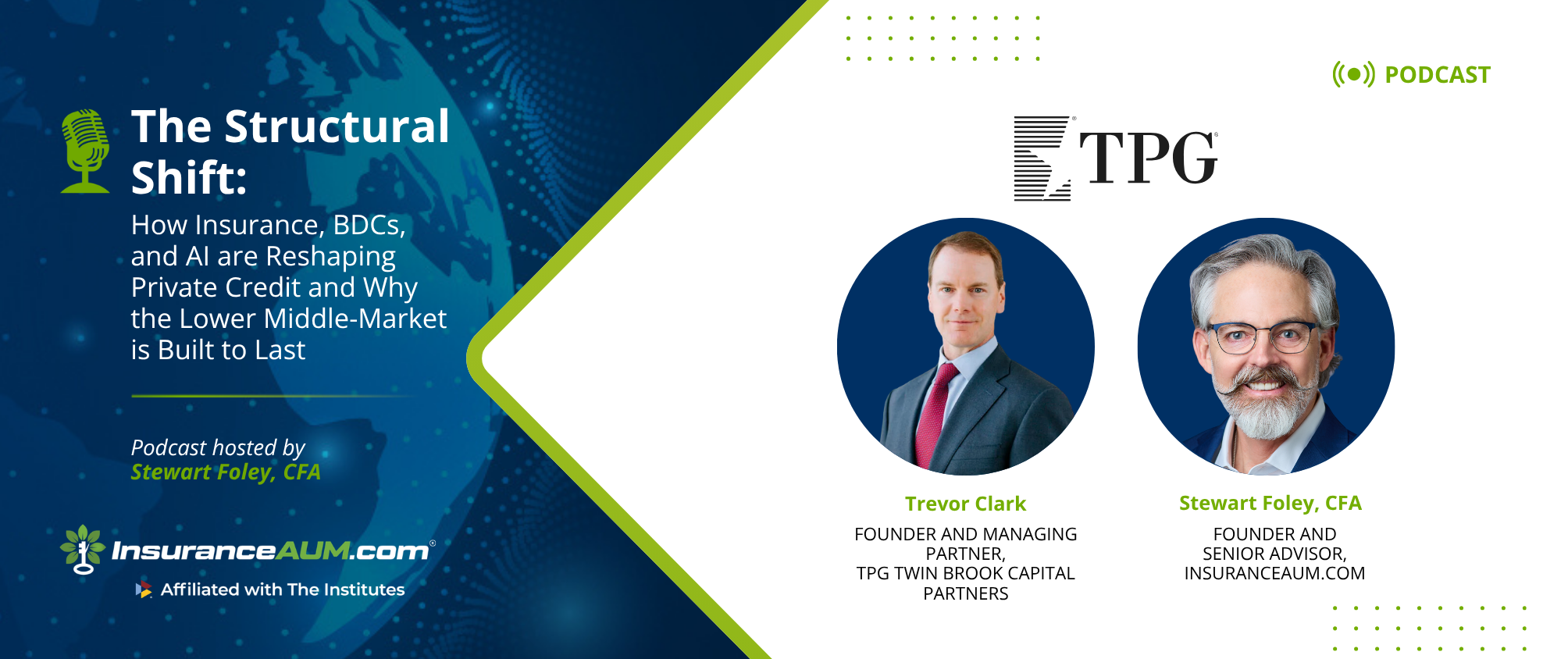
The Structural Shift: How Insurance, BDCs, and AI are Reshaping Private Credit and Why the Lower Middle-Market is Built to Last

Image
IAUM_Podcast_E378_TPG_Web


Stewart: Hey, welcome back. It's great to have you on the InsuranceAUM.com podcast. We are the Home of the World's Smartest Money℠. I don't know if you saw, but there was a great post on LinkedIn. We had a very large number of insurance LPs at our Chicago event. They were all posted in one picture in our meeting room there in Chicago and it was really, really cool. So if you get a chance, check that out and we're thrilled to be back in the podcast today with a topic that could not be more timely, which is... And kind of the lead into this goes that private credit has gone from a niche asset class to one of the defining stories in institutional investing. The market has grown significantly and so have the questions. Are underwriting standards changing, is AI creating new risks for lenders, and are insurance companies reshaping the market? And perhaps more importantly, where does disciplined lending still create durable value, which is I know near and dear to a lot of the folks who listen to this podcast.

So the title is today, The Structural Shift: How Insurance, BDCs and AI are Reshaping Private Credit and Why the Lower Middle Market is Built to Last. And we're joined today by Trevor Clark, founder and managing partner of TPG's Twinbrook Capital Partners. Trevor, welcome back. You're a repeat guest. We're thrilled to have you. Thanks so much for taking the time.

Trevor: Thanks, Stewart. Good to be here.

Stewart: You have a really amazing background. You were a co-founder of Madison Capital Funding. You were at roles at Antares and GE Capital and Bank of America. And by comparison to the looks of me, you look like you're in your early 30s. So how have you done it? Talk to us a little bit about your background.

Trevor: Yeah. So again, thanks for having me come back and excited to share some insights of what we're seeing in the marketplace today. My backdrop, and listen, anyone you're going to find who's been in and around this industry for 30 years like I have, typically you're going to hear somebody who started in a commercial bank because 30 years ago that's who was doing this type of lending. So to your point, starting at Bank of America, I was either blessed or not thoughtful enough to sit back and say, I liked the intellectual piece of this business and I liked learning about lots of different companies, which the world of lending kind of offers up. To the point you raised between working at different types of companies in the late '90s to co-founding Madison Capital in the early 2000s, that period of time really highlighted for me that this idea of direct lending, and I'm sure we're going to unpack some of this today, where it started in the world of banks that moved to non-banks to kind of funds as you've kind of seen that evolution.

The other piece that became really clear is this idea that direct lending was just a thing and you just need to get an allocation and what you were doing within that space or what the different managers were bringing from an acumen standpoint was less relevant. I can tell you in the last five years that changed in a good way. People now understand upper market versus lower middle market, top versus bottom of the cap stack, where you come in from an industry standpoint, and then size, scale, experience of teams also started to play more relevance. So for me, starting in the kind of banking world, founding my first firm in 2001, and then moving the team over to Angelo Gordon TPG in the 2014 timeframe allowed me to not only ride the evolution of the asset class, but also hone in and use the experience of whether it's the GFC, whether it was the pandemic, the what and why behind what we do has become much more clear over that period of time.

Stewart: Yeah. I mean, I think that's really, really well stated and really true. All right, my fun icebreaker since you've been... This has changed since you were on.

Trevor: Oh, great.

Stewart: What job would you most like to have if not this one?

Trevor: Man, that's a great question. So again, and you heard me say this before, I love the diversity of what we do. I'm going to juxtapose this because I love the creation mechanism of organizations and learning what makes companies operate. So I'd probably move into venture capital is probably what I would highlight for you because again, it's that early stage, seeing companies come to fruition, being able to have that major impact of an organization. I mean, I sit here at TPG Twinbrook today and 310 plus borrowers, 30 billion of AUM. I mean, I love what we do, but you're not at the kind of creation element of what we do every day.

Stewart: Yeah, it's really funny. I will tell you, and everybody who's ever worked with me will tell you that I'm a lot better at creating than managing.

Trevor: You are not alone in that, my friend.

Stewart: Yeah. I mean, I'm like, "Oh yeah, this is what's got to look like, blah, blah, blah." And then in our case, this is prior to selling the company, Lindy O'Brien who runs InsuranceAUM would be like, okay, so that's 69 steps that all take... And I'm like, "Oh yeah, okay. Yeah. Okay. Have you thought about..." I'm like, "Oh no, I didn't think about that at all." Oh yeah. And then I'm like, "Hey, where are we on?" And then I'm like, "Okay, squirrel back over here." And what I realized is that to be candid, the company's running better without me, without a doubt. And they just pulled off an amazing event in Chicago that... I mean, I was notified the day before, "By the way, you're opening." And I'm like, "Oh, okay. Alright, thanks." So no, all right, sorry. So private credit has grown dramatically over the last decade.

And you know way better than I do, there's been headlines. And when there's headlines, board members read those headlines and then questions go to the CIO. And I think in fairness, the folks who are in the media business of financial services like CNBC or Wall Street Journal, whoever it may be, they get more viewers when you can dramatize that in some way and make it sound bigger than it probably is. But many of the CIOs that we are working with and collaborate with, many of them view that as an opportunity, which I think a lot of smart money thinks in those terms. So why do you think right now that lower-middle market, and I want you to define that by the way, remains one of the most attractive parts of the universe today.

Trevor: Sure. Well, if you'll allow, to the point you raised, let's separate a little fact and fiction here. To your point, listen, sensationalizing news, redemptions, AI impact in terms of different parts of the industry, bad valuation methodologies, whatever that line or narrative that has been being pushed, people want clicks, people want to get eyeballs. So you kind of hit the big headline and see if it runs. There's a little bit of fact in there, but there's a lot of fiction associated with this as well. And what I would highlight is the basic premise, go back in time. We just hit 20 years ago, direct lending was really the purview mainly of commercial banks and a few really large financial services companies. Post GFC, you started to see the advent of funds being raised and obviously that took off over these last 10 to 15 years where lots of outside investors, institutional and retail have come to the asset class and take a beat and ask why.

Why did that happen? Well, coming out of the GFC, people started to realize, wow, I can move from public credit to private credit. I can get this "illiquidity premium." And oh, by the way, my losses in private credit are actually better than in public credit and non-mark to market and floating rate, all those. Guess what? None of those facts, they haven't changed.

Stewart: Not a bit.

Trevor: What has changed? Well, you had a lot of capital get raised in that asset class over the last 15 years and you didn't have really up until the last five years, you didn't really have as much delineation between different managers, different GPs within the asset class. So you had a little bit of this rush to, "Well, let me pay the least amount. It's a beta play. So paying less means I'm probably going to make more." And the last five years has started to shake out. Well, hold on a second, getting to your question, strategy actually does matter. How long have you been doing this does matter. Not taking concentrations in individual position sizes, having financial covenants, not over-levering companies, not going down the cap stack. All of those things really do aggregate into the realized and continuing return. So to bring this back to your initial question, why lower-middle market?

If I go back to my history, and again, you heard me say 30 years in the industry, 20 plus being a lower-middle market focused lender. I am not going to sit here today and say the only way to be a direct lender is to focus on the lower middle market. That would be false. What I am going to tell you is what we identified 20 years ago is we wanted to bring something that was different to the marketplace and we wanted to really highlight this. For us, what we identified is the lower middle-market, it's a less efficient part of the market. You have to look at more companies.

You obviously on average deploy less capital, so you don't attract the same level of competition. We like that and we can get better lender protections. That was kind of creating the alpha. The retention of that alpha that I'm sure we'll unpack is you bring other level of protections, you have a high level of selectivity, you put less debt on the companies, you only do cash flow lending, you get covenants, you have position sizes of 1% or less and the net result after doing this for 20 plus years. And the one other caveat before I'll turn it back to you is that's true because we've been doing this a long time.

We haven't had strategy drift. We have a team of over 120 people and we've maintained that discipline over a period of time. You can get bad outcomes in lower middle market, just like the upper middle market. You just have to have a strategy that doesn't allow you to have that discipline.

Stewart: I'm going to get on my soapbox for a minute, which is when you see headlines and you see people starting to ask for redemptions based on that, I would argue that they didn't belong there in the first place. They didn't know what they were doing. They didn't know what they were buying. They didn't know whatever they didn't know because you bought an asset and you said it. You bought an asset class that you're getting paid for illiquidity and then you go, "I want to sell this." I mean, I'll tell you what, go to your car. You think it's private credit, go to your car dealer, go buy a brand new whatever it is and then drive it off the lot, go to McDonald's, come back and go, "Hey, I want to sell this back to you." That's not going to be a good number.

And at the end of the day, it's like, who's surprised at this when you get paid for an illiquidity premium and then you want liquidity? When you get more liquidity, the premium goes away. Like this is like finance 101. It is. And at the end of the day, you go, were there some folks who made some allocations that maybe they got over their skis? I don't know. And to your point about being down, going in the lower-middle market,

One of the things that in my 75 different positions along my illustrious career, I was interested to tell you that I worked for a small workers' comp carrier and we found that the profitability of our smaller policyholders was better and the loss experience was better. One of the reasons that we came up with was the distance from the owner to the newest employee is way less than in a big company and safety procedures, "Hey, make sure you're tied off on that roof, things like that." And I suspect I would kind of, I don't know, extrapolate that experience into lower middle market where you've got, I mean, these companies are not behemoths necessarily and it gets you some of the results that you were talking about.

Trevor: Yeah. But Stewart, to your point though, similar to what you highlighted, it doesn't happen by accident. We're going to look at 1,500 small companies every year. We're then going to down select around 10% of those that we think have really, really good sustainable cash flow production over a long period of time. We're then going to do two to three months of due diligence to confirm all that and then close on three to 4% of those companies. And then you're going to have covenants and you're not going to overlever... I mean, if you're asked what, okay, is there a secret sauce? It's discipline, discipline, discipline. And the backup, you can take advantage.

Stewart: And you talked about this, but I'm not getting paid by any manager, but at the end of the day, there's some facts that people ought to be aware of. And one of them is that nobody wants the cheapest brain surgeon. I want the cheapest haircut. No, no. So what happens is when you have less fee income and less AUM, and I'm not telling you anything, you know way better than I do, but there is a lot of work by a lot of smart people, none of whom were cheap, to be able to analyze 1,500 companies, that's an enormous undertaking. And when people look at fees, management fees and you go, "We spent two, three months on due diligence and tossed it in the trash more often, way more often than not.”

And so that's not just a marketing pitch or whatever, that's reality. And there's no substitute for rolling up your sleeves. And there's a lot of sleeves that get rolled up, right? I mean, there are. There are. So when more capital, to your point, rates were at really, really low levels for a long, long time and people decided, look, I can't run my business like this and money flowed into private credit. And you talked about this at the top of the show. Hey, direct lending, okay now everybody knows, okay, there's a lot of different flavors and a lot of different, this is not one thing, right? There's a lot of things here. What do you think the market or particularly the insurance market misunderstands about the competitive landscape today? Is there something that you consistently hear in your travels that you go, "Eh, that's not exactly right."

Trevor: Well, using what you kind of started closer to the top, talking to, okay, there's lots of questions about this. Let's start with redemptions. And to your point, this perception that there's something wrong with direct lending because redemptions have gone up. I'm going to come back to your point, and by the way, this is where it's a tale of two cities. Did some investors get into an illiquid asset class and then expect to have liquidity? Sure.

Stewart: Absolutely.

Trevor: The other part of the story is there are direct lenders who made a very specific choice in the last five years to lean really into retail capital formation. And with this asset class, I think I'm fine with that being a piece of your story, but when you see people with 30, 40, 50% of their capital being in that bucket for this asset class, I'm going to say that some of these managers needed to rethink that as well. So I think that's also partially good. That's what's kind of sitting out here.

Stewart: It's the funniest thing to me because no insurance company says, "I want to maximize premium volume." It's like, no, you don't. But yet we go, "I want to maximize yield."

Trevor: Yeah, exactly.

Stewart: We go, "No, you don't. No, you don't." You want to look, make sure you understand the risks that you're taking and then decide, am I being compensated for those risks?

Trevor: That's it.

Stewart: Period. And you go, "Oh, this one earns nine and that one earns eight. I want the nine." It's like, wait a minute, hang on a minute. There's more to it than that. And so talk to us a little bit about... And it's fun for me because I got in to spend 30 years in this business as you have. And so it helps me learn too, frankly. I suspect that you and others may have industry or sector specialization, credit structures, ongoing portfolio management. We had someone on not long ago that talked about it's not only the initial underwriting, it's the ongoing portfolio management and monitoring of risks and identifying things that are showing signs of stress or smoke, if you will. Talk to us about your underwriting philosophy.

Trevor: So it's a super important point to make here because I've been in way too many presentations, way too many panels. When we're talking about the asset class and you're sitting next to somebody and they'll sit there and say, "You know what we do? We pick the very best companies. We do the very best due diligence. That's how we're separated." And I'm here to tell you that is a joke. I mean, there's a lot of really smart people in here across the investing universe, but specifically credit.

If that's what you're really relying on. We should all be running away scared because I don't care if it's the pandemic, I don't care if it's AI. There was something that with all your great experience you didn't see coming. So for God's sakes, we look at all those companies. I think we've got an amazing underwriting process that I'm happy to talk you through, but I also want to highlight this key point, which is that's a key element, selection and underwriting, but that is one of five things you hit on a really key piece, which is what do you do post-close to manage? But I'm also going to pull you back to what's the structure you bring? Do you adjust cash flows to a point where you're actually putting too much leverage on these companies, either with the quantum of debt or the cash flows that are repeatable?

And if you look at software, software is not a bad industry. People got sideways because you did a bunch of recurring revenue-based loans or enterprise value loans that you didn't have the cash flows to actually meet the current cash burden of it and that's how they got sideways. So I think it's this multi-varied equation of, yes, do really good, thoughtful due diligence. It is candidly not that hard to understand how companies make money. That really is there's enough information out there. We do enough due diligence to be able to unpack that. What you then have to do is take that really good sound due diligence, put a reasonable capital structure, but candidly, also look at what is that... In our case, we back private equity owners of these lower middle market companies. What do they want to do to grow that company? Your company was really successful doing business services support to a specific industry.

Are you turning that on its head and changing what this company does? That's something you need to be careful of. And then the last piece to your point of yes, we also look at what we do and again, this isn't an indictment to the upper middle market because there's great upper middle market companies. You pick and identify a good company, but if I do something, I take away financial covenants. So now I have to wait for a payment default to be able to take action. I'm not in the revolving credit facility, so I can't watch those daily cash flows. I adjusted cash flows that I'm lending against so it isn't even real cash. It's an adjustment to it, which again puts me in a different risk position. And then I put a big bank group in place so when there finally is a payment default, I've got a big group I've got to try to coordinate with to take action.

That's tough. That's going to create worse outcomes than where we go, which is, yeah, do really good analysis, find good companies. Let's put a reasonable amount of debt on this thing, but give this company some wiggle room if they don't hit that plan. Have a private equity group that has a good growth plan that doesn't completely move the company from its historical actions, but then have that monitoring, to your point, that's watching on not only a monthly basis where we get our financial statements, but a daily basis of that revolver, which is that kind of cash flow in and out of that company. You do all those things. By the time I actually have to use that financial covenant, I've typically solved any potential issue. And by the way, the covenant is set at a level where I'm not out of the money as a lender because again, we don't get the upside so we have to protect the downside.

Stewart: Absolutely. Yeah. I think we've seen that movie play out over time in various different asset classes. I think it's important to remember, I'll take you back to when I was teaching and I would say some version of, well, in the mid '90s, and then I realized that was six years before the class was born. So I know, I know. Can you imagine how old... I mean, their version of old is like you're 35 or something. And I'm like, I'm sorry, I'm just like... And half the time I felt like they were saying, "Hey, grandpa, tell me another story." But there are people in this space that came in well after the GFC.

Trevor: Oh, for sure. In fact, the vast majority did, yes. Right.

Stewart: I'll take you back to, I may have the numbers slightly wrong, but I remember it seems like it was in early 09 when PepsiCo came with a five year bond at 400 over. So you have been through and I have been through periods of market stress.

Trevor: For sure.

Stewart: Do you see anything that is repeating that concerns you that maybe some folks who weren't around pre-GFC may not be able to recognize as easy?

Trevor: Yeah, and I do it from a couple of different places. One, it's industry. Take the late '90s and again, the tech wreck, lots of money obviously throwing in the early days of the internet and people sitting back saying lots of winners, but you didn't know what the proportion was going to be and everything ripped until it didn't. Well, I think what you're kind of reliving a different version of that same story with AI and its impact in terms of whether it's software, but candidly, software is a canary in the coal mine. AI obviously is going to have an impact on lots of different industries. So really understanding what that means, bring discipline to how you underwrite, how you select and actually have a forward-looking view in terms of operations. So I do think there's an element to people who haven't been around long enough to understand what I'd highlighted before, which is there's no perfect identification of the perfect credits.

Bad companies can be over levered, good companies can get over levered. Let's just figure out how to bring structure discipline as well as credit identification discipline. I think that's going to be a key piece. I think the other piece I would highlight in terms of bad decisions that are getting made, you just sit back and see people who they don't have a direct origination. So relying on someone else to source for you and you're just going to try to buy what's ever in the marketplace. That worked when a big direct lender had $5 billion of assets under management. When lenders now have 30, 50, $100 billion, they're not selling loans to other lenders. So you've got a negative selection bias that's going to start to show up. The other piece that's coming into play, and we talked about this, whether it's raising retail money, whether it's raising dollars with using scrape to kind of highlight and kind of create income that way, this lack of alignment within the lender universe, that's starting to bubble up too in terms of this whole topic around valuation.

So people are sitting back saying, "Well, hold on a second. Private asset, how are you even valuing that asset? Can I trust what you're saying?" The world of the BDCs has been actually wonderful because it started to bring a consistency in reporting that did not exist prior to that. You saw some groups using, again, private funds that were doing valuations. I'm going to take a subset of my portfolio and once or twice a year, that subset, I'm going to have a third-party valuation versus our mindset, which is I don't want to play that game. Every single name, every single quarter, I'm going to have a third party come in. You're having, again, some of this realization back to your point of if you want to have people feel good about private credit in a world where there's all this noise going on, create a system where when someone's saying, "Are you seeing redemptions?" And you can say, “No.”

And people sit back and say, "Why?" Well, the why is because you chose to be a direct lender or an investor in direct lending because you were looking for a certain return profile and a certain level of stability. If with all that noise, you can still point to those things still being real. I think you're going to find that I don't think there's going to be some big tsunami of bad news coming out. I do think there's going to be a shakeout. I think there's going to be fewer direct lenders two, three, five years from now, because people are going to realize you didn't need to have 2,000 plus.

Stewart: I don't think there's any doubt about that, Trevor.

Trevor: I think you're also going to see, still to that point, what you've seen in other asset classes, a realization that yes, we want to see people who have the repeatability of a return profile and a discipline that if I'm a lower middle market lender, you guys select us because that's what you're looking for. Don't turn around three years from now and look at your portfolio and half of what you actually put out the door is core upper middle market last out second lien loans because that's the other piece. I don't think there's been that discipline of what you underwrote to what lots of people delivered.

Stewart: Yeah, it's interesting. I think that a lot of people equate redemptions with distress and I would argue a lot of these redemptions are people who shouldn't have been there in the first place.

Trevor: Agreed.

Stewart: And not saying that there's no stress, there is. And to your point, the world's not a perfect place and nobody's a perfect underwriter.

Trevor: Yeah.

Stewart: I don't care who it is, but at the end of the day, you've got other levers, you've got issuer concentration, you've got post-close portfolio management. There's other things that... So let me ask you this. I mean, I want to get here and I got one more for you, but where are you leaning in? Is there a place that you think that you're leaning in and is there anywhere you're cautious?

Trevor: Yeah. In terms of leaning in, I'd say no. So I don't think you'd feel anything different other than given our scale and our market share, M&A activity in general, our add-on acquisitions to our existing portfolio are really going to drive the volumes of what you're going to see in that regard. What I would twist a little bit to your point of, okay, what are you not doing? The beauty of the last five years, and by the way, it wasn't just the pandemic. I mean, between the pandemic, between supply chain challenges, between high inflation, between really low interest rates, between valuation changes, you've had a lot of body blows thrown at lots of these portfolios.

And so your ability to continue to provide returns I think has a lot more to do with did you have resiliency and discipline in your strategy as well as the team and experience? I would also highlight for you, we aren't static. What we were doing 20 years ago isn't the same as what we were doing 10 years ago. I mean, if I think through our model, 20 years ago, about 3% of what we did was building services. Guess what happened during the GFC? Kind of got exposed, maybe not as sustainable. Obviously during the pandemic, you started to see certain nuances, certain industries having more stress and things like that. About a third of our overall book has a version of healthcare, whether it's healthcare services or others. We've looked and seen some of that business is great, sustainable. Other parts of that business have felt more stress.

So I think what I would highlight is we're obviously focused on what real time results are indicating. With a portfolio of over 300 different borrowers and a history of over doing this for 25 years, you got lots and lots and lots of data that's going to be able to indicate where you need to be maybe twisting in or twisting out in terms of some of those things. The other piece I would highlight, because this has been a really important element to what we've done. Hold times have changed. And you might say, "Well, Trevor, why do I care about that?" Well, I'll tell you a couple of reasons why you care. You go from the average private equity hold time of an asset of four years. So today it's over six years. A couple things are going to happen. One of the things that's going to happen is, okay, in a period of time where you're going to continue to try to grow that company, depending where interest rates are, depending on where some of the inflationary aspects are, that growth might be harder to achieve.

And so part of what you have to ask yourself is, remember, it isn't just what happened to the earnings. We're stepping up covenants every year. A deal that you held onto three years versus six years, your covenants continued to get tighter and tighter. If you don't have that earnings, you were going to start to create again. We could talk about defaults. A covenant default is not a payment default, but it definitely shows in perception a higher level of stress just from hold times without really kind of thinking through a performance change. That's been something that's real that we live with. And then the last piece I'd sit back and say is, when you think about what's happening in the marketplace, lots of additional capital raised. M&A activity the last couple years, it's been okay but not great. What did that mean to the competitive dynamic upper and lower middle market?

You definitely saw in certain cases, I would argue the risk premium in certain cases was getting compressed in parts of the direct lending universe.

Stewart: Yeah, it is really interesting and I've learned a lot here today. I really have. What would you want insurance investors to understand about the future of direct lending and where lower middle market fits within the insurance investment portfolio landscape?

Trevor: So I did it from a couple of angles. One is, and we've seen that across our LP framework. It is clear that when you're looking at not only the level of returns, but the quality of returns, the capital charges that insurance gets for direct lending, there is an absolute rational reason why direct lending should be a very integral piece to the investment profile for the insurance industry. The question then gets into, okay, what should that portfolio look like? And part of what we've been guiding people to is that mindset of larger company always safer I think has been debunked. And so, making sure you kind of think through what you're trying to solve from return profile, look to those groups that are scaled, differentiated, experienced, bring that into your mix.

And then the last piece I'd say, Stewart, is the form at which you're making that investment, is it a rated note? Is it an SMA? Is it a multi-strat? I think that's the other piece we're seeing. It isn't just who the manager is, what's the structure which you're accessing that specific manager.

Stewart: Yeah, 100%. I mean, I think that structure is right up there with what is the asset class because it's not only the yield, it's the yield on haircut capital. And the more you haircut the capital, the lower the yield is no matter what happens. And so I think that's a great point. So let me go here. And I mean, it's been a tremendous education here. I really appreciate that. You've had a lot of time in this space. What characteristics when you're interviewing someone particularly early, what characteristics are important to you when you're adding the members of your team there?

Trevor: Yeah, so it's a couple things. I'd start with this. The baseline case we're looking for is someone who's high attention to detail, highly curious. If I get those two things, we can train you really well. Again, we have history, we have really thoughtful training acronym that gets spread in, but if I don't have an attention to detail and curiosity, it's really, really hard to continue to push. The last piece that's kind of interesting that people don't really constantly think through is bringing that curiosity to, okay, what I did historically, okay, that's great. I want you to understand that, but what's changing? In real time, that's been really, really critical. And the place that it's most natural is we are spending time obviously with the topic of artificial intelligence. And you can sit back and say, "Okay, what does that mean to individual companies when we're analyzing that?

How does that change, whether it's staffing, whether it's margins, what that looks like? But the other piece is how do we bring it to our underwriting and review process? If you think about this 300 plus portfolio companies with monthly financial statements and daily types of revolving credit facilities, there's lots and lots of data that we can kind of analyze and push and try to get smarter in terms of reacting and get in front of issues that might potentially typically take two, three, four months to actually get revealed. So we're trying to bring both elements when we think about technology coming to bear.

Stewart: Yeah, it's really interesting that our agenda in Chicago is set entirely by insurance investors and AI was not really on the agenda in 2025, and it was all over the agenda in 2026.

Not only how is AI changing what the asset quality of their portfolios, because there's things that software has been called into question, as you mentioned, but also how are managers using AI? They just want to understand to what extent are you leveraging? I mean, a crazy example, but do you just have no more analysts? You just got one bot that does everything? All right, last question. You've heard this one before. I'm sorry, but everybody seems to like this question. So who's going to dinner with you? You got up to three guests, one, two, or three, alive or dead, dinner's on us. I think our new owner's okay with that. Dinner's on us. And who's coming to dinner with you, Trevor?

Trevor: Well, okay, this is great because again, I'm going to give you the boring work element because I think that's going to be interesting in terms of how that kind of drives thing and then just total personality kind of, okay, with someone who's actually kind of front and center in this. So first and foremost, from a true business acumen, someone who kind of looks at not only the world of credit, but it kind of brings an insight into this. I think Jamie Dimon is a great person to bring to bear, been here a long time, has seen both the commercial banking aspect of our world, but obviously trying to fit that into a slightly different format in their new world of kind of lending. I think he's actually really, really informative and someone who I think wants to bring to bear. I then bring someone who's more fun focused in this, but also with kind of an acumen around credit aspect.

I'm going to tell you Howard Marks. I mean, I feel like what he brings in terms of insight and a slightly different... I mean, I know a lot. His flavor in terms of that I think can be really fascinating. And then the last one, it's more, whether it's trends, whether it's insight, someone who's kind of well outside our normal element, but also has been a big focus in terms of cheering for the New York Knicks. I'm going to tell you Timothée Chalamet. I'm going to put him in that mix.

Stewart: Wow, there you go.

Trevor: You're going to learn a lot about the world and get different insights that I think would be fascinating.

Stewart: That's awesome. Alright. Listen, thanks so much. You're a repeat guest. We've had more and more repeat guests, but very happy to have you on, Trevor. Thanks so much for taking the time and we look forward to, hopefully we'll see you again.

Trevor: That sounds great, Stewart. And appreciate, again, what you're bringing to this kind of subset of investors I think is really, really critical and you're thoughtful and timely in terms of the topics you're looking at. So really appreciate your time.

Stewart: I appreciate it. Thanks so much. We've been joined today by Trevor Clark, founder and managing partner of TPG, Twinbrook Capital Partners. Thanks for listening. If you like what we're doing, please rate us and review us. It really does matter on Apple, Spotify, or wherever you listen to your favorite shows. We also do these on video and you can catch those on our YouTube channel at InsuranceAUM Community. My name's Stewart Foley. We're the home of the world's smartest money. We'll see you next time on the InsuranceAUM.com podcast.

Share this post

Sign Up Now for Full Access to Articles and Podcasts!

Unlock full access to our vast content library by registering as an institutional investor

Register

Contacts


Image
TPG logo Color

TPG is a leading global alternative asset manager with $306 billion* in assets under management. Jim Coulter and David Bonderman, former colleagues at the Bass Family Office, created TPG in 1992 and opened the firm's first offices in San Francisco. Today, TPG is led by CEO Jon Winkelried, who became sole CEO in 2021 after serving as Co-CEO since 2015.

A Unique Perspective    
With our family office roots, entrepreneurial heritage, and West Coast base, TPG has developed a distinctive approach to alternative investments based on innovation-led growth, an affinity for disruption and technology, and a distinctive culture of openness and collaboration.

Innovation and Organic Growth   
Our principled focus on innovation has resulted in a disciplined, organic evolution of our business. Incubating, launching, and scaling new platforms and products organically—often early in the development of important industry trends—is embedded in our DNA. Over 30 years, we have developed an ecosystem of insight, engagement, and collaboration across our platforms and products, which currently include more than 300 active portfolio companies headquartered in more than 30 countries. With an extensive track record, a diversified set of investment strategies, and a strategic orientation towards areas of high growth, such as technology, healthcare, and impact, we are helping shape the future of alternative asset management.

Strategic Acquisition   
In 2023, TPG acquired Angelo Gordon, marking a significant expansion into credit investing and offering real estate capabilities that are complementary to our current strategies. This strategic transaction meaningfully expanded our investing capabilities and broadens our product offering, underscoring our continued focus on growing and scaling through diversification.   


*As of 03/31/2026
 

Matt Heintz   
Co-Head of Insurance   
mheintz@tpg.com   
(312) 779-8957

TPG
245 Park Avenue   
New York, NY 10167


View the contributor page

Sign Up Now for Full Access to Articles and Podcasts!

Unlock full access to our vast content library by registering as an institutional investor .

Create an account

Already have an account ? Sign in

Ѐ Ё Ђ Ѓ Є Ѕ І Ї Ј Љ Њ Ћ Ќ Ѝ Ў Џ А Б В Г Д Е Ж З И Й К Л М Н О П Р С ΄ ΅ Ά · Έ Ή Ί Ό Ύ Ώ ΐ Α Β Γ Δ Ε Ζ Η Θ Ι Κ Λ Μ Ν Ξ Ο Π Ρ Ё Ђ Ѓ Є Ѕ І Ї Ј Љ Њ Ћ Ќ Ў Џ А Б В Г Д Е Ж З И Й К Л М Н О П Р С Т У Ф Х Ц Ч Ш Ā ā Ă ă Ą ą Ć ć Ĉ ĉ Ċ ċ Č č Ď ď Đ đ Ē ē Ĕ ĕ Ė fi fl œ æ ß