

TCW -

The Tightrope Economy: Resilience, Risks, and the Road Ahead

TCWFeatured

Keith Luna, CFA


Key Takeaways

01

The U.S. economy remains resilient but faces a narrow path – policy risks and full valuations mean caution is warranted

02

Insurance portfolios should overweight securitized credit and private placements for yield, diversification, and capital efficiency

03

Balance offense and defense: focus on quality, flexibility, and preparedness to navigate uncertainty in 2026


As we turn the page to 2026, the economic landscape presents a paradox. On the surface, the U.S. economy appears to be on solid footing. Inflation has eased from its peak, the Federal Reserve has begun to cautiously unwind its tightening cycle, and consumers remain resilient. Markets, emboldened by a broad-based rally in 2025, are priced for a near-perfect outcome: a soft landing powered by AI-fueled productivity gains, stable growth, and a benign policy backdrop.

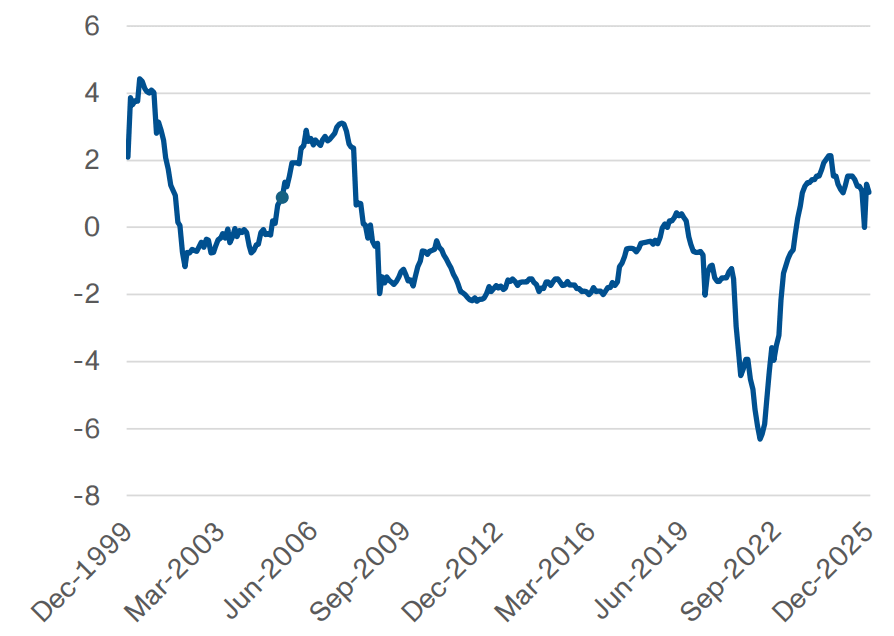
But beneath the surface, the picture is more nuanced and more fragile. Inflation, while lower, remains above the Fed’s 2% target. The labor market, though still tight, is showing signs of cooling. And the Fed’s policy stance, though softened by 75 basis points (bps) of cuts in late 2025, remains restrictive in real terms. The central bank has shifted from an aggressive inflation-fighting posture to a more balanced approach, signaling a willingness to respond to evolving data but cautioning against premature easing. As Chair Powell made it clear this month, the Fed is not in a hurry to cut further, wary of reigniting inflation or stalling progress. However, the fact that real rates remain restrictive suggests the economy is still digesting a meaningful drag from monetary policy, reinforcing the case for caution in underwriting growth expectations and for selectively adding income at today’s elevated yields.
 

Real Fed Funds Rate
Image
Chart from 1999 to 2025

Source: TCW, Bloomberg
 

Our Base Case – Moderated Momentum

The central expectation is for the U.S. economy to continue growing modestly in 2026, extending the resilience seen in 2025. Inflation has decelerated from last year’s highs but remains stubbornly above the Fed’s 2% target. This suggests the Fed will proceed carefully and we anticipate only gradual additional easing, if any, until price stability is assured. Meanwhile, U.S. consumers remain the backbone of the expansion. Household balance sheets remain strong, with liquid assets rising and home equity near record levels. Nearly half of all consumption is driven by the top decile of earners, those most insulated from economic shocks. These factors have helped keep retail sales resilient, with the “wealth effect” from record equity markets providing an additional lift to demand. Indeed, consumer spending and retail sales have been growing without signs of an imminent drop-off, despite rather downbeat consumer sentiment measures. The labor market, while no longer red-hot, continues to provide income support through low unemployment and real wage growth.

With monetary policy only slightly less restrictive, our base case is not a return to boom times, but rather a continuation of the complicated “higher for longer” environment, albeit one where outright recession is avoided. In practical terms, this means credit fundamentals should remain generally sound (low default rates, decent corporate earnings) and risk assets can grind out gains, but the degree of outperformance will be tempered by full valuations.

Resilient Base Case, but Inflation is Key

Baseline: Moderate growth continues into 2026, underpinned by strong consumers and easing inflation. The Fed’s modest rate cuts reflect confidence that price pressures are abating. However, inflation is still above target, so any surprise uptick could force renewed tightening. The economy’s path is positive but narrow – a soft landing is likely if inflation behaves.

Yet this strength is not without its vulnerabilities. The economy is walking a narrow tightrope, between sustained expansion and a stumble. Several risks could tip the balance:

  • A reacceleration of inflation could force the Fed to reverse course, tightening financial conditions and triggering a repricing of risk assets.
  • A policy misstep, either easing too slowly in the face of a downturn or too quickly in the face of sticky inflation, could undermine the recovery.
  • A sudden pullback in consumer spending, particularly among high-income households, could ripple through the economy.
  • Geopolitical tensions, from trade disputes to regional conflicts, remain a persistent source of uncertainty.

In this environment, the margin for error is slim. Credit spreads are tight across nearly every sector, equity valuations are elevated, and volatility has been conspicuously absent. Investors are being paid less to take risks: less to own credit, less to extend duration, less to venture into lower-rated or less liquid corners of the market. Should the economy falter, the repricing could be swift and unforgiving.

For insurers, this backdrop presents both opportunity and challenge. The economy’s resilience supports continued exposure to risk assets, but the ambiguity of policy direction and the tightness of valuations argue for caution. Portfolios must be constructed to navigate a narrow path, one that rewards quality carry and capital efficiency, but also maintains the flexibility to respond to shocks. In short, resilience has carried us this far. Renewal, in strategy, in discipline, and in allocation, must carry us further.

Watch Tight Spreads & Fed Uncertainty

Credit spreads are near historic tights across most sectors, which limits the cushion if growth disappoints. Geopolitical tensions and a still-uncertain Fed (real rates remain high) add caution. We could see volatility if investors demand more risk premium. Thus, while we are not “hugely worried” about an imminent downtrun, insurers should be prepared for bouts of spread widening should any of these risks materialize.

Implications for Insurance Portfolios: Strategy and Asset Allocation

To navigate today’s market dynamics, insurance investors should pursue a balanced, capital-efficient allocation, one that maintains yield to meet obligations, yet can withstand either outcome (continued expansion or a downturn). The key is to ensure resiliency of credit underwriting – avoiding potential downgrades and defaults that could come if the economy underperforms our expectations. Below we outline our recommended portfolio tilts for 2026, focusing on sectors and strategies that align with insurers’ long-term horizons and regulatory capital considerations. Notably:

01  |  Favor Spread and Structures:

We see particularly strong value in securitized products – asset classes like commercial mortgage-backed securities (MBS), non-agency residential MBS, asset-backed securities, and Collateralized Loan Obligations (CLOs) – which offer compelling yields and diversification for insurers. These often provide higher spreads than corporate bonds of equivalent ratings and capital requirements, plus structural protection (collateral and tranching) that aligns well with insurance risk management. Our strategy is to overweight select securitized sectors, notably:

  • Commercial MBS (CMBS), Focus on High-Quality Office Exposure: After the pandemic, the commercial real estate market, especially the office sector, has been under pressure. Investors have shunned office-related credit, creating significant dislocation in CMBS pricing. As a result, even senior, AAA-rated CMBS tranches backed by diversified pools or strong single assets offer spreads in the ballpark of 120-150 bps, far wider than comparable corporate bonds. We view this as an opportunity. Not all offices are doomed, and many single-asset, singleborrower CMBS deals are backed by top-tier properties or feature robust credit enhancement. By selecting CMBS with strong collateral and structure, seeking out strong sponsors with committed equity, ensuring lease terms that exceed the debt term, and avoiding deals overly concentrated in troubled properties, insurers can earn attractive carry with substantial downside cushion. Bottom line: selectively overweight CMBS, aimed at highquality slices and single-asset-single borrower (SASB) CMBS that benefit from the market’s generalized fear.
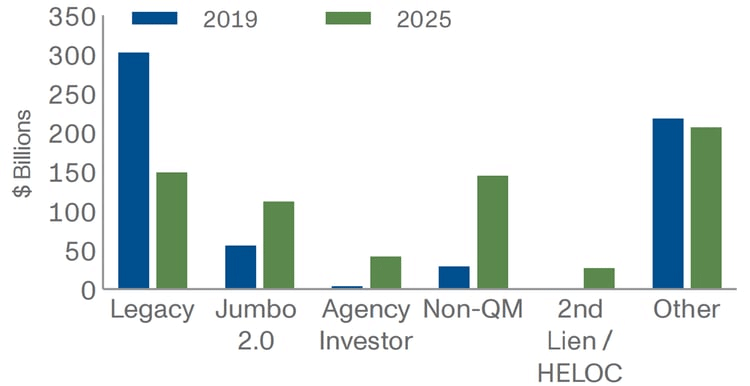
  • Non-Agency Residential MBS, Supported by Strong Housing Fundamentals: In residential mortgages, we favor non-agency RMBS (including “Non-Qualified Mortgage (Non-QM)” mortgages and credit risk transfer deals). U.S. housing fundamentals are solid – home prices have been resilient due to limited supply, and mortgage underwriting in the past decade has been disciplined. This means recently issued non-agency pools have strong credit profiles, as reflected in high homeowner equity and low loan-to-value ratios. We recommend adding exposure to both Non-QM mortgage securitizations as well as Non-QM whole loans (given the December clarifications provided by the NAIC on mortgages in statutory pass-through trusts. AAA rated tranches of Non-QM deals often come at ~100-120 bps spreads, underpinned by borrowers with substantial down payments and significant credit enhancement in the structure. These bonds offer a way to earn incremental spreads over agency MBS, without venturing into high corporate default risk. We also see value in mezzanine tranches (e.g., BBB rated) of seasoned non-agency deals, which can yield in the mid 200s bps but still have 5-10% subordination beneath them. Here, deep credit work is required, but certain structures like mortgage pass-through trusts analyzed in our internal research show robust resilience – for example, deals where stress tests indicate they could weather a Global Financial Crisis (GFC)-level housing downturn with minimal losses. Lastly, we have seen value in closed-end second-liens with strong underwriting, high quality originators, and low loan-to-value (LTV) first-lien mortgages, trading at similar spreads to Non-QM. Bottom line: non-agency RMBS offers yield pickup and diversification, and we overweight it within our spread allocation, focusing on deals with reliable servicers and well-underwritten collateral (e.g., prime jumbo loans, seasoned reperforming loans, and verified-income Non-QM loans).
     
RMBS Market Outstanding
Image
Bar chart comparing RMBS market

Source: Bank of America
 

  • CLOs, a Barbell Approach: CLOs have performed well over the past several years, given strong credit fundamentals, technicals of demand, supported by resilient structure. Spreads took a pause in 2025 after a long run of tightening. CLOs provide protection against a potential rise in rates, structural enhancements that make tranches down through single-A nearly unbreakable even in the face of massive economic disruption, and the opportunity to pick up attractive spread. Historically, CLOs have shown durability through prior default cycles such as the GFC and COVID. There have been no losses to AAA and AA tranches, even through these extreme scenarios. AAA tranches are near 100 bps, representing a sizable pick-up to like-rated corporate bonds, and BBB tranches still provide spreads north of 300 bps. Bottom line: Given the compression in single-A and double-A tranches from insurance company-buying, we recommend a barbell strategy that splits between AAA and BBB CLO tranches for attractive risk and capital-adjusted spread.
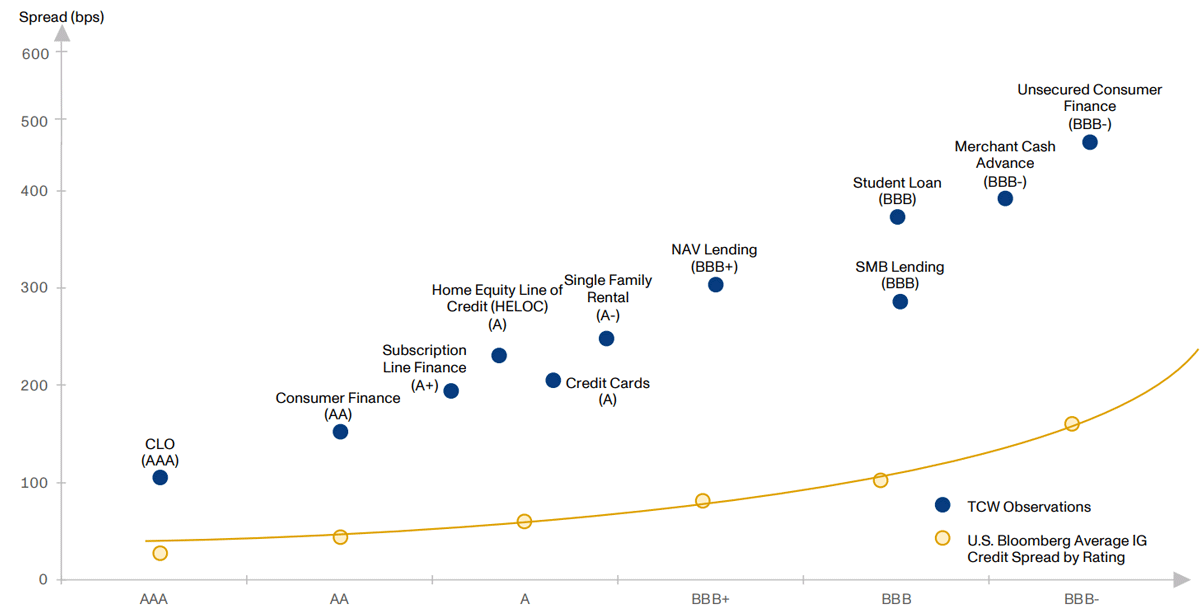
  • Unlocking Yield With Discipline and Structure in AssetBacked Securities (ABS): Within ABS, we continue to lean into the segments with the most durable fundamentals and defensible risk adjusted return potential. One of the most compelling themes in the outlook is digital infrastructure ABS, now a major BBB rated sector with strong structural protections. Despite recent 30-40 bps spread widening driven by heavy supply and AI related uncertainty, the long term financing needs of data center buildout create a persistent opportunity set for selective investors who can navigate technical headwinds and differentiate among issuers. We recommend a focus on cash flow visibility, long term leases, and hyperscaler anchors. Another attractive area is fund finance, with NAV lending, subscription lines, and CFOs offering attractive spread compensation against low LTV collateral. Bottom line: Our positioning favors defensive consumer shelves, commercial ABS, select digital infrastructure transactions, and select fund financing, where structure, collateral, and market dislocation collectively provide compelling yield without disproportionate credit risk. Where ABS offers stability, Asset-Backed Finance (ABF) delivers incremental yield through exposure to specialty receivables (consumer loans, small business financing, equipment leases, solar loans, and various flavors of infrastructure loans). We view ABF as the private-market extension of public ABS, with investors compensated for illiquidity, structural complexity, and sourcing expertise through meaningfully higher yields relative to comparable public markets. We pursue ABF selectively through specialized partnerships and expanding in house expertise, focusing on segments where underlying credit risk is well understood, structures are robust, and capital providers are scarce. Areas of ongoing interest include solar loan securitizations, and specialty consumer loan pools, all of which offer compelling risk adjusted return potential anchored by real, verifiable collateral. Position sizing remains modest and disciplined due to higher capital charges and reduced liquidity. For insurers, ABF offers a clear premium, compensating for illiquidity and structural nuance with spreads far above comparable public IG credit and with historically low correlation relative to traditional public credit. Bottom line: ABF plays a valuable role as a targeted alpha engine, delivering floating rate, shorter tenor exposure that complements our public ABS positioning and helps enhance overall portfolio income without materially increasing credit risk.
     
Illiquidity + Complexity = Incremental Spread

ABF investments offer incremental spread versus public corporates and exhibit lower volatility and correlations

Image
Graph

Source: Bloomberg, TCW from market research. October 2025.
 

Potential spread is intended to illustrate potential contractual spread terms in an example ABF investment and structure and is not intended to indicate Fund returns. Spread and returns may vary materially and adversely. There can be no assurance the Fund will invest in securities with similar terms.


02 | Upgrade Corporate Credit Exposure

and Dip Into Private Markets: Corporate credit remains expensive with limited dispersion, so selectivity is essential. We prefer to upgrade quality and structure across both public and private markets.

  • Across Public Corporate Bonds, Stick to Quality: Investment-grade (IG) corporate spreads (~75 bps) are near multi-year tights. They don’t offer much room for error, but they are still a necessary part of the portfolio for income and liquidity. We focus on the A/ BBB segment of IG, favoring stable sectors (utilities, high-quality financials, select consumer non-cyclicals). These issuers can likely weather a soft patch with minimal default risk, and some are exposed to the multi-decade trends of power demand and digital infrastructure build-out, leaving more durability in the opportunity. One particularly attractive opportunity has been utility hybrids. Rated BBB-, the debt trades in the high 100s for high quality credit profiles. For those insurance investors who have allowances for below investment grade, we recommend only a modest tactical allocation to BB-rated corporates, and generally shy away from deep high-yield (B/CCC) for now as you are simply not being paid enough for the risk, in our view. One exception within public markets is financial subordinated debt: some bank and insurance sub debt still offers a bit of a premium due to 2025’s regional bank turmoil, and for those we do selective picking. Bottom line: Stick to high‑quality credit. IG remains essential but offers little margin for error, so we emphasize A/BBB issuers in stable sectors and keep below‑IG exposure modest and selective. Broad HY beta is not compelling in 2026.
  • IG Private Placements Provide Illiquidity That Pays: Private placement IG remains a core tool for insurers, typically offering 40-70 bps of spread pickup versus public bonds, plus better covenants and comparable or lower historical losses. For insurers with long horizons, the trade-off is usually favorable: give up liquidity that we don’t urgently need and receive extra yield and often better covenants. We access private markets through two channels that differ meaningfully in structure and liquidity. 4(a)(2) private placements are true primary market, negotiated issuances exempt from registration, typically sold to a small set of accredited investors with bespoke documentation and tighter covenants; they are designed for buy and hold insurers and carry a higher illiquidity premium. By contrast, Rule 144A provides a safe harbor for resales of restricted securities to Qualified Institutional Buyers (QIBs), creating a deeper secondary market, broader buyer base, and pricing closer to public IG credit – more liquid but with a smaller complexity premium. We use both: 4(a)(2) for covenant strength and structural control, and 144A for scalable exposure with better secondary liquidity. Historically, default rates on private placements are similar to or lower than publics, in part due to stronger covenants and collateral provisions. We continue to be active in this space, effectively boosting portfolio yield without adding credit risk. From a capital perspective, we utilize NAIC’s security valuation processes to get these private assets designated, optimizing their treatment in our required insurance regulatory capital calculations. Bottom line: Selective exposures can enhance portfolio yield – potentially on the order of +50 to +100 bps over a public-focused mix – in a way that’s aligned with insurers’ long-term mandate.
     
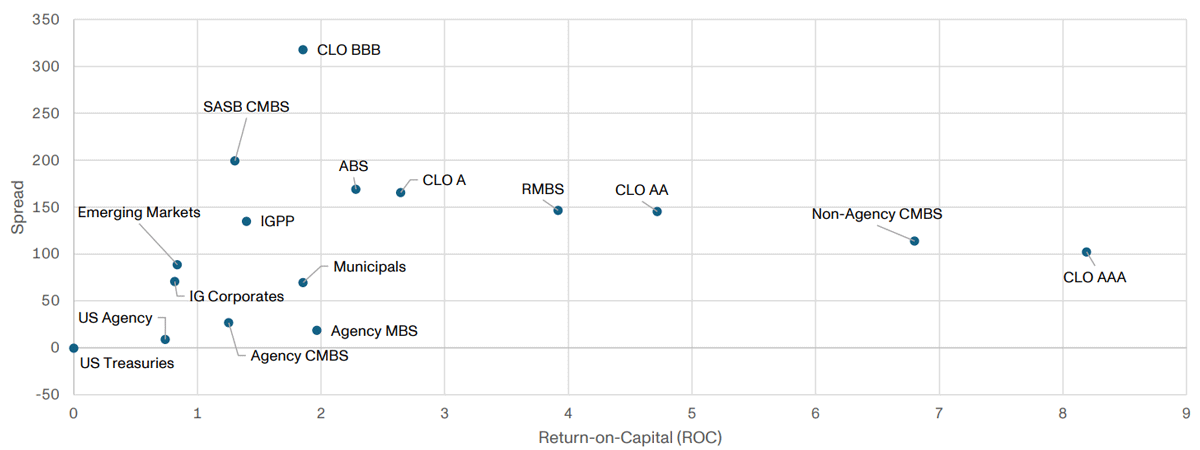
Capital Efficiency (Spread) Life Post-Tax
Image
Scatter graph

Source: TCW, Bloomberg
 

To visualize the relative value landscape that informs our allocations, consider how various credit sectors map onto their post tax return on capital versus spread, highlighting the differences in capital efficiency across the universe. The chart underscores why our strategy tilts toward multiple securitized sectors and IG private credit: these sectors deliver meaningfully higher capital efficiency, combining attractive spreads with stronger post‑tax return‑on‑capital, relative to mainstream public credit. While elevated spreads often reflect greater structural complexity or lower liquidity, those are precisely the areas where an insurer’s advantages in patience, underwriting expertise, and regulatory capital treatment allow us to harvest the premium effectively.

Resilience and Renewal – Tying It All Together:

In practice, portfolio resilience comes from high quality core holdings and true diversification, while renewal comes from rotating into opportunities as they arise. Our approach is straightforward: when spreads widen and value improves, we shift our focus from low risk assets into higher yielding ones; when spreads tighten beyond fundamentals, we upgrade the quality of our target portfolio, preparing for the next turn in the cycle. Ultimately, the 2026 insurance portfolio playbook is about balancing offense and defense. We pursue carry where it’s still compelling – securitized credit, private markets, and select corporates – while structuring exposures to protect principal and preserving liquidity for the unexpected. “Resilience and Renewal” means relying on what has worked across cycles but continually refreshing the portfolio by leaning into new sources of value such as ABF, IG private placements, and dislocated CMBS.

Our base case is cautiously optimistic, but we are positioned for a range of outcomes. By balancing current realities with future uncertainty, we seek stable income, capital preservation, and agility in a tightrope economy.


Read More from TCW


Disclosure
This material is for general information purposes only and does not constitute an offer to sell, or a solicitation of an offer to buy, any security. TCW, its officers, directors, employees or clients may have positions in securities or investments mentioned in this publication, which positions may change at any time, without notice. While the information and statistical data contained herein are based on sources believed to be reliable, we do not represent that it is accurate and should not be relied on as such or be the basis for an investment decision. The information contained herein may include preliminary information and/or “forward-looking statements.” Due to numerous factors, actual events may differ substantially from those presented. TCW assumes no duty to update any forward-looking statements or opinions in this document. Any opinions expressed herein are current only as of the time made and are subject to change without notice. Past performance is no guarantee of future results. All investing involves risk including the potential loss of principal. Market volatility may significantly impact the value of your investments. Recent tariff announcements may add to this volatility, creating additional economic uncertainty and potentially affecting the value of certain investments. Tariffs can impact various sectors differently, leading to changes in market dynamics and investment performance. © 2026 TCW

Share this post

Sign Up Now for Full Access to Articles and Podcasts!

Unlock full access to our vast content library by registering as an institutional investor

Register

Contacts


Image
TCW_Logo_Black


TCW has a dedicated insurance platform that is fully integrated with our dynamic investment management platform, which has served investors for over 50 years, enabling clients to evaluate opportunities through both an investment and insurance lens. The firm’s insurance portfolios incorporate a full range of solutions that can be customized as individual strategies or designed to function together within a diversified general account framework.  

Combining insurance-focused expertise, specialized infrastructure, and analytical capabilities, the platform helps insurers address portfolio construction, capital efficiency, regulatory considerations, statutory reporting, and balance sheet optimization as part of the investment process. By integrating these capabilities into a single client experience, TCW provides insurers with a more comprehensive approach to managing assets and liabilities. In a market where many managers offer insurance-compatible products, TCW distinguishes itself through the depth of its insurance-focused resources and its ability to support insurers holistically as regulatory, reporting, and capital requirements continue to evolve.

TCW is a global asset manager with $200 billion in assets under management as of June 30, 2026, offering innovative strategies across fixed income, equities, and alternatives to diverse insurance clients. 
 

TCW
515 South Flower Street
Los Angeles, CA 90071
insurancesolutions@tcw.com
 

View the contributor page

Sign Up Now for Full Access to Articles and Podcasts!

Unlock full access to our vast content library by registering as an institutional investor .

Create an account

Already have an account ? Sign in

Ѐ Ё Ђ Ѓ Є Ѕ І Ї Ј Љ Њ Ћ Ќ Ѝ Ў Џ А Б В Г Д Е Ж З И Й К Л М Н О П Р С ΄ ΅ Ά · Έ Ή Ί Ό Ύ Ώ ΐ Α Β Γ Δ Ε Ζ Η Θ Ι Κ Λ Μ Ν Ξ Ο Π Ρ Ё Ђ Ѓ Є Ѕ І Ї Ј Љ Њ Ћ Ќ Ў Џ А Б В Г Д Е Ж З И Й К Л М Н О П Р С Т У Ф Х Ц Ч Ш Ā ā Ă ă Ą ą Ć ć Ĉ ĉ Ċ ċ Č č Ď ď Đ đ Ē ē Ĕ ĕ Ė fi fl œ æ ß