





Federated Hermes-

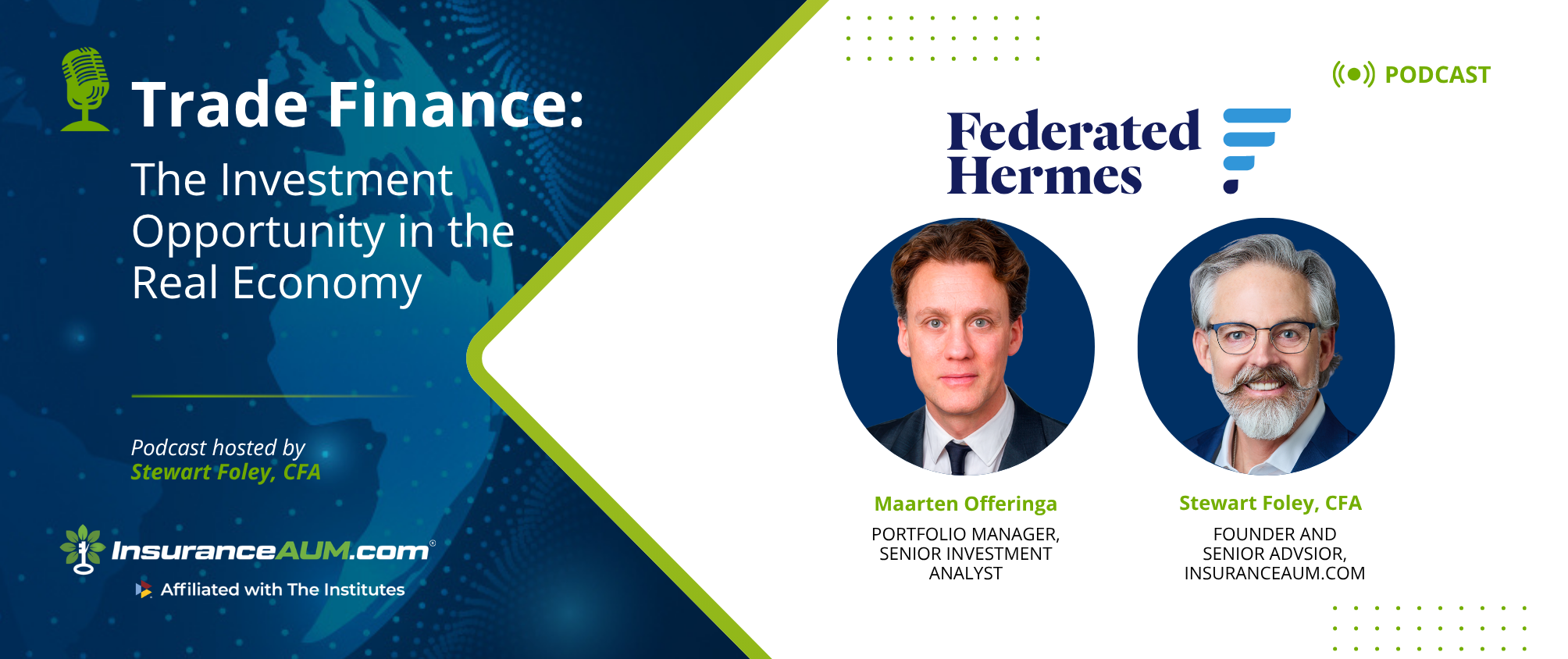
Trade Finance: The Investment Opportunity In The Real Economy

Image
IAUM_Podcast_E377_FederatedHermes_Web


Stewart: My name’s Stewart Foley. I’ll be your host, and this is the InsuranceAUM.com Podcast. We’ve got a great topic for you today and something just a little different. When most insurance investors think about fixed income, most of us think about corporate bonds and private credit, mortgages, asset-backed securities. But every day, and I was not aware of the scale of this, trillions of dollars move around the world: energy, food, raw materials, manufactured products. And behind every one of those transactions sits a financing need. The asset class is called trade finance, and it may be one of the largest and most important credit markets that many investors have never really seriously considered. The title of today’s podcast is “Trade Finance: The Opportunity in the Real Economy.”

I’m joined today by Maarten Offeringa, Portfolio Manager and Senior Investment Strategist on the Project and Trade Finance Strategy at Federated Hermes. Maarten is responsible for portfolio management and research across the strategy and brings experience from both the banking and risk management worlds. Maarten, we’re thrilled to have you on. You were also at J.P. Morgan in London. You’ve got a very interesting background, and I can’t wait to learn more about this asset class that, honestly, I’ve got a lot to learn. So welcome to the show.

Maarten: Thank you. Thanks for having me, Stewart. It’s great to be here.

Stewart: We’re thrilled you’re here. It’s going to be fun. So let’s tell everybody a couple of things about you. So, where’d you grow up? And if you weren’t doing this job today, what job would you most like to have instead?

Maarten: Well, I grew up in a small village outside of Amsterdam in the Netherlands. And in terms of a job that I would like to have, if not this one, I’d like to think that I could make a good diving instructor or be a professional athlete, if I had the talent for it.

Stewart: Wow, good for you. I’ll tell you one of the things: I love Amsterdam. I’ve been there three years in a row. Last time, we stayed in Utrecht, and one of our former clients is based there. My contact’s name is Renek, and he introduced me to Utrecht. And one of the jobs I think would be interesting is operating that crane that goes in on the barges and has that claw that scoops the bikes out of the canals. I saw an article that said they pull about 15,000 bikes a year out of those canals, and I would think there have got to be some interesting stories about how they got in there.

Maarten: That’s correct. That’s a well-known phenomenon back home.

Stewart: Part of it is, we’ve stayed in a canal house, and in the U.S., you get used to certain things. One of them is our litigious society. There are warning signs and big guardrails and everything, every which way. There was zero between me, at my front door, and the canal. It was kind of sloped toward the canal, and it got a little cold, so it got a little slippery. I was like, “I could see how this could go wrong for me in a big way.” But I love that part of the world and just appreciate you being on.

Let’s start with the basics. For listeners who may not be familiar with this asset class, and I’m kind of in that camp a little bit, what exactly is trade finance? How does it work, and why should an insurance investor be interested?

Maarten: Trade finance is a relatively little-known pocket of the credit markets, and in my opinion, it’s underappreciated. It’s important to define trade finance because it’s one of these terms that can mean different things to different people, right? Contrary, perhaps, to common perception, trade finance is not just factoring of invoices or discounting of payables from supply chains. That is one part of trade finance, but in fairness, it is much broader than that.

Trade finance, in its broader sense, is all the forms of short-duration capital that finance the production of physical goods, their related infrastructure, and the subsequent movement of those goods through global supply chains. That’s a long-winded way of saying that trade finance is essentially a number of products, but it’s perhaps best thought of as loans. Trade finance portfolios are portfolios of loans. So, in effect, it’s a subset of the bank loan market.

But these loans are pretty unique in that they’re not just generic balance sheet leverage for the borrowers that take them out. Each and every one of those loans is, like I said, short, and it’s specifically linked to a specifically identified physical flow of goods that it helps to finance.

Trade finance as an asset class, as a product, is not new. To be fair, it’s been around forever. It’s the most traditional form of bank lending. It’s the type of credit that banks extend to their key relationship clients, and they love doing it and continue doing it.

Stewart: You mentioned this, but I want to follow up there. I’m kind of with you there, and history is not my highest and best use, but it’s existed for centuries. This has existed in whatever economy it is for years and years, but it’s relatively recent that an institutional investor can play in this space. What structural changes in global trade and bank lending have led to the emergence of trade finance as an asset class?

Maarten: There are two prongs to this, two fundamental structural shifts that have contributed to the emergence of this as an asset class for institutional investors. First of all, there have been shifts in the way global trade is done, the way global trade happens these days. By that, I mean concepts that we’re probably all familiar with, such as globalization and the outsourcing of industrial production and manufacturing capabilities. That has led to an increasing amount of industrial activity moving away from developed markets, such as the U.S. or Western Europe, and toward developing or emerging market economies.

This is fairly well understood because globalization has obviously been through changes over the past 30 years, where first activity was outsourced, and then you have the whole offshoring trend. Subsequent to that, you had reshoring, bringing activity back onshore, and friendshoring. With all of those concepts, I guess what the main theme is, is that these global supply chains for physical goods constantly evolve. They continuously get repositioned and optimized, and accordingly, the business of financing those goods changes in tandem therewith.

So really, in trade finance, what you’re tapping into is that changing way global trade gets done. You’re tapping into those new market dynamics, higher economic growth, and changes in consumption and production of physical goods.

The second element to your question is: What has changed? How has this become institutionally investable? That’s on the financing side itself. The banks that have been the traditional providers of this credit, post-financial crisis, have been under ever-increasing regulatory requirements. They are required to set aside much more capital, be more prudent in their lending, and just do less of this type of activity for their clients.

As banks are forced to retreat, it opens up opportunity for non-bank providers of this capital that continues to be in such high demand. That trend, the regulatory trend and the pressures that banks are under, is of course nothing new.

That’s the very same trend that, in a broader sense, drives the emergence and continued growth of private markets more broadly. Private credit, direct lending, asset-backed finance, real estate lending, infrastructure debt — those all benefit from that same trend in the financing market.

Stewart: Our listeners have different size portfolios. One of the maybe counterintuitive notions is that markets have to be a certain size for some of these folks to even consider them because of the scale of the capital that they need to deploy on a regular basis. If you can help us understand the size of this opportunity, by the way you’re describing it, it sounds like a big market. But how does trade finance provide investors access to global economic activity?

Maarten: You’re absolutely right. The market for trade finance is very significant. It’s huge. And it’s understandable if you think about it, because the value of global merchandise trade, the goods that move around the world, is very significant. There’s some data around this. For example, the World Trade Organization publishes periodic data around this. For the most recent year, 2025, the WTO estimates that the value of global merchandise trade is something to the tune of $26 trillion. That’s huge.

About 80% or so is estimated to currently attract some form of financing — 80% of $26 trillion. In addition to that huge existing market, there are studies that indicate that a significant amount of global trade doesn’t even get financed at all, even though it would like to. There’s an unmet trade finance gap of an estimated $2.5 trillion annually that just doesn’t get financed at all. So those are significant numbers.

Stewart: Yes, they are, without a doubt. Let’s talk about the return side of it just a little bit. What drives returns in trade finance, and how should insurance investors think about the yield, volatility, liquidity, and diversification characteristics? And let’s throw duration in there as well. You mentioned short duration. Sounds like it’s going to be, by the way you’re describing the asset or the underlying collateral. If I’m a CIO, how should I be thinking about this?

Maarten: Trade finance is really a defensive income investment strategy. And I say defensive income because, fundamentally, this is buy-and-hold investing in performing, senior-most credit to the borrowers that we back. It’s really investing for cash-pay income in financing structures that are characterized by their short tenors. That’s the profile.

It’s defensive because, as I said, these are senior credit structures to performing credits, and the loans not only are short, but they typically amortize. In a way, they are self-liquidating exposures. And in this investment portfolio, we constantly come back into cash on these investments as a result of that. That’s a very significant feature, if you think about it, compared to other private market credit products because you’re not really contingent on an M&A transaction to materialize or for a capital market refinancing window to open up or not. These are, by and large, self-amortizing, short-duration, performing credit products.

The yield that this offers, the yield profile, this is cash-pay yield type. Effectively, the loans that are put into these portfolios, they are performing credits, cash-pay coupons only. There are no PIK financing structures. They earn income from the periodic payment of interest, as well as any associated fees with new loan originations or corporate actions as and when they occur. That’s really the yield type here.

Stewart: Do you have a way to quote or give a range on duration? It seems like, given the nature, I mean, duration measures interest rate sensitivity, and given the speed at which these things are being converted, it seems like the duration wouldn’t be the same as floating rate, but it can’t be very long, right?

Maarten: It is a floating-rate investment strategy. The underlying instruments are all floating rate. So, in effect, the duration of these portfolios is very low.

Stewart: Very short. Yeah.

Maarten: Very short. Duration is perhaps best thought of as the weighted average life of these financings on that basis. We manage these portfolios to an average life of around two years.

Stewart: Yeah, that makes sense. I think that’s a good proxy for sure. Let’s talk a little bit about the investment process. A lot of times, your sourcing, your deal flow, can be a source of significant differentiation. Where are you sourcing investments, and what makes your origination and underwriting approach different than others, or is it different than others?

Maarten: The sourcing of the trade finance assets is indeed a differentiator compared to, for example, other floating-rate private asset classes such as direct lending or private credit. The way we source these deals is through the bank market. We do not self-structure or originate these loans directly. We always partner with the banks rather than look to overtake and outcompete them on their own turf.

We really think of this as a symbiotic approach, where the banks are wanting to do plenty of this business for their core relationship clients on an ongoing basis, but they’re, for a number of reasons, not able to do so. So, the demand for this type of financing far outstrips supply. We are here to partner with the banks and leverage their origination networks and invest alongside them on a syndicated basis in these performing credit structures so that it’s a win-win for us to get invested and to get that exposure, and for the banks, who don’t see us as a competitive threat to the business that they value so much.

Stewart: You’re almost an enabler, right? You’re providing them with something. Without that relationship, they would struggle to continue to do that business. Is that fair?

Maarten: That is correct.

Stewart: Yeah. One of the things that helps me on these podcasts are examples. Can you give us a real-world example of how a trade finance transaction works and how capital ultimately gets deployed into the real economy?

Maarten: We finance exclusively a subset of the global trade that is available for financing. Our focus is on essential goods only. What I mean by that is we very selectively finance which types of trade we finance and which we don’t. I’ll give you a couple of examples of what I mean by these essential goods types of physical trade flow.

We did a deal last year where we financed a major commercial airline that was looking to expand its operating fleet of passenger aircraft. They placed an order with the manufacturer, paid a partial down payment, and then worked with us and a commercial bank syndicate to finance the remainder of the purchase price.

We were secured as lenders on that purchase contract, so their spot in the manufacturing queue was effectively assigned to lenders. In addition to being collateralized by mortgages over the planes that were already in possession of the airline itself and in operation, we had further credit enhancement by way of a corporate guarantee. Altogether, that financing was on a one-year tenor, literally to finance that cross-border flow of capital goods, the aircraft going from the United States to the airline in question. That was a prime example of strategic essential goods trade flow.

Another example would be where we finance, on a periodic basis, an agency of the government. The government runs an annual program of subsidized bread in the country to feed its population. In order to facilitate that program, they need to purchase wheat in international commodity tenders on a recurring basis, monthly or quarterly. As they proceed into those tenders, we finance them alongside a multilateral development bank to help pay for those purchases of wheat that then go to finance the subsidized food program for the population of the country. That is a core and essential-goods, strategic-nature trade flow that we think is of great value to all the parties involved, and we are more than happy to invest on a recurring basis.

Stewart: That’s very helpful. Very helpful examples. As we wrap, as a CIO, where does this fit in my general account? Can you talk a little bit about how you see folks, and everybody categorizes things in different ways, how do you see your clients positioning this asset class?

Maarten: Trade finance is really one allocation; it’s an option across your spectrum of fixed income options. It’s not necessarily here to replace any other product allocation category, but it is here to complement. We see clients allocate this as a standalone fixed income allocation alongside public markets fixed income, so high yield, high grade, asset-backed, EM. And as you go from public to private, you can have private credit, direct lending, IG direct lending, non-IG, asset-backed finance. There is a space for trade finance to sit alongside those public fixed income allocations and private fixed income allocations.

This is really an alternative-type allocation. That’s how you probably best categorize it. It gives you that optionality. Because of its low correlations to other fixed income asset classes that I just spoke about, there is not really anything like it. Because, as a floating-rate product, this protects against typical fixed income risks associated with inflation and interest rate changes. It is a perfect diversifier.

Insurers can allocate to this as either a standalone allocation on the spectrum of fixed income options, or it can perfectly well be used in a multi-asset wrap, where you look to combine a number of credit solutions into one combined portfolio. Whether it’s standalone or in a multi-asset wrap, it has that benefit of low volatility, improving your diversification, and boosting a good, stable return.

Stewart: It’s been super helpful. It’s been a great education on trade finance. I’ve learned a lot today, and I really appreciate you being on. I’ve got a couple of not-investment topics for you on the way out the door. The first one really is trying to get at the culture of your firm. Not only that, but you’ve been at a couple places, and you’ve been at this for a minute. What characteristics do you think are most important when you’re adding members to your team?

Maarten: Sure. It’s a great culture here. The firm was founded as far back as 1955 by two high school friends who started out in the money market space. Obviously, the firm has grown and expanded significantly since then, but despite being a listed firm, Federated Hermes, to this day, has very strong family values to it. It’s a great place to work. It’s a very diverse set of employees that work together here, and I think it’s shown by the fact that a lot of employees have a long tenure with the company. People really value working here. It’s an open and collaborative environment. And I think if those features appeal to you, that’s a space that would suit you very well.

Stewart: That’s fantastic. I love that. All right, so last one. You can have dinner with up to three guests. They can be alive or dead. Who would you most like to have dinner with, Maarten? I love this question. I ask it a zillion times, and the answer is always interesting.

Maarten: Three. Let’s see.

Stewart: You don’t have to. You can do one, two, or three. I should have said that.

Maarten: I would say, at dinner, I would love to have dinner with Warren Buffett.

Stewart: He’s the leader in the clubhouse.

Maarten: Alongside him, I would place probably Steve Jobs, just for his ingenuity and the vision that he represents. Lastly, I would add to the table Michael Jordan, formerly of the Chicago Bulls, because of his exceptional record as an athlete and his subsequent success in business.

Stewart: He’s also a team owner in NASCAR, and one of his cars has done exceptionally well this year. He’s at several races. It’s fun to see him, and it’s true that he’s been a winner in athletics, he’s been a winner in business. The Jumpman deal he did with Nike is just a brilliant, brilliant deal. And then he’s been a winner as a team owner as well. So that would be a great, very interesting table.

Maarten, thanks so much for being on today. We got a great education and got to know you a little bit too, which is always fun. Thank you so much.

Maarten: Thanks for having me, Stewart. It’s been great.

Stewart: We’ve been joined by Maarten Offeringa, Portfolio Manager and Senior Investment Analyst on the Project and Trade Finance Strategy at Federated Hermes. If you like what we do, please rate us and review us on Apple Podcasts, Spotify, or wherever you listen to your favorite shows. You can also watch us on our YouTube channel at InsuranceAUM Community. Thanks for joining us. We’ll see you next time. We are the home of the world’s smartest money on the InsuranceAUM.com Podcast.


Disclosure:

Views are as of May 29th, 2026 and are subject to change based on market conditions and other factors. These views should not be construed as a recommendation for any specific security or sector.

Investments in trade finance-related instruments may entail credit, liquidity, currency, and market risks in addition to other risks, such as the risk of investing in foreign securities and emerging market securities.

Trade finance related securities will be located primarily in, or have exposure to, global emerging markets. International investing involves special risks including currency risk, increased volatility, political risks, and differences in auditing and other financial standards. Prices of emerging markets securities can be significantly more volatile than the prices of securities in developed countries and currency risk and political risks are accentuated in emerging markets.

Diversification does not assure a profit nor protect against loss.

Bond prices are sensitive to changes in interest rates and a rise in interest rates can cause a decline in their prices. In addition, fixed-income investors should be aware of other risks such as credit risk, inflation risk, call risk and liquidity risk.

Duration is a measure of a security’s price sensitivity to changes in interest rates. Securities with longer durations are more sensitive to changes in interest rates than securities of shorter durations.

Issued and approved by Federated Investment Management Company.

Share this post

Sign Up Now for Full Access to Articles and Podcasts!

Unlock full access to our vast content library by registering as an institutional investor

Register

Contacts


Federated Hermes

Federated Hermes is a global leader in active, responsible investing, with a commitment to responsibility deeply embedded in our heritage, client relationships, long-term vision, and fiduciary principles. Our extensive platform of investment solutions empowers investors to achieve a diverse range of outcomes. We specialize in managing equity, fixed-income, alternative/private markets, multi-asset, and liquidity management strategies for institutional investors, including insurance entities. Headquartered in Pittsburgh, our team of over 2,000 employees spans across major financial hubs such as London, New York, Boston, and other locations worldwide.

Brian Willer   
Institutional Business Development 
North America National Sales Manager
Federated Securities Corp.
Brian.Willer@FederatedHermes.com  
617-335-0770

Federated Hermes
1001 Liberty Avenue,  
Pittsburgh,  
PA 15222-3779


View the contributor page

Sign Up Now for Full Access to Articles and Podcasts!

Unlock full access to our vast content library by registering as an institutional investor .

Create an account

Already have an account ? Sign in

Ѐ Ё Ђ Ѓ Є Ѕ І Ї Ј Љ Њ Ћ Ќ Ѝ Ў Џ А Б В Г Д Е Ж З И Й К Л М Н О П Р С ΄ ΅ Ά · Έ Ή Ί Ό Ύ Ώ ΐ Α Β Γ Δ Ε Ζ Η Θ Ι Κ Λ Μ Ν Ξ Ο Π Ρ Ё Ђ Ѓ Є Ѕ І Ї Ј Љ Њ Ћ Ќ Ў Џ А Б В Г Д Е Ж З И Й К Л М Н О П Р С Т У Ф Х Ц Ч Ш Ā ā Ă ă Ą ą Ć ć Ĉ ĉ Ċ ċ Č č Ď ď Đ đ Ē ē Ĕ ĕ Ė fi fl œ æ ß