
Hamilton Lane -

Venture Capital in the Age of AI

HamiltonLaneFeatured

Miguel Luiña
Managing Director, Co-Head of Venture Capital & Growth Equity

Nathan Ritsko
Managing Director, Venture Capital & Growth Equity


Venture capital is entering a new phase, one that looks fundamentally different from prior cycles both in scale and structure. The convergence of artificial intelligence, shifting capital allocation and evolving exit dynamics is reshaping where value is created, how it compounds and who captures it. While headlines often focus on record-breaking funding rounds or eye-popping valuations, a more nuanced story lies beneath the surface: Venture capital has increasingly become the critical engine of value creation in the global innovation economy.

 
The Great Shift from Public to Private Markets

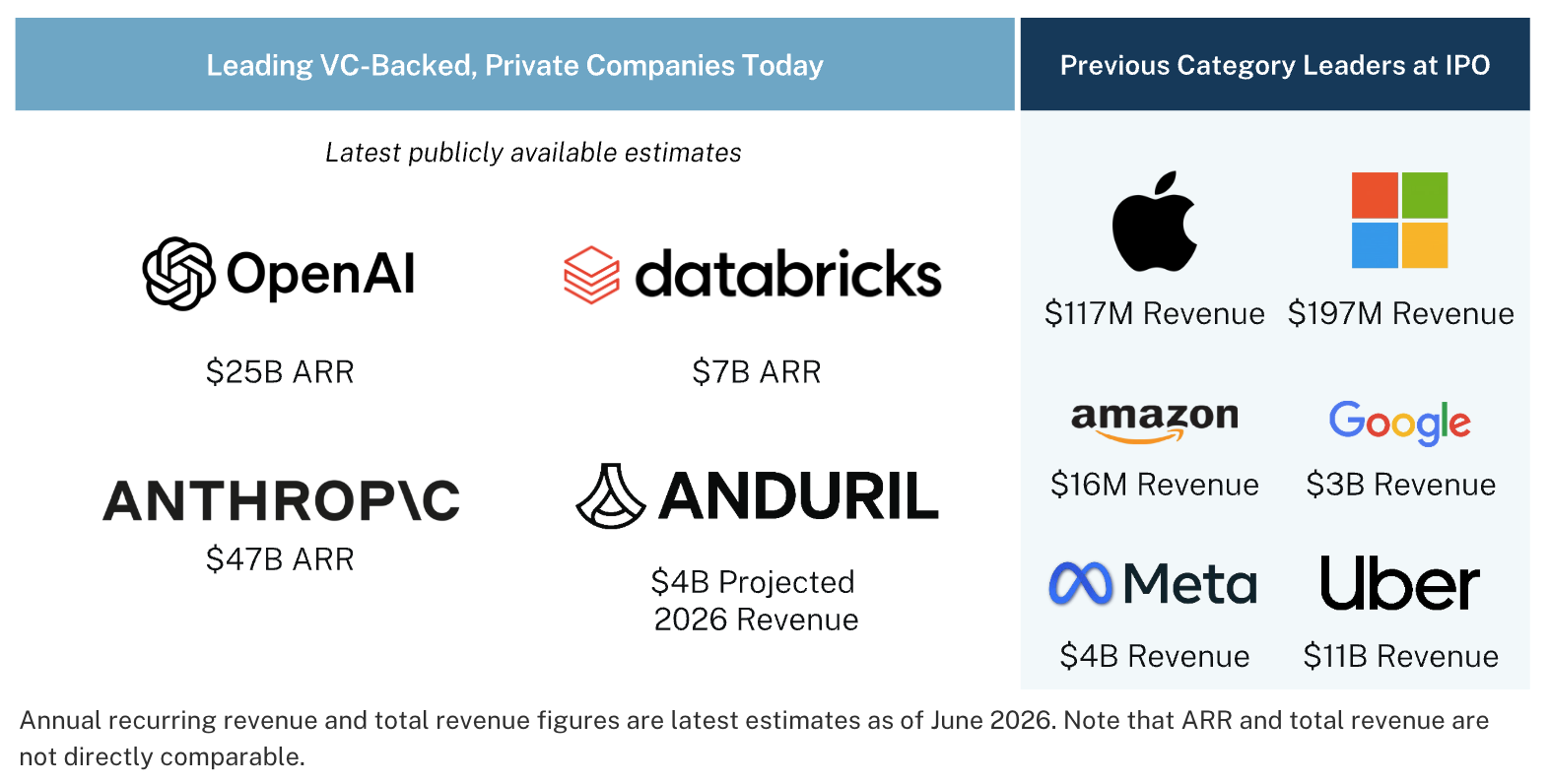
Historically, many of the world’s most iconic technology companies entered public markets at relatively early stages of maturity. Revenue at IPO was modest, growth trajectories were more uncertain and much of the value creation occurred after listing. That paradigm has changed decisively.

Chart comparing company revenue and value creation before and after entering public markets

Today’s category-defining companies, particularly those born in the AI era, are reaching extraordinary scale while still private. Many companies are now generating billions, sometimes tens of billions, in annual recurring revenue before ever contemplating an IPO. This represents a structural shift. A growing share of long-term value is being created and captured in private markets, and venture capital increasingly sits at the center of that value capture.

The implications for investors are clear. Earlier access within private markets matters far more than it did in prior generations. Simply “waiting for the IPO” might miss a significant portion of that growth of the most powerful innovation cycles.

 
Capital Is Concentrating Quickly

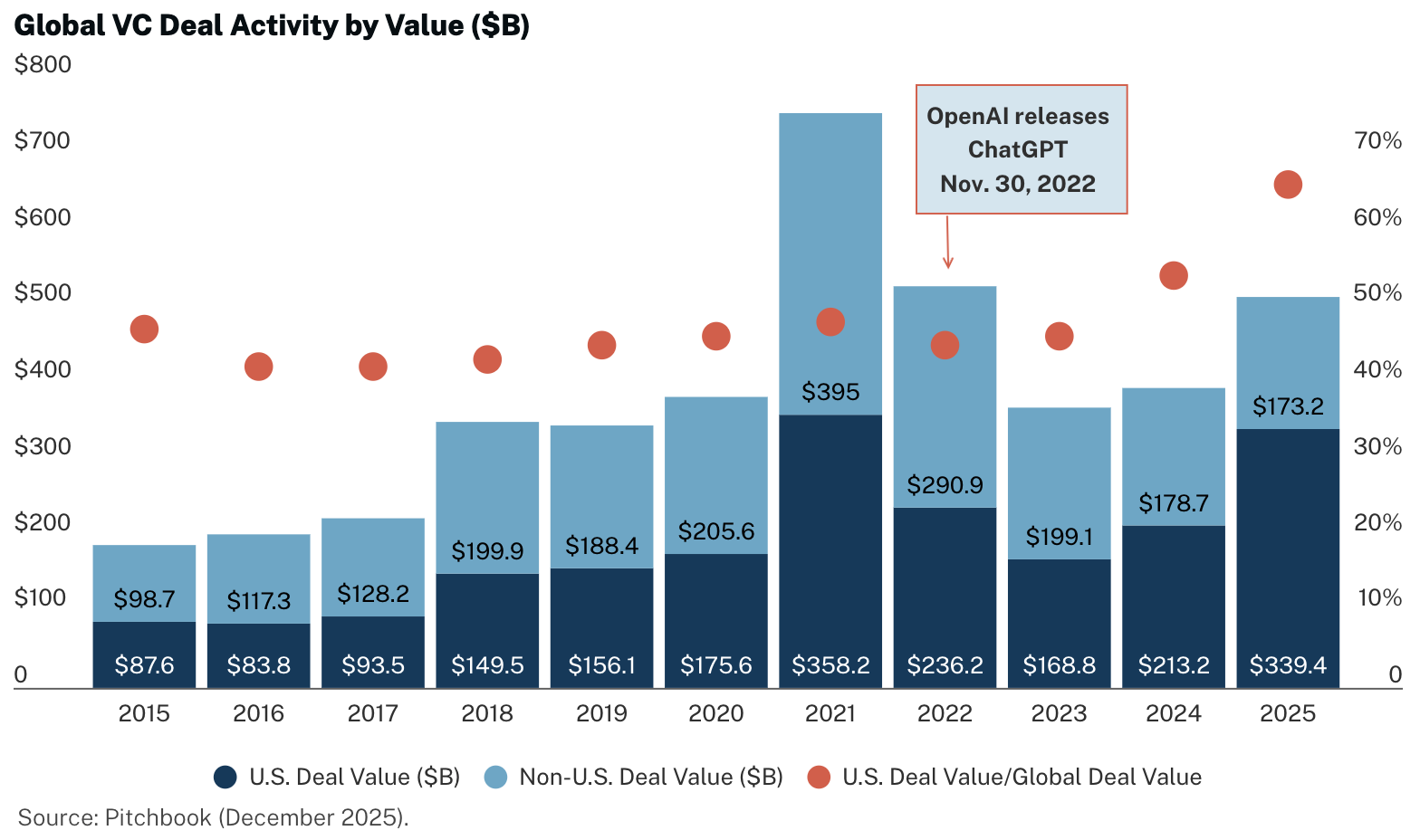
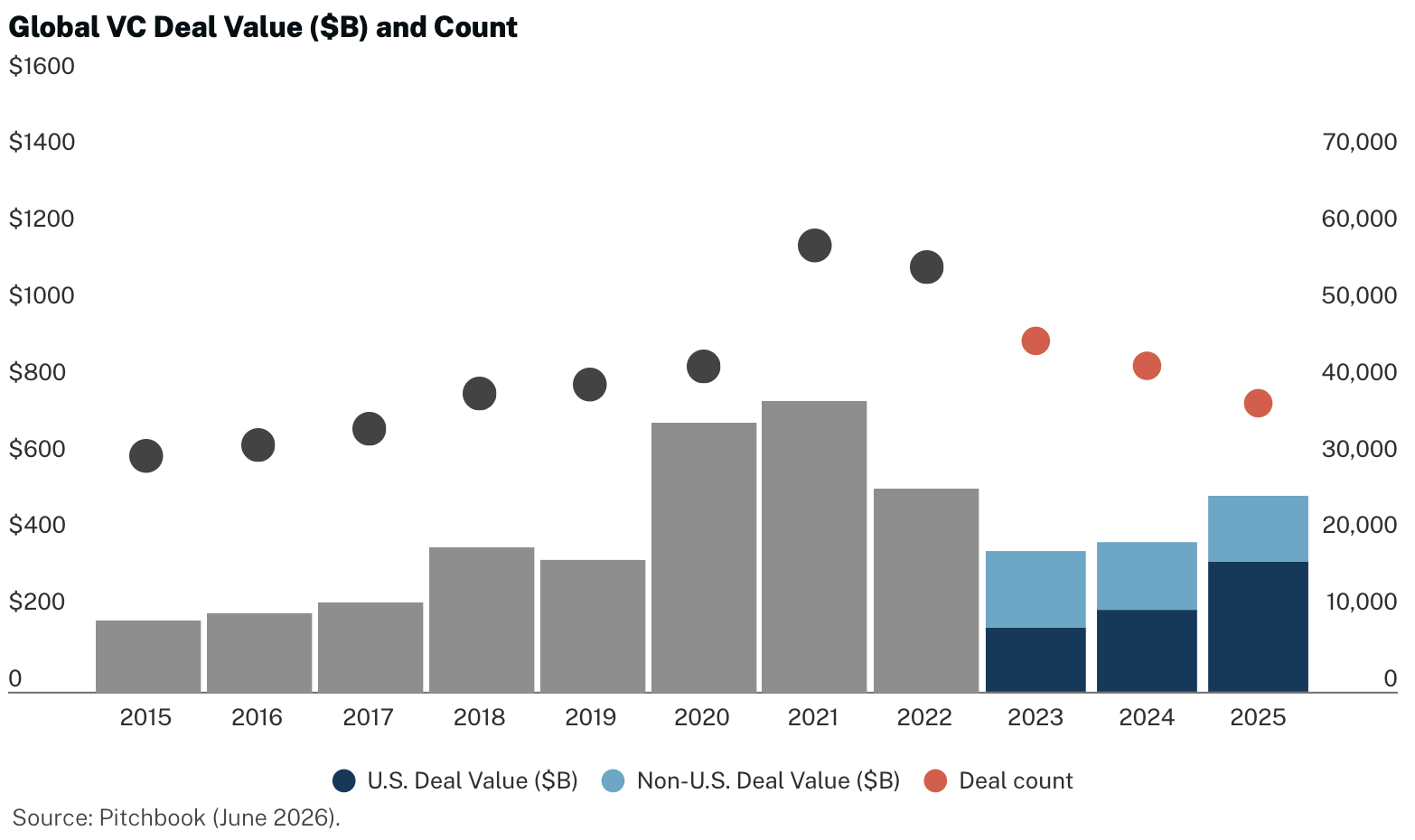
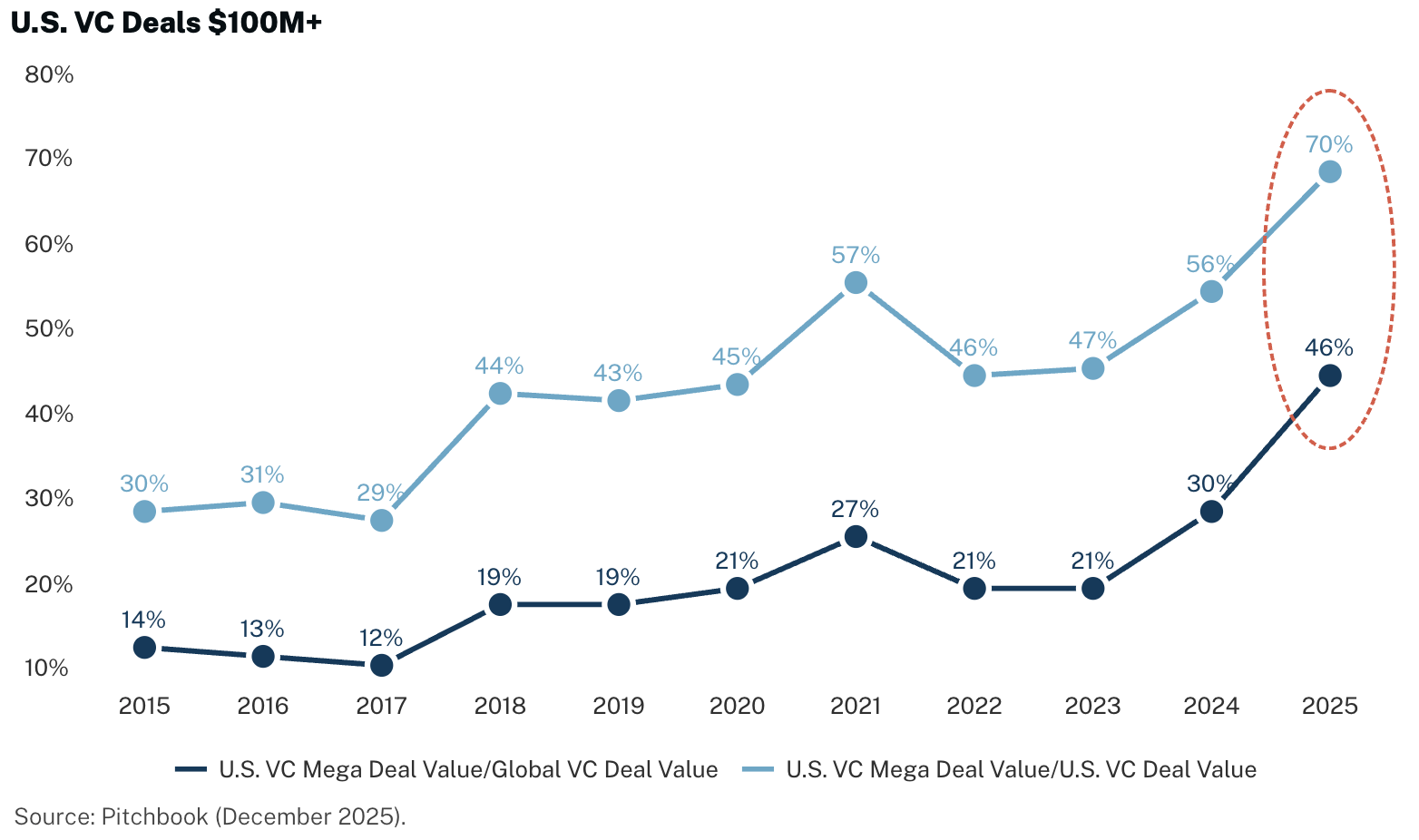
Global venture deal value rebounded sharply in 2025, reaching one of the highest levels of the past decade. Yet that resurgence masks a striking divergence. While dollars invested have surged, the number of deals has continued to decline. Capital is being deployed into fewer companies, at larger check sizes, with so-called “mega-deals” of $100m+ now representing a dominant share of the market.

Chart showing global venture capital deal activity by value

Chart comparing global venture capital deal value with the number of transactions

AI is the primary driver of this concentration. Capital is flowing disproportionately to companies demonstrating early, decisive revenue traction, often at a scale and speed previously unseen in venture. The result is a bifurcated market: breakout winners absorbing ever-larger pools of capital, while the long tail becomes increasingly capital constrained.

This concentration dynamic does not necessarily reduce the opportunity set, but it raises the bar. Manager selection, sourcing depth and the ability to differentiate between durable leadership and temporary momentum have never been more important.

Chart showing the growing share of US venture capital invested through deals of 100 million dollars or more

 
Valuations: Elevated, but Not Untethered

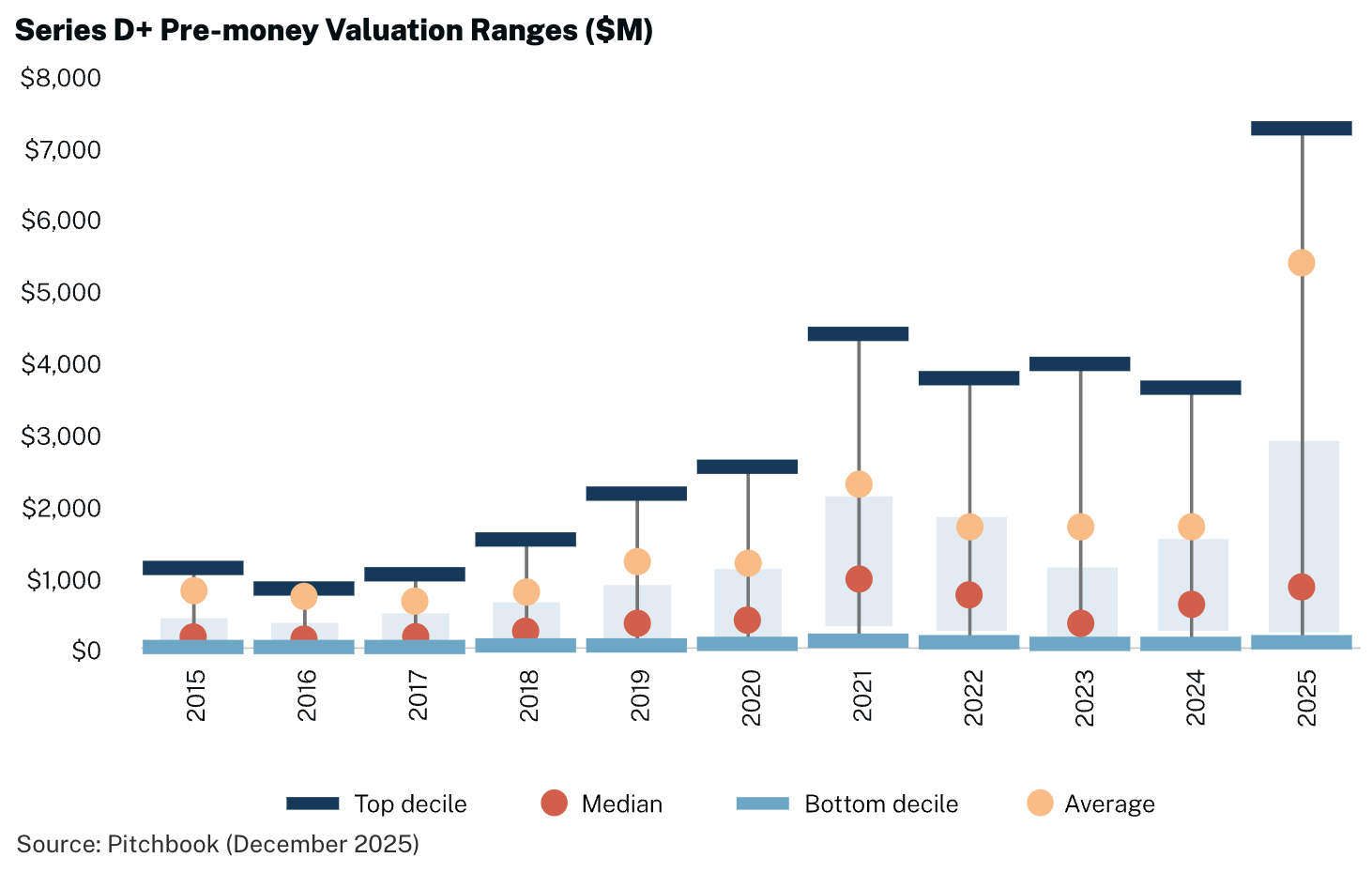
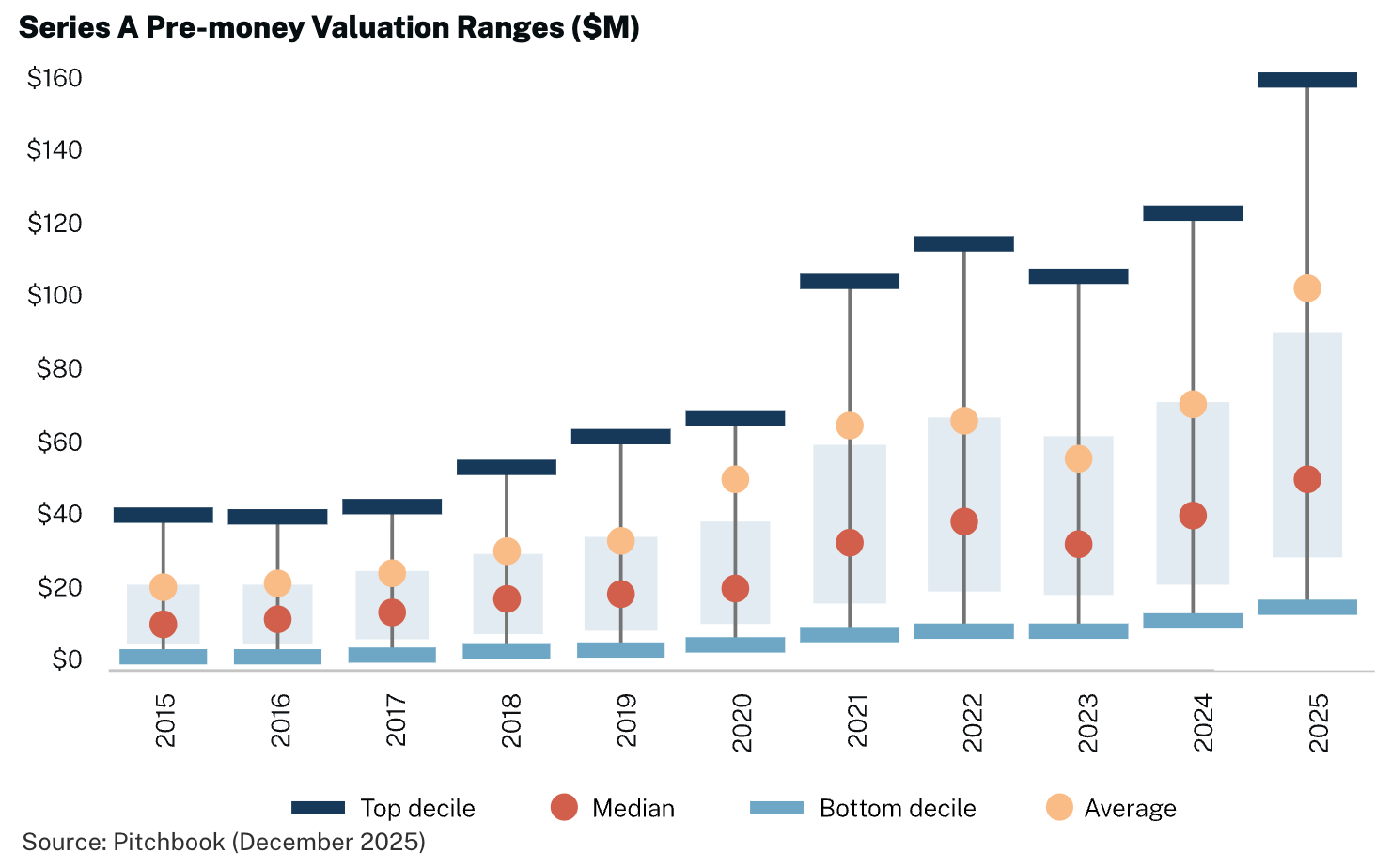
Rising valuations are an unavoidable topic in today’s venture landscape. Early-stage valuations are meaningfully higher than a decade ago, and dispersion across and within stages is widening. Yet context matters. For example, 2021 marked a recent high in venture deal activity, yet the median valuations of later-stage VC-backed companies (Series D+) remain below 2021 levels (0.9x). When viewed through the lens of rapid growth, today’s market looks more robust than headlines might imply.

Chart showing historical Series A pre-money venture capital valuation ranges

Chart showing historical Series D and later-stage pre-money venture capital valuation ranges

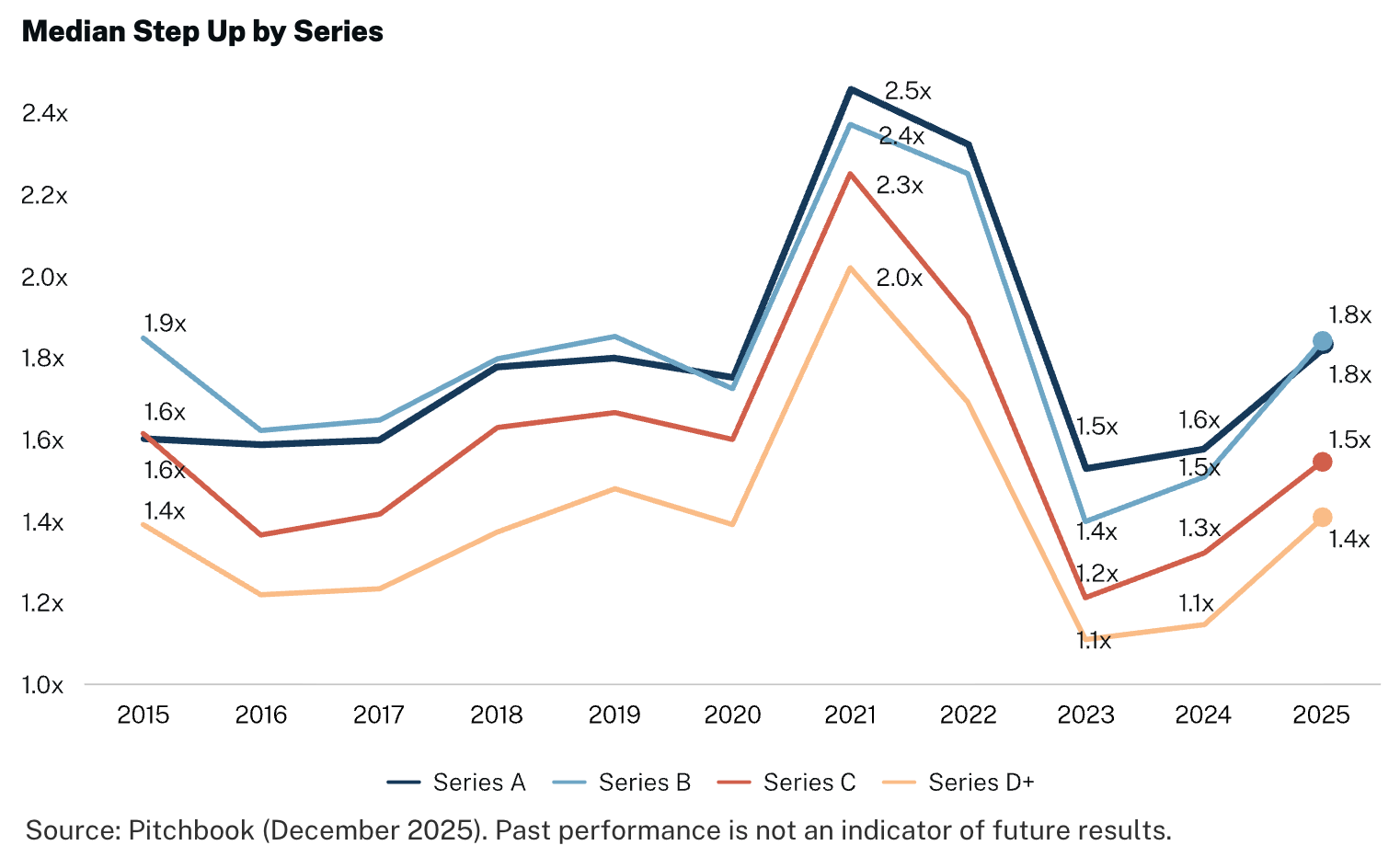
Another way to measure the momentum valuations on the current venture market is to look at valuation step up between rounds. Perhaps surprisingly, step-ups are in line with historical averages of a decade ago, normalizing to those level following the post-pandemic peak. At the same time, the fastest-growing AI-native companies are “growing into” their valuations with unprecedented speed. Revenue expansion is compressing multiples rapidly, often within months rather than years.

Chart comparing median valuation increases between venture capital funding rounds

The lesson is not that valuation risk has disappeared. It has not. But simplistic narratives about bubbles miss the nuance. In a market defined by extreme dispersion, valuation alone is an incomplete story. Growth durability, competitive positioning and monetization pathways matter just as much.

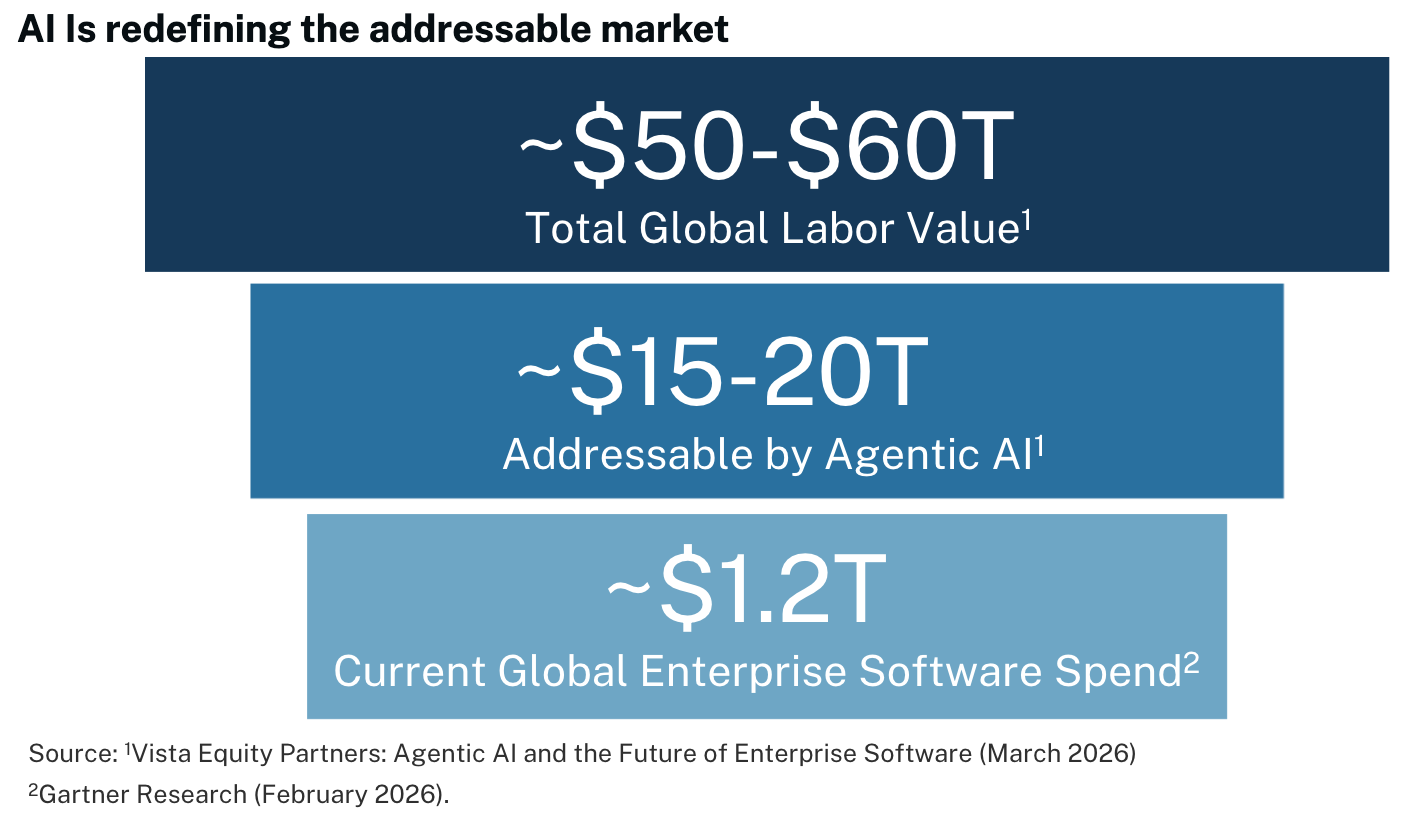
Chart illustrating the expanding addressable market for artificial intelligence applications

 
AI Is Redefining the Addressable Market

What separates this cycle from prior technology waves is not just speed, but scope. AI is not merely another software category competing for a slice of a finite IT budget. It is targeting a far larger pool of economic activity: the labor market, and specifically, repetitive intellectual labor across industries, functions and geographies.

This market is significantly larger than traditional enterprise software, and largely unconstrained by legacy incumbents. As a result, enterprise AI has scaled faster than any software category in history, moving from negligible revenue to tens of billions in just a few years. AI-native companies are consistently outpacing non-AI peers in growth, fundraising and exit activity.

Importantly, the center of gravity is shifting from foundational models toward the application and agent layers, where use cases proliferate and value accrues closer to the end customer. History suggests this layer is where the majority of long-term winners ultimately emerge.

 
SaaS Is Not Dead

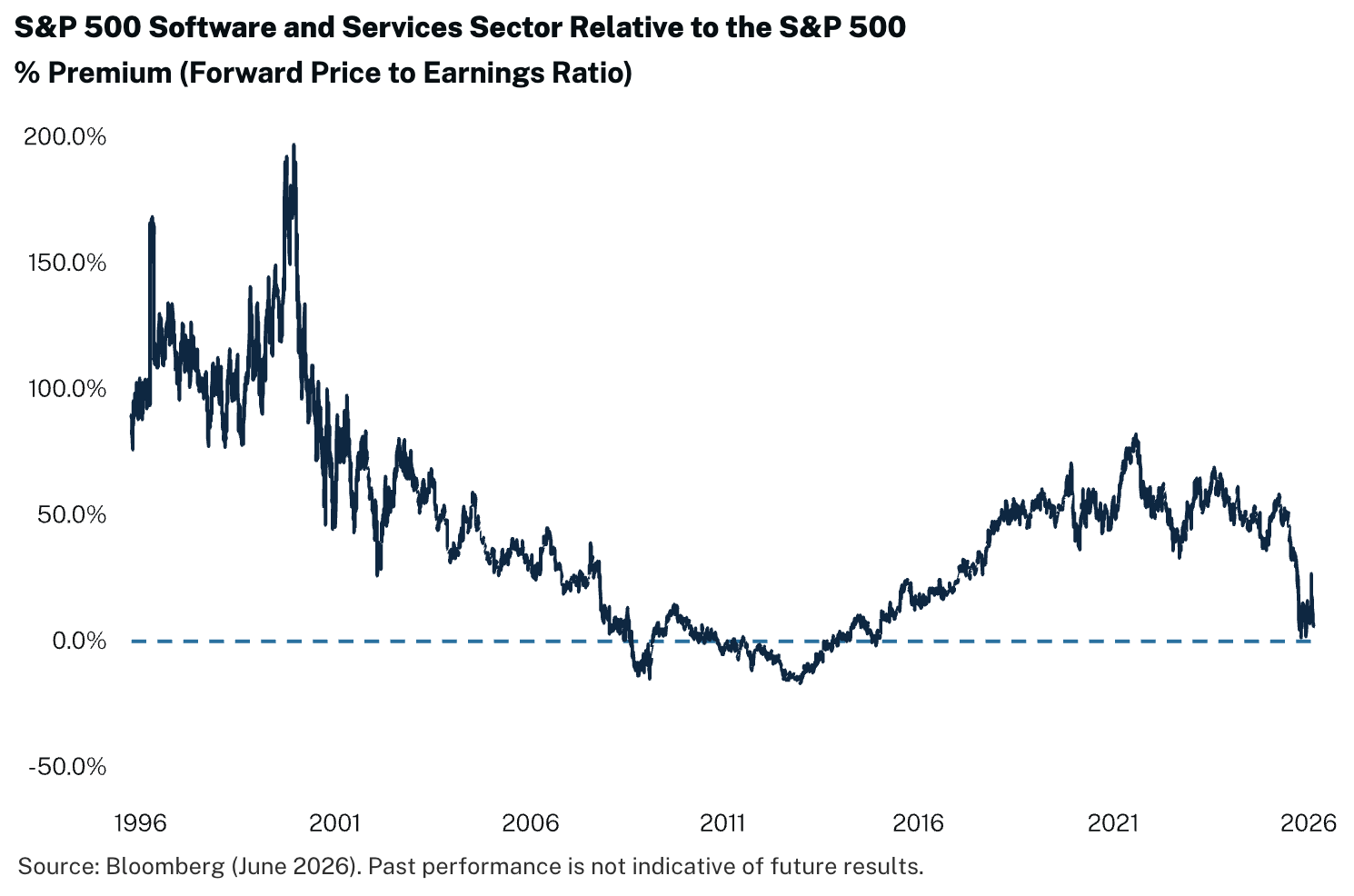
Chart comparing the forward price-to-earnings premium of the S&P 500 software and services sector with the broader S&P 500

The rise of AI has sparked existential questions about the future of traditional software. Public market multiples suggest skepticism, with software trading at historically low levels. Yet the reality is more nuanced.

AI is not erasing software completely. Instead, it is accelerating a Darwinian process. Software with deep workflow integration, proprietary data and strong customer trust is well positioned to embed AI, expand functionality and improve margins. SaaS companies with less differentiation and a weaker competitive moat face real obsolescence risk.

This bifurcation mirrors prior platform shifts, from on-premise to cloud to mobile. In most cases, incumbents did not disappear, but leadership changed hands. AI appears poised to follow the same pattern.

 
Liquidity Is Evolving

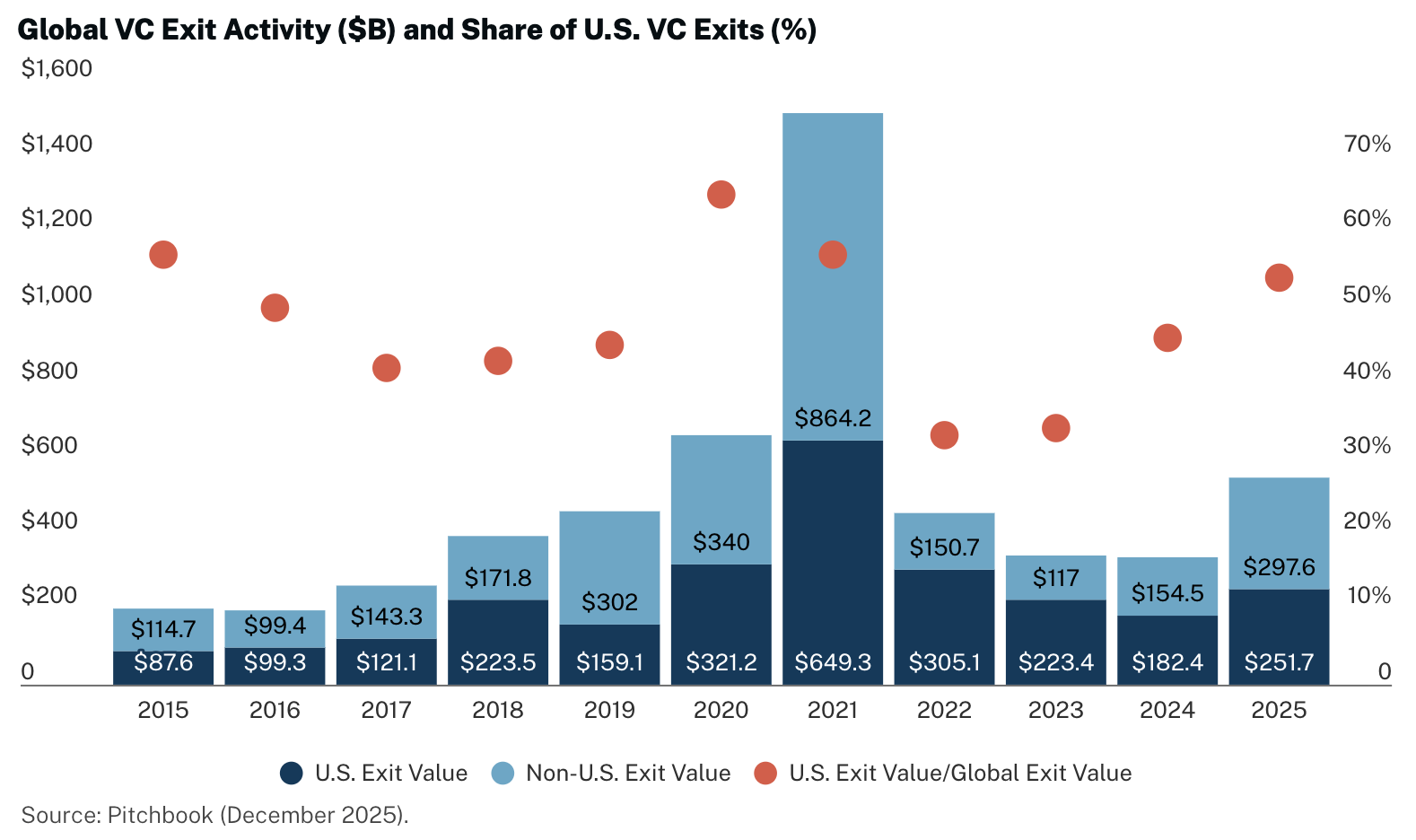
Chart showing global venture capital exit activity and the share represented by US venture exits

While traditional exit markets remain muted relative to their 2021 peak, liquidity has not disappeared. It has shifted. AI-driven M&A is rising, the IPO window is selectively reopening, and venture secondaries have become a critical pressure release valve for both GPs and LPs.

Secondaries, in particular, offer a compelling dual role: providing liquidity in a constrained exit environment while also presenting attractive entry points into mature, often quality companies at potentially favorable pricing. As companies stay private longer, venture secondaries are moving from a niche solution to a core portfolio tool.

 
Looking Ahead: Discipline in an Age of Abundance

The venture market today is the engine of innovation, making access, selection and liquidity even greater challenges for investors.

AI may be redefining the limits of growth, but it does not suspend the laws of investing. We believe the opportunity is generational, but it belongs to those prepared to navigate complexity, not chase headlines.


READ MORE FROM HAMILTON LANE


Disclosures

This document has been prepared solely for informational purposes and contains proprietary information, the disclosure of which could be harmful to Hamilton Lane. Accordingly, the recipients of this document are requested to maintain the confidentiality of the information contained herein. This document may not be copied or distributed, in whole or in part, without the prior written consent of Hamilton Lane.

There are a number of factors that can affect the private markets which can have a substantial impact on the results included in this analysis. There is no guarantee that this analysis will accurately reflect actual results which may differ materially. These valuations do not necessarily reflect current values in light of market disruptions and volatility experienced in the fourth quarter of 2020, particularly in relation to the evolving impact of COVID-19, which affected markets globally.

The information contained in this presentation may include forward-looking statements. Forward-looking statements include a number of risks, uncertainties and other factors beyond our control which may result in material differences in actual results, performance or other expectations. The opinions, estimates and analyses reflect our current judgment, which may change in the future.

All opinions, estimates and forecasts contained herein are based on information available to Hamilton Lane as of the date of this presentation and are subject to change. The information included in this presentation has not been reviewed or audited by independent public accountants. Certain information included herein has been obtained from sources that Hamilton Lane believes to be reliable but the accuracy of such information cannot be guaranteed.

This presentation is not an offer to sell, or a solicitation of any offer to buy, any security or to enter into any agreement with Hamilton Lane or any of its affiliates. Any such offering will be made only at your request. We do not intend that any public offering will be made by us at any time with respect to any potential transaction discussed in this presentation. Any offering or potential transaction will be made pursuant to separate documentation negotiated between us, which will supersede entirely the information contained herein.

The information herein is not intended to provide, and should not be relied upon for, accounting, legal or tax advice, or investment recommendations. You should consult your accounting, legal, tax or other advisors about the matters discussed herein.

Hamilton Lane (UK) Limited is a wholly-owned subsidiary of Hamilton Lane Advisors, L.L.C. Hamilton Lane (UK) Limited is authorized and regulated by the Financial Conducts Authority. In the UK this communication is directed solely at persons who would be classified as a professional client or eligible counterparty under the FCA Handbook of Rules and Guidance. Its contents are not directed at, may not be suitable for and should not be relied upon by retail clients.

Hamilton Lane Advisors, L.L.C. is exempt from the requirement to hold an Australian financial services license under the Corporations Act 2001 in respect of the financial services by operation of ASIC Class Order 03/1100: U.S. SEC regulated financial service providers. Hamilton Lane Advisors, L.L.C. is regulated by the SEC under U.S. laws, which differ from Australian laws. The PDS and target market determination for the Hamilton Lane Global Private Assets Fund (AUD) can be obtained by calling 02 9293 7950 or visiting our website www.hamiltonlane.com.au.

Hamilton Lane (Germany) GmbH is a wholly-owned subsidiary of Hamilton Lane Advisors, L.L.C. Hamilton Lane (Germany) GmbH is authorised and regulated by the Federal Financial Supervisory Authority (BaFin). In the European Economic Area this communication is directed solely at persons who would be classified as professional investors within the meaning of Directive 2011/61/EU (AIFMD). Its contents are not directed at, may not be suitable for and should not be relied upon by retail clients.

As of 6/30/2026

Share this post

Sign Up Now for Full Access to Articles and Podcasts!

Unlock full access to our vast content library by registering as an institutional investor

Register

Contacts


Hamilton Lane

Hamilton Lane (Nasdaq: HLNE) is one of the largest private markets investment firms globally, innovative solutions to institutional and private wealth investors around the world. Dedicated exclusively to private markets investing for more than 30 years, the firm currently employs approximately 785 professionals operating in offices throughout North America, Europe, Asia Pacific and the Middle East. Hamilton Lane has $1 trillion in assets under management and supervision, composed of $141.8 billion in discretionary assets and $905.3 billion in non-discretionary assets, as of March 31, 2026. Hamilton Lane specializes in building flexible investment programs that provide clients access to the full spectrum of private markets strategies, sectors and geographies. For more information, please visit hamiltonlane.com.
 

John Brecker
Managing Director, Client Solutions 
484 531 6659
jbrecker@hamiltonlane.com


Seven Tower Bridge
110 Washington Street
Suite 1300
Conshohocken, PA 19428
USA
+1 610 934 2222

 

View the contributor page

Image
Hamilton Lane Icon

Sign Up Now for Full Access to Articles and Podcasts!

Unlock full access to our vast content library by registering as an institutional investor .

Create an account

Already have an account ? Sign in

Ѐ Ё Ђ Ѓ Є Ѕ І Ї Ј Љ Њ Ћ Ќ Ѝ Ў Џ А Б В Г Д Е Ж З И Й К Л М Н О П Р С ΄ ΅ Ά · Έ Ή Ί Ό Ύ Ώ ΐ Α Β Γ Δ Ε Ζ Η Θ Ι Κ Λ Μ Ν Ξ Ο Π Ρ Ё Ђ Ѓ Є Ѕ І Ї Ј Љ Њ Ћ Ќ Ў Џ А Б В Г Д Е Ж З И Й К Л М Н О П Р С Т У Ф Х Ц Ч Ш Ā ā Ă ă Ą ą Ć ć Ĉ ĉ Ċ ċ Č č Ď ď Đ đ Ē ē Ĕ ĕ Ė fi fl œ æ ß