

TCW -

What a Proposed New Capital Regime Could Mean for Bank-Owned Life Insurance Portfolios

TCWFeatured

Keith Luna, CFA
Eddie Wang, CFA, FRM


Key Takeaways

01 | The capital floor moves lower

The senior securitization risk-weight floor would fall from 20% to 15%, so a high-quality BOLI portfolio could be constructed below the level at which agency MBS books have historically been anchored. On floor-eligible exposures that would translate into a one-third improvement in return on capital for unchanged spread.

02 | Securitized credit is still the answer

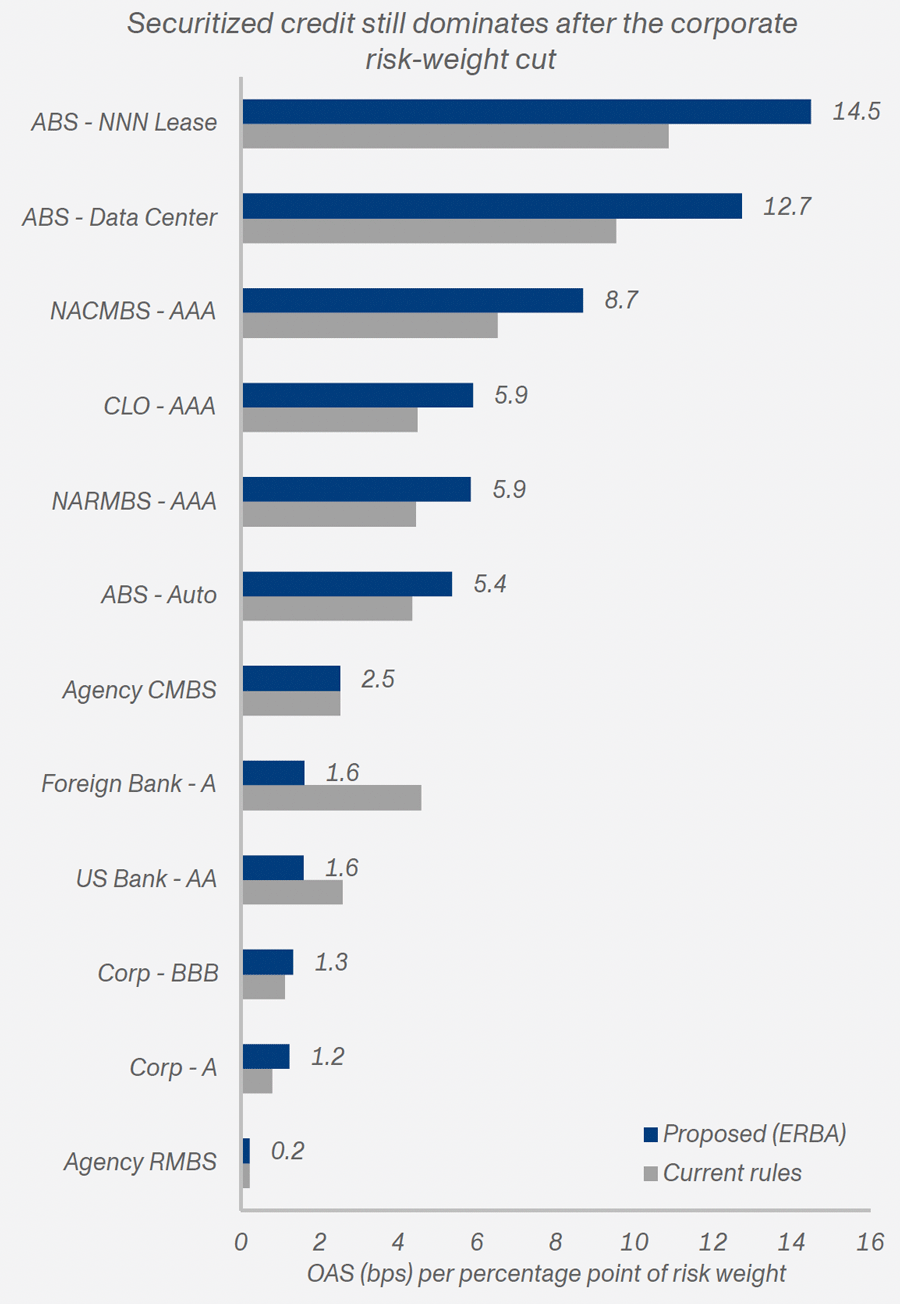
Even if the investment-grade corporate risk weight falls from 100% to 65% as proposed, single-A corporates would still earn only roughly 1.2 basis points of spread per point of risk weight, against 5.9 for AAA CLOs and 8.7 for AAA nonagency CMBS. The corporate change would buy capacity, not a change in preference.

03 | One exposure gets meaningfully worse

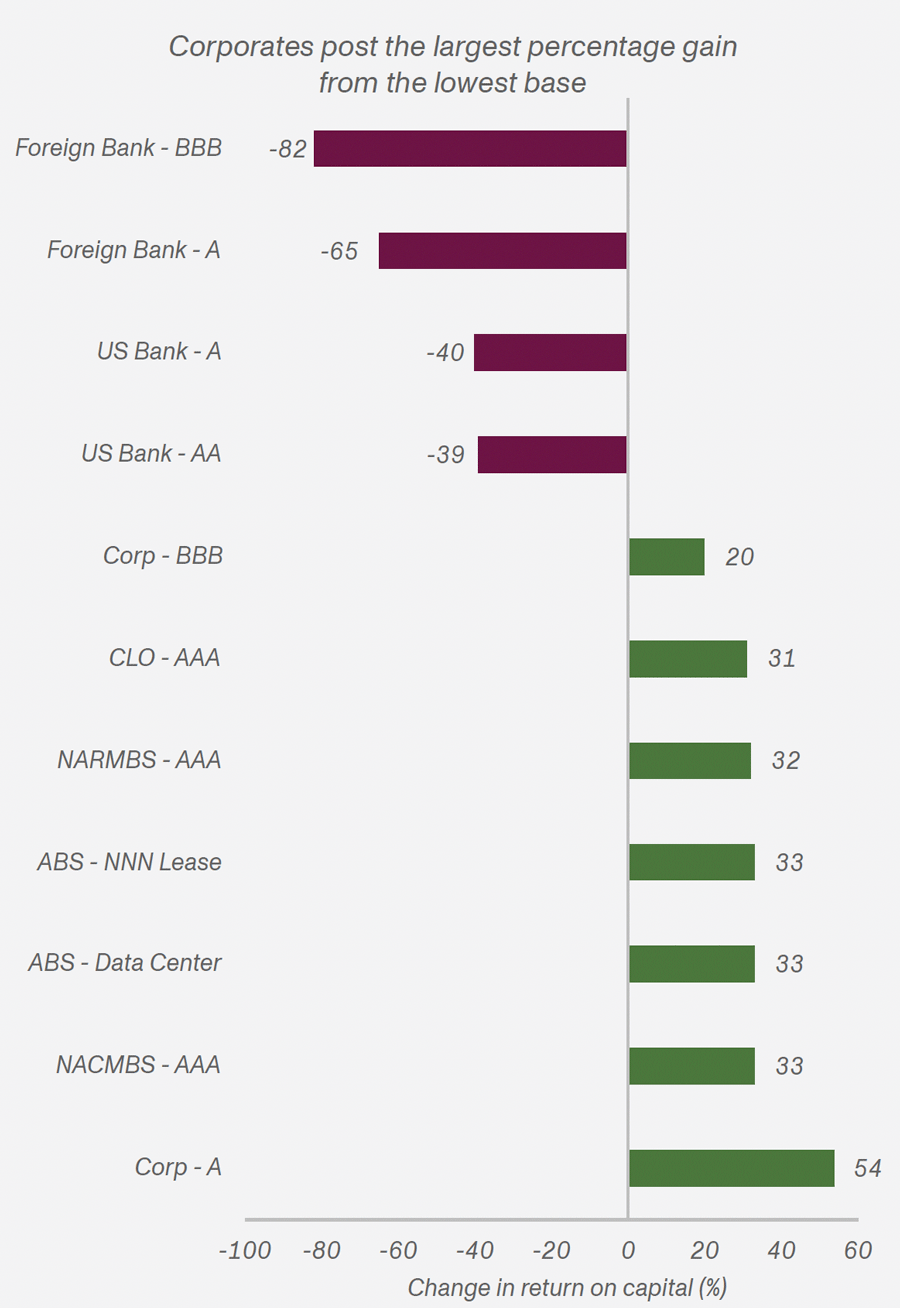
Senior bank paper would lose the 20% risk weight that currently makes it capitalefficient. Single-A foreign bank exposure would move to roughly 57% and BBB to roughly 111%, cutting return on capital by 65% and 82% respectively. This is the one change that would call for a look at existing holdings rather than at new money.


Bank-owned life insurance (BOLI) is one of the few places on a bank balance sheet where the investment decision is governed as much by risk-based capital as by yield. Return on capital – spread earned per unit of risk weight – is the operative metric, and it is set jointly by the market and by the capital rules. The market half has been stable with spreads that are tight and the ranking of sectors by carry has not moved much. The regulatory half, however, is on the verge of a significant shift.

On March 19, 2026, the Federal Reserve, the Office of the Comptroller of the Currency and the FDIC re-proposed the U.S. bank capital framework, including Basel III “Endgame,” in three coordinated proposals: a new Expanded Risk-Based Approach mandatory for Category I and II banking organizations1 and optional for others, a revised Standardized Approach for everyone else, and a recalibrated GSIB surcharge2. Including parallel stress-test reform, the agencies expect aggregate common equity tier 1 requirements to fall by roughly 4.8% for Category I and II firms, 5.2% for Category III and IV firms, and 7.8% for smaller banks. Given the more measured design and the 6-1 Federal Reserve Board vote in favor, we believe this version has a materially higher probability of adoption than the 2023 proposal the agencies rescinded.

The aggregate capital figure is not what should interest a BOLI investor. Three of the changes would land directly on assets these portfolios hold, and they would not all point the same way. What follows is where return on capital would improve, where it would deteriorate, and what we would do differently as a result.

Three Changes That Move Return on Capital

01 | The senior securitization floor would fall to 15%

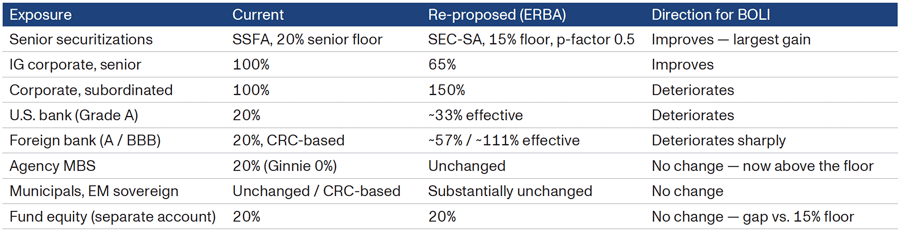
The Securitization Standardized Approach would replace SSFA3, the senior non-re-securitization floor would drop from 20% to 15%, and the p-factor would be retained4 at 0.5. For senior tranches already pinned to the floor, spread would be unchanged while required capital would fall by a quarter. This would be the largest single improvement available to a BOLI portfolio.

02 | Investment-grade corporates would fall to 65% 

The corporate risk weight would drop from 100% to 65% under the Expanded Risk-Based Approach, and the investment-grade designation would apply to any exposure a bank rates investment grade through a qualifying internal rating system, which would also help non-U.S. and emerging-market corporates. Two limits deserve to be stated plainly. Subordinated corporate exposures would move the other way, to 150%. And on an index basis the BBB corporate effective risk weight would land near 84% rather than 65%, because not every constituent would qualify. Banks that remain on the Standardized Approach would face a flat 95% corporate risk weight and would capture almost none of this benefit.

03 | Bank exposures would be recalibrated, mostly upward

Depository-institution debt from highly rated banks currently receives a 20% risk weight, holding company debt is treated as corporate at 100%, and foreign bank debt follows the country risk classification. The re-proposal would replace this with three grades reflecting tenor and position in the capital structure. The stated intent is consistency across issuers; the effect on BOLI would be a material increase in risk weight on senior bank paper, from 20% to roughly 33% for Grade A U.S. banks and considerably higher for foreign banks.
 

Image
Table comparing exposure current ERBA and direction for BOLI

Source: TCW analysis of the March 19, 2026 re-proposals. Effective risk weights are index-level and blend qualifying and non-qualifying constituents.
 

Where That Leaves the Opportunity Set

Netting the three changes across the sectors a BOLI portfolio can own produces a clearer picture than any individual risk weight would on its own. Two observations dominate.

First, the ranking would barely change. Floor-eligible senior securitized exposures would sit between 8.7 and 14.5 basis points of spread per point of risk weight if the proposal is adopted. Investment-grade corporates would arrive at 1.2 to 1.4. Agency residential mortgage-backed securities (RMBS), the traditional anchor of these portfolios, would still earn only 0.2 – the lowest return on capital in the opportunity set, because a 20% risk weight against roughly three basis points of spread is an expensive use of capital under either set of rules.

Second, percentage change would be a misleading lens here. Corporates would post the largest proportional improvement in the universe, roughly 54%, because they start from the lowest base. A 54% improvement on 0.8 is still 1.2. In our view, reading Figure 2 without Figure 1 would be the most likely route to the wrong allocation conclusion from this proposal.

Figure 1. Return on capital by asset class, current rules versus proposed
Image
Securitized credit still dominates after the corporate risk-weight cut

Source: TCW. Return on capital is index option-adjusted spread divided by effective risk weight, in basis points of spread per percentage point of risk weight. Representative index-level sleeves; individual security outcomes vary.

Figure 2. Change in return on capital, selected sectors
Image
Corporates post the largest percentage gain from the lowest base

Source: TCW. Change in basis points of option-adjusted spread per percentage point of risk weight, current rules versus the proposed Expanded Risk-Based Approach.
 

What We Would Do Differently

Build toward 15%, not 20%.

If adopted, it would become possible for the first time to construct a high-quality spread portfolio with a minimum credit risk weight below the agency MBS level. That would have two uses. A bank whose priority is capital relief could lower the charge on its BOLI program while holding better-carrying assets than agency MBS. A bank whose priority is return could hold the capital charge constant and fund higher-yielding, higher-risk-weight positions against a 15% base. Both routes argue for preparing to reduce the agency anchor in favor of senior non-agency securitized exposure.

Treat corporate relief as capacity, not preference.

At a 25% portfolio risk-based-capital target blending 20% risk-weight assets with 65% risk-weight corporates, maximum corporate weight would rise from roughly 6.3% to 11.1%; at a 35% target, from roughly 19% to 33%. That headroom would be genuinely valuable, but it would be optionality to exercise when corporate spreads widen, not a reason to add at today’s levels. Where corporates would earn a place, seniority would matter more: at a proposed 150%, subordinated corporate risk would be clearly capital-inefficient.

Re-underwrite bank and foreign-bank exposure.

This would be the only implication that concerns the existing book. Senior bank paper has been a staple of capital-efficient BOLI portfolios precisely because highly rated depository debt currently carries the same 20% risk weight as agency MBS while paying materially more spread. Under the re-proposal that trade would largely disappear. Portfolios should be screened now for positions sized on the assumption of a 20% risk weight, so that floor-eligible securitized exposure is ready as the replacement if the rule is finalized.

Widen the operating range rather than pick a new sector.

The practical consequence of a lower floor plus more corporate headroom would be a wider capital envelope, not a different single-sector book. A 15% to 25% risk-based-capital operating range would become credible, with the same portfolio able to dial capital usage down when spreads are tight and up when the cycle is paying for risk. Static, single-sector mandates would remain the structure least able to use any of this.

One Gap Still Open

If the minimum credit risk weight falls to 15% as proposed, equity exposures to investment funds would remain at 20% and fund-equity treatment applies to the entirety of the separate-account BOLI market. Aligning the minimum fund-equity weight with the minimum credit risk weight would restore the consistency that existed under the prior framework, and was a natural point of comment during the consultation, which closed on June 18, 2026. Until the final rule addresses it, the lower floor would improve underlying portfolio economics without fully passing through to the risk weight a bank carries on the separate account itself. We are also watching whether Category III and IV banks would elect into the Expanded Risk-Based Approach, since the flat 95% corporate risk weight under the Standardized Approach would make the corporate relief largely academic for those that do not.

TCW BOLI Portfolio Solutions

When spreads are tight and risks are skewed to the downside, the ability to react quickly to dislocations is what a wider capital envelope is for, and the traditional single-sector BOLI mandate is structurally slow to reallocate. TCW’s BOLI platform is built around a dynamic, capital-optimized framework: a 15% to 25% target risk-based-capital operating range with the flexibility to move capital usage across the cycle; active use of the full securitized capital stack alongside agency MBS, investment-grade corporates and municipals, allocated on return on capital rather than sector labels; and an integrated view of BOLI alongside broader balance-sheet assets, including pension surplus where relevant, so that capital and duration decisions are made together. An unconstrained risk-based-capital solution targeted at roughly 20% remains optimal in today’s market. What the re-proposal changes is how much room there is to move when the market pays for it.


Read More from TCW


Endnotes
1 Category I/II: The Federal Reserve groups large banks into four size- and complexity-based categories. Category I banks are the U.S. GSIBs; Category II are other very large banks. Both face the strictest capital rules; Category III and IV are progressively smaller and less constrained.
2 GSIB: Global systemically important bank — one of the largest, most interconnected U.S. banks, subject to an added capital surcharge on top of standard requirements.
3 SSFA: Simplified Supervisory Formula Approach — the current formula banks use to calculate required capital against securitized bonds. SEC-SA (Securitization Standardized Approach) is the re-proposed replacement.
4 p-factor: A supervisory multiplier in the securitization capital formula that adjusts risk weight for pool quality and concentration. It is unchanged in the re-proposal.


Disclosure
For institutional investor use only. This material reflects TCW views as of July 2026 and is based on proposed rules that may change before adoption. Return-on-capital figures are index-level illustrations, not portfolio results, and are not a recommendation to buy or sell any security.

This material is for general information purposes only and does not constitute an offer to sell, or a solicitation of an offer to buy, any security. TCW, its officers, directors, employees or clients may have positions in securities or investments mentioned in this publication, which positions may change at any time, without notice. While the information and statistical data contained herein are based on sources believed to be reliable, we do not represent that it is accurate and should not be relied on as such or be the basis for an investment decision. The information contained herein may include preliminary information and/or “forward-looking statements.” Due to numerous factors, actual events may differ substantially from those presented. TCW assumes no duty to update any forward-looking statements or opinions in this document. Any opinions expressed herein are current only as of the time made and are subject to change without notice. Past performance is no guarantee of future results. All investing involves risk including the potential loss of principal. Market volatility may significantly impact the value of your investments. Recent tariff announcements may add to this volatility, creating additional economic uncertainty and potentially affecting the value of certain investments. Tariffs can impact various sectors differently, leading to changes in market dynamics and investment performance. © 2026 TCW

Share this post

Sign Up Now for Full Access to Articles and Podcasts!

Unlock full access to our vast content library by registering as an institutional investor

Register

Contacts


Image
TCW_Logo_Black


TCW has a dedicated insurance platform that is fully integrated with our dynamic investment management platform, which has served investors for over 50 years, enabling clients to evaluate opportunities through both an investment and insurance lens. The firm’s insurance portfolios incorporate a full range of solutions that can be customized as individual strategies or designed to function together within a diversified general account framework.  

Combining insurance-focused expertise, specialized infrastructure, and analytical capabilities, the platform helps insurers address portfolio construction, capital efficiency, regulatory considerations, statutory reporting, and balance sheet optimization as part of the investment process. By integrating these capabilities into a single client experience, TCW provides insurers with a more comprehensive approach to managing assets and liabilities. In a market where many managers offer insurance-compatible products, TCW distinguishes itself through the depth of its insurance-focused resources and its ability to support insurers holistically as regulatory, reporting, and capital requirements continue to evolve.

TCW is a global asset manager with $200 billion in assets under management as of June 30, 2026, offering innovative strategies across fixed income, equities, and alternatives to diverse insurance clients. 
 

TCW
515 South Flower Street
Los Angeles, CA 90071
insurancesolutions@tcw.com
 

View the contributor page

Sign Up Now for Full Access to Articles and Podcasts!

Unlock full access to our vast content library by registering as an institutional investor .

Create an account

Already have an account ? Sign in

Ѐ Ё Ђ Ѓ Є Ѕ І Ї Ј Љ Њ Ћ Ќ Ѝ Ў Џ А Б В Г Д Е Ж З И Й К Л М Н О П Р С ΄ ΅ Ά · Έ Ή Ί Ό Ύ Ώ ΐ Α Β Γ Δ Ε Ζ Η Θ Ι Κ Λ Μ Ν Ξ Ο Π Ρ Ё Ђ Ѓ Є Ѕ І Ї Ј Љ Њ Ћ Ќ Ў Џ А Б В Г Д Е Ж З И Й К Л М Н О П Р С Т У Ф Х Ц Ч Ш Ā ā Ă ă Ą ą Ć ć Ĉ ĉ Ċ ċ Č č Ď ď Đ đ Ē ē Ĕ ĕ Ė fi fl œ æ ß