




Hamilton Lane-

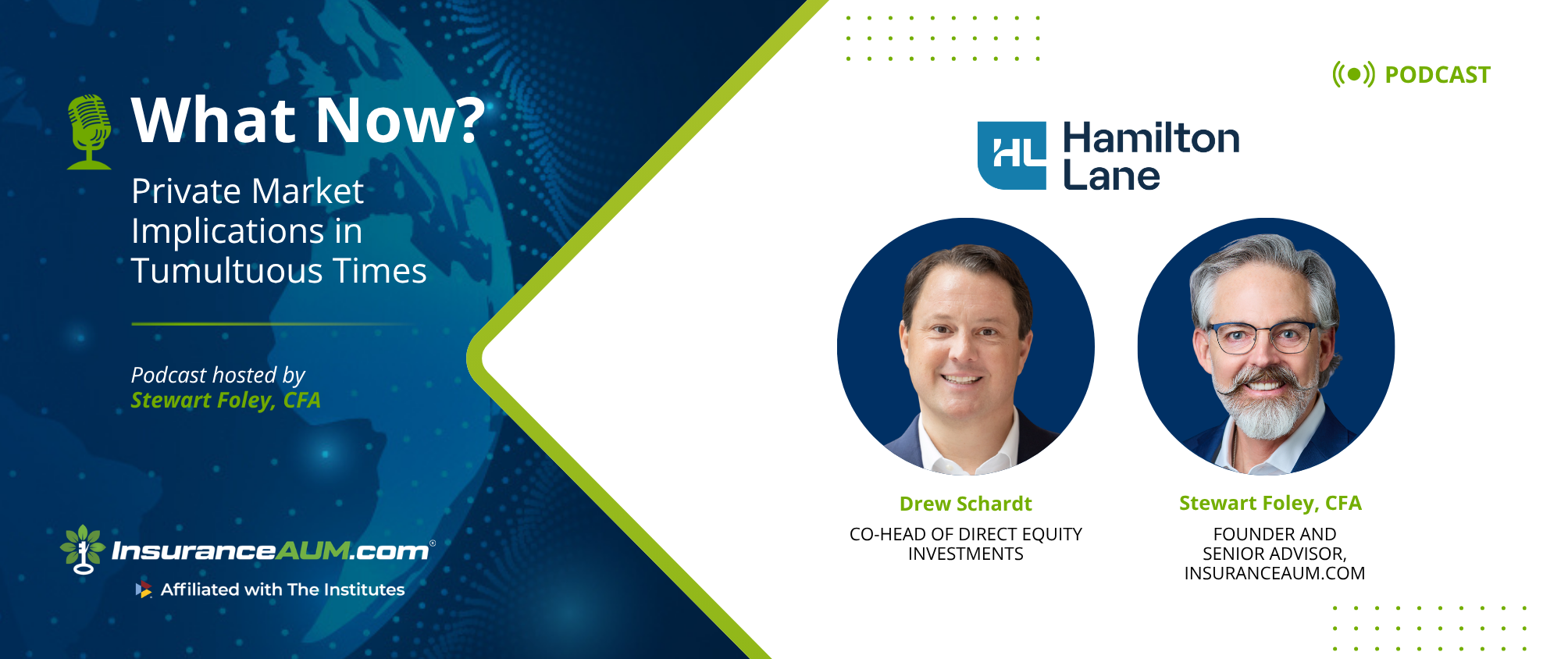
What Now? Private Market Implications in Tumultuous Times

Image
03.16.26 Hamilton Lane_Web


Stewart: My name's Stewart Foley, CFA. I'm your host, and we're thrilled to have you with us today. The title of today's podcast is What Now? Private Market Implications in Tumultuous Times. And I'm joined by Drew Schardt, who's the Co-Head of Direct Equity Investments at Hamilton Lane. In his role, Drew oversees the firm's direct equity investment platform, including strategic implementation, team leadership, and investment activity. Over the years, he's also served as Co-Head of Investments and Co-Head of Direct Credit. Drew, you earned your MBA from Duke University's Fuqua School of Business and your undergraduate degree in economics from Cornell, which is a heady accomplishment, my friend. Welcome back to the podcast, I should say.

Drew: Excited and thankful to be here. Great to be with you again, Stew.

Stewart: Yeah, no, it's good. So tell me ... So one of my former colleagues got her PhD in economics at Cornell. And I was an academic bottom of the totem pole, non-terminal degree academic. And so if you have an MBA, you get to wear these really hideous black gargoyle style robe at graduation. That's how it's done. But my colleague had this amazing red robe and tam and everything that went with it. And it was so cool. So tell us a little bit about Cornell before we get going.

Drew: Yeah, no, it was a fun experience. I grew up in upstate New York in Syracuse, so Cornell wasn't too far away. I was also a student athlete, played lacrosse. But yeah, I think economics, I'd always been a big fan of math and science in high school, kind of a nerd. And it gave me a great opportunity to continue on that path. I think what I liked about that economics field was just studying the history of how different choices in that realm can affect populations and countries and all sorts of different things to drive decisions, drive economies, drive growth. And so that was always intriguing to me and it was a great, great experience. I'm sure that the bar was lower for me than when you described your friend. That's probably why they got that fancy red garb. I think mine was just the traditional black graduation.

Stewart: Yeah, I hear you.

Drew: But nevertheless, it was a great experience. And same thing down at Fuqua, a great school, studied a little bit more in the finance and marketing side of things. And great people like Dan Ariely, who wrote lots of different books. Again, back to the behavioral economics, “Predictably Irrational,” his famous book. He was actually my professor while I was there. So really cool and sort of took advantage of the opportunities that those places presented.

Stewart: That's cool. All right. So you said you grew up in upstate New York. What was your high school mascot? And if you weren't doing this job today, what job would you most like to have instead?

Drew: Oh, wow. So the high school mascot's a weird way. It's not that interesting. I don't quite know what it was.  

Stewart: Mine was the owls. So, it's got to be north of that.  

Drew: My daughter goes to a school here, currently a girls school, and theirs is the owls. So certainly in good company with you there, Stew. My high school, Cicero North Syracuse High School, CNS. We were the North Stars, which again, it's like, what kind of is that? And the same thing with Cornell. Cornell was like a color, the big red. Big red. I guess I had this lackluster mascot trend here. The cool thing about CNS though, or I guess two of the more famous alumni. One is Breonna Stewart. So Stew, the famous WNBA player. She's probably one of the more famous alumni. And then I'm dating myself, but Richard Gere of '80s and '90s movie stardom was also an alumni of that high school.

Stewart: Wow, there you go. My claim to fame is I went to college with Brad Pitt and he and I are the same age. And if you look at us, we don't look like we're the same age, but we are actually the same age. So what about what job would you most like to have if you weren't knocking the cover off the ball at Hamilton Lane?

Drew: Yeah. I mean, listen, I feel like you are a good example of like you've killed it, you've been around the insurance world forever and now you're doing this podcast among other things. I also learned from you, you're an enthusiast and have won multiple awards in the low rider motorcycle realm. So clearly, it's hard comparison to make, and I'm thrilled to be talking to you. I think I would probably be a coach. I love coaching youth sports, have done it with my children. And as I mentioned, was a student athlete myself. I love the mentorship pieces of it. I love the ... It's a cliche, but you hear people talking about, well, the lessons you learn in sports aren't just about the sport or the game or your accomplishments. It's the broader team dynamics. How do you deal with adversity? How do you respond when there's a lot of pressure on you and the mental pieces of it?

And so again, firsthand having a benefit of thinking ... Again, I think I've learned a lot from it personally, and now it's almost like a cycle. It's rewarding to try to go back and do a lot of the things my mentors had helped me learn from and experience. And obviously that translates, you have mentors in the professional setting, the academic setting, but I think sports is such a unique forum to learn lessons in a different way that, again, just like any of those other areas, you could apply across the spectrum. And so I would probably be coaching high school sports somewhere if I wasn't doing my day job.

Stewart: That's cool. All right. So let's get into it here. For folks who might not be as familiar with Hamilton Lane, can you tell us just kind of broadly where your firm focuses and sort of the depth and breadth of what you do?

Drew: So we are a specialist asset management group that focuses on the private markets. And so what are the private markets? Essentially anything that's not the public stock or bond market, we don't do hedge funds, but think of investing in private companies, private transactions and structures. It's a vast expanding landscape that's something like 90% of the corporate ecosystem globally, and that is all that we do. We focus on finding, sourcing, investing on behalf of our clients in those private market opportunities. So we started in 1991, so we've been at it for 35 plus years. We have 23 offices globally, about 900 or so, excuse me, 800 employees at this point, soon to be probably 900 the way we're growing. But we have 23 offices globally, and the business is built on building pipes and connections and relationships into that ecosystem, which then allows us to serve our clients, building unique portfolios to find risk, return, liquidity, duration in this very nuanced asset class that I know we'll get into today.

And it's a space that has really evolved pretty rapidly over the last 25 plus years, and I think it's becoming more commonplace and accepted. And so for us, it's what we've been doing all along. When we first started out helping investors find and access those investments and opportunities, it's no different today. I think the audience, though, of potential investors and new investors is ever increasing. And so we're going to stick with our mission of helping serve those clients with unique solutions globally.

Stewart: Yeah. I mean, the insurance space is a very, very prominent topic almost everywhere you look, from allocations to regulation, to capital charges and structuring and all of that. I mean, I would argue that sometimes the structure of whatever it is is important as whatever it actually is. So let's just talk about the macro backdrop for a second. You mentioned your focus at Hamilton Lane on private markets. There's a lot going on from an economic and investor perspective, and everybody kind of wants to know where we are today. So you guys put together every year, in my understanding, a market overview. And this year you've focused something called Pandora's Box. So talk to us about your outlook and how you're playing on this Pandora's Box idea.

Drew: Yeah, no. And as you point out, this is an annual release and we released it last week and each year we come up with a new theme. And I think part of the reason, just the foundation where we're able to do this, we have more data than just about anybody on this asset class. We've spent that 35-year history building data that are all fed into our technology platform. So we have it, we can synthesize it, and it's not the same for everybody. And so I think you got to start from a standpoint of that database and the information we have is pretty unique and hard to replicate. And so what we do each year is take that and try to boil it down. And this comes from our executive co-chairman who usually kicks around the theme of what encapsulates what we're all feeling seeing today as investors.

And this year's theme, as you mentioned, is Pandora's box, from Greek mythology. The box comes down. You're not supposed to open it because you're not sure what it could unleash, good, bad, or otherwise. And so I think for us in bringing it back to where we are today, we're in this world where we're starting to crack open this box and it's starting to kind of the lights pouring out, sounds are starting to hum and releasing themes around AI and disruption, increased exposure to private markets via new structures in the evergreen semi-liquid world, headlines and noise around private credit, the secondary market, and now for nothing, no shortage of geopolitical headlines, noise that seem to take lots of twists and turns. So it's not that it's all going to be good or all going to be bad. I think none of us just fully knows yet what this box might unleash, but I think as an investor, you have to have a bit of a plan, you have to have an understanding.

And so I think we try to bring a data oriented approach of what could it mean, what should you think about, what considerations are there, and then help investors maybe within their own sort of realm and ranks encapsulate what they want to do going forward. And so we try to do that in a humorous way. We try not to take ourselves too seriously. But again, I think it's chockfull of data and insight that we think is hard to find. And so it sort of spearheads our effort to continue to increase transparency and bring others into the world that we see day-to-day, hour-to-hour in real time.

Stewart: Yeah. I guess it takes me to kind of performance distributions and valuations. So I think bad news or salacious headlines drive views. And when people talk about private assets, it is a massive broad spectrum of things that can be placed in that box. So you see the headline is, oh, recoveries are some crazy low number. And then in paragraph 18, it talks about, well, we're talking about single B middle market direct lending. So talk to us about the performance and liquidity in private markets today. What are you seeing across returns, distributions, and valuations?

Drew: Yeah. And I think you're pointing back to what investors are feeling. If you look at the equity markets or public equity markets, it says, this is a lot of, like you're saying, noise and headline risk and everything's going to be great. The bond markets saying the opposite, like, no, there's costs from concern and gold and metal prices, no, they're definitely cause for concern. So I think you're trying to get through all of the noise, the headline pieces and drill back down into data and what really matters. And I think what you're seeing today is what gets the headlines is typically the negativity and a lot of the negative chatter that in some cases is justified and warranted, but in a lot of places, it is just that noise. And I think you have to be careful not to paint with too broad a brush whether you're talking about headlines around private credit risk or performance.

But if you go back to what the private markets are, it's just a much more diverse ecosystem. You're talking about, as I said, 90% of the corporate ecosystem, hundreds of thousands of mature private companies are just offering investors different ways to build portfolios versus a traditional 60 / 40 or a shrinking public stock market. The performance is the conundrum where the S&P 500 has been the best performing asset class over the last two or three years over anything, including private markets. But if you look through that back to the data, what you'd see is through cycles over longer term horizons, private markets typically outperform and you get benefit from that sort of illiquidity premium owning these assets and thinking about decisions on three and five year time horizons, it just drives better fundamental performance, which again, historically over long horizons, that performance would be stronger.

And I think that's where we are today where you have S&P and other public indices performing in the 96 percentile of the long-term averages. It's kind of the opposite. It's a 26 percentile for buyout private equity performance. So we think you're at a spot where if you do believe that there's a capitulation or correction in public markets, you're going to see a real snapback or reversion to outperformance on the private side. Liquidity is another big headline, Stewart, and you hit on it where investors have wanted more liquidity. The deal flow, the momentum is starting to pick back up, but over the last two to three years, it's been anemic. And so I think investors are looking for strategies that can not only generate organic liquidity through the types of sectors or company sizes, for example, that you're looking at, but they're also looking to places like the secondary market to find liquidity, even if it's somewhat synthetic, whether it's continuation vehicles or just older mature portfolios you're buying into that are a little closer to the harvesting phase.

And so it's a lot of things for investors to consider, but to us, we are in a place where the worry index is somewhat in the neutral category today. And the fundamentals sort of suggest that private markets will outperform when you're in that kind of meh overall return expectation environment.

Stewart: You touched on private credit, and that's where, at least from what I've seen, where there's the most headlines. What does the data tell us versus the folks who want to sell clicks?

Drew: Yeah, exactly. And I think private credit has obviously been a useful tool for insurers in particular. And I think that's been a great matchup, matching balance sheet, liability, sort of duration and taking and shifting more capital away from traditional more liquid banking market loans that aren't as well matched. And you sort of, in the process, ironically, take some systemic risk, I think, by shifting more market share to the more appropriately structured and duration matched private markets, but that's neither here nor there. Your question is around those headlines. And I think it's popular, again, to paint with that broad brush, but all of this, in our opinion, is much ado about nothing. It is overdone the concerns around private credit because not only is the sort of lending base massive. I mean, you're talking about private companies that are much more numerous than what you're seeing on the syndicated banking side or what the large banks are lending to.

So you're getting a more diverse portfolio, but if you drill into where there are concerns and the fundamentals of the borrowers, it's nowhere near levels that are flashing red and most aren't even flashing yellow. If anything, it's the opposite. And what I mean by that is interest and cash flow coverage, the ability to service debt. If you look at equity cushions, how much equity is sort of at risk before you start to erode the credit value? On the private credit side, those metrics from a lender standpoint are sort of at or near all time best in terms of the health of these borrowers. I think what's happened is the names that have gotten into trouble, the first brands of TriColor, those have been not private credit names, those have been syndicated loan names, those have been hedge funds. And I think it's easy for them to say, "Well, this could be emblematic of a broader credit issue." We sit across all the data, we sit across all the private credit lenders.

We are not seeing anything that's approaching the level of worry that is being created in panic in these headlines, similar with default rates at or slightly below long-term averages. And so I think the private credit market is a confluence of negative headlines, concerns about software exposure in private markets and other semi-liquid structures that are all being balled into, we have a fundamental private credit problem. We don't think that the reality is nearly approaching anything that's sort of been presented, whether it's headlines or others.

Stewart: Well, I mean, let's not forget that some of the folks making those headlines are talking their own book. It's interesting from a risk perspective, and you talked about this, insurance company balance sheets make a lot of sense versus private credit lending. You think about banking where you've got long-dated loans backed by overnight deposits backed up by the FDIC. I mean, from a risk management perspective, you go, "Wouldn't you rather have cash flows that are matched up naturally without the run on the bank risk?" I mean, insurance companies don't get enough credit for funding economic growth in the United States.

Drew: I feel like the insurers are ahead of that more than others in terms of that liability matching and again, taking out the risk of depository versus a large fixed base of capital of the private creditors. And so again, I feel like in a lot of ways that transfers some potential systemic risk. I mean, the banks were also the ones were lending to those companies previously that's been more shifted to these private credit groups where, again, the liquidity matching makes a lot more sense for investors like that.

Stewart: Yeah. And just real quick, I mean, you mentioned Pandora's Box, and I think in fairness to you and all the other asset management firms out there, and we say this a lot, this is a set of circumstances that we've never seen before on a lot of levels and a lot of ways. And I think that we're all, because of the fact that it's new and we're not quite sure, it's like, how do these variables fit together? We've never really seen these variables in this form before. Are there any things in particular, Drew, that if there was something you could say, what would create headwinds? Are there scenarios that you say, "Hey, we would be more concerned if X, Y, or Z happened?" I'm sure you guys have had this conversation in writing, Pandora's this market outlook. Are there things that could happen and you'd go, "Gee, that would make me have a second look?"

Drew: Absolutely. I think there's always risks and importantly, there's always unknowable risks. And I think certainly recently the geopolitics and some of the headlines, like if you were to tell me things in Iran, and it's March 16th when we're recording this, but if that continued to spiral and that conflict were to be extended, I think what would worry me on that same front would be if China sort of felt increased pain and started to think through, well, what would the ramifications be if we took more aggressive action with Taiwan or coordinated, as you're seeing with Russia and Iran on different intelligence and or strategic positioning, those are all things that are not going away anytime soon. So I think you have to plan the portfolio philosophies recognizing those are going to be some unknowable risks. I think another, back to the Pandora's box theme though, another more thematic or sort of sector specific is AI.

That is probably one of, if not the biggest, one of the larger elements being unleashed out of that box. And as an investor, how should you play that? If you're playing it in the public realm, there's a very small basket of stocks that are all tied to LMMs and chips that are essentially intercorrelated and have circular financing and all these odd dynamics. That is one very specific part of the market. And you think of the concentration around that versus the private market and playing it in that way, you're just getting at a broad-based exposure to AI that is uncorrelated, whereas the public markets are showing increasing correlated. You have the venture element, you have the buyout side in the private markets that are all investing in different things, but importantly, it's a wider range of less sort of tied together correlated assets. And so non-LMM, so think of agentic or think of things that are going to build abroad work processes or operational flows.

There's a lot more opportunities by combining what you're doing on the public side, much more concentrated and are correlated versus the baskets and portfolios you can put together using the private market strategy. I think AI generally is going to take some time to play out. No one's quite sure where it's all going to go, but it is going to transform things, of course. And so I think you need to have a strategy around that and that the market overview evaluates how to invest in that diversification versus playing it in a more concentrated public market format.

Stewart: And just kind of wrapping, right? So insurance investors, it's interesting, we had a conversation with some CIOs recently. About half were concerned about the headlines and getting questions from the board. About half saw it as an opportunity. When you're buying stuff that's priced to perfection and fixed income markets, it's tough, and some of these headlines can help to improve risk premium or premia. So as we kind of wrap here, how should we be thinking about private markets right now?

Drew: Yeah. Listen, private markets aren't immune from the headlines or broader risks that we've talked about today, but I think private markets are a diversifier for most investors' portfolios. I think the other element we haven't touched on as much is the new tools and structures the private markets are offering. This isn't your grandparents' asset class anymore. Things like secondaries offer unique entry points with very differentiated risk return and sort of duration pieces, things like open-ended evergreen structures, you're seeing that become another tool. And even traditional investors, the institutional investors, the insurance world, liking the ease of use, the ability to sort of tactically build different positions and different strategy areas. That's where we are in this environment. I think while you want a diversified portfolio, this is going to be a thematic deal pickers market where tactically leaning into a certain strategy or a certain geography or focusing on a certain size of company, all places where the private markets have a lot more choice than maybe what you can get and the choices on the public side, I think you're going to see a much wider range of investor outcomes based on those decisions today.

So you have to be thoughtful, you have to be data driven, and you have to really have a plan you're willing to stick to, to sort of see some of those things through. And that's the environment I think most of our investors are facing. The volatility's not going to go away anytime soon. I think it's where do you find opportunity when others may be leaning out of certain things for unjustified reasons or headline risks, et cetera.

Stewart: Alright. So on the way out the door here, you've had the opportunity to serve at a senior level in a few different places. What characteristics are important to you at Hamilton Lane when you're adding to members of your team?

Drew: Yeah. Listen, I think the culture part is always important. And I think first and foremost, I think why we've gotten to where we have with literally thousands of clients globally is because we do lots of different things well, but it's also because we think of our clients first and we're trying to hire and bring in people that in our industry, I think it has a reputation for having people that are maybe a little sharp elbowed and not saying we don't want to win or be excellent or deliver for our clients, but I think we've created this balance where we're hiring people that are a little bit more team oriented, are collaborative and are clearly, when you look at what we're doing and how we're doing it with transparency, with data and as a partner to our clients, that's a big differentiator and I don't think we would've grown the way we have if we weren't hiring the right people.

It's also what keeps me up the most at night of how do you continue as you get bigger to maintain that balance of delivering for the client excellence, but also kind of not, part of my French, being assholes, right? We want people to see us as extension of itself, but it has to be genuine and we've managed to do that and find that balance pretty well over the last 35 years.

Stewart: Really helpful. So all right, last one, the one's coming. So you and up to three guests, you can have one, two, or three. Who would you most like to have dinner with, Drew, alive or dead?

Drew: Oh, wow. Well, I've gotten this before, so I'll answer something different this time. Listen, we just talked about there's a lot of heavy things going on in the world, whether it's the investment landscape, the political world. And so I kind of feel like I just need to take a load and laugh a little bit. And so I'm probably going to pick someone who I view as a brilliant, witty, kind of attuned to it, but is a brilliant comedian. So I'm going to go Dave Chappelle, I think would be the person I'd love to just sit down, have dinner, chop it up with. I better bring my wife, so that probably would be my other guess. Maybe Dave brings his wife, but that would probably be it. I think needing to laugh a little bit and try to decompress and not take everything so seriously, especially yourself, is important. And so especially now in these times, maybe more so than ever. So that's where I'm going with Chappelle. Who's on your list right now, Stew?

Stewart: Oh man, I don't know. Listen, there is so much going on right now. And the thing that's interesting is you wonder if what you're hearing and seeing has been massaged in some way. And it's one thing to have an opinion about whatever it is, but it's also like, how accurate is the information I'm getting? But I think that there's an awful lot of interesting folks out there. You mentioned my two lives, but I've got a bunch of racing folks that would ... And old school motorcycle guys, there's a famous picture of a guy named Rolly Free who set the land speed record on some Vincent motorcycle. And it's famous because he took his clothes off and was literally in swim trunks, extended fully out on this motorcycle to set this speed record. And his feet are on the seat. I mean, it's an impossible position.

And you go, I'd love to just talk to that guy and go, "Listen, man, this picture, you can go buy it, you can go find it. "People hang it up in their house or their garage. And you just go, "Wow, there's some real pioneers out there." And I love pioneers, people who do new things, break new ground. And so yeah, that would be for me. So we've been joined today by Drew Schardt, who's the Co-Head of Direct Equity Investments at Hamilton Lane. Drew, thanks so much for being back on. Really appreciate it. Great discussion today. Really appreciate your time.

Drew: Yeah, no, thank you, Stew. It was a pleasure.

Stewart: So if you like what we're doing, please rate us like us and review us on Apple Podcast, Spotify, or wherever you listen to your favorite shows. We also have a YouTube channel. If you want to watch us, you can watch us on an Insurance AUM community. That's our YouTube channel. If you have ideas, please shoot me a note at stewart@insuranceaum.com. Thanks for joining us. We really appreciate our audience, really dedicated group, and it is why we are called the home of the world's smartest money. So thanks for joining us. This has been the insuranceaum.com podcast. 

Share this post

Sign Up Now for Full Access to Articles and Podcasts!

Unlock full access to our vast content library by registering as an institutional investor

Register

Contacts


Hamilton Lane

Hamilton Lane (Nasdaq: HLNE) is one of the largest private markets investment firms globally, providing innovative solutions to institutional and private wealth investors around the world. Dedicated exclusively to private markets investing for more than 30 years, the firm currently employs approximately 770 professionals operating in offices throughout North America, Europe, Asia Pacific and the Middle East. Hamilton Lane has $1.0 trillion in assets under management and supervision, composed of $145.4 billion in discretionary assets and $859.8 billion in non-discretionary assets, as of September 30, 2025. Hamilton Lane specializes in building flexible investment programs that provide clients access to the full spectrum of private markets strategies, sectors and geographies. For more information, please visit www.hamiltonlane.com
 

John Brecker
Managing Director, Client Solutions 
484 531 6659
jbrecker@hamiltonlane.com


Seven Tower Bridge
110 Washington Street
Suite 1300
Conshohocken, PA 19428
USA
+1 610 934 2222

 

View the contributor page

Image
Hamilton Lane Icon

Sign Up Now for Full Access to Articles and Podcasts!

Unlock full access to our vast content library by registering as an institutional investor .

Create an account

Already have an account ? Sign in

Ѐ Ё Ђ Ѓ Є Ѕ І Ї Ј Љ Њ Ћ Ќ Ѝ Ў Џ А Б В Г Д Е Ж З И Й К Л М Н О П Р С ΄ ΅ Ά · Έ Ή Ί Ό Ύ Ώ ΐ Α Β Γ Δ Ε Ζ Η Θ Ι Κ Λ Μ Ν Ξ Ο Π Ρ Ё Ђ Ѓ Є Ѕ І Ї Ј Љ Њ Ћ Ќ Ў Џ А Б В Г Д Е Ж З И Й К Л М Н О П Р С Т У Ф Х Ц Ч Ш Ā ā Ă ă Ą ą Ć ć Ĉ ĉ Ċ ċ Č č Ď ď Đ đ Ē ē Ĕ ĕ Ė fi fl œ æ ß