

We're currently experiencing email delivery delays. For urgent matters, please contact us directly at lindsay@insuranceaum.com.

Aberdeen Investments -

Why Income Investing in Emerging Markets

AberdeenFeatured

Most often associated with growth investing, a look at how emerging markets represent can represent an appealing income universe for today's active investors with a total return mindset.

Matt Williams Senior Investment Director, Global Emerging Markets Equities


Emerging markets (EM) are often considered an asset class associated with growth, not income. 

However, EMs can represent an appealing income universe for active investors with a total return mindset. We believe the breadth of the universe and underlying growth make for a powerful combination in portfolios.     

Proportion of dividend-paying companies

Paying a dividend signals a shareholder-driven mindset from management and a discerning approach to capital allocation. And many companies in EM now recognize the need to pay a dividend. 

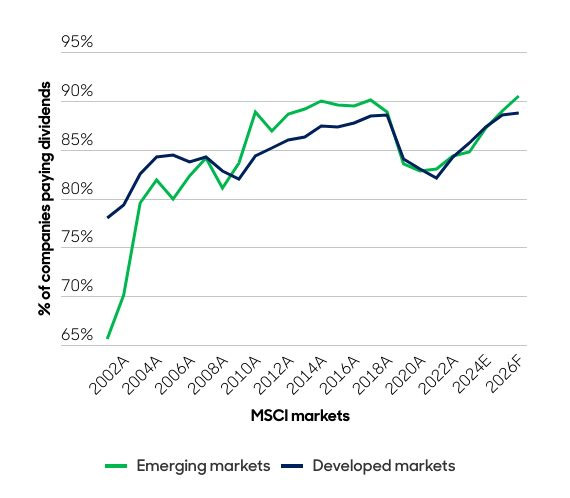
The number of companies paying a dividend in EM has grown significantly since 2001, supported by strong underlying company fundamentals. Surprisingly, the same proportion of companies in EM now pay a dividend when compared to developed markets (DM), which is close to 85% (Chart 1).1 
 

Chart 1. More companies paying dividends in emerging markets than in developed markets
Image
Line graph showing similarity between MSCI markets and % of companies paying dividends

Source: Factset, Jefferies Equity Research, March 2025. Notes: A*Actual (2001-2023), E*Estimate (2024), F*Forecast (2025-2026). Using MSCI universe as it existed in the past. Based on local currency performance. Gross reinvested dividends without considering the impact of taxes.
 

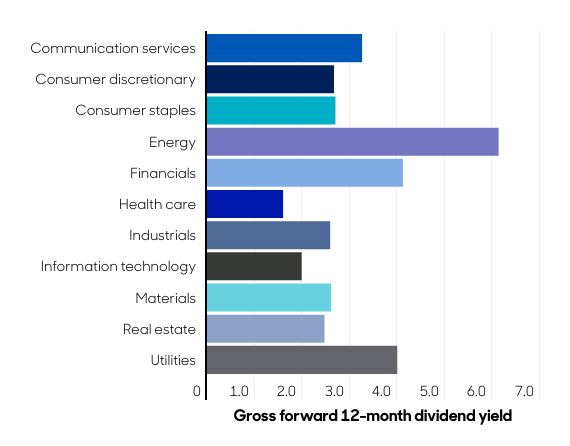
Perhaps more significantly, nearly 40% of companies in EM pay a dividend over 3% (Chart 2).2


Chart 2. Market cap weighted yield by sector
Image
Bar chart showing gross forward 12-month dividend yield

Source: Bloomberg, March 2025.
 

Isn’t income investing just telecommunications and utilities?

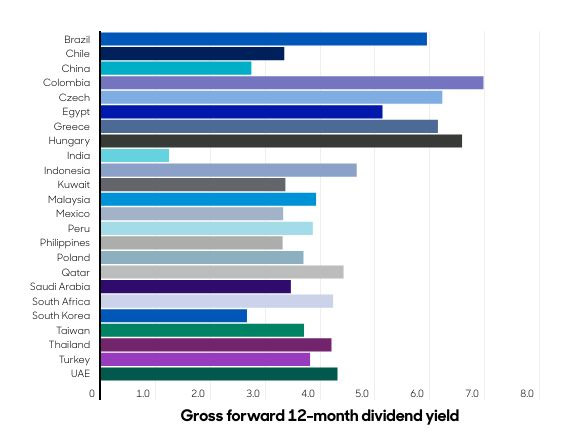
Not exactly. We believe there is an embarrassment of riches when it comes to dividend opportunities in EMs. These span across the spectrum, on both a sector (Chart 2) and country basis (Chart 3).
 

Chart 3. Market cap weighted yield by country
Image
Bar chart showing gross forward 12-month dividend yield between various countries

Source: Bloomberg, March 2025.
 

Yield doesn’t preclude growth

In such a dynamic asset class, it is not uncommon for investors to assume that investing in an income strategy, often associated with mature companies, would mean missing out on exciting growth opportunities. However, we believe in EM, this is not the case. 

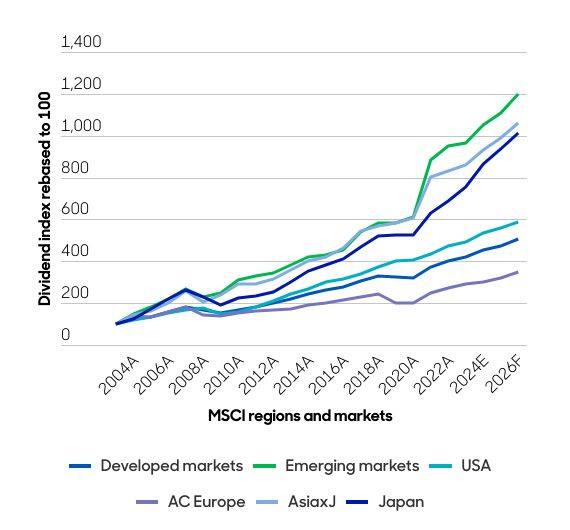
Strong corporate fundamentals and good underlying economic growth mean dividends have grown significantly faster in EM vs. DM since the early 2000s. The unprecedented pace of this growth, a compound annual growth rate (CAGR) of around 12% over the last 20 years (Chart 4).2
 

Chart 4. MSCI regions and markets - Dividend index over the past 20 years
Image
Line graph between dividend index rebased to 100 and MSCI regions and markets

Source: Factset, Jefferies Equity Research, March 2025. Notes: A*Actual (2001-2023), E*Estimate (2024), F*Forecast (2025-2026). Dividend CAGR (2003 Actual-2024:DM (7.4%), EM (11.9%), USA (8.3%), AC Europe (5.4%), AsiaxJ (11.2%), and Japan (10.8%). Bottom-up aggregated with free float adjustment on a year-over-year like-for-like basis for the current MSCI universe.
 

Total returns’ two components

Income is the lifeblood of total returns over time. It not only comes in the form of dividend distributions, but also represents the cash flow that companies generate and reinvest to grow tomorrow’s income.

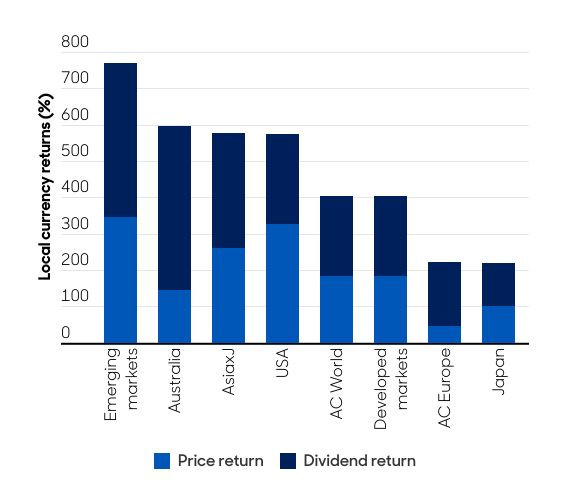
The two components behind the MSCI EM Index’s total return since 2000, earnings growth (i.e., price return) and dividends. Dividend returns in EM since December 2000 have been among the highest relative to other regions (Chart 5). 
 

Chart 5. Emerging markets’ dividend returns have been one of the highest since 2000
Image
Bar chart showing local currency returns of various markets, lead by emerging markets

Source: Factset, Jefferies Equity Research, March 2025. Note: Using MSCI universe as it existed in the past. Based on local currency performance. Gross reinvested dividends without considering the impact of taxes. Past dividends are not a guide to future dividends.
 

The price return component, which represents half of investor returns, is primarily driven by cash flow growth, which in turn fuels dividend growth. The other half of investor returns has come from the compounding effect of dividend payments.

Income delivery is attributable to strong underlying economic growth and corporate health. The attractive growth characteristics of EM dividends, stemming from both the underlying growth of cash flows and rising payouts, are a trend we expect to continue. Coverage of dividends in EMs is also appealing, with strong balance sheet health, providing further support for the growth of payout ratios. 

By combining high and growing income in EMs, active investors can gain access to attractive opportunities in EM as part of a diversified portfolio that may generate strong total returns. 

Why now? 

Tariff changes are part of a structural shift that brings macroeconomic uncertainty in the near term but presents significant opportunities for EMs over the medium and long term. Historically, EM performance has been tied to the global investment cycle, and we believe we are embarking on a new one. 

At a strategy level, our insight can be grouped into three core investment pillars: technology as a platform, infrastructure, and domestic brands.

The first two are key beneficiaries of the drive to invest in modernizing economies in a productive and environmentally conducive manner. Domestic brands will also benefit from this tailwind of higher employment and investment activity.  

Technology as a platform

We believe there lies particular interest in technology hardware companies, such as semiconductor producers, which represent the new building blocks of the digital economy. 

As economies grow and modernize, we expect to see significant investments in telecommunications and high-powered computers. 

One of the most recent developments in this space has been the commercial emergence of generative artificial intelligence, which is accelerating the development of new industry applications, such as autonomous driving. We believe dividend growth technology hardware stocks are major beneficiaries of the rising need for advanced computing power.

Infrastructure

The economic and productivity enhancements of new industries in this field (e.g., robotics and autonomous driving) suggest that they will be successful even if policymakers' political appetite tempers the pace of development. 

While autonomous driving offers significant safety and productivity improvements to the automotive industry, we are also witnessing a substantial demand for data centers that will power our digital economies. A demand that, in turn, has triggered the need for infrastructure investment in antiquated electricity networks.

Elsewhere, the shipping industry is also undergoing a transition cycle, driven by cleaner propulsion technologies and a need for greater defense spending. Finally, we believe innovations in the nuclear industry will meet baseload power needs with a lower carbon footprint. We believe EMs are well-positioned to benefit from these developments, as technology owners and low-cost providers of industrial metal resources.

Domestic brands and rising consumption

As economies continue to develop and modernize, we expect to see increased income levels. This trend in rising incomes will drive an expanding middle class as well as greater levels of aspiration and consumption. This consumption growth presents a fertile hunting ground for dividend-paying companies, particularly for leading domestic brands that have established a significant market share in their respective industries.

Final thoughts

We believe EMs are evolving into a compelling destination for income-focused investors, offering a rare combination of high dividend yields and robust growth potential. With nearly 85% of EM companies now paying dividends – many yielding over 3% – the landscape has shifted significantly from the traditional narrative of growth alone.[1,2] This income is not confined to a narrow set of sectors; instead, it spans a diverse range of industries and geographies, supported by strong corporate fundamentals and economic momentum. Importantly, income investing in EM does not mean sacrificing growth. Dividend payouts have grown at a compound annual rate of close to 12% over the past two decades, outpacing developed markets.[2] This growth is underpinned by rising cash flows, healthy balance sheets, and increasing payout ratios, making EM dividends an influential contributor to total returns. Finally, as the global economy enters a new investment cycle shaped by structural shifts, such as tariff realignments and technological transformation, we believe EMs are poised to benefit. From tech hardware and infrastructure to domestic consumer brands, the opportunities are broad and deep.

Read More From Aberdeen Investments


1 Jefferies, 2023 actual.
2 Bloomberg, March 2025.


Important information

Dividends are not guaranteed and a company’s future ability to pay dividends may be limited.

Projections are offered as opinion and are not reflective of potential performance. Projections are not guaranteed and actual events or results may differ materially.

Foreign securities are more volatile, harder to price and less liquid than U.S. securities. They are subject to different accounting and regulatory standards, and political and economic risks. These risks are enhanced in emerging markets countries.

Aberdeen Investments Global is the trade name of Aberdeen's investments business, herein referred to as "Aberdeen Investments" or "Aberdeen". In the United States, Aberdeen Investments refers to the following affiliated, registered investment advisers: abrdn Inc., abrdn Investments Limited, and abrdn Asia Limited.

UNITED STATES RESIDENTS

The purpose of this website is to provide general information about the US-registered investment advisers which are part of abrdn, and the strategies they manage. The information provided is not intended as an offer or solicitation for the purchase or sale of any financial instrument.

Past performance is not indicative of future results, and there can be no guarantee as to the accuracy of market forecasts. Opinions, estimates, and forecasts may be changed without notice. This site does not provide financial or investment advice and does not take into account the particular financial circumstances of individual investors. Before investing, investors should seek their own professional advice. The views and opinions expressed are provided for general information only, and do not constitute specific tax, legal, or investment advice to, or recommendations for, any person. We suggest that you consult your financial or tax advisor, accountant, or attorney with regard to your specific situation.

AA-190525-193685-1

Share this post

Sign Up Now for Full Access to Articles and Podcasts!

Unlock full access to our vast content library by registering as an institutional investor

Register

Contacts


Aberdeen Investments

Aberdeen Investments is a leading global insurance asset manager. While now independent, we were one of Europe’s largest insurance groups for over two centuries, until 2018. Today, Aberdeen Investment’s core strength is the breadth, depth and scale of our insurance investment capabilities. 150 insurers now trust abrdn to manage $230bn across public and private markets, making abrdn one of the largest independent managers of insurance assets worldwide.

Matthew DePont, CIMA
Director, Institutional Business Development
matthew.depont@aberdeenplc.com
+1 445-284-8590


1900 Market Street, Suite 200 
Philadelphia, PA 19103
 

View the contributor page

Image
abrdn_icon

Sign Up Now for Full Access to Articles and Podcasts!

Unlock full access to our vast content library by registering as an institutional investor .

Create an account

Already have an account ? Sign in

Ѐ Ё Ђ Ѓ Є Ѕ І Ї Ј Љ Њ Ћ Ќ Ѝ Ў Џ А Б В Г Д Е Ж З И Й К Л М Н О П Р С ΄ ΅ Ά · Έ Ή Ί Ό Ύ Ώ ΐ Α Β Γ Δ Ε Ζ Η Θ Ι Κ Λ Μ Ν Ξ Ο Π Ρ Ё Ђ Ѓ Є Ѕ І Ї Ј Љ Њ Ћ Ќ Ў Џ А Б В Г Д Е Ж З И Й К Л М Н О П Р С Т У Ф Х Ц Ч Ш Ā ā Ă ă Ą ą Ć ć Ĉ ĉ Ċ ċ Č č Ď ď Đ đ Ē ē Ĕ ĕ Ė fi fl œ æ ß