
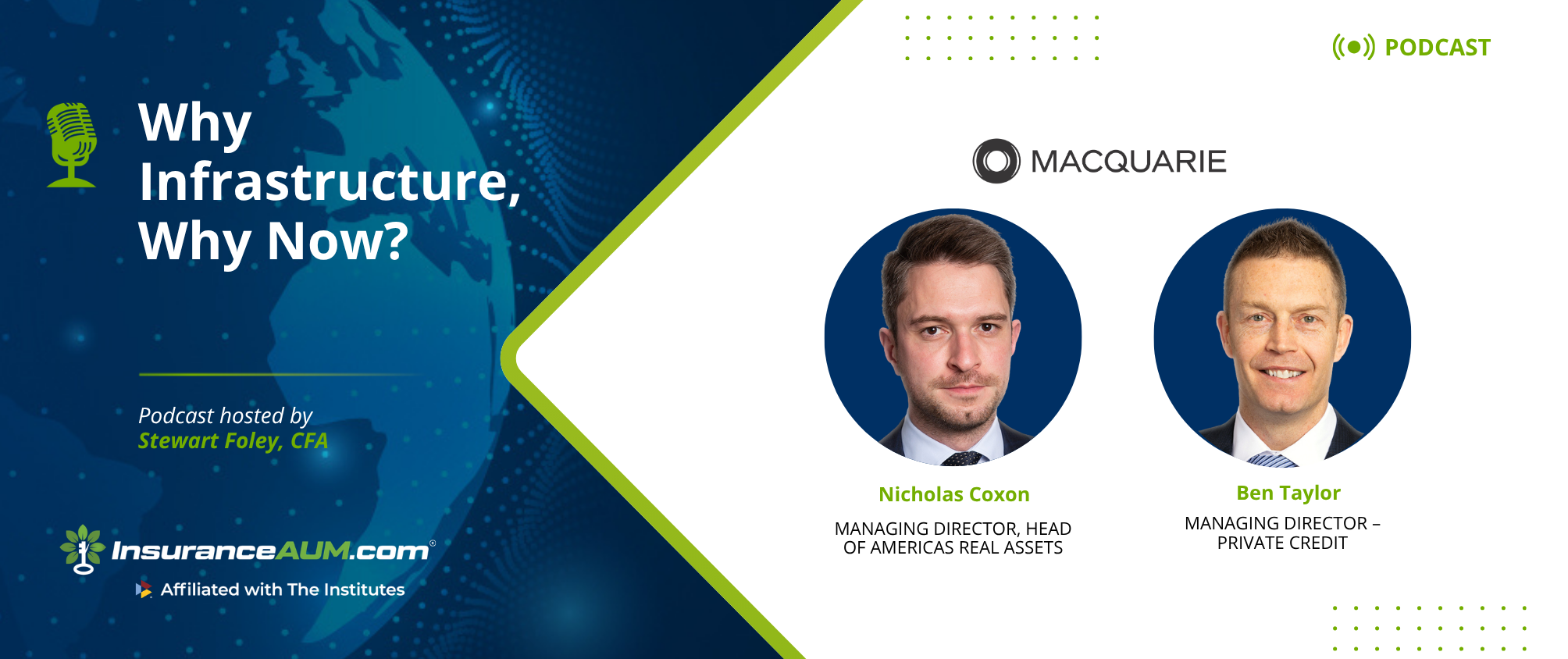




Macquarie Asset Management-

Why Infrastructure, Why Now?

Image
IAUM_Podcast_11.25_Macquarie_Web


Note: This was recorded in December, 2025.


Stewart: Hey, welcome back to the Home of the World's Smartest Money. I'm Stewart Foley. My official title these days is Founder and Senior Advisor to InsuranceAUM, which is proudly affiliated with The Institutes. And today, we're talking about one of the most important and fastest-growing areas in private markets infrastructure. And the question we hear over and over from insurers is “Why infrastructure and why now?” And to help us answer that question, we're joined by two guests from an infrastructure global leader, Macquarie Asset Management. We're joined by Nick Coxon, Managing Director, Head of Americas Real Assets, and Ben Taylor, Managing Director, Private Credit at Macquarie Asset Management. Gentlemen, thanks for being on. Thanks for taking the time.

Ben: Thanks, Stewart. Nice to be here.

Stewart: Now it's our pleasure. Here we go. So the question goes, where did you grow up? Easy enough. And the new icebreaker is, if you weren't doing this job, what job would you want? Alright, ready? Ben, it's up to you.

Ben: Yeah, no. So I was born in Brisbane, Australia. The accent didn't give it away, and if I weren't doing this job, I would be a personal trainer at a gym. I enjoy working out and the endorphins I get from hitting the weights.

Stewart: Nice. Alright, Nick, you got some competition there. Where'd you grow up?

Nick: I’m worried about Ben's answer.

Stewart: Yeah, there you go. I was too a little bit, but what job would you want if you weren't doing this one?

Nick: Okay, so I grew up in the UK. Again, my accent's a bit of a giveaway, same as Ben's, just outside of London. And I don't know, I reckon I'd be a gardener. I think that'd be fun, being outside a lot, getting involved in flowers and plants and things.

Stewart: There is a fabulous movie that seven people have seen called The Constant Gardener, have you ever seen this?

Nick: Movie? I have seen that. I've seen that. Very good movie.

Stewart: Amazing. The cinematography in that movie is amazing. And that gentleman is a British, he's a diplomat, but he's also a gardener, which is really cool. Alright, so I like the new icebreaker. I have to say, I actually got it from AI, and it seems like it's going to work. So Nick, let's start with a simple one, right? So you hear the term infrastructure a lot, but what is it? And if you could give us an example of an infrastructure asset, which I think has potentially evolved, as the economy has evolved, what about it makes it infrastructure?

Nick: Sure. Let do that, Stewart. And thanks again. And I think your comment about infrastructure being kind of topical and talked about is definitely right. It's something that's increasingly topical for institutional investors and others. So good to get into it. I think maybe I'll take this two ways. I'll talk a bit about the kind of physical characteristics. What if you're at a dinner party, you'd talk about as infrastructure, and then I'll talk about how we as investors in infrastructure, think about infrastructure and defining it. So in the sort of plain English form, infrastructure refers to the fundamental physical organizational structures that we all depend on in our daily lives in society. So these are things like when you think about the transport sector, things like roads, bridges, railways, airports, ports, things that transport goods. When you think about the utility sector, for example, things like power infrastructure, water and wastewater, gas to people's homes and to premises, digital infrastructure, things like data centers and fiber networks, and all the things that we've been hearing a lot about with the AI boom the last few years.

And then even things like social infrastructure, things like hospitals and sites and schools and public housing, and other social infrastructure. So these are the things that if you form the backbone of any society and they're critical to economic and social life and from an investment perspective. And then when we think about investing in infrastructure, we actually then have what you think of as an economic definition of the asset class, the attributes that we're looking for when we make an investment, which are similar sectors and similar themes to what I just mentioned. But when we think about the definition, we think about is the service that this business provides is genuinely essential? Is it needed by the population it serves? Is the business or does the sector have high barriers to entry? And that's often because these businesses are very capital-intensive. Do they have a long-life infrastructure?

Businesses typically are very long-lived? And I'll get into an example in a moment. Do they have an inflation linkage? One of the things that we actually see, and I think you said it in the title, one of the answers to the question why now is that infrastructure assets are really like inflation. They often have an explicit or implicit linkage to inflation in how they perform over time. And finally, and most importantly, that their performance is stable and predictable. And you'll hear us talk about this, I imagine, a fair bit across this podcast, but the key thing we're looking for besides that essential service characteristic is that these businesses are stable and predictable in their performance across a range of different cycles because of those essential use attributes. And then to quickly just touch on the question you had about, let's use an example, I'm going to use a really boring example, Stewart, which is a road infrastructure. The guys aren't always the most exciting. So I'll play out to that stereotype now.

Stewart: Like roads, I'm a driving guy.

Nick: Roads are very important.

Stewart: I'm a fan.

Nick: But this is the punchline, Stewart. Yeah, roads are essential to our lives in the way that we operate, particularly living here in the US, roads are essential. We travel on them every day. They're useful not just for getting around but for economic activity, for getting to work, and for doing work. And there aren't actually particularly, depending on your route, of course, but there aren't many close substitutes to using a road. Now, obviously, a road also is very long-lived. Roads can last a very long time, albeit with maintenance, they're pretty expensive to replace. In fact, often it's not as if you or I could just go and build a road tomorrow. There's regulation, there's controls about and therefore regulatory as well as economic barriers to entry to building a new road. And if you're lucky enough to own a road and collect tolls, and we own a number of toll roads around the world, very often the arrangement you have as the concessionaire with the relevant government or authority is that you're able to increase your tolls in line with inflation.

So you have a really clear inflation linkage. It isn't all quite that simple, by the way. I'm sure we'll get into this a little bit later, but you've actually got lots of different types of roads. Then you've got roads that are point-to-point roads versus roads that are networks. And if it's a point-to-point road, there'll often be other ways of traveling on that route. And it could be a relief road, for example. And there are different geographies you can invest in a road, and different points that roads will connect, and all of those things can play into the risk profile like the investment you're making. But a road's a really good example. We often use that because it's quite a simple business and easy to understand.

Stewart: It's helpful because, and I know that you know this well, but insurance companies have liabilities that are exposed to inflation, and bonds don't like inflation a bit, and that's a major asset for most insurance companies. They own a bunch of bonds; they hate inflation. Inflation goes up, bonds go down, the cost of their liabilities go up, and they're always in, whether they'll say it out loud or not, an inflation hedge or something that keeps pace with inflation is certainly helpful. Right. So Ben, with regard to debt versus equity, can you talk to us a little bit about ways that we could invest, right? Are we talking about infrastructure debt, or are we talking about equity, and what does it actually mean to lend to infrastructure?

Ben: Yeah, definitely. So similar to what Nick just outlined from a debt side of the business, which is sort of my world, we're really looking to finance the backbone of modern life. If you or your listeners have used electricity today or wifi or driven anywhere to use Nick's example about the toll road or road in general, then you've touched or one derivative away of the type of assets. As an infrastructure debt lender, we're looking to finance and these are typically going to be essential assets, things that people rely on every single day, whether the stock market is up, down or trending sideways. So things such as power plants, digital infrastructure, data centers, transportation assets, or even renewable energy projects. These are things that are always on systems in the economy, so you don't skip your electricity, your internet, or your transportation because the S&P is down 2% this week.

And that dependability is exactly why we found investors and more specifically insurance companies, they like infrastructure debt, you have exposure to assets that have a more steady income, and that's powerful in sort of volatile markets. So what are we actually lending to? These could be the initial construction or expansion of what we view as sort of an essential asset to a community. This could also be the acquisition or the refinancing of operating assets that have an existing steady cash flow that can service the debt that we're ultimately providing, that operator. These assets benefit from being underpinned by revenue streams that are both either contractual or regulated, and that's powerful. So things such as PPA contracts, or power purchase contracts, availability payments, take or pay structures, and or regulated tariffs. Once again, from the debt side, we really like the infrastructure assets because we find demand is more inelastic and that inelasticity provides greater visibility and stability.

So think electricity, water, broadband usage, they don't fall 20% in a recession. They're somewhat inelastic in what people use that and require that to live their daily lives. These assets are typically expensive to build, hard to replace, and therefore strategically essential to once again provide that downside protection, which is powerful as a lender. And then we find that value comes from the infrastructure's placement within society, not consumer preferences. So you don't choose to use the next toll road example again, you don't choose a different highway because GDP went down. You use that because it is convenient and ultimately is the way for you to commute from location A to B.

Stewart: That's super helpful. So I've got a variety of friends who are CIOs at various places, and occasionally they let me borrow the hat for a moment. So I'm going to put on my CIO hat for a second and ask you why I should be investing in infrastructure, right? So what does it offer me as an investor? I know that's a big question, a broad question, but how do I think about equity, debt, and then compared to other asset classes? I think this one goes to Nick, but Ben, you're welcome to chime in as well.

Nick: I think we'll both jump in. I think we've touched on some of it already. I think that the most important thing to get across is because infrastructure benefits from those characteristics that we mentioned of essential services and all the rest of it, it's therefore very defensive. And Ben, I think described this really well a moment ago, and Stewart, when you introduced us, you mentioned our business, we've been doing this for 30 years, so we've got the benefit of having that long performance history, pretty much as long as the asset class has been in existence, to see how the whole thing's performed. And I think what you find as you look at all of that is that we've got some infrastructure has some really favorable performance characteristics. And also to your question relative to other asset classes. So maybe getting into that quickly. Firstly, infrastructure is, in terms of performance, very stable and predictable even regardless of what's happening in terms of GDP growth. What you find is that like every asset class infrastructure does like a growing economy, but it doesn't mind declining economy or a softer economic picture.

I think we did a piece of research that we produced as a firm a few months ago looking back across the last 20 years, which obviously encompasses a whole range of different parts of the economic cycle up and down and with different things going on. And I think what we found was that the best performing asset class, no surprise, was listed equities when markets are going really well and when GDP is really elevated. But infrastructure also did really, really well in that timeframe and very close to the performance of US equities in particular. But crucially in the time, in that 20 year period, when GDP was below average, what we saw was that infrastructure, equities performance was actually really, really resilient in terms of its performance and it was the most resilient in fact of any asset class other than pretty much fixed income, which I think is a really, really good and clear point, which says it really is all weather investing when you're investing in infrastructure, investing in business that are so secure, it's managed well that they should produce good performance regardless of what's going on in the macro economy and in sort of clever language we say it's therefore uncorrelated to the broader market and often uncorrelated to other asset classes.

Maybe the second point I'll make is just to pick up on your earlier comment, Stewart, where I completely agree. A lot of what's been driving the interest in this asset class in the last few years, including from insurers, is that inflation linkage that you mentioned, and infrastructure really likes inflation. And there are lots of reasons for that. You see it in the historic performance when inflation's elevated infrastructure assets perform really, really well. Now a lot of that is because, given these businesses are essential, used the term demand elastic is elasticity. Yeah, they have pricing power. Means you can increase prices for these businesses and consumers, and populations. You still use these services more often. Those services typically are regulated, or you have contracts in place that stipulate that prices will increase with inflation. So these assets are really well hedged against inflation in a way that pretty much no other part of the economy is, really.

And so that's a really important reason why people have pivoted towards the asset class in recent times. And I think that the summary of what I'd say there is that this is a defensive asset class, it has some really, really good attributes for a whole range of different scenarios. And even on the equity side, when you think about the actual return profile you see as an investor, you will often see some dividend yield, investing in infrastructure equity where regular cash distributions are a key feature because these businesses, being so stable and predictable, are also very cash oriented. And that might be a good segue for Ben to touch on the debt side.

Ben: Yeah, no, happy to talk about yields. On the debt side, we like infrastructure because it is very income generative and on a comparative yield to public corporates, you pick up a decent spread on both the investment grade and below investment grade markets here and insurance companies we work with value that additional sort of yield that they can pick up through being able to capture the complexity that comes from underwriting and financing an infrastructure asset and the required skill that is needed to do that and how you're able to extract that excess spread because of it. Nick touched on it, one of the big assets' benefits that investors of all types, both insurers and non-insurers value in this asset class from a lender's perspective is that downside protection, these assets are secured and backed by hard collateral with meaningful covenants that actually have teeth. And that's powerful when something doesn't go to plan. And then finally, I would say just to keep it short, is the predictability, the financings that we underwrite on the infrastructure side are typically underpinned by contracted revenue from hard physical assets that they're essential to the communities they serve. This offers stability, and it's not underwriting growth or hype. And so ultimately, if your clients are looking for yield and exposure to real assets, which they can actually understand, we think infrastructure sits in a unique spot on the risk-return spectrum in anyone's portfolio.

Stewart: Yeah, it's interesting. I mean, the question that comes around is now a good time to invest in whatever it is? And so we've spent, I don't know, most of our lives saying market timing never works. Then we have questions that go, is this a good time? And it's like, well, but where I'm kind of taking that question, I don't know how accurate this number is, but the gap that I've heard is something on the order of over $7 trillion, just US infrastructure. And I used to live, no disrespect to Chicago, love Chicago, but there are underpasses, bridges, train trestles that are crumbling, literally pieces falling off of them. And it's not just Chicago, it's all over the place. So how does it create an opportunity for private asset investors? And maybe a twist on that question is, is there enough capital to meet to close that gap?

Ben: Yeah, maybe I'll take that. When we think about this from a finance perspective, we don't view this as trying to time the economy. You're right, as you look at the US infrastructure, the number of 50-year-old physical assets, whether they're bridges, tunnels, train trestles, power grids, it's pretty stark how much is out there that needs repair or replacement, and that's real. And those do throw out some of those large numbers that you just quoted. I think, in addition to those needs, that you can visibly see infrastructure as an asset class, whether it's on the equity or the debt, is really benefiting from large structural forces. So your clients may have heard about the three Ds, which are sort of digitalization, decarbonization, and demographic changes that ultimately are driving the need for not only repair and replacement of existing infrastructure, but also the build out and construction and development and repair and growth of existing assets to be able to service the communities that we all live in today.

So we don't view this as sort of a one-year opportunity or now as a good time or in six months is going to be a good time. We really view infrastructure investing, both debt and equity, as sort of being a multi-degree capital cycle where, from my perspective, both private credit and equity can be essential to helping modernize what is critical to the growth in the community from an infrastructure perspective. So a number of forces are actually playing into this, which are within on the credit side, bank retrenchment. I think this is a massive part of the story that its sort of overlooked, but I like to say that infrastructure debt is demonstrating many of the same characteristics that direct lending was demonstrating coming out of the financial crisis, where it was historically dominated by banks, but they've started to retrench in recent years and private capital has been able to step into that and fill those voids because of not only regulation and balance sheet pressures, but banks that are really starting to in the last couple of years, step back from longer dated or higher yielding infrastructure loans, which has allowed firms like ours to step in and fill that void.

Because we're infrastructure and because the level of players of scale is fewer than you see on corporate lending, we feel that you're getting more attractive yields or better risk return with better lender controls when you are in a private bilateral infrastructure debt facility, whether that is investment grade or below investment grade and you're able to therefore capture wider spreads, get stronger protections in the form of covenants, tighter structural protections in the documentation. And because these are or we focus on private credit infrastructure loans, we're negotiating terms directly with the borrowers, whether that is a sponsor or a corporation, or a strategic, we are facing off directly against them. And then you sort of touched on this, so to figure your quote of north of 7 trillion of demand within the US as a funding gap is real, and that's being driven by record CapEx needs and on the back of both data growth and digital infrastructure, mobility in demographic changes, but also people wanting to relocate from Chicago or elsewhere.

And ultimately, being able to service those communities as they develop and grow in different locations, and think the sources of that sort of funding gap are being driven by the deferred maintenance of infrastructure assets for decades. Everybody loves to kick the can down the road, and we'll get to that next budget and not today. And that's starting to come home to roost. The demand for electricity growth is growing 10 x not just driven by data centers, but also just broader development and digitization of the broader economy, such as 5G densification, fiber to the home, and then also upgrading, as you sort of outlined at the start of this transportation, whether that's bridges, ports, or locomotives as well. And that all needs to happen as the population continues to grow and relocate.

Stewart: Nick, just in terms of demand growth for infrastructure assets, where does that come from? Is it about the economic cycle, or are there other drivers, and Ben just talked about digital infrastructure, which is when I hear infrastructure, I think road, rail, whatever, but the digital piece of this is massive. Talk to us about the demand growth.

Nick: So firstly, the point you made about digital is actually a really good point, which is that it is a massively growing area of the economy and for infrastructure. Everything we're seeing around AI and capacity and all those things that you're seeing in the broader market and in our daily lives. I guess the point I'd make is that is actually a massive driver of infrastructure, but it's a driver of different types than just digital. Even just the data center build-out we're seeing has massive power demand requirements. We can get into that in more detail, but we're seeing a lot of opportunity there. I guess my headline comment to begin with on the question of infrastructure demand and why it's growing, actually, we don't need infrastructure demand to be growing for infrastructure to be a really good investment. Just as the saying goes, I think infrastructure, the stability and predictability of what we're doing, is because the businesses we're investing in are essential and because we have some degree of pricing power, and those businesses, therefore, in a steady state, actually do really, really well.

But it's also true that we are seeing an explosion in demand in a way that we haven't seen for the past probably before five years ago for the preceding 30 or so years. You think about the US power sector, for example, that's basically been flat demand for 40 years, largely because of energy efficiency; all the appliances we have in our homes have become more and more efficient over time. But that is dramatically changing because of that digital trend that you mentioned. And for the first time, really in 40 years, we're seeing they're really growing both current and future demand in power. That's an investment need. A more simplistic level, and this is perhaps a bit less relevant in some parts of the US, but parts, but in population trends, and growing populations create a massive need for infrastructure, as does increasing urban populations outside of the us. And you think about developed markets, yeah, we do invest in developing markets as well as developed markets in developing markets.

You're seeing a huge amount of infrastructure needs driven by that growth in population and urbanization. But I think the mega trends that Ben mentioned are really significant. The other factor, of course, is just GDP growth and not all investments in infrastructure will be exposed to GDP, but when you think about something like air travel, I mean a really obvious example you look at the last 50 years I think I'm running in saying that the rate of air travel has grown at two times the rate of GDP growth. In other words, as people get richer, they have a disproportionately higher in propensity to travel by air, and that propensity increases the richer people get. And so what you see is a massive impact if you're an owner, as we are of lots of airports around the world. That's been a huge driver of what's been going on. So a kind of two-part answer. We don't necessarily need demand growth to have successful investments in infrastructure. That's the beauty of investing in infrastructure, but we're seeing a lot of demand and a lot of growth in demand and investment needs.

Stewart: Yeah, that's super helpful from an insurer's perspective. Can you talk a little bit about how infrastructure fares in a liability-aware portfolio?

Ben: Yeah, yeah, definitely. As it relates to the insurers that we partner with, we think that the infrastructure credit offers a rare combination of not only yield duration predictability but also downside protection. And we've hit on a number of these characteristics through today's conversation. And I think the way we view it is infrastructure naturally produces long-dated, more predictable cash flows that better align with insurers' long-term liability needs. So, as you think about an infrastructure asset, think that they're going to have or likely going to have contractual availability, payments, regulated tariffs, or long-term contracted revenues that you can underwrite as a financier and ultimately understand how they're going to service the debt that you're ultimately going to provide them. When you look at an infrastructure asset, you are underwriting something that has a higher recovery rate. There are studies out there that go back 30-plus years that sort of support this thesis as compared to corporate loans.

And ultimately, the crux of it is that infrastructure asset, because of their essential nature, have strong collateral and underlying asset values. They've enjoyed historically lower default rates compared to corporate credit markets of a similar sort of credit quality. And when there is a default, they've actually experienced higher recovery rates because there is an intangible value that people do see a value and are willing to take on and sort of repair, replace, or maintain the existing assets. So that's important from a recovery standpoint. And then we've touched on this a couple of times, and Nick did a really good job of explaining this, is that we think that infrastructure debt specifically adds a lot of stability to a portfolio from introducing a lower correlation asset class, but also providing diversification to broader private credit portfolios. And once again, this goes to both investment grade and also below investment grade.

And when we've interacted with our insurance partners, we've found that they really care about or value the characteristics that infrastructure debt provides, that it's able to generate a stable income flow from those underlying contracted revenue streams and it's able to exhibit lower volatility because it is or a demonstrated historical stability in volatile markets as it relates to private credit, as enjoys limited mark to mark risk. And finally, the other big value which we're seeing a lot of people today when they look at their private credit portfolio and they say, I really like what my portfolio has generated from a yield and also a stability standpoint, but what I'm really looking for is diversification away from my corporate direct lending exposure and this is a great substitute where I can generate comparable, if not what I would argue more attractive risk return from a exposure to an asset class or manager sponsor sector asset that is differentiated from the broader corporate lending space.

Stewart: Yeah, that's super helpful. So Nick, the area Macquarie is focused on is infrastructure adjacent investments, and I don't know a lot about what you're doing there, but I think it's interesting. Can you talk a little bit about what you're doing there, what sort of businesses you're investing in? And then I've got a couple of fun ones for you guys on the way out the door.

Nick: Right. Okay, well, I'll keep it brief. We want to get to the fun ones, Stewart. So I think, well firstly, Ben and I find infrastructure really exciting whether it's equity or debt, but not everyone does because while what we're describing is we think really compelling, it also is an asset class where the return ranges that we'll be targeting, often we can outperform these, but that we're targeting are between call it five and 15% IRRs. There's obviously a whole universe beyond that in terms of private equity and other asset classes that are really relevant. And one thing we've been thinking about is just how we can identify areas of opportunity a little bit higher up the risk-return spectrum, but that still have those defensive attributes that come from essential service stability and predictability and all the things that you see with an infrastructure investment. So what we've been doing of late is just beginning to think about investing in that whole ecosystem of infrastructure, but not actually investing in the infrastructure companies themselves, but in companies that provide services, products, or actually technology to those companies.

So going back to my power example, and particularly with the growth we're seeing in that sector, you're actually seeing your utility companies of today, the company that looks very different than 30 years ago, it gives a whole bunch of products from different manufacturers, but actually something we found really interesting is a lot of that those utility companies when they're doing improvement of their grid and build out of new infrastructure are doing that outsourced. They're hiring a third-party services company to do that for them. So I'm using that as one example, but in that example, that services business looks and feels like a sort of private equity style services business that is asset light where you've got good opportunity to grow it with what I described as a PE playbook and through M&A and service expansion and all the rest of it, but where it really benefits from the essential need elements of its main customer being utility companies and where that utility company, because of all the thematics we talked about, has to grow and has to invest and has to do all those things and use the services of those sorts of companies. So I'm spotlighting that one example, what we think actually there's a really interesting thematic to invest in just beyond pure infrastructure, but in the companies that service infrastructure.

Stewart: It makes total sense. It's been a great education today on infrastructure with you both. I've got a couple of fun ones for you on the way out the door, which is the first one's really intended to get at the culture at Macquarie, and it reads some version of what characteristics are you looking for when you're adding to members of your team? Certainly, a lot of smart folks, a lot of great schools, a lot of folks have a lot of hard skills. What characteristics matter when you're adding to folks? Nick or Ben? Either one.

Nick: Well, shall I start? Well, I'll start. Ben's got a fun story. Ben used to be at Macquarie, left, and then came back. He's a boomerang, as the Aussies say, so he should definitely answer as well. I think culture is really important. I think collaboration's the key word. Yeah, we're not a place where you succeed by being a lone wolf; collaborating with your colleagues and trying to do things together is absolutely at the heart of what we look for in new hires.

Ben: Yeah, no, I'd say that from my experience here, I think where I look at people that have been really successful here in the firm, and I think a lot of people look to these people for sort of leadership, is thinking outside the box. That's one thing to come in and do the same thing that's worked well historically, that may not work as well going forward. So people who can sort of see where the puck is going, I think that's valuable, and ultimately we'll become the leaders of this firm and the industry more broadly in the years ahead.

Stewart: I think that's interesting because I've been at this for a minute, and over the course of my career, there have been asset classes that offer outsized returns. Folks crowd into them, they become commoditized and sometimes overdone, and it's happened over and over again. And you have to be able to have a core set of principles of being able to recognize value because the one thing we can count on is that this opportunity set changes over time. About 10 minutes before Chat GTP showed up on the scene, people were saying, oh, we're decades away from generative AI. And it's like all of a sudden that's different. And you've got to be able to adapt because you've got to deal with what the market's going to give you. So last fun one for you guys, dinner for four with two guests, you're both coming and you each get to bring one person alive or dead. Ben, we went to Nick first last time. Who are you bringing to this dinner? Who would you most like to have dinner with, alive or dead?

Ben: So coming from Australia, I sort of grew up there and have a lot of fond memories and curiosity there. I probably invite Captain Cook, who identified the Australian landmass for the European world. I’d be very interested to hear his stories.

Stewart: I think that is a first on the podcast after some 340 odd episodes! Who, Nick, in addition to Ben and Captain Cook, is joining for dinner?

Nick: I'm just pleased you picked a Brit Ben. That makes me very happy. I feel like I should reciprocate and pick an Australian, therefore, I'm going to pick an Australian. I would pick Don Bradman Ben. So Don Bradman's like the best cricketer of all time. And I think Ben and I are both cricket people. I'm just being nice by picking an Aussie given he picked a Brit, but he has some good stories, some amazing some sports stories from people in the past.

Stewart: That's fantastic. I really appreciate you both being on. Thank you very much for taking the time with us today. Been a great education, and thank you so much.

Nick: Thanks, Stewart. All the best.

Stewart: We've been joined today by Nick Coxon, Managing Director and Head of Americas Real Assets, and Ben Taylor, Managing Director, Private Credit at Macquarie Asset Management. Thanks for listening. If you like what we're doing, please rate us, review us on Apple Podcasts, Spotify, or wherever you listen to your favorite shows. You can check us out on our new YouTube channel at InsuranceAUM community. And if you have ideas for podcasts, please shoot me a note at podcast@insuranceaum.com. My name's Stewart Foley. We're the home of the world's smartest money. InsuranceAUM.com. Now proudly affiliated with The Institutes.

Share this post

Sign Up Now for Full Access to Articles and Podcasts!

Unlock full access to our vast content library by registering as an institutional investor

Register

Contacts


Macquarie Asset Management

Macquarie Asset Management (MAM) is a leading global asset manager, trusted by institutions, individuals and communities to responsibly manage $US497.6 billion in assets. MAM provides clients with a diverse range of investment solutions that seek to deliver superior risk-adjusted returns.

Macquarie Asset Management is part of Macquarie Group, a diversified global financial services group operating in asset management, retail and business banking, wealth management, as well as advisory, and risk and capital solutions across debt, equity, financial markets and commodities. Founded in 1969, Macquarie Group employs over 19,100 people in 30 markets and is listed on the Australian Securities Exchange.

All figures as of 31 March 2026.
 

Shannon Pons 
Head of Americas Insurance Solutions 
Shannon.Pons@macquarie.com 
704-975-5621

 

View the contributor page

Image
Macquarie_Group_logo

Sign Up Now for Full Access to Articles and Podcasts!

Unlock full access to our vast content library by registering as an institutional investor .

Create an account

Already have an account ? Sign in

Ѐ Ё Ђ Ѓ Є Ѕ І Ї Ј Љ Њ Ћ Ќ Ѝ Ў Џ А Б В Г Д Е Ж З И Й К Л М Н О П Р С ΄ ΅ Ά · Έ Ή Ί Ό Ύ Ώ ΐ Α Β Γ Δ Ε Ζ Η Θ Ι Κ Λ Μ Ν Ξ Ο Π Ρ Ё Ђ Ѓ Є Ѕ І Ї Ј Љ Њ Ћ Ќ Ў Џ А Б В Г Д Е Ж З И Й К Л М Н О П Р С Т У Ф Х Ц Ч Ш Ā ā Ă ă Ą ą Ć ć Ĉ ĉ Ċ ċ Č č Ď ď Đ đ Ē ē Ĕ ĕ Ė fi fl œ æ ß