
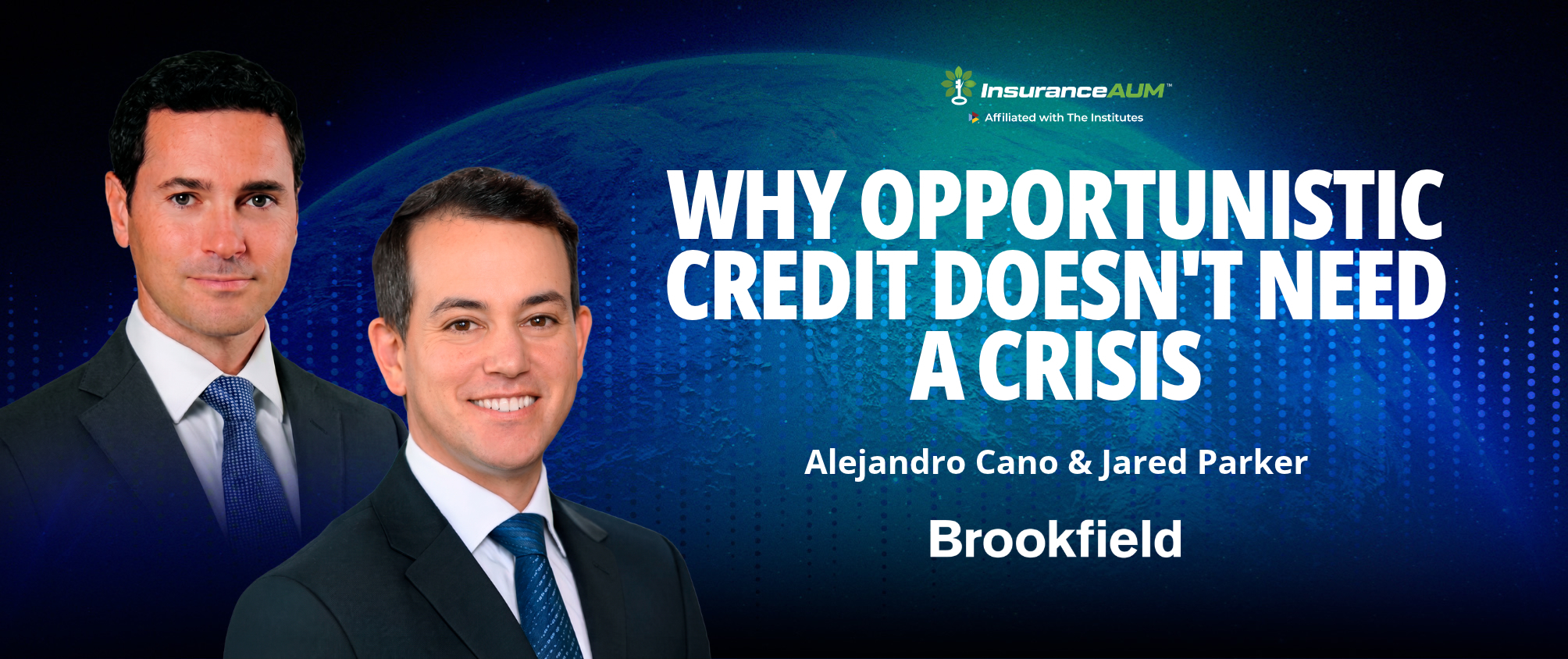





Brookfield Asset Management, Oaktree Capital Management-

Why Opportunistic Credit Doesn't Need a Crisis

Image
IAUM_Podcast_Brookfield-11.23_Web_2026


Stewart: Hey, welcome back to another edition of the InsuranceAUM Podcast – the Home of the World's Smartest Money, and my name is Stew Foley. I will be your host. There's an old saying in investments that you make your money when you buy and not when you sell. But in opportunistic credit, I think there's another question. Are you buying something cheap or are you buying something that's cheap for a reason? That's what we're going to talk about today, finding opportunity in complicated markets, understanding where you actually get paid to take on risk and figuring out how much downside risk you're taking when things don't go exactly according to plan.

I've got two terrific guests today from Oaktree Capital Management, part of the Brookfield Investment Platform, to help us through this. Alejandro Cano is a Managing Director and Co-Head of Europe for Oaktree's Global Opportunities Strategies. He's been with Oaktree since 2012, investing across Europe and Latin America, and previously worked at Hellman & Friedman, Goldman Sachs and McKinsey. Alejandro, we've heard of those firms. He also has a Stanford MBA and a background in mathematics and engineering. So you're better at math than I am, for sure.

Jared Parker is Managing Director and Co-Head of North America for the same strategy. Jared joined Oaktree in 2004 and has more than two decades of experience across private equity and opportunistic credit. He's worked extensively in infrastructure and complex investments and serves on Oaktree's Global Opportunities Investment Committee. Gentlemen, welcome to the show. It's great to have you both.

Alejandro: Pleasure to be here.

Jared: Thanks, Stewart. Thanks for having us. And I'm humbled by Alejandro's pedigree.

Alejandro: Oh, come on.

Stewart: So, Alejandro, we always start with the same two questions. Where did you grow up, and what's a fun fact you're willing to share?

Alejandro: So I was born in Barcelona, and I've heard that you really ask about the first jobs and how they have influenced us. So I'm going to give you a couple of things on those. So my first full-time job was at McKinsey. Before that, as you mentioned before, I had spent six years studying for degrees in mathematics and engineering at the same time. So you can't imagine what kind of profile I was at the end of it. And my wife always says that McKinsey changed me more than any other job, that it turned me from an absolute nerd into a functional introvert. And I think that the lesson I got from there, which is still very relevant, is that being right or knowing what you need to do in your own head is not enough. You need to explain your reasoning; you have to influence people, and you have to bring them along.

And now I have another one with regard to my first paid job, which is a bit embarrassing. So I think I'm going to tell you only if you promise me that you are going to ask Jared the difficult questions going forward.

Stewart: Absolutely.

Alejandro: OK. So we have a deal. So when I was studying, I had an internship at the university in the north of Scotland. And my English at the time was terrible. It's not that it has gotten much better, but it was truly terrible. And as you know, the local accent in northern Scotland is, let us say, challenging, right?

Stewart: That's fair, I think.

Alejandro: Yeah. So I was given a corner, a computer and tons of data. And what we were working on was a European Union-funded project to find objective ways to measure fish freshness. So there was one team in one university that was working on computer vision, another one on artificial noses, and another one was measuring the electrical conductivity of fish as the fish age post-capture. And our team was in charge of measuring the elastic response of fish. So they used a machine that would press the fish and record how the flesh deformed and recovered. And my job was to interpret the data, clean the curves and get a model that predicted how far from the catch that specimen was. So basically, before McKinsey, my first job was analyzing squashed fish.

Stewart: That's a first. 400 podcasts, that's a first. That's a good one, man. I appreciate it. Same questions for you: Where did you grow up, and what's a fun fact?

Jared: I grew up in New York City, which is also where I'm based. I'm a born-and-bred New Yorker, very much a city kid and probably a city lifer. I'm tempted to follow Alejandro's lead and talk about a first job, but I can go any direction you think the audience would be most entertained by.

Stewart: Hey, man, we're just looking for a fun fact. Anything will work. If the first job is it, we'll go with it.

Jared: Well, let's keep on Alejandro's theme. I think I could probably one-up him in terms of embarrassment. I always liked to work. So I was one of these kids that would work whenever I had a vacation. If I could find a job, whether it was my parents paying me to do chores or if I could find anything where someone would pay me an hourly wage, I would go get it. And when I was, I guess I was 15, I got a semi-regular gig working in a department store in sales in New York City, and I would do that whenever I had free time. So I would do it on long weekends. I would do it on Christmas break. I would do it during spring break. We didn't take a lot of extensive vacations, so I was usually around when I didn't have school. And I'll protect the innocent; I won't name the store, but it's a household name.

I got in there and I worked essentially at the beauty counter, and I was selling perfume and cologne and shaving products. It was a fascinating learning experience. I mean, of course, I was just in it for the money, which was pretty good in cash, especially for a 15-year-old. But I learned a lot about how much trust people have in the person who's selling them something, as I think back on it. I mean, people would ask me about these products, which I had never used, and looked to me as an authority figure on them. So it was really interesting to observe the human dynamics around consumer behavior and the trust that's put into the person in the uniform. And so that was my first job.

The first sort of more sustained job I had was as a summer camp counselor. So in between school and college, I went to work at an all-boys camp, at a sleepaway camp for eight weeks as a camp counselor. And I was living in a cabin with young men half my age, probably a dozen. And I had broad responsibility for teaching sports and life skills to a community of young men, about 80 of them or so. And that was a pretty big challenge. There were a lot of lessons learned that have been useful as a parent. They've been useful as a business leader and also very instructive in terms of human behavior and how to maybe create order and motivation for large groups of people. So another very meaningful experience, not quite the same as starting at McKinsey, but I'm sure that it's helped me professionally.

Stewart: All right. So Jared, Oaktree has a long history of distressed and opportunistic credit, and I'd love to know the difference between those two, but how has that heritage shaped the way that you assess risk and opportunity across credit markets today? And Alejandro, I'd love to hear your perspective on this as well, but I want to start with Jared.

Jared: When you ask that, the starting point for me goes to our heritage and our founders. So a lot of people are familiar with Howard Marks through his writings and his speeches; he is a very prolific thinker in investing and in credit. He has a partner, Bruce Karsh, whom Alejandro and I have worked for virtually all of our careers in credit. Bruce is kind of the master and godfather of the distressed industry. And we've learned a lot and continue to learn a lot from both of them, who are still leading the firm and very active in our business.

If I were to try and distill down maybe some sound bites from both Howard and from Bruce that I think about all the time, Howard talks a lot about credit investing as a negative art, which is applicable to the opportunistic side as well as anywhere else. And what he means by that is the skill for a credit analyst is identifying and avoiding the losers. And in that instance, the winners in the portfolio differentiate you from the pack and take care of themselves and of the performance of your strategy. And so that's a big lesson and guiding principle that we take from Howard.

From Bruce, Bruce started his career as a lawyer and he very much thinks like a lawyer and applies his legal mindset to his investing capabilities. And that also, in particular for opportunistic credit, maybe more so than other parts of the credit landscape, is a very useful guiding principle to think like a lawyer, think about not only the company that you're investing in and the advertised return, contractual return for the instrument you're considering, but also think about the underlying documentation, think about what weapons can be used against you in a worst-case scenario and think actively about the worst-case scenario. And so that's pretty fundamental to the way we underwrite and the mindset that is useful for a distressed or opportunistic approach to investing.

Stewart: Alejandro, do you want to add to that?

Alejandro: I agree with that. I think that the biggest lesson from distressed investing is that there are many things that can go wrong. The business can disappoint. You can have a claim that is weaker than you thought. A restructuring can cost more or be longer or go in a different direction than you had expected. So when you've gone through many of those repetitions, that makes you, as Jared was saying, really focused on the downside. And again, in credit, in most situations, your returns are capped. They are contractual, but if you have a piece of paper that says 10 percent, you are not going to get 12 percent in most cases. So the name of the game is this: How do you avoid the losers? And that's why, as Jared was saying, we really focus on thinking about scenarios that stretch what can go wrong, and we want to be fine in those situations.

Stewart: Howard Marks was speaking at the Chicago CFA Society and he said, "At Oaktree, we try to lend money to people who are going to pay us back and invest in companies that are going to grow." And I was like, "One of the brilliant things about people who really have command of a subject is the ability to make something very complex, very simple." And I thought that was an excellent way to look at things.

Jared: He's the best at it.

Stewart: Yeah, he's very good at that.

Alejandro: He's made it sound much simpler than the two of us.

Stewart: Well, I'll tell you, he was at our event in Chicago and he went to the board. Now, rookie mistake: We had old markers on the board that didn't work, but he went to the board, and when he did, I was so excited. Nick Smith from Nationwide was sitting next to me and I whacked Nick Smith and I said, "He's going to the board." I don't know what's wrong with me, but I'm on Alejandro's team.

Jared: Whiteboards and markers are like catnip for Howard.

Stewart: No, it's good.

Alejandro: Totally. Yeah, it's totally a magnet.

Stewart: Yeah. It's good. So, Alejandro, sometimes there's a perception that opportunistic credit requires a broadly distressed market to generate returns. Is that the case today? And Jared, I want to come back to you and ask you if you have similar dynamics in North America.

Alejandro: So I think that the very short answer is no, we don't need markets to fall off a cliff in order to have opportunities. It is true that when there is a broad crisis, it produces a lot of fire-sale flow, primarily in the liquid markets. But individual businesses encounter financing problems even when the market looks healthy. So think, for instance, of an excellent company that was acquired at a very high valuation, let's say between the second half of 2020 and the first half of 2022, when there was a lot of financing, and it was provided very aggressively. So that acquisition was probably done at a very high multiple and with a lot of leverage. Now you fast-forward the movie. We're in 2026, 2027. That debt is coming due. And the question is, can it borrow? Can that company get the same amount of capital today with the current interest rates or not?

And if the company has grown, then it might, but in many cases it will not. And then that brings about a situation where the owner may need to inject capital, they may need to sell an asset or they may need to do something that is not going to be provided by your typical capital markets. And that means that these are situations that we are going to be involved in. So I think that the opportunities for us come at periods of stress, and stress is created by complacency, and we've gone through a very long period of a lot of complacency. So I think that the very short answer is no, we don't need to have a big correction. And there's constantly a set of companies that are going to need what we can provide.

Jared: What I would add to what Alejandro said, and it's an area that I'm sure Alejandro agrees we take a lot of pride in at Oaktree, is using what I would describe as a two-pronged approach to our deployment. On the one hand, we are bottom-up analysts and we're very focused on underwriting individual companies. On the other hand, we also pay very careful attention to what I would describe as our mode.

And we talk actively throughout the year, in any given year, about what the market is offering and what the appropriate mode is for that market. And in maybe big-picture terms, there are some markets where the market is offering such incredible value with wide dispersion across assets, industries, maybe geographies, that the weapon you need is more of a broad brush than a surgical tool. And it's more important to accumulate as much as you can in that market. Warren Buffett talks about moments like this when it's raining value and you should have buckets to capture as much as you can. So part of our clients' expectations of us, and I think part of the skill that comes from Oaktree being around as long as we have and from the professionals on the team being as experienced as they are, is to recognize when you're in one of those markets and to shift your mode accordingly.

To Alejandro's point, we're not in, we don't think, that kind of market. And so that's not our mode right now, but that doesn't mean we do nothing. That means we need to use the surgical tool and be more proactive in sussing out where there's good relative value and where we can deploy in a manner that's consistent with our risk-adjusted return expectations and still deliver a good result for our clients. And I think we've demonstrated that we can operate effectively. We can recognize when to use each mode, and we can operate effectively within each mode.

Stewart: Yeah, that's super helpful. One of the things is that I've been doing this podcast since what seems like time began, and one of the things I've learned is that some of the most interesting investments aren't necessarily the ones that are the most attractive or the shiniest object, if you will. Sometimes the best opportunities are buried in situations that are complicated, misunderstood or just uncomfortable. Alejandro, Oaktree has invested across 28 vintages of its opportunistic credit strategy. So drawing on that experience, why is now a compelling time to invest in opportunistic credit? And we've talked a little bit about this, but what's Oaktree's edge or differentiator in capturing that opportunity?

Alejandro: So let me start by stepping back for a second because it's not just that now it's a good time to invest in opportunistic credit; it's a good time to invest in credit. So the first thing that I would say is that now, for the first time in a long period, you get paid to issue credit. You go a few years back and there were some high-yield bonds that were issued in the threes, maybe even in the twos, but definitely in the threes. And how you can call that "high yield" is something that still baffles me. But today I think that you can find a good borrower, negotiate the right terms and get a very interesting interest rate.

And I think that it's always interesting to have a comparison with equities. If you look at the S&P 500, its historical average returns have been about 10 percent. Now, equity valuations today are somewhat elevated. They are higher than historical norms. And I'm not calling this a bubble at all, but if you start from a higher valuation than average, in principle, you should be expecting returns over, say, the next decade that are going to be lower than the historical average. So we are now at a time where if you can underwrite a double-digit contractual return on something that we feel very confident about, I think that that is very compelling. And obviously a loan doesn't guarantee a return. As you were saying, the borrower must pay, but even if they do not, then we have rights that are ahead of the equity. So I think that right now the balance of power has shifted a bit toward credit. And when you think about the pie of cash flow that is being generated by companies, a larger portion of that pie is going to lenders and a smaller one is going to equity.

So I think that the first thing is we are at a time where credit has become a lot more attractive, and I think that the markets are a lot healthier because what we had before was, I would say, really an exception or even an aberration in a historical context. So now with regard to opportunistic credit, I think that there's been, again, a period that has been very long where we have had lots of excesses, and those excesses need to be addressed. And the way to address them is oftentimes through capital like ours.

And one of the things that I really, really like about working for Oaktree is that we have an extremely flexible mandate. We can invest in any geography provided that there's a rule of law. I always joke that in terms of sector, "If it's legal, we've done it," and then we can invest anywhere in the capital structure. So we can go all the way from senior secured all the way to equity. And by the way, sometimes there are situations where the equity is so well protected, and you are creating the equity at such an attractive valuation, that it is the right place to go because you also have the upside.

But I think that that combination gives us a tremendous advantage because at any point in the cycle, we can select which combination of geography, sector and position in the capital structure is providing the best risk-adjusted return and go for that, which is very different from situations where your mandate is a very narrow mandate and you need to do that. And there will be times where the thing that you are tasked to do is unattractive.

Stewart: It's an interesting observation. I do think that if you are in a narrow segment and that segment gets cold, it's not like people go, "Well, we're going to hang it up for this year and we'll be back next year." It doesn't happen that way. So I think that's a great point.

Jared, I've said on this show before, with AI, it seems like we're living in dog years, right? One year is like seven, with interest rates and economic uncertainty. And let's not forget that what's moved markets as much as anything is what comes out of politicians' mouths. And hey, "We're going to do this and we're going to have that," and the next thing you know, whatever. And so you've got AI, rapid technology change. It seems like all of a sudden it's like, "Oh, software bad. OK, well, let's run." How do you distinguish between risks that are real and those that can create real opportunity?

Jared: It's an important question. My starting point in maybe explaining how Oaktree thinks about that is back to our principles of how we underwrite. And the starting point for us is to think like value investors. Bottom-up, what is the intrinsic value of an asset or an enterprise? Can we enter the capital structure of that balance sheet with a significant margin of safety underneath us while also giving ourselves an adequate return in both absolute and relative formats?

And you mentioned software and the dislocation in software. We talked earlier about recognizing what kind of market we're in, and Alejandro used the word flexibility, which I think is an incredibly powerful ingredient to our mandate. We, I think, have been able to hold our heads very high this year in having been extremely underweight software as an asset class across our firm. And when you ask yourself why, the question is: How do we use the mandate to recognize opportunity and also avoid value traps?

I think software looked like a classic value trap to us. Almost definitionally, the archetypal enterprise software issuer doesn't have a lot of asset value. There's not a lot of collateral in the business. You are investing principally on the premise of a business that's going to continue to grow and continue to have demand for the enterprise, including the equity, at capitalization rates that are well in excess of the funded amount of debt. And when we look at that proposition, as Alejandro said earlier, if you're in the credit, you don't get paid any upside beyond your contracted return. So for that sort of profile, the contracted return had better really compensate you for the nature of the risk that you're undertaking.

And our observation toward the end of last year, beginning of this year, 2026, is that software was offering excess return relative to other asset classes in both private credit and syndicated credit, but not a particularly large amount of excess. And relative to other opportunities we were seeing with better downside protection, it was unscintillating for us. And because we have the flexibility to move around regions, move around industries, pick different spots in the balance sheet, including, as Alejandro said, equity, if we think that's the better value opportunity, we weren't forced. We weren't forced into an allocation to a sector that we didn't think was offering particularly compelling risk-adjusted returns. And so we didn't do it.

And there's no more magic to it than that, but the satisfying moment for us was seeing the sector re-rate and not having been dragged down and having to play defense and sort of firefight through the portfolio in that moment, and actually having the ability to reconsider the space from an offensive perspective and see if, again, back to mode, this is a back-up-the-truck moment for software. We don't think it is. Is this an opportunity where there may be the proverbial babies thrown out with the bathwater where we can selectively add exposure using the framework of value underwriting heuristics? Absolutely. And so I think that is the way we approach and try to delineate between opportunities and value traps.

Stewart: Yeah, it's super helpful.

Alejandro: I would add a very small point here, which is that what we did was not easy because there was a lot of opportunity in software. It was very easy to deploy capital in software. So passing mostly on it was the difficult thing to do. But as Jared was saying, when you are a credit investor, you cannot base your returns on heroic predictions and on assuming that something will continue indefinitely. So we passed on it, not because we were geniuses, not because we thought that AI was around the corner, just because we didn't feel comfortable with being repaid through cash flow generation, which is what we care about.

Stewart: Yeah, it's interesting. I mean, I think back to, I mean, I'm old enough to remember the '90s when everybody was like, "Buffett's lost his touch. He's not in this dot-com thing and he's lost it." And his answer was, "Listen, I don't think there's value here." And it turned out that he was proven right. So it's interesting because, to your point, Alejandro, if you look at issuance, the amount of issuance around software and hyperscalers and all of that infrastructure, I'm sure that it was a challenge to avoid some of that.

So kind of coming back to you, Alejandro, and this is the question we ask a fair amount, which is where do you see opportunity where the broad market may be overlooking complexity or mispricing it? And where are you cautious, if anywhere?

Alejandro: Yeah. So I'll cover Europe and Latin America, and maybe Jared can cover North America, but I would start with one word that you mentioned that is key, in particular outside of North America, which is complexity. When you go outside of North America, first of all, the liquid markets are a lot smaller, so everything happens on the private side, or pretty much everything happens on the private side. And then you have a number of layers of complexity. You have currencies, you have different legal systems, you have different restructuring systems, and you have a big discrepancy in many cases between what the law says will happen and what actually happens. So knowing all of that is extremely important.

Now, complexity is something that puts off a lot of people, and that is a potential competitive advantage if you know how to simplify, if you know how to cut through complexity. So when we look at things outside of North America, oftentimes there's complexity that we can simplify, that we can untangle, and those situations oftentimes create very good returns because other people cannot be bothered. But there are situations where actually the complexity is not solvable, and we pass on those.

Now, with regard to where we're seeing opportunity in Europe, I think that I would mention three things. So the first one is industrial companies. Many of them are facing higher energy costs, changes in supply chains, and then there's even technological change in some sub-industries like auto. And while those challenges are very real, and there are some companies that are just going to be permanent losers, there are still very sound companies that you can work with.

The second, and I'm repeating this, is businesses that were acquired with a lot of leverage when rates were low. And the funny thing is that if you think about LBOs back in those days, the companies that private equity sponsors tend to buy are oftentimes very, very old companies. And you get this distinction between good company and bad balance sheet, but many of those companies are excellent, and I think that there are going to be opportunities there.

And the third is, I would say, corporate carve-outs in the sense that there are companies that want to maybe retain an IG rating and they need to generate cash from selling non-core assets. And in those situations, it's often complicated. There's a need for speed, certainty or structures that, let's say, a conventional lender is not going to be able to provide. So that complexity, again, puts off competition and gives us the ability to negotiate something that is tailor-made to the counterparty and therefore creates value for them, but also creates a lot of value for our investors.

In Latin America, things are even more complex there. So in Latin America, capital tends to come and go. And when financing is scarce, then there can be opportunities to invest in really great bargains. But then when enthusiasm returns, it's the moment to be extremely careful.

Stewart: Jared, how about you?

Jared: Well, first of all, I would just say what a luxury it is to be in North America and have a partner that's able to talk across Latin America and Europe and augment that flexibility that's so powerful to our mandate to complement what also is a very deep opportunity set historically and today in North America. So I think it's a real testament to the capabilities of the firm and the strategy, with Alejandro and his team boots on the ground, focused on the complexity of those markets and the opportunities that they are able to turn up there.

I would say maybe our job's a little easier in North America right now. In 2022, Howard wrote a memo that internally got all of our attention, really kind of got our antennas up, and the title of that memo was Sea Change. I would encourage the listeners to dig it up and read it or reread it if you've read it because it's as important today in 2026 as it was when he wrote it near the end of 2022.

And the point of the memo was that the sort of violent movement in rates from the ultra-low levels back to historically normal levels is likely to reset the deck at a borrowing cost that is in line with the norm and away from the last 20 years of these very unusually low, ultra-low interest rates. And as a result, the kinds of strategies that worked so well in the last several vintages of alternative investment strategies are likely to work less well because interest rates were such a powerful underlying gravitational force propelling those strategies. And the inverse, of course, is credit, which struggled to produce compelling returns in an ultra-low-rate environment and, as Alejandro mentioned earlier, will now be in a position to soak up more of the economic share of the pie. And so as a framework, I think that sets up a much more compelling opportunity set, and it's compelling in both the public and private markets, in which North America is the deepest on both fronts.

And we had on top of that what I would describe as an LBO boom that took place in the immediately preceding period from 2020 through the first half of 2022. And the borrowers of debt fueling that LBO boom were across all industries. So in other words, there's not a single industry that is occupying our focus for opportunities. It's all borrowers across all industries that had the mindset of complacency, as Alejandro was describing, when they took on debt and presumed they were right-sized in terms of the amount of issuance for their business model because they were presuming a continuation of these abnormally low interest rates. And now that seems unlikely to persist.

The rate environment we're in is not a high environment. People are talking about higher for longer. It's back to normal. And as recently as the last two quarters, even with the Trump administration's intensity in trying to push rates back down, they're actually going the other way. They're going back up. And so what that means is there are a lot of borrowers with a lot of debt in the system who are losing hope in the likelihood of a bailout from a rate reduction. The maturity wall from that LBO boom is right in front of us in the windshield, and that's going to create a very steady, healthy diet of opportunities for a strategy like ours and for credit across the board.

And then on top of that, I think we'll see pockets of idiosyncratic volatility. You mentioned, and we talked about, software earlier this year, and that is continuing today. We're recording this in the last week of October. We're seeing some interesting things happening around the AI and data center buildout right now. The housing sector does have a lot of direct rate exposure. Housing sales are at trough levels in the United States. Housing fuels a lot of the U.S. economy. What do you do when you buy a new home? You paint it, you refurnish it, you buy a new car. So a lot of the general industrial economy experiences first- and second-order impacts from activity on the housing side. And ultimately the movement in rates is creating headwinds throughout a big swath of the economy and among the borrowers, both sponsored and non-sponsored, who took on debt not anticipating this move in rates.

Stewart: We had somebody on the show that said this will be the best class of distressed credit in history because of exactly what you're talking about. So most people listening, and I would say all, because it is a very narrow audience, are responsible for insurance company assets, and they're not looking for the highest return in the same way that they're not looking to maximize their net written premium. They're trying to earn attractive returns and protect their capital, manage their liquidity and make sure the portfolio works for the enterprise, which is, let's not forget, writing insurance.

And it's interesting that I'm convinced that if you said to a CIO, "Would you rather have a top-decile manager or no OTTI?" Pretty sure I know the answer to that one. So, Jared, when you look at opportunistic credit to deliver equity-like returns with debt-like downside protection, how does the investment approach align with an insurer's broader investment philosophy and what role can this strategy play in their portfolios today?

Jared: Well, I think you've hinted at the answer, and maybe the reason why we've benefited from very long-standing, great partnerships with a lot of marquee insurance investors throughout all of our vintages and through today is the consistency. And I hope I'm not boring you or the audience with continuing to refer to our founder Howard, but Howard has written extensively about the benefits of consistency in a portfolio. And the memo that I'm recalling is a very influential conversation Howard had with the CIO of the General Mills pension when the CIO told Howard that he had never been a top-decile performer in a given vintage, but he had also never been outside of the second quartile. And over, I can't remember exactly, but I think it was—

Alejandro: 14 years.

Jared: Was it 14 years? I thought it was 17 years. But in any event, over a decade-plus period of consistent investment performance that put him in the top 2 percent, I believe, versus his peer group. And so statistically, this was a bit of a light switch moment for Howard: Statistically, being a consistent performer is actually the better strategy than trying to be a top-decile performer, which almost definitionally means you have to accept sometimes being a bottom-decile performer. And so what's kind of in the water at Oaktree, and for me and Alejandro and our teams, is vigilance about consistency at the expense of individual excellence in a given vintage.

And I think that resonates with insurance capital. I think our non-correlated returns also resonate. Our performance is not as tethered as other beta strategies to moves in rates or headline risk. So that has broad appeal, but definitely for insurance clients. Oftentimes we're generating a lot of our performance through income. Equity upside is a component, but income provides stability. Our DPI tends to be a good calling card for us in contrast to other closed-end strategies. So these are the things that increasingly are getting spotlighted by our insurance customers as reasons to want to continue to partner with us.

Stewart: What is DPI, just for whatever it's worth, what's DPI?

Jared: It's capital return.

Stewart: OK.

Jared: So it's really the difference between unrealized and realized returns.

Stewart: So, Alejandro, we've kind of covered this, which is what could create opportunities. And we've talked about rising rates more than distress in the underlying business, which is an important distinction. That tells me that there's going to be some pain for holders of some of that debt that is facing this maturity wall. So can you talk a little bit about the opportunity and then can you help define what the risk is to the existing corpus of that debt?

Alejandro: Yeah. So again, it all comes from what Howard has called this sea change in interest rates, which again, as Jared was saying, is going from abnormally low rates toward rates that are perfectly normal from a historical standpoint. And the lower the interest rate, the more debt that a company can support with its cash flow. So as we get closer to refinancings, more companies are going to be in a situation where they will need to find a solution for the tremendous amounts of leverage that they have.

And I always give a numerical example here that makes it very tangible to people. So let us imagine that in 2021, you go to the bank and you say, "Hey, this is my company." And the bank concludes your company can pay comfortably $21 million of interest, and the prevailing interest rates are 0 percent, and the bank decides that they want to charge a 300-basis-point spread. So your all-in cost is 3 percent. At 3 percent, $21 million of interest equals a $700 million loan that the bank will give you.

Now you fast-forward the movie to today, and then interest rates are, let's call it, 4 percent. Let us assume that they are still going to give you the same spread. That brings you to 7 percent. If you can still pay only $21 million, that means that they are going to give you $300 million. And the big question is what happens with the difference between the $700 million and the $300 million? And there's the potential for equity injections. There's the potential for restructurings. There's the potential for bridge financing so that the company will grow into the capital structure, but it's generally complicated to fight back that math, the math that I just ran you through.

So to your question, I think that there are going to be a lot of things that need to be resized, and that could have consequences, not only in the first order for those issuers, but also in terms of confidence from the market. Because if lenders are not getting repaid, that means that lenders are going to be more, let's say, more picky on a go-forward basis. So there's also that vicious cycle, if you want to call it that way, which I think could trigger an episode. So I think that it all comes from the rise in interest rates to what, as I was saying, is a perfectly normal rate, and now the whole market is going to have to adjust to that.

Jared: I think about this all the time, mostly when I want to feel bad about how hard our jobs are. But if you put us in a time machine back to the moment, let's say before Howard wrote the Sea Change memo, and you erased our memories of the last four years, and you said over the next four years, you're going to see the following. You're going to see the fastest rise in interest rates in the U.S. in its history. You're going to see a new administration come in and put historically high tariffs on all of its biggest trading partners. You're going to see a wave of bank failures. You're going to see oil prices spike 50 percent and be persistently above $100 a barrel, both Brent and WTI. You're going to see a wave of corporate fraud and bankruptcies in both public and private issuers. And you're going to see geopolitical conflicts expand from Russia and Ukraine to Iran, Yemen and Venezuela, with the U.S. heavily involved in all of these conflicts.

I can't imagine anybody would think – I wouldn't be smart enough to think – that over those four years we'd be setting record highs year after year in asset values, that we'd have record-high issuance in credit, that we'd be at historically tight spreads. And so I think what gets us maybe excited, if I can use that word, is we haven't had something tip over and create the market dislocation. And we've still found a lot of interesting things to do, but we still hold this wild card that something inevitably will actually be the catalyst that starts the flame. And there is a lot of stacked kindling wood right now, more than we've ever seen, that will take an already very robust market and turn it into an exceptional market.

Stewart: It's been a great conversation. I've learned a lot from both of you. I got a fun one for you on the way out the door. And I want to go – I'll start with you, Alejandro. Describe – so people prep for our questions that were like a year ago. So this is a slightly different question. Describe your best real or fantasy dinner. Who's there, where are you, and what are you having?

Alejandro: So I don't know where I would be. It would be somewhere nice, probably by the beach because I love the sea. And then who would be there? I'm going to start with my grandfather. He had to leave school when he was 11, but he spent the rest of his life learning and he was extremely curious and very wise. And I think that I would appreciate a conversation with him about the tough choices in life, the decisions that matter in hindsight, and also what he would make of the choices that I'm facing today.

And then for the other two, and maybe this comes from my background in engineering, I have always admired people who master different fields and see connections between them. And so for the other two seats, I would choose Antoni Gaudí, the architect behind Sagrada Família, and Leonardo da Vinci. And then I think that with Gaudí, what I like is that he brought together geometry, engineering, sculpture, light, music and faith in buildings to design them in a way that he described as beautiful and perfect.

And Leonardo, he was incredible. He would move between observing something, drawing it, and then creating an invention with extraordinary freedom. So I think it would be a great dinner. It would be great to understand from them how they look at the world. For instance, with Leonardo, how did he decide which ideas merited the time? Because he had a finite amount of time and he was doing so many different things. So I think that that would be fascinating, but I really think that my grandfather would be the one with the best questions. So it would be one of these dinners where I would sort of step back and just listen and learn from them.

Stewart: I'd love to see the look on your grandfather's face when you handed him your phone. Can you imagine? I mean, it's astonishing what your phone will do. We all take it for granted.

Jared: There's a line around the block for it.

Stewart: It's crazy. All right. So, Jared, same question for you. Best real or fantasy dinner?

Jared: Well, my best real dinner, similar to Alejandro's, would be with family and friends. That's probably a cheesy answer, but it's very much true. And I'm very fortunate that I can have those dinners often.

Fantasy dinner: It's Oct. 23, which means it's opening week for the NBA here in the U.S. And as I mentioned, I'm a born-and-bred New Yorker. The New York Knicks won their first championship in my lifetime last season. They had their ring ceremony this week. We won't talk about what happened in their opening-night game after the ring ceremony, but I would love to have dinner with the team that brought a championship to New York. And I would recruit Larry David, who is a self-proclaimed excellent middler, to sit in the middle of the table and make sure that the conversation was moving and flowing and funny and engaging. And I would recruit Francis Mallmann to cook. And I would probably spend half the dinner at the table and half the dinner watching him because I love to cook and love that style of cooking. So that would be my fantasy dinner.

Stewart: That's awesome. Thank you both for being on. I really appreciate it. We've been joined today by Alejandro Cano, Managing Director and Co-Head of Europe, Oaktree Global Opportunities, and Jared Parker, Managing Director and Co-Head of North America, Oaktree Global Opportunities. Gentlemen, thanks for taking the time today.

Jared: Thanks, Stewart.

Alejandro: Thank you very much.

Stewart: Thanks for listening. If you like us, please rate us and review us on Apple Podcasts, Spotify, or wherever you listen to your favorite shows. You can also watch this podcast on our YouTube channel at InsuranceAUM Community. This is the Home of the World's Smartest Money on the InsuranceAUM Podcast.

Share this post

Sign Up Now for Full Access to Articles and Podcasts!

Unlock full access to our vast content library by registering as an institutional investor

Register

Contacts


Image
Brookfield-in-Blue-sidebar

Brookfield Asset Management is a leading global alternative asset manager with over $1 trillion of assets under management across infrastructure, energy, private equity, real estate and credit. We invest client capital for the long term, focusing on real assets and essential service businesses that form the backbone of the global economy. We offer a range of alternative investment products to investors around the world, including insurance companies, public and private pension plans, endowments and foundations, sovereign wealth funds, financial institutions and private wealth investors. Drawing on Brookfield's heritage as an owner and operator, as well as its imbedded specialized credit capabilities, including Oaktree’s leading alternative credit platform, we seek to invest for value and generate strong returns for our clients across economic cycles.
 

Brookfield
250 Vesey Street, 14th Fl.
New York, NY 10281
 

Roger Kramer
Managing Director, Insurance Strategist 
roger.kramer@brookfield.com
+1.646.774.3472
 

https://www.brookfield.com/


View the contributor page

Sign Up Now for Full Access to Articles and Podcasts!

Unlock full access to our vast content library by registering as an institutional investor .

Create an account

Already have an account ? Sign in

Ѐ Ё Ђ Ѓ Є Ѕ І Ї Ј Љ Њ Ћ Ќ Ѝ Ў Џ А Б В Г Д Е Ж З И Й К Л М Н О П Р С ΄ ΅ Ά · Έ Ή Ί Ό Ύ Ώ ΐ Α Β Γ Δ Ε Ζ Η Θ Ι Κ Λ Μ Ν Ξ Ο Π Ρ Ё Ђ Ѓ Є Ѕ І Ї Ј Љ Њ Ћ Ќ Ў Џ А Б В Г Д Е Ж З И Й К Л М Н О П Р С Т У Ф Х Ц Ч Ш Ā ā Ă ă Ą ą Ć ć Ĉ ĉ Ċ ċ Č č Ď ď Đ đ Ē ē Ĕ ĕ Ė fi fl œ æ ß