

Federated Hermes -

With a Flatter Curve, Less Duration Can Be More

Winding road beside a mountain lake under cloudy skies.

Higher long-term bond yields have made the headlines, but the short end has also risen sharply. This gives investors historically attractive yields across the curve.

When the third quarter opened, the 10-year Treasury was just below 4.5%. It closed the quarter just below 5.3%, an 80 basis point quarterly spike. Yields remain volatile with the start of the fourth quarter, and it’s difficult to say whether peaks have been reached, as markets and the Federal Reserve will respond to data and events. What we can say with some certainly is that the highest yields in decades have caught investors’ attention.

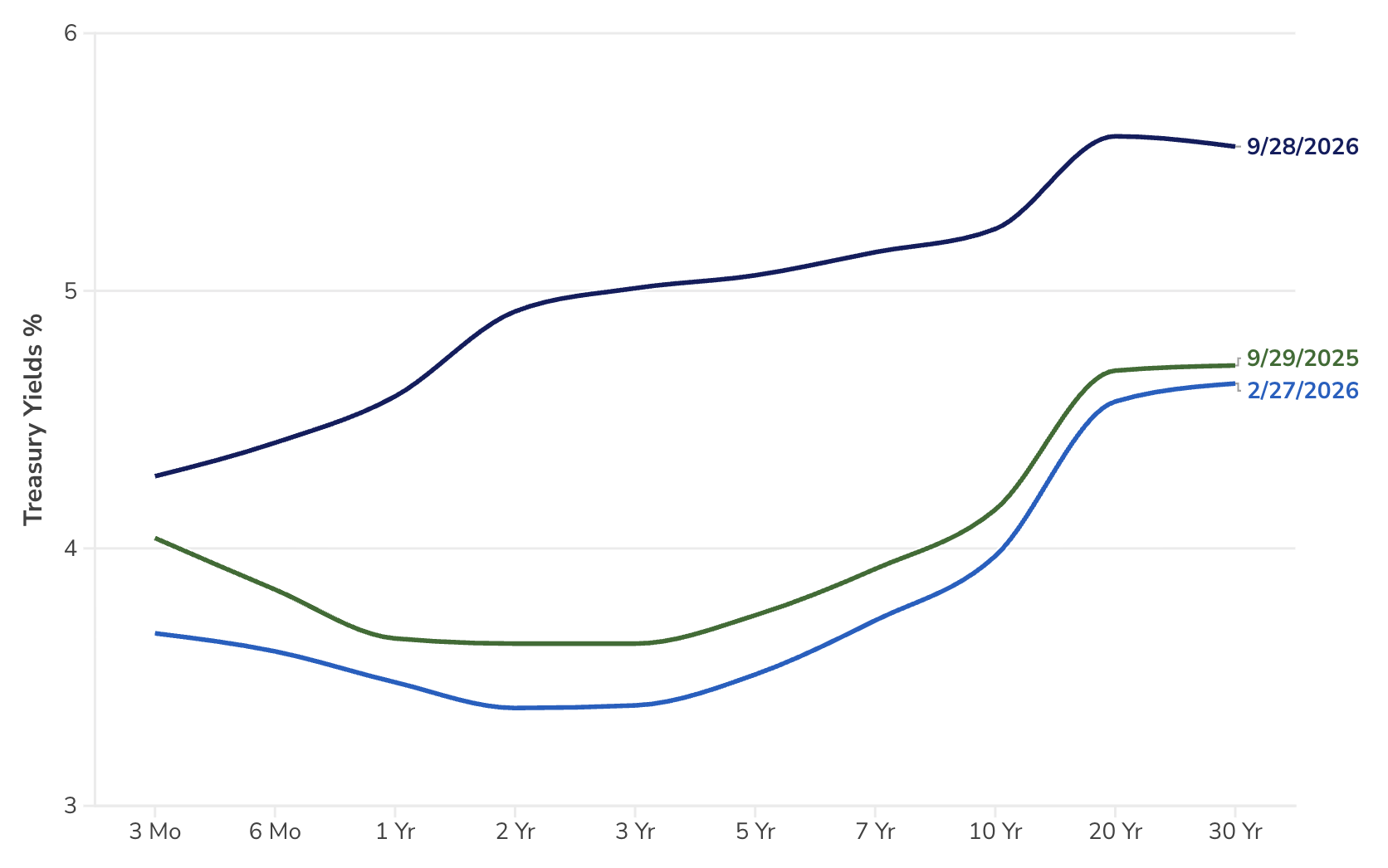
The talk has mostly been about the inexorable rise of long-term yields, but the yields on 2-year Treasurys aren’t that much lower than for 10-year notes. The yield curve is flattening and the modest term premium for longer-term bonds suggests the shorter end may offer particular value at present: With short duration, investors can get attractive yields while taking on far less duration risk.

As ever, central bank policy is at the heart of the equation. If the market expects more hikes than the Fed actually delivers, we could see the yield curve stay elevated on the longer end but rapidly fall on the shorter end. Why? Short duration trades more closely off the Fed’s interest rate moves, while yields for longer duration bonds are more reflective of competition for capital (hyperscalers), inflation expectations and the strength of the economy as a whole.

Yields have risen across the curve

10-Year Treasury yields are at their highest levels since 2007

Chart showing 10-Year Treasury yields

Source: US Department of the Treasury, 9/29/2026

Our outlook:

At today’s rates, we believe that bonds can be attractive for many investors. This is especially so at the shorter end of the yield curve, though, since there’s less chance of being caught offside by rapid shifts in the market. It’s too soon to know with certainty whether the Fed is already nearly done or has barely begun on its rate-hiking cycle. Shorter duration could see much of the upside of a soft landing scenario with less exposure than longer duration to the risk of stagflation.

  • Sticky soft landing scenario — Inflation moderates gradually, growth slows but stays positive, and the labor market cools but remains healthy. Potential portfolio considerations: We believe diversified equities could work well, with a tilt toward large-cap quality and international names potentially benefiting from stable global growth; small caps may have less support without a stronger growth catalyst; emerging-market equities look attractive. In fixed income, short-duration strategies (roughly one- to three-years) allow a nimble stance without betting on rate-cut timing, and investment-grade credit is favored over high yield given moderate growth and contained spreads. In our view, emerging market debt can perform reasonably well if the US dollar stays range-bound.
  • Inflation persistence scenario (stagflation lite) — Growth weakens while inflation remains sticky from energy costs, wages, tariffs, and geopolitics. Potential portfolio considerations: Historically, large-cap, quality stocks with pricing power tend to hold up better against margin pressure; value tends to outperform growth, and small caps may be more vulnerable to tightening conditions. Ultra-short and floating-rate fixed income reprices automatically if the Fed hikes, offering a potential hedge, while investment-grade credit may be preferable to high yield for its stronger balance sheets. Emerging market debt may lag, as sticky inflation and a firmer dollar work against it.


READ MORE FROM FEDERATED HERMES

DISCLOSURES

Views are as of the date above and are subject to change based on market conditions and other factors. These views should not be construed as a recommendation for any specific security or sector.

The Institute of Supply Management (ISM) manufacturing index is a composite, forward-looking index derived from a monthly survey of U.S. businesses.

Bond prices are sensitive to changes in interest rates and a rise in interest rates can cause a decline in their prices. In addition, fixed-income investors should be aware of other risks such as credit risk, inflation risk, call risk and liquidity risk. Credit ratings are subject to change and don’t protect against market. 

High-yield, lower-rated securities generally entail greater market, credit, and liquidity risk than investment-grade securities and may include higher volatility and higher risk of default.

Foreign investing involves special risks including currency risk, increased volatility, political risks, and differences in auditing and other financial standards.

Yield Curve: Graph showing the comparative yields of securities in a particular class according to maturity. Securities on the long end of the yield curve have longer maturities.

Past performance is no guarantee of future results.

The performance quoted is for illustrative purposes only and is not representative of any specific investment.

For additional information, including definitions of related terms and indexes, see the Financial Glossary and Benchmark Index Glossary. In addition, by accessing documents containing CUSIP information, you agree to the Terms of Use for CUSIP Information contained in the Financial Glossary.

Although the information provided has been obtained from sources which Federated Hermes believes to be reliable, it does not guarantee accuracy of such information and such information may be incomplete or condensed.

The value of equity securities will rise and fall. These fluctuations could be a sustained trend or a drastic movement.

Prices of emerging-markets securities can be significantly more volatile than the prices of securities in developed countries and currency risk and political risks are accentuated in emerging markets.

There are no guarantees that dividend-paying stocks will continue to pay dividends. In addition, dividend-paying stocks may not experience the same capital appreciation potential as non-dividend-paying stocks.

Secured Overnight Financing Rate (SOFR): a broad measure of the cost of borrowing cash that is collateralized by U.S. Treasury securities. The New York Fed publishes SOFR on a daily basis.

Value stocks may lag growth stocks in performance, particularly in late stages of a market advance.

Growth stocks are typically more volatile than value stocks.

Small company stocks may be less liquid and subject to greater price volatility than large company stocks.

The value of some mortgage-backed securities may be particularly sensitive to changes in prevailing interest rates, and although the securities are generally supported by some form of government or private insurance, there is no assurance that private guarantors or insurers will meet their obligations.

Variable and floating rate loans and securities generally are less sensitive to interest rate changes but may decline in value if their interest rates do not rise as much or as quickly as interest rates in general. Conversely, variable and floating rate loans and securities generally will not increase in value as much as fixed rate debt instruments if interest rates decline.

Issued and approved by Federated Advisory Services Company

Share this post

Sign Up Now for Full Access to Articles and Podcasts!

Unlock full access to our vast content library by registering as an institutional investor

Register

Contacts


Image
Federated-Hermes_Lockup_2C_CMYK_6p0_NR


Federated Hermes is a global leader in active, responsible investing, with a commitment to responsibility deeply embedded in our heritage, client relationships, long-term vision, and fiduciary principles. Our extensive platform of investment solutions empowers investors to achieve a diverse range of outcomes. We specialize in managing equity, fixed-income, alternative/private markets, multi-asset, and liquidity management strategies for institutional investors, including insurance entities. Headquartered in Pittsburgh, our team of over 2,000 employees spans across major financial hubs such as London, New York, Boston, and other locations worldwide.
 

Brian Willer   
Institutional Business Development 
North America National Sales Manager
Federated Securities Corp.
Brian.Willer@FederatedHermes.com  
617-335-0770
 

Federated Hermes
1001 Liberty Avenue,  
Pittsburgh,  
PA 15222-3779
 

View the contributor page

Sign Up Now for Full Access to Articles and Podcasts!

Unlock full access to our vast content library by registering as an institutional investor .

Create an account

Already have an account ? Sign in

Ѐ Ё Ђ Ѓ Є Ѕ І Ї Ј Љ Њ Ћ Ќ Ѝ Ў Џ А Б В Г Д Е Ж З И Й К Л М Н О П Р С ΄ ΅ Ά · Έ Ή Ί Ό Ύ Ώ ΐ Α Β Γ Δ Ε Ζ Η Θ Ι Κ Λ Μ Ν Ξ Ο Π Ρ Ё Ђ Ѓ Є Ѕ І Ї Ј Љ Њ Ћ Ќ Ў Џ А Б В Г Д Е Ж З И Й К Л М Н О П Р С Т У Ф Х Ц Ч Ш Ā ā Ă ă Ą ą Ć ć Ĉ ĉ Ċ ċ Č č Ď ď Đ đ Ē ē Ĕ ĕ Ė fi fl œ æ ß