


We're currently experiencing email delivery delays. For urgent matters, please contact us directly at lindsay@insuranceaum.com.

New England Asset Management -

2024 U.S. Life Industry Investment Highlights: Yield Momentum Persists, Though Moderating

NEAMFeatured

Mark Yu, Head of Enterprise Capital Strategy
Phil Lee, Enterprise Capital Strategist
Eric Huang, Enterprise Capital Strategist
 

Following notable increases of 45 basis points (bps) in 2022 and 38 bps in 2023, the life insurance industry’s book yield rose by a further 15 bps in 2024, reaching a decade-high of 4.76%.

Executive Summary

In 2024, the U.S. life insurance industry’s net investment income increased by 25 bps, extending the upward trajectory observed in 2023. This growth was primarily supported by persistently elevated interest rates.

Asset allocations remained relatively stable, with bonds, mortgage loans, and Schedule BA assets continuing to dominate. However, bond allocations have gradually declined over the long term, offset by increased investments in mortgage loans and Schedule BA assets. Notably, cash and short-term investments surged to a record 3.5% in 2023 and held steady in 2024, reflecting the appeal of short-term yields.

The industry’s fixed income book yield rose by 15 bps in 2024, benefiting from the high-rate environment despite improvements in credit quality and a shortening of portfolio duration. Allocations to corporate bonds continued to decline, while investments in private placements and asset-backed securities (ABS) reached new highs.

Net Investment Income (NII) Climbed, Driven by Bonds, Mortgage Loans, and Short-Term Holdings

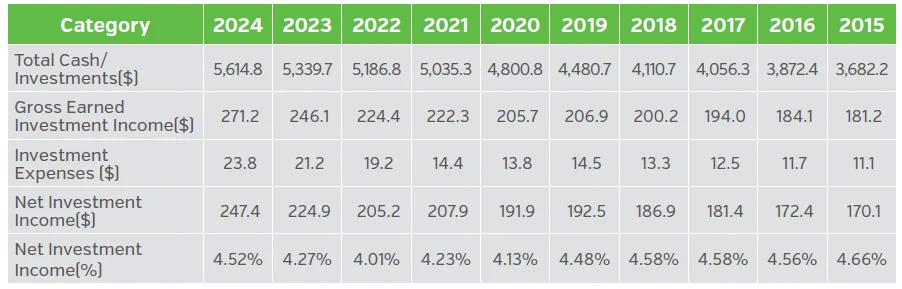
Table 1 presents the life insurance industry’s total cash and investments, along with earned investment income on both a gross and net basis. Since 2019 (pre-pandemic), total cash and investments have increased by 25%, rising from US$4.5tn to US$5.6tn. Over the same period, net investment income (in dollar terms) grew by 30%, from US$192.5bn to US$247.4bn. In 2024, the industry’s annual net investment income as a percentage of assets increased by 25 bps, following a 26 bps increase in 2023.
 

Table 1. Earned Investment Income $ Billion and Percentage
Image
Fig1

Source: NEAM, S&P Capital IQ Pro
 

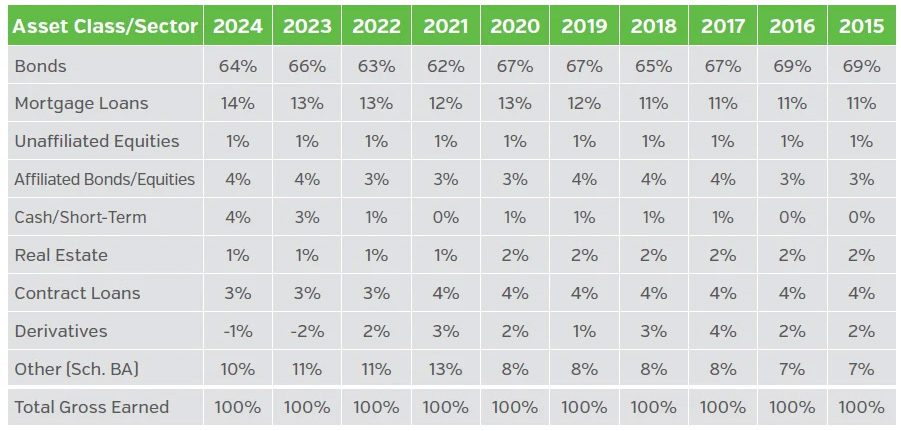
Table 2 details the contribution to earned investment income by major asset classes. Bonds and mortgage loans together accounted for 78% of total investment income, reaffirming their central role in the industry’s portfolio. In contrast, unaffiliated equities contributed only 1%, reflecting their relatively minor impact. Notably, cash and short-term holdings contributed a meaningful 4% share, up from virtually zero a decade ago.
 

Table 2. Earned Investment Income Contribution by Asset Class
Image
Fig2

Source: NEAM, S&P Capital IQ Pro
 

Broad Sector Allocations Held Steady, with Growth in Mortgage Loans and Schedule BA Assets

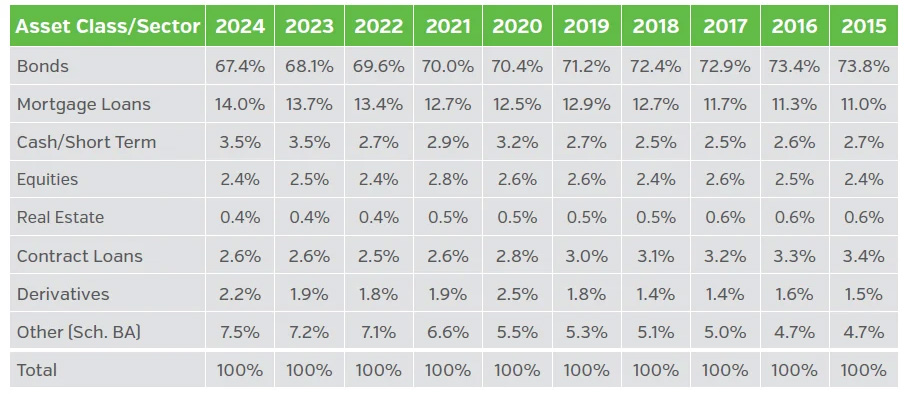
In 2024, the U.S. life insurance industry’s statutory asset allocation across broad sectors remained largely stable, continuing a gradual shift observed over the past decade (see Table 3). Bonds, while still the dominant asset class, saw a continued decline in their share of total assets. Mortgage loans, the second-largest sector, reached a new high, comprising 14.0% of total assets. Schedule BA assets also increased in 2024, with allocations concentrated primarily among larger organizations. Meanwhile, cash and short-term holdings held steady for the second consecutive year, supported by attractive short-term interest rates.
 

Table 3. Broad Sector Asset Allocation
Image
Fig3

Source: NEAM, S&P Capital IQ Pro
 

Fixed Income Allocation: Growth in Private Placements and Asset-Backed Securities

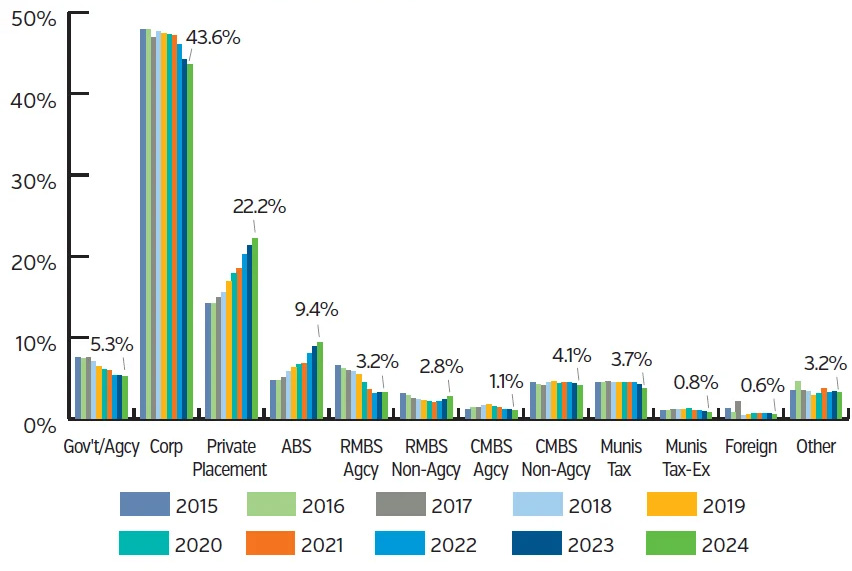
Chart 1 illustrates long-term trends in fixed income sector allocations over the past decade. Together, the corporate and private placement sectors accounted for approximately two-thirds of total fixed income allocations. In 2024, corporate bond allocations continued their downward trajectory, while private placements showed sustained growth. As noted in prior publications, our private placement figures exclude publicly-traded 144A securities.

Among structured securities – namely ABS, RMBS, and CMBS – the asset-backed securities (ABS) sector has steadily grown over the past decade, reaching a new high of 9.4% in 2024. In contrast, the commercial mortgage-backed securities (CMBS) sector has experienced a gradual decline. The residential mortgage-backed securities (RMBS) sector followed a downward trend until rebounding modestly in 2023.

Allocations to taxable municipal bonds rose from under 1% prior to the 2008 global financial crisis to a peak of 4.6% in 2017. This growth was largely driven by the introduction of “Build America Bonds” under the 2009 American Recovery and Reinvestment Act, which enabled municipalities to issue debt with federal subsidies covering a portion of the interest costs. After several years of relative stability, allocations began to decline over the past three years, primarily due to reduced issuance in the taxable municipal bond market.
 

Chart 1. Fixed Income Sector Allocation
Image
Fig4

Source: NEAM, S&P Capital IQ Pro
 

Book Yield Reached Decade High in 2024

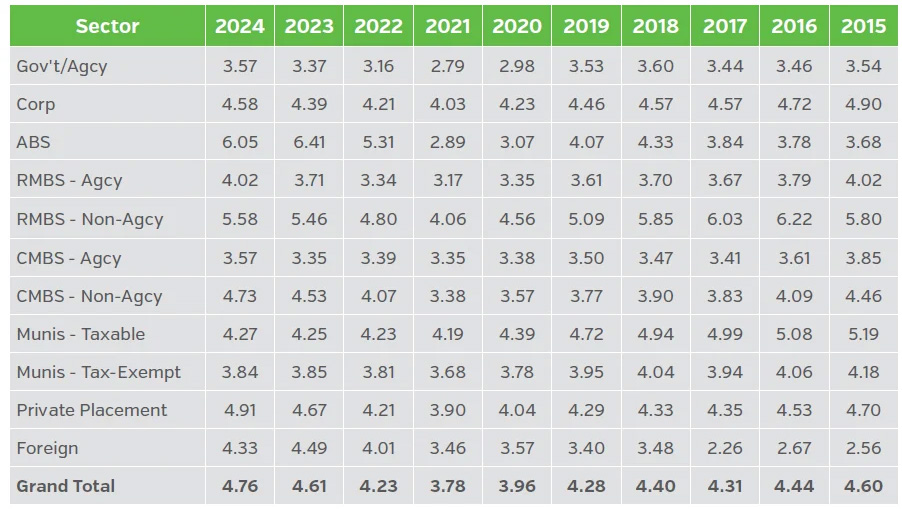
In 2024, supported by persistently elevated interest rates, the industry’s book yield rose to 4.76%—its highest level in the past decade. This marks the third consecutive annual increase, following gains of 45 bps in 2022 and 38 bps in 2023 (see Table 4). Book yields increased across nearly all sectors, with the exception of ABS and Foreign. The RMBS-Agency sector led the gains, posting a 31 bps increase.
 

Table 4. Fixed Income Book Tield (%)
Image
Fig5

Source: NEAM, S&P Capital IQ Pro
 

Duration Continued to Shorten, Driven by Shifts in Sector Allocation

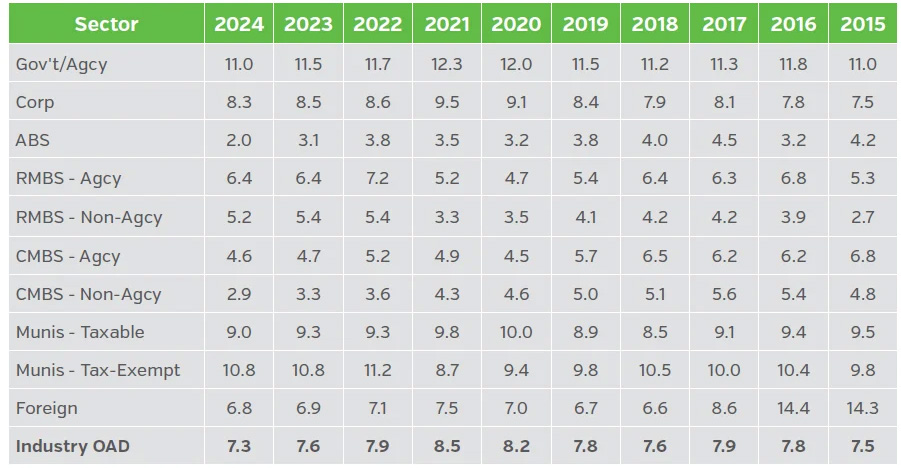
Table 5 presents option-adjusted duration (OAD) by fixed income sector, based on CUSIP-level holdings extracted from Schedule D statutory filings. The dataset excludes bonds held at the holding company level, derivatives, and private placements. From 2015 through 2021, the industry gradually extended portfolio duration in pursuit of higher yields. This trend accelerated in 2020 and 2021, coinciding with the Federal Reserve’s accommodative monetary policy and a broader market shift toward longer-duration bonds.

Beginning in 2022, however, the industry’s aggregate duration began to shorten, reflecting rising interest rates and a market-wide pivot toward shorter-duration instruments. This trend continued through 2024, driven in part by reduced allocations to long-duration corporate and municipal bonds, and increased exposure to short-duration asset-backed securities (ABS).
 

Table 5. Fixed Income Option Adjusted Duration (Years)
Image
Fig6

Source: NEAM, S&P Capital IQ Pro
 

Credit Quality Continued to Improve

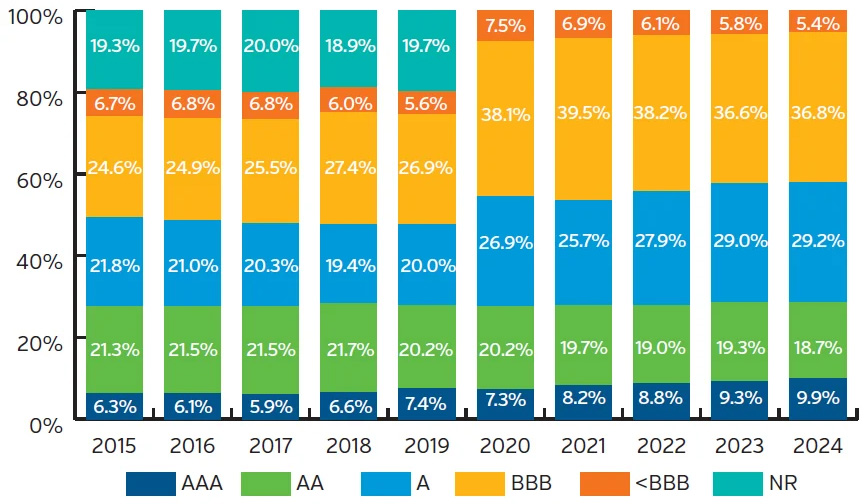
Prior to 2022, the low-interest rate environment led the industry to increase credit risk, as evidenced by rising allocations to BBB-rated securities, which peaked in 2021 (see Chart 2). Beginning in 2022, with the Federal Reserve’s aggressive tightening policy, the industry began to take advantage of elevated interest rates. This shift enabled an improvement in credit quality, marked by increased allocations to AAA and A-rated securities and reduced exposure to BBB and below-investment-grade (<BBB) holdings.

Starting in 2020, the National Association of Insurance Commissioners (NAIC) expanded its credit rating framework from six to 20 categories. The “NR” category shown for 2019 and earlier years primarily reflects “true” private placement securities (see Chart 1). Based on historical statutory filings, approximately half of the industry’s private placement holdings were rated BBB. This reclassification helps explain the 11-percentage-point increase in BBB allocations observed between 2019 and 2020 (see Chart 2).
 

Chart 2. Fixed Income Credit Quality
Image
Fig7

Source: NEAM, S&P Capital IQ Pro
 

Yield Rise and Durations Shorten Across All Credit Rating Categories

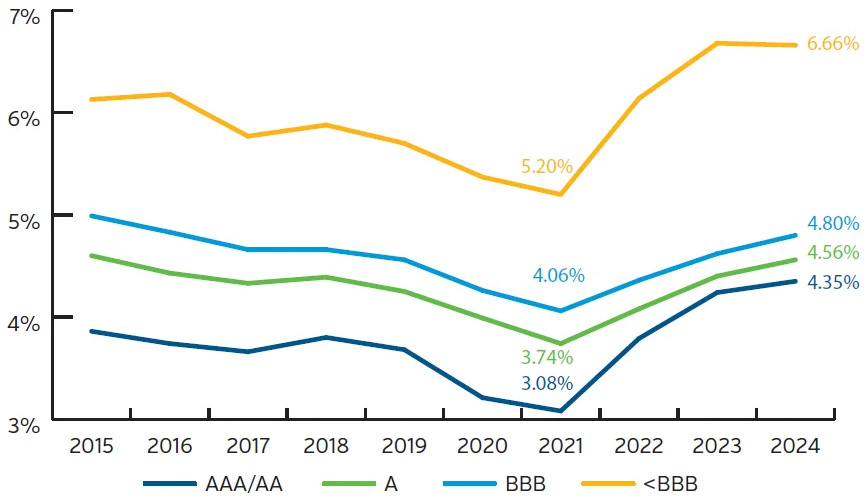
Chart 3 illustrates the book yields for public fixed income securities segmented by credit rating category. Since 2022, there has been a consistent upward trend in yields across all categories. Notably, securities rated AAA/AA and those rated below BBB (<BBB) experienced yield increases of 127 bps and 146 bps, respectively, over the past three years.
 

Chart 3. Fixed Income Book Yields by Credit Rating Category
Image
Fig8

Source: NEAM, S&P Capital IQ Pro
 

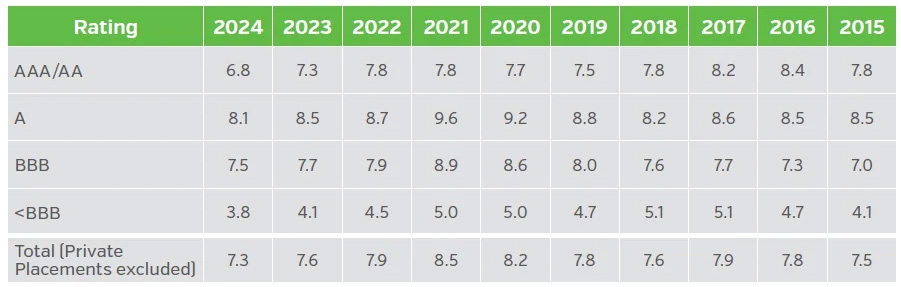
Table 6 presents the option-adjusted duration (OAD) for public fixed income securities by credit rating. As expected, high-yield bonds (<BBB) generally exhibit shorter durations than investment-grade bonds. In 2024, durations declined across all rating categories, reflecting a broader market shift. It is important to note that private placement securities, comprising 22.2% of total fixed income holdings in 2024 (see Chart 2), were excluded from the aggregate duration calculations.
 

Table 6. Fixed Income Duration by Credit Rating Category
Image
Fig9

Source: NEAM, S&P Capital IQ Pro
 

Key Takeaways

  • Investment income continued to rise in 2024, supported by higher interest rates. The industry maintained a relatively high allocation to cash and short-term assets, likely influenced by attractive short-term interest rates.
  • Core sector allocations remained stable, with bonds, mortgage loans, and Schedule BA assets continuing to dominate. However, bond allocations have trended downward over the past decade, while mortgage loans and Schedule BA assets have increased steadily.
    Within the fixed income portfolio, allocations to private placements and asset-backed securities (ABS) continued to grow, while corporate bond allocations declined.
  • The industry’s book yield rose steadily, increasing by 45 bps in 2022, 38 bps in 2023, and 15 bps in 2024, reaching a decade high. This occurred alongside improvements in credit quality and a shortening of portfolio duration.

We offer tailored analyses that compare your company’s enterprise characteristics to peer organizations. These insights can support strategic decision-making around enterprise risk preferences and investment strategy.


Originally published by NEAM in July 2025. This is not an offer to conduct business in any jurisdiction in which New England Asset Management, Inc. and its subsidiaries are not registered or authorized to conduct business.

© 2025New England Asset Management, Inc.
 
All rights reserved. This publication has been prepared solely for general informational purposes and does not constitute investment advice or a recommendation with respect to any particular security, investment product or strategy. Nothing contained herein constitutes an offer to provide investment or money management services, nor is it an offer to buy or sell any security or financial instrument. The investment views expressed herein constitute judgments as of the date of this material and are subject to change at any time without notice. Future results may differ significantly from those stated in forward-looking statements, depending on factors such as changes in securities or financial markets or general economic conditions. While every effort has been made to ensure the accuracy of the information contained herein, neither New England Asset Management, Inc. (“NEAM, Inc.”) nor New England Asset Management Limited (together, “NEAM”) guarantee the completeness, accuracy or timeliness of this publication and any opinions contained herein are subject to change without notice. This publication may not be reproduced or disseminated in any form without express written permission. NEAM, Inc. is an SEC registered Investment Advisor located in Farmington, CT. This designation does not imply a certain level of skill or training. In the EU this publication is presented by New England Asset Management Limited, a wholly owned subsidiary of NEAM, Inc. with offices located in Dublin, Ireland and London, UK. New England Asset Management Limited is regulated by the Central Bank of Ireland. New England Asset Management Limited is authorized by the Central Bank of Ireland and subject to limited regulation by the Financial Conduct Authority. Details about the extent of our regulation by the Financial Conduct Authority are available from us on request. This is not an offer to conduct business in any jurisdiction in which New England Asset Management, Inc. and New England Asset Management Limited are not reigistered or authorized to conduct business.

Share this post

Sign Up Now for Full Access to Articles and Podcasts!

Unlock full access to our vast content library by registering as an institutional investor

Register

Contacts


New England Asset Management

New England Asset Management (NEAM) strives to be integral to the success of our insurance industry clients by providing investment management solutions through a team of skilled professionals dedicated to delivering exceptional client service. We aim to build true, enduring relationships with our insurance company clients by combining three core attributes:

Dedicated Teams    
NEAM is staffed with dedicated teams of knowledgeable insurance and capital markets professionals.

Actionable Tools    
Our combination of talent and technology is designed to support all aspects of your investment management.

Tailored Solutions    
We are acutely aware of the unique concerns and challenges insurers face on a daily basis and so these are reflected in our investment process.

Our comprehensive offering includes a wide range of services:

  • Asset Management Services
  • Enterprise Capital Strategy Services
  • Capital & Risk Analytics Platform
  • Investment Accounting & Reporting Services

www.neamgroup.com
74 Batterson Park Road
Farmington, CT 06032


View the contributor page

Sign Up Now for Full Access to Articles and Podcasts!

Unlock full access to our vast content library by registering as an institutional investor .

Create an account

Already have an account ? Sign in

Ѐ Ё Ђ Ѓ Є Ѕ І Ї Ј Љ Њ Ћ Ќ Ѝ Ў Џ А Б В Г Д Е Ж З И Й К Л М Н О П Р С ΄ ΅ Ά · Έ Ή Ί Ό Ύ Ώ ΐ Α Β Γ Δ Ε Ζ Η Θ Ι Κ Λ Μ Ν Ξ Ο Π Ρ Ё Ђ Ѓ Є Ѕ І Ї Ј Љ Њ Ћ Ќ Ў Џ А Б В Г Д Е Ж З И Й К Л М Н О П Р С Т У Ф Х Ц Ч Ш Ā ā Ă ă Ą ą Ć ć Ĉ ĉ Ċ ċ Č č Ď ď Đ đ Ē ē Ĕ ĕ Ė fi fl œ æ ß