




Income Research & Management-

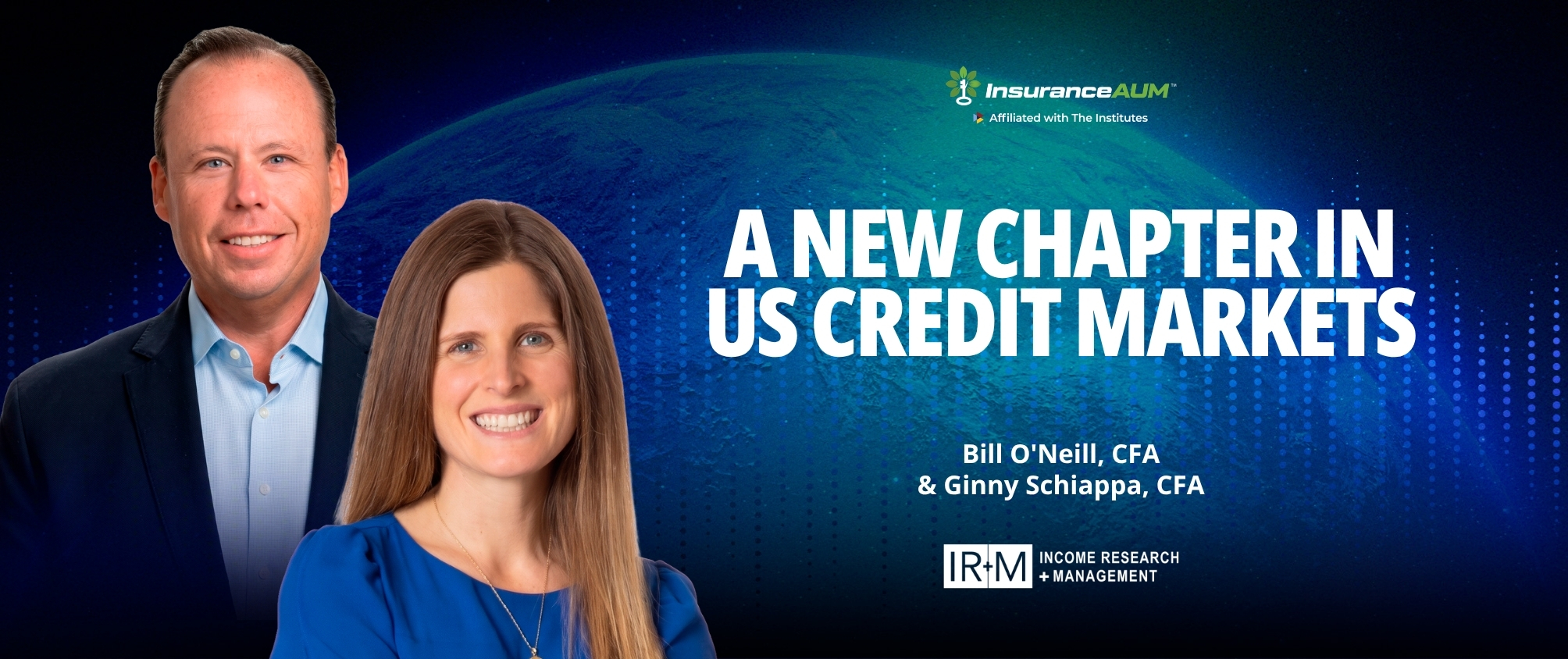
A New Chapter in US Credit Markets

Image
IAUM_Podcast_IRM-11.2_Web_2026


Stewart: Hey, welcome back. This is the InsuranceAUM Podcast, Home of the World's Smartest Money. My name's Stewart Foley. I'll be your host, and I'm glad you're with us today.

It's interesting because the U.S. credit market is changing. AI investment, private credit, passive flows, and an evolving issuer base are increasingly challenging some of the more traditional labels that insurance investors have relied on for a long time.

So today's title is A New Chapter in U.S. Credit Markets. Today, I'm joined by Bill O'Neill and Ginny Schiappa from Income Research and Management.

Bill is a Senior Portfolio Manager and Co-Director of Portfolio Management. He's been with Income Research and Management, which goes by IR+M, for more than 20 years and helps oversee portfolio construction and implementation across the firm's strategies.

Ginny is a Senior Portfolio Manager at IR+M, where she focuses on portfolio construction, sector analysis, and investment decision-making across sectors.

So we've got multiple perspectives on credit today. We're thrilled to have you both on.

Bill: Thrilled to be here. Thank you.

Stewart: So we always start the same way, and we're going to start with you, Ginny. Where'd you grow up and what's a fun fact that either our audience or your colleagues are going to find interesting?

Ginny: So thanks, Stewart. I grew up in Virginia Beach, Virginia, so further south. And something the audience may not know, I grew up playing classical piano and I still play when I have some spare time.

Stewart: Oh, wow. Yeah, that's cool. I play the drums, not well. So how about you, Bill? Where are you from and what's a fun fact? I bet there's some fun facts there.

Bill: There are some fun facts. I'll go with the sanitized one. So I grew up in Cumberland, Rhode Island, which is a suburb of Boston, a distant suburb.

And a fun fact is that we're fortunate to have a few acres up in New Hampshire, and I consider myself a little bit of a gentleman farmer. So I like, on the weekends, to clean the lawn and cut the branches and drive around my little cart, fertilize the whole thing. I really enjoy it. I didn't think I would, but I've taken to it.

Stewart: Okay. I didn't mean to make this disclosure, but I just wrote a contract on 40 acres up the road from me, and it's right on a major road, and there are goats. So I am adding goat rancher to my resume, just so you know.

Bill: You'll have some clean land. Goats clear everything out.

Stewart: Yeah, they do. And they're Boer goats, B-O-E-R. And I think that's a Latin word that means extra cute. They are so cute.

So let's start with what's probably the biggest capital spending story in the market today, and probably ever in the history of whatever we've seen. The AI buildout is just not about technology companies. We were talking about data centers, power generation, and all the rest.

And some of our clients, some of our insurer clients, are trying to get a handle on their AI exposure across their portfolios because it's not just tech.

So when you look across out there, how do you distinguish between issuers that could become long-run beneficiaries and those that might struggle to earn an adequate return on all that capital?

Ginny: Great way to start, Stewart. So if I were to set the scene in terms of AI financing, which has been a humongous theme in credit markets this year and certainly in years to come, the existing players. So we have the traditional hyperscalers.

We've also seen a new entrant, which is investment-grade and high-yield-issued project finance backed by AI data centers. So that's been a new chapter, introducing some new challenges and risks that the traditional investment-grade market hasn't been typically focused on.

So that's been a ripe opportunity to take a look across those opportunities, which we can get more into in our discussion.

But if we round out the players, we also have opportunities within the securitized market, so both infrastructure and ABS as well as CMBS. Again, just a broader toolkit.

So then what's the plot in this dynamic? We have really tremendous financing needs coming from all of those venues across structures, across markets.

And then we have an investor base that's evaluating not only what their capital needs are, but what the expected return on investment capital is going to be.

So investors are also thinking about concentrations within their portfolios, within indices, and not all of these ideas are in traditional indices. So what you own and what's in the index can be two very different things.

So in terms of who are the winners and how we're evaluating, I think at this stage as credit investors, we have an investment thesis around really finding those more disciplined and differentiated businesses that are able to withstand a variety of outcomes and probably have a sustainable business, whether AI is a hopeful premise or not.

And that will really support those businesses and certainly those that have more financial cushion, more levers to pull should the thesis and the AI story change.

So that's how we're thinking about durable issuers with understandable risks, appreciating there's going to be some known unknowns in this theme over the next few years and making sure their portfolios are positioned in a way that can add value, but not introducing too much or too misunderstood correlations or unintended risks.

Stewart: I do kind of think that AI has turned everything into dog years. A year seems like we went forward like seven years, but it's only one year. So when we start talking about two years out, the pace at which things are changing, I mean, that's a good distance out.

So let's talk about something different happening between investment grade and high yield. So we used to talk about, I mean, I grew up in an era when 5% high yield was a walk on the wild side for a P&C insurer.

So we tend to talk about these things as pretty clean categories, high yield and investment grade. But you're seeing double-B-rated companies with scale balance sheets and business characteristics that begin to look like lower-rated investment-grade markets.

And so at the same time, the IG universe itself is changing as new sectors are entering.

So is the traditional line between investment grade and high yield becoming less useful? What does that mean for insurance investors in particular?

Ginny: There's a world of nuance between rating categories, it seems. And as analytical investors, we tend to love and be attracted to delineations, and the market is certainly set up that way, higher-quality investment grade, low investment grade, but it is a much more nuanced setting.

So it is more nuanced if you look at investment grade. As you've mentioned, the hyperscalers are really turning from cash-rich to capital-intensive businesses. And so with AA ratings, their bonds are pricing with more triple-B-like spread compensation.

And then you're also seeing some of the AI data center project finance deals with triple-B ratings with yields and spreads that are more reflective of the high-yield market.

So the market is really looking at themes versus rating category.

So then it comes to a team being able to think across subsectors, across investment grade, high yield, securitized, especially on some of these newer risks within the project finance subsector, and really underwriting to make sure that we're triangulating and putting the full mosaic together to understand where risks are.

So that's certainly seeing some blurred lines within the investment-grade world.

If you transition to high yield, it does feel more bifurcated between the double Bs, as you've mentioned, much stronger balance sheets. Leverage is actually slightly inside that of some of the low-investment-grade ratings, so that's really compelling.

But on the other side, we have the triple-C cohort that still remains pressured. We have some concentrations in sectors around telecom, even some building materials names, and we just have higher leverage.

So in a higher-rate environment, those balance sheets really get pressured.

So you are seeing differentiation across party lines in the high-yield space, but certainly room for more blurred lines in investment grade and high-quality high yield.

So for insurance clients, it's very important to know for each category what is the risk profile, and that it may not just be as clean-cut as it may have been in years past, and appreciating that there's more beneath just a letter rating.

Stewart: Oh, that's interesting. I didn't know the spread-to-rating story there. That's interesting.

Let's stay with high yield for a minute. I think there's maybe another change taking place as companies mature and generate cash and delever. Parts of the high-yield market itself seem to be migrating upward in quality.

Is that true, first of all? And how is the underlying credit quality of the high-yield market changing that maybe, if I'm looking solely at ratings, what may I be missing?

Ginny: So across high yield, as we were exploring earlier, double-B credit has really improved. Margins are expanding, top-line EBITDA is growing, leverage at around four turns is relatively healthy relative to historic averages, and access to capital has been really open for those.

Now, certainly as you go down in credit quality, there's a bigger delineation in terms of the leverage and the coverage profile. And we mentioned more pressured sectors with the higher-rate environment. More time under tension really pressures those businesses.

But as you think of some of the higher-quality cohorts, if you have investors that are looking across ratings, they can see attractive opportunities, especially as the AI theme has really driven some of those subsectors to trade wide relative to the ratings.

If you have the flexibility to go down to high-quality high yield, you're able to get incremental spread as well as lower risk versus other places in your portfolio potentially.

Stewart: That's interesting. Let's talk a little bit about passive ownership.

So passive ownership has become increasingly important in fixed income, which means capital can move because of benchmark construction and fund flows rather than because somebody has made a fundamental judgment about an individual security.

So how are passive flows changing credit markets and where can they, I assume that that can create opportunities for an active manager if you somewhat know what's going to happen due to these index shifts or whatever it might be.

Bill: I'd really characterize passive as two things. So you have traditional passive, where there's a lot of retail money that focuses on passive that follows benchmarks very closely.

And then I think you have closet passive. So there are a lot of managers, insurance companies and the like, that stick very closely to benchmarks. So benchmark inclusion can be a big factor for investing.

When you think about the impact that these passive investors have, it can be large just because, in the grand scheme of things, we're in a pretty small market.

When you think about investment-grade credit, that market's about $9 trillion in size, and you compare that to some of the balance sheets of large insurers, large state plans, large pension sponsors, and that market starts to feel pretty small pretty quickly.

So the passive demand, especially at new issue, can really influence pricing and can often take pricing on new issues to levels that you think is economically not smart, maybe not compensatory for the risk.

So I think as active managers, you can unselect and say, "Hey, this thing is maybe being overbought."

And then when passive needs to move out, especially around quality transitions, you can get active and be very deliberate in terms of taking the position against them.

So it does introduce, I would call it more of an ocean-type wave that you can somewhat predict and you can somewhat operate around, but it's always going to be there.

Stewart: Yeah, that is interesting. It's funny, one of the more provocative, and I love provocative stuff, by the way, Bill, it's good, especially in fixed income. I mean, come on.

I can tell you that when you're making the mortgage guys mad because you're doubting the OAD, this is the kind of stuff I live for.

But so for generations of investors, Treasuries have occupied a unique place in the market as it is used as the risk-free asset. When you teach finance, that is the risk-free rate. That's what we're talking about with the CAPM, blah, blah, blah. That is it.

But it's interesting that federal debt levels, interest expense, and issuance requirements have made a broader conversation about this.

It's also not lost on me that it's difficult to default on debt that you make the currency.

Ginny: Yes.

Stewart: I'm not saying that currency is worth a lot, but if they're the ones printing it.

But I do think this is a super interesting topic here. So how should institutional investors think about the role of Treasuries now, and is it useful to think more broadly about what constitutes defensive fixed income?

Bill: Yeah. So one hot take that we share around the firm is that if you were to just look at pure supply and demand, you can make an argument that the Treasury market is oversupplied.

You have $2 trillion of marginal issuance every year. You have the factors of deglobalization, meaning maybe less demand. Whereas if you were looking at the credit markets, you can make an argument that those markets are undersupplied, which is maybe what leads us to tight spreads relative to Treasuries.

So when you're thinking about Treasuries, you want to understand that that curve is the base curve that sets all the yields for all assets, and it's extremely important, but what's the value of the spread on top of it? And understanding the interplay of both of those is very important.

Our thoughts are that the deficit will persist. There doesn't seem to be much organization around financial accountability in the U.S. especially, but as you alluded to, the U.S. likely has the strongest balance sheet globally, will remain a reserve currency.

You don't see Treasuries going away anytime soon. So they're the center of the ecosystem, but I think on a relative basis, they're becoming less important to some investors.

I also think other investors are looking at credit markets as diversifiers away from Treasury risk.

The last thing I would say is that we can also think about the decomposition of the curve in the Treasury market. We're seeing more issuance towards the shorter end, less issuance in the back end, and presumably that might help the shape of the curve, but for now there seems to be a bit of a buyer strike in longer-duration Treasuries.

So when I take that into account, I'd be very careful around your potential volatility in some of those longer-duration assets. There is some yield out there, but they can move down pretty quickly in price if rates were to rise.

Stewart: Yeah, it's super interesting. I mean, it was one of those things that earlier in my career was never, ever brought up, and now it's talked about more and more.

So we've talked about traditional corporate credit, but the investable universe itself seems to have gotten a lot broader.

So private credit has grown dramatically. You've got specialty sectors such as gas prepaids, structured products, music royalties, other less-followed markets that are finding their way into institutional portfolios.

And I think that where insurance companies are concerned, they are interested in diversified sources of reliable interest income.

And so to avoid everybody being on the same side of the canoe, it seems like some of these new sectors are actually healthy for the bond market, particularly given some of the scale of the players that you mentioned earlier.

So can you talk a little bit about where you're finding opportunities outside of traditional corporate bonds and why complexity can create an advantage for investors that are willing to roll up their sleeves?

Bill: Yeah, sure. So our MO, when we manage portfolios, whether it's insurance or not, is to create a diverse set of risks and be able to put our head on the pillow at night and understand our portfolios and know that we're doing the right thing by our clients in terms of generating good, repeatable income.

And in the search for that, we are uncovering many different ideas.

So we're very active in the ABS space, very active in the CMBS space, and we've seen big evolutions in both of those spaces.

So one example would be in the ABS, we have what's called a whole-business securitization. So this would be franchises franchising their royalty fees.

So you think about a Dunkin' or a Domino's. They get paid franchise fees by their franchisees. They will securitize those cash flow streams.

So when you do that analysis, you're kind of thinking about the idiosyncratic risk of those franchises and thinking about the ability of those franchises to stay in business, but then you're also thinking about U.S. consumer behavior and the like.

So there's an interesting analysis of credit analysis, but then there's also structure because you are enhanced relative to issues lower in that structure.

Within CMBS, we've seen a rise in single-asset, single-borrower deals. So these would be deals that are structured somewhat like conduit deals in that you have lots of enhancement below you, but there's one property.

So as you can imagine, the idiosyncratic risk around that one property grows.

So what we try to do is we take all these risks and we stack them up and we think about, as Ginny was saying earlier, we think about their relationships relative to one another and try to find a broad palette of acceptable risks that we can weave on top of corporate bonds and on top of how that market's changing.

We haven't spoken a lot about data center issuance yet, but we can stack all these things together and make what we think is a very repeatable high-income portfolio.

Stewart: Yeah, it's interesting. I'm a fixed income guy at the end of the day, and the contrarian in me is like, wow, there's a lot of capital going to data centers.

And I talked to a tech person the other day and they were like, "Yep, and it's going to the moon." And I was like, "Wow."

And so it is interesting. There are folks who are concerned. I mean, with zero data, it just seems to me, given that not within my lifetime, computers were the size of rooms that are a very small fraction of the capability of the phone that you carry in your pocket.

So I always wonder, is there going to be a discovery that says, "Oh, we can now do this compute for one-tenth the power." And then all of this, you go, "Oh wow, and we can get that out of the sun, so we've got solar and it's going to go forever."

I'm asking you guys a hard question, which is to dust off your crystal ball. Where do you see opportunities as you look out, and are there places where you think maybe the risk isn't adequately priced?

Bill: Yeah, maybe I'll start and then hand it off to Ginny.

When you used that term earlier, dog years. So in terms of capital markets, I think you'd argue that just since November of '25, we've seen about seven dog years.

So in November '25, the big marker was there was a Blue Owl Meta data center deal that came, and subsequent to that, we've seen just under, when you add up high yield, you add up investment grade, you're looking at over 20 of these different deals.

And what's interesting is they've all had different wrinkles. They've all had different offtakers, they've all had different construction companies, they've all had different financing vehicle structures, calls, different draw schedules, and the like.

And from an investor's perspective, it's very important to take stock of the participants in each one of those deals and the deal functions in each one of those deals and to understand those at a micro level.

And as you alluded to, Stewart, it's also very important to think about the newness risk here.

So as you said, we've got this massive buildout. We don't know what the return on capital is of this buildout. The expectations are that it's going to be very high, but things can change.

So you need to think about that in terms of your total portfolio context.

A lot of these deals individually look pretty good, but when you stack them up and you start to think about the magnitude of your total risk to this space, that's when we think investors really need to be very careful.

We as bond portfolio manufacturers, let's say, we tend to think about our bond portfolios relative to the assets that our clients have away from us.

So if we're contracted by an insurance company, we manage their portfolio, but they also have significant private credit exposures away from us and maybe public equities, maybe private equities.

Those markets are very concentrated in this future risk as well. So when you think about our client's whole book, it's very important that on the fixed income side, we don't overreach.

Our yields and our returns are limited by your purchase yield. There's upside in those other classes. It's our job to protect.

So we tend to think about it very holistically, again, at the bottom level, at the deal level, but then we'll add it up and think about that total exposure and be very responsible about it.

Ginny: Isn't it incredible to think that it was almost a year ago when that large Meta data center was brought?

And then since then, we've seen a variety of deals, and when a new subsector hits the ground, the thought is, okay, well maybe there'll be a standard form. There'll be a standard term sheet that we'll be all dissecting the same way, and it's been the complete opposite.

And I think the complexity is going to continue, and it really depends on how nuanced each lease and each project, each location, each energy contractor is.

So that's why it's so complex, but that for us as active managers, as security selectors, really opens up the door to be choosy, to be picky.

We have really integrated cross-functional thinking on the team across digital infrastructure. So each project finance deal, we're applying the same cash flow testing we're using on our securitized ideas.

And that way, the best idea may not be that data center, it might be the AAA data center.

So really having to be selective and focused and appreciating what our investment thesis is as bond investors.

Our upside is par. We need to realize where the incentives are aligned.

And yes, higher rates provide an attractive entry, especially when there's more supply that's commanding more of an incentive to get people off the bench, but even still needing to be mindful of what the known unknowns could be and that this is going to be a long secular trend in our economy.

Stewart: Yeah, it's interesting. So this is on kind of a personal note, but the vast majority of my InsuranceAUM podcasts are behind me. And so I'm on the downhill slide of my podcast career here.

And I believe that part of the value that I add is that I know insurance, I know asset managers really well, and I get the chance to, I've had the opportunity over the last several years to work with some really high-quality managers.

And y'all are very well versed in this topic.

One of the things I think that is underrated at IR+M is your commitment to technology. You have a massive shop, a massive effort in your technology platform, and I know that it's an impromptu topic, and if you don't want to talk about it, you don't have to.

But Bill, can you talk a little bit about Income Research and Management's technology capabilities, your analytical capabilities?

Bill: Yeah, sure. So we're very proud of what we've accomplished.

As a lot of shops do, we've built around some core systems. We've built around a core trade order management system on the desk, but through all that, we've developed a remarkable amount of data and a remarkable set of well-structured data.

And what we've been able to do on the investment side is use that structured data to create many different analytics and views so our portfolio managers, our research analysts, and traders can all be on the same page, so we can get into the market day in and day out and really be efficient.

We've taken that over the past 12 months and we've accelerated that with AI. We're fortunate to have a team that's very, very internally motivated.

And when you have highly motivated people, they tend to think about how can they scratch their own itch.

So we've seen some of our folks take their development skills and turbocharge them via the help from an LLM, and they've been able to develop prototypes that our investment technology team can then take and finish the race with.

So we think that, my colleague Max DeSantis said this today in a meeting, we've really just scratched the surface here in terms of our ability to develop tools internally to deliver better portfolios in the future to our clients.

And I think you could say the same thing organizationally. So we've made some strides in operations using some agents to classify different deals in our technology.

On the client service side, we're using different technology to access our CRM.

So anywhere we can apply new technology in a new, differentiated way, we try to do it to the best of our extent.

Stewart: That's super helpful. All right. Great, great discussion. Thank you.

We've got a fun one for you on the way out the door. So this is a new question. It's not the same as the old question, but describe your best...

Going to Bill first, describe your best real or fantasy dinner. So this gives you time to think, Ginny. You can think about some classical pianist dinner, but Bill, what comes to your mind when I say, "Hey, describe your best real or fantasy dinner?"

Bill: Yeah, I'll tell you, so I go to a lot of client dinners. It's part of the job.

And what I like the most is when you get a talker, so I could just sit back and drink my wine and eat my food, and then you have people talking.

So I try to surround myself with talkers so I don't have to talk that much.

One topic that I'm very interested in is golf. Folks know that I'm an avid, not very good, but avid golfer.

So I'd probably surround myself with maybe Jack Nicklaus, Lee Trevino, Arnold Palmer, and let those guys tell stories, maybe get them going and ask some provocative questions and then listen because I am an information sponge.

Stewart: That's super cool. Yeah, that would be a great dinner. You could even get Gary Player in there.

Bill: Yeah, he'd be a good one too. Yeah.

Stewart: Chi Chi Rodriguez. The guy that, I mean, he's the one with the... He used to do the Zorro move with the putter. I mean, it's great stuff.

All right, good stuff. All right. How about you, Ginny, on the way out?

Ginny: All right, Stewart, I have AI on the mind, so I love reading, and I think being able to sit down with some of the critical sci-fi authors of our time would be really fascinating.

So I'm a big fan of Octavia Butler, Kurt Vonnegut, Aldous Huxley, the like.

So I think that would be really compelling for them to hear how our world is shaping and to hear their perspectives and just to get to know them as authors.

And then in terms of the food selection, I have two young kids at home, so anything that I don't have to cook would be amazing.

Stewart: That's great. And I'll use this transcript to look up those people that you mentioned, which is great.

So I'll tell you what, thank you both very much. We've been joined by Bill O'Neill and Ginny Schiappa from Income Research and Management. Thanks so much for being on.

Bill: Thanks very much for having us. We appreciate it.

Ginny: Thanks, Stewart.

Stewart: Please rate us, review us, and like us wherever you listen to your favorite shows. You can also watch our podcast at InsuranceAUM Community on YouTube.

Thanks so much for joining us. I'm really sincere about that. My name's Stewart Foley. This has been The Home of the World's Smartest Money at the InsuranceAUM Podcast.

Share this post

Sign Up Now for Full Access to Articles and Podcasts!

Unlock full access to our vast content library by registering as an institutional investor

Register

Contacts


Income Research

IR+M is a privately-owned, independent, fixed income investment management firm that serves institutional and private clients. Our investment philosophy and process are based on our belief that careful security selection and active risk management provide superior results over the long-term. By combining the capacity and technology of a larger firm with the culture and nimbleness of a boutique firm, we strive to provide exceptional service for our clients and a rewarding experience for our employees.

Rob Lund, CFA
SVP, Senior Client Portfolio Manager
rlund@incomeresearch.com
617-330-9333

www.incomeresearch.com
115 Federal Street,
22nd Floor,
Boston, MA 02110


View the contributor page

Image
IRM_icon

Sign Up Now for Full Access to Articles and Podcasts!

Unlock full access to our vast content library by registering as an institutional investor .

Create an account

Already have an account ? Sign in

Ѐ Ё Ђ Ѓ Є Ѕ І Ї Ј Љ Њ Ћ Ќ Ѝ Ў Џ А Б В Г Д Е Ж З И Й К Л М Н О П Р С ΄ ΅ Ά · Έ Ή Ί Ό Ύ Ώ ΐ Α Β Γ Δ Ε Ζ Η Θ Ι Κ Λ Μ Ν Ξ Ο Π Ρ Ё Ђ Ѓ Є Ѕ І Ї Ј Љ Њ Ћ Ќ Ў Џ А Б В Г Д Е Ж З И Й К Л М Н О П Р С Т У Ф Х Ц Ч Ш Ā ā Ă ă Ą ą Ć ć Ĉ ĉ Ċ ċ Č č Ď ď Đ đ Ē ē Ĕ ĕ Ė fi fl œ æ ß